
the Creative Commons Attribution 4.0 License.
the Creative Commons Attribution 4.0 License.
 | 13 Nov 2025
Vulnerability of carbon in subalpine soils in the face of warmer temperatures
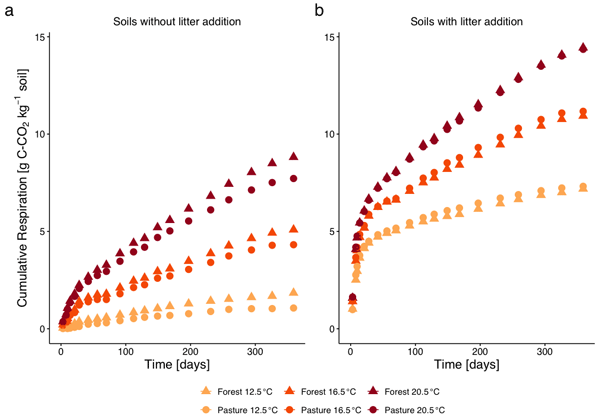
Abstract. Alpine and subalpine soils are significant reservoirs of labile carbon (C) and are highly sensitive to warming, yet the mechanistic interactions between temperature and organic inputs are poorly understood. A one-year laboratory incubation was conducted with mineral surface soils from a subalpine pasture and an adjacent coniferous forest site. Soil samples were incubated in closed jars at three different temperatures: Current growing season temperature (12.5 °C), and two increased temperature treatments (16.5 °C and 20.5 °C). To assess decomposition differences between litter and native soil organic matter (SOM), 13C-labelled plant litter was added to a subset of the jars. CO2 production, δ13C partitioning, and phospholipid fatty acid (PLFA) profiles were used to quantify soil organic matter (SOM) and litter decomposition, and to assess microbial dynamics. Warming increased total CO2 respiration by 15–37 % in pasture and 12–33 % in forest soils, with strongest stimulation in litter-amended soils. Positive priming of native soil organic matter (SOM) peaked within one week (up to +77 % over controls) and declined to near zero after one month. Cumulative litter-induced respiration (LIR) was highest at 16.5 °C (+6–10 % vs. 12.5 °C) in both soils, coinciding with maximum microbial biomass; 20.5 °C reduced microbial biomass by up to 25 % and accelerated 13C label loss. The response of pasture soils was more rapid and pronounced compared to forest soils, which exhibited slower, more sustained responses. PLFA profiles revealed warming-induced declines in Gram+ and Gram- bacteria and increased cyclopropyl markers at high temperature. These findings show that even moderate warming can accelerate C loss from subalpine soils, with vegetation history and microbial traits modulating both rate and timing of decomposition.
-
Notice on discussion status
The requested preprint has a corresponding peer-reviewed final revised paper. You are encouraged to refer to the final revised version.
-
Preprint
(990 KB)
-
The requested preprint has a corresponding peer-reviewed final revised paper. You are encouraged to refer to the final revised version.
- Preprint
(990 KB) - Metadata XML
- BibTeX
- EndNote
- Final revised paper


Journal article(s) based on this preprint
Interactive discussion
Status: closed
-
RC1: 'Comment on egusphere-2025-5429', Anonymous Referee #1, 15 Dec 2025
-
AC1: 'Reply on RC1', Dario Püntener, 05 Feb 2026
Response to the comments of Anonymous Referee #1
We thank the referee for the positive assessment and the helpful suggestions. We will revise the manuscript accordingly to improve clarity, methodological transparency, and precision of interpretation. Below, we address each comment and outline the planned changes in the manuscript.
1) Line 35: Link between vegetation shifts and SOM dynamics: The section discussing vegetation changes (treeline advance, shrub encroachment, abandonment of pastures) is thorough and well supported by literature. To further strengthen this part, the link between vegetation-driven changes (e.g. litter quality and quantity) and the observed SOM and microbial dynamics could be made more explicit. A short synthesis paragraph highlighting these mechanistic connections would improve coherence.
We agree and will add a short synthesis paragraph after the vegetation-change section to more explicitly link vegetation-driven changes (litter quantity/quality) to the expected microbial and SOM responses in our incubation framework.
2) Line 46: The statement that a 10 °C temperature increase can double or triple soil respiration is well established, but in alpine and subalpine soils temperature responses are often non-linear and constrained by substrate availability and microbial adaptation. While this complexity is addressed roughly in this passage, a slightly more precise wording would improve this part.
We agree and will revise the wording to be more precise for alpine/subalpine soils, emphasizing that temperature responses can be non-linear and constrained by substrate availability and microbial acclimation/adaptation rather than implying a universal “doubling/tripling” response.
3) Line 113: The collection of approximately 30 kg of mineral soil from a depth of 5-10 cm implies substantial soil disturbance. It would be helpful to clarify whether this amount was obtained by pooling multiple spatially distributed subsamples or by excavating a single location. This information is relevant for assessing representativeness and spatial heterogeneity.
The samples were taken from one single location at an area of approximately 1 m2, we will add this information to the text.
4) PLFA Analysis: Please clarify whether recovery rates were used to assess extraction efficiency in the PLFA analyses.
We will clarify this by updating the method section on PLFA.
5) The 360-day incubation period is appropriate to capture both short-term and longer-term dynamics. However, it remains unclear how frequently samples were taken during the incubation. Sampling frequency maybe better move from Supplement to main manuscript.
We agree, and will add this to the method section, while keeping the detailed schedule in the Supplement. Shortly, in the beginning of the incubation we had a higher sampling frequency for the respired CO2 of about 3 days, at later stages of 1 week. Soil samples were destructively sampled at 6 points throughout the incubation.
6) Some sentences are very long, occasionally affecting readability. Maybe shorten sentences to improve readability.
We agree and will edit multiple sentences across the Introduction and Discussion for readability by splitting long sentences, reducing nested clauses, and removing redundancy while preserving technical precision.
7) The large number of reported percentages and time points could be summarized more clearly in overview tables or schematic figures.
We will improve how the main temporal patterns and treatment effects are summarized, either by consolidating repeated percentages in the text and/or adding a compact overview table/schematic to guide the reader.
We thank the reviewer once more for the thoughtful and helpful comments. We will implement targeted revisions to sharpen our interpretations and improve the manuscript’s structure and readability. We expect these changes will enhance the manuscript’s precision, clarity, and conciseness, and we hope the revised submission will be suitable for publication in SOIL.
Citation: https://doi.org/10.5194/egusphere-2025-5429-AC1
-
AC1: 'Reply on RC1', Dario Püntener, 05 Feb 2026
-
RC2: 'Comment on egusphere-2025-5429', Jérémy Puissant, 23 Dec 2025
This manuscript is well described, detailed, and clearly written. I enjoyed reading it, and it represents a valuable contribution to the field by providing mechanistic insights into how warming influences carbon losses from subalpine soils and how microbial processes may modulate the timing of these responses. Several points would benefit from clarification before publication. In particular, given the limited site replication and the nature of the incubation experiment, some conclusions—especially those related to vegetation effects and temperature optima—could be interpreted more cautiously. I therefore suggest adding a short “limitations of the study” paragraph to clarify the scope and generality of the findings, especially with respect to points 3–5 below. The aim of these comments is not to downplay the results, but rather to more precisely define what this study contributes to the field and to clearly state its limitations, so that its mechanistic insights can be interpreted appropriately and provide a robust basis for future work. The comments below focus on several key points that would benefit from detailed clarification and response, as they influence the interpretation and scope of the conclusions.
Major comments
1-Soil moisture control and incubation conditions
Additional details on soil moisture control would help ensure that the higher litter-induced respiration (LIR) observed at 16.5 °C compared to 20.5 °C reflects biological responses rather than methodological effects.
Please clarify: How soil moisture was controlled throughout the experiment; The target soil moisture used (gravimetric water content or %WHC); How often soil moisture was checked and adjusted; Whether differences in vapor pressure deficit among temperature treatments were considered; Whether a pre-incubation period was used to stabilize respiration before applying temperature treatments and litter addition; Whether soils were air-dried and rewetted or kept field-moist and stored cold prior to incubation (and for how long).
These details are important for interpreting temperature effects on respiration.
2-Link between hypotheses and discussion
The Introduction presents three main research questions/hypotheses, but these are not always explicitly revisited in the Discussion. Structuring the Discussion more clearly around these hypotheses, or explicitly stating whether each is supported, would improve readability. Priming is mentioned in two hypotheses but is only briefly discussed, despite being a central component of the results. A more explicit treatment of priming in the Discussion would strengthen the manuscript.
3-Duration and realism of the incubation experiment
A one-year incubation at constant temperatures represents a strong treatment for subalpine soils. The 12.5 °C treatment corresponds to growing-season temperatures, whereas these ecosystems normally experience long periods of cold temperatures and snow cover. It would be helpful to clarify that this experiment is primarily intended for mechanistic or hypothesis testing, rather than for direct simulation of field conditions, and to discuss how the results should be interpreted in relation to natural climate scenarios.
4-Interpretation of litter-induced respiration (LIR)
Cumulative litter-induced respiration (LIR = R(L+) − R(L−)) integrates both litter-derived CO₂ and priming-induced SOM mineralization. Because priming is strong, transient, and temperature-dependent (Fig. 4), the statement (line 388) that “the LIR optimum was consistent across both soils … suggesting that microorganisms decomposing the litter operate near their physiological optimum at this temperature”implicitly interprets LIR as litter decomposition.
Without explicitly presenting isotopically partitioned litter-derived CO₂ fluxes, the observed LIR maximum at 16.5 °C cannot be uniquely attributed to a physiological optimum of litter-decomposing microorganisms. It may instead reflect differences in priming dynamics, microbial biomass persistence, carbon use efficiency, stress-related community shifts at 20.5 °C, or the integration of short-lived respiration pulses in cumulative fluxes. Tempering this interpretation and, if possible, presenting cumulative priming and/or litter-derived CO₂ fluxes would help clarify the underlying mechanisms.
5-Site replication and ecosystem effects
Only two sites (one forest and one pasture) are included. As a result, site-specific effects are confounded with ecosystem type. It would therefore be helpful to acknowledge more explicitly that conclusions regarding vegetation effects are based on limited replication and should be interpreted cautiously.
6-PLFA interpretation
PLFA results are reported as absolute concentrations (µg g⁻¹), but presenting relative abundances (%) would help support statements regarding changes in community composition. Interpretations of cyclopropyl PLFAs as stress indicators could also be phrased more cautiously, as increases in cyclopropyl fatty acids can reflect stationary phase, nutrient limitation, or general stress, not exclusively heat stress.
Minor comments and clarifications
- Line 23: Gobiet et al. do not directly demonstrate SOM vulnerability to climate change; please revise or update the reference.
- Line 47: Please clarify what is meant by “classical theory” (cite explicitly) or rephrase.
- Line 115: Please clarify the sampling strategy (field replication vs pooling).
- Line 409: Forest stand age is given, but pasture age/history is not; please clarify.
- Lines 342 and 439: Avoid acronyms such as “L−” in the Discussion; spelling out terms would improve readability.
Citation: https://doi.org/10.5194/egusphere-2025-5429-RC2 -
AC2: 'Reply on RC2', Dario Püntener, 05 Feb 2026
Response to the comments of Referee #2 Jérémy Puissant
We thank Jérémy Puissant for the constructive and detailed review. We agree that several points can be clarified and that some interpretations should be phrased more cautiously. Below we outline how we will address each comment in the revised manuscript.
Major comments
1) Soil moisture control and incubation conditions
Additional details on soil moisture control would help ensure that the higher litter-induced respiration (LIR) observed at 16.5 °C compared to 20.5 °C reflects biological responses rather than methodological effects.
Please clarify: How soil moisture was controlled throughout the experiment; The target soil moisture used (gravimetric water content or %WHC); How often soil moisture was checked and adjusted; Whether differences in vapor pressure deficit among temperature treatments were considered; Whether a pre-incubation period was used to stabilize respiration before applying temperature treatments and litter addition; Whether soils were air-dried and rewetted or kept field-moist and stored cold prior to incubation (and for how long). These details are important for interpreting temperature effects on respiration.We agree and will clarify moisture control and incubation conditions in the Methods. We will specify that soils were adjusted to field capacity at the start of the incubation (20 mL water added) and that, to minimize evaporation and differences in headspace humidity among temperature treatments, we placed vials containing 20 mL water inside each jar next to the soil. We will also clarify that soil moisture was maintained around 30% (close to the water-holding capacity of the mineral soils) and was checked gravimetrically during the experiment to avoid moisture limitation of microbial activity. Finally, we will make the pre-conditioning period (two weeks prior to 13C litter addition) explicit in the description of the incubation sequence.
2) Link between hypotheses and discussion
The Introduction presents three main research questions/hypotheses, but these are not always explicitly revisited in the Discussion. Structuring the Discussion more clearly around these hypotheses, or explicitly stating whether each is supported, would improve readability. Priming is mentioned in two hypotheses but is only briefly discussed, despite being a central component of the results. A more explicit treatment of priming in the Discussion would strengthen the manuscript.We agree that the Discussion should more clearly revisit the research questions/hypotheses stated in the Introduction. We will restructure the Discussion so that each hypothesis is explicitly addressed and we will state clearly whether it is supported by the results. We also agree that priming deserves more explicit treatment. We will expand the priming discussion to better link the transient, temperature-dependent priming patterns to the observed respiration trajectories and the microbial biomass/community indicators over time.
3) Duration and realism of the incubation experiment
A one-year incubation at constant temperatures represents a strong treatment for subalpine soils. The 12.5 °C treatment corresponds to growing-season temperatures, whereas these ecosystems normally experience long periods of cold temperatures and snow cover. It would be helpful to clarify that this experiment is primarily intended for mechanistic or hypothesis testing, rather than for direct simulation of field conditions, and to discuss how the results should be interpreted in relation to natural climate scenarios.We agree and will clarify that the one-year incubation at constant temperatures is intended primarily as a mechanistic/hypothesis-testing approach rather than a direct simulation of field seasonal conditions (including winter/snow cover). We will add a short paragraph (scope/limitations) stating how the temperature levels relate to growing-season conditions and warming increments, and how this should guide interpretation with respect to natural climate scenarios.
4) Interpretation of litter-induced respiration (LIR)
Cumulative litter-induced respiration (LIR = R(L+) − R(L−)) integrates both litter-derived CO₂ and priming-induced SOM mineralization. Because priming is strong, transient, and temperature-dependent (Fig. 4), the statement (line 388) that “the LIR optimum was consistent across both soils … suggesting that microorganisms decomposing the litter operate near their physiological optimum at this temperature”implicitly interprets LIR as litter decomposition.
Without explicitly presenting isotopically partitioned litter-derived CO2 fluxes, the observed LIR maximum at 16.5 °C cannot be uniquely attributed to a physiological optimum of litter-decomposing microorganisms. It may instead reflect differences in priming dynamics, microbial biomass persistence, carbon use efficiency, stress-related community shifts at 20.5 °C, or the integration of short-lived respiration pulses in cumulative fluxes. Tempering this interpretation and, if possible, presenting cumulative priming and/or litter-derived CO2 fluxes would help clarify the underlying mechanisms.We agree that LIR represents the net effect of litter addition and therefore integrates two components: litter-derived CO₂ and priming-induced changes in native SOM mineralization (i.e., priming). In the original manuscript, our wording in the Discussion (Section 4.3) implicitly interpreted cumulative LIR as a proxy for litter decomposition, which was not sufficiently precise.
Importantly, our experiment includes δ13C measurements of respired CO2 and an isotopic partitioning approach (Methods 2.3) that allows separation of litter-derived CO2 and SOM-derived CO2 in litter-amended treatments, and calculation of priming.
Two lines of evidence already support that litter contributed strongly to respiration immediately after addition, while priming was short-lived: The respired CO2 in litter-amended treatments shows a strong 13C enrichment immediately after litter addition (Fig. 3b), indicating substantial litter-derived contributions during the early phase. Priming peaked within the first week (day 8) and declined rapidly to near zero by ~day 28 (Fig. 4), showing that priming was largely confined to the initial period.
That said, we agree with the reviewer that Fig. 3b shows isotope enrichment but does not explicitly present the isotopically partitioned fluxes (litter-derived CO2 vs. priming/SOM-derived CO2). To address this, we will revise the manuscript by tempering and clarifying the interpretation in Section 4.3. We will revise the statement to explicitly treat LIR as a net response that includes priming, and we will avoid attributing the LIR maximum uniquely to a physiological optimum of litter decomposers. Instead, we will frame the pattern as reflecting an integrated balance among litter mineralization, transient priming, microbial biomass dynamics, and potential high-temperature stress (supported by PLFA patterns and reduced biomass at 20.5 °C).5) Site replication and ecosystem effects
Only two sites (one forest and one pasture) are included. As a result, site-specific effects are confounded with ecosystem type. It would therefore be helpful to acknowledge more explicitly that conclusions regarding vegetation effects are based on limited replication and should be interpreted cautiously.We agree and will adjust the wording throughout to avoid overgeneralization (e.g., “these forest and pasture soils/sites” rather than general ecosystem-level claims).
6-PLFA interpretation
PLFA results are reported as absolute concentrations (µg g-1), but presenting relative abundances (%) would help support statements regarding changes in community composition. Interpretations of cyclopropyl PLFAs as stress indicators could also be phrased more cautiously, as increases in cyclopropyl fatty acids can reflect stationary phase, nutrient limitation, or general stress, not exclusively heat stress.We agree that reporting relative PLFA abundances would better support statements about shifts in microbial community composition. We will therefore provide relative abundances (%) in addition to absolute concentrations (µg g-1), and we will include these as supplementary material (with an explicit reference in the main text), to keep the main figures concise (to also see changes in concentrations) while improving interpretability.
We also agree that cyclopropyl PLFAs should be interpreted cautiously. We will revise the wording to avoid attributing changes exclusively to heat stress and instead describe cyclopropyl fatty acids as indicators consistent with physiological stress and/or stationary phase responses in line with common interpretations of these biomarkers.Minor comments and clarifications
Line 23: Gobiet et al. do not directly demonstrate SOM vulnerability to climate change; please revise or update the reference.We will revise the statement so the citation supports the intended point (regional climate change context) without implying direct evidence for SOM vulnerability, and we will update/rephrase as needed.
Line 47: Please clarify what is meant by “classical theory” (cite explicitly) or rephrase.
We will clarify what is meant and cite explicitly (or rephrase to avoid vague terminology).
Line 115: Please clarify the sampling strategy (field replication vs pooling).
The samples were taken from one single location at an area of approximately 1 m2, we will add this information to the text to clarify the sampling strategy.
Line 409: Forest stand age is given, but pasture age/history is not; please clarify.
Pasture was present for at least the last ~150 years, most likely longer as the region has a long history of being used for grassing. We will clarify this in the text.
Lines 342 and 439: Avoid acronyms such as “L−” in the Discussion; spelling out terms would improve readability.
We will reduce shortened acronyms (e.g., “L−”) in the Discussion and spell out treatment descriptions for readability.
We again thank the reviewer for the constructive feedback, which will help us strengthen both the scientific interpretation and the presentation of the manuscript. We will revise the text accordingly to improve precision, clarity, and conciseness, and we hope the revised version will meet the reviewer’s expectations for publication in SOIL.
Citation: https://doi.org/10.5194/egusphere-2025-5429-AC2


Interactive discussion
Status: closed
-
RC1: 'Comment on egusphere-2025-5429', Anonymous Referee #1, 15 Dec 2025
This manuscript presents a well-designed and carefully executed laboratory incubation study investigating the effects of temperature, litter input, and microbial community dynamics on soil organic carbon turnover in subalpine forest and pasture soils. The combination of respiration measurements, δ¹³C tracing, priming calculations, and PLFA-based microbial analyses provides a robust and comprehensive framework to address soil carbon–climate feedbacks. The results are clearly presented and well discussed in the context of existing literature. Overall, the study makes a valuable contribution to the understanding of SOM dynamics under warming in alpine and subalpine ecosystems. The manuscript is of high quality, and I only suggest minor revisions aimed at improving clarity, methodological transparency, and precision in interpretation.
- Line 35: Link between vegetation shifts and SOM dynamics: The section discussing vegetation changes (treeline advance, shrub encroachment, abandonment of pastures) is thorough and well supported by literature. To further strengthen this part, the link between vegetation-driven changes (e.g. litter quality and quantity) and the observed SOM and microbial dynamics could be made more explicit. A short synthesis paragraph highlighting these mechanistic connections would improve coherence.
- Line 46: The statement that a 10 °C temperature increase can double or triple soil respiration is well established, but in alpine and subalpine soils temperature responses are often non-linear and constrained by substrate availability and microbial adaptation. While this complexity is addressed roughly in this passage, a slightly more precise wording would improve this part.
- Line 113: The collection of approximately 30 kg of mineral soil from a depth of 5-10 cm implies substantial soil disturbance. It would be helpful to clarify whether this amount was obtained by pooling multiple spatially distributed subsamples or by excavating a single location. This information is relevant for assessing representativeness and spatial heterogeneity.
- PLFA Analysis: Please clarify whether recovery rates were used to assess extraction efficiency in the PLFA analyses.
- The 360-day incubation period is appropriate to capture both short-term and longer-term dynamics. However, it remains unclear how frequently samples were taken during the incubation. Sampling frequency maybe better move from Supplement to main manuscript.
- General:
- Some sentences are very long, occasionally affecting readability. Maybe shorten sentences to improve readability.
- The large number of reported percentages and time points could be summarized more clearly in overview tables or schematic figures.
Citation: https://doi.org/10.5194/egusphere-2025-5429-RC1 -
AC1: 'Reply on RC1', Dario Püntener, 05 Feb 2026
Response to the comments of Anonymous Referee #1
We thank the referee for the positive assessment and the helpful suggestions. We will revise the manuscript accordingly to improve clarity, methodological transparency, and precision of interpretation. Below, we address each comment and outline the planned changes in the manuscript.
1) Line 35: Link between vegetation shifts and SOM dynamics: The section discussing vegetation changes (treeline advance, shrub encroachment, abandonment of pastures) is thorough and well supported by literature. To further strengthen this part, the link between vegetation-driven changes (e.g. litter quality and quantity) and the observed SOM and microbial dynamics could be made more explicit. A short synthesis paragraph highlighting these mechanistic connections would improve coherence.
We agree and will add a short synthesis paragraph after the vegetation-change section to more explicitly link vegetation-driven changes (litter quantity/quality) to the expected microbial and SOM responses in our incubation framework.
2) Line 46: The statement that a 10 °C temperature increase can double or triple soil respiration is well established, but in alpine and subalpine soils temperature responses are often non-linear and constrained by substrate availability and microbial adaptation. While this complexity is addressed roughly in this passage, a slightly more precise wording would improve this part.
We agree and will revise the wording to be more precise for alpine/subalpine soils, emphasizing that temperature responses can be non-linear and constrained by substrate availability and microbial acclimation/adaptation rather than implying a universal “doubling/tripling” response.
3) Line 113: The collection of approximately 30 kg of mineral soil from a depth of 5-10 cm implies substantial soil disturbance. It would be helpful to clarify whether this amount was obtained by pooling multiple spatially distributed subsamples or by excavating a single location. This information is relevant for assessing representativeness and spatial heterogeneity.
The samples were taken from one single location at an area of approximately 1 m2, we will add this information to the text.
4) PLFA Analysis: Please clarify whether recovery rates were used to assess extraction efficiency in the PLFA analyses.
We will clarify this by updating the method section on PLFA.
5) The 360-day incubation period is appropriate to capture both short-term and longer-term dynamics. However, it remains unclear how frequently samples were taken during the incubation. Sampling frequency maybe better move from Supplement to main manuscript.
We agree, and will add this to the method section, while keeping the detailed schedule in the Supplement. Shortly, in the beginning of the incubation we had a higher sampling frequency for the respired CO2 of about 3 days, at later stages of 1 week. Soil samples were destructively sampled at 6 points throughout the incubation.
6) Some sentences are very long, occasionally affecting readability. Maybe shorten sentences to improve readability.
We agree and will edit multiple sentences across the Introduction and Discussion for readability by splitting long sentences, reducing nested clauses, and removing redundancy while preserving technical precision.
7) The large number of reported percentages and time points could be summarized more clearly in overview tables or schematic figures.
We will improve how the main temporal patterns and treatment effects are summarized, either by consolidating repeated percentages in the text and/or adding a compact overview table/schematic to guide the reader.
We thank the reviewer once more for the thoughtful and helpful comments. We will implement targeted revisions to sharpen our interpretations and improve the manuscript’s structure and readability. We expect these changes will enhance the manuscript’s precision, clarity, and conciseness, and we hope the revised submission will be suitable for publication in SOIL.
Citation: https://doi.org/10.5194/egusphere-2025-5429-AC1
-
RC2: 'Comment on egusphere-2025-5429', Jérémy Puissant, 23 Dec 2025
This manuscript is well described, detailed, and clearly written. I enjoyed reading it, and it represents a valuable contribution to the field by providing mechanistic insights into how warming influences carbon losses from subalpine soils and how microbial processes may modulate the timing of these responses. Several points would benefit from clarification before publication. In particular, given the limited site replication and the nature of the incubation experiment, some conclusions—especially those related to vegetation effects and temperature optima—could be interpreted more cautiously. I therefore suggest adding a short “limitations of the study” paragraph to clarify the scope and generality of the findings, especially with respect to points 3–5 below. The aim of these comments is not to downplay the results, but rather to more precisely define what this study contributes to the field and to clearly state its limitations, so that its mechanistic insights can be interpreted appropriately and provide a robust basis for future work. The comments below focus on several key points that would benefit from detailed clarification and response, as they influence the interpretation and scope of the conclusions.
Major comments
1-Soil moisture control and incubation conditions
Additional details on soil moisture control would help ensure that the higher litter-induced respiration (LIR) observed at 16.5 °C compared to 20.5 °C reflects biological responses rather than methodological effects.
Please clarify: How soil moisture was controlled throughout the experiment; The target soil moisture used (gravimetric water content or %WHC); How often soil moisture was checked and adjusted; Whether differences in vapor pressure deficit among temperature treatments were considered; Whether a pre-incubation period was used to stabilize respiration before applying temperature treatments and litter addition; Whether soils were air-dried and rewetted or kept field-moist and stored cold prior to incubation (and for how long).
These details are important for interpreting temperature effects on respiration.
2-Link between hypotheses and discussion
The Introduction presents three main research questions/hypotheses, but these are not always explicitly revisited in the Discussion. Structuring the Discussion more clearly around these hypotheses, or explicitly stating whether each is supported, would improve readability. Priming is mentioned in two hypotheses but is only briefly discussed, despite being a central component of the results. A more explicit treatment of priming in the Discussion would strengthen the manuscript.
3-Duration and realism of the incubation experiment
A one-year incubation at constant temperatures represents a strong treatment for subalpine soils. The 12.5 °C treatment corresponds to growing-season temperatures, whereas these ecosystems normally experience long periods of cold temperatures and snow cover. It would be helpful to clarify that this experiment is primarily intended for mechanistic or hypothesis testing, rather than for direct simulation of field conditions, and to discuss how the results should be interpreted in relation to natural climate scenarios.
4-Interpretation of litter-induced respiration (LIR)
Cumulative litter-induced respiration (LIR = R(L+) − R(L−)) integrates both litter-derived CO₂ and priming-induced SOM mineralization. Because priming is strong, transient, and temperature-dependent (Fig. 4), the statement (line 388) that “the LIR optimum was consistent across both soils … suggesting that microorganisms decomposing the litter operate near their physiological optimum at this temperature”implicitly interprets LIR as litter decomposition.
Without explicitly presenting isotopically partitioned litter-derived CO₂ fluxes, the observed LIR maximum at 16.5 °C cannot be uniquely attributed to a physiological optimum of litter-decomposing microorganisms. It may instead reflect differences in priming dynamics, microbial biomass persistence, carbon use efficiency, stress-related community shifts at 20.5 °C, or the integration of short-lived respiration pulses in cumulative fluxes. Tempering this interpretation and, if possible, presenting cumulative priming and/or litter-derived CO₂ fluxes would help clarify the underlying mechanisms.
5-Site replication and ecosystem effects
Only two sites (one forest and one pasture) are included. As a result, site-specific effects are confounded with ecosystem type. It would therefore be helpful to acknowledge more explicitly that conclusions regarding vegetation effects are based on limited replication and should be interpreted cautiously.
6-PLFA interpretation
PLFA results are reported as absolute concentrations (µg g⁻¹), but presenting relative abundances (%) would help support statements regarding changes in community composition. Interpretations of cyclopropyl PLFAs as stress indicators could also be phrased more cautiously, as increases in cyclopropyl fatty acids can reflect stationary phase, nutrient limitation, or general stress, not exclusively heat stress.
Minor comments and clarifications
- Line 23: Gobiet et al. do not directly demonstrate SOM vulnerability to climate change; please revise or update the reference.
- Line 47: Please clarify what is meant by “classical theory” (cite explicitly) or rephrase.
- Line 115: Please clarify the sampling strategy (field replication vs pooling).
- Line 409: Forest stand age is given, but pasture age/history is not; please clarify.
- Lines 342 and 439: Avoid acronyms such as “L−” in the Discussion; spelling out terms would improve readability.
Citation: https://doi.org/10.5194/egusphere-2025-5429-RC2 -
AC2: 'Reply on RC2', Dario Püntener, 05 Feb 2026
Response to the comments of Referee #2 Jérémy Puissant
We thank Jérémy Puissant for the constructive and detailed review. We agree that several points can be clarified and that some interpretations should be phrased more cautiously. Below we outline how we will address each comment in the revised manuscript.
Major comments
1) Soil moisture control and incubation conditions
Additional details on soil moisture control would help ensure that the higher litter-induced respiration (LIR) observed at 16.5 °C compared to 20.5 °C reflects biological responses rather than methodological effects.
Please clarify: How soil moisture was controlled throughout the experiment; The target soil moisture used (gravimetric water content or %WHC); How often soil moisture was checked and adjusted; Whether differences in vapor pressure deficit among temperature treatments were considered; Whether a pre-incubation period was used to stabilize respiration before applying temperature treatments and litter addition; Whether soils were air-dried and rewetted or kept field-moist and stored cold prior to incubation (and for how long). These details are important for interpreting temperature effects on respiration.We agree and will clarify moisture control and incubation conditions in the Methods. We will specify that soils were adjusted to field capacity at the start of the incubation (20 mL water added) and that, to minimize evaporation and differences in headspace humidity among temperature treatments, we placed vials containing 20 mL water inside each jar next to the soil. We will also clarify that soil moisture was maintained around 30% (close to the water-holding capacity of the mineral soils) and was checked gravimetrically during the experiment to avoid moisture limitation of microbial activity. Finally, we will make the pre-conditioning period (two weeks prior to 13C litter addition) explicit in the description of the incubation sequence.
2) Link between hypotheses and discussion
The Introduction presents three main research questions/hypotheses, but these are not always explicitly revisited in the Discussion. Structuring the Discussion more clearly around these hypotheses, or explicitly stating whether each is supported, would improve readability. Priming is mentioned in two hypotheses but is only briefly discussed, despite being a central component of the results. A more explicit treatment of priming in the Discussion would strengthen the manuscript.We agree that the Discussion should more clearly revisit the research questions/hypotheses stated in the Introduction. We will restructure the Discussion so that each hypothesis is explicitly addressed and we will state clearly whether it is supported by the results. We also agree that priming deserves more explicit treatment. We will expand the priming discussion to better link the transient, temperature-dependent priming patterns to the observed respiration trajectories and the microbial biomass/community indicators over time.
3) Duration and realism of the incubation experiment
A one-year incubation at constant temperatures represents a strong treatment for subalpine soils. The 12.5 °C treatment corresponds to growing-season temperatures, whereas these ecosystems normally experience long periods of cold temperatures and snow cover. It would be helpful to clarify that this experiment is primarily intended for mechanistic or hypothesis testing, rather than for direct simulation of field conditions, and to discuss how the results should be interpreted in relation to natural climate scenarios.We agree and will clarify that the one-year incubation at constant temperatures is intended primarily as a mechanistic/hypothesis-testing approach rather than a direct simulation of field seasonal conditions (including winter/snow cover). We will add a short paragraph (scope/limitations) stating how the temperature levels relate to growing-season conditions and warming increments, and how this should guide interpretation with respect to natural climate scenarios.
4) Interpretation of litter-induced respiration (LIR)
Cumulative litter-induced respiration (LIR = R(L+) − R(L−)) integrates both litter-derived CO₂ and priming-induced SOM mineralization. Because priming is strong, transient, and temperature-dependent (Fig. 4), the statement (line 388) that “the LIR optimum was consistent across both soils … suggesting that microorganisms decomposing the litter operate near their physiological optimum at this temperature”implicitly interprets LIR as litter decomposition.
Without explicitly presenting isotopically partitioned litter-derived CO2 fluxes, the observed LIR maximum at 16.5 °C cannot be uniquely attributed to a physiological optimum of litter-decomposing microorganisms. It may instead reflect differences in priming dynamics, microbial biomass persistence, carbon use efficiency, stress-related community shifts at 20.5 °C, or the integration of short-lived respiration pulses in cumulative fluxes. Tempering this interpretation and, if possible, presenting cumulative priming and/or litter-derived CO2 fluxes would help clarify the underlying mechanisms.We agree that LIR represents the net effect of litter addition and therefore integrates two components: litter-derived CO₂ and priming-induced changes in native SOM mineralization (i.e., priming). In the original manuscript, our wording in the Discussion (Section 4.3) implicitly interpreted cumulative LIR as a proxy for litter decomposition, which was not sufficiently precise.
Importantly, our experiment includes δ13C measurements of respired CO2 and an isotopic partitioning approach (Methods 2.3) that allows separation of litter-derived CO2 and SOM-derived CO2 in litter-amended treatments, and calculation of priming.
Two lines of evidence already support that litter contributed strongly to respiration immediately after addition, while priming was short-lived: The respired CO2 in litter-amended treatments shows a strong 13C enrichment immediately after litter addition (Fig. 3b), indicating substantial litter-derived contributions during the early phase. Priming peaked within the first week (day 8) and declined rapidly to near zero by ~day 28 (Fig. 4), showing that priming was largely confined to the initial period.
That said, we agree with the reviewer that Fig. 3b shows isotope enrichment but does not explicitly present the isotopically partitioned fluxes (litter-derived CO2 vs. priming/SOM-derived CO2). To address this, we will revise the manuscript by tempering and clarifying the interpretation in Section 4.3. We will revise the statement to explicitly treat LIR as a net response that includes priming, and we will avoid attributing the LIR maximum uniquely to a physiological optimum of litter decomposers. Instead, we will frame the pattern as reflecting an integrated balance among litter mineralization, transient priming, microbial biomass dynamics, and potential high-temperature stress (supported by PLFA patterns and reduced biomass at 20.5 °C).5) Site replication and ecosystem effects
Only two sites (one forest and one pasture) are included. As a result, site-specific effects are confounded with ecosystem type. It would therefore be helpful to acknowledge more explicitly that conclusions regarding vegetation effects are based on limited replication and should be interpreted cautiously.We agree and will adjust the wording throughout to avoid overgeneralization (e.g., “these forest and pasture soils/sites” rather than general ecosystem-level claims).
6-PLFA interpretation
PLFA results are reported as absolute concentrations (µg g-1), but presenting relative abundances (%) would help support statements regarding changes in community composition. Interpretations of cyclopropyl PLFAs as stress indicators could also be phrased more cautiously, as increases in cyclopropyl fatty acids can reflect stationary phase, nutrient limitation, or general stress, not exclusively heat stress.We agree that reporting relative PLFA abundances would better support statements about shifts in microbial community composition. We will therefore provide relative abundances (%) in addition to absolute concentrations (µg g-1), and we will include these as supplementary material (with an explicit reference in the main text), to keep the main figures concise (to also see changes in concentrations) while improving interpretability.
We also agree that cyclopropyl PLFAs should be interpreted cautiously. We will revise the wording to avoid attributing changes exclusively to heat stress and instead describe cyclopropyl fatty acids as indicators consistent with physiological stress and/or stationary phase responses in line with common interpretations of these biomarkers.Minor comments and clarifications
Line 23: Gobiet et al. do not directly demonstrate SOM vulnerability to climate change; please revise or update the reference.We will revise the statement so the citation supports the intended point (regional climate change context) without implying direct evidence for SOM vulnerability, and we will update/rephrase as needed.
Line 47: Please clarify what is meant by “classical theory” (cite explicitly) or rephrase.
We will clarify what is meant and cite explicitly (or rephrase to avoid vague terminology).
Line 115: Please clarify the sampling strategy (field replication vs pooling).
The samples were taken from one single location at an area of approximately 1 m2, we will add this information to the text to clarify the sampling strategy.
Line 409: Forest stand age is given, but pasture age/history is not; please clarify.
Pasture was present for at least the last ~150 years, most likely longer as the region has a long history of being used for grassing. We will clarify this in the text.
Lines 342 and 439: Avoid acronyms such as “L−” in the Discussion; spelling out terms would improve readability.
We will reduce shortened acronyms (e.g., “L−”) in the Discussion and spell out treatment descriptions for readability.
We again thank the reviewer for the constructive feedback, which will help us strengthen both the scientific interpretation and the presentation of the manuscript. We will revise the text accordingly to improve precision, clarity, and conciseness, and we hope the revised version will meet the reviewer’s expectations for publication in SOIL.
Citation: https://doi.org/10.5194/egusphere-2025-5429-AC2
Peer review completion


Journal article(s) based on this preprint
Viewed
| HTML | XML | Total | BibTeX | EndNote | |
|---|---|---|---|---|---|
| 2,160 | 906 | 220 | 3,286 | 207 | 224 |
- HTML: 2,160
- PDF: 906
- XML: 220
- Total: 3,286
- BibTeX: 207
- EndNote: 224
Viewed (geographical distribution)
| Country | # | Views | % |
|---|
| Total: | 0 |
| HTML: | 0 |
| PDF: | 0 |
| XML: | 0 |
- 1
Dario Püntener
Philipp Zürcher
Tatjana C. Speckert
Carrie L. Thomas
Guido L. B. Wiesenberg
The requested preprint has a corresponding peer-reviewed final revised paper. You are encouraged to refer to the final revised version.
- Preprint
(990 KB) - Metadata XML
This manuscript presents a well-designed and carefully executed laboratory incubation study investigating the effects of temperature, litter input, and microbial community dynamics on soil organic carbon turnover in subalpine forest and pasture soils. The combination of respiration measurements, δ¹³C tracing, priming calculations, and PLFA-based microbial analyses provides a robust and comprehensive framework to address soil carbon–climate feedbacks. The results are clearly presented and well discussed in the context of existing literature. Overall, the study makes a valuable contribution to the understanding of SOM dynamics under warming in alpine and subalpine ecosystems. The manuscript is of high quality, and I only suggest minor revisions aimed at improving clarity, methodological transparency, and precision in interpretation.