
the Creative Commons Attribution 4.0 License.
the Creative Commons Attribution 4.0 License.
 | 07 Nov 2025
Response of Extreme Precipitation to Dust Aerosols in the Tarim Basin under Climate Warming
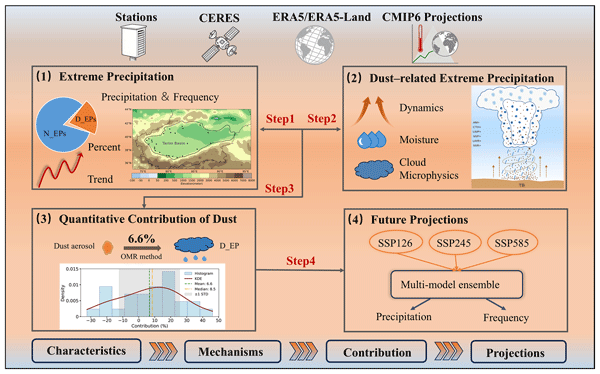
Abstract. Climate warming is simultaneously intensifying both dust activity and extreme precipitation (EP) in the arid and semi-arid regions. Meanwhile, dust aerosols further influence EP through complex cloud physical processes. However, significant uncertainties remain regarding the modulating role of dust aerosols within the aerosol-cloud-precipitation interaction system. There is a pressing need to quantitatively resolve this complex process to address disaster prevention challenges in arid regions. Based on long-term ground-based observations, satellite data, reanalysis data, and CMIP6 models, this study leverages a systematic analysis to investigate the impact of dust aerosols on EP in the Tarim Basin. Results reveal that dust-related extreme precipitation (D_EP) accounts for a relatively high proportion of EP (35.52 % for frequency and 34.34 % for precipitation amount) in the Tarim Basin. Dust weather provides the necessary lifting for precipitation., while water vapor acts as a limiting factor. Accordingly, dust aerosols enhance precipitation efficiency by increasing cloud particle radius and promoting cloud water path, ice water path, and cloud top height under conditions of sufficient moisture. Furthermore, the regional average contribution of dust aerosols to EP events is quantified as 6.6 % using long-term in situ observations. CMIP6 projections indicate that D_EP events will persist at relatively high values in the near term. This findings reveal that dust aerosols serve as a key regulator of the water cycle in arid regions, providing a new perspective for understanding the mechanisms driving EP.
-
Notice on discussion status
The requested preprint has a corresponding peer-reviewed final revised paper. You are encouraged to refer to the final revised version.
-
Preprint
(1962 KB)
-
The requested preprint has a corresponding peer-reviewed final revised paper. You are encouraged to refer to the final revised version.
- Preprint
(1962 KB) - Metadata XML
- BibTeX
- EndNote
- Final revised paper


Journal article(s) based on this preprint
Interactive discussion
Status: closed
- RC1: 'Comment on egusphere-2025-5307', Anonymous Referee #1, 26 Nov 2025
-
RC2: 'Comment on egusphere-2025-5307', Anonymous Referee #2, 27 Nov 2025
Dust aerosols significantly influence cloud evolution and subsequent precipitation processes, primarily through their modulation of cloud microphysical properties via aerosol-radiation and aerosol-cloud interactions. Based on multi-source observational data, this study aims to analyze the impact of dust aerosols on cloud microphysical characteristics over long timescales and quantitatively assess their contribution to extreme precipitation events. The research topic holds considerable scientific value, and the analysis is relatively systematic and comprehensive. Therefore, I recommend acceptance of this manuscript after the authors address the following points.
General comments:
1.The impact of dust aerosols on extreme precipitation is modeled under various emission scenarios, adding completeness to the paper. Nevertheless, the interpretation of the results is too succinct to convey the significance of these findings. The analysis and discussion of this part (Figures 9b and 9c) should be expanded.
2.To ensure the robustness of the conclusions regarding threshold selection, it is recommended that the authors include an additional analysis in the main text or supplementary materials. For instance, a brief demonstration of whether key statistical characteristics of D_EP events, such as trends and contribution rates, remain consistent when using the 80th or 85th percentile thresholds compared to the current 75th percentile would be valuable.
Specific comments:
1.Line 33: "This findings" contains a grammatical error and should be corrected to "These findings".
2.Line 36: "Dust–cloud-precipitation interactions" should be revised to "Dust-cloud-precipitation interactions".
3.It is recommended to replace "spring and summer" in Line 39 with "March–August" and maintain this terminology consistently throughout the manuscript.
4.Lines 117-118 state that 'It is noteworthy that only five to six models satisfy the aforementioned daily scale output specification'. Please specify which output variables (e.g., daily precipitation, dust concentration) were used to screen the models, leading to the exclusion of others.
5.In Section 2.5, "Definition of EP events", the D_EP event appears to be defined based on station observation data. How is the D_EP event defined when investigating the future projections of extreme precipitation influenced by dust aerosols?
6.Lines 153-156 mention "removing the associated systematic errors from the reanalysis". What specific method was employed to achieve this?
7.The sentence in Line 164, "We analyze the background environmental conditions...", should be revised to "This step involves analyzing the background environmental conditions...".
8.In Lines 176-178, the phrasing "frequency (81%) and amount (74%)" is ambiguous. Do these percentages refer to the proportion of stations showing a significant increasing trend, or do they indicate the magnitude of the trend itself? The authors are advised to clarify this to ensure precise interpretation.
9.It is recommended to delete the word "respectively" in line 194 of the figure caption.
10.Lines 226-229 describe the study area as "reconstructed using a moving coordinate system centered on the stations experiencing D_EP events". Could you please specify whether this coordinate system moves dynamically with each individual D_EP event, or is it aggregated based on specific time windows?
11.Line 259: "undersores" is a spelling error and should be corrected to "underscores".
12.Lines 258-259: The clause "However, observations show an increasing trend in EP events within the Tarim Basin" can be replaced with the more concise and impactful phrase "However, the observed increase in EP events within the Tarim Basin".
13.Line 279: Please delete the redundant "nuclei".
14.Lines 294-296: The text states "significantly increasing the particle size of hydrometeors such as liquid water radius (LWR) and ice water radius (IWR; Figs. 7d, 7e)". According to classical cloud microphysics, the ice nucleation process inherently consumes supercooled liquid water, converting it to ice phase particles, which should theoretically reduce liquid water content and decrease the liquid water radius. Please clarify the physical mechanism behind the observed increase in LWR.
15.Line 304: Please change "g m⁻²" to "g·m⁻²".
16.It is recommended to replace "Therefore" in line 331 with "Consistently".
17.Lines 360-364: It is recommended to replace the conjunction pair "On one hand... On the other hand..." with "Under certain conditions... Under other conditions..." to more accurately reflect that these are potential outcomes under different scenarios, rather than two coexisting aspects of a single process.
18.It is recommended to correct "persists" to "persist" in line 383.Citation: https://doi.org/10.5194/egusphere-2025-5307-RC2 -
AC1: 'Comment on egusphere-2025-5307', Chenglong Zhou, 02 Feb 2026
The point-to-point responses to the associate editor and reviewer's comments are provided in the attached file "Response to Reviewer."
Citation: https://doi.org/10.5194/egusphere-2025-5307-AC1 - AC2: 'Comment on egusphere-2025-5307', Chenglong Zhou, 02 Feb 2026


Interactive discussion
Status: closed
- RC1: 'Comment on egusphere-2025-5307', Anonymous Referee #1, 26 Nov 2025
-
RC2: 'Comment on egusphere-2025-5307', Anonymous Referee #2, 27 Nov 2025
Dust aerosols significantly influence cloud evolution and subsequent precipitation processes, primarily through their modulation of cloud microphysical properties via aerosol-radiation and aerosol-cloud interactions. Based on multi-source observational data, this study aims to analyze the impact of dust aerosols on cloud microphysical characteristics over long timescales and quantitatively assess their contribution to extreme precipitation events. The research topic holds considerable scientific value, and the analysis is relatively systematic and comprehensive. Therefore, I recommend acceptance of this manuscript after the authors address the following points.
General comments:
1.The impact of dust aerosols on extreme precipitation is modeled under various emission scenarios, adding completeness to the paper. Nevertheless, the interpretation of the results is too succinct to convey the significance of these findings. The analysis and discussion of this part (Figures 9b and 9c) should be expanded.
2.To ensure the robustness of the conclusions regarding threshold selection, it is recommended that the authors include an additional analysis in the main text or supplementary materials. For instance, a brief demonstration of whether key statistical characteristics of D_EP events, such as trends and contribution rates, remain consistent when using the 80th or 85th percentile thresholds compared to the current 75th percentile would be valuable.
Specific comments:
1.Line 33: "This findings" contains a grammatical error and should be corrected to "These findings".
2.Line 36: "Dust–cloud-precipitation interactions" should be revised to "Dust-cloud-precipitation interactions".
3.It is recommended to replace "spring and summer" in Line 39 with "March–August" and maintain this terminology consistently throughout the manuscript.
4.Lines 117-118 state that 'It is noteworthy that only five to six models satisfy the aforementioned daily scale output specification'. Please specify which output variables (e.g., daily precipitation, dust concentration) were used to screen the models, leading to the exclusion of others.
5.In Section 2.5, "Definition of EP events", the D_EP event appears to be defined based on station observation data. How is the D_EP event defined when investigating the future projections of extreme precipitation influenced by dust aerosols?
6.Lines 153-156 mention "removing the associated systematic errors from the reanalysis". What specific method was employed to achieve this?
7.The sentence in Line 164, "We analyze the background environmental conditions...", should be revised to "This step involves analyzing the background environmental conditions...".
8.In Lines 176-178, the phrasing "frequency (81%) and amount (74%)" is ambiguous. Do these percentages refer to the proportion of stations showing a significant increasing trend, or do they indicate the magnitude of the trend itself? The authors are advised to clarify this to ensure precise interpretation.
9.It is recommended to delete the word "respectively" in line 194 of the figure caption.
10.Lines 226-229 describe the study area as "reconstructed using a moving coordinate system centered on the stations experiencing D_EP events". Could you please specify whether this coordinate system moves dynamically with each individual D_EP event, or is it aggregated based on specific time windows?
11.Line 259: "undersores" is a spelling error and should be corrected to "underscores".
12.Lines 258-259: The clause "However, observations show an increasing trend in EP events within the Tarim Basin" can be replaced with the more concise and impactful phrase "However, the observed increase in EP events within the Tarim Basin".
13.Line 279: Please delete the redundant "nuclei".
14.Lines 294-296: The text states "significantly increasing the particle size of hydrometeors such as liquid water radius (LWR) and ice water radius (IWR; Figs. 7d, 7e)". According to classical cloud microphysics, the ice nucleation process inherently consumes supercooled liquid water, converting it to ice phase particles, which should theoretically reduce liquid water content and decrease the liquid water radius. Please clarify the physical mechanism behind the observed increase in LWR.
15.Line 304: Please change "g m⁻²" to "g·m⁻²".
16.It is recommended to replace "Therefore" in line 331 with "Consistently".
17.Lines 360-364: It is recommended to replace the conjunction pair "On one hand... On the other hand..." with "Under certain conditions... Under other conditions..." to more accurately reflect that these are potential outcomes under different scenarios, rather than two coexisting aspects of a single process.
18.It is recommended to correct "persists" to "persist" in line 383.Citation: https://doi.org/10.5194/egusphere-2025-5307-RC2 -
AC1: 'Comment on egusphere-2025-5307', Chenglong Zhou, 02 Feb 2026
The point-to-point responses to the associate editor and reviewer's comments are provided in the attached file "Response to Reviewer."
Citation: https://doi.org/10.5194/egusphere-2025-5307-AC1 - AC2: 'Comment on egusphere-2025-5307', Chenglong Zhou, 02 Feb 2026
Peer review completion
Journal article(s) based on this preprint
Viewed
| HTML | XML | Total | BibTeX | EndNote | |
|---|---|---|---|---|---|
| 803 | 351 | 81 | 1,235 | 101 | 87 |
- HTML: 803
- PDF: 351
- XML: 81
- Total: 1,235
- BibTeX: 101
- EndNote: 87
Viewed (geographical distribution)
| Country | # | Views | % |
|---|
| Total: | 0 |
| HTML: | 0 |
| PDF: | 0 |
| XML: | 0 |
- 1
Ze Chen
Chenglong Zhou
Jiacheng Gao
Congzhen Zhu
Meiqi Song
Yu Wang
Yabin Wei
Lu Meng
Mingjie Ma
Cong Wen
The requested preprint has a corresponding peer-reviewed final revised paper. You are encouraged to refer to the final revised version.
- Preprint
(1962 KB) - Metadata XML
Please find the comment in the supplement.