
the Creative Commons Attribution 4.0 License.
the Creative Commons Attribution 4.0 License.
 | 07 Nov 2025
Reassessment of the glyoxal-to-formaldehyde ratio (RGF) as a proxy for VOC source identification
Abstract. The glyoxal-to-formaldehyde ratio (RGF) has been proposed as a proxy to distinguish sources of volatile organic compounds (VOCs) in the atmosphere. However, the interpretation of its variability remains uncertain because of the diverse processes that affect VOC emissions and chemistry. In this study, we revisit the applicability and limitations of RGF using multi-year ground-based MAX-DOAS measurements at four distinct sites: two biogenic (Orléans, France, and ATTO Tower, Brazil) and two anthropogenic (Athens, Greece, and Incheon, South Korea).
The results show higher RGF in anthropogenic environments and lower at biogenic sites. Seasonal RGF patterns are broadly similar across sites, with reduced values in summer and enhanced values in winter, driven by HCHO variability. Diurnal cycles, caused by CHOCHO variability, are more pronounced at urban sites, with weekend effects of 10 %. Correlations between RGF and NO2 vary, even among anthropogenic stations, indicating the importance of local emission contributions.
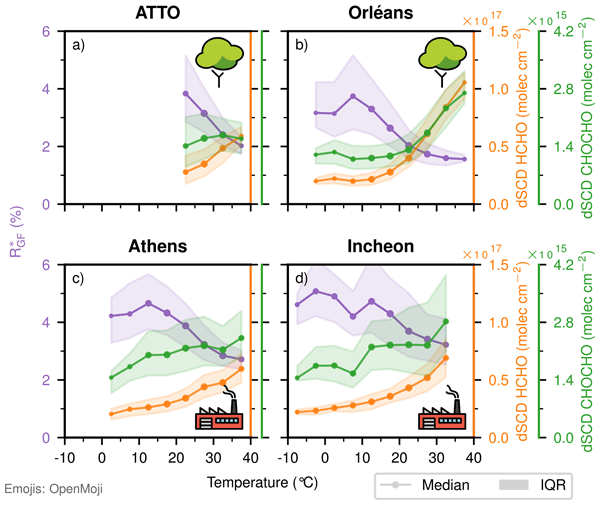
Additionally, our analysis shows that increasing temperatures leads to a decrease of RGF by up to 1.9 percentage points across all sites, due to the more rapid increase of HCHO levels with temperature than CHOCHO.
Moreover, we discuss four effects that reduce the comparability between different RGF values: measurement volume, vertical sensitivity, time dependence, and the impact of averaging-ratioing order.
Our findings suggest that ground-based remote sensing RGF contains valuable diagnostic information about VOC source environments. However, its use as a universal proxy remains challenging, as our incomplete understanding of the various effects currently limits the reliable use of RGF for VOC source attribution.
Competing interests: At least one of the (co-)authors is a member of the editorial board of Atmospheric Chemistry and Physics.
Publisher's note: Copernicus Publications remains neutral with regard to jurisdictional claims made in the text, published maps, institutional affiliations, or any other geographical representation in this paper. While Copernicus Publications makes every effort to include appropriate place names, the final responsibility lies with the authors. Views expressed in the text are those of the authors and do not necessarily reflect the views of the publisher.-
Notice on discussion status
The requested preprint has a corresponding peer-reviewed final revised paper. You are encouraged to refer to the final revised version.
-
Preprint
(6828 KB)
-
The requested preprint has a corresponding peer-reviewed final revised paper. You are encouraged to refer to the final revised version.
- Preprint
(6828 KB) - Metadata XML
- BibTeX
- EndNote
- Final revised paper


Journal article(s) based on this preprint
Interactive discussion
Status: closed
-
RC1: 'Comment on egusphere-2025-5285', Anonymous Referee #1, 10 Nov 2025
-
AC3: 'Reply on RC1', Simon Bittner, 15 Mar 2026
We would like to thank the Referee #1 for the detailed feedback, helpful comments, and advice on the manuscript. The suggestions improved the manuscript message and extended the analysis in a great way.
Detailed responses to the reviewer’s comments can be found in the attached document. We hope that we have incorporated all suggestions and comments in a satisfactory way.
-
AC3: 'Reply on RC1', Simon Bittner, 15 Mar 2026
-
RC2: 'Comment on egusphere-2025-5285', Anonymous Referee #2, 24 Nov 2025
This study investigated the diurnal, seasonal, and weekly characteristics of glyoxal-to-formaldehyde ratio RGF over four ground-based MAX-DOAS measurement sites, with additional investigations about the dependence of elevation, temperature, and NO2 concentrations. The study also discussed the effects of different measurement techniques in the literature of ground-based versus column-based, vertical sensitivity, temporal sampling biases, and calculation order for RGF on the differences across various reports. The analyses are comprehensive and is helpful for the generalization on the usage of RGF on the understanding of VOC emission characteristics.
General Comments
- The study argued that there are various calculation methods adopted in the literature. When comparing the results in this study against prior studies, the differences are dominated by the calculation methods or the real variation of RGF temporally and spatially?
- How spatially representative are these ground-based measurement sites?
- As the reference was taken at the high elevation angles, then naturally the analyses about the elevation effects would be close to 1 with high elevation angles. Would the uncertainties increase with elevation angles as well?
- Why were the slant column sensitivities chosen instead of vertical column sensitivities?
Specific Comments
- Line 474-475: what would be the emission ratio of NOx and VOCs over these two measurement sites? Would different emitted VOCs from different sector contribute to the different values of RGF?
- Line 510-512: how would the RGF values compare between MAX-DOAS measurement sites and that coincidently sampled from TROPOMI observations?
Citation: https://doi.org/10.5194/egusphere-2025-5285-RC2 -
AC2: 'Reply on RC2', Simon Bittner, 15 Mar 2026
We would like to thank Referee #2 for the insightful comments and questions that helped to improve our manuscript.
Detailed responses to the reviewer’s comments can be found in the attached document. We hope that we have incorporated all suggestions and comments in a satisfactory way.
-
RC3: 'Comment on egusphere-2025-5285', Anonymous Referee #3, 28 Nov 2025
General evaluation
The article presents an observational analysis of CHOCHO, HCHO, and their ratio (RGF) across contrasting environments using MAX-DOAS measurements. The study investigates temporal variability and relationships with meteorological parameters and NO₂, aiming to improve understanding of the applicability of RGF as an indicator for VOC source attribution. It also discusses the factors contributing to discrepancies among previous studies using different methodological approaches, thereby highlighting both the potential and limitations of employing RGF as a proxy for VOC source identification. The manuscript addresses a timely, underexplored topic and is generally well-structured and informative. Before publication, several issues should be clarified or strengthened as noted below.
Specific comments
- It would be recommended that the authors further elaborate on how the substantial differences in instrument placement (10–500 m above ground) and non-overlapping measurement periods (2017–2024, varying by site) may influence the retrieved diurnal, weekly, and seasonal patterns. MAX-DOAS sensitivity to boundary-layer gases depends strongly on viewing geometry and instrument height, and differences in measurement years imply variations in meteorology and emissions among the sites.
- MAX-DOAS data were aggregated into 30-minute bins, whereas accompanying reanalysis meteorology is hourly and subsequently interpolated. Please justify this choice. Using hourly averages for MAX-DOAS would reduce noise and ensure temporal consistency with the meteorology without interpolation.
- The diurnal cycles results show higher RGF-related values in ATTO than in Orléans, which seems counterintuitive given the expected dominance of HCHO in the Amazon. Figure 4 shows unscaled ATTO values as the lowest. Could the scaling applied introduce a bias in the RGF representation at ATTO?
- In Figure 11, it is difficult to visually confirm a systematic increase in RGF with viewing elevation. Since O₄-based light-path corrections have reduced influence at higher elevation angles, applying a uniform correction across sites with substantially different instrument heights (e.g., Athens at ~500 m a.g.l.) may introduce biases. Excluding the highest elevation angles appears to yield more consistent trends, and the median pattern remains relatively stable with only a slight U-shaped variation. Please clarify how these factors may influence the interpretation of elevation-dependent RGF behavior.
- Including relative humidity datasets in the analysis or discussion may be valuable, as it strongly influences glyoxal uptake and therefore RGF variability in different environments.
- The “seasonal” analysis currently reflects monthly averages. Because hemispheric seasons differ and the sites span both hemispheres, grouping by season or consistently referring to “monthly variability” would improve clarity.
- Differences in the correlation between RGF and NO₂ at the urban sites may reflect differing emission trends, such as the recent decline in NOₓ levels in Seoul (Incheon). A brief note on this possibility could enhance interpretation.
- Line 113 indicates 1–3° viewing angles, but figures include data beyond 30°. Please clarify the full range of elevation angles used in the analysis.
- Line 213: It would be helpful to include the latitude and longitude of each measurement site to clearly define their locations.
- Line 348: While temperature variability in ATTO is limited, a slight increase during September–October coincides with peak HCHO values; this may be worth noting.
- Line 496: Please clarify the spatial representativeness of the MAX-DOAS measurements. Over what approximate horizontal extension can these observations be considered representative, and how does this compare to a point measurement assumption?
- The description of how temperature dependence was evaluated is unclear. Were data grouped into temperature bins? How does this analysis add beyond what is shown in Fig. 7 where temperature influences are already visible?
- Figure 9 indicates a possible weekend effect in RGF. It would be helpful to assess whether the differences between weekdays and weekends are statistically significant.
Citation: https://doi.org/10.5194/egusphere-2025-5285-RC3 -
AC4: 'Reply on RC3', Simon Bittner, 15 Mar 2026
We thank the Referee #3 for the constructive feedback to the manuscript. The raised issues helped us to further improve the manuscript.
Detailed responses to the reviewer’s comments can be found in the attached document. We hope that we have incorporated all suggestions and comments in a satisfactory way.
-
RC4: 'Comment on egusphere-2025-5285', Anonymous Referee #4, 07 Dec 2025
Bittner et al. present a valuable multi-year analysis of RGF using ground-based MAX-DOAS measurements at four sites: two biogenic and two anthropogenic. The author found that the patterns of the glyoxal-to-formaldehyde ratio (RGF) varied across the four study sites, including diurnal, weekly, and seasonal cycles. They also investigate how the temperature and NO2 drive the changes in RGF, and provide a valuable discussion of the four factors that reduce the comparability between different RGF values.
When the language is well used and data visualizations are very good, I feel the manuscript is very long, so I find it challenging to extract the take-home messages. Efforts should be made to improve the readability of the manuscript by combining certain sections and figures. More discussions should be included for other factors that can affect RGF, e.g., boundary layer height and air mass history. Machine learning could be a useful approach for this discussion. Overall, major revisions are required before the work can be published.
Major Comments:
- Section 3.2 and Section 3.5: The seasonal patterns are mainly attributed to temperature-driven HCHO changes (Figure 7), but other factors like boundary layer height, cloud coverage, and photolysis rates also need to be discussed.
- Section 3.6: The authors provide valuable empirical analysis of RGF-NO2 relationships across diverse environments. But there is a lack of mechanistic interpretation of how varying NOx regimes fundamentally alter CHOCHO and HCHO yields from different VOC precursors. In addition, it is unclear how the industrial processes in Incheon and Athens drive the observed difference in the CHOCHO-NO2
Minor Comments:
- Lines 58-86: The summary of the latest research on RGF is descriptive. It lacks clear motivation. I recommend that the authors make it more concise and compact for better readability.
- Please include a table in Section 2.5 to summarize key characteristics: coordinates, type, instrument height, viewing direction, measurement period, and typical NO₂ level for each site. This would help readers quickly grasp information about the four study sites.
- Figure 3: Please include the median and interquartile range for better statistics.
- Figure 4: The difference in mark sizes for data availability is not clear. The same applies to Figures 5-7 and other similar figures.
- Figure 4: What are the uses of overpass times? There is no discussion in section 3.2.
- Lines 266-275: It is good that the authors mentioned findings in light of the literature. However, I feel that the comparison in RGF between this study and the literature is lacking. The same applies to the Lines 324 -329 in Section 3.2 Seasonal cycle.
- Lines 280 – 282: The manuscript reports substantial differences in RGF values between biogenic (2.2-3.1%pt) and anthropogenic sites (3.5-4.2%pt) (Line 280-282). However, no statistical test is performed to validate these differences. Given the considerable overlap in standard deviations (e.g., Athens 3.5±0.4%pt and Incheon 3.7±0.7%pt), statistical tests (e.g., ANOVA with post-hoc testing or non-parametric equivalents) should be applied to confirm whether the observed differences between sites are statistically significant beyond random variations. This is particularly important for supporting the central conclusion that RGF values systematically differ between environment types (Line 630). The same concerns on annual mean values of RGF (Line 331).
- Figure 5 and Lines 296-297: It is not clear what information the authors want to convey with the O4
- Figures 4 and 5 can be potentially combined into one plot. The same applies to Figures 6 and 7 and also other figures.
- Lines 301-302: It is unclear how the dilution effects contribute to the observed shape.
- Section 3.7: The discussion on the factors affecting RGF values between different measurement techniques is highly appreciated. It would also be good to include suggestions to guide future work, e.g., “Future work should quantify these effects through radiative transfer simulations or direct instrument intercomparisons.”
Technical Comments:
- Abstract: When mentioning HCHO and CHOCHO, it will be good to include their names.
- The use of NMVOC is unnecessary, as it is used only four times. Instead, using non-methane VOCs is fine.
- Line 90: When “with meteorological variables” is mentioned, only temperature is analyzed throughout this study.
- Line 275: “to” is repeated.
- Do “%” and “%pt.” mean the same thing?
Citation: https://doi.org/10.5194/egusphere-2025-5285-RC4 -
AC1: 'Reply on RC4', Simon Bittner, 14 Mar 2026
We would like to thank the Referee #4 for the valuable feedback that improved the manuscript significantly.
Detailed responses to the reviewer’s comments can be found in the attached document. We hope that we have incorporated all suggestions and comments in a satisfactory way.
Peer review completion


Interactive discussion
Status: closed
-
RC1: 'Comment on egusphere-2025-5285', Anonymous Referee #1, 10 Nov 2025
The paper presents a thorough multi-site analysis of the glyoxal-to-formaldehyde ratio (RGF) derived from ground-based MAX-DOAS measurements across four environments (tropical forest, temperate forest, and two urban sites). The authors attempt to clarify why the RGF values reported in different studies often diverge, emphasizing observational geometry, aerosol and NOx regimes, and temperature dependence. The topic is timely and valuable for improving the interpretation of satellite and ground-based VOC proxies.
I should note that I am not a specialist in atmospheric chemistry or VOC oxidation modeling, so my comments focus mainly on the scientific reasoning, completeness of the analysis, and clarity of interpretation. Overall, the study is carefully executed and well documented, but it still lacks several essential elements that would make the findings more conclusive. Below I summarize major and minor scientific questions and suggestions.
- The paper interprets RGF differences as signals of VOC source composition, yet it does not provide a quantitative link from precursor classes to CHOCHO and HCHO yields. Please add a concise mechanism-based discussion that relates RGF to isoprene, aromatics, alkenes, and oxygenates, including the role of NOx regime and OH reactivity.
- Differences in photolysis, OH loss, heterogeneous uptake, and wet removal for CHOCHO versus HCHO can alter RGF independently of emissions. Please analyze, at least qualitatively, whether the observed diurnal and seasonal patterns can be explained by lifetime contrasts. A short sensitivity test or a conceptual lifetime budget would help.
- The manuscript reports a robust negative dependence of RGF on temperature but does not present temperature-normalized RGF. Please include a regression-based removal of temperature effects and show the residual RGF variability that might be attributable to emission composition or chemistry. A supplemental figure would suffice.
- Because photochemistry drives both CHOCHO and HCHO, actinic flux and cloudiness matter. Please document any clear-sky filtering and examine whether shortwave radiation or AOD anomalies co-vary with RGF. Summarize this in Methods and expand the Discussion with a brief correlation or stratification analysis.
- Opposite RGF–NO2 relationships across urban sites are described but not explained. Please provide a mechanistic discussion of how NOx modifies RO2 and HO2 pathways and shifts product yields, and reconcile the contrasting behaviors at the two city sites with local emission structure.
- Quality control thresholds are described, but a quantitative error budget is missing. Please provide random and systematic uncertainties for CHOCHO and HCHO dSCDs, account for correlation between bands, and propagate to RGF. Include an uncertainty table and show how uncertainties vary by season and site.
- The O4 correction assumes similar vertical sensitivity for CHOCHO, HCHO, and O4. Please discuss the validity range and potential failure modes, for example under lofted layers or strong stratification. A short diagnostic test or a reference to AMF differences would strengthen the argument.
- The paper notes that average-then-ratio versus ratio-then-average can produce different results but does not quantify the bias. Please add a numerical example using the actual time series to demonstrate the magnitude under realistic variability.
- As RGF is often used in satellite validation, please include a brief comparison to coincident satellite products if available, or at least set expectations by summarizing typical satellite RGF ranges for similar environments. A limited collocation analysis or a literature-based context paragraph would be valuable.
- For the tropical site, discuss the role of biomass burning using fire counts or CO as a tracer. Show whether peaks in RGF align with burning indicators. Add a short subsection or figure in Results for seasonality at the tropical site.
- RGF here is derived from dSCDs that emphasize near-surface sensitivity. Please clarify how conclusions might change for VCD-based ratios or for in-situ concentrations. If possible, provide an AMF-based conversion for at least a sensitivity check.
- Please define the representative footprint for each station under the low-elevation MAX-DOAS geometry and discuss how it affects inter-site comparability. A map and a paragraph would help readers interpret differences among sites.
- Conclusions state that RGF is not universal. Please add two or three sentences on how chemical transport models or box models could assimilate site-specific RGF constraints to evaluate VOC mechanisms.
Citation: https://doi.org/10.5194/egusphere-2025-5285-RC1 -
AC3: 'Reply on RC1', Simon Bittner, 15 Mar 2026
We would like to thank the Referee #1 for the detailed feedback, helpful comments, and advice on the manuscript. The suggestions improved the manuscript message and extended the analysis in a great way.
Detailed responses to the reviewer’s comments can be found in the attached document. We hope that we have incorporated all suggestions and comments in a satisfactory way.
-
RC2: 'Comment on egusphere-2025-5285', Anonymous Referee #2, 24 Nov 2025
This study investigated the diurnal, seasonal, and weekly characteristics of glyoxal-to-formaldehyde ratio RGF over four ground-based MAX-DOAS measurement sites, with additional investigations about the dependence of elevation, temperature, and NO2 concentrations. The study also discussed the effects of different measurement techniques in the literature of ground-based versus column-based, vertical sensitivity, temporal sampling biases, and calculation order for RGF on the differences across various reports. The analyses are comprehensive and is helpful for the generalization on the usage of RGF on the understanding of VOC emission characteristics.
General Comments
- The study argued that there are various calculation methods adopted in the literature. When comparing the results in this study against prior studies, the differences are dominated by the calculation methods or the real variation of RGF temporally and spatially?
- How spatially representative are these ground-based measurement sites?
- As the reference was taken at the high elevation angles, then naturally the analyses about the elevation effects would be close to 1 with high elevation angles. Would the uncertainties increase with elevation angles as well?
- Why were the slant column sensitivities chosen instead of vertical column sensitivities?
Specific Comments
- Line 474-475: what would be the emission ratio of NOx and VOCs over these two measurement sites? Would different emitted VOCs from different sector contribute to the different values of RGF?
- Line 510-512: how would the RGF values compare between MAX-DOAS measurement sites and that coincidently sampled from TROPOMI observations?
Citation: https://doi.org/10.5194/egusphere-2025-5285-RC2 -
AC2: 'Reply on RC2', Simon Bittner, 15 Mar 2026
We would like to thank Referee #2 for the insightful comments and questions that helped to improve our manuscript.
Detailed responses to the reviewer’s comments can be found in the attached document. We hope that we have incorporated all suggestions and comments in a satisfactory way.
-
RC3: 'Comment on egusphere-2025-5285', Anonymous Referee #3, 28 Nov 2025
General evaluation
The article presents an observational analysis of CHOCHO, HCHO, and their ratio (RGF) across contrasting environments using MAX-DOAS measurements. The study investigates temporal variability and relationships with meteorological parameters and NO₂, aiming to improve understanding of the applicability of RGF as an indicator for VOC source attribution. It also discusses the factors contributing to discrepancies among previous studies using different methodological approaches, thereby highlighting both the potential and limitations of employing RGF as a proxy for VOC source identification. The manuscript addresses a timely, underexplored topic and is generally well-structured and informative. Before publication, several issues should be clarified or strengthened as noted below.
Specific comments
- It would be recommended that the authors further elaborate on how the substantial differences in instrument placement (10–500 m above ground) and non-overlapping measurement periods (2017–2024, varying by site) may influence the retrieved diurnal, weekly, and seasonal patterns. MAX-DOAS sensitivity to boundary-layer gases depends strongly on viewing geometry and instrument height, and differences in measurement years imply variations in meteorology and emissions among the sites.
- MAX-DOAS data were aggregated into 30-minute bins, whereas accompanying reanalysis meteorology is hourly and subsequently interpolated. Please justify this choice. Using hourly averages for MAX-DOAS would reduce noise and ensure temporal consistency with the meteorology without interpolation.
- The diurnal cycles results show higher RGF-related values in ATTO than in Orléans, which seems counterintuitive given the expected dominance of HCHO in the Amazon. Figure 4 shows unscaled ATTO values as the lowest. Could the scaling applied introduce a bias in the RGF representation at ATTO?
- In Figure 11, it is difficult to visually confirm a systematic increase in RGF with viewing elevation. Since O₄-based light-path corrections have reduced influence at higher elevation angles, applying a uniform correction across sites with substantially different instrument heights (e.g., Athens at ~500 m a.g.l.) may introduce biases. Excluding the highest elevation angles appears to yield more consistent trends, and the median pattern remains relatively stable with only a slight U-shaped variation. Please clarify how these factors may influence the interpretation of elevation-dependent RGF behavior.
- Including relative humidity datasets in the analysis or discussion may be valuable, as it strongly influences glyoxal uptake and therefore RGF variability in different environments.
- The “seasonal” analysis currently reflects monthly averages. Because hemispheric seasons differ and the sites span both hemispheres, grouping by season or consistently referring to “monthly variability” would improve clarity.
- Differences in the correlation between RGF and NO₂ at the urban sites may reflect differing emission trends, such as the recent decline in NOₓ levels in Seoul (Incheon). A brief note on this possibility could enhance interpretation.
- Line 113 indicates 1–3° viewing angles, but figures include data beyond 30°. Please clarify the full range of elevation angles used in the analysis.
- Line 213: It would be helpful to include the latitude and longitude of each measurement site to clearly define their locations.
- Line 348: While temperature variability in ATTO is limited, a slight increase during September–October coincides with peak HCHO values; this may be worth noting.
- Line 496: Please clarify the spatial representativeness of the MAX-DOAS measurements. Over what approximate horizontal extension can these observations be considered representative, and how does this compare to a point measurement assumption?
- The description of how temperature dependence was evaluated is unclear. Were data grouped into temperature bins? How does this analysis add beyond what is shown in Fig. 7 where temperature influences are already visible?
- Figure 9 indicates a possible weekend effect in RGF. It would be helpful to assess whether the differences between weekdays and weekends are statistically significant.
Citation: https://doi.org/10.5194/egusphere-2025-5285-RC3 -
AC4: 'Reply on RC3', Simon Bittner, 15 Mar 2026
We thank the Referee #3 for the constructive feedback to the manuscript. The raised issues helped us to further improve the manuscript.
Detailed responses to the reviewer’s comments can be found in the attached document. We hope that we have incorporated all suggestions and comments in a satisfactory way.
-
RC4: 'Comment on egusphere-2025-5285', Anonymous Referee #4, 07 Dec 2025
Bittner et al. present a valuable multi-year analysis of RGF using ground-based MAX-DOAS measurements at four sites: two biogenic and two anthropogenic. The author found that the patterns of the glyoxal-to-formaldehyde ratio (RGF) varied across the four study sites, including diurnal, weekly, and seasonal cycles. They also investigate how the temperature and NO2 drive the changes in RGF, and provide a valuable discussion of the four factors that reduce the comparability between different RGF values.
When the language is well used and data visualizations are very good, I feel the manuscript is very long, so I find it challenging to extract the take-home messages. Efforts should be made to improve the readability of the manuscript by combining certain sections and figures. More discussions should be included for other factors that can affect RGF, e.g., boundary layer height and air mass history. Machine learning could be a useful approach for this discussion. Overall, major revisions are required before the work can be published.
Major Comments:
- Section 3.2 and Section 3.5: The seasonal patterns are mainly attributed to temperature-driven HCHO changes (Figure 7), but other factors like boundary layer height, cloud coverage, and photolysis rates also need to be discussed.
- Section 3.6: The authors provide valuable empirical analysis of RGF-NO2 relationships across diverse environments. But there is a lack of mechanistic interpretation of how varying NOx regimes fundamentally alter CHOCHO and HCHO yields from different VOC precursors. In addition, it is unclear how the industrial processes in Incheon and Athens drive the observed difference in the CHOCHO-NO2
Minor Comments:
- Lines 58-86: The summary of the latest research on RGF is descriptive. It lacks clear motivation. I recommend that the authors make it more concise and compact for better readability.
- Please include a table in Section 2.5 to summarize key characteristics: coordinates, type, instrument height, viewing direction, measurement period, and typical NO₂ level for each site. This would help readers quickly grasp information about the four study sites.
- Figure 3: Please include the median and interquartile range for better statistics.
- Figure 4: The difference in mark sizes for data availability is not clear. The same applies to Figures 5-7 and other similar figures.
- Figure 4: What are the uses of overpass times? There is no discussion in section 3.2.
- Lines 266-275: It is good that the authors mentioned findings in light of the literature. However, I feel that the comparison in RGF between this study and the literature is lacking. The same applies to the Lines 324 -329 in Section 3.2 Seasonal cycle.
- Lines 280 – 282: The manuscript reports substantial differences in RGF values between biogenic (2.2-3.1%pt) and anthropogenic sites (3.5-4.2%pt) (Line 280-282). However, no statistical test is performed to validate these differences. Given the considerable overlap in standard deviations (e.g., Athens 3.5±0.4%pt and Incheon 3.7±0.7%pt), statistical tests (e.g., ANOVA with post-hoc testing or non-parametric equivalents) should be applied to confirm whether the observed differences between sites are statistically significant beyond random variations. This is particularly important for supporting the central conclusion that RGF values systematically differ between environment types (Line 630). The same concerns on annual mean values of RGF (Line 331).
- Figure 5 and Lines 296-297: It is not clear what information the authors want to convey with the O4
- Figures 4 and 5 can be potentially combined into one plot. The same applies to Figures 6 and 7 and also other figures.
- Lines 301-302: It is unclear how the dilution effects contribute to the observed shape.
- Section 3.7: The discussion on the factors affecting RGF values between different measurement techniques is highly appreciated. It would also be good to include suggestions to guide future work, e.g., “Future work should quantify these effects through radiative transfer simulations or direct instrument intercomparisons.”
Technical Comments:
- Abstract: When mentioning HCHO and CHOCHO, it will be good to include their names.
- The use of NMVOC is unnecessary, as it is used only four times. Instead, using non-methane VOCs is fine.
- Line 90: When “with meteorological variables” is mentioned, only temperature is analyzed throughout this study.
- Line 275: “to” is repeated.
- Do “%” and “%pt.” mean the same thing?
Citation: https://doi.org/10.5194/egusphere-2025-5285-RC4 -
AC1: 'Reply on RC4', Simon Bittner, 14 Mar 2026
We would like to thank the Referee #4 for the valuable feedback that improved the manuscript significantly.
Detailed responses to the reviewer’s comments can be found in the attached document. We hope that we have incorporated all suggestions and comments in a satisfactory way.
Peer review completion
Journal article(s) based on this preprint
Viewed
| HTML | XML | Total | BibTeX | EndNote | |
|---|---|---|---|---|---|
| 3,208 | 1,163 | 293 | 4,664 | 218 | 235 |
- HTML: 3,208
- PDF: 1,163
- XML: 293
- Total: 4,664
- BibTeX: 218
- EndNote: 235
Viewed (geographical distribution)
| Country | # | Views | % |
|---|
| Total: | 0 |
| HTML: | 0 |
| PDF: | 0 |
| XML: | 0 |
- 1
Simon Bittner

Andreas Richter
Bianca Zilker
Sebastian Donner
Thomas Wagner
Leonardo M. A. Alvarado
Mihalis Vrekoussis
The requested preprint has a corresponding peer-reviewed final revised paper. You are encouraged to refer to the final revised version.
- Preprint
(6828 KB) - Metadata XML
The paper presents a thorough multi-site analysis of the glyoxal-to-formaldehyde ratio (RGF) derived from ground-based MAX-DOAS measurements across four environments (tropical forest, temperate forest, and two urban sites). The authors attempt to clarify why the RGF values reported in different studies often diverge, emphasizing observational geometry, aerosol and NOx regimes, and temperature dependence. The topic is timely and valuable for improving the interpretation of satellite and ground-based VOC proxies.
I should note that I am not a specialist in atmospheric chemistry or VOC oxidation modeling, so my comments focus mainly on the scientific reasoning, completeness of the analysis, and clarity of interpretation. Overall, the study is carefully executed and well documented, but it still lacks several essential elements that would make the findings more conclusive. Below I summarize major and minor scientific questions and suggestions.