
the Creative Commons Attribution 4.0 License.
the Creative Commons Attribution 4.0 License.
 | 11 Dec 2025
Long-term cloud characterization at the AGORA ACTRIS-CCRES station using a novel classification algorithm
Abstract. The Western Mediterranean is a climatic hotspot with strong variability in cloud processes. However, Cloudnet sites there are scarce compared to northern Europe. This study presents for the first time a five-year cloud statistical analysis at the AGORA ACTRIS-CCRES station in Granada (Spain), using 94 GHz Doppler radar, microwave radiometer, and ceilometer data. Analyses focus on single-layer clouds and their interannual variability in macrophysical and microphysical properties. A new cluster-based algorithm (CBA) is introduced for cloud classification, reducing spurious correlations found in earlier methods. The CBA shows single-layer cloud minima in summer, with annual occurrences of 5.0 % for ice, 3.6 % for precipitating ice, 3.4 % for mixed-phase, 3.2 % for precipitating mixed-phase, and 1.4 % (1.2 %) for liquid (precipitating liquid) clouds. Liquid clouds are observed at 1–2 km, thin (∼200–300 m), with a droplet radius of 5 μm and liquid water paths of 12 g m−2. Mixed-phase clouds occur at 5–6 km, nearly 1 km thicker, with larger droplets (10.8 μm) and ice water paths of 3.5 g m−2. Ice clouds dominate at 7–8 km, the thickest type, with higher ice water paths (8.5 g m−2) but smaller particles (∼39 μm) than mixed-phase (∼45 μm). Across all phases, precipitating clouds have lower bases, greater thickness, and higher water content and particle sizes than non-precipitating clouds. These results provide benchmark data for satellite and model evaluation. The algorithm can be applied to other Cloudnet sites, supporting consistent European cloud statistics.
Competing interests: Daniel Pérez-Ramírez is a member of the editorial board of AMT
Publisher's note: Copernicus Publications remains neutral with regard to jurisdictional claims made in the text, published maps, institutional affiliations, or any other geographical representation in this paper. While Copernicus Publications makes every effort to include appropriate place names, the final responsibility lies with the authors. Views expressed in the text are those of the authors and do not necessarily reflect the views of the publisher.-
Notice on discussion status
The requested preprint has a corresponding peer-reviewed final revised paper. You are encouraged to refer to the final revised version.
-
Preprint
(19282 KB)
-
The requested preprint has a corresponding peer-reviewed final revised paper. You are encouraged to refer to the final revised version.
- Preprint
(19282 KB) - Metadata XML
- BibTeX
- EndNote
- Final revised paper


Journal article(s) based on this preprint
Interactive discussion
Status: closed
-
RC1: 'Comment on egusphere-2025-5239', Anonymous Referee #2, 03 Jan 2026
-
AC2: 'Reply on RC1', Matheus Tolentino da Silva, 27 Feb 2026
The comment was uploaded in the form of a supplement: https://egusphere.copernicus.org/preprints/2025/egusphere-2025-5239/egusphere-2025-5239-AC2-supplement.pdf
-
AC2: 'Reply on RC1', Matheus Tolentino da Silva, 27 Feb 2026
-
RC2: 'Comment on egusphere-2025-5239', Anonymous Referee #3, 05 Jan 2026
This manuscript presents a long-term characterisation of single-layer cloud macrophysical and microphysical properties at the AGORA ACTRIS-CCRES station (2018-2023), with a particular emphasis on the under-sampled western Mediterranean region. A key contribution is the proposed cluster-based algorithm (CBA), designed to treat clouds as volumetric entities (time-height clusters) and thereby reduce physically unrealistic type-to-type correlations that can arise with profile-based approaches. The paper is generally well written, the motivation is clear, and the results should be useful as regional reference statistics for model/satellite evaluation. I have only two main concerns:
1) Several central elements of the CBA rely on empirically determined thresholds (cloud-size criterion and phase/precipitation rules). For example: a cluster is considered a cloud if it has >100 pixels (excluding drizzle/rain), liquid is defined by P(droplets+drizzle)+P(droplets) > 70%, ice by criteria including P(ice) > 90% (or small droplet fraction), and precipitating clouds by >10 “drizzle or rain” pixels. The manuscript notes these were selected after case-study evaluation, which is a reasonable starting point, but the conclusions (cloud-type frequencies and derived property statistics) could be sensitive to these choices.
I would suggest to add a short sensitivity analysis showing how key outputs change when thresholds are perturbed (e.g., cloud pixel criterion 50/100/150; liquid threshold 60/70/80%; precip threshold 5/10/20 pixels). Reporting changes in (a) cloud-type occurrence and (b) a couple of headline statistics (e.g., median LWP/IWP, CBH/CTH or thickness) would greatly strengthen confidence.
Alternatively, provide a brief justification table summarising the thresholds, what they control, and why they are physically/observationally motivated.
2) The manuscript clearly documents strong seasonality in data availability, with Jan-Mar having the lowest availability (40-50%), while Apr-Oct exceeds 60%. Missing periods are linked to maintenance/technical issues and scanning measurements not processed by Cloudnet. This is important context because many results emphasise seasonal contrasts, and uneven sampling could bias frequency estimates and vertical-profile statistics.
Can the authors add a short assessment of whether the reported seasonal patterns remain robust after accounting for uneven sampling.
Other minor comments:
1. Cloud-top definition is said to be not valid when radar LWP > 0.9 kg m⁻², and such cases are filtered because attenuation may mask cloud tops. It would help to report how frequent this condition is and whether it impacts reported cloud thickness distributions.
2. Ensure consistent terminology between “TCP/TC” and the Cloudnet “target classification” product across sections.
Citation: https://doi.org/10.5194/egusphere-2025-5239-RC2 -
AC3: 'Reply on RC2', Matheus Tolentino da Silva, 27 Feb 2026
The comment was uploaded in the form of a supplement: https://egusphere.copernicus.org/preprints/2025/egusphere-2025-5239/egusphere-2025-5239-AC3-supplement.pdf
-
AC3: 'Reply on RC2', Matheus Tolentino da Silva, 27 Feb 2026
-
RC3: 'Comment on egusphere-2025-5239', Anonymous Referee #1, 14 Jan 2026
1 General comments
This manuscript presents a 5-year analysis of cloud statistics at the station AGORA in Granada, Spain, using data of ground-based observations (radar, ceilometer and microwave radiometer). The dataset is analyzed focusing on the microphysical and microphysical properties of single-layer clouds. The authors introduced a cluster-based algorithm which considers cloud volume, and they compared the algorithm with profile-based method used for cloud classification. The dataset presented in this study is the only ground-based cloud database available for this region. The results of this study are valuable for other studies on modeling or comparison with satellites and other the sites with similar ground-based instruments. The manuscript is within the scope of AMT journal. Generally, it is well-structured and well-written manuscript. However, it would benefit from a practical application of the proposed method and the inclusion of a case study that demonstrates its performance advantages and potential areas of application. Accordingly, I recommend that the authors undertake a major revision to address the following points.
2 Specific comments
- The manuscript presents the CBA method, but the question is related to its applicability. What is the applicability of the introduced method CBA with the homogeneous phase of the clouds? What advantages does CBA have over PBA, and in which applications can it be used? The manuscript does not discuss which specific tasks the CBA method is intended to solve. Could authors include a case study which shows the benefit of CBA in one of the applications? Including a case study (or several) that demonstrates when CBA provides new information compared with PBA, and for which applications CBA reduces uncertainty relative to PBA, would substantially strengthen the manuscript.
- Could the CBA method be forcing the cloud phase and properties to look more uniform than they really are?
- Questions to Figure 5: How precipitating-ice clouds are derived in the method? What is the difference between Precipitating-Mixed-Phase and precipitating Ice clouds in the applied method? Based on the applied method how do you distinguish between snow and ice cloud particles and therefore separate ice clouds and ice precipitating clouds?
- In the lines 181-182 the authors wrote: ‘For ice and mixed-phase precipitating clouds, it is the first pixels within the melting layer.’ If ice clouds have a melting layer, shouldn't they be classified as mixed‑phase precipitating clouds rather than as ice clouds?
3 Minor comments (technical corrections)
Lines 86-87: ‘…measures the brightness temperature (TB) around the water vapor (22-31 GHz) and oxygen (51-58 GHz) absorption bands at seven channels for each one,… The main product used here is the liquid water path (LWP) (see Tab. 1), which is derived from the (TB) at the water vapor channels.’ 31.4 GHz is a window channel sensitive to presence of liquid in atmosphere. The frequency range 22-31.4 GHz is sensitive to both water vapor and liquid water absorption. Please correct the sentence.
Line 82: first time the abbreviation ‘LWP’ appear here. Please add the transcript ‘liquid water path (LWP)‘ here and remove from lines 88-89.
Lines 93-94: Please add comma after ‘… respectively, and …’ : ‘The temporal and vertical resolutions are 15 s and 15 m, respectively, and the full overlap …’.
Lines 118,119: Please replace ‘models’ by ‘instruments’ in the sentence.
Line 137: The abbreviation DCR is not used without transcript and is not explained in the text: ‘… DCR reflectivity (Z) … ‘.
Line 139: Ice needs to be in double quotes: ‘ …as „Ice“, … ‘. Please correct.
Line 165: Please add ‘as’ in the sentence: ‘…, it is considered as a cloud…’.
In Figure 3: in part 3b please correct ‘CBT’ to ‘CTH’.
Line 256: please correct to ‘the 25/50/75th percentiles’.
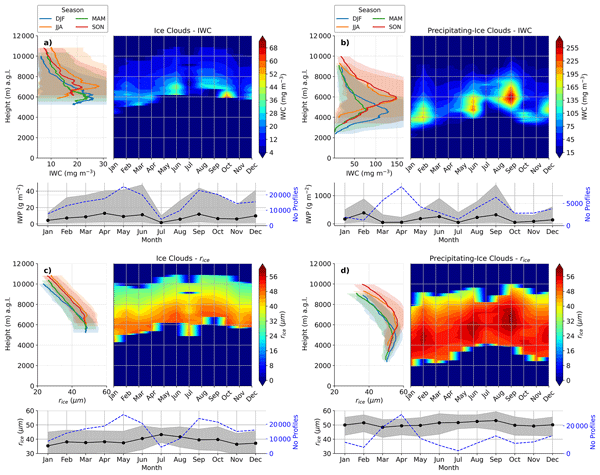
Lines 308-309: Please specify exact Figure 7a ‘in August (see top-right panel, Figure 7a)’.
Lines 311-312: Please specify exact Figure: ‘These peaks do not significantly influence the seasonal statistics, as observed in the seasonal profile (left panel, Figure 7a).’
Citation: https://doi.org/10.5194/egusphere-2025-5239-RC3 -
AC1: 'Reply on RC3', Matheus Tolentino da Silva, 27 Feb 2026
The comment was uploaded in the form of a supplement: https://egusphere.copernicus.org/preprints/2025/egusphere-2025-5239/egusphere-2025-5239-AC1-supplement.pdf


Interactive discussion
Status: closed
-
RC1: 'Comment on egusphere-2025-5239', Anonymous Referee #2, 03 Jan 2026
The manuscript by Tolentino et al. introduced a new cluster-based algorithm for cloud classification, which reduces spurious correlations found in earlier methods. Great efforts have been devoted to addressing the gap of studies in South of Europe. This study presented a five-year cloud statistical analysis focusing on single-layer clouds, systematically investigating the macro- and micro-physical properties of different phase clouds. The topic is within the scope of Atmospheric Measurement Techniques. The manuscript is well-structured and well-written. However, I have some concerns regarding the validity and reliability of the method proposed. Specific comments are as follows.
Sec 3.2: Here, the authors evaluated the performance of the CBA algorithm by comparison with the PBA algorithm, based on the Pearson correlation coefficients. Only one case is presented. From my perspective, the CBA algorithm tends to preserve the homogeneity of cloud phase or properties, so such variation in the correlation coefficient is predictable. However, is there an issue of over-uniformity? Comparative validation against other products may better illustrate the algorithm's performance and advantages?
Figure 5: “the number of occurrence of a particular cloud, divided by the total number of observations at each month”. According to the definition given by the authors, the sum of Frequency of Occurrence for all conditions (i.e., Single-layer clouds, Multi-layer clouds, Clear-sky, and Not classified) should be 100%, yet the results presented in this figure do not appear to match this expectation. Could the authors clarify this discrepancy? From Figure 5b, could the authors explain the reason for the high occurrence of “precipitating-ice” in Mar and Apr?
Line 35: “asses” change to “assess”
Line 94: “More details can be found in (Cazorla et al., 2017).” Please correct.
Line 188: What’s the definition of “cloud overlap” here?
Figure 3: The “CBT” in part 3) of this figure should be “CTH”. Please correct.
Citation: https://doi.org/10.5194/egusphere-2025-5239-RC1 -
AC2: 'Reply on RC1', Matheus Tolentino da Silva, 27 Feb 2026
The comment was uploaded in the form of a supplement: https://egusphere.copernicus.org/preprints/2025/egusphere-2025-5239/egusphere-2025-5239-AC2-supplement.pdf
-
AC2: 'Reply on RC1', Matheus Tolentino da Silva, 27 Feb 2026
-
RC2: 'Comment on egusphere-2025-5239', Anonymous Referee #3, 05 Jan 2026
This manuscript presents a long-term characterisation of single-layer cloud macrophysical and microphysical properties at the AGORA ACTRIS-CCRES station (2018-2023), with a particular emphasis on the under-sampled western Mediterranean region. A key contribution is the proposed cluster-based algorithm (CBA), designed to treat clouds as volumetric entities (time-height clusters) and thereby reduce physically unrealistic type-to-type correlations that can arise with profile-based approaches. The paper is generally well written, the motivation is clear, and the results should be useful as regional reference statistics for model/satellite evaluation. I have only two main concerns:
1) Several central elements of the CBA rely on empirically determined thresholds (cloud-size criterion and phase/precipitation rules). For example: a cluster is considered a cloud if it has >100 pixels (excluding drizzle/rain), liquid is defined by P(droplets+drizzle)+P(droplets) > 70%, ice by criteria including P(ice) > 90% (or small droplet fraction), and precipitating clouds by >10 “drizzle or rain” pixels. The manuscript notes these were selected after case-study evaluation, which is a reasonable starting point, but the conclusions (cloud-type frequencies and derived property statistics) could be sensitive to these choices.
I would suggest to add a short sensitivity analysis showing how key outputs change when thresholds are perturbed (e.g., cloud pixel criterion 50/100/150; liquid threshold 60/70/80%; precip threshold 5/10/20 pixels). Reporting changes in (a) cloud-type occurrence and (b) a couple of headline statistics (e.g., median LWP/IWP, CBH/CTH or thickness) would greatly strengthen confidence.
Alternatively, provide a brief justification table summarising the thresholds, what they control, and why they are physically/observationally motivated.
2) The manuscript clearly documents strong seasonality in data availability, with Jan-Mar having the lowest availability (40-50%), while Apr-Oct exceeds 60%. Missing periods are linked to maintenance/technical issues and scanning measurements not processed by Cloudnet. This is important context because many results emphasise seasonal contrasts, and uneven sampling could bias frequency estimates and vertical-profile statistics.
Can the authors add a short assessment of whether the reported seasonal patterns remain robust after accounting for uneven sampling.
Other minor comments:
1. Cloud-top definition is said to be not valid when radar LWP > 0.9 kg m⁻², and such cases are filtered because attenuation may mask cloud tops. It would help to report how frequent this condition is and whether it impacts reported cloud thickness distributions.
2. Ensure consistent terminology between “TCP/TC” and the Cloudnet “target classification” product across sections.
Citation: https://doi.org/10.5194/egusphere-2025-5239-RC2 -
AC3: 'Reply on RC2', Matheus Tolentino da Silva, 27 Feb 2026
The comment was uploaded in the form of a supplement: https://egusphere.copernicus.org/preprints/2025/egusphere-2025-5239/egusphere-2025-5239-AC3-supplement.pdf
-
AC3: 'Reply on RC2', Matheus Tolentino da Silva, 27 Feb 2026
-
RC3: 'Comment on egusphere-2025-5239', Anonymous Referee #1, 14 Jan 2026
1 General comments
This manuscript presents a 5-year analysis of cloud statistics at the station AGORA in Granada, Spain, using data of ground-based observations (radar, ceilometer and microwave radiometer). The dataset is analyzed focusing on the microphysical and microphysical properties of single-layer clouds. The authors introduced a cluster-based algorithm which considers cloud volume, and they compared the algorithm with profile-based method used for cloud classification. The dataset presented in this study is the only ground-based cloud database available for this region. The results of this study are valuable for other studies on modeling or comparison with satellites and other the sites with similar ground-based instruments. The manuscript is within the scope of AMT journal. Generally, it is well-structured and well-written manuscript. However, it would benefit from a practical application of the proposed method and the inclusion of a case study that demonstrates its performance advantages and potential areas of application. Accordingly, I recommend that the authors undertake a major revision to address the following points.
2 Specific comments
- The manuscript presents the CBA method, but the question is related to its applicability. What is the applicability of the introduced method CBA with the homogeneous phase of the clouds? What advantages does CBA have over PBA, and in which applications can it be used? The manuscript does not discuss which specific tasks the CBA method is intended to solve. Could authors include a case study which shows the benefit of CBA in one of the applications? Including a case study (or several) that demonstrates when CBA provides new information compared with PBA, and for which applications CBA reduces uncertainty relative to PBA, would substantially strengthen the manuscript.
- Could the CBA method be forcing the cloud phase and properties to look more uniform than they really are?
- Questions to Figure 5: How precipitating-ice clouds are derived in the method? What is the difference between Precipitating-Mixed-Phase and precipitating Ice clouds in the applied method? Based on the applied method how do you distinguish between snow and ice cloud particles and therefore separate ice clouds and ice precipitating clouds?
- In the lines 181-182 the authors wrote: ‘For ice and mixed-phase precipitating clouds, it is the first pixels within the melting layer.’ If ice clouds have a melting layer, shouldn't they be classified as mixed‑phase precipitating clouds rather than as ice clouds?
3 Minor comments (technical corrections)
Lines 86-87: ‘…measures the brightness temperature (TB) around the water vapor (22-31 GHz) and oxygen (51-58 GHz) absorption bands at seven channels for each one,… The main product used here is the liquid water path (LWP) (see Tab. 1), which is derived from the (TB) at the water vapor channels.’ 31.4 GHz is a window channel sensitive to presence of liquid in atmosphere. The frequency range 22-31.4 GHz is sensitive to both water vapor and liquid water absorption. Please correct the sentence.
Line 82: first time the abbreviation ‘LWP’ appear here. Please add the transcript ‘liquid water path (LWP)‘ here and remove from lines 88-89.
Lines 93-94: Please add comma after ‘… respectively, and …’ : ‘The temporal and vertical resolutions are 15 s and 15 m, respectively, and the full overlap …’.
Lines 118,119: Please replace ‘models’ by ‘instruments’ in the sentence.
Line 137: The abbreviation DCR is not used without transcript and is not explained in the text: ‘… DCR reflectivity (Z) … ‘.
Line 139: Ice needs to be in double quotes: ‘ …as „Ice“, … ‘. Please correct.
Line 165: Please add ‘as’ in the sentence: ‘…, it is considered as a cloud…’.
In Figure 3: in part 3b please correct ‘CBT’ to ‘CTH’.
Line 256: please correct to ‘the 25/50/75th percentiles’.
Lines 308-309: Please specify exact Figure 7a ‘in August (see top-right panel, Figure 7a)’.
Lines 311-312: Please specify exact Figure: ‘These peaks do not significantly influence the seasonal statistics, as observed in the seasonal profile (left panel, Figure 7a).’
Citation: https://doi.org/10.5194/egusphere-2025-5239-RC3 -
AC1: 'Reply on RC3', Matheus Tolentino da Silva, 27 Feb 2026
The comment was uploaded in the form of a supplement: https://egusphere.copernicus.org/preprints/2025/egusphere-2025-5239/egusphere-2025-5239-AC1-supplement.pdf
Peer review completion
Journal article(s) based on this preprint
Viewed
| HTML | XML | Total | BibTeX | EndNote | |
|---|---|---|---|---|---|
| 350 | 130 | 39 | 519 | 35 | 33 |
- HTML: 350
- PDF: 130
- XML: 39
- Total: 519
- BibTeX: 35
- EndNote: 33
Viewed (geographical distribution)
| Country | # | Views | % |
|---|
| Total: | 0 |
| HTML: | 0 |
| PDF: | 0 |
| XML: | 0 |
- 1
Matheus Tolentino
Juan Antonio Bravo-Aranda
Juan Luis Guerrero-Rascado
Francisco Navas-Guzmán
Daniel Pérez-Ramírez
Lucas Alados-Arboledas
Maria José Granados-Muñoz
The requested preprint has a corresponding peer-reviewed final revised paper. You are encouraged to refer to the final revised version.
- Preprint
(19282 KB) - Metadata XML
The manuscript by Tolentino et al. introduced a new cluster-based algorithm for cloud classification, which reduces spurious correlations found in earlier methods. Great efforts have been devoted to addressing the gap of studies in South of Europe. This study presented a five-year cloud statistical analysis focusing on single-layer clouds, systematically investigating the macro- and micro-physical properties of different phase clouds. The topic is within the scope of Atmospheric Measurement Techniques. The manuscript is well-structured and well-written. However, I have some concerns regarding the validity and reliability of the method proposed. Specific comments are as follows.
Sec 3.2: Here, the authors evaluated the performance of the CBA algorithm by comparison with the PBA algorithm, based on the Pearson correlation coefficients. Only one case is presented. From my perspective, the CBA algorithm tends to preserve the homogeneity of cloud phase or properties, so such variation in the correlation coefficient is predictable. However, is there an issue of over-uniformity? Comparative validation against other products may better illustrate the algorithm's performance and advantages?
Figure 5: “the number of occurrence of a particular cloud, divided by the total number of observations at each month”. According to the definition given by the authors, the sum of Frequency of Occurrence for all conditions (i.e., Single-layer clouds, Multi-layer clouds, Clear-sky, and Not classified) should be 100%, yet the results presented in this figure do not appear to match this expectation. Could the authors clarify this discrepancy? From Figure 5b, could the authors explain the reason for the high occurrence of “precipitating-ice” in Mar and Apr?
Line 35: “asses” change to “assess”
Line 94: “More details can be found in (Cazorla et al., 2017).” Please correct.
Line 188: What’s the definition of “cloud overlap” here?
Figure 3: The “CBT” in part 3) of this figure should be “CTH”. Please correct.