
the Creative Commons Attribution 4.0 License.
the Creative Commons Attribution 4.0 License.
 | 03 Nov 2025
At-a-site and between-site variability of bedload transport, inferred from continuous surrogate monitoring, and comparison to predictive equations
Abstract. This study investigates spatial and temporal variability of bedload transport in four Swiss mountain streams using continuous Swiss Plate Geophone (SPG) monitoring. This surrogate measuring system had been calibrated in previous studies to produce reliable estimates of bedload transport rates. The measurements were analysed at two different time scales: short-term transport events typically covering a duration of a few weeks and multi-year annual transport totals. Power-law relations between dimensionless transport intensity and shear stress were derived to evaluate the temporal variability in the steepness of transport relations and in the reference shear stress. Results were compared with predictive equations developed for mountain streams. Findings show substantial variability both within and across sites, likely reflecting the influence of sediment availability, stream slope, streambed texture and flow history. Overall, continuous monitoring highlights the strong role of temporal spatial variability on bedload transport levels, possibly due to changing sediment availability and bed surface composition, and with implications for predictive modelling and river management.
-
Notice on discussion status
The requested preprint has a corresponding peer-reviewed final revised paper. You are encouraged to refer to the final revised version.
-
Preprint
(2636 KB)
-
Supplement
(2385 KB)
-
The requested preprint has a corresponding peer-reviewed final revised paper. You are encouraged to refer to the final revised version.
- Preprint
(2636 KB) - Metadata XML
-
Supplement
(2385 KB) - BibTeX
- EndNote
- Final revised paper


Journal article(s) based on this preprint
Interactive discussion
Status: closed
-
RC1: 'Comment on egusphere-2025-5178', Jonathan Laronne, 16 Dec 2025
-
AC1: 'Reply on RC1', Dieter Rickenmann, 22 Jan 2026
Dear Jonathan Laronne, Reviewer #1,
I thank Jonathan Laronne for his positive review and for his constructive comments that have helped to improve the quality of the manuscript. Following his suggestions, I have implemented revisions to improve the clarity and completeness of the manuscript. All changes have been highlighted in the revised version, and detailed point-by-point responses are attached.
Sincerely,
Dieter Rickenmann
Citation: https://doi.org/10.5194/egusphere-2025-5178-AC1
-
AC1: 'Reply on RC1', Dieter Rickenmann, 22 Jan 2026
-
RC2: 'Comment on egusphere-2025-5178', Anonymous Referee #2, 22 Dec 2025
The present manuscript offers a thorough and data-rich analysis of bedload transport variability in four Swiss mountain streams, drawing upon long-term continuous Swiss Plate Geophone (SPG) monitoring. The study's findings, which are based on an explicit examination of variability at both sub-seasonal (event to multi-week windows) and annual timescales, provide a compelling evidence base demonstrating that the steepness of transport relations (m) and the reference shear stress (τ*ref) are subject to significant temporal and geographical variation. This finding is of significant importance for the field of sediment transport theory as well as for the development of applied models and the management of rivers.
The dataset is exceptional, the methodological approach is largely sound, and the comparison across transport equation families (SEA-1/SEA-2, Recking-type formulations, and MPM variants) is informative. In sum, the submitted manuscript constitutes a substantial contribution and is well suited for EGUsphere.
This manuscript provides a robust and timely contribution to understanding the temporal and spatial variability of bedload transport and highlights fundamental limitations of stationary transport formulations. The manuscript would benefit from minor to moderate revisions, mainly aimed at improving clarity, contextualization, and figure presentation.
Major comments:
1) Sediment availability and non-stationarity
The manuscript plausibly identifies sediment supply as a dominant control on the observed variability of transport parameters and model performance. However, sediment supply is mostly inferred indirectly from bedload transport processes and disequilibrium concepts. The discussion would benefit from a clearer conceptual and, where possible, quantitative framing of sediment supply (e.g. antecedent flow conditions, cumulative transport since major events, or catchment area-related measurement data). This would strengthen the interpretation of m and τ*ref values and improve reproducibility.2) Transferability of results
The selected sites are characterized by their pristine alpine mountain streams, which are well-instrumented to facilitate scientific analysis. A more precise articulation regarding the anticipated transferability of the findings to disparate channel categories, such as less precipitous gravel-bed rivers, regulated channels, or wider channels, would enhance the general relevance of the conclusions and facilitate readers' evaluation of where analogous variability can be anticipated.3) Adjustment options?
The manuscript unequivocally substantiates the constraints imposed by time-invariance parameterizations. The discussion would be strengthened by the provision of more explicit guidance on how these findings could be translated into practical modeling strategies, such as event-based or state-dependent calibration, adaptive parameterizations, or conditional formulations linked to sediment availability.Minor comments
4) Workflow: Section 2 comprises a multitude of equations and processing steps. A concise workflow schematic that summarizes the analysis would improve accessibility, especially for readers who are less familiar with the individual formulations.
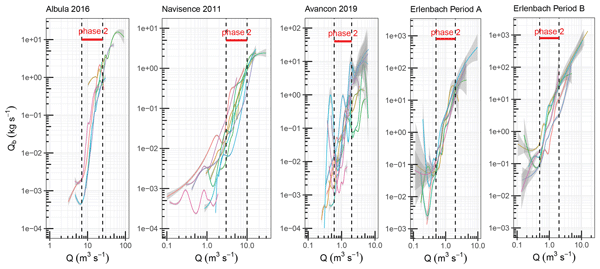
5) Definition of Phase-2 transport conditions: Phase-2 conditions are identified through a visual inspection of smoothed trends and discharge ranges. A concise, precise operational definition (even if site-specific) would enhance clarity and reproducibility. At this juncture, a thorough elucidation of the rationale behind the selection of a static interval of two weeks would be advantageous for the reader's comprehension.
6) Sediment supply and implicit assumptions (Figure 3): The application of transport equations presupposes transport-limited conditions, that is to say, there is no explicit supply limitation. In light of the observed scatter and site-specific trends depicted in Figure 3, it would be beneficial to elucidate the potential influence of variations in sediment availability between sites and years on the comparison between measured and predicted transport rates. This clarification would assist in determining the extent to which deviations might be indicative of supply-limited behavior rather than being solely governed by hydraulic controls.
7) Relation to recent literature: The discussion could be further strengthened by briefly positioning the results within recent publications addressing sediment supply effects based on long-term surrogate monitoring (including plate geophone data), as well as recent transport-equation or comparison studies. This would provide a more accurate placement of the findings within the rapidly expanding body of surrogate-monitoring literature.
8) Figures 2, 3, and 7: layout and interpretability:
a) In Figures 2 and 7, legends partly overlap the plotted curves and, in places, extend beyond the plotting area, reducing readability. Adjusting legend placement (e.g. outside the axes) would improve clarity.
b)Figure 3 shows a Qb–Q relationship that is typical of Alpine environments and comparable to published datasets from Italy and Austria. A brief comparison to such studies could help contextualize the observed scatter.
c) Furthermore, it is not possible to discern individual years in Figure 3. The utilization of distinct colors or symbols to denote different years would significantly enhance interpretability and facilitate a more transparent discussion of interannual variability.
9) Global figure comment
Several figures would benefit from minor layout adjustments (e.g. legend placement, margins, and font sizes), as some legends overlap with plotted data; a consistent re-layout would improve readability without affecting the scientific content.
Citation: https://doi.org/10.5194/egusphere-2025-5178-RC2 -
AC2: 'Reply on RC2', Dieter Rickenmann, 22 Jan 2026
Dear Reviewer #2,
I thank reviewer #2 for his positive review and for his constructive comments that have helped to improve the quality of the manuscript. Following his suggestions, I have implemented revisions to improve the clarity and completeness of the manuscript. All changes have been highlighted in the revised version, and detailed point-by-point responses are attached.
Sincerely,
Dieter Rickenmann
Citation: https://doi.org/10.5194/egusphere-2025-5178-AC2
-
AC2: 'Reply on RC2', Dieter Rickenmann, 22 Jan 2026


Interactive discussion
Status: closed
-
RC1: 'Comment on egusphere-2025-5178', Jonathan Laronne, 16 Dec 2025
This is an overall high quality manuscript in terms of the topic, the techniques of obtaining and analyzing data. With some edits this will be a useful addition to indirect bedload monitoring. Several of the latter parts of this submission are best moved from the manuscript to the supplement.
-
AC1: 'Reply on RC1', Dieter Rickenmann, 22 Jan 2026
Dear Jonathan Laronne, Reviewer #1,
I thank Jonathan Laronne for his positive review and for his constructive comments that have helped to improve the quality of the manuscript. Following his suggestions, I have implemented revisions to improve the clarity and completeness of the manuscript. All changes have been highlighted in the revised version, and detailed point-by-point responses are attached.
Sincerely,
Dieter Rickenmann
Citation: https://doi.org/10.5194/egusphere-2025-5178-AC1
-
AC1: 'Reply on RC1', Dieter Rickenmann, 22 Jan 2026
-
RC2: 'Comment on egusphere-2025-5178', Anonymous Referee #2, 22 Dec 2025
The present manuscript offers a thorough and data-rich analysis of bedload transport variability in four Swiss mountain streams, drawing upon long-term continuous Swiss Plate Geophone (SPG) monitoring. The study's findings, which are based on an explicit examination of variability at both sub-seasonal (event to multi-week windows) and annual timescales, provide a compelling evidence base demonstrating that the steepness of transport relations (m) and the reference shear stress (τ*ref) are subject to significant temporal and geographical variation. This finding is of significant importance for the field of sediment transport theory as well as for the development of applied models and the management of rivers.
The dataset is exceptional, the methodological approach is largely sound, and the comparison across transport equation families (SEA-1/SEA-2, Recking-type formulations, and MPM variants) is informative. In sum, the submitted manuscript constitutes a substantial contribution and is well suited for EGUsphere.
This manuscript provides a robust and timely contribution to understanding the temporal and spatial variability of bedload transport and highlights fundamental limitations of stationary transport formulations. The manuscript would benefit from minor to moderate revisions, mainly aimed at improving clarity, contextualization, and figure presentation.
Major comments:
1) Sediment availability and non-stationarity
The manuscript plausibly identifies sediment supply as a dominant control on the observed variability of transport parameters and model performance. However, sediment supply is mostly inferred indirectly from bedload transport processes and disequilibrium concepts. The discussion would benefit from a clearer conceptual and, where possible, quantitative framing of sediment supply (e.g. antecedent flow conditions, cumulative transport since major events, or catchment area-related measurement data). This would strengthen the interpretation of m and τ*ref values and improve reproducibility.2) Transferability of results
The selected sites are characterized by their pristine alpine mountain streams, which are well-instrumented to facilitate scientific analysis. A more precise articulation regarding the anticipated transferability of the findings to disparate channel categories, such as less precipitous gravel-bed rivers, regulated channels, or wider channels, would enhance the general relevance of the conclusions and facilitate readers' evaluation of where analogous variability can be anticipated.3) Adjustment options?
The manuscript unequivocally substantiates the constraints imposed by time-invariance parameterizations. The discussion would be strengthened by the provision of more explicit guidance on how these findings could be translated into practical modeling strategies, such as event-based or state-dependent calibration, adaptive parameterizations, or conditional formulations linked to sediment availability.Minor comments
4) Workflow: Section 2 comprises a multitude of equations and processing steps. A concise workflow schematic that summarizes the analysis would improve accessibility, especially for readers who are less familiar with the individual formulations.
5) Definition of Phase-2 transport conditions: Phase-2 conditions are identified through a visual inspection of smoothed trends and discharge ranges. A concise, precise operational definition (even if site-specific) would enhance clarity and reproducibility. At this juncture, a thorough elucidation of the rationale behind the selection of a static interval of two weeks would be advantageous for the reader's comprehension.
6) Sediment supply and implicit assumptions (Figure 3): The application of transport equations presupposes transport-limited conditions, that is to say, there is no explicit supply limitation. In light of the observed scatter and site-specific trends depicted in Figure 3, it would be beneficial to elucidate the potential influence of variations in sediment availability between sites and years on the comparison between measured and predicted transport rates. This clarification would assist in determining the extent to which deviations might be indicative of supply-limited behavior rather than being solely governed by hydraulic controls.
7) Relation to recent literature: The discussion could be further strengthened by briefly positioning the results within recent publications addressing sediment supply effects based on long-term surrogate monitoring (including plate geophone data), as well as recent transport-equation or comparison studies. This would provide a more accurate placement of the findings within the rapidly expanding body of surrogate-monitoring literature.
8) Figures 2, 3, and 7: layout and interpretability:
a) In Figures 2 and 7, legends partly overlap the plotted curves and, in places, extend beyond the plotting area, reducing readability. Adjusting legend placement (e.g. outside the axes) would improve clarity.
b)Figure 3 shows a Qb–Q relationship that is typical of Alpine environments and comparable to published datasets from Italy and Austria. A brief comparison to such studies could help contextualize the observed scatter.
c) Furthermore, it is not possible to discern individual years in Figure 3. The utilization of distinct colors or symbols to denote different years would significantly enhance interpretability and facilitate a more transparent discussion of interannual variability.
9) Global figure comment
Several figures would benefit from minor layout adjustments (e.g. legend placement, margins, and font sizes), as some legends overlap with plotted data; a consistent re-layout would improve readability without affecting the scientific content.
Citation: https://doi.org/10.5194/egusphere-2025-5178-RC2 -
AC2: 'Reply on RC2', Dieter Rickenmann, 22 Jan 2026
Dear Reviewer #2,
I thank reviewer #2 for his positive review and for his constructive comments that have helped to improve the quality of the manuscript. Following his suggestions, I have implemented revisions to improve the clarity and completeness of the manuscript. All changes have been highlighted in the revised version, and detailed point-by-point responses are attached.
Sincerely,
Dieter Rickenmann
Citation: https://doi.org/10.5194/egusphere-2025-5178-AC2
-
AC2: 'Reply on RC2', Dieter Rickenmann, 22 Jan 2026
Peer review completion


Journal article(s) based on this preprint
Viewed
| HTML | XML | Total | Supplement | BibTeX | EndNote | |
|---|---|---|---|---|---|---|
| 251 | 85 | 28 | 364 | 54 | 18 | 17 |
- HTML: 251
- PDF: 85
- XML: 28
- Total: 364
- Supplement: 54
- BibTeX: 18
- EndNote: 17
Viewed (geographical distribution)
| Country | # | Views | % |
|---|
| Total: | 0 |
| HTML: | 0 |
| PDF: | 0 |
| XML: | 0 |
- 1
Dieter Rickenmann
The requested preprint has a corresponding peer-reviewed final revised paper. You are encouraged to refer to the final revised version.
- Preprint
(2636 KB) - Metadata XML
-
Supplement
(2385 KB) - BibTeX
- EndNote
- Final revised paper
This is an overall high quality manuscript in terms of the topic, the techniques of obtaining and analyzing data. With some edits this will be a useful addition to indirect bedload monitoring. Several of the latter parts of this submission are best moved from the manuscript to the supplement.