
the Creative Commons Attribution 4.0 License.
the Creative Commons Attribution 4.0 License.
 | 03 Nov 2025
Destabilization of buried carbon under changing moisture regimes
Abstract. Paleosols formed by the burial of topsoil during landscape evolution can sequester substantial amounts of soil organic carbon (SOC) over millennia due to protection from surface disturbances. We investigated the moisture sensitivity of buried SOC storage in the Brady paleosol, a loess-derived soil in Nebraska, USA, where historical aeolian deposition during the Pleistocene–Holocene transition buried soils up to 6 m deep. Topsoils from erosional (up to 1.8 m depth) and depositional (up to 5.8 m depth) transects were incubated under two moisture regimes – continuous wetting (60 % water-holding capacity) and repeated drying–rewetting – to assess SOM vulnerability to changing hydrologic conditions.
SOC decomposition rates modeled from CO2 fluxes were consistently higher in erosional than depositional settings, with surface re-exposure of Brady soils enhancing microbial accessibility and destabilization. A two-pool model showed that >96 % of SOC was stored in a slow-cycling pool, particularly in deeply buried soils where stabilization was linked to mineral association, fine particles, and Ca-mediated flocculation. However, this pool decomposed more rapidly in shallower Brady soils (higher turnover rate relative to buried soil), reflecting increased microbial responsiveness to surface-driven processes.
Drying–rewetting cycles caused greater SOC losses from Brady soils than continuous wetting, despite the dominance of the slow pool and depletion of labile SOC. These cycles also accelerated fast pool decay in modern soils and erosional transects, whereas burial dampened variability in Brady soils. Although continuous wetting increased overall decay in burial transects during the incubation period, wet–dry cycles destabilized the slow pool, which may result in greater long-term SOC loss. Together, these results underscore the importance of burial depth, geomorphic context, and moisture regime in shaping the long-term vulnerability of ancient SOC under climate change.
-
Notice on discussion status
The requested preprint has a corresponding peer-reviewed final revised paper. You are encouraged to refer to the final revised version.
-
Preprint
(6944 KB)
-
The requested preprint has a corresponding peer-reviewed final revised paper. You are encouraged to refer to the final revised version.
- Preprint
(6944 KB) - Metadata XML
- BibTeX
- EndNote
- Final revised paper


Journal article(s) based on this preprint
Interactive discussion
Status: closed
-
RC1: 'Comment on egusphere-2025-5164', Anonymous Referee #1, 08 Dec 2025
-
AC1: 'Reply on RC1', Teneille Nel, 14 Jan 2026
Response to Reviewer 1
Manuscript: Destabilization of buried carbon under changing moisture regimes
General Response
We thank Reviewer 1 for their thorough evaluation of our manuscript and their recognition that the research question is "timely and relevant" and the experiment "well designed and executed." We appreciate the opportunity to clarify the scope and contributions of our study.
We respectfully note that our study was designed to characterize the decomposition dynamics of buried versus modern SOC under contrasting moisture regimes across landscape positions—not to elucidate the molecular mechanisms of SOC stabilization. Our analytical framework, combining respirometry, radiocarbon dating, two-pool decay modeling, and multiple linear regression with soil physicochemical properties, is well-suited to this objective and has yielded robust results (R² = 0.94–0.98 for MLR models predicting decomposition parameters).
We acknowledge that advanced molecular techniques (FTIR, NMR, thermal analyses) would provide complementary mechanistic insights, and we have been careful in our discussion to frame interpretations appropriately. Below, we address each specific concern and outline our proposed revisions.
Point-by-Point Responses1. Mechanistic Depth and Analytical Framework
Reviewer Comment: "The analytical framework relies almost exclusively on routine soil characterization... These analyses are adequate for descriptive comparisons but do not allow inference about the biogeochemical mechanisms governing the observed differences in SOC decomposition."
Response: We appreciate this perspective but respectfully suggest that our analytical framework is appropriate for our research objectives. Our study aims to quantify how moisture regime and geomorphic position influence SOC decomposition rates and pool dynamics – questions that are effectively addressed through incubation-based respirometry combined with radiocarbon constraints on carbon turnover.
The two-pool decay modeling approach is a well-established method for partitioning SOC into fast- and slow-cycling fractions and has been widely used in soil carbon research (e.g., Paul et al., 2001; Torn et al., 2009). Our MLR models achieved R² values of 0.94–0.98, demonstrating that the measured soil properties explain the vast majority of variance in decomposition parameters. This suggests our analytical framework captures the dominant controls on decomposition dynamics.
We acknowledge that techniques such as FTIR, NMR, or selective extractions would provide additional mechanistic insight into the chemical nature of stabilized SOC. However, these analyses would constitute a complementary study rather than a prerequisite for the conclusions we draw. We will revise our Discussion to more clearly distinguish between (a) patterns we directly observed and (b) mechanistic interpretations drawn from the literature, ensuring that our conclusions are appropriately bounded.
Importantly, the molecular- and mineral-scale analyses requested by the reviewers have already been conducted on the same soils and geomorphic transects in companion papers emerging from the same dissertation and broader project. These include FTIR, selective fractionation, and high-resolution molecular characterization (e.g., Dolui et al., in press; Marin-Spiotta et al., 2014), which demonstrate the roles of polyvalent cation bridging, mineral association, and pyrogenic carbon in SOC stabilization across burial and erosional contexts. The present manuscript (Paper 3) is intentionally focused on quantifying decomposition dynamics and turnover responses using incubation and radiocarbon approaches, rather than re-analyzing molecular composition already reported elsewhere.
Proposed Revision: We will add the following text to the Discussion (Section 4.1):
"While our study characterizes decomposition dynamics through respirometry and radiocarbon-based modeling, we acknowledge that the specific molecular mechanisms underlying differential SOC stability (e.g., the chemical composition of mineral-associated organic matter, the nature of organo-mineral bonds, or microbial community composition) were not directly measured. The mechanistic interpretations offered here – including the potential roles of Ca²⁺-mediated flocculation and pyrogenic carbon – are informed by prior molecular and fractionation-based work conducted on the same soils and geomorphic transects (Marin-Spiotta et al., 2014; Dolui et al., in press), which demonstrated enhanced mineral association and cation-mediated stabilization in buried profiles. Rather than duplicating those analyses, the present study extends this framework by quantifying how these stabilization contexts translate into differences in SOC turnover and pool dynamics under contrasting moisture regimes.”
2. Sample Size and Sampling Design
Reviewer Comment: "Based on the description provided, it appears that only a relatively small number of samples were analyzed (two settings × three transects × three depths ≈ 18 sampling points). This places the study in an intermediate position..."
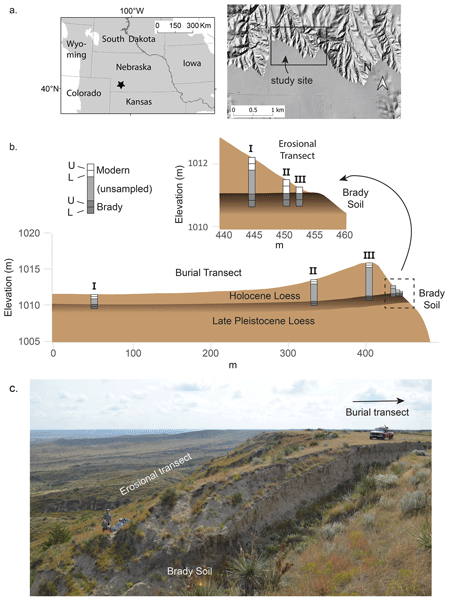
Response: We appreciate the reviewer's attention to study design. To clarify: our sampling included two geomorphic settings (erosional and depositional), each with three replicate transects, and multiple depth intervals. The incubation experiment focused on the 0–30 cm intervals of both modern soils and Brady paleosols, with two technical replicates per treatment, plus controls. This design was developed to balance logistical constraints with statistical rigor for detecting treatment effects.
We agree that the sampling design description in the Methods could be clearer and will revise Sections 2.1 and 2.3.1 to explicitly state the number of samples and their allocation across treatments.
Proposed Revision to Section 2.1:
"Sampling was conducted in 2016 and 2017 across two geomorphic settings: burial transects (where the Brady Soil is deeply buried beneath Holocene loess) and erosional transects (where the Brady Soil is exposed or shallowly buried due to hillslope erosion). Within each setting, three replicate transects were established. We collected samples at three depths relative to the soil surface from each of the transects per setting (details in Fig.1). Sampling stratigraphy relative to the present land surface was categorized using Roman numerals (Supplementary Information, Table A1). At each transect position, samples were collected from (1) the modern soil surface (0–30 cm), (2) the subsurface modern soil (30–60 cm, where present), and (3) the upper Brady paleosol horizon (0–30 cm into the Ab horizon, at variable depth below the modern surface depending on burial thickness). All samples were analyzed for physicochemical properties, but only samples from the 0-30 cm depth intervals were used for incubation experiments.”
Proposed Revision to Section 2.3.1:
“The incubation experiment was set up to determine the effect of continuous wetting and drying–rewetting on SOC fluxes using soils that were collected from the upper layer of modern and Brady Soil samples at depositional and erosional transect types. To isolate the effects of moisture, roots >2 mm were removed by sieving and manual sorting. Samples from 0-30 cm depth from different transect numbers were homogenized (so that they had only unique paleostatus, transect type and burial/ erosional degree). Two types of water addition experiments were conducted: continuous wet and drying–rewetting. Two sub-samples were taken from each composite to perform biological replicates of each incubation experiment, such that there was a total number of 24 individual incubation vessels.”
3. Introduction Framing and Contextualization
Reviewer Comment: "The Introduction... does not sufficiently contextualize why buried SOC specifically warrants investigation... Linking this geomorphic vulnerability to the central research question—How resistant is this ancient carbon once exposed to moisture and oxygen relative to modern SOC?—would provide a much stronger motivation."
Response: We agree that the Introduction would benefit from more explicitly connecting the geomorphic vulnerability of buried soils to our research questions. We will revise the Introduction to emphasize that (1) burial has historically protected these SOC stocks through physical and hydrological isolation, (2) this isolation is increasingly threatened by erosion, land-use change, and climate-driven hydrological shifts, and (3) the decomposition response of this previously protected carbon to re-exposure is poorly constrained.
Proposed Revision (new paragraph to be inserted after line 90):
"The stability of buried SOC, however, depends entirely on continued isolation from surface conditions – an assumption increasingly at odds with landscape dynamics across the Great Plains. Accelerated gully erosion, agricultural tillage, and more intense precipitation events are progressively exhuming paleosols that remained protected for millennia (Mason et al., 2008; Jacobs and Mason, 2007). Yet the decomposition response of this ancient carbon to re-exposure remains poorly constrained. Will millennia-old SOC decompose rapidly once oxygen and moisture access is restored, or do the same properties that enabled its long-term preservation – fine texture, mineral associations, chemical recalcitrance – confer lasting resistance? This uncertainty carries substantial implications for carbon-climate feedbacks: if re-exposed paleosol carbon proves vulnerable to decomposition, ongoing erosion across loess landscapes could convert a long-term carbon sink into an unaccounted source."
4. Sampling Depth Clarification
Reviewer Comment: "The manuscript states that samples were taken 'at three depths' but only specifies two fixed intervals (0–30 and 30–60 cm). If the third depth corresponds to the Brady horizon at variable depth, this should be clearly stated."
Response: The reviewer is correct that this requires clarification. Samples were collected at fixed intervals relative to the modern land surface (0–30 cm and 30–60 cm for modern soils) and separately from the Brady paleosol horizon, which occurs at variable depth depending on the thickness of overlying loess. We will revise the text to eliminate this ambiguity.
Proposed Revision:
See response to Comment 2. Sample Size and Sampling Design and associated revisions of Sections 2.1.
5. Presentation of MLR Results
Reviewer Comment: "The presentation of the MLR results is somewhat odd. The equation could be placed in the supplementary material, and the main text could focus instead on a table summarizing the coefficients, RMSE, R², etc."
Response: We appreciate this suggestion and agree that a summary table would improve readability. We will move the full equations to Supplementary Material and replace them with a summary table in the main text showing the key coefficients, their direction of effect, model fit statistics, and the most influential predictors.
Proposed Revision: We added Table 3, which summarizes MLR results:
Response Variable
Key Positive Predictors
Key Negative Predictors
R²
RMSE
k_slow
clay, Ca, EC
SAR, Mg, K, pH, TOC, TIC
0.98
7.01*10^{-7}
k_fast
SAR, clay, Ca, Mg, TIC
K, EC, pH
0.95
1.41*10^{-3}
f_slow
SAR, Mg, K, pH, TIC
clay, Ca, EC, TOC
0.97
8.38*10^{-4}
f_fast
clay, Ca, EC, TOC
SAR, Mg, K, pH, TIC
0.97
8.38*10^{-4}
k_one-pool
clay, K, pH, TOC
SAR, Ca, Mg
0.94
2.15*10^{-4}
The full equations will be provided in Supplementary Material for readers requiring complete model specifications.
6. Discussion Depth and Speculation
Reviewer Comment: "The Discussion section lacks depth... The section is mostly speculative and relies heavily on previous studies – for example, attributing greater resistance to decomposition to flocculation with Ca²⁺ or to the presence of pyrogenic carbon."
Response: We acknowledge that some mechanistic interpretations in the Discussion draw on prior work rather than direct measurements in this study. However, we note that:
- The Ca²⁺ flocculation hypothesis is supported by our measured exchangeable cation data and the significant correlations between Ca and decomposition parameters in our MLR models (Figure 6).
- The pyrogenic carbon interpretation draws on published work from this exact study site (Marin-Spiotta et al., 2014), making it directly relevant rather than speculative.
- The role of fine particles in SOC protection is supported by our texture data and is consistent with well-established soil carbon stabilization theory (Six et al., 2004).
We will revise the Discussion to integrate incubation-based decomposition dynamics with bulk soil physicochemical measurements and prior molecular-scale work conducted at the same site. Where mechanisms are inferred rather than directly measured in this study, we will more clearly distinguish between interpretations directly supported by our data versus those informed by prior site-specific research or broader literature. We will also temper language where appropriate to reflect the level of evidence.
Proposed Revisions (Section 4.1):
Original: "This enhanced stability may be attributed to several mechanisms: flocculation facilitated by polyvalent cations such as Ca²⁺..."
Revised: "Several mechanisms likely contribute to this enhanced stability, though their relative importance remains unresolved. Prior work at this site documented elevated exchangeable Ca²⁺ in Brady soils and linked Ca-mediated flocculation to aggregate stability (Dolui et al., in press). Our data are consistent with this interpretation: Ca concentration positively predicted slow-pool size in the MLR model. However, we did not directly measure aggregate dynamics or flocculation, so the mechanistic pathway connecting Ca to reduced decomposition – whether through physical protection, reduced microbial access, or altered substrate diffusivity – remains an open question. Thus, Ca²⁺ emerges here as a statistically robust predictor of SOC pool structure, even though the precise physical or biochemical pathway linking Ca availability to slowed decomposition cannot be resolved without direct aggregation or mineral-surface measurements.
The potential contribution of pyrogenic carbon to SOC persistence in Brady soils is informed by prior molecular analyses from this site, which documented condensed aromatic compounds consistent with fire-derived inputs (Marin-Spiotta et al., 2014). Although pyrogenic carbon was not quantified in the present study, its persistence provides an important historical context for interpreting the slow-cycling SOC pool observed here. Our results therefore do not demonstrate a pyrogenic control on decomposition rates per se, but are compatible with a stabilization legacy established during Brady Soil formation.”
Original: The Brady soils also contained more fine particles i.e., clay and silt (Szymanski et al. 2021), likely due to loess deposition \citep{Jacobs2007LateModel}, which enhanced SOM protection. These fine particles, through electrostatic interactions and microaggregate formation (Six et al. 2004), were strong predictors of the radiocarbon age of the slow-cycling SOM pool (Dolui et al., in press). Their influence is further underscored by the superior predictive power of the MLR models for slow-cycling SOM decay rate and pool size, compared to the more transient fast-cycling pool.
Revised: The association between finer texture and reduced SOC decomposition observed here is consistent with established theory linking clay-rich soils to enhanced mineral-associated organic matter formation (Six et al., 2004). In this study, clay content was a significant predictor of slow-pool dynamics in the MLR models, indicating that particle size exerts a first-order control on SOC accessibility. However, we did not resolve mineral surface chemistry or sorption energetics, and therefore interpret texture primarily as a proxy for potential stabilization capacity rather than a direct mechanistic driver.
Proposed additions (Section 4.2):
- “The destabilization of slow-pool SOC under drying–rewetting cycles indicates that burial-associated protection is not absolute, even for millennially persistent carbon. While the underlying mechanisms may include aggregate disruption, increased solute mobility, or shifts in microbial accessibility, our data resolve only the outcome (accelerated decomposition of previously slow-cycling carbon) rather than the specific pathway. This highlights moisture variability as a critical destabilizing force, independent of the precise chemical form of SOC.”
- "Rather than operating independently of soil chemistry, geomorphic position integrates multiple stabilization mechanisms by regulating burial depth, moisture exposure, oxygen availability, and the persistence of mineral–organic associations. In this sense, geomorphic context functions as a higher-order control that modulates how chemical and physical stabilization mechanisms are expressed through time. These findings challenge a common assumption in soil carbon modeling: that geomorphic context can be safely ignored when parameterizing decomposition rates. Our results indicate otherwise. Erosional exposure significantly accelerated slow-pool decay relative to burial transects under continuous wetting, while wet-dry cycling destabilized slow-pool carbon regardless of landscape position. For Earth system models that treat subsoil carbon as a passive reservoir, these dynamics represent an unaccounted vulnerability. The implication is clear: predicting SOC response to changing precipitation regimes requires explicit consideration of burial depth and exposure history – parameters rarely included in current model frameworks."
Proposed additions (Conclusion):
- “When interpreted alongside prior molecular- and fractionation-based analyses from this site (Marin-Spiotta et al., 2014; Dolui et al., in press), our results suggest that long-term SOC persistence in Brady soils arises from the convergence of mineral association, cation-mediated stabilization, and limited environmental exposure. The present study extends this framework by demonstrating that these stabilization contexts remain vulnerable to hydrologic perturbation and geomorphic re-exposure. Although this study does not resolve molecular-scale mechanisms directly, it demonstrates that decomposition parameters derived from incubation and radiocarbon modeling are highly sensitive to landscape history – an effect that must be accounted for even when detailed chemical data are unavailable.”
Summary of Proposed Revisions
Section
Revision Type
Description
Introduction
Addition
New paragraph establishing instability: why buried SOC protection is threatened and why this matters for carbon-climate feedbacks
Methods 2.1
Clarification
Explicit description of sampling design, sample numbers, and depth intervals
Results 3.6
Restructuring
Replace in-text equations with summary table; move equations to Supplement
Discussion 4.1
Revision
Distinguish observed patterns from mechanistic interpretations; acknowledge open questions
Discussion 4.2
Addition
New concluding paragraph showing implications for Earth system modeling
Conclusion
We believe our study addresses a problem that matters to the soil carbon community: the fate of ancient buried carbon under changing moisture regimes remains poorly constrained, yet this uncertainty has direct consequences for predicting carbon-climate feedbacks. Our results demonstrate that moisture regime and landscape position exert strong, quantifiable controls on decomposition dynamics – controls that current Earth system models largely ignore.
While molecular-level mechanistic analyses would provide complementary insights, the patterns we document are robust: wet-dry cycling destabilizes slow-pool carbon, erosional exposure accelerates decomposition, and these effects interact in ways that deserve attention from modelers and field scientists alike. We are committed to revising the manuscript to address the legitimate concerns raised, particularly regarding clarity of methods description, framing of the Introduction, and appropriate hedging of mechanistic interpretations.
Citation: https://doi.org/10.5194/egusphere-2025-5164-AC1
-
AC1: 'Reply on RC1', Teneille Nel, 14 Jan 2026
-
RC2: 'Comment on egusphere-2025-5164', Anonymous Referee #2, 20 Dec 2025
Overall, I find the paper to be generally well written however some of the discussion and conceptual findings lack depth in the writing (one or two references are cited rather than a connection at the mechanism at play and how the current soil condition or manipulation may drive or affect that mechanism) and due to the absence of data that can further confirm the presence of certain mechanisms in soil C retention for the erosional, deposition, and Brady soils at various depths (soil mineralogy and extractable metals, carbon compound chemical composition and oxidation levels).
Also, the paper keeps referencing to an issue with replication however this doesn’t match the sample/experimental design table’s description. Something seems to be missing or the description within the methods must be improved to better reflect this sampling scheme and what samples were composited and which samples were treated as technical reps.Line 47: You introduce the acronym SOM without distinguishing it from SOC or defining it earlier in the text
Basically saying that as old C gets exposed to outdoor/exposure conditions its C begins to get destabilized
Lines 130- 145: We aren’t given any information on the equipment you’ve used to run these analyses.
Line 197 – 205: There’s some repetitiveness here with discussion on how you treated your samples and replicates for stats.
Line 280: This could essentially be due to material at the shallowest depth receiving more perturbations via percolation or oxygen transport to depths.
Line 280: There seems to be some impacts on the ability for the study to state significance due to controls that are not rigorous
Lines 423-430: A lot of your discussion sentences contain multiple complex comparisons making it hard for the reader to parse out the distinguishing features or patterns that you are trying to make in this paper. Weakening the delivery of your arguments and comparisons.
Figure 2 is missing an explanation of the asterisk symbol curves
The notation, “(cite Dolui et al. i.e., paper 1)” seems rather odd and so does the embedment of the equations.
Why is the constantly wet treatment done for longer than the wet-dry treatment? This seems likely to have affected the results in the experiment but is never explained or discussed in the methods. You also don't describe how you were able to maintain or detect changes in moisture which would help in this study's replication.
The absence of replication in this study unfortunately does weaken many of the arguments and the conceptual strength of the paper. But despite this, the ideas this paper explores are intellectually stimulating however, arguments for geomorphology over soil chemistry controls in this study would have been much stronger had this paper incorporated more modern geochemical measurements. More of the modern day measurements (i.e. soil carbon chemical composition and soil minerology) would provide a stronger basis for arguing that geomorphology overrides soil chemistry with regards to C pool resilience to moisture disturbance. This would particularly strengthen the papers claims.
Citation: https://doi.org/10.5194/egusphere-2025-5164-RC2 -
AC2: 'Reply on RC2', Teneille Nel, 14 Jan 2026
Response to Reviewer 2
Manuscript: Destabilization of buried carbon under changing moisture regimes
General Response
We thank Reviewer 2 for their constructive feedback and their recognition that the paper is "generally well written" and explores "intellectually stimulating" ideas. We appreciate the specific, actionable suggestions for improving clarity and methodological transparency.
We agree that several aspects of the Methods require clarification, particularly regarding replication, equipment, and the rationale for treatment durations. We also acknowledge that some Discussion passages are difficult to parse due to complex sentence structures. Below, we address each concern and outline our proposed revisions.
Point-by-Point Responses1. Replication and Experimental Design Clarity
Reviewer Comment: "The paper keeps referencing to an issue with replication however this doesn't match the sample/experimental design table's description. Something seems to be missing or the description within the methods must be improved to better reflect this sampling scheme and what samples were composited and which samples were treated as technical reps."
Response: We apologize for this confusion. The manuscript uses "replicates" to describe multiple levels of the experimental design, which has created ambiguity. We will revise the Methods to clearly distinguish field replicates from technical replicates and explicitly describe the compositing scheme.
Proposed Revisions (Section 2.1 and 2.3.1):
See Response to Reviewer 1
Proposed Revision (Section 2.4):
“Soil-respired CO2 measurements from the incubation experiment were averaged over two biological replicates for each treatment, while the control was only representative of a single value (no duplication).”
2. SOM/SOC Terminology (Line 47)
Reviewer Comment: "You introduce the acronym SOM without distinguishing it from SOC or defining it earlier in the text."
Response: We will define both terms at first use and clarify their relationship.
Proposed Revision (to be inserted at first use, ~Line 74):
"Soil organic matter (SOM) encompasses the full suite of organic compounds in soil, including living biomass, particulate debris, and mineral-associated organic molecules. SOC refers specifically to the carbon fraction of SOM and is the metric used throughout this study to quantify carbon stocks and fluxes."
3. Equipment and Analytical Methods (Lines 130–145)
Reviewer Comment: "We aren't given any information on the equipment you've used to run these analyses."
Response: We agree this information is essential for reproducibility and will add equipment specifications.
Proposed Revision (Section 2.2):
"Soil pH and electrical conductivity (EC) were measured in 1:2 soil:water extracts using a SevenExcellence multiparameter benchtop meter (Mettler Toledo, United States). Total carbon was determined by dry combustion using an ECS 4010 elemental combustion analyzer (Costech Analytical Technologies, Inc., USA); inorganic carbon was removed by acidification with 1M HCl prior to TOC determination. Exchangeable base cations were quantified by ICP-OES (Optima 5300 DV Spectrometer, Perkin-Elmer, Germany) following ammonium acetate extraction (buffered to pH 7). Sodium adsorption ratio (SAR) was determined by dividing concentration of Na in soil extract by the square root of half of sum of Ca and Mg concentrations (Dolui et al., in press). Particle size distribution was determined using the pipette method for clay (<2 μm) and laser diffraction (Mastersizer 2000 particle size analyzer, Malvern Panalytical, UK) for silt and sand fractions. Radiocarbon (14C) analyses of bulk soil samples were conducted to determine the age and turnover time of carbon in both modern and buried soils. Samples were pre-treated, combusted, and then measured by accelerator mass spectrometry using an FN accelerator mass spectrometer (Van de Graaff, US) at the center for accelerator mass spectrometry at Lawrence Livermore National Laboratory."
4. Repetitiveness in Statistical Methods (Lines 197–205)
Reviewer Comment: "There's some repetitiveness here with discussion on how you treated your samples and replicates for stats."
Response: We will consolidate this section to eliminate redundancy.
Proposed Revision: We will merge the repeated explanations into a single, concise paragraph describing the statistical treatment of replicates, removing duplicate statements about averaging and model structure.
5. Treatment Duration Differences
Reviewer Comment: "Why is the constantly wet treatment done for longer than the wet-dry treatment? This seems likely to have affected the results in the experiment but is never explained or discussed in the methods."
Response: This is an important point that warrants explanation. The treatment durations differed by design: the continuous wet treatment (225 days) was intended to capture long-term decomposition dynamics and allow fitting of two-pool decay models, while the wet-dry treatment (56 days, 8 cycles) was designed to assess the cumulative effect of repeated moisture pulses over a timeframe relevant to seasonal precipitation variability.
We will add this rationale to the Methods and explicitly address how we handled the duration difference in our comparisons.
Proposed Revision (Section 2.3.1):
"Soil WHC was pre-determined by tensiometry (using pressure plates) and soil moisture content was monitored on a mass-basis by weighing soils periodically during the incubation.... Treatment durations differed by experimental objective. The continuous wet incubation (225 days) was designed to capture the full trajectory of decomposition, enabling robust fitting of two-pool decay models that partition SOC into fast- and slow-cycling fractions. The wet-dry treatment (56 days, 8 cycles of 7-day drying followed by rewetting) was designed to assess cumulative effects of repeated moisture pulses over a timeframe comparable to a growing season. For direct comparison between treatments, we modeled CO₂ loss over equivalent 49-day windows and compared decay parameters derived from each treatment's full duration."
6. Controls and Significance (Line 280)
Reviewer Comment: "There seems to be some impacts on the ability for the study to state significance due to controls that are not rigorous."
Response: We acknowledge that control samples (maintained at 5% WHC) were not replicated at the same level as treatments, which limits statistical comparison. However, the controls serve primarily as a baseline to confirm that observed CO₂ fluxes in treatments result from moisture addition rather than handling artifacts. The 50-fold difference in cumulative CO₂ between treatments and controls (23.3 vs. 0.48 mg CO₂-C g C⁻¹) provides strong evidence that moisture drives the observed decomposition.
We will add a statement acknowledging this limitation.
Proposed Addition (Section 2.4):
"Despite limited replication, the large magnitude of difference between control and treatment fluxes (>45-fold) indicates that moisture addition, rather than incubation artifacts, drove observed respiration patterns."
7. Complex Sentence Structure in Discussion (Lines 423–430)
Reviewer Comment: "A lot of your discussion sentences contain multiple complex comparisons making it hard for the reader to parse out the distinguishing features or patterns that you are trying to make in this paper."
Response: We agree and will revise these passages for clarity. Complex comparisons will be broken into shorter sentences with clearer subject-verb structure.
Proposed Revision (example from Section 4.2, Lines 423–430):
Original: "The greater cumulative C loss from shallower soils, together with the smaller size of the fast-cycling SOM pool and the significantly lower decay rate of slow-cycling SOM in depositional Brady soils compared to their erosional counterparts (Fig. 4a), underscores the destabilizing effect of surface exposure."
Revised: "Shallower soils lost more carbon than deeper soils. The fast-cycling pool was smaller in depositional Brady soils than in erosional settings, and the slow pool decayed more slowly (Fig. 4a). Together, these patterns point to a consistent conclusion: surface exposure destabilizes buried SOC."
8. Figure 2 Asterisk Explanation
Reviewer Comment: "Figure 2 is missing an explanation of the asterisk symbol curves."
Response: We will add the missing legend entry.
Proposed Revision (Figure 2 caption):
"Asterisks (*) indicate control samples maintained at 5% WHC."
9. Citation Format and Equation Presentation
Reviewer Comment: "The notation, '(cite Dolui et al. i.e., paper 1)' seems rather odd and so does the embedment of the equations."
Response: We apologize for this oversight – the placeholder citation was inadvertently left in the manuscript. This will be replaced with the proper citation format. Regarding equations, as noted in our response to Reviewer 1, we will move the full MLR equations to Supplementary Material and present a summary table in the main text.
10. Depth Effects and Alternative Explanations (Line 280)
Reviewer Comment: "This could essentially be due to material at the shallowest depth receiving more perturbations via percolation or oxygen transport to depths."
Response: This is a valid alternative interpretation that we should acknowledge. We will add this consideration to the Discussion.
Proposed Addition (Section 4.2):
"The greater decomposition observed in shallower Brady soils may reflect not only historical exposure to surface conditions but also differences in contemporary oxygen and water flux. Shallower positions experience more frequent percolation events and greater oxygen diffusion, which could prime microbial communities for rapid response to rewetting. Distinguishing legacy effects of exposure from ongoing environmental differences would require controlled manipulation of burial depth—an important direction for future work."
11. Mechanistic Depth and Geochemical Measurements
Reviewer Comment: "Arguments for geomorphology over soil chemistry controls in this study would have been much stronger had this paper incorporated more modern geochemical measurements (i.e. soil carbon chemical composition and soil mineralogy)."
Response: We agree that additional geochemical characterization would strengthen mechanistic interpretations. Our study was designed to quantify decomposition responses to moisture and landscape position rather than to resolve molecular mechanisms. The strong predictive power of our MLR models (R² = 0.94–0.98) using bulk soil properties suggests that these properties capture the dominant controls and we agree that molecular-level data would clarify the pathways involved. We will temper our claims accordingly and revise the Discussion to explicitly clarify that geomorphic position integrates underlying chemical and physical stabilization mechanisms documented in prior molecular-scale studies at this site.
Proposed Addition (Section 5, Conclusion):
"Our findings establish that geomorphic context – burial depth and erosional exposure – exerts strong control over SOC decomposition dynamics under variable moisture regimes. When interpreted alongside prior molecular-scale analyses from this site (e.g., FTIR, NMR) (Marin-Spiotta et al., 2014; Dolui et al., in press), our results suggest that geomorphic context integrates multiple chemical and physical stabilization mechanisms, which manifest here as strong controls on SOC decomposition dynamics. Future studies combining microbiological analyses and soil structural characterization with the incubation approach used here would clarify whether geomorphic effects operate primarily through physical protection, chemical recalcitrance, or microbial community differences."
Summary of Proposed Revisions
Location
Revision Type
Description
Section 2.3.1
Clarification
Distinguish field replicates from technical replicates; explain compositing
Line ~29
Definition
Define SOM and SOC at first use
Section 2.2
Addition
Add equipment specifications for all analytical methods
Lines 197–205
Consolidation
Remove repetitive text about statistical treatment
Section 2.3.1
Addition
Explain rationale for different treatment durations; describe moisture monitoring
Section 2.4
Addition
Acknowledge control replication limitation
Section 4.2
Revision
Simplify complex sentences; break comparisons into clearer statements
Figure 2
Correction
Add asterisk explanation to caption
Throughout
Correction
Replace placeholder citation with proper format
Section 4.2
Addition
Acknowledge alternative explanation for depth effects
Section 5
Addition
Note molecular characterization as future direction
Conclusion
We are grateful for Reviewer 2's detailed and practical feedback. The suggested revisions will substantially improve the clarity and reproducibility of our manuscript. We are committed to implementing all proposed changes and believe the revised manuscript will more effectively communicate our findings to readers.
Citation: https://doi.org/10.5194/egusphere-2025-5164-AC2
-
AC2: 'Reply on RC2', Teneille Nel, 14 Jan 2026
Peer review completion


Interactive discussion
Status: closed
-
RC1: 'Comment on egusphere-2025-5164', Anonymous Referee #1, 08 Dec 2025
While the research question is timely, relevant, and the experiment itself is well designed and executed, the study ultimately does not provide the mechanistic depth required for publication in SOIL. The analytical framework relies almost exclusively on routine soil characterization (pH, EC, exchangeable bases, particle size distribution, TOC/TIC) and radiocarbon, combined with respirometry assays. These analyses are adequate for descriptive comparisons but do not allow inference about the biogeochemical mechanisms governing the observed differences in SOC decomposition.
In addition, the study does not include a sufficiently large or diverse sampling design that might justify a more limited analytical framework. Based on the description provided, it appears that only a relatively small number of samples were analyzed (two settings × three transects × three depths ≈ 18 sampling points). This places the study in an intermediate position: the authors could either have expanded the sampling to include additional geomorphic settings—providing a broader understanding of buried soils across landscape contexts—or, alternatively, delved more deeply into the analytical characterization to generate mechanistic insight from the existing sample set.
Given the stated goal of evaluating the resistance of buried SOC to disturbance and re-exposure, one would expect the study to investigate processes such as mineral interactions, aggregation, chemical composition of SOC, microbial community shifts, or stabilization pathways. However, no analytical techniques that allow to assess these mechanisms (e.g., FTIR, NMR, selective extractions, thermal analyses, or microbial functional assays) were employed. As a result, the manuscript interprets differences in CO₂ production without any supporting evidence for the underlying processes, making the broader conclusions speculative.
Introduction
The Introduction is well written and provides an extensive overview of SOC stabilization and destabilization mechanisms, but it remains overly general and does not sufficiently contextualize why buried SOC specifically warrants investigation. The manuscript would be substantially strengthened by framing the problem around the real-world vulnerability of buried paleosols.
At present, the Introduction does not clearly articulate that buried SOC persists mainly because it is physically and hydrologically isolated from the surface environment, and that this isolation is increasingly threatened. There is ample evidence that buried soils in many landscapes (including loess systems similar to the Brady) are undergoing accelerated erosion, gully incision, agricultural disturbance, and enhanced exposure linked to climate-driven increases in extreme rainfall and land-use pressures. These processes directly control the likelihood that paleosols become re-exposed to surface conditions.
Linking this geomorphic vulnerability to the central research question—How resistant is this ancient carbon once exposed to moisture and oxygen relative to modern SOC?—would provide a much stronger motivation for the study and highlight its relevance for carbon–climate feedbacks. Bringing in quantitative context (e.g., rates of erosion, the spatial extent of paleosol exposure, or documented cases of rapid exhumation) would further emphasize why studying the oxidation potential of buried SOC is urgent.
The Introduction would benefit from being more oriented toward the mechanisms that are actually investigated in the experiment. I encourage the authors to revise the Introduction so that it explicitly connects (1) the increasing exposure risk of buried soils, (2) the large stock of “stabilized” carbon they hold, and (3) the uncertainty surrounding their decomposition dynamics once reintroduced to surface-like hydrological regimes. This would substantially sharpen the narrative and more effectively justify the experimental focus.
Material and Methods
2.1 Site and sampling
The study site is well described; however, the sampling design could be presented more explicitly. While I assume that three samples were collected at each point (two from the overlying soil and one from the buried Brady horizon), the manuscript states that samples were taken “at three depths” but only specifies two fixed intervals (0–30 and 30–60 cm). If the third depth corresponds to the Brady horizon at variable depth, this should be clearly stated to avoid ambiguity.
Results
The Results section is clearly described and the figures are of good quality. However, the presentation of the MLR results is somewhat odd. The equation could be placed in the supplementary material, and the main text could focus instead on a table summarizing the coefficients, RMSE, R², etc.
Discussion
The Discussion section lacks depth, largely due to the limited analytical framework mentioned above. The section is mostly speculative and relies heavily on previous studies—for example, attributing greater resistance to decomposition to flocculation with Ca²⁺ or to the presence of pyrogenic carbon. Similarly, attributing SOC protection merely to greater silt and clay content is also obvious and does not provide new insights.
Citation: https://doi.org/10.5194/egusphere-2025-5164-RC1 -
AC1: 'Reply on RC1', Teneille Nel, 14 Jan 2026
Response to Reviewer 1
Manuscript: Destabilization of buried carbon under changing moisture regimes
General Response
We thank Reviewer 1 for their thorough evaluation of our manuscript and their recognition that the research question is "timely and relevant" and the experiment "well designed and executed." We appreciate the opportunity to clarify the scope and contributions of our study.
We respectfully note that our study was designed to characterize the decomposition dynamics of buried versus modern SOC under contrasting moisture regimes across landscape positions—not to elucidate the molecular mechanisms of SOC stabilization. Our analytical framework, combining respirometry, radiocarbon dating, two-pool decay modeling, and multiple linear regression with soil physicochemical properties, is well-suited to this objective and has yielded robust results (R² = 0.94–0.98 for MLR models predicting decomposition parameters).
We acknowledge that advanced molecular techniques (FTIR, NMR, thermal analyses) would provide complementary mechanistic insights, and we have been careful in our discussion to frame interpretations appropriately. Below, we address each specific concern and outline our proposed revisions.
Point-by-Point Responses1. Mechanistic Depth and Analytical Framework
Reviewer Comment: "The analytical framework relies almost exclusively on routine soil characterization... These analyses are adequate for descriptive comparisons but do not allow inference about the biogeochemical mechanisms governing the observed differences in SOC decomposition."
Response: We appreciate this perspective but respectfully suggest that our analytical framework is appropriate for our research objectives. Our study aims to quantify how moisture regime and geomorphic position influence SOC decomposition rates and pool dynamics – questions that are effectively addressed through incubation-based respirometry combined with radiocarbon constraints on carbon turnover.
The two-pool decay modeling approach is a well-established method for partitioning SOC into fast- and slow-cycling fractions and has been widely used in soil carbon research (e.g., Paul et al., 2001; Torn et al., 2009). Our MLR models achieved R² values of 0.94–0.98, demonstrating that the measured soil properties explain the vast majority of variance in decomposition parameters. This suggests our analytical framework captures the dominant controls on decomposition dynamics.
We acknowledge that techniques such as FTIR, NMR, or selective extractions would provide additional mechanistic insight into the chemical nature of stabilized SOC. However, these analyses would constitute a complementary study rather than a prerequisite for the conclusions we draw. We will revise our Discussion to more clearly distinguish between (a) patterns we directly observed and (b) mechanistic interpretations drawn from the literature, ensuring that our conclusions are appropriately bounded.
Importantly, the molecular- and mineral-scale analyses requested by the reviewers have already been conducted on the same soils and geomorphic transects in companion papers emerging from the same dissertation and broader project. These include FTIR, selective fractionation, and high-resolution molecular characterization (e.g., Dolui et al., in press; Marin-Spiotta et al., 2014), which demonstrate the roles of polyvalent cation bridging, mineral association, and pyrogenic carbon in SOC stabilization across burial and erosional contexts. The present manuscript (Paper 3) is intentionally focused on quantifying decomposition dynamics and turnover responses using incubation and radiocarbon approaches, rather than re-analyzing molecular composition already reported elsewhere.
Proposed Revision: We will add the following text to the Discussion (Section 4.1):
"While our study characterizes decomposition dynamics through respirometry and radiocarbon-based modeling, we acknowledge that the specific molecular mechanisms underlying differential SOC stability (e.g., the chemical composition of mineral-associated organic matter, the nature of organo-mineral bonds, or microbial community composition) were not directly measured. The mechanistic interpretations offered here – including the potential roles of Ca²⁺-mediated flocculation and pyrogenic carbon – are informed by prior molecular and fractionation-based work conducted on the same soils and geomorphic transects (Marin-Spiotta et al., 2014; Dolui et al., in press), which demonstrated enhanced mineral association and cation-mediated stabilization in buried profiles. Rather than duplicating those analyses, the present study extends this framework by quantifying how these stabilization contexts translate into differences in SOC turnover and pool dynamics under contrasting moisture regimes.”
2. Sample Size and Sampling Design
Reviewer Comment: "Based on the description provided, it appears that only a relatively small number of samples were analyzed (two settings × three transects × three depths ≈ 18 sampling points). This places the study in an intermediate position..."
Response: We appreciate the reviewer's attention to study design. To clarify: our sampling included two geomorphic settings (erosional and depositional), each with three replicate transects, and multiple depth intervals. The incubation experiment focused on the 0–30 cm intervals of both modern soils and Brady paleosols, with two technical replicates per treatment, plus controls. This design was developed to balance logistical constraints with statistical rigor for detecting treatment effects.
We agree that the sampling design description in the Methods could be clearer and will revise Sections 2.1 and 2.3.1 to explicitly state the number of samples and their allocation across treatments.
Proposed Revision to Section 2.1:
"Sampling was conducted in 2016 and 2017 across two geomorphic settings: burial transects (where the Brady Soil is deeply buried beneath Holocene loess) and erosional transects (where the Brady Soil is exposed or shallowly buried due to hillslope erosion). Within each setting, three replicate transects were established. We collected samples at three depths relative to the soil surface from each of the transects per setting (details in Fig.1). Sampling stratigraphy relative to the present land surface was categorized using Roman numerals (Supplementary Information, Table A1). At each transect position, samples were collected from (1) the modern soil surface (0–30 cm), (2) the subsurface modern soil (30–60 cm, where present), and (3) the upper Brady paleosol horizon (0–30 cm into the Ab horizon, at variable depth below the modern surface depending on burial thickness). All samples were analyzed for physicochemical properties, but only samples from the 0-30 cm depth intervals were used for incubation experiments.”
Proposed Revision to Section 2.3.1:
“The incubation experiment was set up to determine the effect of continuous wetting and drying–rewetting on SOC fluxes using soils that were collected from the upper layer of modern and Brady Soil samples at depositional and erosional transect types. To isolate the effects of moisture, roots >2 mm were removed by sieving and manual sorting. Samples from 0-30 cm depth from different transect numbers were homogenized (so that they had only unique paleostatus, transect type and burial/ erosional degree). Two types of water addition experiments were conducted: continuous wet and drying–rewetting. Two sub-samples were taken from each composite to perform biological replicates of each incubation experiment, such that there was a total number of 24 individual incubation vessels.”
3. Introduction Framing and Contextualization
Reviewer Comment: "The Introduction... does not sufficiently contextualize why buried SOC specifically warrants investigation... Linking this geomorphic vulnerability to the central research question—How resistant is this ancient carbon once exposed to moisture and oxygen relative to modern SOC?—would provide a much stronger motivation."
Response: We agree that the Introduction would benefit from more explicitly connecting the geomorphic vulnerability of buried soils to our research questions. We will revise the Introduction to emphasize that (1) burial has historically protected these SOC stocks through physical and hydrological isolation, (2) this isolation is increasingly threatened by erosion, land-use change, and climate-driven hydrological shifts, and (3) the decomposition response of this previously protected carbon to re-exposure is poorly constrained.
Proposed Revision (new paragraph to be inserted after line 90):
"The stability of buried SOC, however, depends entirely on continued isolation from surface conditions – an assumption increasingly at odds with landscape dynamics across the Great Plains. Accelerated gully erosion, agricultural tillage, and more intense precipitation events are progressively exhuming paleosols that remained protected for millennia (Mason et al., 2008; Jacobs and Mason, 2007). Yet the decomposition response of this ancient carbon to re-exposure remains poorly constrained. Will millennia-old SOC decompose rapidly once oxygen and moisture access is restored, or do the same properties that enabled its long-term preservation – fine texture, mineral associations, chemical recalcitrance – confer lasting resistance? This uncertainty carries substantial implications for carbon-climate feedbacks: if re-exposed paleosol carbon proves vulnerable to decomposition, ongoing erosion across loess landscapes could convert a long-term carbon sink into an unaccounted source."
4. Sampling Depth Clarification
Reviewer Comment: "The manuscript states that samples were taken 'at three depths' but only specifies two fixed intervals (0–30 and 30–60 cm). If the third depth corresponds to the Brady horizon at variable depth, this should be clearly stated."
Response: The reviewer is correct that this requires clarification. Samples were collected at fixed intervals relative to the modern land surface (0–30 cm and 30–60 cm for modern soils) and separately from the Brady paleosol horizon, which occurs at variable depth depending on the thickness of overlying loess. We will revise the text to eliminate this ambiguity.
Proposed Revision:
See response to Comment 2. Sample Size and Sampling Design and associated revisions of Sections 2.1.
5. Presentation of MLR Results
Reviewer Comment: "The presentation of the MLR results is somewhat odd. The equation could be placed in the supplementary material, and the main text could focus instead on a table summarizing the coefficients, RMSE, R², etc."
Response: We appreciate this suggestion and agree that a summary table would improve readability. We will move the full equations to Supplementary Material and replace them with a summary table in the main text showing the key coefficients, their direction of effect, model fit statistics, and the most influential predictors.
Proposed Revision: We added Table 3, which summarizes MLR results:
Response Variable
Key Positive Predictors
Key Negative Predictors
R²
RMSE
k_slow
clay, Ca, EC
SAR, Mg, K, pH, TOC, TIC
0.98
7.01*10^{-7}
k_fast
SAR, clay, Ca, Mg, TIC
K, EC, pH
0.95
1.41*10^{-3}
f_slow
SAR, Mg, K, pH, TIC
clay, Ca, EC, TOC
0.97
8.38*10^{-4}
f_fast
clay, Ca, EC, TOC
SAR, Mg, K, pH, TIC
0.97
8.38*10^{-4}
k_one-pool
clay, K, pH, TOC
SAR, Ca, Mg
0.94
2.15*10^{-4}
The full equations will be provided in Supplementary Material for readers requiring complete model specifications.
6. Discussion Depth and Speculation
Reviewer Comment: "The Discussion section lacks depth... The section is mostly speculative and relies heavily on previous studies – for example, attributing greater resistance to decomposition to flocculation with Ca²⁺ or to the presence of pyrogenic carbon."
Response: We acknowledge that some mechanistic interpretations in the Discussion draw on prior work rather than direct measurements in this study. However, we note that:
- The Ca²⁺ flocculation hypothesis is supported by our measured exchangeable cation data and the significant correlations between Ca and decomposition parameters in our MLR models (Figure 6).
- The pyrogenic carbon interpretation draws on published work from this exact study site (Marin-Spiotta et al., 2014), making it directly relevant rather than speculative.
- The role of fine particles in SOC protection is supported by our texture data and is consistent with well-established soil carbon stabilization theory (Six et al., 2004).
We will revise the Discussion to integrate incubation-based decomposition dynamics with bulk soil physicochemical measurements and prior molecular-scale work conducted at the same site. Where mechanisms are inferred rather than directly measured in this study, we will more clearly distinguish between interpretations directly supported by our data versus those informed by prior site-specific research or broader literature. We will also temper language where appropriate to reflect the level of evidence.
Proposed Revisions (Section 4.1):
Original: "This enhanced stability may be attributed to several mechanisms: flocculation facilitated by polyvalent cations such as Ca²⁺..."
Revised: "Several mechanisms likely contribute to this enhanced stability, though their relative importance remains unresolved. Prior work at this site documented elevated exchangeable Ca²⁺ in Brady soils and linked Ca-mediated flocculation to aggregate stability (Dolui et al., in press). Our data are consistent with this interpretation: Ca concentration positively predicted slow-pool size in the MLR model. However, we did not directly measure aggregate dynamics or flocculation, so the mechanistic pathway connecting Ca to reduced decomposition – whether through physical protection, reduced microbial access, or altered substrate diffusivity – remains an open question. Thus, Ca²⁺ emerges here as a statistically robust predictor of SOC pool structure, even though the precise physical or biochemical pathway linking Ca availability to slowed decomposition cannot be resolved without direct aggregation or mineral-surface measurements.
The potential contribution of pyrogenic carbon to SOC persistence in Brady soils is informed by prior molecular analyses from this site, which documented condensed aromatic compounds consistent with fire-derived inputs (Marin-Spiotta et al., 2014). Although pyrogenic carbon was not quantified in the present study, its persistence provides an important historical context for interpreting the slow-cycling SOC pool observed here. Our results therefore do not demonstrate a pyrogenic control on decomposition rates per se, but are compatible with a stabilization legacy established during Brady Soil formation.”
Original: The Brady soils also contained more fine particles i.e., clay and silt (Szymanski et al. 2021), likely due to loess deposition \citep{Jacobs2007LateModel}, which enhanced SOM protection. These fine particles, through electrostatic interactions and microaggregate formation (Six et al. 2004), were strong predictors of the radiocarbon age of the slow-cycling SOM pool (Dolui et al., in press). Their influence is further underscored by the superior predictive power of the MLR models for slow-cycling SOM decay rate and pool size, compared to the more transient fast-cycling pool.
Revised: The association between finer texture and reduced SOC decomposition observed here is consistent with established theory linking clay-rich soils to enhanced mineral-associated organic matter formation (Six et al., 2004). In this study, clay content was a significant predictor of slow-pool dynamics in the MLR models, indicating that particle size exerts a first-order control on SOC accessibility. However, we did not resolve mineral surface chemistry or sorption energetics, and therefore interpret texture primarily as a proxy for potential stabilization capacity rather than a direct mechanistic driver.
Proposed additions (Section 4.2):
- “The destabilization of slow-pool SOC under drying–rewetting cycles indicates that burial-associated protection is not absolute, even for millennially persistent carbon. While the underlying mechanisms may include aggregate disruption, increased solute mobility, or shifts in microbial accessibility, our data resolve only the outcome (accelerated decomposition of previously slow-cycling carbon) rather than the specific pathway. This highlights moisture variability as a critical destabilizing force, independent of the precise chemical form of SOC.”
- "Rather than operating independently of soil chemistry, geomorphic position integrates multiple stabilization mechanisms by regulating burial depth, moisture exposure, oxygen availability, and the persistence of mineral–organic associations. In this sense, geomorphic context functions as a higher-order control that modulates how chemical and physical stabilization mechanisms are expressed through time. These findings challenge a common assumption in soil carbon modeling: that geomorphic context can be safely ignored when parameterizing decomposition rates. Our results indicate otherwise. Erosional exposure significantly accelerated slow-pool decay relative to burial transects under continuous wetting, while wet-dry cycling destabilized slow-pool carbon regardless of landscape position. For Earth system models that treat subsoil carbon as a passive reservoir, these dynamics represent an unaccounted vulnerability. The implication is clear: predicting SOC response to changing precipitation regimes requires explicit consideration of burial depth and exposure history – parameters rarely included in current model frameworks."
Proposed additions (Conclusion):
- “When interpreted alongside prior molecular- and fractionation-based analyses from this site (Marin-Spiotta et al., 2014; Dolui et al., in press), our results suggest that long-term SOC persistence in Brady soils arises from the convergence of mineral association, cation-mediated stabilization, and limited environmental exposure. The present study extends this framework by demonstrating that these stabilization contexts remain vulnerable to hydrologic perturbation and geomorphic re-exposure. Although this study does not resolve molecular-scale mechanisms directly, it demonstrates that decomposition parameters derived from incubation and radiocarbon modeling are highly sensitive to landscape history – an effect that must be accounted for even when detailed chemical data are unavailable.”
Summary of Proposed Revisions
Section
Revision Type
Description
Introduction
Addition
New paragraph establishing instability: why buried SOC protection is threatened and why this matters for carbon-climate feedbacks
Methods 2.1
Clarification
Explicit description of sampling design, sample numbers, and depth intervals
Results 3.6
Restructuring
Replace in-text equations with summary table; move equations to Supplement
Discussion 4.1
Revision
Distinguish observed patterns from mechanistic interpretations; acknowledge open questions
Discussion 4.2
Addition
New concluding paragraph showing implications for Earth system modeling
Conclusion
We believe our study addresses a problem that matters to the soil carbon community: the fate of ancient buried carbon under changing moisture regimes remains poorly constrained, yet this uncertainty has direct consequences for predicting carbon-climate feedbacks. Our results demonstrate that moisture regime and landscape position exert strong, quantifiable controls on decomposition dynamics – controls that current Earth system models largely ignore.
While molecular-level mechanistic analyses would provide complementary insights, the patterns we document are robust: wet-dry cycling destabilizes slow-pool carbon, erosional exposure accelerates decomposition, and these effects interact in ways that deserve attention from modelers and field scientists alike. We are committed to revising the manuscript to address the legitimate concerns raised, particularly regarding clarity of methods description, framing of the Introduction, and appropriate hedging of mechanistic interpretations.
Citation: https://doi.org/10.5194/egusphere-2025-5164-AC1
-
AC1: 'Reply on RC1', Teneille Nel, 14 Jan 2026
-
RC2: 'Comment on egusphere-2025-5164', Anonymous Referee #2, 20 Dec 2025
Overall, I find the paper to be generally well written however some of the discussion and conceptual findings lack depth in the writing (one or two references are cited rather than a connection at the mechanism at play and how the current soil condition or manipulation may drive or affect that mechanism) and due to the absence of data that can further confirm the presence of certain mechanisms in soil C retention for the erosional, deposition, and Brady soils at various depths (soil mineralogy and extractable metals, carbon compound chemical composition and oxidation levels).
Also, the paper keeps referencing to an issue with replication however this doesn’t match the sample/experimental design table’s description. Something seems to be missing or the description within the methods must be improved to better reflect this sampling scheme and what samples were composited and which samples were treated as technical reps.Line 47: You introduce the acronym SOM without distinguishing it from SOC or defining it earlier in the text
Basically saying that as old C gets exposed to outdoor/exposure conditions its C begins to get destabilized
Lines 130- 145: We aren’t given any information on the equipment you’ve used to run these analyses.
Line 197 – 205: There’s some repetitiveness here with discussion on how you treated your samples and replicates for stats.
Line 280: This could essentially be due to material at the shallowest depth receiving more perturbations via percolation or oxygen transport to depths.
Line 280: There seems to be some impacts on the ability for the study to state significance due to controls that are not rigorous
Lines 423-430: A lot of your discussion sentences contain multiple complex comparisons making it hard for the reader to parse out the distinguishing features or patterns that you are trying to make in this paper. Weakening the delivery of your arguments and comparisons.
Figure 2 is missing an explanation of the asterisk symbol curves
The notation, “(cite Dolui et al. i.e., paper 1)” seems rather odd and so does the embedment of the equations.
Why is the constantly wet treatment done for longer than the wet-dry treatment? This seems likely to have affected the results in the experiment but is never explained or discussed in the methods. You also don't describe how you were able to maintain or detect changes in moisture which would help in this study's replication.
The absence of replication in this study unfortunately does weaken many of the arguments and the conceptual strength of the paper. But despite this, the ideas this paper explores are intellectually stimulating however, arguments for geomorphology over soil chemistry controls in this study would have been much stronger had this paper incorporated more modern geochemical measurements. More of the modern day measurements (i.e. soil carbon chemical composition and soil minerology) would provide a stronger basis for arguing that geomorphology overrides soil chemistry with regards to C pool resilience to moisture disturbance. This would particularly strengthen the papers claims.
Citation: https://doi.org/10.5194/egusphere-2025-5164-RC2 -
AC2: 'Reply on RC2', Teneille Nel, 14 Jan 2026
Response to Reviewer 2
Manuscript: Destabilization of buried carbon under changing moisture regimes
General Response
We thank Reviewer 2 for their constructive feedback and their recognition that the paper is "generally well written" and explores "intellectually stimulating" ideas. We appreciate the specific, actionable suggestions for improving clarity and methodological transparency.
We agree that several aspects of the Methods require clarification, particularly regarding replication, equipment, and the rationale for treatment durations. We also acknowledge that some Discussion passages are difficult to parse due to complex sentence structures. Below, we address each concern and outline our proposed revisions.
Point-by-Point Responses1. Replication and Experimental Design Clarity
Reviewer Comment: "The paper keeps referencing to an issue with replication however this doesn't match the sample/experimental design table's description. Something seems to be missing or the description within the methods must be improved to better reflect this sampling scheme and what samples were composited and which samples were treated as technical reps."
Response: We apologize for this confusion. The manuscript uses "replicates" to describe multiple levels of the experimental design, which has created ambiguity. We will revise the Methods to clearly distinguish field replicates from technical replicates and explicitly describe the compositing scheme.
Proposed Revisions (Section 2.1 and 2.3.1):
See Response to Reviewer 1
Proposed Revision (Section 2.4):
“Soil-respired CO2 measurements from the incubation experiment were averaged over two biological replicates for each treatment, while the control was only representative of a single value (no duplication).”
2. SOM/SOC Terminology (Line 47)
Reviewer Comment: "You introduce the acronym SOM without distinguishing it from SOC or defining it earlier in the text."
Response: We will define both terms at first use and clarify their relationship.
Proposed Revision (to be inserted at first use, ~Line 74):
"Soil organic matter (SOM) encompasses the full suite of organic compounds in soil, including living biomass, particulate debris, and mineral-associated organic molecules. SOC refers specifically to the carbon fraction of SOM and is the metric used throughout this study to quantify carbon stocks and fluxes."
3. Equipment and Analytical Methods (Lines 130–145)
Reviewer Comment: "We aren't given any information on the equipment you've used to run these analyses."
Response: We agree this information is essential for reproducibility and will add equipment specifications.
Proposed Revision (Section 2.2):
"Soil pH and electrical conductivity (EC) were measured in 1:2 soil:water extracts using a SevenExcellence multiparameter benchtop meter (Mettler Toledo, United States). Total carbon was determined by dry combustion using an ECS 4010 elemental combustion analyzer (Costech Analytical Technologies, Inc., USA); inorganic carbon was removed by acidification with 1M HCl prior to TOC determination. Exchangeable base cations were quantified by ICP-OES (Optima 5300 DV Spectrometer, Perkin-Elmer, Germany) following ammonium acetate extraction (buffered to pH 7). Sodium adsorption ratio (SAR) was determined by dividing concentration of Na in soil extract by the square root of half of sum of Ca and Mg concentrations (Dolui et al., in press). Particle size distribution was determined using the pipette method for clay (<2 μm) and laser diffraction (Mastersizer 2000 particle size analyzer, Malvern Panalytical, UK) for silt and sand fractions. Radiocarbon (14C) analyses of bulk soil samples were conducted to determine the age and turnover time of carbon in both modern and buried soils. Samples were pre-treated, combusted, and then measured by accelerator mass spectrometry using an FN accelerator mass spectrometer (Van de Graaff, US) at the center for accelerator mass spectrometry at Lawrence Livermore National Laboratory."
4. Repetitiveness in Statistical Methods (Lines 197–205)
Reviewer Comment: "There's some repetitiveness here with discussion on how you treated your samples and replicates for stats."
Response: We will consolidate this section to eliminate redundancy.
Proposed Revision: We will merge the repeated explanations into a single, concise paragraph describing the statistical treatment of replicates, removing duplicate statements about averaging and model structure.
5. Treatment Duration Differences
Reviewer Comment: "Why is the constantly wet treatment done for longer than the wet-dry treatment? This seems likely to have affected the results in the experiment but is never explained or discussed in the methods."
Response: This is an important point that warrants explanation. The treatment durations differed by design: the continuous wet treatment (225 days) was intended to capture long-term decomposition dynamics and allow fitting of two-pool decay models, while the wet-dry treatment (56 days, 8 cycles) was designed to assess the cumulative effect of repeated moisture pulses over a timeframe relevant to seasonal precipitation variability.
We will add this rationale to the Methods and explicitly address how we handled the duration difference in our comparisons.
Proposed Revision (Section 2.3.1):
"Soil WHC was pre-determined by tensiometry (using pressure plates) and soil moisture content was monitored on a mass-basis by weighing soils periodically during the incubation.... Treatment durations differed by experimental objective. The continuous wet incubation (225 days) was designed to capture the full trajectory of decomposition, enabling robust fitting of two-pool decay models that partition SOC into fast- and slow-cycling fractions. The wet-dry treatment (56 days, 8 cycles of 7-day drying followed by rewetting) was designed to assess cumulative effects of repeated moisture pulses over a timeframe comparable to a growing season. For direct comparison between treatments, we modeled CO₂ loss over equivalent 49-day windows and compared decay parameters derived from each treatment's full duration."
6. Controls and Significance (Line 280)
Reviewer Comment: "There seems to be some impacts on the ability for the study to state significance due to controls that are not rigorous."
Response: We acknowledge that control samples (maintained at 5% WHC) were not replicated at the same level as treatments, which limits statistical comparison. However, the controls serve primarily as a baseline to confirm that observed CO₂ fluxes in treatments result from moisture addition rather than handling artifacts. The 50-fold difference in cumulative CO₂ between treatments and controls (23.3 vs. 0.48 mg CO₂-C g C⁻¹) provides strong evidence that moisture drives the observed decomposition.
We will add a statement acknowledging this limitation.
Proposed Addition (Section 2.4):
"Despite limited replication, the large magnitude of difference between control and treatment fluxes (>45-fold) indicates that moisture addition, rather than incubation artifacts, drove observed respiration patterns."
7. Complex Sentence Structure in Discussion (Lines 423–430)
Reviewer Comment: "A lot of your discussion sentences contain multiple complex comparisons making it hard for the reader to parse out the distinguishing features or patterns that you are trying to make in this paper."
Response: We agree and will revise these passages for clarity. Complex comparisons will be broken into shorter sentences with clearer subject-verb structure.
Proposed Revision (example from Section 4.2, Lines 423–430):
Original: "The greater cumulative C loss from shallower soils, together with the smaller size of the fast-cycling SOM pool and the significantly lower decay rate of slow-cycling SOM in depositional Brady soils compared to their erosional counterparts (Fig. 4a), underscores the destabilizing effect of surface exposure."
Revised: "Shallower soils lost more carbon than deeper soils. The fast-cycling pool was smaller in depositional Brady soils than in erosional settings, and the slow pool decayed more slowly (Fig. 4a). Together, these patterns point to a consistent conclusion: surface exposure destabilizes buried SOC."
8. Figure 2 Asterisk Explanation
Reviewer Comment: "Figure 2 is missing an explanation of the asterisk symbol curves."
Response: We will add the missing legend entry.
Proposed Revision (Figure 2 caption):
"Asterisks (*) indicate control samples maintained at 5% WHC."
9. Citation Format and Equation Presentation
Reviewer Comment: "The notation, '(cite Dolui et al. i.e., paper 1)' seems rather odd and so does the embedment of the equations."
Response: We apologize for this oversight – the placeholder citation was inadvertently left in the manuscript. This will be replaced with the proper citation format. Regarding equations, as noted in our response to Reviewer 1, we will move the full MLR equations to Supplementary Material and present a summary table in the main text.
10. Depth Effects and Alternative Explanations (Line 280)
Reviewer Comment: "This could essentially be due to material at the shallowest depth receiving more perturbations via percolation or oxygen transport to depths."
Response: This is a valid alternative interpretation that we should acknowledge. We will add this consideration to the Discussion.
Proposed Addition (Section 4.2):
"The greater decomposition observed in shallower Brady soils may reflect not only historical exposure to surface conditions but also differences in contemporary oxygen and water flux. Shallower positions experience more frequent percolation events and greater oxygen diffusion, which could prime microbial communities for rapid response to rewetting. Distinguishing legacy effects of exposure from ongoing environmental differences would require controlled manipulation of burial depth—an important direction for future work."
11. Mechanistic Depth and Geochemical Measurements
Reviewer Comment: "Arguments for geomorphology over soil chemistry controls in this study would have been much stronger had this paper incorporated more modern geochemical measurements (i.e. soil carbon chemical composition and soil mineralogy)."
Response: We agree that additional geochemical characterization would strengthen mechanistic interpretations. Our study was designed to quantify decomposition responses to moisture and landscape position rather than to resolve molecular mechanisms. The strong predictive power of our MLR models (R² = 0.94–0.98) using bulk soil properties suggests that these properties capture the dominant controls and we agree that molecular-level data would clarify the pathways involved. We will temper our claims accordingly and revise the Discussion to explicitly clarify that geomorphic position integrates underlying chemical and physical stabilization mechanisms documented in prior molecular-scale studies at this site.
Proposed Addition (Section 5, Conclusion):
"Our findings establish that geomorphic context – burial depth and erosional exposure – exerts strong control over SOC decomposition dynamics under variable moisture regimes. When interpreted alongside prior molecular-scale analyses from this site (e.g., FTIR, NMR) (Marin-Spiotta et al., 2014; Dolui et al., in press), our results suggest that geomorphic context integrates multiple chemical and physical stabilization mechanisms, which manifest here as strong controls on SOC decomposition dynamics. Future studies combining microbiological analyses and soil structural characterization with the incubation approach used here would clarify whether geomorphic effects operate primarily through physical protection, chemical recalcitrance, or microbial community differences."
Summary of Proposed Revisions
Location
Revision Type
Description
Section 2.3.1
Clarification
Distinguish field replicates from technical replicates; explain compositing
Line ~29
Definition
Define SOM and SOC at first use
Section 2.2
Addition
Add equipment specifications for all analytical methods
Lines 197–205
Consolidation
Remove repetitive text about statistical treatment
Section 2.3.1
Addition
Explain rationale for different treatment durations; describe moisture monitoring
Section 2.4
Addition
Acknowledge control replication limitation
Section 4.2
Revision
Simplify complex sentences; break comparisons into clearer statements
Figure 2
Correction
Add asterisk explanation to caption
Throughout
Correction
Replace placeholder citation with proper format
Section 4.2
Addition
Acknowledge alternative explanation for depth effects
Section 5
Addition
Note molecular characterization as future direction
Conclusion
We are grateful for Reviewer 2's detailed and practical feedback. The suggested revisions will substantially improve the clarity and reproducibility of our manuscript. We are committed to implementing all proposed changes and believe the revised manuscript will more effectively communicate our findings to readers.
Citation: https://doi.org/10.5194/egusphere-2025-5164-AC2
-
AC2: 'Reply on RC2', Teneille Nel, 14 Jan 2026
Peer review completion
Journal article(s) based on this preprint
Viewed
| HTML | XML | Total | BibTeX | EndNote | |
|---|---|---|---|---|---|
| 1,104 | 411 | 83 | 1,598 | 86 | 78 |
- HTML: 1,104
- PDF: 411
- XML: 83
- Total: 1,598
- BibTeX: 86
- EndNote: 78
Viewed (geographical distribution)
| Country | # | Views | % |
|---|
| Total: | 0 |
| HTML: | 0 |
| PDF: | 0 |
| XML: | 0 |
- 1

Manisha Dolui
Abbygail R. McMurtry
Stephanie Chacon
Joseph A. Mason
Laura M. Phillips
Erika Marin-Spiotta
Marie-Anne de Graaff
Asmeret A. Berhe
Teamrat A. Ghezzehei
The requested preprint has a corresponding peer-reviewed final revised paper. You are encouraged to refer to the final revised version.
- Preprint
(6944 KB) - Metadata XML
While the research question is timely, relevant, and the experiment itself is well designed and executed, the study ultimately does not provide the mechanistic depth required for publication in SOIL. The analytical framework relies almost exclusively on routine soil characterization (pH, EC, exchangeable bases, particle size distribution, TOC/TIC) and radiocarbon, combined with respirometry assays. These analyses are adequate for descriptive comparisons but do not allow inference about the biogeochemical mechanisms governing the observed differences in SOC decomposition.
In addition, the study does not include a sufficiently large or diverse sampling design that might justify a more limited analytical framework. Based on the description provided, it appears that only a relatively small number of samples were analyzed (two settings × three transects × three depths ≈ 18 sampling points). This places the study in an intermediate position: the authors could either have expanded the sampling to include additional geomorphic settings—providing a broader understanding of buried soils across landscape contexts—or, alternatively, delved more deeply into the analytical characterization to generate mechanistic insight from the existing sample set.
Given the stated goal of evaluating the resistance of buried SOC to disturbance and re-exposure, one would expect the study to investigate processes such as mineral interactions, aggregation, chemical composition of SOC, microbial community shifts, or stabilization pathways. However, no analytical techniques that allow to assess these mechanisms (e.g., FTIR, NMR, selective extractions, thermal analyses, or microbial functional assays) were employed. As a result, the manuscript interprets differences in CO₂ production without any supporting evidence for the underlying processes, making the broader conclusions speculative.
Introduction
The Introduction is well written and provides an extensive overview of SOC stabilization and destabilization mechanisms, but it remains overly general and does not sufficiently contextualize why buried SOC specifically warrants investigation. The manuscript would be substantially strengthened by framing the problem around the real-world vulnerability of buried paleosols.
At present, the Introduction does not clearly articulate that buried SOC persists mainly because it is physically and hydrologically isolated from the surface environment, and that this isolation is increasingly threatened. There is ample evidence that buried soils in many landscapes (including loess systems similar to the Brady) are undergoing accelerated erosion, gully incision, agricultural disturbance, and enhanced exposure linked to climate-driven increases in extreme rainfall and land-use pressures. These processes directly control the likelihood that paleosols become re-exposed to surface conditions.
Linking this geomorphic vulnerability to the central research question—How resistant is this ancient carbon once exposed to moisture and oxygen relative to modern SOC?—would provide a much stronger motivation for the study and highlight its relevance for carbon–climate feedbacks. Bringing in quantitative context (e.g., rates of erosion, the spatial extent of paleosol exposure, or documented cases of rapid exhumation) would further emphasize why studying the oxidation potential of buried SOC is urgent.
The Introduction would benefit from being more oriented toward the mechanisms that are actually investigated in the experiment. I encourage the authors to revise the Introduction so that it explicitly connects (1) the increasing exposure risk of buried soils, (2) the large stock of “stabilized” carbon they hold, and (3) the uncertainty surrounding their decomposition dynamics once reintroduced to surface-like hydrological regimes. This would substantially sharpen the narrative and more effectively justify the experimental focus.
Material and Methods
2.1 Site and sampling
The study site is well described; however, the sampling design could be presented more explicitly. While I assume that three samples were collected at each point (two from the overlying soil and one from the buried Brady horizon), the manuscript states that samples were taken “at three depths” but only specifies two fixed intervals (0–30 and 30–60 cm). If the third depth corresponds to the Brady horizon at variable depth, this should be clearly stated to avoid ambiguity.
Results
The Results section is clearly described and the figures are of good quality. However, the presentation of the MLR results is somewhat odd. The equation could be placed in the supplementary material, and the main text could focus instead on a table summarizing the coefficients, RMSE, R², etc.
Discussion
The Discussion section lacks depth, largely due to the limited analytical framework mentioned above. The section is mostly speculative and relies heavily on previous studies—for example, attributing greater resistance to decomposition to flocculation with Ca²⁺ or to the presence of pyrogenic carbon. Similarly, attributing SOC protection merely to greater silt and clay content is also obvious and does not provide new insights.