
the Creative Commons Attribution 4.0 License.
the Creative Commons Attribution 4.0 License.
 | 03 Nov 2025
A Universal Aerosol Composition Analysis Method for Optical Tweezers Measurement and Its Application to Determine Hygroscopic Growth Factor of Single-particle Aerosol
Abstract. Traditional hygroscopicity bulk measurements of aerosols using humidified tandem differential mobility analyzer (HTDMA) are limited to population-averaged properties, potentially overlooking individual particle growth processes. Although aerosol optical tweezers (AOT) enable single-particle measurements, no universal and accurate method exists to determine particle dry radius and hygroscopic growth factor (GF). Here, we develop a robust method using AOT to quantify GF of individual particles accurately. Solution densities were accurately predicted via apparent molar volume, and refractive indices were predicted using the molar refraction method. By fitting particle radius and refractive index across multiple relative humidities under the conservation of solute mass, we retrieve dry particle size and hygroscopic growth curves. Application to typical aerosols, including ammonium sulfate, sodium chloride, and sucrose, yields GF in excellent agreement with reported values and thermodynamic models, while extension to mixed-component particles also demonstrates broad applicability. This study provides the first accurate characterization of single-particle hygroscopic growth with AOT, yielding a self-consistent set of physical parameters and a framework to test and refine thermodynamic models, while improving the representation of aerosol–radiation–cloud interactions in climate models.
-
Notice on discussion status
The requested preprint has a corresponding peer-reviewed final revised paper. You are encouraged to refer to the final revised version.
-
Preprint
(1092 KB)
-
Supplement
(427 KB)
-
The requested preprint has a corresponding peer-reviewed final revised paper. You are encouraged to refer to the final revised version.
- Preprint
(1092 KB) - Metadata XML
-
Supplement
(427 KB) - BibTeX
- EndNote
- Final revised paper


Journal article(s) based on this preprint
Interactive discussion
Status: closed
-
RC1: 'Comment on egusphere-2025-5150', Anonymous Referee #1, 29 Nov 2025
-
AC1: 'Reply on RC1', Chunsheng Zhao, 18 Dec 2025
The comment was uploaded in the form of a supplement: https://egusphere.copernicus.org/preprints/2025/egusphere-2025-5150/egusphere-2025-5150-AC1-supplement.pdf
-
AC1: 'Reply on RC1', Chunsheng Zhao, 18 Dec 2025
-
RC2: 'Comment on egusphere-2025-5150', Anonymous Referee #2, 04 Dec 2025
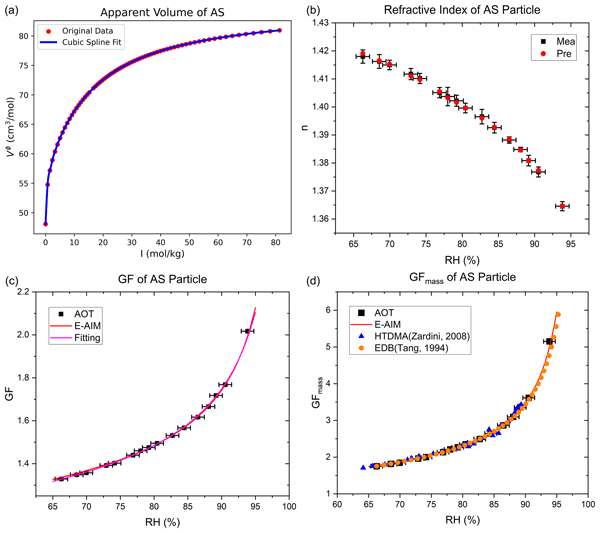
This is a nice piece of work, I enjoy reading it. This work provides a new method to measure single particle hygroscopicity using optical tweezer. This new method is well validated against E-AIM theoretical values and other observations from previous studies. Better measurements of single particle hygroscopicity could not only help us improve aerosol-cloud-climate interactions in the climate models, can also help us measure PM pollution more precisely (Chen 2025). The manuscript is well written and structured. I only have a few minor comments to help further improve the article, detailed below.
A few minor comments may help improve the discussion.
1) suggest dropping the abbreviation of AOT, could just simply call aerosol optical tweezer (refer to only tweezer later for simplicity), because AOT is commonly referred to as aerosol optical thickness in the community, therefore, to avoid confusion.
2) L32: I guess you want to say “diameter” growth factor (CF)?
3) Please provide explanation of error bars in the figure captions.
4) I think adding some discussion of the limitation of this new method, some forward looking of how to improve it in future studies, and some perspective of potential applications in future, these would help further strengthen the article.
References:
Chen, Y. Air pollution in New Delhi is more severe than observed due to hygroscopicity-induced bias in aerosol sampling. npj Clean Air 1, 1 (2025). https://doi.org/10.1038/s44407-024-00001-6
Citation: https://doi.org/10.5194/egusphere-2025-5150-RC2 -
AC2: 'Reply on RC2', Chunsheng Zhao, 18 Dec 2025
The comment was uploaded in the form of a supplement: https://egusphere.copernicus.org/preprints/2025/egusphere-2025-5150/egusphere-2025-5150-AC2-supplement.pdf
-
AC2: 'Reply on RC2', Chunsheng Zhao, 18 Dec 2025


Interactive discussion
Status: closed
-
RC1: 'Comment on egusphere-2025-5150', Anonymous Referee #1, 29 Nov 2025
The manuscript presents scientifically valuable and timely work on advancing single-particle hygroscopicity measurements using aerosol optical tweezers. The authors propose a novel and robust methodology for retrieving dry particle size and hygroscopic growth factors, and the results show clear potential for improving our understanding of aerosol physicochemical properties and their representation in climate models. While the study is of high scientific relevance and demonstrates promising methodological innovation, the current version of the manuscript requires major improvements in clarity, structure, and methodological justification before it can be considered for publication.
Please specify the measurement duration at each relative humidity and discuss how it relates to the particle (droplet) relaxation time. This information is essential for assessing whether equilibrium conditions were reached during the measurements.
The meaning of the error bars is unclear. Do they represent standard deviation, standard error, or another metric? Please ensure consistency and explain why error bars are included in some cases but omitted in others. In Fig. S2C, the box plot presentation also requires clarification—do the bounds represent specific quantiles? Throughout the manuscript, any statistical tool or metric used should be explicitly defined and described.
Please explain why the RH range starts at 65%. What prevents measurements at lower humidities?
In line 52, the statement “accurate size measurements, high temporal resolution” requires quantification. How accurate are the size measurements, and what is the actual temporal resolution achieved? Please provide numerical values or ranges.
Have any statistical metrics been applied to evaluate model performance or measurement reliability (e.g., RMSE, confidence intervals, significance tests)? If so, please report them; if not, please justify their absence.
The manuscript discusses dry diameter retrieval extensively, yet the results for truly dry particles are not clearly presented. Since the method is applied mainly to droplets, please clarify how “dry conditions” are defined in practice. Additionally, hysteresis effects should be addressed: does the direction of RH change (humidification vs. dehumidification) influence the retrieved sizes or growth factors? Please elaborate.
The generated and analyzed particles (droplets?) are reported to fall within the 6–12 µm size range (line 71). What occurs when particles (droplets?) shrink below this range? Were such cases observed or excluded? Additionally, did the authors measure or retrieve any evolution of the size distribution (e.g., dn/dlog Dp) as humidity changed? Please clarify.
If I understand correctly, the study considers only soluble compounds, implying an internal mixing assumption. How would the method perform for externally mixed aerosols? In the presence of organic material or surfactants, additional effects may arise. While this may be beyond the current scope, such situations are common for pristine aerosols (e.g., sea spray). Could the authors comment or speculate, based on their experience and findings, on the applicability or limitations of the method in these cases?
The analysis assumes that uncertainties in measured particle radius and refractive index follow a normal distribution. What is the justification for this choice? Aerosol properties are typically lognormally distributed, and it is not clear that a normal distribution is the most appropriate representation of measurement uncertainty. Please explain why the normal assumption was selected and whether alternative distributions were considered.
The manuscript discusses only the real part of the refractive index, which governs scattering. What about absorption? Please comment on the imaginary part of the refractive index and whether it influences the retrievals or the applicability of the method.
You present the functional dependence of the growth factor for each individual compound, but it is unclear how this approach extends to mixtures. How does the functional form behave for a binary mixture of the analyzed components, and how would the growth factor be derived in such cases? Please clarify the applicability of the method to mixed systems.
The manuscript presents a schematic of the experimental setup. Would it be possible to include a photograph of the actual setup, at least in the Supplementary Information, to provide additional clarity and context?
line 91: Please define (spell out) the abbreviation when it first appears, "WGMs".
line 246: Figure 5: What is the BIC method?
Citation: https://doi.org/10.5194/egusphere-2025-5150-RC1 -
AC1: 'Reply on RC1', Chunsheng Zhao, 18 Dec 2025
The comment was uploaded in the form of a supplement: https://egusphere.copernicus.org/preprints/2025/egusphere-2025-5150/egusphere-2025-5150-AC1-supplement.pdf
-
AC1: 'Reply on RC1', Chunsheng Zhao, 18 Dec 2025
-
RC2: 'Comment on egusphere-2025-5150', Anonymous Referee #2, 04 Dec 2025
This is a nice piece of work, I enjoy reading it. This work provides a new method to measure single particle hygroscopicity using optical tweezer. This new method is well validated against E-AIM theoretical values and other observations from previous studies. Better measurements of single particle hygroscopicity could not only help us improve aerosol-cloud-climate interactions in the climate models, can also help us measure PM pollution more precisely (Chen 2025). The manuscript is well written and structured. I only have a few minor comments to help further improve the article, detailed below.
A few minor comments may help improve the discussion.
1) suggest dropping the abbreviation of AOT, could just simply call aerosol optical tweezer (refer to only tweezer later for simplicity), because AOT is commonly referred to as aerosol optical thickness in the community, therefore, to avoid confusion.
2) L32: I guess you want to say “diameter” growth factor (CF)?
3) Please provide explanation of error bars in the figure captions.
4) I think adding some discussion of the limitation of this new method, some forward looking of how to improve it in future studies, and some perspective of potential applications in future, these would help further strengthen the article.
References:
Chen, Y. Air pollution in New Delhi is more severe than observed due to hygroscopicity-induced bias in aerosol sampling. npj Clean Air 1, 1 (2025). https://doi.org/10.1038/s44407-024-00001-6
Citation: https://doi.org/10.5194/egusphere-2025-5150-RC2 -
AC2: 'Reply on RC2', Chunsheng Zhao, 18 Dec 2025
The comment was uploaded in the form of a supplement: https://egusphere.copernicus.org/preprints/2025/egusphere-2025-5150/egusphere-2025-5150-AC2-supplement.pdf
-
AC2: 'Reply on RC2', Chunsheng Zhao, 18 Dec 2025
Peer review completion
Journal article(s) based on this preprint
Viewed
| HTML | XML | Total | Supplement | BibTeX | EndNote | |
|---|---|---|---|---|---|---|
| 151 | 79 | 29 | 259 | 38 | 24 | 19 |
- HTML: 151
- PDF: 79
- XML: 29
- Total: 259
- Supplement: 38
- BibTeX: 24
- EndNote: 19
Viewed (geographical distribution)
| Country | # | Views | % |
|---|
| Total: | 0 |
| HTML: | 0 |
| PDF: | 0 |
| XML: | 0 |
- 1
Chengyi Fan
Chunsheng Zhao
The requested preprint has a corresponding peer-reviewed final revised paper. You are encouraged to refer to the final revised version.
- Preprint
(1092 KB) - Metadata XML
-
Supplement
(427 KB) - BibTeX
- EndNote
- Final revised paper
The manuscript presents scientifically valuable and timely work on advancing single-particle hygroscopicity measurements using aerosol optical tweezers. The authors propose a novel and robust methodology for retrieving dry particle size and hygroscopic growth factors, and the results show clear potential for improving our understanding of aerosol physicochemical properties and their representation in climate models. While the study is of high scientific relevance and demonstrates promising methodological innovation, the current version of the manuscript requires major improvements in clarity, structure, and methodological justification before it can be considered for publication.
Please specify the measurement duration at each relative humidity and discuss how it relates to the particle (droplet) relaxation time. This information is essential for assessing whether equilibrium conditions were reached during the measurements.
The meaning of the error bars is unclear. Do they represent standard deviation, standard error, or another metric? Please ensure consistency and explain why error bars are included in some cases but omitted in others. In Fig. S2C, the box plot presentation also requires clarification—do the bounds represent specific quantiles? Throughout the manuscript, any statistical tool or metric used should be explicitly defined and described.
Please explain why the RH range starts at 65%. What prevents measurements at lower humidities?
In line 52, the statement “accurate size measurements, high temporal resolution” requires quantification. How accurate are the size measurements, and what is the actual temporal resolution achieved? Please provide numerical values or ranges.
Have any statistical metrics been applied to evaluate model performance or measurement reliability (e.g., RMSE, confidence intervals, significance tests)? If so, please report them; if not, please justify their absence.
The manuscript discusses dry diameter retrieval extensively, yet the results for truly dry particles are not clearly presented. Since the method is applied mainly to droplets, please clarify how “dry conditions” are defined in practice. Additionally, hysteresis effects should be addressed: does the direction of RH change (humidification vs. dehumidification) influence the retrieved sizes or growth factors? Please elaborate.
The generated and analyzed particles (droplets?) are reported to fall within the 6–12 µm size range (line 71). What occurs when particles (droplets?) shrink below this range? Were such cases observed or excluded? Additionally, did the authors measure or retrieve any evolution of the size distribution (e.g., dn/dlog Dp) as humidity changed? Please clarify.
If I understand correctly, the study considers only soluble compounds, implying an internal mixing assumption. How would the method perform for externally mixed aerosols? In the presence of organic material or surfactants, additional effects may arise. While this may be beyond the current scope, such situations are common for pristine aerosols (e.g., sea spray). Could the authors comment or speculate, based on their experience and findings, on the applicability or limitations of the method in these cases?
The analysis assumes that uncertainties in measured particle radius and refractive index follow a normal distribution. What is the justification for this choice? Aerosol properties are typically lognormally distributed, and it is not clear that a normal distribution is the most appropriate representation of measurement uncertainty. Please explain why the normal assumption was selected and whether alternative distributions were considered.
The manuscript discusses only the real part of the refractive index, which governs scattering. What about absorption? Please comment on the imaginary part of the refractive index and whether it influences the retrievals or the applicability of the method.
You present the functional dependence of the growth factor for each individual compound, but it is unclear how this approach extends to mixtures. How does the functional form behave for a binary mixture of the analyzed components, and how would the growth factor be derived in such cases? Please clarify the applicability of the method to mixed systems.
The manuscript presents a schematic of the experimental setup. Would it be possible to include a photograph of the actual setup, at least in the Supplementary Information, to provide additional clarity and context?
line 91: Please define (spell out) the abbreviation when it first appears, "WGMs".
line 246: Figure 5: What is the BIC method?