
the Creative Commons Attribution 4.0 License.
the Creative Commons Attribution 4.0 License.
 | 23 Oct 2025
Dynamic and Steric Sea-level Changes due to a Collapsing AMOC in the Community Earth System Model
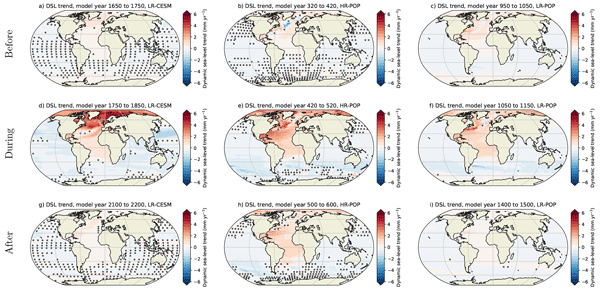
Abstract. A collapse of the Atlantic Meridional Overturning Circulation (AMOC) leads to a redistribution of dynamic sea level (DSL) across the global ocean surface. Here, we investigate AMOC-induced DSL and steric sea-level responses using the Community Earth System Model and two stand-alone ocean configurations (strongly eddying and parameterising eddy effects) with the Parallel Ocean Program. For our analysis, we employ various quasi-equilibrium freshwater hosing experiments in which AMOC collapses were reported. As the AMOC begins to collapse, the DSL substantially rises over the Atlantic Ocean and Arctic Ocean, with the largest DSL changes reaching 6 mm yr-1 over the North Atlantic Ocean. In densely-populated coastal regions along the North Atlantic Ocean, DSL trends of up to 4 mm yr-1 are found, potentially doubling local sea-level rise rates under an AMOC collapse scenario. Given the quasi-equilibrium approach, the hosing contribution to DSL trends is relatively small for periods of ≤ 100 years but becomes increasingly important over longer timescale. Moreover, an AMOC collapse increases the radiative imbalance at the top of the atmosphere up to +0.5 W m-2, with the excess heat being absorbed by the ocean, leading to more than 20 cm of global mean thermosteric sea-level rise. These results highlight the potential value of accounting for an AMOC collapse scenario when developing or applying sea-level rise projections for the North Atlantic Ocean.
-
Notice on discussion status
The requested preprint has a corresponding peer-reviewed final revised paper. You are encouraged to refer to the final revised version.
-
Preprint
(76448 KB)
-
The requested preprint has a corresponding peer-reviewed final revised paper. You are encouraged to refer to the final revised version.
- Preprint
(76448 KB) - Metadata XML
- BibTeX
- EndNote
- Final revised paper


Journal article(s) based on this preprint
Interactive discussion
Status: closed
-
RC1: 'Comment on egusphere-2025-5102', Anonymous Referee #1, 27 Nov 2025
-
AC1: 'Reply on RC1', René van Westen, 16 Jan 2026
The comment was uploaded in the form of a supplement: https://egusphere.copernicus.org/preprints/2025/egusphere-2025-5102/egusphere-2025-5102-AC1-supplement.pdf
-
AC1: 'Reply on RC1', René van Westen, 16 Jan 2026
-
RC2: 'Comment on egusphere-2025-5102', Anonymous Referee #2, 29 Nov 2025
General Comments
van Westen et al. present an analysis of sea-level changes resulting from an AMOC collapse using a set of numerical experiments with the Community Earth System Model in which a freshwater hosing is performed over the North Atlantic regions to induce an AMOC collapse. The experiments used form an interesting model hierarchy to study sea-level changes with both low- and high-resolution ocean-only simulations, and a single low-resolution fully coupled simulation. Given the lack of previous studies, especially using modern ocean models, I think the results of the present study are timely. I think the manuscript is generally written to a good standard, structured appropriately, and the results presented with an appropriate degree of clarity. However, I do think the DSL analyses, and some of the claims made from these are limited by the absence of a reverse hosing simulation in the ocean-only configurations. Nevertheless, given the structure of the model hierarchy used, there is potential to better explain the mechanisms and how these compare between the different experiments of the present study. This could be important for interpreting DSL/TS sea level changes in other climate models. Lastly, I think computing the total sterodynamic sea level change would be helpful – currently it is hard to determine how significant the overall changes are. Ultimately, I suggest moderate revisions before publication in Ocean Sciences.
Specific Comments
L8-11: I think it’s good to include this information in the abstract, however, could the authors quote/estimate these values in terms of mm/year sea-level rise? This would be helpful for readers to make a quick comparison to the overall DSL changes.
L16: Somewhere in this paragraph I think it would be appropriate to cite:
Liu et al. Sci. Adv. (https://doi.org/10.1126/sciadv.aaz4876)
Bellomo and Mehling GRL. (https://doi.org/10.1029/2023GL107624)
L35: Could also cite Baker et al. 2025, Nature (already cited in the manuscript).
L55-57: I think it would be better to split the Methods section more cleanly between each model used (e.g., with subheadings) and provide a little more information on the simulation components to make this a more standalone manuscript. I understand these experiments have been used in several previous studies, but for completeness in the current paper I think the authors should at least briefly state which components of CESM are being used here (e.g., is this FV/spectral CAM; CICE? etc.). A short table would help.
L98: The authors need to expand on this more. Critically, are there reasons to think that the hosing effect would be significantly different in these experiments? One of the main takeaways from the analysis performed in section 3.2 is that the hosing corrected, AMOC-induced DSL change is highly dependent on the AMOC state and hosing conditions, but this has only been explicitly calculated for one simulation. These effects could be highly dependent on the model resolution.
L146-159/Figure 2: The authors have not justified why they are using a linear fit for dynamic sea level difference and ‘Volume transport difference’ in figures 2.e-g. It’s potentially interesting if there is a well-justified physical relationship which holds over some region of the parameter space, but I think this should be far better justified/explained if it is to be included.
L152-153: I do not think this statement (as it is currently written) is justified by figure 2.
L180: This needs to be substantiated. For instance, which climate feedbacks and why?
L198: Ultimately it is up to the authors, but perhaps it would make more sense to discuss the magnitude of the hosing correction first? Or, even include this in the methods where it is first introduced? Presently, the reader is introduced to changes in DSL which initially appear very large, but the end of section 3.1 ends with an acknowledgment of the substantial hosing correction, and the correspondingly large reduction in DSL trends. Importantly, many figures show the uncorrected DSL results.
L255-257 Here, LR-POP and LR-CESM yield significantly different responses at the same resolution – I think there is an opportunity here to explore the role of eddies in more depth than is currently presented.
L262: Only in the adiabatic limit.
L267: Ocean heat content can be easily computed from POP variables (fig. A3 partially addresses this).
Figure 7: What is the difference in thermosteric sea level rise between the forward and backward simulations?
L305-309: I think the authors need to take a lot more care here. Arguments based on a link between AMOC and TOA imbalance can only be applied to LR-CESM (as acknowledged). The surface fluxes are presumably the most important aspect - for instance, the surface fluxes in LR-CESM are not 0 prior to the AMOC collapse.
L340-342: How does this value compare to estimates of sea level rise due to accelerated melting of the Greenland (or Antarctic) ice sheet? How large is the overall sea level change due to AMOC collapse?
L348: I think it would be helpful to show this somewhere in the manuscript. Again on L372-373, should the total sea-level change be quoted?
Technical Points
L69: “which occurs at \delta F_H = 0.03Sv” ?
L151: “quantity” ?
L220: Better to put these values in a table?
L253: salinity is already a concentration.
L304: “of the Earth system” ?
L306: “primarily” ?
L360: “…which allows us to…” ?
Figure 4: A lot of the text here (and in other figures) is very small – could the authors increase the size? Moreover, some of the inset panels clutter the figures.
Figure 7: are panels b-d the total steric contribution, or just the thermosteric contribution, as shown in panel a? Are we meant to compare panel a to panels b-d?
Citation: https://doi.org/10.5194/egusphere-2025-5102-RC2 -
AC2: 'Reply on RC2', René van Westen, 16 Jan 2026
The comment was uploaded in the form of a supplement: https://egusphere.copernicus.org/preprints/2025/egusphere-2025-5102/egusphere-2025-5102-AC2-supplement.pdf
-
AC2: 'Reply on RC2', René van Westen, 16 Jan 2026
Peer review completion


Interactive discussion
Status: closed
-
RC1: 'Comment on egusphere-2025-5102', Anonymous Referee #1, 27 Nov 2025
The study by van Westen et al. investigates dynamic and steric sea-level responses to an AMOC collapse using hosing experiments conducted with a fully coupled model and two ocean-only models with different horizontal resolutions. The authors find that an AMOC collapse induces dynamic sea-level rise across the Atlantic and Arctic Oceans, with the largest signals in the North Atlantic. Meanwhile, the collapse produces global-mean thermosteric sea-level rise due to enhanced net downward top-of-atmosphere (TOA) energy flux, most of which is absorbed by the ocean through increased ocean heat uptake. Overall, the results are robust and clearly presented. I recommend minor revision with the following comments.
- Line 22: The term “regional” needs clarification. Does this refer specifically to the Atlantic sector? Similarly, does “background ocean circulation” correspond to the AMOC, or does it include gyre circulations or other components? Please specify to avoid ambiguity.
- Line 91: The details of the prescribed surface forcing in the ocean-only simulations should be clarified. My interpretation is that momentum fluxes are prescribed, while heat fluxes are interactive.
- Line 277-290: Related to the previous comment: Are surface heat fluxes prescribed in the POP simulations? If they are interactive, then surface-flux feedbacks may also contribute to the large ocean heat-uptake anomalies in the North Atlantic and Southern Ocean. This could partially explain the spatial heterogeneity of heat-uptake responses across the models.
- Figure 4b: The dynamic sea-level (DSL) response shows a positive trend in the time series but exhibits negative anomalies north of 30°N in the spatial difference map. How these two diagnostics relate?
- Figure 8: The Southern Ocean heat-uptake response differs markedly between HR-POP and LR-POP, consistent with the role of mesoscale eddies highlighted in the manuscript. However, the physical teleconnection between AMOC collapse (or hosing) and Southern Ocean eddy activity is not discussed. A brief explanation of the mechanism, e.g., changes in wind stress, ACC baroclinicity, or remote propagation of density anomalies would strengthen the interpretation.
- How many ensemble members are conducted in each experiment? Will the internal variability affect the results such as AMOC tipping time?
Others:
Line 129: how are the basin boundaries are defined?
Line 129: determined - determine
Citation: https://doi.org/10.5194/egusphere-2025-5102-RC1 -
AC1: 'Reply on RC1', René van Westen, 16 Jan 2026
The comment was uploaded in the form of a supplement: https://egusphere.copernicus.org/preprints/2025/egusphere-2025-5102/egusphere-2025-5102-AC1-supplement.pdf
-
RC2: 'Comment on egusphere-2025-5102', Anonymous Referee #2, 29 Nov 2025
General Comments
van Westen et al. present an analysis of sea-level changes resulting from an AMOC collapse using a set of numerical experiments with the Community Earth System Model in which a freshwater hosing is performed over the North Atlantic regions to induce an AMOC collapse. The experiments used form an interesting model hierarchy to study sea-level changes with both low- and high-resolution ocean-only simulations, and a single low-resolution fully coupled simulation. Given the lack of previous studies, especially using modern ocean models, I think the results of the present study are timely. I think the manuscript is generally written to a good standard, structured appropriately, and the results presented with an appropriate degree of clarity. However, I do think the DSL analyses, and some of the claims made from these are limited by the absence of a reverse hosing simulation in the ocean-only configurations. Nevertheless, given the structure of the model hierarchy used, there is potential to better explain the mechanisms and how these compare between the different experiments of the present study. This could be important for interpreting DSL/TS sea level changes in other climate models. Lastly, I think computing the total sterodynamic sea level change would be helpful – currently it is hard to determine how significant the overall changes are. Ultimately, I suggest moderate revisions before publication in Ocean Sciences.
Specific Comments
L8-11: I think it’s good to include this information in the abstract, however, could the authors quote/estimate these values in terms of mm/year sea-level rise? This would be helpful for readers to make a quick comparison to the overall DSL changes.
L16: Somewhere in this paragraph I think it would be appropriate to cite:
Liu et al. Sci. Adv. (https://doi.org/10.1126/sciadv.aaz4876)
Bellomo and Mehling GRL. (https://doi.org/10.1029/2023GL107624)
L35: Could also cite Baker et al. 2025, Nature (already cited in the manuscript).
L55-57: I think it would be better to split the Methods section more cleanly between each model used (e.g., with subheadings) and provide a little more information on the simulation components to make this a more standalone manuscript. I understand these experiments have been used in several previous studies, but for completeness in the current paper I think the authors should at least briefly state which components of CESM are being used here (e.g., is this FV/spectral CAM; CICE? etc.). A short table would help.
L98: The authors need to expand on this more. Critically, are there reasons to think that the hosing effect would be significantly different in these experiments? One of the main takeaways from the analysis performed in section 3.2 is that the hosing corrected, AMOC-induced DSL change is highly dependent on the AMOC state and hosing conditions, but this has only been explicitly calculated for one simulation. These effects could be highly dependent on the model resolution.
L146-159/Figure 2: The authors have not justified why they are using a linear fit for dynamic sea level difference and ‘Volume transport difference’ in figures 2.e-g. It’s potentially interesting if there is a well-justified physical relationship which holds over some region of the parameter space, but I think this should be far better justified/explained if it is to be included.
L152-153: I do not think this statement (as it is currently written) is justified by figure 2.
L180: This needs to be substantiated. For instance, which climate feedbacks and why?
L198: Ultimately it is up to the authors, but perhaps it would make more sense to discuss the magnitude of the hosing correction first? Or, even include this in the methods where it is first introduced? Presently, the reader is introduced to changes in DSL which initially appear very large, but the end of section 3.1 ends with an acknowledgment of the substantial hosing correction, and the correspondingly large reduction in DSL trends. Importantly, many figures show the uncorrected DSL results.
L255-257 Here, LR-POP and LR-CESM yield significantly different responses at the same resolution – I think there is an opportunity here to explore the role of eddies in more depth than is currently presented.
L262: Only in the adiabatic limit.
L267: Ocean heat content can be easily computed from POP variables (fig. A3 partially addresses this).
Figure 7: What is the difference in thermosteric sea level rise between the forward and backward simulations?
L305-309: I think the authors need to take a lot more care here. Arguments based on a link between AMOC and TOA imbalance can only be applied to LR-CESM (as acknowledged). The surface fluxes are presumably the most important aspect - for instance, the surface fluxes in LR-CESM are not 0 prior to the AMOC collapse.
L340-342: How does this value compare to estimates of sea level rise due to accelerated melting of the Greenland (or Antarctic) ice sheet? How large is the overall sea level change due to AMOC collapse?
L348: I think it would be helpful to show this somewhere in the manuscript. Again on L372-373, should the total sea-level change be quoted?
Technical Points
L69: “which occurs at \delta F_H = 0.03Sv” ?
L151: “quantity” ?
L220: Better to put these values in a table?
L253: salinity is already a concentration.
L304: “of the Earth system” ?
L306: “primarily” ?
L360: “…which allows us to…” ?
Figure 4: A lot of the text here (and in other figures) is very small – could the authors increase the size? Moreover, some of the inset panels clutter the figures.
Figure 7: are panels b-d the total steric contribution, or just the thermosteric contribution, as shown in panel a? Are we meant to compare panel a to panels b-d?
Citation: https://doi.org/10.5194/egusphere-2025-5102-RC2 -
AC2: 'Reply on RC2', René van Westen, 16 Jan 2026
The comment was uploaded in the form of a supplement: https://egusphere.copernicus.org/preprints/2025/egusphere-2025-5102/egusphere-2025-5102-AC2-supplement.pdf
-
AC2: 'Reply on RC2', René van Westen, 16 Jan 2026
Peer review completion
Journal article(s) based on this preprint
Viewed
| HTML | XML | Total | BibTeX | EndNote | |
|---|---|---|---|---|---|
| 1,766 | 612 | 94 | 2,472 | 70 | 80 |
- HTML: 1,766
- PDF: 612
- XML: 94
- Total: 2,472
- BibTeX: 70
- EndNote: 80
Viewed (geographical distribution)
| Country | # | Views | % |
|---|
| Total: | 0 |
| HTML: | 0 |
| PDF: | 0 |
| XML: | 0 |
- 1

Caroline A. Katsman
Dewi Le Bars
The requested preprint has a corresponding peer-reviewed final revised paper. You are encouraged to refer to the final revised version.
- Preprint
(76448 KB) - Metadata XML
The study by van Westen et al. investigates dynamic and steric sea-level responses to an AMOC collapse using hosing experiments conducted with a fully coupled model and two ocean-only models with different horizontal resolutions. The authors find that an AMOC collapse induces dynamic sea-level rise across the Atlantic and Arctic Oceans, with the largest signals in the North Atlantic. Meanwhile, the collapse produces global-mean thermosteric sea-level rise due to enhanced net downward top-of-atmosphere (TOA) energy flux, most of which is absorbed by the ocean through increased ocean heat uptake. Overall, the results are robust and clearly presented. I recommend minor revision with the following comments.
Others:
Line 129: how are the basin boundaries are defined?
Line 129: determined - determine