
the Creative Commons Attribution 4.0 License.
the Creative Commons Attribution 4.0 License.
 | 20 Nov 2025
Spatially Contrasting CO2 Dynamics Driven by Green Manure Intercropping in Subtropical Tea Plantations
Abstract. Tea plantations are important contributors to greenhouse gas emissions due to intensive fertilization and continuous cultivation. However, the mechanisms by which green manure intercropping regulates soil CO2 dynamics in these systems remain poorly understood. We investigated how intercropping with Vulpia myuros (SM) and a legume–nonlegume mixture of Lolium perenne and Trifolium repens (HM) influenced spatial CO2 flux dynamics compared with a no-intercropping control (CK) from tea rows and inter-row zones in a subtropical tea plantation. Distinct seasonal variations were observed, with CO2 fluxes peaking in summer and autumn and declining in spring and winter. Average tea-row fluxes were 7.41 ± 0.45, 7.35 ± 0.44, and 8.12 ± 0.46 mg·m⁻²·min⁻¹ under SM, HM, and CK, respectively, indicating emission reductions with intercropping. In contrast, inter-row fluxes were higher under SM (10.83 ± 0.52 mg m⁻² min⁻¹) and HM (9.77 ± 0.54 mg m⁻² min⁻¹) than under CK (9.07 ± 0.44 mg m⁻² min⁻¹), demonstrating pronounced spatial contrasts. Diurnal patterns exhibited midday peaks (12:00–14:00), especially in spring and summer, and short-term CO₂ pulses were triggered by field operations such as fertilization and pruning. Notably, HM effectively suppressed fertilization-induced CO2 pulses, revealing the mitigation potential of legume–nonlegume mixtures. Green manure increased soil organic carbon (6.4 %), lowered soil temperature (4.5 %), and enhanced porosity (4.2 %), collectively shaping CO2 dynamics. Multivariate analysis identified soil organic carbon (SOC) and temperature as dominant flux drivers, and a potential SOC threshold was detected, beyond which CO2 emissions accelerated. While intercropping reduced tea-row emissions by 7.1–7.9 % but increased inter-row emissions by 12.7–28.9 %, continuous intercropping significantly decreased overall inter-row emissions over time. These results highlight the spatially heterogeneous nature of carbon flux regulation and demonstrate the long-term potential of green manure intercropping as a climate-smart management strategy in perennial agroecosystems.
-
Notice on discussion status
The requested preprint has a corresponding peer-reviewed final revised paper. You are encouraged to refer to the final revised version.
-
Preprint
(4748 KB)
-
The requested preprint has a corresponding peer-reviewed final revised paper. You are encouraged to refer to the final revised version.
- Preprint
(4748 KB) - Metadata XML
- BibTeX
- EndNote
- Final revised paper


Journal article(s) based on this preprint
Interactive discussion
Status: closed
-
RC1: 'Comment on egusphere-2025-5065', Anonymous Referee #1, 29 Dec 2025
-
AC1: 'Reply on RC1', shuo liu, 16 Jan 2026
The comment was uploaded in the form of a supplement: https://egusphere.copernicus.org/preprints/2025/egusphere-2025-5065/egusphere-2025-5065-AC1-supplement.pdf
-
AC2: 'Reply on RC1', shuo liu, 16 Jan 2026
The comment was uploaded in the form of a supplement: https://egusphere.copernicus.org/preprints/2025/egusphere-2025-5065/egusphere-2025-5065-AC2-supplement.pdf
-
AC1: 'Reply on RC1', shuo liu, 16 Jan 2026
-
RC2: 'Comment on egusphere-2025-5065', Anonymous Referee #2, 03 Jan 2026
The comment was uploaded in the form of a supplement: https://egusphere.copernicus.org/preprints/2025/egusphere-2025-5065/egusphere-2025-5065-RC2-supplement.pdf
-
AC3: 'Reply on RC2', shuo liu, 16 Jan 2026
The comment was uploaded in the form of a supplement: https://egusphere.copernicus.org/preprints/2025/egusphere-2025-5065/egusphere-2025-5065-AC3-supplement.pdf
-
AC3: 'Reply on RC2', shuo liu, 16 Jan 2026
-
RC3: 'Comment on egusphere-2025-5065', Anonymous Referee #3, 26 Jan 2026
This manuscript examines how green manure intercropping with grasses and grass–legume mixtures influences spatial and temporal patterns of soil CO2 fluxes in a subtropical tea plantation, with a focus on contrasts between tea-row and inter-row zones. The dataset appears extensive, and the field effort is clearly substantial. However, based on the current framing in the introduction, the broader scientific importance and implications of the study would benefit from further clarification and strengthening before the manuscript is ready for publication.
The introduction places the study within the context of greenhouse gas emissions, but this framing would benefit from greater conceptual precision. In agricultural systems, soil CO2 fluxes are not necessarily equivalent to net GHG emissions, as their climatic relevance depends strongly on C origin. CO2 derived from root respiration or recent plant inputs is part of the short-term carbon cycle rather than a net climatic forcing. Clarifying whether the measured CO2 fluxes represent autotrophic respiration, heterotrophic respiration, or their combination would greatly improve interpretation of the results and help align the study more clearly with its stated climate relevance. In addition, although N2O emissions are mentioned in the introduction, they are not included in the study, and refining the scope of the introduction to better match the measurements would improve coherence.
The motivation for the study currently appears to rest primarily on the limited number of prior studies examining soil CO2 dynamics in tea plantations with green manure intercropping. While this system-specific focus is valuable, the manuscript would be strengthened by more clearly articulated scientific questions and testable hypotheses that highlight the underlying processes or mechanisms being investigated. As written, the study is largely descriptive, and the novelty would be clearer if the authors explicitly stated what new conceptual or mechanistic insights are expected beyond documenting spatial and temporal flux patterns. Similarly, the role of green manure would benefit from clearer definition and context. It is not always clear whether green manure refers to cover crops or other intercropping practices, and relevant literature on how green manure influences soil C cycling could be more fully integrated. Statements regarding green manure introducing soil disturbance would also benefit from additional explanation or supporting evidence.
The Materials and Methods section would benefit from substantially more detail to allow readers to fully evaluate the experimental design and reproduce the study. Important information that should be clarified includes the timing of green manure planting and termination, planting rates, termination methods, plot layout and size, the presence of buffer zones between treatments, and whether chamber bases included vegetation. The rationale for diurnal monitoring, as well as how diurnal and seasonal variations were calculated, also needs to be more clearly explained. Several methodological aspects would benefit from clarification, including gas sampling and storage procedures, flux calculation methods, whether fresh soil was used for total C and N analyses, and the distinction between injected gas and carrier gas. In addition, management activities such as fertilization, grass cutting or termination, and tea pruning are discussed in the Results and Discussion but should be more fully described in the Methods.
The discussion is logically structured, but it would benefit from deeper engagement with underlying mechanisms and clearer links back to explicit hypotheses. Terms such as “human management” would be clearer if they were more precisely defined and contextualized, including what conditions are being compared before and after management interventions. Additional clarification on how high-frequency flux measurements were aggregated or transformed to generate the reported temporal patterns would also strengthen interpretation. Overall, the main take-home message and the broader contribution of the study would be clearer with a more analytical and mechanism-focused discussion rather than a primarily descriptive one. Overall, the dataset has potential, but the manuscript would benefit from conceptual reframing, clearer hypotheses, improved methodological transparency, and a more mechanistically grounded discussion. Addressing these points would substantially strengthen the scientific clarity and impact of the study.
Citation: https://doi.org/10.5194/egusphere-2025-5065-RC3 -
AC4: 'Reply on RC3', shuo liu, 22 Feb 2026
The comment was uploaded in the form of a supplement: https://egusphere.copernicus.org/preprints/2025/egusphere-2025-5065/egusphere-2025-5065-AC4-supplement.pdf
-
AC4: 'Reply on RC3', shuo liu, 22 Feb 2026
Peer review completion


Interactive discussion
Status: closed
-
RC1: 'Comment on egusphere-2025-5065', Anonymous Referee #1, 29 Dec 2025
Title: Spatially Contrasting CO₂ Dynamics Driven by Green Manure Intercropping in Subtropical Tea Plantations
Author(s): Shuo Liu et al.
MS No.: egusphere-2025-5065
General Comments
The manuscript presents valuable insights from a two-year measurement campaign of CO₂ fluxes in a tea plantation in China. The study compares plots subjected to different intercropping treatments, providing an interesting perspective by distinguishing emissions from tea rows and inter-row spaces. The discussion is comprehensive; however, additional experimental details would enhance the reader’s ability to interpret the results. Aside from this, I have only a few minor comments (see below). Overall, the paper falls within the scope of Biogeosciences and merits publication after these minor revisions are addressed.
Specific Comments
Abstract
- Lines 28–31: These absolute values are difficult to interpret without broader context regarding tea plantation emissions. Readers will likely be more interested in relative changes compared to control plots, as mentioned in line 41. Please provide relative changes for the total flux as well (see comment on line 41).
- Lines 32–33: Specify for which plots midday peaks occurred.
- Line 41: The relative changes reported do not correspond to the values in lines 28–31. Be more precise which aggregates are shown and used for the relative changes.
- Lines 40–45: This section is unclear. Tea-row and inter-row fluxes appear similar in magnitude (e.g., 8.12 CK (tea-row) vs. 9.07 CK (inter-row)). Tea-row emissions decrease by 7–8%, while inter-row emissions increase by 13–29%. How does this support the conclusion that intercropping is a climate-smart management strategy?
- Add to the abstract: measurement method (flux chambers), campaign duration, and dataset size.
Experimental Setup (Lines 164 ff.)
- Provide more details: plantation size, distances between plots and replicates, age of plantation and tea plants, etc.
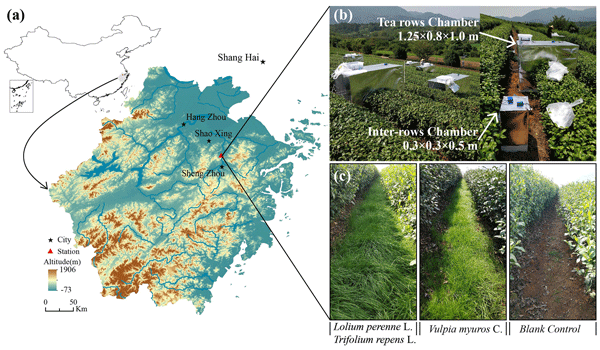
- Consider adding a schematic (with dimensions) to Figure 1. Clarify whether tea plants were inside the chambers.
- According to lines 183–184, one measurement included four samples every 7 minutes: indicate when the first sample was taken after chamber closure and how long (overall) a single experiment took. How high were the CO2 concentrations at the end? Include an example showing the 4 measured CO2 concentrations over time (perhaps in the appendix) and illustrate how fluxes were calculated. Was a linear fit applied to the four data points? How linear was the CO₂ increase? How consistent were the three replicates? Were all six plots always sampled simultaneously? Did you ever observe decreases in CO2 concentrations? Figure 2 shows only positive fluxes.
- Include an uncertainty analysis for flux determination.
Figure and Table Captions
- Add a condensed explanation of your three letter codes to the different figure/table captions: Something like: CK = control, SM and HM = intercropping types, T = tea row, G = inter-row.
Results
- Line 243: Explain what the uncertainties represent.
- Line 245: Specify the significance level for “significantly higher.”
Figures and Tables
- Figure 2: Clarify whether error bars indicate uncertainty of a single flux measurement or standard deviation across duplicates.
- Table 1: Explain ± values and superscript letters.
- Figure 2: Use a different color for precipitation vs. temperature. Confirm whether negative CO₂ fluxes were ever observed. Were tea plants present in the chambers?
- Figure 3: Explain superscript letters and error bars. Add “T” for tea row and “G” for inter-row in the legend.
Results
- Lines 354 ff.: The consistent differences in soil properties are surprising given the short distances. Provide more detail on plantation history and intercropping duration. When did the intercropping practices start?
Conclusions
- Line 587 refers to the mitigation of carbon losses. Quantify overall CO₂ emission reductions when summing tea-row and inter-row fluxes for HM, SM, and CK. Data (e.g. in abstract, see my comment there) do not support it and Figure 3 suggest reductions only for HM in the second year. If mitigation exists, contextualize its potential impact at larger scales.
- Add general considerations on intercropping: benefits and drawbacks (costs, labor, temperature effects, soil compaction, aeration, etc.). Large-scale adoption depends on whether benefits outweigh additional costs.
Citation: https://doi.org/10.5194/egusphere-2025-5065-RC1 -
AC1: 'Reply on RC1', shuo liu, 16 Jan 2026
The comment was uploaded in the form of a supplement: https://egusphere.copernicus.org/preprints/2025/egusphere-2025-5065/egusphere-2025-5065-AC1-supplement.pdf
-
AC2: 'Reply on RC1', shuo liu, 16 Jan 2026
The comment was uploaded in the form of a supplement: https://egusphere.copernicus.org/preprints/2025/egusphere-2025-5065/egusphere-2025-5065-AC2-supplement.pdf
-
RC2: 'Comment on egusphere-2025-5065', Anonymous Referee #2, 03 Jan 2026
The comment was uploaded in the form of a supplement: https://egusphere.copernicus.org/preprints/2025/egusphere-2025-5065/egusphere-2025-5065-RC2-supplement.pdf
-
AC3: 'Reply on RC2', shuo liu, 16 Jan 2026
The comment was uploaded in the form of a supplement: https://egusphere.copernicus.org/preprints/2025/egusphere-2025-5065/egusphere-2025-5065-AC3-supplement.pdf
-
AC3: 'Reply on RC2', shuo liu, 16 Jan 2026
-
RC3: 'Comment on egusphere-2025-5065', Anonymous Referee #3, 26 Jan 2026
This manuscript examines how green manure intercropping with grasses and grass–legume mixtures influences spatial and temporal patterns of soil CO2 fluxes in a subtropical tea plantation, with a focus on contrasts between tea-row and inter-row zones. The dataset appears extensive, and the field effort is clearly substantial. However, based on the current framing in the introduction, the broader scientific importance and implications of the study would benefit from further clarification and strengthening before the manuscript is ready for publication.
The introduction places the study within the context of greenhouse gas emissions, but this framing would benefit from greater conceptual precision. In agricultural systems, soil CO2 fluxes are not necessarily equivalent to net GHG emissions, as their climatic relevance depends strongly on C origin. CO2 derived from root respiration or recent plant inputs is part of the short-term carbon cycle rather than a net climatic forcing. Clarifying whether the measured CO2 fluxes represent autotrophic respiration, heterotrophic respiration, or their combination would greatly improve interpretation of the results and help align the study more clearly with its stated climate relevance. In addition, although N2O emissions are mentioned in the introduction, they are not included in the study, and refining the scope of the introduction to better match the measurements would improve coherence.
The motivation for the study currently appears to rest primarily on the limited number of prior studies examining soil CO2 dynamics in tea plantations with green manure intercropping. While this system-specific focus is valuable, the manuscript would be strengthened by more clearly articulated scientific questions and testable hypotheses that highlight the underlying processes or mechanisms being investigated. As written, the study is largely descriptive, and the novelty would be clearer if the authors explicitly stated what new conceptual or mechanistic insights are expected beyond documenting spatial and temporal flux patterns. Similarly, the role of green manure would benefit from clearer definition and context. It is not always clear whether green manure refers to cover crops or other intercropping practices, and relevant literature on how green manure influences soil C cycling could be more fully integrated. Statements regarding green manure introducing soil disturbance would also benefit from additional explanation or supporting evidence.
The Materials and Methods section would benefit from substantially more detail to allow readers to fully evaluate the experimental design and reproduce the study. Important information that should be clarified includes the timing of green manure planting and termination, planting rates, termination methods, plot layout and size, the presence of buffer zones between treatments, and whether chamber bases included vegetation. The rationale for diurnal monitoring, as well as how diurnal and seasonal variations were calculated, also needs to be more clearly explained. Several methodological aspects would benefit from clarification, including gas sampling and storage procedures, flux calculation methods, whether fresh soil was used for total C and N analyses, and the distinction between injected gas and carrier gas. In addition, management activities such as fertilization, grass cutting or termination, and tea pruning are discussed in the Results and Discussion but should be more fully described in the Methods.
The discussion is logically structured, but it would benefit from deeper engagement with underlying mechanisms and clearer links back to explicit hypotheses. Terms such as “human management” would be clearer if they were more precisely defined and contextualized, including what conditions are being compared before and after management interventions. Additional clarification on how high-frequency flux measurements were aggregated or transformed to generate the reported temporal patterns would also strengthen interpretation. Overall, the main take-home message and the broader contribution of the study would be clearer with a more analytical and mechanism-focused discussion rather than a primarily descriptive one. Overall, the dataset has potential, but the manuscript would benefit from conceptual reframing, clearer hypotheses, improved methodological transparency, and a more mechanistically grounded discussion. Addressing these points would substantially strengthen the scientific clarity and impact of the study.
Citation: https://doi.org/10.5194/egusphere-2025-5065-RC3 -
AC4: 'Reply on RC3', shuo liu, 22 Feb 2026
The comment was uploaded in the form of a supplement: https://egusphere.copernicus.org/preprints/2025/egusphere-2025-5065/egusphere-2025-5065-AC4-supplement.pdf
-
AC4: 'Reply on RC3', shuo liu, 22 Feb 2026
Peer review completion
Journal article(s) based on this preprint
Viewed
| HTML | XML | Total | BibTeX | EndNote | |
|---|---|---|---|---|---|
| 2,276 | 782 | 229 | 3,287 | 162 | 166 |
- HTML: 2,276
- PDF: 782
- XML: 229
- Total: 3,287
- BibTeX: 162
- EndNote: 166
Viewed (geographical distribution)
| Country | # | Views | % |
|---|
| Total: | 0 |
| HTML: | 0 |
| PDF: | 0 |
| XML: | 0 |
- 1
Shuo Liu
Zeping Jin
Ziyi Chen
Haolin Li
Zihan Fan
Shaohui Li
Haiwang Fu
Wei He
Kunpeng Zang
Shuangxi Fang

Peng Yan
The requested preprint has a corresponding peer-reviewed final revised paper. You are encouraged to refer to the final revised version.
- Preprint
(4748 KB) - Metadata XML
Title: Spatially Contrasting CO₂ Dynamics Driven by Green Manure Intercropping in Subtropical Tea Plantations
Author(s): Shuo Liu et al.
MS No.: egusphere-2025-5065
General Comments
The manuscript presents valuable insights from a two-year measurement campaign of CO₂ fluxes in a tea plantation in China. The study compares plots subjected to different intercropping treatments, providing an interesting perspective by distinguishing emissions from tea rows and inter-row spaces. The discussion is comprehensive; however, additional experimental details would enhance the reader’s ability to interpret the results. Aside from this, I have only a few minor comments (see below). Overall, the paper falls within the scope of Biogeosciences and merits publication after these minor revisions are addressed.
Specific Comments
Abstract
Experimental Setup (Lines 164 ff.)
Figure and Table Captions
Results
Figures and Tables
Results
Conclusions