
the Creative Commons Attribution 4.0 License.
the Creative Commons Attribution 4.0 License.
 | 14 Oct 2025
Monitoring Diffuse Volcanic Degassing with Seismic Ambient Noise
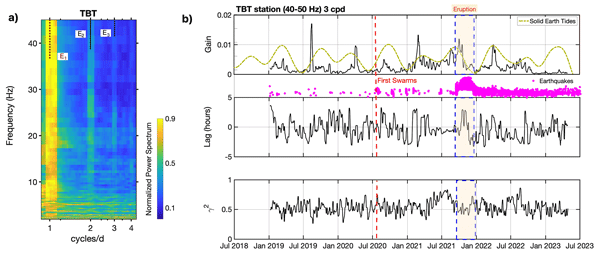
Abstract. Diffuse volcanic degassing is a persistent and often underestimated natural hazard, with potential impacts on air quality, ecosystem health, and volcanic risk management. Detecting and monitoring this process is challenging, especially in volcanoes lacking visible fumarolic activity, where the final stage of gas migration is jointly modulated by the shallow subsurface structure and natural pressure forcings. We present a continuous monitoring approach based on Rayleigh wave ellipticity from ambient seismic noise to track pressure-driven gas transport in the uppermost soil layers. Applied to Cumbre Vieja Volcano (La Palma, Canary Islands), the method detects subdaily seismic velocity variations linked to periodic pressure oscillations, consistent with natural forcings such as atmospheric and solid earth tides. In this work, we focus on the terdiurnal cycle, the only subdaily band at La Palma Island that reflects purely atmospheric pressure forcing. Its temporal evolution reveals long-term fluctuations that broadly coincide with reported CO2 emission trends, despite differences in spatial and temporal resolution between both estimates. In addition, we identify a clear semi-annual cycle in the long-term ellipticity response at the terdiurnal frequency. This seasonality coincides with the modulation by solid Earth tides and confirms their role in controlling permeability in the upper vadose zone and in the enhancement of barometric pumping efficiency across all stations analyzed. Prior to the 2021 eruption, the terdiurnal cycle reveals contrasting station responses, with TBT exhibiting the earliest and most sustained increase. Together, these observations point to the usefulness of this approach as a complementary tool in the assessment of diffuse degassing and volcanic unrest. This seismic-noise-based approach offers a cost-effective and resilient strategy for detecting hazardous gas migration, supporting early warning and mitigation efforts in volcanic regions.
-
Notice on discussion status
The requested preprint has a corresponding peer-reviewed final revised paper. You are encouraged to refer to the final revised version.
-
Preprint
(6735 KB)
-
The requested preprint has a corresponding peer-reviewed final revised paper. You are encouraged to refer to the final revised version.
- Preprint
(6735 KB) - Metadata XML
- BibTeX
- EndNote
- Final revised paper


Journal article(s) based on this preprint
Interactive discussion
Status: closed
-
RC1: 'Comment on egusphere-2025-5031', Anonymous Referee #1, 07 Nov 2025
-
AC1: 'Reply on RC1', Helena Seivane, 04 Jan 2026
Dear Reviewer,
Thank you very much for your thorough and constructive review. Your comments have been helpful in identifying aspects that required clarification. We provide detailed responses to all your remarks in the attached document and indicate the corresponding changes in the revised manuscript.
We hope that these revisions adequately address your concerns,
Sincerely,
Helena Seivane and Martin Schimmel
-
AC1: 'Reply on RC1', Helena Seivane, 04 Jan 2026
-
RC2: 'Comment on egusphere-2025-5031', Anonymous Referee #2, 27 Nov 2025
Dear authors,
I found your approach very interesting, as well as potentially relevant to the community. However, I think that, in its current state, the paper does not convey this message clearly enough. This is most likely due to the way the paper is currently set up. I will outline my main points first and provide more detailed comments later.Main Points:
I think the current structure of the paper is unbalanced and not ideal. Some sections are extremely long, while other, more important sections are rather short and confusing. Even after reading the paper several times, I found the main message somewhat difficult to follow. I think the authors should consider restructuring the paper and its focus.
The authors use the RWE measure, which seems to be relatively new to the community (there are not many references to its application in monitoring). Since this is the key metric, I think the authors should explain it in more detail. They should explain how the processing is done and how the RWE is determined. They should also consider showing the original RWE series, as well as the processed ones. Once they have done so and established the main features that are known to the community, they can discuss the short-term behaviour.
If I understand correctly, the authors want to measure changes in degassing caused by atmospheric tides using RWE. While I found this idea very interesting, I became confused when the time scales switched back and forth between short-term Fourier analysis and long-term interpretation. I think the idea and the goal should be outlined more clearly.
Where is the high-frequency noise coming from? What are the sources of the noise? These questions should be discussed.
Some aspects mentioned in the paper are not fully relevant to the study and its interpretation. I would suggest focusing more strongly on the relevant aspects (e.g. seismicity is an important factor in volcanic unrest, but perhaps not for this study or the authors mention HVSR, but it is not used in this study). Revising or cutting these sections could help to streamline the manuscript.
Other things, such as a description of atmospheric tides and their origin, are missing. I think the authors should provide a comprehensive yet concise summary of these effects (comparable to Kramer et al., 2025).For me, it is unclear why the authors present Rayleigh wave ellipticity as a measure when Vp is more affected. For an inexperienced reader, this might sound contradictory. This needs to be discussed more clearly.
Why is the 8-hour tide used? For example, a 4-hour tide has a similar magnitude according to the spectrum. In general, the testing signal is quite weak. I’m wondering why the authors are not using 2cpd instead. Solid Earth tides have a 2cpd component, but I don't expect this to have a significant impact on the near-surface zone. The authors could easily test this and compare the results.
While I am convinced by the author's claim that RWE is affected by the atmospheric tide, I am not so sure about the degassing part. I did not understand whether RWE is small or large, e.g. before an event, or what influence a greater release of gas has on RWE.
The anomalies identified by the authors appear to be of a similar magnitude to noise or other events. How did the authors classify the anomalies?
Minor Points:
The authors claim that RWE is similar to dv/v, yet no comparison is made, for example on line 266. Recent studies (e.g., Oakley 2021 or Kramer et al., 2023, 2025) show a similar correlation, just for dv/v. In general, I think the body of literature could be more comprehensive. Some of the claims should be supported by references, even the commonly used metric dv/v and the proposed RWE are not exactly the same.
I found the use of terms such as 'RWE' and 'RWE gain' confusing. What is the difference between them? Why are they not consistent?
Why is the tidal spectrum suddenly being calculated when it's about pressure changes?
I have decided not to mention minor language inconsistencies in order to focus on the content of the discussion for now. Again, I think it could be a valuable contribution, but it needs to be simplified and clarified. I look forward to hearing your thoughts.
Citation: https://doi.org/10.5194/egusphere-2025-5031-RC2 -
AC2: 'Reply on RC2', Helena Seivane, 04 Jan 2026
Dear Reviewer,
We thank you for your insightful review. Your remarks have been very helpful in improving the clarity and structure of the manuscript.Several of the points you raise overlap with those of Reviewer 1, and we have updated the manuscript to address these aspects.
We provide detailed responses to all your remarks in the attached document and indicate the corresponding changes in the revised manuscript.
We hope that these revisions satisfactorily address your concerns,
Sincerely,
Helena Seivane and Martin Schimmel
-
AC2: 'Reply on RC2', Helena Seivane, 04 Jan 2026
Peer review completion


Interactive discussion
Status: closed
-
RC1: 'Comment on egusphere-2025-5031', Anonymous Referee #1, 07 Nov 2025
Major points:I didn`t find the main measure used in the paper well-explained. It is not difficult though to give a concise, but precise description of what the ellipticity measure is. I went back recursively to several earlier papers, but frankly, didn`t find any simple explanation. Is it the sum of the two larger eigenvalues of the cross-spectral matrix, normalized by the trace? Is it, or is it something else? After looking through three of their papers, I`m still wondering. That shouldn`t be. The sense of motion in a Rayleigh wave is also indicative of subsurface structure. Is that included in the measure or not?What type are the seismic stations? One of them is an accelerometer, ok, but what about the others? How is the data processing done?
What time windows are used? How is the stacking done?Something else that is missing from the paper (and perhaps the earlier ones as well) is what the ellipticity says about the subsurface really:
what is the sensitivity to lateral dimensions? Is it sensitive up to a half wavelength away laterally? How does behave for a nearly monochromatic wave? That probably has a very complicated shape. The discussion of ellipticity constraining vp rather than vs changes is interesting though.As written above, the "DOP-E method" should be explained in this paper (see above). What are min/max values the measure of ellipticity can assume? Are you using a synthetic reference ellipticity calculation here, or not? Why actually should the ellipticity measure be insensitive to variations in noise sources?Which tidal component is used in Figure 2? Vertical displacement?In earlier studies (from other places), the barometric signal at 3/day had small amplitude, which did not allow for such studies at 3/day. It is surprising that the 3/day component is so large on the Canary Islands. Was the same time window used for barometric data from ERA5, as for the ellipticity.
What line 217 say in comparison with the 2/day component "..about 5 times smaller" "should say "..about 10 times smaller", right?It is a pity that only one one among the three seismic stations considered (in the vicinity of the volcano that is erupting) shows a clear pre-eruption signal, and incidentally the one the most distant from the volcano (which should show the smallest effect). The statement that the 3 cpd seismic component "represents a reliable diagnostic of pressure-driven processes" (line 448) seems too bold to me. I don`t think that the paper has demonstrated this yet.Unfortunately there has been only a short time window of outgassing measurements at one station, and that does not really agree well with the gain measurements. Line 309 states a "moderate agreement" between the lines in Figure 4a and A2. It is obvious what making such a statement would require: averaging the gain data to annual values, and comparing that quantitatively with the CO2 release. What is the statistical significance of the comparison (quantitatively)?Figure 3 is the first time the seismological data appear, but only in a heavily-processed and very specialized way. Is it really not possible toLine 313/314: that is pure speculation.
simply show the pertaining seismological data themselves. Neither the raw seismological data, nor the ellipticity traces show up in the paper anywhere. Don`t you think that this is missing?The paper is extremely dense and not easy to read. Figures are of good quality, but the complexity of the
measures and the complexity of the observed phenomena are complicating reading the paper.The seasonal variation is real, but it is not clear which process causes that.The anomaly is intriguing, but the other two stations don`t corroborate it. (Figure 4 contains label "anomalies" but they appear at different times on the different traces (!). You can`t be serious.The arguments of why the two closer stations don`t show the effects invoke different geology, hydrology etc. Sure, that could perhaps be true,
but the case for convincing that this "represents a reliable diagnostic of pressure-driven processes" is not strong.Line 460: "a slight increase is observed" seems to optimistic to me: to me that peak look just like noise.The Appendix shows DSI. That requires a few words saying what it is (one minus the crocor at 0-lag).Minor points:
Line 57: put a dot at the end.Line 115: replace "result from" by something like "are affected by". Otherwise the sentence is wrong.Line 148: define c_m" also.Figure 2: write "Normalized Spectral Amplitude"Line 259: since you`re not given a significance level, I would rather use "show" than "prove" (a strong word).Figures 4 and A2: "annual" instead of "anual".Figure 5: It would be nicer if the same frequency could be used as for the other two stations.
Line 303: Put a "(MSC)" behind "Magnitude-squared coherence".
Figure 4: label a), b), c) are missing.
Line 367: put a dot at the end.Line 630, 635 ff: "HVSNR" should be "HVSR".Citation: https://doi.org/10.5194/egusphere-2025-5031-RC1 -
AC1: 'Reply on RC1', Helena Seivane, 04 Jan 2026
Dear Reviewer,
Thank you very much for your thorough and constructive review. Your comments have been helpful in identifying aspects that required clarification. We provide detailed responses to all your remarks in the attached document and indicate the corresponding changes in the revised manuscript.
We hope that these revisions adequately address your concerns,
Sincerely,
Helena Seivane and Martin Schimmel
-
AC1: 'Reply on RC1', Helena Seivane, 04 Jan 2026
-
RC2: 'Comment on egusphere-2025-5031', Anonymous Referee #2, 27 Nov 2025
Dear authors,
I found your approach very interesting, as well as potentially relevant to the community. However, I think that, in its current state, the paper does not convey this message clearly enough. This is most likely due to the way the paper is currently set up. I will outline my main points first and provide more detailed comments later.Main Points:
I think the current structure of the paper is unbalanced and not ideal. Some sections are extremely long, while other, more important sections are rather short and confusing. Even after reading the paper several times, I found the main message somewhat difficult to follow. I think the authors should consider restructuring the paper and its focus.
The authors use the RWE measure, which seems to be relatively new to the community (there are not many references to its application in monitoring). Since this is the key metric, I think the authors should explain it in more detail. They should explain how the processing is done and how the RWE is determined. They should also consider showing the original RWE series, as well as the processed ones. Once they have done so and established the main features that are known to the community, they can discuss the short-term behaviour.
If I understand correctly, the authors want to measure changes in degassing caused by atmospheric tides using RWE. While I found this idea very interesting, I became confused when the time scales switched back and forth between short-term Fourier analysis and long-term interpretation. I think the idea and the goal should be outlined more clearly.
Where is the high-frequency noise coming from? What are the sources of the noise? These questions should be discussed.
Some aspects mentioned in the paper are not fully relevant to the study and its interpretation. I would suggest focusing more strongly on the relevant aspects (e.g. seismicity is an important factor in volcanic unrest, but perhaps not for this study or the authors mention HVSR, but it is not used in this study). Revising or cutting these sections could help to streamline the manuscript.
Other things, such as a description of atmospheric tides and their origin, are missing. I think the authors should provide a comprehensive yet concise summary of these effects (comparable to Kramer et al., 2025).For me, it is unclear why the authors present Rayleigh wave ellipticity as a measure when Vp is more affected. For an inexperienced reader, this might sound contradictory. This needs to be discussed more clearly.
Why is the 8-hour tide used? For example, a 4-hour tide has a similar magnitude according to the spectrum. In general, the testing signal is quite weak. I’m wondering why the authors are not using 2cpd instead. Solid Earth tides have a 2cpd component, but I don't expect this to have a significant impact on the near-surface zone. The authors could easily test this and compare the results.
While I am convinced by the author's claim that RWE is affected by the atmospheric tide, I am not so sure about the degassing part. I did not understand whether RWE is small or large, e.g. before an event, or what influence a greater release of gas has on RWE.
The anomalies identified by the authors appear to be of a similar magnitude to noise or other events. How did the authors classify the anomalies?
Minor Points:
The authors claim that RWE is similar to dv/v, yet no comparison is made, for example on line 266. Recent studies (e.g., Oakley 2021 or Kramer et al., 2023, 2025) show a similar correlation, just for dv/v. In general, I think the body of literature could be more comprehensive. Some of the claims should be supported by references, even the commonly used metric dv/v and the proposed RWE are not exactly the same.
I found the use of terms such as 'RWE' and 'RWE gain' confusing. What is the difference between them? Why are they not consistent?
Why is the tidal spectrum suddenly being calculated when it's about pressure changes?
I have decided not to mention minor language inconsistencies in order to focus on the content of the discussion for now. Again, I think it could be a valuable contribution, but it needs to be simplified and clarified. I look forward to hearing your thoughts.
Citation: https://doi.org/10.5194/egusphere-2025-5031-RC2 -
AC2: 'Reply on RC2', Helena Seivane, 04 Jan 2026
Dear Reviewer,
We thank you for your insightful review. Your remarks have been very helpful in improving the clarity and structure of the manuscript.Several of the points you raise overlap with those of Reviewer 1, and we have updated the manuscript to address these aspects.
We provide detailed responses to all your remarks in the attached document and indicate the corresponding changes in the revised manuscript.
We hope that these revisions satisfactorily address your concerns,
Sincerely,
Helena Seivane and Martin Schimmel
-
AC2: 'Reply on RC2', Helena Seivane, 04 Jan 2026
Peer review completion
Journal article(s) based on this preprint
Viewed
| HTML | XML | Total | BibTeX | EndNote | |
|---|---|---|---|---|---|
| 2,166 | 1,277 | 208 | 3,651 | 173 | 212 |
- HTML: 2,166
- PDF: 1,277
- XML: 208
- Total: 3,651
- BibTeX: 173
- EndNote: 212
Viewed (geographical distribution)
| Country | # | Views | % |
|---|
| Total: | 0 |
| HTML: | 0 |
| PDF: | 0 |
| XML: | 0 |
- 1

Martin Schimmel
The requested preprint has a corresponding peer-reviewed final revised paper. You are encouraged to refer to the final revised version.
- Preprint
(6735 KB) - Metadata XML
What time windows are used? How is the stacking done?
what is the sensitivity to lateral dimensions? Is it sensitive up to a half wavelength away laterally? How does behave for a nearly monochromatic wave? That probably has a very complicated shape. The discussion of ellipticity constraining vp rather than vs changes is interesting though.
What line 217 say in comparison with the 2/day component "..about 5 times smaller" "should say "..about 10 times smaller", right?
simply show the pertaining seismological data themselves. Neither the raw seismological data, nor the ellipticity traces show up in the paper anywhere. Don`t you think that this is missing?
measures and the complexity of the observed phenomena are complicating reading the paper.
but the case for convincing that this "represents a reliable diagnostic of pressure-driven processes" is not strong.
Line 57: put a dot at the end.
Line 303: Put a "(MSC)" behind "Magnitude-squared coherence".
Figure 4: label a), b), c) are missing.
Line 367: put a dot at the end.