
the Creative Commons Attribution 4.0 License.
the Creative Commons Attribution 4.0 License.
 | 14 Nov 2025
The diurnal cycle and temperature dependence of crystal shapes in ice clouds from satellite lidar polarized measurements
Abstract. The shape of crystals in ice clouds influences many aspects of the cloud lifecycle and radiative impact, yet they are extremely variable and hard to categorize. In this paper, we apply a recent crystal shape classification methodology to 33 months of spaceborne lidar measurements. We take advantage of their non-sun-synchronous nature to document the diurnal variability of ice crystal shapes. We find that that mid-level clouds are dominated by 3D bullets and 2D columns, with more 3D bullets at higher latitudes, in agreement with previous results. Shape dependence on latitude is generally symmetric around the equator. We document the repartition of shapes with temperatures, and show that the proportion of complex shapes (Droxtals and Voronois) increases at colder temperatures, becoming dominant below -60 °C. Finally, we document the diurnal cycle of the repartition of shapes according to temperature and latitude. We find that 2D plates and columns appear preferentially during daytime, while complex shapes are more likely to appear during nighttime. 3D bullets follow a unique behavior, shifting from a daytime maximum at coldest temperatures to a nighttime maximum at warmer temperatures. The amplitude of diurnal cycles generally strengthens at colder temperatures. These results provide new constraints for the representation of ice clouds in atmospheric and climate models.
-
Notice on discussion status
The requested preprint has a corresponding peer-reviewed final revised paper. You are encouraged to refer to the final revised version.
-
Preprint
(2721 KB)
-
The requested preprint has a corresponding peer-reviewed final revised paper. You are encouraged to refer to the final revised version.
- Preprint
(2721 KB) - Metadata XML
- BibTeX
- EndNote
- Final revised paper


Journal article(s) based on this preprint
Interactive discussion
Status: closed
-
RC1: 'Comment on egusphere-2025-5018', Anonymous Referee #1, 28 Nov 2025
-
AC2: 'Reply on RC1', Vincent Noel, 23 Feb 2026
The comment was uploaded in the form of a supplement: https://egusphere.copernicus.org/preprints/2025/egusphere-2025-5018/egusphere-2025-5018-AC2-supplement.pdf
-
AC2: 'Reply on RC1', Vincent Noel, 23 Feb 2026
-
RC2: 'Comment on egusphere-2025-5018', Anonymous Referee #2, 29 Nov 2025
General Comments:
This paper uses the methodology of Sato and Okamoto (2023) that was applied to CALIPSO lidar
(CALIOP) measurements to estimate the relative abundance of various ice particle shapes in
clouds but now applies this methodology to the CATS (Cloud Aerosol Transport System) satellite
lidar dataset for this same purpose. As a “sanity check”, consistency between the results from
this new study and that of Sato and Okamoto (2023) was verified. Then the diurnal variation of
ice particle shape was investigated for the first time, with quite interesting results. This paper is
of high caliber and worthy of publication in ACP after minor revision by addressing the
comments listed below. The paper is well organized and well written.
Specific Comments:
1. Section 2.2: As shown by Eq. 1 in Sato and Okamoto (2023), the lidar backscatter β is an
integral product of the particle size distribution (PSD) and the particle’s mean
backscattering cross-section (Cbk) where Cbk depends on particle size. Thus, β appears to
be a measure of the PSD second moment, while the ice particle number concentration Ni
denotes the 0th moment of the PSD. Is it safe to relate the fraction of a particle shape in
this paper to the relative Ni of that particle shape in the clouds? That is, there may be a
tendency for readers to interpret these results as a relative measure of Ni for each ice
particle shape. Since the lidar depolarization ratio δ that is used to discriminate cloud
particle shape is the ratio of two β values (for horizontal and vertical polarization), PSD
effects should cancel, leaving just the depolarization effect. The statistics in this paper
would thus be reporting the frequency of occurrence of δ corresponding to various
cloud particle shape categories as defined in Sato and Okamoto (2023), where δ
identifies the dominant shape sampled.
While in essence this is implied in Sect. 2.2 (and is evident in Sato and Okamoto), more
of this information could be presented so that the reader can more clearly understand
what the statistics in this paper actually mean.
2. The paper would be more interesting if it included images for the different ice particle
shapes being evaluated. Voronois ice particles are especially important since many
readers may not be familiar with them, and several images may be justified due to their
varied, complex shapes.
3. Lines 251-252: Please cite Ken Sassen’s work from the 1990’s here. Ken was the first to
relate lidar depolarization ratios to cloud particle shape as per my understanding, and he
has many published papers on this topic.
Technical Comments:
1. Line 69: This line contains “1.1.1 Subsection (as Heading 3)” and should be deleted.
2. Line 92: ATB => TAB?
3. Line 107: -80°S => -80°C ?-
AC1: 'Reply on RC2', Vincent Noel, 22 Feb 2026
The comment was uploaded in the form of a supplement: https://egusphere.copernicus.org/preprints/2025/egusphere-2025-5018/egusphere-2025-5018-AC1-supplement.pdf
-
AC1: 'Reply on RC2', Vincent Noel, 22 Feb 2026
Peer review completion


Interactive discussion
Status: closed
-
RC1: 'Comment on egusphere-2025-5018', Anonymous Referee #1, 28 Nov 2025
General comments:
This paper applies to the CATS observations a cloud-particle-shape partitioning framework based on lidar depolarization ratio, originally developed by Okamoto et al. (2019) and previously applied to CALIPSO observations by Sato and Okamoto (2023). The main interest of this study is that the CATS observations from the ISS offer a unique opportunity to document the global diurnal cycle of particle types observed by a spaceborne lidar.
While the topic is relevant, the choices made by the authors in presenting the results make the key information difficult to interpret. All results are shown as fractional partitions rather than absolute occurrences of cloud-particle shapes. There may be valid reasons for this choice, but the authors do not provide any justification. As a consequence, several of their interpretations become confusing, especially when discussing the diurnal cycle (Fig. 3) and the so-called “diurnal fraction anomaly amplitude” (Fig. 4). For instance, statements such as “Particles with strong daily cycles include 2D columns and plates at cold temperatures” (line 263) are hard to assess, because it is unclear whether these particle types actually exhibit a diurnal cycle in absolute occurrence, or whether the variations seen in fractional partition simply reflect diurnal changes in other categories (e.g., droxtals or Voronois), or vice versa.
In addition, the study does not address uncertainties. Since the classification relies entirely on depolarization-ratio thresholds, it would be important to demonstrate that the reported diurnal cycles are not artifacts arising from daytime–nighttime differences in signal retrieval. Moreover, variations could also arise from changes in detection sensitivity in the TAB when applying the Hagihara et al. (2010) cloud detection methodology.
Finally, it would strengthen the paper to relate the reported diurnal variations in particle shapes to existing knowledge on cloud diurnal evolution and microphysical processes. Highlighting how the different particle shapes interact with radiation, and how the results presented here help improve our understanding of these interactions, would also enhance the overall impact of the study.
I recommend that the manuscript undergo major revision to address the points outlined above. The topic is of significant interest, and the study has the potential to make a valuable contribution to the field once the issues related to presentation, interpretation, and uncertainties are adequately addressed.
Specific comments:
- The terms ‘3D’ and ‘2D’ ice particle types are not defined and may be unclear to the reader. Please clarify their meaning, or consider using clearer terminology such as ‘randomly oriented’ and ‘horizontally oriented’ particle types.
- The 3D column category is not mentioned. In the method proposed by Sato and Okamoto (2023) and followed here, it appears that 3D columns as well as aggregates of rosettes and columns are included in the 3D bullet types. Please clarify whether your categories are intended to be exhaustive with respect to ice particle shapes, or whether some particle types were deliberately excluded. For example, under which category should dendrites be classified?
- The classification relies solely on depolarization thresholds. Consequently, our confidence in the results depends directly on the uncertainty in the depolarization parameter retrieved by CATS. Please provide information on this uncertainty and discuss how it may affect the findings.
- I suggest including a few example lidar curtains showing the ice-type classification masks to help demonstrate the method and build confidence in its application to the CATS data.
- Figure 1 shows the partitioning of crystal shapes at each latitude, as indicated by the caption (“The sum of frequencies for all shapes at a given latitude is unity.”). If the authors wish to retain partitioning-fraction representation, I therefore suggest the following:
- Use a 100% stacked area chart, as in Fig. 2.
- Revise the caption from “Variation of crystal shape repartition with latitude” to “Partitioning of crystal shape categories with latitude”,
- Avoid discussing zonal ‘variations’ of the fraction of a single ice type, because such statements do not provide meaningful information on their own; the fraction of one category is inherently dependent on the occurrence of all other categories. For example:
- Line 138: “liquid particles still follow a symmetric repartition” => May be misleading. Since the figure shows the partitioning among particle types, the apparent symmetry of one category is inherently dependent on the fractions of the other categories and does not necessarily reflect the actual distribution of liquid particles.
- Lines 140–141: “the distributions of solid particles show a slight hemispheric asymmetry” => The plot does not show the distributions of particles, but their partitioning among particle types. Therefore, if the zonal distribution of one particle type is asymmetric, the zonal partitioning of all other particle types will automatically appear asymmetric, even if their actual distribution are not.
- Line 143: “Within the Tropics, they are clearly less present in the southern hemisphere” => Misleading. A decrease in the fraction of one particle type does not necessarily imply that this type is less present; it may simply reflect changes in the occurrence of other particle types.
- Lines 151–154: “A slight increase in liquid particles […] could be related to the local minimum of ice cloud amount […] which would lead to an increased influence of detection sensitivity.” => The conditional (‘could’) is unnecessary here because the plot represents partitioning. It is unclear what information this statement conveys.
- Lines 154–155: “Considering now solid particles, their amount are all symmetric around the equator” => Idem.
- I suggest including illustrations of the different ice shapes somewhere in the article. For example, above each column in Fig. 3.
- Lines 73–74: “This averaging configuration provided appropriate signal quality for shape classification on CALIPSO data.” => Please provide evidence or justification to support this statement.
- Line 91: “Third, we identified ice clouds based on temperature (colder than -5°C) and the x parameter.” => I am confused. Do you restrict your analysis to clouds that meet these conditions? If so, do the clouds satisfying these criteria (which are intended to identify ice particles) still include only liquid particles in low-level tropical clouds (Fig. 1a)?
- What hypotheses do the authors propose to explain that “CATS-based results report fewer bullets near the equator” (lines 159–162)?
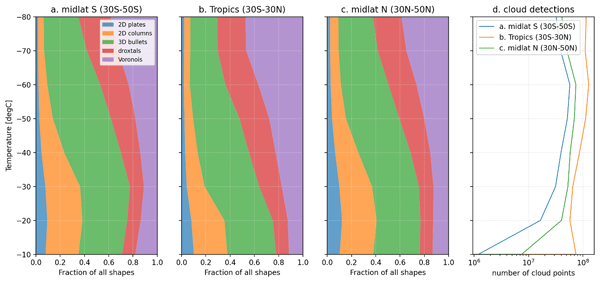
- Why does “The importance of 2D columns drops faster in the Tropics (Fig. 2b) compared to midlatitudes (Fig. 2a and 2c).” (line 185)?
- Lines 208–209: “amplitude as an indicator of the diurnal fluctuations of the importance of a given particle shape” (lines 208–209) => Although the sentence is logically correct, it is unclear what useful physical insight this ‘indicator’ is supposed to provide.
- Lines 217–219: “The DFA amplitude and the average fraction are not independent: large daily variations of fractions are only possible when the average fraction is important.” => I find this statement unclear, and it also appears to be mathematically incorrect. For example, imagine a situation where liquid particles are almost absent throughout the day except during one specific hour when all ice particles suddenly become liquid. In that case, the daily average liquid fraction would remain very small, yet the DFA amplitude could still reach 100%. While this example is exaggerated, it illustrates that a large amplitude does not require a large daily mean.
Technical corrections:
- Line 5: “Institut Polytechnique de Pairs” => “Institut Polytechnique de Paris”.
- Line 12: “33 months of CATS spaceborne”.
- Line 13: “We find that that” => Remove one “that”.
- Lines 63–64: “These come from the MERRA-2 reanalysis” => Indicate the spatial and temporal resolutions.
- Line 69: Remove “1.1.1 Subsubsection (as Heading 3)”.
- Line 72: “the CALIPSO Kyushu University (CALIPSO-KU) cloud product (Yoshida et al., 2010)”
Yoshida, R., Okamoto, H., Hagihara, Y., & Ishimoto, H. (2010). Global analysis of cloud phase and ice crystal orientation from Cloud‐Aerosol Lidar and Infrared Pathfinder Satellite Observation (CALIPSO) data using attenuated backscattering and depolarization ratio. Journal of Geophysical Research: Atmospheres, 115(D4).
- Line 74: “Although CATS and CALIPSO operated at different wavelengths” => Please clarify, as both instruments actually operate at 532 nm and 1064 nm.
- Line 76: “the CALIPSO-KU averaging scheme” and remove “designed for CALIPSO”
- Line 92: “ATB” => “TAB”.
- Fig. 1d: Replace the y-axis max value by 1e8.
- Lines 99–100: “bullets (including bullet rosettes and 3D aggregates)” => And 3D columns?
- Line 129: “ice particles in those clouds are almost exclusively liquid” => Seems to defy a few laws of thermodynamics.
- Lines 169–170: “high clouds feature mostly 3D bullets and Voronois (the second one being significantly more frequent in the 20°S-20°N band)” => The comment in parentheses does not support the statement that “the CATS results shown here agree very well with the CALIPSO results”.
- Line 194: “In daytime conditions (06:00-18:00 local time, not shown)” => Please add it to the appendix.
Citation: https://doi.org/10.5194/egusphere-2025-5018-RC1 -
AC2: 'Reply on RC1', Vincent Noel, 23 Feb 2026
The comment was uploaded in the form of a supplement: https://egusphere.copernicus.org/preprints/2025/egusphere-2025-5018/egusphere-2025-5018-AC2-supplement.pdf
-
RC2: 'Comment on egusphere-2025-5018', Anonymous Referee #2, 29 Nov 2025
General Comments:
This paper uses the methodology of Sato and Okamoto (2023) that was applied to CALIPSO lidar
(CALIOP) measurements to estimate the relative abundance of various ice particle shapes in
clouds but now applies this methodology to the CATS (Cloud Aerosol Transport System) satellite
lidar dataset for this same purpose. As a “sanity check”, consistency between the results from
this new study and that of Sato and Okamoto (2023) was verified. Then the diurnal variation of
ice particle shape was investigated for the first time, with quite interesting results. This paper is
of high caliber and worthy of publication in ACP after minor revision by addressing the
comments listed below. The paper is well organized and well written.
Specific Comments:
1. Section 2.2: As shown by Eq. 1 in Sato and Okamoto (2023), the lidar backscatter β is an
integral product of the particle size distribution (PSD) and the particle’s mean
backscattering cross-section (Cbk) where Cbk depends on particle size. Thus, β appears to
be a measure of the PSD second moment, while the ice particle number concentration Ni
denotes the 0th moment of the PSD. Is it safe to relate the fraction of a particle shape in
this paper to the relative Ni of that particle shape in the clouds? That is, there may be a
tendency for readers to interpret these results as a relative measure of Ni for each ice
particle shape. Since the lidar depolarization ratio δ that is used to discriminate cloud
particle shape is the ratio of two β values (for horizontal and vertical polarization), PSD
effects should cancel, leaving just the depolarization effect. The statistics in this paper
would thus be reporting the frequency of occurrence of δ corresponding to various
cloud particle shape categories as defined in Sato and Okamoto (2023), where δ
identifies the dominant shape sampled.
While in essence this is implied in Sect. 2.2 (and is evident in Sato and Okamoto), more
of this information could be presented so that the reader can more clearly understand
what the statistics in this paper actually mean.
2. The paper would be more interesting if it included images for the different ice particle
shapes being evaluated. Voronois ice particles are especially important since many
readers may not be familiar with them, and several images may be justified due to their
varied, complex shapes.
3. Lines 251-252: Please cite Ken Sassen’s work from the 1990’s here. Ken was the first to
relate lidar depolarization ratios to cloud particle shape as per my understanding, and he
has many published papers on this topic.
Technical Comments:
1. Line 69: This line contains “1.1.1 Subsection (as Heading 3)” and should be deleted.
2. Line 92: ATB => TAB?
3. Line 107: -80°S => -80°C ?-
AC1: 'Reply on RC2', Vincent Noel, 22 Feb 2026
The comment was uploaded in the form of a supplement: https://egusphere.copernicus.org/preprints/2025/egusphere-2025-5018/egusphere-2025-5018-AC1-supplement.pdf
-
AC1: 'Reply on RC2', Vincent Noel, 22 Feb 2026
Peer review completion
Journal article(s) based on this preprint
Viewed
| HTML | XML | Total | BibTeX | EndNote | |
|---|---|---|---|---|---|
| 955 | 392 | 95 | 1,442 | 75 | 522 |
- HTML: 955
- PDF: 392
- XML: 95
- Total: 1,442
- BibTeX: 75
- EndNote: 522
Viewed (geographical distribution)
| Country | # | Views | % |
|---|
| Total: | 0 |
| HTML: | 0 |
| PDF: | 0 |
| XML: | 0 |
- 1

Hélène Chepfer
Christelle Barthe
John Yorks
The requested preprint has a corresponding peer-reviewed final revised paper. You are encouraged to refer to the final revised version.
- Preprint
(2721 KB) - Metadata XML
General comments:
This paper applies to the CATS observations a cloud-particle-shape partitioning framework based on lidar depolarization ratio, originally developed by Okamoto et al. (2019) and previously applied to CALIPSO observations by Sato and Okamoto (2023). The main interest of this study is that the CATS observations from the ISS offer a unique opportunity to document the global diurnal cycle of particle types observed by a spaceborne lidar.
While the topic is relevant, the choices made by the authors in presenting the results make the key information difficult to interpret. All results are shown as fractional partitions rather than absolute occurrences of cloud-particle shapes. There may be valid reasons for this choice, but the authors do not provide any justification. As a consequence, several of their interpretations become confusing, especially when discussing the diurnal cycle (Fig. 3) and the so-called “diurnal fraction anomaly amplitude” (Fig. 4). For instance, statements such as “Particles with strong daily cycles include 2D columns and plates at cold temperatures” (line 263) are hard to assess, because it is unclear whether these particle types actually exhibit a diurnal cycle in absolute occurrence, or whether the variations seen in fractional partition simply reflect diurnal changes in other categories (e.g., droxtals or Voronois), or vice versa.
In addition, the study does not address uncertainties. Since the classification relies entirely on depolarization-ratio thresholds, it would be important to demonstrate that the reported diurnal cycles are not artifacts arising from daytime–nighttime differences in signal retrieval. Moreover, variations could also arise from changes in detection sensitivity in the TAB when applying the Hagihara et al. (2010) cloud detection methodology.
Finally, it would strengthen the paper to relate the reported diurnal variations in particle shapes to existing knowledge on cloud diurnal evolution and microphysical processes. Highlighting how the different particle shapes interact with radiation, and how the results presented here help improve our understanding of these interactions, would also enhance the overall impact of the study.
I recommend that the manuscript undergo major revision to address the points outlined above. The topic is of significant interest, and the study has the potential to make a valuable contribution to the field once the issues related to presentation, interpretation, and uncertainties are adequately addressed.
Specific comments:
- The terms ‘3D’ and ‘2D’ ice particle types are not defined and may be unclear to the reader. Please clarify their meaning, or consider using clearer terminology such as ‘randomly oriented’ and ‘horizontally oriented’ particle types.
- The 3D column category is not mentioned. In the method proposed by Sato and Okamoto (2023) and followed here, it appears that 3D columns as well as aggregates of rosettes and columns are included in the 3D bullet types. Please clarify whether your categories are intended to be exhaustive with respect to ice particle shapes, or whether some particle types were deliberately excluded. For example, under which category should dendrites be classified?
- The classification relies solely on depolarization thresholds. Consequently, our confidence in the results depends directly on the uncertainty in the depolarization parameter retrieved by CATS. Please provide information on this uncertainty and discuss how it may affect the findings.
- I suggest including a few example lidar curtains showing the ice-type classification masks to help demonstrate the method and build confidence in its application to the CATS data.
- Figure 1 shows the partitioning of crystal shapes at each latitude, as indicated by the caption (“The sum of frequencies for all shapes at a given latitude is unity.”). If the authors wish to retain partitioning-fraction representation, I therefore suggest the following:
- I suggest including illustrations of the different ice shapes somewhere in the article. For example, above each column in Fig. 3.
- Lines 73–74: “This averaging configuration provided appropriate signal quality for shape classification on CALIPSO data.” => Please provide evidence or justification to support this statement.
- Line 91: “Third, we identified ice clouds based on temperature (colder than -5°C) and the x parameter.” => I am confused. Do you restrict your analysis to clouds that meet these conditions? If so, do the clouds satisfying these criteria (which are intended to identify ice particles) still include only liquid particles in low-level tropical clouds (Fig. 1a)?
- What hypotheses do the authors propose to explain that “CATS-based results report fewer bullets near the equator” (lines 159–162)?
- Why does “The importance of 2D columns drops faster in the Tropics (Fig. 2b) compared to midlatitudes (Fig. 2a and 2c).” (line 185)?
- Lines 208–209: “amplitude as an indicator of the diurnal fluctuations of the importance of a given particle shape” (lines 208–209) => Although the sentence is logically correct, it is unclear what useful physical insight this ‘indicator’ is supposed to provide.
- Lines 217–219: “The DFA amplitude and the average fraction are not independent: large daily variations of fractions are only possible when the average fraction is important.” => I find this statement unclear, and it also appears to be mathematically incorrect. For example, imagine a situation where liquid particles are almost absent throughout the day except during one specific hour when all ice particles suddenly become liquid. In that case, the daily average liquid fraction would remain very small, yet the DFA amplitude could still reach 100%. While this example is exaggerated, it illustrates that a large amplitude does not require a large daily mean.
Technical corrections:
- Line 5: “Institut Polytechnique de Pairs” => “Institut Polytechnique de Paris”.
- Line 12: “33 months of CATS spaceborne”.
- Line 13: “We find that that” => Remove one “that”.
- Lines 63–64: “These come from the MERRA-2 reanalysis” => Indicate the spatial and temporal resolutions.
- Line 69: Remove “1.1.1 Subsubsection (as Heading 3)”.
- Line 72: “the CALIPSO Kyushu University (CALIPSO-KU) cloud product (Yoshida et al., 2010)”
Yoshida, R., Okamoto, H., Hagihara, Y., & Ishimoto, H. (2010). Global analysis of cloud phase and ice crystal orientation from Cloud‐Aerosol Lidar and Infrared Pathfinder Satellite Observation (CALIPSO) data using attenuated backscattering and depolarization ratio. Journal of Geophysical Research: Atmospheres, 115(D4).
- Line 74: “Although CATS and CALIPSO operated at different wavelengths” => Please clarify, as both instruments actually operate at 532 nm and 1064 nm.
- Line 76: “the CALIPSO-KU averaging scheme” and remove “designed for CALIPSO”
- Line 92: “ATB” => “TAB”.
- Fig. 1d: Replace the y-axis max value by 1e8.
- Lines 99–100: “bullets (including bullet rosettes and 3D aggregates)” => And 3D columns?
- Line 129: “ice particles in those clouds are almost exclusively liquid” => Seems to defy a few laws of thermodynamics.
- Lines 169–170: “high clouds feature mostly 3D bullets and Voronois (the second one being significantly more frequent in the 20°S-20°N band)” => The comment in parentheses does not support the statement that “the CATS results shown here agree very well with the CALIPSO results”.
- Line 194: “In daytime conditions (06:00-18:00 local time, not shown)” => Please add it to the appendix.