
the Creative Commons Attribution 4.0 License.
the Creative Commons Attribution 4.0 License.
 | 23 Oct 2025
Measurement report: Ice nucleation ability of perthite feldspar powder
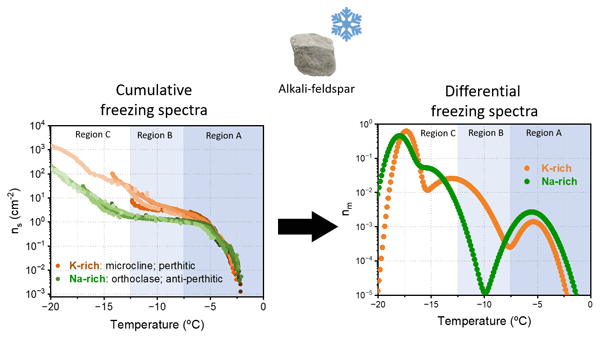
Abstract. Feldspars are among the most efficient mineral ice-nucleating particles (INPs) in the atmosphere. However, their nucleation behavior varies significantly across natural samples. This study investigates six feldspar powders selected for their perthitic or anti-perthitic textures and spanning a range of K/Na compositions. All samples were comprehensively characterized in terms of mineralogy, bulk and surface chemistry, and microstructure. Droplet freezing assays revealed consistent onset temperatures between −2 and −4 °C, suggesting the presence of shared active nucleation sites across all feldspar types. Cumulative and differential freezing spectra revealed marked differences in the density and distribution of ice-nucleating sites, which were found to correlate with both feldspar composition and microtexture. Using HUB analysis, different subpopulations of ice-nucleating sites were identified. Perthites showing microcline structures exhibited a continuous increase in nucleation site density with decreasing temperature as subpopulations became active. In contrast, samples lacking dominant microcline structures showed plateaus in the cumulative spectra within specific temperature ranges, indicating a significant reduction in certain subpopulations. These findings highlight the crucial role of exsolution textures and crystallographic structure in regulating feldspar ice-nucleation efficiency. The results have implications for understanding feldspar behavior in the atmosphere and for improving predictive models in cloud microphysics.
-
Notice on discussion status
The requested preprint has a corresponding peer-reviewed final revised paper. You are encouraged to refer to the final revised version.
-
Preprint
(1199 KB)
-
Supplement
(1232 KB)
-
The requested preprint has a corresponding peer-reviewed final revised paper. You are encouraged to refer to the final revised version.
- Preprint
(1199 KB) - Metadata XML
-
Supplement
(1232 KB) - BibTeX
- EndNote
- Final revised paper


Journal article(s) based on this preprint
Interactive discussion
Status: closed
-
RC1: 'Comment on egusphere-2025-5014', Thomas F. Whale, 07 Nov 2025
-
AC1: 'Reply on RC1', Júlia Canet, 15 Dec 2025
We would like to sincerely thank the reviewer for taking the time to evaluate our work and for the constructive comments provided. We appreciate the suggestions, which have been very helpful in improving the clarity and quality of the paper. Below, we provide detailed, point-by-point responses to each of the reviewer’s comments and describe the corresponding revisions made to the text, organized in the same order for ease of comparison.
1) RC1: The authors may find the LDH1 feldspar data from Daily et al. (2023) of interest. It originates from the same location (Mt Malosa, Malawi) as the TUD#3 sample in Harrison et al. This material, described, perhaps a little hyperbolically, as ‘hyper-active’ in Harrison et al. (2016), appears to eliminate supercooling entirely when present in sufficient quantity—even Snomax and AgI don’t do this. Could you compare this measurement to what you already have? Would it change your conclusions regarding the nature of high temperature feldspar ice nucleation sites?
To avoid ambiguity in Fig. 6, we clarify that the dataset labelled Microcline in Fig. 6 corresponds to the TUD#3 Microcline (1 wt%) reported in Harrison et al. (2016), while the dataset labelled Albite corresponds to the Amelia albite (1 wt%) from the same study. The nomenclature has now been made consistent in the revised manuscript.
LDH1 from Daily et al. (2023) originates from the same geological location as the TUD#3 Microcline analyzed in Harrison et al. (2016). However, the dataset provided by Daily et al. (2023) reports fraction frozen and Nm (active sites per mass), rather than Ns (active sites per surface area), and therefore it cannot be included directly in Fig. 6, which compares Ns(T).
To address the reviewer’s comment, we compared the fraction frozen curves of LDH1 (1 µL) and TUD#3 (Fig. C1 in the response pdf file). LDH1 shows higher freezing efficiently than TUD#3. This is probably due to the higher density or accessibility of active sites in LDH1, although the underlying nucleation mechanism is likely the same.
It appears to eliminate supercooling for LDH1 are only found for droplets of 50 µL, and not be directly compared with our experimental results. Therefore, adding Daily et al. (2023)’s LDH1 data does not alter the interpretation or conclusions presented in the manuscript.
2) RC2: It is important to state how long feldspar samples were in contact with water before ice nucleation measurements. Harrison et al. (2016) demonstrated significant changes in activity over time for some feldspars (see Fig. 4). For example, our purest albite sample started highly active but became much less active after 16 months. The hyperactive TUD#3 feldspar also declined, though less dramatically. While I am not suggesting time-consuming aging experiments here, acknowledging this potential variability and complexity would strengthen the discussion.
We fully agree that the residence time of feldspar in water can influence its ice-nucleation activity, as shown in Harrison et al. (2016). This is an important point that requires explicit clarification, and it has been added to the manuscript.
3) RC1: Regarding the impact of aluminosilicate ordering on the nucleation mode at -15°C – it seems likely that this is still something to do with exposure of the feldspar (100)? Can anything be said about likely differences in the relevant features between orthoclase and microcline? I agree that the evidence points to this (and it may be the main new finding in this work) but it’s not obvious to me why aluminosilicate structural disorder itself should have anything much to do with ice nucleation. Maybe I am missing something.
Our data show that the more ordered feldspars (Microcline) display an increase in nₛ(T), whereas the more disordered ones (Orthoclase) exhibit a pronounced plateau around −15 °C. This contrast aligns well with the mechanism proposed in previous studies (Kiselev et al., 2016; Pedevilla et al., 2016, 2017; Franceschi et al., 2024), which suggests that Al/Si ordering in Microcline governs the arrangement of surface –OH groups and cations on the (100) face, thereby influencing the ability of the surface to stabilise a quasi-ordered layer of interfacial water. Although we did not directly measure surface structure or OH distribution, the nucleation behavior we observe is consistent with this mechanism, indicating that Al/Si disorder reduces the chemical and structural regularity of the active surface and consequently its efficiency as an ice-nucleating substrate. Additional sentences have been included to clarify this point in the revised manuscript.
4) RC1: The phrase ‘shared active nucleation sites’ is a little unclear I would say. I agree the sites are most likely very similar in nature, but the measured onset temperatures are still different, so they are in some sense ‘different’. What constitutes ‘shared’? Perhaps I am being too picky here but I think it is wrong to imply that the sites are identical in the way that e.g. ice nucleating proteins might be.
The wording has been revised to avoid implying that the active sites are identical. The manuscript now refers to “a similar class of high-temperature nucleation sites” instead of “shared active sites.”.5) RC1: More discussion of the findings in Kiselev et al. (2021) would be valuable, particularly the results the for FS08-64 samples (o and c). These samples began as gem-quality sanidines but underwent ion exchange and annealing under different conditions to induce cracks, resulting in distinct cumulative spectra. Their processes may have created both the site population at -5 °C and the colder modes identified in this paper. Could you conduct the HUB analysis on that data? I think this would add significant value.
Following these suggestions, we performed a HUB analysis on the FS08-64 data from Kiselev et al. (2021). The figure of ns(T) generated from the published data and its HUB analysis is attached (Fig. C2 in the pdf file). This analysis and the corresponding figure have been included in both the main text of the manuscript and the Supplementary Information.
We compared data from the untreated sample (FS08-VS) with samples that, after different treatments, were finally tempered at 550 °C either in vacuum (FS08-c) or in a NaCl–KCl salt melt (FS08-o) to induce cracking. For FS08-VS and FS08-c, our HUB analysis, restricted to temperatures down to –25 °C, required two subpopulations to achieve a good fit, whereas for FS08-o three subpopulations were necessary.
Using the same subpopulation regions defined in Figure 8, we observed that FS08-VS shows peaks only within Subpopulation C. In contrast, the HUB analysis of FS08-c requires peaks in both Subpopulation B and Subpopulation C for an adequate fit, while FS08-o requires contributions from all three regions (A, B, and C).
According to the authors, the first treatment (FS08-c) induces the formation of patches of (100) crystal surfaces along the crack walls, enhancing ice-nucleating activity. Our HUB analysis is consistent with this interpretation, as this treatment increases the contribution of Subpopulation B, which we have associated mainly with perthites exhibiting ordered microcline structure; structures that would facilitate the exposure of ordered (100) surface patches inside cracks.
The second treatment (FS08-o) leads to the formation of a K-rich surface layer along the crystal surfaces and cracks. The authors hypothesize that this may have produced secondary surface-parallel cracks, thereby increasing IN activity, although the nature of the newly formed nucleation sites remains unclear. We hypothesize that these additional sites may be related to a more defective surface and potentially linked to water confinement effects. This interpretation aligns with our general finding that these IN sites appear across all our samples, regardless of whether they are more microcline- or orthoclase-rich.
6) RC1: The claim that similar IN behaviour implies comparable geological conditions and analogous surface properties may be overstated to my mind? I think Kiselev et al. (2021) shows that you can probably get similar relevant features on a feldspar surfaces in rather different ways.
We understand the reviewer’s concern. We now clarify that similar INA behaviour does not necessarily imply identical geological conditions. The wording has been adjusted accordingly to avoid overstatement.
Regarding minor comments:
- Citations to Kiselev et al. (2017) and Keinert et al. (2022) have been added to support the statement regarding nucleation on the (100) face.
- The resolution of Figure 1(a) has been improved in the revised submission.
- The reference list has been checked and corrected so all have the same format.
We thank the reviewer again for the constructive suggestions and positive assessment. If any point requires further clarification, we are happy to address it.
-
AC1: 'Reply on RC1', Júlia Canet, 15 Dec 2025
-
RC2: 'Comment on egusphere-2025-5014', Anonymous Referee #2, 15 Nov 2025
Canet et al. presented a study on the immersion freezing activity of 6 feldspar samples to characterize their ice nucleation behaviour. The authors analyzed the chemical composition, minerology, surface area and particle size distribution of those samples, in addition to microscopy images for particle visualization. The authors also applied newly reported data analysis method (i.e., Heterogeneous Underlying-Based (HUB) method) to investigate the contribution of different sub-group of ice nucleation sites. Then, the authors compared their results with those in literature. As a measurement report, the amount of work included in this preprint is sufficient. Unfortunately, following ACP guideline, the presentation quality should be improved before acceptance for publication. We briefly list our general comments as below, followed by more detailed comments. We hope that our comments can help the authors improve this preprint and we encourage the authors to do a resubmission.
General comments:
- This preprint is lack of in-depth discussion on interpreting the ice nucleation activity of the samples. For some figures, for instance Figure 4, 6 and 9, even the main information of the data is not sufficiently presented. For example, statements in Line 250-254 are all the text for data in Figure 4, which even did not fully elaborate data in each panel, not mention in-depth discussions for help readers to digest the results.
- There are some (mis-) over-interpretations on the data presented in Figure 3 and 8. For example, the statement in Line 218-219 is not consistent with the data shown in Figure 3a which shows the 0.1wt%-sample freezes almost by 100% at -20°C but not like what the authors elaborated: 90% droplets remained unfrozen. For Figure 8, the statement in line 415-416 goes that the IN active site density of the ‘first subpopulation’ (defined by the authors) appears to be higher in both K-rich and Na-rich perthite feldspars compared to those with more balanced Na/K ratios. However, Figure 8a shows that the peak of the ‘first subpopulation’ of IK1 is similar to that of LNaK1 in Figure 8b.
- Some data was visualized carelessly. There are some obvious mistakes regarding the labeling in figures and sample/measurement information is inconsistent through the text. For example, the authors introduced sample concentrations in section 2 as ‘concentration of 10, 5, 2, 1, 0.5, 0.1, 0.05, 0.01 and 0.001 wt%.’, however, Figure 3a shows results for samples with concentrations from 5 wt% to 0.00001 wt%. What is the sample with concentration of 0.00001 wt%? And Figure 3b for ns should be based on the frozen fraction data in Figure 3a. But Figure 3a does not include data for a sample with concentration 0.001 wt% which is shown in Figure 3b. And what is the sample called FK1 in Figure 2a? Such a sample is not introduced elsewhere in the main text. We suggest the authors carefully going through the preprint for corrections and ensuring the quality of the presentation.
- Discussions on the correlations between sample properties and IN behavior are lacking. The authors first presented the property characterization results for feldspar samples in Figures 1 and 2 and Tables 1 and 2. From Figure 3, the authors started to focus on the IN behavior of the samples. Unfortunately, the authors did not link both parts sufficiently.
- The Discussion section is poorly organized. It should be better structured with subtitles and clearer delivery messages.
- Some literature citations are inappropriate. For example, line 397 ‘Interestingly, similar trends have been observed in this study (Welti et al., 2019),’. The statement refers to this study, why is there a need to refer to Welti et al. 2019? Also in line 455, one did not see it is necessary to refer to Burrows et al., 2022. The literature is relevant but not cited in the correct way.
- Figures generally should be improved for better quality. For example, Figure 1 should have better resolution and Figures 3, 4 and 5 are hard to read because of the poor color scheme.
- Given the high sample concentration (1, 2, 5, 10 wt%) tested for droplet freezing experiments, one critical issue would be the aggregation/agglomeration of particles and even the formation of sediment at the tip of PCR wells, which renders the IN results not relevant for suspended particles anymore. Unfortunately, the effects of particle clusters/sediments were not addressed in the preprint. One would challenge that the freezing activity at warm temperatures of concentrated samples is because of freezing on sedimented sample surface, which corresponds to the first sub-group active sites in Figure 8, while the freezing of suspended particles of less concentrated samples at lower temperatures may be more relevant to the second subgroup below -15C. In the literature, it is rarely reported that mineral dust aerosol particles can freeze at such warm temperatures but more reported freezing for T<-15C (Murray et al. 2012) .
- We suggest the authors to prepare some text figures and tables in the supplementary. Without any text in the supplementary or if not clearly introduced in the main text like now, it is hard for readers to read them.
Detailed comments:
- Line 15: should be ice nucleation
- Line 16: ‘comprehensively’ change the wording. One will expect more objective statements. Also for ‘systematically’ (line 430) and ‘robust and statistically meaningful’ (line 431), etc.
- Line 17-19: the sample mass concentration should be clarified. Otherwise, the statement is misleading readers to assume K-feldspar is as active as biological particles (e.g., bacteria) that single particles can trigger ice formation at warm sub-zero temperatures.
- Line 20: ‘HUB’ should be defined
- Line 26: better to use ‘INP parameterizations’ instead of ‘predictive models’
- Line 31: should be homogeneous freezing but not homogeneous ice nucleation. Please check Vali et al. (2015).
- Line 33: by some of airborne particles. Not all airborne particles are INPs.
- Line 41 and 45 (other parts relevant also): be consistent with ‘ice nucleation efficiency’
- Line 52: give a definition for active sites. There are already some relevant statements in Line 43-45.
- Line 58: ‘specific’? please be explicit and unambiguously develop these statements. Also, there are many statements in this preprint like this in an ambiguous way. Please revise them accordingly.
- Line 61-74: consider revising this part and improving Figure 1 with better schematics to more clearly introduce the mineralogy of feldspar
- Line 127-128: did the samples for IN measurements undergo the same suspension by sonication?
- Line 130: why do the degassing at 393K for 24 hours? There are studies reporting the phase change of feldspar after exposing to temperatures above 100C and leads to increased surface area (e.g., Thomas M. Blattmann, Applied Clay Science 258 (2024) 107477, https://doi.org/10.1016/j.clay.2024.107477).
- Line 135: sample concentrations should be consistent with results in following figures
- Line 135-136: ‘For each dilution, 96 droplets of 3 μL were dispensed into two 384 -well plates,’ is not a clear statement. How were 96 droplets dispensed into two 384-well plates?
- Line 146-147: was background noise subtracted for samples for which there is an influence from the background?
- Line 188-190: It is not intuitive to see aligned porosity of samples in the microscopy images. Please indicate it to guide naked eyes.
- Line 218-219: NO. Almost all droplets freeze at -20C even for 0.05wt%.
- Line 220: should be pure water
- Line 226-227: the results of heated samples should be provided, at least in the supplementary
- Line 240: equation wrong. Please check Vali (2019) for their equation 4
- Line 241: what is NL(T)? did it show up in equation (1) or somewhere?
- Line 247-248: ice nucleation sites
- Line 250-254: no discussions on the date in Figure 4. What do we learn from the data? Any deliverables?
- Line 267-268: what do we learn from the data? Does it mean the size of particles is not important for feldspar ice nucleation?
- Line 276: consistent? How? the data points in Figure 6 spreads for four orders of magnitude around -4C and more than two orders of magnitude at lower temperatures? How can the authors argue that the results are consistent?
- Line 290-291: for which sample concentration was the temperature values calculated?
- Line 291-292: please indicate the temperature values in many publications the authors referred to. However, in Figure 6, LNaK1 in this study shows the lowest onset temperature, which is lower than results from the literature, isn't it? One cannot write down statements out of the blue.
- Line 302-305: we cannot agree. What is the effect of particle agglomeration given such high concentration of particles in the tested samples?
- Line 306: now, go back to figure 4. Why not discuss it when first introduce data in Figure 4?
- Line 328-329: we cannot agree with the authors that size is not important for particle ice nucleation. Also, BET results depends on particle size. Samples with smaller sizes generally show larger BET surface area. This is also supported by the results of LNa2 (Table 2). The authors should consider this point when discussing results in Figure 5.
- Line 334: ‘and correspondingly display higher IN sites densities between −5 to −20 ℃.’ Refers to which figure?
- Line 367: Not very similar. The biggest difference is between IK1 and IK2. Any explanations?
- Line 391-395: please refer to results presented in figures.
- Line 397: It is inapposite to refer to Welti et al. for this study.
- Line 406-413: Are these statements relevant to this study? Does this study include any results with samples having different -OH groups?
- Line 415-416: over interpretation! The first peak of IK1 is similar to LNaK1 in the figure
- Line 419-420: the statement can be supported by results in which figure? Please clearly refer to it
- Line 457: which sample group? Be clear
- Line 455: why refer to Burrows et al., 2022 when mentioning findings in this study
Technical corrections:
- Figure 1: what is Qz? The quality is very poor. Text is hard to read. Is panel a created by the authors or does it need a copyright from other publications?
- Table 1: why are sample names in different colors? to highlight anything?
- Figure 2: what is the sample FK1 in panel a? According to ACP guidelines, this figure should be labeled as 6 panels. And the font size of the text in the figure should be the same as the main text.
- Table 2: the same as for Table 1
- Figure 3: Figure 3b should be based on Figure 3a. However, there is no frozen fraction curve for sample with concentration of 0.001wt%. In panel a, the samples with concentration of 0.0001 wt% and 0.00001wt% were not introduced in the main text at all? Where are they from? The color scheme used is a bad decision.
- Figure 4: very hard to read because of the bad choice of color scheme
- Figure 5: use legend for samples with large and small particles
- Figure 6: there are four font sizes in this figure. Please check ACP guidelines
- Figure 7: add axis scales. What is the thin black line at the top?
- Figure 9: what is the unit on the y-axis for panel b and d?
- Figure S4: change the color scheme for better readability
- Figure S5: use different colors for better readability
References:
Murray, B. J., O’Sullivan, D., Atkinson, J. D., and Webb, M. E.: Ice Nucleation by Particles Immersed in Supercooled Cloud Droplets, Chem. Soc. Rev., 41, 6519–6554, https://doi.org/10.1039/c2cs35200a, 2012.
Vali, G.: Revisiting the differential freezing nucleus spectra derived from drop-freezing experiments: methods of calculation, applications, and confidence limits, Atmos. Meas. Tech., 12, 1219-1231, https://doi.org/10.5194/amt-12-1219-2019, 2019.
Vali, G., DeMott, P. J., Möhler, O., and Whale, T. F.: Technical Note: A Proposal for Ice Nucleation Terminology, Atmos. Chem. Phys., 15, 10263-10270, https://doi.org/10.5194/acp-15-10263-2015, 2015.
Citation: https://doi.org/10.5194/egusphere-2025-5014-RC2 -
AC2: 'Reply on RC2', Júlia Canet, 18 Dec 2025
We are grateful to the reviewer for the thorough assessment of the preprint and for providing insightful and constructive remarks. These observations have greatly contributed to refining the presentation and strengthening the scientific content of the study. In the following paragraphs, we address the reviewer’s points individually and outline the specific modification implemented in the revised manuscript.
1) RC2: This preprint is lack of in-depth discussion on interpreting the ice nucleation activity of the samples. For some figures, for instance Figure 4, 6 and 9, even the main information of the data is not sufficiently presented. For example, statements in Line 250-254 are all the text for data in Figure 4, which even did not fully elaborate data in each panel, not mention in-depth discussions for help readers to digest the results.
We thank the referee for this constructive comment. We agree that the results were not explained clearly enough in the original version, and we have revised the manuscript to improve clarity and expand the discussion accordingly
2) RC2: There are some (mis-) over-interpretations on the data presented in Figure 3 and 8. For example, the statement in Line 218-219 is not consistent with the data shown in Figure 3a which shows the 0.1wt%-sample freezes almost by 100 % at -20°C but not like what the authors elaborated: 90% droplets remained unfrozen. For Figure 8, the statement in line 415-416 goes that the IN active site density of the ‘first subpopulation’ (defined by the authors) appears to be higher in both K-rich and Na-rich perthite feldspars compared to those with more balanced Na/K ratios. However, Figure 8a shows that the peak of the ‘first subpopulation’ of IK1 is similar to that of LNaK1 in Figure 8b.
There was a mistyping in the original version of the figure, which led to an inconsistency between the plotted values and the description in the text. This has now been corrected in the revised manuscript.
Regarding Figure 8, we appreciate the reviewer’s careful reading and agree that the previous wording could lead to over-interpretation. We have revised the sentence. Specifically, we now clarify that the IN active site density of the first subpopulation does not uniformly exceed that of samples with more balanced Na/K ratios. The revised text now explicitly states the observed similarities (e.g., the comparable peak heights of IK1 in Fig. 8a and LNaK1 in Fig. 8b) and avoids generalizations that were not fully supported by the data.
3) RC2: Some data was visualized carelessly. There are some obvious mistakes regarding the labeling in figures and sample/measurement information is inconsistent through the text. For example, the authors introduced sample concentrations in section 2 as ‘concentration of 10, 5, 2, 1, 0.5, 0.1, 0.05, 0.01 and 0.001 wt%.’, however, Figure 3a shows results for samples with concentrations from 5 wt% to 0.00001 wt%. What is the sample with concentration of 0.00001 wt%? And Figure 3b for ns should be based on the frozen fraction data in Figure 3a. But Figure 3a does not include data for a sample with concentration 0.001 wt% which is shown in Figure 3b. And what is the sample called FK1 in Figure 2a? Such a sample is not introduced elsewhere in the main text. We suggest the authors carefully going through the preprint for corrections and ensuring the quality of the presentation.
You are absolutely right. The correct concentrations have now been incorporated into the revised version of Fig. 3. Regarding Fig. 4, the feldspar name has also been corrected. In an earlier draft of the manuscript, the sample had that previous label, and we had modified it to ease readability. In the revised version, we have restored the appropriate name to ensure full consistency with both the mine acquired and the compositional data.
Discussions on the correlations between sample properties and IN behavior are lacking. The authors first presented the property characterization results for feldspar samples in Figures 1 and 2 and Tables 1 and 2. From Figure 3, the authors started to focus on the IN behavior of the samples. Unfortunately, the authors did not link both parts sufficiently.
4) RC2: The Discussion section has been better linked to improve clarity and overall understanding.
The Discussion section is poorly organized. It should be better structured with subtitles and clearer delivery messages.
5) RC2: We agree that the previous structure could hinter readability and the clarity of the main messages. Therefore, we have improved the progression of the arguments, and the flow of the discussion is easier to follow.
Some literature citations are inappropriate. For example, line 397 ‘Interestingly, similar trends have been observed in this study (Welti et al., 2019),’. The statement refers to this study, why is there a need to refer to Welti et al. 2019? Also in line 455, one did not see it is necessary to refer to Burrows et al., 2022. The literature is relevant but not cited in the correct way.
These references were originally included because, at the time of writing, they seemed to support the general context of the discussion. However, upon re-reading the text in light of the reviewer’s remark, we recognize that their placement is confusing and not strictly necessary where they are cited (neither in line 397 nor in line 455).
7) RC2: Figures generally should be improved for better quality. For example, Figure 1 should have better resolution and Figures 3, 4 and 5 are hard to read because of the poor color scheme.
After printing it, we noticed that the resolution could indeed be improved. Therefore, in the revised version, the resolution has been enhanced to ensure better clarity and readability.
8) RC2: Given the high sample concentration (1, 2, 5, 10 wt%) tested for droplet freezing experiments, one critical issue would be the aggregation/agglomeration of particles and even the formation of sediment at the tip of PCR wells, which renders the IN results not relevant for suspended particles anymore. Unfortunately, the effects of particle clusters/sediments were not addressed in the preprint. One would challenge that the freezing activity at warm temperatures of concentrated samples is because of freezing on sedimented sample surface, which corresponds to the first sub-group active sites in Figure 8, while the freezing of suspended particles of less concentrated samples at lower temperatures may be more relevant to the second subgroup below -15C. In the literature, it is rarely reported that mineral dust aerosol particles can freeze at such warm temperatures but more reported freezing for T<-15C (Murray et al. 2012).
We agree with the referee that some tests were performed at higher concentrations than the standard measurements commonly reported in the literature (for example, at 10, 5, or 2 wt%), and that these concentrations are above what would normally be expected for atmospheric suspended particles. Nevertheless, we believe that the results remain relevant, as they show consistent behavior when Nₛ(T) is calculated. Specifically, Nₛ(T) exhibits the same trends regardless of concentration in terms of the density of accumulated active sites as a function of a given supercooled temperature. Therefore, these measurements can still provide important insight into the fundamental mechanisms by which the properties of each feldspar influence its ice-nucleating (IN) behavior, even though the more concentrated droplets may, as the referee notes, experience particle aggregation.
To address this issue, we have added a new paragraph in the main text together, modified Fig. 3 in the main text and added a new figure in the Supplementary Information. In this new figure (also attached here as a pdf: Fig. C3), Nₛ(T) for each concentration of one of the samples (equivalent plots can be obtained for the other samples) is shown with an offset along the y-axis for clarity, allowing the range and shape of Nₛ(T) for each concentration to be visualized clearly. These results demonstrate that the first subgroup of active sites is not only observed for highly concentrated measurements but also for 1, 0.5 and 0.1 wt%, concentrations widely used in the literature and considered relevant for suspended atmospheric particles. Mineral particles active at temperatures above –15 °C have been reported in several publications (Harrison et al., 2016; Peckhaus et al., 2016; Kanji et al., 2017; Whale et al., 2017; Keniert et al., 2022). For example, Nₛ(T) measured from suspensions of a microcline perthite feldspar (labelled FS06) in Keinert et al. (2022) for 1, 0.1, and 0.01 wt% shows a very similar shape and temperature range to the Nₛ(T) data we report here.
Harrison, A. D., Whale, T. F., Carpenter, M. A., Holden, M. A., Neve, L., O'Sullivan, D., Vergara Temprado, J., and Murray, B. J.: Not all feldspars are equal: a survey of ice nucleating properties across the feldspar group of minerals, Atmos. Chem. Phys., 16, 10927–10940, https://doi.org/10.5194/acp-16-10927-2016, 2016.
Kanji, Z. A., Ladino, L. A., Wex, H., Boose, Y., Burkert-Kohn, M., Cziczo, D. J., and Krämer, M.: Overview of Ice Nucleating Particles, Am. Meteorol. Soc., 58, 1.1-1.33, https://doi.org/10.1175/amsmonographs-d-16-0006.1, 2017.
Keniert, A., Deck, K., Gaedeke, T., Leisner, T., & Kiselev, A. A.: Mechanism of ice nucleation in liquid water on alkali feldspars. Faraday Discuss., 235, 148-161, https://doi.org/10.1039/d1fd00115a, 2022.
Peckhaus, A., Kiselev, A., Hiron, T., Ebert, M., and Leisner, T.: A comparative study of K-rich and Na/Ca-rich feldspar ice-nucleating particles in a nanoliter droplet freezing assay, Atmos. Chem. Phys., 16, 11477–11496, https://doi.org/10.5194/acp-16-11477-2016, 2016.
Whale, T. F., Holden, M. A., Kulak, A. N., Kim, Y. Y., Meldrum, F. C., Christenson, H. K., and Murray, B. J.: The role of phase separation and related topography in the exceptional ice-nucleating ability of alkali feldspars, PCCP, 19, 31186-31193, https://doi.org/10.1039/c7cp04898j, 2017.
9) RC2: We suggest the authors to prepare some text figures and tables in the supplementary. Without any text in the supplementary or if not clearly introduced in the main text like now, it is hard for readers to read them.
We agree that, as previously presented, the figures and tables in the Supplementary Information need more contextualization. In response, we have revised the supplementary material by adding explanatory text and clarifying captions.
10) RC2: Detailed comments:
Regarding the detailed comments, they preprint has been revised as follows:
- Figures: All figures have been improved in terms of resolution, axis and label sizes, and overall readability, in accordance with ACP guidelines. Figure captions have also been refined to assist interpretation and enhance clarity.
- Supplementary Information: The graphical quality and color definition of the supplementary figures have been improved. In addition, heat-treatment plots have now been incorporated into the supplementary material.
- Tables: tables previously containing colored names have been reformatted à all names now appear in black.
- References: The reference list has been reviewed and adjusted to comply with ACP formatting requirements.
- Discussion: The Discussion section has been refined.
-
RC3: 'Comment on egusphere-2025-5014', Anonymous Referee #3, 20 Nov 2025
This study presents measurements of the ice nucleation activity of 6 different feldspar samples. Immersion freezing experiments were performed with sample powders with particle sizes in the range of several micrometers and suspensions prepared with a broad range of particle concentrations. The samples were chemically and mineralogically characterized to discuss the relevance of different mineralogical features for the ice nucleation activity. HUB analysis was used to divide the samples in subpopulations and to better resolve different stages of ice nucleation behavior. This study confirms the findings of Whale et al. (2017), Welti et al. (2019) and Kiselev et al. (2017) by demonstrating that initial high T freezing is associated with perthitic exsolution features in alkali feldspars. A steady increase of active sites with decreasing temperatures was observed for microcline samples with high degree of Al-Si ordering in contrast to a plateau behavior before active sites increased at much lower temperatures for orthoclase samples with lower Al-Si ordering.
The manuscript is mostly well-structured and clearly written. It presents well conducted experiments and contributes to previous studies by discussing subpopulations with HUB analyses and evaluating the impact of mineralogical differences between the samples. However, especially the mineralogical characterization of the samples needs some additional work to support the presented results and the discussion. I think with a few changes and additions, the presented study is ready for publication.
General comments:
It is one of the strong points of the study that it uses mineralogical information to understand the different ice nucleation activity in different feldspar samples. But I think it needs to be improved to support the conclusions made about the impact of perthite lamellae, state of Al-Si ordering and alkali feldspar polymorphs to the IN activity.
- The distinction of the samples based on Na/K ratios is not sufficient: 1) As shown in figures 2a and S2, the feldspars can have several complex features, that can have relevance for IN. By separating the samples bases on their Na/K ratio, one cannot distinguish the relevance of hydrothermal alteration features from perthite features or polymorphs on IN activity. 2) The chemical analyses given in table 1 and the mineral fractions shown in figure 1b indicate, that IK samples are perthitic alkali feldspars and the Llançà samples are rock samples with pl, kfs, q and ms. The Na/K ratio in the Llançà samples therefore seems to be an arbitrary value resulting from the selected sample volume and the mineral fractions therein and not from feldspar characteristics. If alkali feldspars and plagioclases grains are not separated, I could take 20 samples from the same rock with different fractions of minerals yielding 20 different element ratios, but the alkali feldspars and the plagioclases could be identical. Then the main difference between LNa and LNaK would be that K-feldspar is diluted in LNa yielding different IN activity. Are the differences shown in fig 4 due to different alkali feldspar concentrations or due to different feldspar characteristics? And the provided chemical information does not necessarily say what the actual compositions of the feldspars are. 3) You argue, based on figure 2, that LNa is mostly an anti-perthitic albite. But I do not see any anti-perthites in figure S2. I also see several other complex features in figure 2a that require clarification (similar to point 1)). => (A) provide more photomicrographs (and more BSE images) for all samples to properly identify the feldspar characteristics: perthite lamellae, hydrothermal alteration, twinning, porosity etc. (e.g. see Parsons et al. (2005), DOI: 10.2110/jsr.2005.071), (B) Provide actual feldspar compositions, at best with EPMA since Inclusions, perthite lamellae hydrothermal alteration zones etc. cannot be separated from the host mineral for XRF analyses, if you use XRF analyses, try to use pure alkali feldspar or plagioclase samples.
- It is very crucial to discriminate microcline and orthoclase. You specifically argue that the higher structural ordering in microcline enhances IN activity. Therefore, a more convincing crystallographic characterization would improve the manuscript significantly. In figure 2, you identify the K-feldspar in LNa and LNaK as orthoclase, in figure S3 as microcline. If you use peaks to distinguish them (figure 2b), provide the reflections they correspond to. Peak positions alone are very dependent on Na-K-composition and only specific reflects can be used to identify a microcline as a microcline. Obtain unit cell parameters form your XRD data or if you already have them, show them to convincingly distinguish microcline from orthoclase.
- Do experiments with highly concentrated suspensions still show immersion freezing, i.e. freezing on particles immersed in water, or do they show freezing of water in sediment pores or in pores in re-congregated particles? Especially larger particles settle within minutes. High particle concentration could also result in fast re-congregation. Your freezing curves show bumps for higher concentrated suspensions. You argue that the early freezing events show the initial freezing triggered by perthites. But why do they almost completely vanish in lower concentrations? Your argumentation is understandable and well structured, but to me, the bumps and the subpopulation could be due to pore/interstice freezing on one and immersion freezing on the other side. Could you please elaborate on this point?
Detailed comments:
63: X(Si,Al)Si2O8 is not correct, it should be X(Al,Si)2Si2O8 or the most general formula AT4O8 with the convention T for tetrahedral site or even better A+xA2+(1-x)Al(2-x)Si(2+x)O8. It should be mentioned here that due to the immiscibility between the Ca and the K end member, feldspars can be subdivided into two binary systems being plagioclase feldspars with NaxCa(1-x)Al(2-x)Si(2+x)O8 and alkali feldspars with NaxK(1-x)AlSi3O8.
67: typo: albite is NaAlSi3O8
72-73: “These lamellae typically align with the (100) crystallographic plane and are especially prominent in monoclinic feldspars.” Should be: “These lamellae are typically subparallel to the (100) crystallographic plane.” 1. Lamellae are equally prominent in triclinic microcline. 2. The lamellae are oriented between (-801) and (-601) (Murchison plane) and are therefore subparallel to (100) which for example lead to the hypothesis by Kiselev et al. (2017 & 2021) that perthite lamellae or cracks along the Murchison plane could create steps with exposed (100). But the perthite lamellae are not aligned with (100).
128: “to avoid particle segregation”, probably to avoid particle congregation
176-179: The section should be rewritten. In table 1, the wt%oxide ratios are given, not the atom ratios. If you calculate the atom ratios, Si/Al is in Imerys samples is with 2.93 and 2.97 very close to 3 for pure alkali feldspars. The minor discrepancy is most likely very little muscovite and/or Ca, Ba and Sr in the feldspar (incorporation of 2+ ions is linked to Al-Si substitution). The charge discrepancy from additional Al cannot be balanced with additional K, there is not enough space in the lattice. In the Llançà samples, Si/Al is between 4 and 4.5 and I would ascribe this entirely to quartz. It seems that the Si/Al ratios and the K/Na ratios in Llançà samples are due to the chosen sample volumes not due to specific feldspar properties.
Table 1 (and S1) and Figure 1b: The table and the diagram are not giving “feldspar compositions” for the Llançà samples, but the composition of a rock powder containing plagioclase, alkali feldspar, quartz and muscovite. As shown in previous studies, it can be assumed that the INPs with highest freezing temperatures are alkali feldspars. If the measured powder is representative for the Llançà powders used for the freezing experiments, then the alkali feldspar concentration is of course diluted with plagioclase, quartz and muscovite, making direct comparison with Imerys samples difficult. How do the curves in fig 4d compare with “corrected” alkali feldspar concentrations and surface areas for the LNa and LNaK samples?
Additional to table 1: I would recommend changing the ratios to atom ratios and you could give calculated mineral formulae. Even better would be EPMA measurements for actual feldspar compositions.
Additional to figure 1: If the exact feldspar compositions are known, plot them in the diagram, if the abbreviations for oligoclase, andesine, labradorite, bywtonite, anorthite, anorthoclase and sanidine are in the diagram, they should be explained in the text. The source (maybe Brown and Parsons, 1988) should be mentioned. I think it makes more sense to include 1b in figure 2 and to combine it with photomicrographs.
184-190: I rather see perthite microstructures is figure S2d and S2b. Figure S2d shows a strongly hydrothermally altered perthite (the perthite lamellae are elongated from upper left to lower right) and probably hydrothermal albitization most likely along (001) or (010) cleavage planes (from lower left to upper right). Photomicrographs of samples IK1 and IK2 would be helpful.
Figure 2a: FK1 is probably IK1. It should be mentioned if these are SE or BSE images. I see two elongated albite structures with different orientation in (a) IK1. I cannot tell from this image what they are. Two perthite lamellae with different orientations due two twinning of the host K-feldspar? Perthite lamellae and hydrothermal albitization along a crack? One Perthite lamella with strong hydrothermal alteration? In the LaNaK2-image, I see horizontal Ab features in Or which could be perthite lamellae and the vertical features which are probably something else. For the LaNa1 image, I can believe that I see a patch anti-perthite. Photomicrographs, more clear SEM images or detailed descriptions of what can be seen in the images are needed. Are the images representative for the whole sample? Is LNaK a mixture of perthitic orthoclase and albite and LNa entirely an anti-perthitic albite? If so, it should be stated in the text.
Figure 2b: Did you obtain lattice parameters from XRD measurements? Even if they are note perfectly refined, lattice parameters or any comparison between triclinic and monoclinic structures fitted to the XRD analyses would be way more convincing for distinguishing microcline from orthoclase.
Figure 4: See comments above. Are the K/Na compositions balanced in the feldspars or the only in the sample volume extracted from the rock?
Section 3.4.: I find the comparison very significant. Maybe you could even add a sentence to state that no features that potentially enhance ice nucleation (like defexts at lamellar interfaces) are affected by the studied particle sizes.
296: It should be mentioned that you mean Ab and Mc by Harrison at al. (2016) or use names like AbH and McH, since you use “Ab” and “Mc” elsewhere to describe your samples.
312-323: It could be a strong point of your study, if you can show differences in ice nucleation behavior and relate them to mineralogical properties of the feldspars in samples LNa and LNaK, but it requires back up with a lot more petrographic information. As I mentioned several times, bulk Na/K ratios alone are not sufficient.
317-319: Similar ice nucleating behavior indicates similar IN surface properties, but it does not say anything about the geological conditions or the rock formation.
331-334: Rb is typically incorporated in alkali feldspars, Sr typically more in plagioclase. Welti et al. (2019) compare microcline with microcline (Amazonite) and labradorite with labradorite. The different Rb/Sr ratios between IK and LNa samples might be attributed to different plag/kfs ratios. You should compare IK1 with IK2 and LNa1 with LNa2 (or purer mineral chemistries therein). I think the slightly higher Rb/Sr in IK1 and the slightly higher freezing T does support the statement.
391-392: what do you mean with mineralogical composition? What I understand under ‘mineralogical composition’ is ‘the sample consists of minerals A, B, C etc.’, which does not make sense to me for perthitic feldspar. Do you mean mineral modification (or polymorph), i.e. microcline and orthoclase or mineral composition (chemical composition of the mineral)?
397: “similar trends have been observed in this study (Welti et al., 2019)” do you mean: “similar trends were observed by Welti et al. (2019)” or “We observed similar trends”?
401-402: “structural ordering”, be more specific: “Al-Si ordering” or “Al-Si ordering in the tetrahedral framework” and add a reference.
404: “In feldspars, ice preferentially nucleates on the (100) crystallographic face”, better: “In feldspars, ice appears to preferentially nucleate…” and refer to Kiselev et al. (2017). Also later, change Kiselev et al. (2016) to Kiselev et al. (2017)
412: an “a” is missing: “of a feldspar surface” or “of feldspar surfaces”
415: active site density of this subpopulation?
418-419: “crystal defects at perthite lamellae interfaces” would be clearer than “defects” when first mentioning them. And cite a reference for the statement, that they are associated with exsolution, e.g. Gerald et al. (2006) https://doi.org/10.2138/am.2006.2029, Abart et al. (2009) https://doi.org/10.2475/06.2009.02
Citation: https://doi.org/10.5194/egusphere-2025-5014-RC3 -
AC4: 'Reply on RC3', Júlia Canet, 29 Dec 2025
We are grateful to the referee for dedicating time to examine our preprint and for offering detailed and constructive observations. In what follows, we provide our responses to each of the points raised.
General comments:
1. It is one of the strong points of the study that it uses mineralogical information to understand the different ice nucleation activity in different feldspar samples. But I think it needs to be improved to support the conclusions made about the impact of perthite lamellae, state of Al-Si ordering and alkali feldspar polymorphs to the IN activity. The distinction of the samples based on Na/K ratios is not sufficient: 1) As shown in figures 2a and S2, the feldspars can have several complex features, that can have relevance for IN. By separating the samples bases on their Na/K ratio, one cannot distinguish the relevance of hydrothermal alteration features from perthite features or polymorphs on IN activity. 2) The chemical analyses given in table 1 and the mineral fractions shown in figure 1b indicate, that IK samples are perthitic alkali feldspars and the Llançà samples are rock samples with pl, kfs, q and ms. The Na/K ratio in the Llançà samples therefore seems to be an arbitrary value resulting from the selected sample volume and the mineral fractions therein and not from feldspar characteristics. If alkali feldspars and plagioclases grains are not separated, I could take 20 samples from the same rock with different fractions of minerals yielding 20 different element ratios, but the alkali feldspars and the plagioclases could be identical. Then the main difference between LNa and LNaK would be that K-feldspar is diluted in LNa yielding different IN activity. Are the differences shown in fig 4 due to different alkali feldspar concentrations or due to different feldspar characteristics? And the provided chemical information does not necessarily say what the actual compositions of the feldspars are. 3) You argue, based on figure 2, that LNa is mostly an anti-perthitic albite. But I do not see any anti-perthites in figure S2. I also see several other complex features in figure 2a that require clarification (similar to point 1)). => (A) provide more photomicrographs (and more BSE images) for all samples to properly identify the feldspar characteristics: perthite lamellae, hydrothermal alteration, twinning, porosity etc. (e.g. see Parsons et al. (2005), DOI: 10.2110/jsr.2005.071), (B) Provide actual feldspar compositions, at best with EPMA since Inclusions, perthite lamellae hydrothermal alteration zones etc. cannot be separated from the host mineral for XRF analyses, if you use XRF analyses, try to use pure alkali feldspar or plagioclase samples.
The classification of the samples was not based on Na/K ratios. Our primary criterion was their crystallographic structure as determined by XRD analyses. However, as all samples contain some of the different types of feldspars, we use the K/Na ratio to show whether KF (either microcline or orthoclase) or albite predominates.
With regard to the Llançà samples, we would like to clarify that these samples are not rocks, but they are also not entirely pure feldspars. The analyses are representative because we obtained them through exhaustive sampling, resulting in a composite sample from various points in the deposit. What would be used on an industrial scale is precisely the material analysed. We will not analyse completely pure feldspar because that is not what we are interested in evaluating in terms of its viability; rather, we are interested in understanding the behavior of real samples.
2. It is very crucial to discriminate microcline and orthoclase. You specifically argue that the higher structural ordering in microcline enhances IN activity. Therefore, a more convincing crystallographic characterization would improve the manuscript significantly. In figure 2, you identify the K-feldspar in LNa and LNaK as orthoclase, in figure S3 as microcline. If you use peaks to distinguish them (figure 2b), provide the reflections they correspond to. Peak positions alone are very dependent on Na-K-composition and only specific reflects can be used to identify a microcline as a microcline. Obtain unit cell parameters form your XRD data or if you already have them, show them to convincingly distinguish microcline from orthoclase.
Concerning Figure 2a, we would like to note that the LNaK2 sample exhibits an antiperthitic texture. Figure S2 presents a petrographic image in which we do not distinguish between perthitic and antiperthitic features. This differentiation can be made in the SEM-EDS analyses, as illustrated in Figure 2a.
For the LNaK sample, Figure 2 clearly shows the XRD peaks corresponding to orthoclase. Figure S3 shows the same samples as in Figure 2 but on a much larger 2θ scale, as this figure aims to illustrate the total composition of the sample. Microcline is shown here, but the marked peaks do not correspond to all samples, but rather only to the IK samples. Therefore, there is no contradiction.
Figure 2 shows different samples, some containing microcline and others orthoclase, which is clearly reflected in the XRD peaks, as indicated in Figure 2b.
3. Do experiments with highly concentrated suspensions still show immersion freezing, i.e. freezing on particles immersed in water, or do they show freezing of water in sediment pores or in pores in re-congregated particles? Especially larger particles settle within minutes. High particle concentration could also result in fast re-congregation. Your freezing curves show bumps for higher concentrated suspensions. You argue that the early freezing events show the initial freezing triggered by perthites. But why do they almost completely vanish in lower concentrations? Your argumentation is understandable and well structured, but to me, the bumps and the subpopulation could be due to pore/interstice freezing on one and immersion freezing on the other side. Could you please elaborate on this point?
We sincerely thank the reviewer for highlighting this point, which we also agree required further clarification. This issue is addressed in our response to Reviewer 2, and we hope that the explanation provided there satisfactorily resolves the concern.
Detailed comments:
63: X(Si,Al)Si2O8 is not correct, it should be X(Al,Si)2Si2O8 or the most general formula AT4O8 with the convention T for tetrahedral site or even better A+xA2+(1-x)Al(2-x)Si(2+x)O8. It should be mentioned here that due to the immiscibility between the Ca and the K end member, feldspars can be subdivided into two binary systems being plagioclase feldspars with NaxCa(1-x)Al(2-x)Si(2+x)O8 and alkali feldspars with NaxK(1-x)AlSi3O8.
Yes, indeed. We have made the corresponding modification.
67: typo: albite is NaAlSi3O8
This adjustment has also been incorporated.
72-73: “These lamellae typically align with the (100) crystallographic plane and are especially prominent in monoclinic feldspars.” Should be: “These lamellae are typically subparallel to the (100) crystallographic plane.” 1. Lamellae are equally prominent in triclinic microcline. 2. The lamellae are oriented between (-801) and (-601) (Murchison plane) and are therefore subparallel to (100) which for example lead to the hypothesis by Kiselev et al. (2017 & 2021) that perthite lamellae or cracks along the Murchison plane could create steps with exposed (100). But the perthite lamellae are not aligned with (100).
We appreciate the referee’s clarification and now state that the lamellae are typically subparallel to the (100) crystallographic plane and oriented along the Murchison plane, located between (–801) and (–601) (Kiselev et al., 2021), and this clarification has been added to the manuscript.
128: “to avoid particle segregation”, probably to avoid particle congregation
Indeed. It has been modified.
176-179: The section should be rewritten. In table 1, the wt% oxide ratios are given, not the atom ratios. If you calculate the atom ratios, Si/Al is in Imerys samples is with 2.93 and 2.97 very close to 3 for pure alkali feldspars. The minor discrepancy is most likely very little muscovite and/or Ca, Ba and Sr in the feldspar (incorporation of 2+ ions is linked to Al-Si substitution). The charge discrepancy from additional Al cannot be balanced with additional K, there is not enough space in the lattice. In the Llançà samples, Si/Al is between 4 and 4.5 and I would ascribe this entirely to quartz. It seems that the Si/Al ratios and the K/Na ratios in Llançà samples are due to the chosen sample volumes not due to specific feldspar properties.
Indeed. The text has been revised.
Table 1 (and S1) and Figure 1b: The table and the diagram are not giving “feldspar compositions” for the Llançà samples, but the composition of a rock powder containing plagioclase, alkali feldspar, quartz and muscovite. As shown in previous studies, it can be assumed that the INPs with highest freezing temperatures are alkali feldspars. If the measured powder is representative for the Llançà powders used for the freezing experiments, then the alkali feldspar concentration is of course diluted with plagioclase, quartz and muscovite, making direct comparison with Imerys samples difficult. How do the curves in fig 4d compare with “corrected” alkali feldspar concentrations and surface areas for the LNa and LNaK samples?
There was indeed an error in the title of Table 1; it has now been corrected to: “Bulk chemical composition of the studied feldspar-rich samples, expressed as wt%, determined by XRF”.
Regarding Figure 1b, the term “microcline” should not have been used, as the quantification did not distinguish among the different K-feldspar polymorphs. We have therefore replaced it with “Kfs (K-feldspar)” in the figure caption and throughout the relevant description.
Additional to table 1: I would recommend changing the ratios to atom ratios and you could give calculated mineral formulae. Even better would be EPMA measurements for actual feldspar compositions.
We thank the referee for this valuable suggestion. However, establishing relationships between atoms would require conducting analyses using a microprobe, which entail a substantial amount of additional work and an estimated timeframe of at least three months. Unfortunately, this is beyond the scope and schedule of the present manuscript.
Additional to figure 1: If the exact feldspar compositions are known, plot them in the diagram, if the abbreviations for oligoclase, andesine, labradorite, bytownite, anorthite, anorthoclase and sanidine are in the diagram, they should be explained in the text. The source (maybe Brown and Parsons, 1988) should be mentioned. I think it makes more sense to include 1b in figure 2 and to combine it with photomicrographs.
At present, we do not have the exact feldspar compositions, and therefore we are unable to plot the samples in the corresponding compositional diagram. Nevertheless, we have clarified the abbreviations in the text and have added the appropriate source in the revised figure caption.
184-190: I rather see perthite microstructures is figure S2d and S2b. Figure S2d shows a strongly hydrothermally altered perthite (the perthite lamellae are elongated from upper left to lower right) and probably hydrothermal albitization most likely along (001) or (010) cleavage planes (from lower left to upper right). Photomicrographs of samples IK1 and IK2 would be helpful.
Thank you for the observation. Some degree of hydrothermal alteration is indeed present, and the corresponding text has been updated to reflect this.
Figure 2a: FK1 is probably IK1. It should be mentioned if these are SE or BSE images.
It has been changed.
I see two elongated albite structures with different orientation in (a) IK1. I cannot tell from this image what they are. Two perthite lamellae with different orientations due two twinning of the host K-feldspar? Perthite lamellae and hydrothermal albitization along a crack? One Perthite lamella with strong hydrothermal alteration? In the LaNaK2-image, I see horizontal Ab features in Or which could be perthite lamellae and the vertical features which are probably something else. For the LaNa1 image, I can believe that I see a patch anti-perthite. Photomicrographs, more clear SEM images or detailed descriptions of what can be seen in the images are needed. Are the images representative for the whole sample?
Based on observations under the optical microscope and SEM examination of the samples, enabled us to confirm that the samples display perthitic textures. The images provided in the manuscript are representative of the feldspars occurring within the deposit.
Is LNaK a mixture of perthitic orthoclase and albite and LNa entirely an anti-perthitic albite? If so, it should be stated in the text.
It has been rewritten. The samples from Llança have two distinct characteristics, depending on the exploitation level where they occur. In two of them (LNaK), they contain both albite and Or (see supplementary Fig. 2), while in other level the feldspars are more albitic (LNa), consisting mainly of albite with smaller amounts of Or in the form of antiperthites. Or peaks exhibit lower intensity and considerable broadening, particularly in the LNa simples. These observations suggest that the dominant Kfs phase in the Llançà samples is more disordered, being Or and not the well-ordered Mc.
Figure 2b: Did you obtain lattice parameters from XRD measurements? Even if they are note perfectly refined, lattice parameters or any comparison between triclinic and monoclinic structures fitted to the XRD analyses would be way more convincing for distinguishing microcline from orthoclase.
Unfortunately, the lattice parameters were not determined in this study.
Figure 4: See comments above. Are the K/Na compositions balanced in the feldspars or the only in the sample volume extracted from the rock?
Thank you for the comment. They represent the sample volume.
Section 3.4.: I find the comparison very significant. Maybe you could even add a sentence to state that no features that potentially enhance ice nucleation (like defexts at lamellar interfaces) are affected by the studied particle sizes.
Thank you for this insightful suggestion. We will work on incorporating it in the revision.
296: It should be mentioned that you mean Ab and Mc by Harrison at al. (2016) or use names like AbH and McH, since you use “Ab” and “Mc” elsewhere to describe your samples.
We appreciate the referee’s comment. We would like to clarify that we are using the standard mineral abbreviations commonly adopted in the literature (as referenced in Mindat). It will be mentioned in the reference list.
312-323: It could be a strong point of your study, if you can show differences in ice nucleation behavior and relate them to mineralogical properties of the feldspars in samples LNa and LNaK, but it requires back up with a lot more petrographic information. As I mentioned several times, bulk Na/K ratios alone are not sufficient.
We agree with the reviewer that bulk Na/K ratios alone are not sufficient to explain differences in IN activity. Since perthitic interfaces and K-feldspar polymorphs are known to contribute strongly to warm-temperature nucleation, the observed differences in IN activity are consistent with these microstructural variations rather than with the bulk Na/K ratio alone. Additional SEM images have been included to clarify these mineralogical differences.
317-319: Similar ice nucleating behavior indicates similar IN surface properties, but it does not say anything about the geological conditions or the rock formation.
We understand the reviewer’s concern. We now clarify that similar INA behavior does not necessarily imply identical geological conditions. The wording has been adjusted accordingly to avoid overstatement
331-334: Rb is typically incorporated in alkali feldspars, Sr typically more in plagioclase. Welti et al. (2019) compare microcline with microcline (Amazonite) and labradorite with labradorite. The different Rb/Sr ratios between IK and LNa samples might be attributed to different plag/kfs ratios. You should compare IK1 with IK2 and LNa1 with LNa2 (or purer mineral chemistries therein). I think the slightly higher Rb/Sr in IK1 and the slightly higher freezing T does support the statement.
Thank you for this observation. This has been clarified in the text. Rb/Sr of IK and LNa are compared in the supplementary material as a table with no clear different among them
391-392: what do you mean with mineralogical composition? What I understand under ‘mineralogical composition’ is ‘the sample consists of minerals A, B, C etc.’, which does not make sense to me for perthitic feldspar. Do you mean mineral modification (or polymorph), i.e. microcline and orthoclase or mineral composition (chemical composition of the mineral)?
The wording has been changed. Mineralogical composition was replaced by “structure”.
397: “similar trends have been observed in this study (Welti et al., 2019)” do you mean: “similar trends were observed by Welti et al. (2019)” or “We observed similar trends”?
This indeed has been changed.
401-402: “structural ordering”, be more specific: “Al-Si ordering” or “Al-Si ordering in the tetrahedral framework” and add a reference.
We understand the reviewer’s concern. Dr. Whale has also commented on this point, and we are currently revising the text to improve its clarity
404: “In feldspars, ice preferentially nucleates on the (100) crystallographic face”, better: “In feldspars, ice appears to preferentially nucleate…” and refer to Kiselev et al. (2017). Also later, change Kiselev et al. (2016) to Kiselev et al. (2017)
It has been changed.
412: an “a” is missing: “of a feldspar surface” or “of feldspar surfaces”
It has been corrected.
415: active site density of this subpopulation?
It has been modified.
418-419: “crystal defects at perthite lamellae interfaces” would be clearer than “defects” when first mentioning them. And cite a reference for the statement, that they are associated with exsolution, e.g. Gerald et al. (2006) https://doi.org/10.2138/am.2006.2029, Abart et al. (2009) https://doi.org/10.2475/06.2009.02
Thank you for this comment. It has been modified and the reference has been added to the list.
Citation: https://doi.org/10.5194/egusphere-2025-5014-AC4
-
RC4: 'Comment on egusphere-2025-5014', Anonymous Referee #4, 02 Dec 2025
This is a relatively well-written well-structured paper that investigates six different feldspar samples of perthitic and anti-perthitic textures with three main K/Na composition ratios, collected from two mining sites. The samples were characterized in terms of mineralogy, bulk and surface chemistry, and microstructure. The authors conducted droplet freezing assays which revealed onset temperatures between −2 and −4 ℃ and concluded the presence of shared active nucleation sites across all feldspar types. Cumulative and differential freezing spectra were discussed and showed differences in the density and distribution of ice nucleating sites. The authors aimed at correlating density and distribution of ice nucleating sites with feldspar composition and microtexture. They also used the Heterogeneous Underlying-Based (HUB) analysis to identify the different subpopulations of ice-nucleating sites. Based on the HUB analysis, the authors suggested that the nucleation activity in the given temperature range may not be directly governed by the degree of crystallographic ordering within the feldspar, but rather by structural imperfections or defects. Samples with microcline structures (Perthites) exhibited a continuous increase in nucleation site density with decreasing temperature as subpopulations became active, while samples lacking dominant microcline structures showed plateaus in the cumulative spectra within specific temperature ranges, indicating a significant reduction in certain subpopulations. The paper aims to highlight the crucial role of exsolution textures and crystallographic structure in regulating feldspar ice-nucleation efficiency which will serve in better understanding of feldspar behavior in the atmosphere.
The paper requires improvements in both presentation and scientific interpretation to reach the ACP level. To prepare this manuscript for publication, the authors need to consider the following points:General comments:
1. The authors depicted and compared the individual modes of nucleation sites for their data and the data from Whale et al. (2017) using the HUB method. Wouldn’t be more convenient to do this comparison with a broader range of data, particularly more recent data (e.g. those in Kiselev et al. (2021))? This would add more strength to the findings in this manuscript.2. The authors are expected to give a statement of the potential aging of their particles.
3. The font size of the axis titles, data labels and legends should be improved and unified for all figures. Sometimes it is not readable.
4. The color schemes of all figures should also be improved and adapted to the ACP standards
5. Please revise and unify the case and format of the acronyms of the “ice-nucleating site densities” used along the manuscript (in both text and figures). (𝑁s, 𝑁s(T), Nm, Nm(T), ns , nm… etc.) Please also add the missing units of these parameters e.g. in the axis title of some figures.
6. The Em dashes “—” are usually used in parenthetical phrase in a text generated or revised by ChatGPT. If the Authors used AI to revise their text, they are requested to mention this in the Acknowledgment to align with the ACP regulations.
Specific comments:
7. L14-15: “However, their nucleation behavior …”
- Replace with “However, their ice nucleation behavior…”8. L16-17: “All samples were comprehensively characterized in terms of mineralogy, bulk and surface chemistry, and microstructure”.
- Along the manuscript, I couldn’t catch the clear correlation between these properties, particularly “microstructure”, and the IN properties. Authors may consider improving their presentation of this correlation.9. L17-18: “Droplet freezing assays revealed consistent onset temperatures between −2 and −4 ℃, suggesting the presence of shared active nucleation sites across all feldspar types”
- Why consistent onset temperatures suggest the presence of shared active nucleation sites?10. L20: “HUB ”
- Replace with “Heterogeneous Underlying-Based”11. L31-33: “However, most natural clouds are mixed-phase, containing both supercooled liquid droplets and ice crystals. In such clouds, ice formation typically occurs at much higher temperatures through heterogeneous IN…”
- Not necessary “much higher”. You can instead write “In such clouds, ice formation typically occurs at higher temperatures...” or “In such clouds, ice formation can occur at much higher temperatures…”.
12. L45: “… can significantly enhance nucleation efficiency at those sites”.
- Replace “sites” by “active sites”.13. L57-59: “Nonetheless, it is well established that feldspars with specific crystal structures and chemical compositions tend to exhibit consistently higher nucleation activity.”
- Give examples and add reference(s)14. L69-74: “The Or-Ab solid solution is fully miscible only at high temperatures. With a decrease in temperature, alkali feldspars unmix, giving rise to an intergrowth of Or- and Ab-rich phases. This immiscibility is produced by the relatively high difference in size between the Na and K atomic radius. One well-known texture is the perthite, which consists of fine, unsolved albite (Na-rich) lamellae within a Mc or Or (K-rich) host crystal. These lamellae typically align with the (100) crystallographic plane and are especially prominent in monoclinic feldspars. The anti-perthite structure, in contrast, features K-rich feldspar lamellae exsolved within a Na-rich albite matrix.”
- Add reference(s)15. L81-82: “Given that alkali feldspars exhibit the highest efficiency in initiating IN at relatively high temperatures, they are especially relevant to mixed-phase cloud formation.”
- Add reference(s)16. L85-87: “Despite this importance, previous studies have reported highly variable freezing spectra for alkali feldspars, even within perthitic samples. Such discrepancies likely arise from uncontrolled differences in sample provenance, crystallographic structure, and microstructural features.”
- Also sample cleaning and experimental conditions (temperature control and cooling rate, and additionally RH control in the deposition freezing studies) may lead to these discrepancies.17. L89: “freezing assays”
- Replace with “immersion freezing assays”18. L89-90: “composition and texture”
- Replace with “composition and surface texture”19. L103-105: “First, portions of each were crushed and homogenized via ball milling to produce fine powders, primarily for ice nucleation experiments and also for granulometric, chemical, and mineralogical analysis.”
- Please briefly explain the milling procedure. What were the milling durations for the different samples?20. L106-107: “This dual approach enabled correlation of ice nucleation behavior with crystallographic texture and surface features of the parent minerals.”
- The crystallographic texture and surface features should have been changed while crushing and ball milling. How can the authors correlate these properties with the ice nucleation behavior?21. L107: “Ultrapure water (resistivity 18 MΩ cm)…”
- Please mention here the measured pH value.22. L177-179: “The absence of mica phases in the Imerys samples implies that Al is incorporated into the feldspar structure via Si–Al substitution, with charge compensation provided by elevated K⁺ content.”
- Please explain in more details or provide a reference.23. L180-181: “The K/Na distribution in selected samples was further investigated through SEM analysis of metallographically polished feldspar surfaces.”
- Metallographic polishing consists of several steps to ultimately produce a deformation-free, scratch-free, and highly reflective sample surface. This process will change the surface physical morphological properties giving ice nucleation properties that are not relevant to the natural particles. Did the author use these polished samples in the freezing assay?
24. L199: Figure (2a):
FK1 should be IK1 (?)25. L109-110: “For the LNa2 sample, two distinct powders were provided, each produced from the same bulk material but subjected to different milling durations, resulting in varying particle size distributions.”
- See my previous comment on the milling procedure.
- What is the relevance of the particle size distributions mentioned here and those exist in nature in the atmosphere?26. L218-219: “As the concentration decreased, freezing shifted to lower temperatures; at 0.1 wt%, 90% of the droplets remained unfrozen until the temperature dropped below −20 ℃.”
- As can be seen from Fig. 3a, at 0.1 wt% less than 80% of the droplets remained unfrozen.27. L219-220: “At the lowest concentrations (≤0.01 wt%), the freezing behavior becomes indistinguishable from that of water”
- As can be seen from Fig. 3a, it is similar but distinguishable with slightly higher on-set temperatures.28. L227-228: “…selected samples were also tested for 𝑓ice(𝑇) after heating at 90 °C and 110 °C for 30 min. Again, no differences were observed, suggesting that biological contamination is unlikely to contribute to ice nucleation in our samples.”
- Please show the results (here or in SI)29. L229: Figure 3:
- The concentrations in panel (b) do not align with the concentrations in panel (a)
- Plotted colors at low concentrations are hard to be distinguished.30. L276-277: “The results presented in this study are consistent with previously reported cumulative active-site density freezing spectra, 𝑁s(𝑇)”
L286-287: “A key observation — both in this study and in previous literature— is the consistent onset of freezing within a narrow temperature range, approximately between −2 and −4 ℃.”
- The term “consistent” could be misleading here. There is a difference of ~ 2°C, Fig. 6, which is not trivial as an onset temperature. It is only consistent with “Dark shap” sample.31. L299-305: “Conversely, for other feldspar types reported in the literature—such as Pl, which show much lower onset temperatures—it is unlikely that increased concentrations would bring their initial freezing into the same range observed for alkali feldspars. These observations suggest that the most active nucleation sites in alkali feldspars are likely shared across all samples, resulting in a common onset temperature. Therefore, the differences in the cumulative spectra (Fig. 5) are best interpreted as a reflection of the density of these active sites (denoted as 𝑁s(𝑇), the number of sites per cm2 , as well as the presence and abundance of other, less active site populations that contribute to nucleation at lower temperatures.”
- This sentence is hard to digest. E.g. Why it is unlikely that increased concentrations of other feldspars would bring their initial freezing into the same range observed for alkali feldspars? Do you have your own measurements? How These observations suggest that the most active nucleation sites in alkali feldspars are likely shared across all samples?32. L317-319: “Despite originating from different extraction fronts, the close similarity of their ice-nucleating behavior suggests that both samples likely formed under comparable geological conditions, resulting in analogous surface properties that govern IN activity.”
- Not necessary. This similarity may occur for samples formed under different geological conditions. A strong evidence or reference should be given here to support this statement.33. L327-329: “Nevertheless, after normalizing by BET derived 𝑆a , the freezing behavior converged across all particle sizes, indicating that IN activity is primarily governed by intrinsic surface chemistry and structural properties rather than by particle size or preparation method itself.”
- This sentence looks incorrect and should be revised. Having the cumulative freezing spectra normalized to specific surface area (Fig. 5b) showing nearly identical Ns(T) cannot be used as an argument that the particle size does not play a role in the IN activity. This statement contradicts with (Fig. 5a).34. L330: “A previous study (Welti et al., 2019)(8) reported…”
- What does (8) here refer to?35. L365-367: “First, the initial IN active population (SubP-A) does not exhibit a clear difference between Na-rich (anti-perthitic) and K-rich (perthitic) feldspars, as both groups initiate freezing at very similar temperatures.”
- What does this indicate? And why this is not the case for corresponding subpopulation in the reference data, published by Whale et al. (2017)? The same for SubP-B and SubP-C.
- In depth discussion is expected here.36. L365-373: “Several trends emerge from the analysis presented in Fig. 8 and Table S3. First, the initial IN active population (SubP-A) does not exhibit a clear difference between Na-rich (anti-perthitic) and K-rich (perthitic) feldspars, as both groups initiate freezing at very similar temperatures. The probability of freezing associated with the first subpopulation appears to be higher in IK samples. In contrast, the second IN population (SubP-B) displays an inverse trend: IK feldspars nucleate at slightly higher freezing temperatures on average (≈ −13.3 to −13.5 ℃) than LNa samples (≈ −13.3 and −15.2 ℃). Notably, between −7 ℃ and −13 ℃, LNa samples, corresponding to an anti-perthitic Or structure, show very low IN activity, with no subpopulation peak assigned to this temperature region, leading to an extended plateau in their 𝑁s(𝑇) cumulative spectra, as observed in Fig. 4d. Feldspars with a similar Na to K ratio, i.e., LNaK samples, exhibit spectra between those of the IK samples and LNa samples (Fig. 4b).”
- The authors show three subpopulations in Fig. 8 while interpret the results in terms of only two subpopulations in the Discussion (?).37. L415-416: “However, the density of this subpopulation appears to be higher in both K-rich and Na-rich perthite feldspars compared to those with more balanced Na/K ratios.”
- Figure 8a and b show similarity between K-rich and balanced Na/K ratios. The three panels of Fig. 8 indicate that the subpopulation (SubP-A) appears to be higher in Na-rich perthite feldspars compared to those in K-rich and balanced Na/K.38. L444-447: “This analysis revealed a fundamental difference between the two nucleation behaviors: plateau-containing spectra are consistent with two well-separated subpopulations—one initiating near onset and another emerging at lower temperatures—whereas continuous spectra require multiple, more gradually activated subpopulations.”
- Again, the authors show three subpopulations in all results, Fig. 8, however, make a conclusion based on two subpopulations. Why SubP-C was not involved in the Discussion and Conclusions?Citation: https://doi.org/10.5194/egusphere-2025-5014-RC4 -
AC3: 'Reply on RC4', Júlia Canet, 29 Dec 2025
We would like to sincerely thank the referee for taking the time to read our preprint and for providing thoughtful and constructive comments. We greatly appreciate the careful assessment and the suggestions, which have helped us improve the clarity of the manuscript. Below we address each point.
General comments:
1. The authors depicted and compared the individual modes of nucleation sites for their data and the data from Whale et al. (2017) using the HUB method. Wouldn’t be more convenient to do this comparison with a broader range of data, particularly more recent data (e.g. those in Kiselev et al. (2021))? This would add more strength to the findings in this manuscript.
We appreciate this valuable suggestion regarding the inclusion of more recent datasets for comparison. Following yours and Dr. Whale recommendation, we have extended our analysis by incorporating two feldspar samples from Kiselev et al. (2021), namely TUD#3 and Amelia albite, using the same HUB-based treatment as applied to our data. This addition broadens the comparison and further strengthens the conclusions presented in the manuscript.
Kiselev, A. A., Keinert, A., Gaedeke, T., Leisner, T., Sutter, C., Petrishcheva, E., and Abart, R.: Effect of chemically induced fracturing on the ice nucleation activity of alkali feldspar, Atmos. Chem. Phys., 21, 11801-11814, https://doi.org/10.5194/acp-21-11801-2021, 2021.
2. The authors are expected to give a statement of the potential aging of their particles.
We thank the referee for raising this important point. We have kept the same bulk feldspar sample for one year, stored in a dry, humidity-free environment. To assess whether aging had occurred, we re-tested the ice nucleating efficiency of the particles after one year and confirmed that feldspars stored under dry, non-humid conditions exhibit IN efficiencies similar with the values obtained earlier this study. This indicates that no detectable aging occurred over this period.
Moreover, we have added in the main text that immersion freezing experiments were performed immediately after preparation of those suspension, and therefore no significant aging effects during water exposure are expected to influence the results.
3. The font size of the axis titles, data labels and legends should be improved and unified for all figures. Sometimes it is not readable.
We have revised and unified the font size of axis labels, legends, and all textual elements across all figures to ensure full readability and consistency.
4. The color schemes of all figures should also be improved and adapted to the ACP standards
We have updated all color schemes to improve contrast, and to ensure compliance with ACP’s graphical standards.
5. Please revise and unify the case and format of the acronyms of the “ice-nucleating site densities” used along the manuscript (in both text and figures). (𝑁s, 𝑁s(T), Nm, Nm(T), ns, nm… etc.) Please also add the missing units of these parameters e.g. in the axis title of some figures.
We have revised the manuscript and all figures to ensure consistent use of acronyms related to ice-nucleating site densities (e.g., Ns, Ns(T), Nm, Nm(T), ns, nm). We have also added the missing units in all figure axes and parameter descriptions where required.
6. The Em dashes “—” are usually used in parenthetical phrase in a text generated or revised by ChatGPT. If the Authors used AI to revise their text, they are requested to mention this in the Acknowledgment to align with the ACP regulations.
We confirm that the occasional use of em dashes is purely typographical and could have been replaced with parentheses or commas. No AI-based tools were used to generate the manuscript text; however, we have used AI tools for grammar checking. This will be acknowledged in manuscript.
Specific comments:
L14-15: “However, their nucleation behavior …”
- Replace with “However, their ice nucleation behavior…”
It has been changed.
L16-17: “All samples were comprehensively characterized in terms of mineralogy, bulk and surface chemistry, and microstructure”.
- Along the manuscript, I couldn’t catch the clear correlation between these properties, particularly “microstructure”, and the IN properties. Authors may consider improving their presentation of this correlation.
We thank the reviewer for highlighting this point. The manuscript has been revised in accordance with the suggestions provided by the other reviewers
L17-18: “Droplet freezing assays revealed consistent onset temperatures between −2 and −4 ℃, suggesting the presence of shared active nucleation sites across all feldspar types”
- Why consistent onset temperatures suggest the presence of shared active nucleation sites?Thank you for your comment. This point has already been addressed and the manuscript was revised in response to Reviewer 1.
L20: “HUB ”.- Replace with “Heterogeneous Underlying-Based”
It has been changed.
L31-33: “However, most natural clouds are mixed-phase, containing both supercooled liquid droplets and ice crystals. In such clouds, ice formation typically occurs at much higher temperatures through heterogeneous IN…”
- Not necessary “much higher”. You can instead write “In such clouds, ice formation typically occurs at higher temperatures...” or “In such clouds, ice formation can occur at much higher temperatures…”.
It has been changed.
L45: “… can significantly enhance nucleation efficiency at those sites”.
- Replace “sites” by “active sites”.It has been changed.
L57-59: “Nonetheless, it is well established that feldspars with specific crystal structures and chemical compositions tend to exhibit consistently higher nucleation activity.”
- Give examples and add reference(s)
As suggested, the relevant references have been incorporated into the revised manuscript
L69-74: “The Or-Ab solid solution is fully miscible only at high temperatures. With a decrease in temperature, alkali feldspars unmix, giving rise to an intergrowth of Or- and Ab-rich phases. This immiscibility is produced by the relatively high difference in size between the Na and K atomic radius. One well-known texture is the perthite, which consists of fine, unsolved albite (Na-rich) lamellae within a Mc or Or (K-rich) host crystal. These lamellae typically align with the (100) crystallographic plane and are especially prominent in monoclinic feldspars. The anti-perthite structure, in contrast, features K-rich feldspar lamellae exsolved within a Na-rich albite matrix.”
- Add reference(s)
The following reference has been added: Ribbe, P.H. (Ed.): Feldspar Mineralogy, Vol 2, Walter de Gruyter GmbH & Co KG, ,369 pp., ISBN 0-939950-14-6,2018.
L81-82: “Given that alkali feldspars exhibit the highest efficiency in initiating IN at relatively high temperatures, they are especially relevant to mixed-phase cloud formation.”
- Add reference(s)
References have been incorporated into the revised manuscript
L85-87: “Despite this importance, previous studies have reported highly variable freezing spectra for alkali feldspars, even within perthitic samples. Such discrepancies likely arise from uncontrolled differences in sample provenance, crystallographic structure, and microstructural features.”
- Also sample cleaning and experimental conditions (temperature control and cooling rate, and additionally RH control in the deposition freezing studies) may lead to these discrepancies
We agree with the reviewer, and the manuscript has been updated accordingly.
L89: “freezing assays”
- Replace with “immersion freezing assays”
It has been changed.
L89-90: “composition and texture”. - Replace with “composition and surface texture”
It has been changed.
L103-105: “First, portions of each were crushed and homogenized via ball milling to produce fine powders, primarily for ice nucleation experiments and also for granulometric, chemical, and mineralogical analysis.”
- Please briefly explain the milling procedure. What were the milling durations for the different samples?
Grinding of the material using cylindrical ball mills, where the mill charge consists of silica (99.9% purity of SiO₂). Information on the milling time has now been included in the Supplementary Information
L106-107: “This dual approach enabled correlation of ice nucleation behavior with crystallographic texture structure and surface features of the parent minerals.”
- The crystallographic texture and surface features should have been changed while crushing and ball milling. How can the authors correlate these properties with the ice nucleation behavior?
Thank you for noting this point. The use of ‘crystallographic texture’ was incorrect and has been corrected to ‘crystallographic structure’ in the revised manuscript. Ball milling does not destroy the crystallographic structure; otherwise, the XRD pattern would be amorphous.
L107: “Ultrapure water (resistivity 18 MΩ cm)…”
- Please mention here the measured pH value.
The pH of the ultrapure water was not measured. Ultrapure water obtained from a Milli-Q system is purified to a resistivity of 18.2 MΩ·cm at 25 °C and a TOC below 5 ppb, ensuring negligible contamination
L177-179: “The absence of mica phases in the Imerys samples implies that Al is incorporated into the feldspar structure via Si–Al substitution, with charge compensation provided by elevated K⁺ content.”
- Please explain in more details or provide a reference.The following reference has been added: Ribbe, P.H. (Ed.): Feldspar Mineralogy, Vol 2, Walter de Gruyter GmbH & Co KG, ,369 pp., ISBN 0-939950-14-6,2018.
L180-181: “The K/Na distribution in selected samples was further investigated through SEM analysis of metallographically polished feldspar surfaces.”
- Metallographic polishing consists of several steps to ultimately produce a deformation-free, scratch-free, and highly reflective sample surface. This process will change the surface physical morphological properties giving ice nucleation properties that are not relevant to the natural particles. Did the author use these polished samples in the freezing assay?
The polished sample was used exclusively for observations under the petrographic and electron microscopes and was not employed in the immersion freezing measurements.
L199: Figure (2a): FK1 should be IK1 (?)The figure has been arranged
L109-110: “For the LNa2 sample, two distinct powders were provided, each produced from the same bulk material but subjected to different milling durations, resulting in varying particle size distributions.”
- See my previous comment on the milling procedure.- What is the relevance of the particle size distributions mentioned here and those exist in nature in the atmosphere?
This point is explained above, and we hope this clarification addresses the reviewer’s concern.
L218-219: “As the concentration decreased, freezing shifted to lower temperatures; at 0.1 wt%, 90% of the droplets remained unfrozen until the temperature dropped below −20 ℃.”
- As can be seen from Fig. 3a, at 0.1 wt% less than 80% of the droplets remained unfrozen.Explanations has been corrected
L219-220: “At the lowest concentrations (≤0.01 wt%), the freezing behavior becomes indistinguishable from that of water”
- As can be seen from Fig. 3a, it is similar but distinguishable with slightly higher on-set temperatures.
Figure 3 has been revised.
L227-228: “…selected samples were also tested for 𝑓ice(𝑇) after heating at 90 °C and 110 °C for 30 min. Again, no differences were observed, suggesting that biological contamination is unlikely to contribute to ice nucleation in our samples.”
- Please show the results (here or in SI)
This plot has been added in the supplementary material.
L229: Figure 3:
- The concentrations in panel (b) do not align with the concentrations in panel (a)
- Plotted colors at low concentrations are hard to be distinguished.
In panel (a), concentrations ≤ 0.001 wt% exhibit freezing behavior indistinguishable from that of pure water and are therefore excluded from the analysis shown in panel (b). In addition, the colors have been adjusted to improve visual distinction.
L276-277: “The results presented in this study are consistent with previously reported cumulative active-site density freezing spectra, 𝑁s(𝑇)”
The wording has been modified.
L286-287: “A key observation — both in this study and in previous literature— is the consistent onset of freezing within a narrow temperature range, approximately between −2 and −4 ℃.”
- The term “consistent” could be misleading here. There is a difference of ~ 2°C, Fig. 6, which is not trivial as an onset temperature. It is only consistent with “Dark shap” sample.A difference of only 2 °C in the onset temperature is considered to be quite consistent when compared with other feldspars, such as plagioclase, which have been reported to show onset temperatures around –10 °C (Harrison et al., 2016; Whale et al., 2017).
L299-305: “Conversely, for other feldspar types reported in the literature—such as Pl, which show much lower onset temperatures—it is unlikely that increased concentrations would bring their initial freezing into the same range observed for alkali feldspars. These observations suggest that the most active nucleation sites in alkali feldspars are likely shared across all samples, resulting in a common onset temperature. Therefore, the differences in the cumulative spectra (Fig. 5) are best interpreted as a reflection of the density of these active sites (denoted as 𝑁s(𝑇), the number of sites per cm2 , as well as the presence and abundance of other, less active site populations that contribute to nucleation at lower temperatures.”
- This sentence is hard to digest. E.g. Why it is unlikely that increased concentrations of other feldspars would bring their initial freezing into the same range observed for alkali feldspars? Do you have your own measurements? How These observations suggest that the most active nucleation sites in alkali feldspars are likely shared across all samples?
This part in the main text has been rewritten for clarity.
Plagioclase feldspars typically exhibit substantially lower onset freezing temperatures than alkali feldspars (e.g. Harrison et al., 2016; Welti et al., 2019). Although immersion freezing measurements for plagioclase were not performed in this study, previously published data indicate that even at comparable concentrations, plagioclase does not initiate freezing within the temperature range characteristic of alkali feldspars.
What we intended to convey is that onset temperatures remain remarkably similar across all measured alkali powders, suggesting that the active nucleation sites exhibit similar onset temperatures rather than being identical. The wording has been revised accordingly.
Harrison, A. D., Whale, T. F., Carpenter, M. A., Holden, M. A., Neve, L., O’Sullivan, D., Vergara Temprado, J., and Murray, B. J.: Not all feldspars are equal: A survey of ice nucleating properties across the feldspar group of minerals, Atm. Chem. Phys., 16, 10927-10940, https://doi.org/10.5194/acp-16-10927-2016, 2016.
Welti, A., Lohmann, U., and Kanji, Z. A.: Ice nucleation properties of K-feldspar polymorphs and plagioclase feldspars, Atmos. Chem. Phys., 19, 10901-10918, https://doi.org/10.5194/acp-19-10901-2019, 2019.
L317-319: “Despite originating from different extraction fronts, the close similarity of their ice-nucleating behavior suggests that both samples likely formed under comparable geological conditions, resulting in analogous surface properties that govern IN activity.”
- Not necessary. This similarity may occur for samples formed under different geological conditions. A strong evidence or reference should be given here to support this statement.
We agree that the sentence is unnecessary and it has been removed.
L327-329: “Nevertheless, after normalizing by BET derived 𝑆a , the freezing behavior converged across all particle sizes, indicating that IN activity is primarily governed by intrinsic surface chemistry and structural properties rather than by particle size or preparation method itself.”
- This sentence looks incorrect and should be revised. Having the cumulative freezing spectra normalized to specific surface area (Fig. 5b) showing nearly identical Ns(T) cannot be used as an argument that the particle size does not play a role in the IN activity. This statement contradicts with (Fig. 5a).It is not contradictory. As shown in Figure 5, when the results are normalized by the effective area, or exposed surface, of each powder, they exhibit the same ice-nucleating activity. In contrast, when the data are normalized by the mass of powder used, different efficiencies are observed because, for the same mass, powders with larger particle sizes expose less surface area. The sentences have been modified accordingly to improve clarity.
L330: “A previous study (Welti et al., 2019)(8) reported…”
- What does (8) here refer to?
The ‘(8)’ was a typographical error from a previous version in which references were numbered. This number has been removed, and the reference list has been updated to the correct format.
L365-367: “First, the initial IN active population (SubP-A) does not exhibit a clear difference between Na-rich (anti-perthitic) and K-rich (perthitic) feldspars, as both groups initiate freezing at very similar temperatures.”
- What does this indicate? And why this is not the case for corresponding subpopulation in the reference data, published by Whale et al. (2017)? The same for SubP-B and SubP-C.
- In depth discussion is expected here.Discussion has been improved.
L365-373: “Several trends emerge from the analysis presented in Fig. 8 and Table S3. First, the initial IN active population (SubP-A) does not exhibit a clear difference between Na-rich (anti-perthitic) and K-rich (perthitic) feldspars, as both groups initiate freezing at very similar temperatures. The probability of freezing associated with the first subpopulation appears to be higher in IK samples. In contrast, the second IN population (SubP-B) displays an inverse trend: IK feldspars nucleate at slightly higher freezing temperatures on average (≈ −13.3 to −13.5 ℃) than LNa samples (≈ −13.3 and −15.2 ℃). Notably, between −7 ℃ and −13 ℃, LNa samples, corresponding to an anti-perthitic Or structure, show very low IN activity, with no subpopulation peak assigned to this temperature region, leading to an extended plateau in their 𝑁s(𝑇) cumulative spectra, as observed in Fig. 4d. Feldspars with a similar Na to K ratio, i.e., LNaK samples, exhibit spectra between those of the IK samples and LNa samples (Fig. 4b).”
- The authors show three subpopulations in Fig. 8 while interpret the results in terms of only two subpopulations in the Discussion (?).
The third subpopulation, active below –15 °C, is considered to be present in many other minerals, such as quartz, mica, and others, and is therefore not specific to feldspars. This point has been clarified in the manuscript. In addition, no distinct behaviour is observed for this subpopulation: it shows a monotonic increase in activity with decreasing temperature, with only a higher density of active sites for the IK samples. We therefore believe that no relevant or specific conclusions can be drawn from this subpopulation.
L415-416: “However, the density of this subpopulation appears to be higher in both K-rich and Na-rich perthite feldspars compared to those with more balanced Na/K ratios.”
- Figure 8a and b show similarity between K-rich and balanced Na/K ratios. The three panels of Fig. 8 indicate that the subpopulation (SubP-A) appears to be higher in Na-rich perthite feldspars compared to those in K-rich and balanced Na/K.The explanation has been modified in the manuscript.
L444-447: “This analysis revealed a fundamental difference between the two nucleation behaviors: plateau-containing spectra are consistent with two well-separated subpopulations—one initiating near onset and another emerging at lower temperatures—whereas continuous spectra require multiple, more gradually activated subpopulations.”
- Again, the authors show three subpopulations in all results, Fig. 8, however, make a conclusion based on two subpopulations. Why SubP-C was not involved in the Discussion and Conclusions?
This point is addressed above, and we hope this clarifies the reviewer’s comment.
Citation: https://doi.org/10.5194/egusphere-2025-5014-AC3
-
AC3: 'Reply on RC4', Júlia Canet, 29 Dec 2025
Peer review completion


Interactive discussion
Status: closed
-
RC1: 'Comment on egusphere-2025-5014', Thomas F. Whale, 07 Nov 2025
This study reports measurements of the ice nucleation activity of six well-characterized perthitic feldspars. The work adds to, and in many respects confirms, previous findings reported in Whale et al. (2017) and Kiselev et al. (2021) showing that exsolution textures and resulting structural features are responsible for the high temperature ice nucleation activity (INA) of feldspar then clearly showing that the INA observed at around -15°C may have more to do with level of disorder in the aluminosilicate network. The inclusion of differential nucleus spectra for Whale et al. (2017) data is particularly and represents an analysis we should have performed originally. I also like the picking out of individual modes of nucleation sites for the new data and our previous measurements using the HUB method.
The experiments appear to be very carefully and thoroughly conducted. The paper is clearly written and well-structured. I think it should be published with relatively few changes, though I have quite a few points regarding the discussion which the authors may wish to consider.Comments
1) The authors may find the LDH1 feldspar data from Daily et al. (2023) of interest. It originates from the same location (Mt Malosa, Malawi) as the TUD#3 sample in Harrison et al. This material, described, perhaps a little hyperbolically, as ‘hyper-active’ in Harrison et al. (2016), appears to eliminate supercooling entirely when present in sufficient quantity—even Snomax and AgI don’t do this. Could you compare this measurement to what you already have? Would it change your conclusions regarding the nature of high temperature feldspar ice nucleation sites?
2) It is important to state how long feldspar samples were in contact with water before ice nucleation measurements. Harrison et al. (2016) demonstrated significant changes in activity over time for some feldspars (see Fig. 4). For example, our purest albite sample started highly active but became much less active after 16 months. The hyperactive TUD#3 feldspar also declined, though less dramatically. While I am not suggesting time-consuming aging experiments here, acknowledging this potential variability and complexity would strengthen the discussion.
3) Regarding the impact of aluminosilicate ordering on the nucleation mode at -15°C – it seems likely that this is still something to do with exposure of the feldspar (100)? Can anything be said about likely differences in the relevant features between orthoclase and microcline? I agree that the evidence points to this (and it may be the main new finding in this work) but it’s not obvious to me why aluminosilicate structural disorder itself should have anything much to do with ice nucleation. Maybe I am missing something.
4) The phrase ‘shared active nucleation sites’ is a little unclear I would say. I agree the sites are most likely very similar in nature, but the measured onset temperatures are still different, so they are in some sense ‘different’. What constitutes ‘shared’? Perhaps I am being too picky here but I think it is wrong to imply that the sites are identical in the way that e.g. ice nucleating proteins might be.
5) More discussion of the findings in Kiselev et al. (2021) would be valuable, particularly the results the for FS08-64 samples (o and c). These samples began as gem-quality sanidines but underwent ion exchange and annealing under different conditions to induce cracks, resulting in distinct cumulative spectra. Their processes may have created both the site population at -5 °C and the colder modes identified in this paper. Could you conduct the HUB analysis on that data? I think this would add significant value.
6) The claim that similar IN behaviour implies comparable geological conditions and analogous surface properties may be overstated to my mind? I think Kiselev et al. (2021) shows that you can probably get similar relevant features on a feldspar surfaces in rather different ways.Minor comments
The statement “In feldspars, ice preferentially nucleates on the (100) crystallographic face” should cite Kiselev et al. (2017) and Keinert et al. (2022).
I’d make sure that the resolution of Fig. 1(a) is improved in the published version.
I’d check the reference list, there are a few mistakes about, e.g B. J. Murray et al., 2021 rather than Murray et al. 2021 in the text. Kiselev et al. (2017) is incorrectly listed as 2016.Daily, M. I., Whale, T. F., Kilbride, P., Lamb, S., John Morris, G., Picton, H. M., and Murray, B. J.: A highly active mineral-based ice nucleating agent supports in situ cell cryopreservation in a high throughput format, Journal of The Royal Society Interface, 20, 20220682, doi:10.1098/rsif.2022.0682, 2023.
Harrison, A. D., Whale, T. F., Carpenter, M. A., Holden, M. A., Neve, L., O'Sullivan, D., Vergara Temprado, J., and Murray, B. J.: Not all feldspars are equal: a survey of ice nucleating properties across the feldspar group of minerals, Atmos. Chem. Phys., 16, 10927-10940, 10.5194/acp-16-10927-2016, 2016.
Keinert, A., Deck, K., Gaedeke, T., Leisner, T., and Kiselev, A. A.: Mechanism of ice nucleation in liquid water on alkali feldspars, Faraday Discussions, 235, 148-161, 10.1039/D1FD00115A, 2022.
Kiselev, A., Bachmann, F., Pedevilla, P., Cox, S. J., Michaelides, A., Gerthsen, D., and Leisner, T.: Active sites in heterogeneous ice nucleation—the example of K-rich feldspars, Science, 355, 367-371, 10.1126/science.aai8034, 2017.
Kiselev, A., Keinert, A., Gaedecke, T., Leisner, T., Sutter, C., Petrishcheva, E., and Abart, R.: Effect of chemically induced fracturing on the ice nucleation activity of alkali feldspar, Atmos. Chem. Phys. Discuss., 2021, 1-17, 10.5194/acp-2021-18, 2021.
Whale, T. F., Holden, M. A., Kulak, A. N., Kim, Y.-Y., Meldrum, F. C., Christenson, H. K., and Murray, B. J.: The role of phase separation and related topography in the exceptional ice-nucleating ability of alkali feldspars, Physical Chemistry Chemical Physics, 10.1039/C7CP04898J, 2017.Citation: https://doi.org/10.5194/egusphere-2025-5014-RC1 -
AC1: 'Reply on RC1', Júlia Canet, 15 Dec 2025
We would like to sincerely thank the reviewer for taking the time to evaluate our work and for the constructive comments provided. We appreciate the suggestions, which have been very helpful in improving the clarity and quality of the paper. Below, we provide detailed, point-by-point responses to each of the reviewer’s comments and describe the corresponding revisions made to the text, organized in the same order for ease of comparison.
1) RC1: The authors may find the LDH1 feldspar data from Daily et al. (2023) of interest. It originates from the same location (Mt Malosa, Malawi) as the TUD#3 sample in Harrison et al. This material, described, perhaps a little hyperbolically, as ‘hyper-active’ in Harrison et al. (2016), appears to eliminate supercooling entirely when present in sufficient quantity—even Snomax and AgI don’t do this. Could you compare this measurement to what you already have? Would it change your conclusions regarding the nature of high temperature feldspar ice nucleation sites?
To avoid ambiguity in Fig. 6, we clarify that the dataset labelled Microcline in Fig. 6 corresponds to the TUD#3 Microcline (1 wt%) reported in Harrison et al. (2016), while the dataset labelled Albite corresponds to the Amelia albite (1 wt%) from the same study. The nomenclature has now been made consistent in the revised manuscript.
LDH1 from Daily et al. (2023) originates from the same geological location as the TUD#3 Microcline analyzed in Harrison et al. (2016). However, the dataset provided by Daily et al. (2023) reports fraction frozen and Nm (active sites per mass), rather than Ns (active sites per surface area), and therefore it cannot be included directly in Fig. 6, which compares Ns(T).
To address the reviewer’s comment, we compared the fraction frozen curves of LDH1 (1 µL) and TUD#3 (Fig. C1 in the response pdf file). LDH1 shows higher freezing efficiently than TUD#3. This is probably due to the higher density or accessibility of active sites in LDH1, although the underlying nucleation mechanism is likely the same.
It appears to eliminate supercooling for LDH1 are only found for droplets of 50 µL, and not be directly compared with our experimental results. Therefore, adding Daily et al. (2023)’s LDH1 data does not alter the interpretation or conclusions presented in the manuscript.
2) RC2: It is important to state how long feldspar samples were in contact with water before ice nucleation measurements. Harrison et al. (2016) demonstrated significant changes in activity over time for some feldspars (see Fig. 4). For example, our purest albite sample started highly active but became much less active after 16 months. The hyperactive TUD#3 feldspar also declined, though less dramatically. While I am not suggesting time-consuming aging experiments here, acknowledging this potential variability and complexity would strengthen the discussion.
We fully agree that the residence time of feldspar in water can influence its ice-nucleation activity, as shown in Harrison et al. (2016). This is an important point that requires explicit clarification, and it has been added to the manuscript.
3) RC1: Regarding the impact of aluminosilicate ordering on the nucleation mode at -15°C – it seems likely that this is still something to do with exposure of the feldspar (100)? Can anything be said about likely differences in the relevant features between orthoclase and microcline? I agree that the evidence points to this (and it may be the main new finding in this work) but it’s not obvious to me why aluminosilicate structural disorder itself should have anything much to do with ice nucleation. Maybe I am missing something.
Our data show that the more ordered feldspars (Microcline) display an increase in nₛ(T), whereas the more disordered ones (Orthoclase) exhibit a pronounced plateau around −15 °C. This contrast aligns well with the mechanism proposed in previous studies (Kiselev et al., 2016; Pedevilla et al., 2016, 2017; Franceschi et al., 2024), which suggests that Al/Si ordering in Microcline governs the arrangement of surface –OH groups and cations on the (100) face, thereby influencing the ability of the surface to stabilise a quasi-ordered layer of interfacial water. Although we did not directly measure surface structure or OH distribution, the nucleation behavior we observe is consistent with this mechanism, indicating that Al/Si disorder reduces the chemical and structural regularity of the active surface and consequently its efficiency as an ice-nucleating substrate. Additional sentences have been included to clarify this point in the revised manuscript.
4) RC1: The phrase ‘shared active nucleation sites’ is a little unclear I would say. I agree the sites are most likely very similar in nature, but the measured onset temperatures are still different, so they are in some sense ‘different’. What constitutes ‘shared’? Perhaps I am being too picky here but I think it is wrong to imply that the sites are identical in the way that e.g. ice nucleating proteins might be.
The wording has been revised to avoid implying that the active sites are identical. The manuscript now refers to “a similar class of high-temperature nucleation sites” instead of “shared active sites.”.5) RC1: More discussion of the findings in Kiselev et al. (2021) would be valuable, particularly the results the for FS08-64 samples (o and c). These samples began as gem-quality sanidines but underwent ion exchange and annealing under different conditions to induce cracks, resulting in distinct cumulative spectra. Their processes may have created both the site population at -5 °C and the colder modes identified in this paper. Could you conduct the HUB analysis on that data? I think this would add significant value.
Following these suggestions, we performed a HUB analysis on the FS08-64 data from Kiselev et al. (2021). The figure of ns(T) generated from the published data and its HUB analysis is attached (Fig. C2 in the pdf file). This analysis and the corresponding figure have been included in both the main text of the manuscript and the Supplementary Information.
We compared data from the untreated sample (FS08-VS) with samples that, after different treatments, were finally tempered at 550 °C either in vacuum (FS08-c) or in a NaCl–KCl salt melt (FS08-o) to induce cracking. For FS08-VS and FS08-c, our HUB analysis, restricted to temperatures down to –25 °C, required two subpopulations to achieve a good fit, whereas for FS08-o three subpopulations were necessary.
Using the same subpopulation regions defined in Figure 8, we observed that FS08-VS shows peaks only within Subpopulation C. In contrast, the HUB analysis of FS08-c requires peaks in both Subpopulation B and Subpopulation C for an adequate fit, while FS08-o requires contributions from all three regions (A, B, and C).
According to the authors, the first treatment (FS08-c) induces the formation of patches of (100) crystal surfaces along the crack walls, enhancing ice-nucleating activity. Our HUB analysis is consistent with this interpretation, as this treatment increases the contribution of Subpopulation B, which we have associated mainly with perthites exhibiting ordered microcline structure; structures that would facilitate the exposure of ordered (100) surface patches inside cracks.
The second treatment (FS08-o) leads to the formation of a K-rich surface layer along the crystal surfaces and cracks. The authors hypothesize that this may have produced secondary surface-parallel cracks, thereby increasing IN activity, although the nature of the newly formed nucleation sites remains unclear. We hypothesize that these additional sites may be related to a more defective surface and potentially linked to water confinement effects. This interpretation aligns with our general finding that these IN sites appear across all our samples, regardless of whether they are more microcline- or orthoclase-rich.
6) RC1: The claim that similar IN behaviour implies comparable geological conditions and analogous surface properties may be overstated to my mind? I think Kiselev et al. (2021) shows that you can probably get similar relevant features on a feldspar surfaces in rather different ways.
We understand the reviewer’s concern. We now clarify that similar INA behaviour does not necessarily imply identical geological conditions. The wording has been adjusted accordingly to avoid overstatement.
Regarding minor comments:
- Citations to Kiselev et al. (2017) and Keinert et al. (2022) have been added to support the statement regarding nucleation on the (100) face.
- The resolution of Figure 1(a) has been improved in the revised submission.
- The reference list has been checked and corrected so all have the same format.
We thank the reviewer again for the constructive suggestions and positive assessment. If any point requires further clarification, we are happy to address it.
-
AC1: 'Reply on RC1', Júlia Canet, 15 Dec 2025
-
RC2: 'Comment on egusphere-2025-5014', Anonymous Referee #2, 15 Nov 2025
Canet et al. presented a study on the immersion freezing activity of 6 feldspar samples to characterize their ice nucleation behaviour. The authors analyzed the chemical composition, minerology, surface area and particle size distribution of those samples, in addition to microscopy images for particle visualization. The authors also applied newly reported data analysis method (i.e., Heterogeneous Underlying-Based (HUB) method) to investigate the contribution of different sub-group of ice nucleation sites. Then, the authors compared their results with those in literature. As a measurement report, the amount of work included in this preprint is sufficient. Unfortunately, following ACP guideline, the presentation quality should be improved before acceptance for publication. We briefly list our general comments as below, followed by more detailed comments. We hope that our comments can help the authors improve this preprint and we encourage the authors to do a resubmission.
General comments:
- This preprint is lack of in-depth discussion on interpreting the ice nucleation activity of the samples. For some figures, for instance Figure 4, 6 and 9, even the main information of the data is not sufficiently presented. For example, statements in Line 250-254 are all the text for data in Figure 4, which even did not fully elaborate data in each panel, not mention in-depth discussions for help readers to digest the results.
- There are some (mis-) over-interpretations on the data presented in Figure 3 and 8. For example, the statement in Line 218-219 is not consistent with the data shown in Figure 3a which shows the 0.1wt%-sample freezes almost by 100% at -20°C but not like what the authors elaborated: 90% droplets remained unfrozen. For Figure 8, the statement in line 415-416 goes that the IN active site density of the ‘first subpopulation’ (defined by the authors) appears to be higher in both K-rich and Na-rich perthite feldspars compared to those with more balanced Na/K ratios. However, Figure 8a shows that the peak of the ‘first subpopulation’ of IK1 is similar to that of LNaK1 in Figure 8b.
- Some data was visualized carelessly. There are some obvious mistakes regarding the labeling in figures and sample/measurement information is inconsistent through the text. For example, the authors introduced sample concentrations in section 2 as ‘concentration of 10, 5, 2, 1, 0.5, 0.1, 0.05, 0.01 and 0.001 wt%.’, however, Figure 3a shows results for samples with concentrations from 5 wt% to 0.00001 wt%. What is the sample with concentration of 0.00001 wt%? And Figure 3b for ns should be based on the frozen fraction data in Figure 3a. But Figure 3a does not include data for a sample with concentration 0.001 wt% which is shown in Figure 3b. And what is the sample called FK1 in Figure 2a? Such a sample is not introduced elsewhere in the main text. We suggest the authors carefully going through the preprint for corrections and ensuring the quality of the presentation.
- Discussions on the correlations between sample properties and IN behavior are lacking. The authors first presented the property characterization results for feldspar samples in Figures 1 and 2 and Tables 1 and 2. From Figure 3, the authors started to focus on the IN behavior of the samples. Unfortunately, the authors did not link both parts sufficiently.
- The Discussion section is poorly organized. It should be better structured with subtitles and clearer delivery messages.
- Some literature citations are inappropriate. For example, line 397 ‘Interestingly, similar trends have been observed in this study (Welti et al., 2019),’. The statement refers to this study, why is there a need to refer to Welti et al. 2019? Also in line 455, one did not see it is necessary to refer to Burrows et al., 2022. The literature is relevant but not cited in the correct way.
- Figures generally should be improved for better quality. For example, Figure 1 should have better resolution and Figures 3, 4 and 5 are hard to read because of the poor color scheme.
- Given the high sample concentration (1, 2, 5, 10 wt%) tested for droplet freezing experiments, one critical issue would be the aggregation/agglomeration of particles and even the formation of sediment at the tip of PCR wells, which renders the IN results not relevant for suspended particles anymore. Unfortunately, the effects of particle clusters/sediments were not addressed in the preprint. One would challenge that the freezing activity at warm temperatures of concentrated samples is because of freezing on sedimented sample surface, which corresponds to the first sub-group active sites in Figure 8, while the freezing of suspended particles of less concentrated samples at lower temperatures may be more relevant to the second subgroup below -15C. In the literature, it is rarely reported that mineral dust aerosol particles can freeze at such warm temperatures but more reported freezing for T<-15C (Murray et al. 2012) .
- We suggest the authors to prepare some text figures and tables in the supplementary. Without any text in the supplementary or if not clearly introduced in the main text like now, it is hard for readers to read them.
Detailed comments:
- Line 15: should be ice nucleation
- Line 16: ‘comprehensively’ change the wording. One will expect more objective statements. Also for ‘systematically’ (line 430) and ‘robust and statistically meaningful’ (line 431), etc.
- Line 17-19: the sample mass concentration should be clarified. Otherwise, the statement is misleading readers to assume K-feldspar is as active as biological particles (e.g., bacteria) that single particles can trigger ice formation at warm sub-zero temperatures.
- Line 20: ‘HUB’ should be defined
- Line 26: better to use ‘INP parameterizations’ instead of ‘predictive models’
- Line 31: should be homogeneous freezing but not homogeneous ice nucleation. Please check Vali et al. (2015).
- Line 33: by some of airborne particles. Not all airborne particles are INPs.
- Line 41 and 45 (other parts relevant also): be consistent with ‘ice nucleation efficiency’
- Line 52: give a definition for active sites. There are already some relevant statements in Line 43-45.
- Line 58: ‘specific’? please be explicit and unambiguously develop these statements. Also, there are many statements in this preprint like this in an ambiguous way. Please revise them accordingly.
- Line 61-74: consider revising this part and improving Figure 1 with better schematics to more clearly introduce the mineralogy of feldspar
- Line 127-128: did the samples for IN measurements undergo the same suspension by sonication?
- Line 130: why do the degassing at 393K for 24 hours? There are studies reporting the phase change of feldspar after exposing to temperatures above 100C and leads to increased surface area (e.g., Thomas M. Blattmann, Applied Clay Science 258 (2024) 107477, https://doi.org/10.1016/j.clay.2024.107477).
- Line 135: sample concentrations should be consistent with results in following figures
- Line 135-136: ‘For each dilution, 96 droplets of 3 μL were dispensed into two 384 -well plates,’ is not a clear statement. How were 96 droplets dispensed into two 384-well plates?
- Line 146-147: was background noise subtracted for samples for which there is an influence from the background?
- Line 188-190: It is not intuitive to see aligned porosity of samples in the microscopy images. Please indicate it to guide naked eyes.
- Line 218-219: NO. Almost all droplets freeze at -20C even for 0.05wt%.
- Line 220: should be pure water
- Line 226-227: the results of heated samples should be provided, at least in the supplementary
- Line 240: equation wrong. Please check Vali (2019) for their equation 4
- Line 241: what is NL(T)? did it show up in equation (1) or somewhere?
- Line 247-248: ice nucleation sites
- Line 250-254: no discussions on the date in Figure 4. What do we learn from the data? Any deliverables?
- Line 267-268: what do we learn from the data? Does it mean the size of particles is not important for feldspar ice nucleation?
- Line 276: consistent? How? the data points in Figure 6 spreads for four orders of magnitude around -4C and more than two orders of magnitude at lower temperatures? How can the authors argue that the results are consistent?
- Line 290-291: for which sample concentration was the temperature values calculated?
- Line 291-292: please indicate the temperature values in many publications the authors referred to. However, in Figure 6, LNaK1 in this study shows the lowest onset temperature, which is lower than results from the literature, isn't it? One cannot write down statements out of the blue.
- Line 302-305: we cannot agree. What is the effect of particle agglomeration given such high concentration of particles in the tested samples?
- Line 306: now, go back to figure 4. Why not discuss it when first introduce data in Figure 4?
- Line 328-329: we cannot agree with the authors that size is not important for particle ice nucleation. Also, BET results depends on particle size. Samples with smaller sizes generally show larger BET surface area. This is also supported by the results of LNa2 (Table 2). The authors should consider this point when discussing results in Figure 5.
- Line 334: ‘and correspondingly display higher IN sites densities between −5 to −20 ℃.’ Refers to which figure?
- Line 367: Not very similar. The biggest difference is between IK1 and IK2. Any explanations?
- Line 391-395: please refer to results presented in figures.
- Line 397: It is inapposite to refer to Welti et al. for this study.
- Line 406-413: Are these statements relevant to this study? Does this study include any results with samples having different -OH groups?
- Line 415-416: over interpretation! The first peak of IK1 is similar to LNaK1 in the figure
- Line 419-420: the statement can be supported by results in which figure? Please clearly refer to it
- Line 457: which sample group? Be clear
- Line 455: why refer to Burrows et al., 2022 when mentioning findings in this study
Technical corrections:
- Figure 1: what is Qz? The quality is very poor. Text is hard to read. Is panel a created by the authors or does it need a copyright from other publications?
- Table 1: why are sample names in different colors? to highlight anything?
- Figure 2: what is the sample FK1 in panel a? According to ACP guidelines, this figure should be labeled as 6 panels. And the font size of the text in the figure should be the same as the main text.
- Table 2: the same as for Table 1
- Figure 3: Figure 3b should be based on Figure 3a. However, there is no frozen fraction curve for sample with concentration of 0.001wt%. In panel a, the samples with concentration of 0.0001 wt% and 0.00001wt% were not introduced in the main text at all? Where are they from? The color scheme used is a bad decision.
- Figure 4: very hard to read because of the bad choice of color scheme
- Figure 5: use legend for samples with large and small particles
- Figure 6: there are four font sizes in this figure. Please check ACP guidelines
- Figure 7: add axis scales. What is the thin black line at the top?
- Figure 9: what is the unit on the y-axis for panel b and d?
- Figure S4: change the color scheme for better readability
- Figure S5: use different colors for better readability
References:
Murray, B. J., O’Sullivan, D., Atkinson, J. D., and Webb, M. E.: Ice Nucleation by Particles Immersed in Supercooled Cloud Droplets, Chem. Soc. Rev., 41, 6519–6554, https://doi.org/10.1039/c2cs35200a, 2012.
Vali, G.: Revisiting the differential freezing nucleus spectra derived from drop-freezing experiments: methods of calculation, applications, and confidence limits, Atmos. Meas. Tech., 12, 1219-1231, https://doi.org/10.5194/amt-12-1219-2019, 2019.
Vali, G., DeMott, P. J., Möhler, O., and Whale, T. F.: Technical Note: A Proposal for Ice Nucleation Terminology, Atmos. Chem. Phys., 15, 10263-10270, https://doi.org/10.5194/acp-15-10263-2015, 2015.
Citation: https://doi.org/10.5194/egusphere-2025-5014-RC2 -
AC2: 'Reply on RC2', Júlia Canet, 18 Dec 2025
We are grateful to the reviewer for the thorough assessment of the preprint and for providing insightful and constructive remarks. These observations have greatly contributed to refining the presentation and strengthening the scientific content of the study. In the following paragraphs, we address the reviewer’s points individually and outline the specific modification implemented in the revised manuscript.
1) RC2: This preprint is lack of in-depth discussion on interpreting the ice nucleation activity of the samples. For some figures, for instance Figure 4, 6 and 9, even the main information of the data is not sufficiently presented. For example, statements in Line 250-254 are all the text for data in Figure 4, which even did not fully elaborate data in each panel, not mention in-depth discussions for help readers to digest the results.
We thank the referee for this constructive comment. We agree that the results were not explained clearly enough in the original version, and we have revised the manuscript to improve clarity and expand the discussion accordingly
2) RC2: There are some (mis-) over-interpretations on the data presented in Figure 3 and 8. For example, the statement in Line 218-219 is not consistent with the data shown in Figure 3a which shows the 0.1wt%-sample freezes almost by 100 % at -20°C but not like what the authors elaborated: 90% droplets remained unfrozen. For Figure 8, the statement in line 415-416 goes that the IN active site density of the ‘first subpopulation’ (defined by the authors) appears to be higher in both K-rich and Na-rich perthite feldspars compared to those with more balanced Na/K ratios. However, Figure 8a shows that the peak of the ‘first subpopulation’ of IK1 is similar to that of LNaK1 in Figure 8b.
There was a mistyping in the original version of the figure, which led to an inconsistency between the plotted values and the description in the text. This has now been corrected in the revised manuscript.
Regarding Figure 8, we appreciate the reviewer’s careful reading and agree that the previous wording could lead to over-interpretation. We have revised the sentence. Specifically, we now clarify that the IN active site density of the first subpopulation does not uniformly exceed that of samples with more balanced Na/K ratios. The revised text now explicitly states the observed similarities (e.g., the comparable peak heights of IK1 in Fig. 8a and LNaK1 in Fig. 8b) and avoids generalizations that were not fully supported by the data.
3) RC2: Some data was visualized carelessly. There are some obvious mistakes regarding the labeling in figures and sample/measurement information is inconsistent through the text. For example, the authors introduced sample concentrations in section 2 as ‘concentration of 10, 5, 2, 1, 0.5, 0.1, 0.05, 0.01 and 0.001 wt%.’, however, Figure 3a shows results for samples with concentrations from 5 wt% to 0.00001 wt%. What is the sample with concentration of 0.00001 wt%? And Figure 3b for ns should be based on the frozen fraction data in Figure 3a. But Figure 3a does not include data for a sample with concentration 0.001 wt% which is shown in Figure 3b. And what is the sample called FK1 in Figure 2a? Such a sample is not introduced elsewhere in the main text. We suggest the authors carefully going through the preprint for corrections and ensuring the quality of the presentation.
You are absolutely right. The correct concentrations have now been incorporated into the revised version of Fig. 3. Regarding Fig. 4, the feldspar name has also been corrected. In an earlier draft of the manuscript, the sample had that previous label, and we had modified it to ease readability. In the revised version, we have restored the appropriate name to ensure full consistency with both the mine acquired and the compositional data.
Discussions on the correlations between sample properties and IN behavior are lacking. The authors first presented the property characterization results for feldspar samples in Figures 1 and 2 and Tables 1 and 2. From Figure 3, the authors started to focus on the IN behavior of the samples. Unfortunately, the authors did not link both parts sufficiently.
4) RC2: The Discussion section has been better linked to improve clarity and overall understanding.
The Discussion section is poorly organized. It should be better structured with subtitles and clearer delivery messages.
5) RC2: We agree that the previous structure could hinter readability and the clarity of the main messages. Therefore, we have improved the progression of the arguments, and the flow of the discussion is easier to follow.
Some literature citations are inappropriate. For example, line 397 ‘Interestingly, similar trends have been observed in this study (Welti et al., 2019),’. The statement refers to this study, why is there a need to refer to Welti et al. 2019? Also in line 455, one did not see it is necessary to refer to Burrows et al., 2022. The literature is relevant but not cited in the correct way.
These references were originally included because, at the time of writing, they seemed to support the general context of the discussion. However, upon re-reading the text in light of the reviewer’s remark, we recognize that their placement is confusing and not strictly necessary where they are cited (neither in line 397 nor in line 455).
7) RC2: Figures generally should be improved for better quality. For example, Figure 1 should have better resolution and Figures 3, 4 and 5 are hard to read because of the poor color scheme.
After printing it, we noticed that the resolution could indeed be improved. Therefore, in the revised version, the resolution has been enhanced to ensure better clarity and readability.
8) RC2: Given the high sample concentration (1, 2, 5, 10 wt%) tested for droplet freezing experiments, one critical issue would be the aggregation/agglomeration of particles and even the formation of sediment at the tip of PCR wells, which renders the IN results not relevant for suspended particles anymore. Unfortunately, the effects of particle clusters/sediments were not addressed in the preprint. One would challenge that the freezing activity at warm temperatures of concentrated samples is because of freezing on sedimented sample surface, which corresponds to the first sub-group active sites in Figure 8, while the freezing of suspended particles of less concentrated samples at lower temperatures may be more relevant to the second subgroup below -15C. In the literature, it is rarely reported that mineral dust aerosol particles can freeze at such warm temperatures but more reported freezing for T<-15C (Murray et al. 2012).
We agree with the referee that some tests were performed at higher concentrations than the standard measurements commonly reported in the literature (for example, at 10, 5, or 2 wt%), and that these concentrations are above what would normally be expected for atmospheric suspended particles. Nevertheless, we believe that the results remain relevant, as they show consistent behavior when Nₛ(T) is calculated. Specifically, Nₛ(T) exhibits the same trends regardless of concentration in terms of the density of accumulated active sites as a function of a given supercooled temperature. Therefore, these measurements can still provide important insight into the fundamental mechanisms by which the properties of each feldspar influence its ice-nucleating (IN) behavior, even though the more concentrated droplets may, as the referee notes, experience particle aggregation.
To address this issue, we have added a new paragraph in the main text together, modified Fig. 3 in the main text and added a new figure in the Supplementary Information. In this new figure (also attached here as a pdf: Fig. C3), Nₛ(T) for each concentration of one of the samples (equivalent plots can be obtained for the other samples) is shown with an offset along the y-axis for clarity, allowing the range and shape of Nₛ(T) for each concentration to be visualized clearly. These results demonstrate that the first subgroup of active sites is not only observed for highly concentrated measurements but also for 1, 0.5 and 0.1 wt%, concentrations widely used in the literature and considered relevant for suspended atmospheric particles. Mineral particles active at temperatures above –15 °C have been reported in several publications (Harrison et al., 2016; Peckhaus et al., 2016; Kanji et al., 2017; Whale et al., 2017; Keniert et al., 2022). For example, Nₛ(T) measured from suspensions of a microcline perthite feldspar (labelled FS06) in Keinert et al. (2022) for 1, 0.1, and 0.01 wt% shows a very similar shape and temperature range to the Nₛ(T) data we report here.
Harrison, A. D., Whale, T. F., Carpenter, M. A., Holden, M. A., Neve, L., O'Sullivan, D., Vergara Temprado, J., and Murray, B. J.: Not all feldspars are equal: a survey of ice nucleating properties across the feldspar group of minerals, Atmos. Chem. Phys., 16, 10927–10940, https://doi.org/10.5194/acp-16-10927-2016, 2016.
Kanji, Z. A., Ladino, L. A., Wex, H., Boose, Y., Burkert-Kohn, M., Cziczo, D. J., and Krämer, M.: Overview of Ice Nucleating Particles, Am. Meteorol. Soc., 58, 1.1-1.33, https://doi.org/10.1175/amsmonographs-d-16-0006.1, 2017.
Keniert, A., Deck, K., Gaedeke, T., Leisner, T., & Kiselev, A. A.: Mechanism of ice nucleation in liquid water on alkali feldspars. Faraday Discuss., 235, 148-161, https://doi.org/10.1039/d1fd00115a, 2022.
Peckhaus, A., Kiselev, A., Hiron, T., Ebert, M., and Leisner, T.: A comparative study of K-rich and Na/Ca-rich feldspar ice-nucleating particles in a nanoliter droplet freezing assay, Atmos. Chem. Phys., 16, 11477–11496, https://doi.org/10.5194/acp-16-11477-2016, 2016.
Whale, T. F., Holden, M. A., Kulak, A. N., Kim, Y. Y., Meldrum, F. C., Christenson, H. K., and Murray, B. J.: The role of phase separation and related topography in the exceptional ice-nucleating ability of alkali feldspars, PCCP, 19, 31186-31193, https://doi.org/10.1039/c7cp04898j, 2017.
9) RC2: We suggest the authors to prepare some text figures and tables in the supplementary. Without any text in the supplementary or if not clearly introduced in the main text like now, it is hard for readers to read them.
We agree that, as previously presented, the figures and tables in the Supplementary Information need more contextualization. In response, we have revised the supplementary material by adding explanatory text and clarifying captions.
10) RC2: Detailed comments:
Regarding the detailed comments, they preprint has been revised as follows:
- Figures: All figures have been improved in terms of resolution, axis and label sizes, and overall readability, in accordance with ACP guidelines. Figure captions have also been refined to assist interpretation and enhance clarity.
- Supplementary Information: The graphical quality and color definition of the supplementary figures have been improved. In addition, heat-treatment plots have now been incorporated into the supplementary material.
- Tables: tables previously containing colored names have been reformatted à all names now appear in black.
- References: The reference list has been reviewed and adjusted to comply with ACP formatting requirements.
- Discussion: The Discussion section has been refined.
-
RC3: 'Comment on egusphere-2025-5014', Anonymous Referee #3, 20 Nov 2025
This study presents measurements of the ice nucleation activity of 6 different feldspar samples. Immersion freezing experiments were performed with sample powders with particle sizes in the range of several micrometers and suspensions prepared with a broad range of particle concentrations. The samples were chemically and mineralogically characterized to discuss the relevance of different mineralogical features for the ice nucleation activity. HUB analysis was used to divide the samples in subpopulations and to better resolve different stages of ice nucleation behavior. This study confirms the findings of Whale et al. (2017), Welti et al. (2019) and Kiselev et al. (2017) by demonstrating that initial high T freezing is associated with perthitic exsolution features in alkali feldspars. A steady increase of active sites with decreasing temperatures was observed for microcline samples with high degree of Al-Si ordering in contrast to a plateau behavior before active sites increased at much lower temperatures for orthoclase samples with lower Al-Si ordering.
The manuscript is mostly well-structured and clearly written. It presents well conducted experiments and contributes to previous studies by discussing subpopulations with HUB analyses and evaluating the impact of mineralogical differences between the samples. However, especially the mineralogical characterization of the samples needs some additional work to support the presented results and the discussion. I think with a few changes and additions, the presented study is ready for publication.
General comments:
It is one of the strong points of the study that it uses mineralogical information to understand the different ice nucleation activity in different feldspar samples. But I think it needs to be improved to support the conclusions made about the impact of perthite lamellae, state of Al-Si ordering and alkali feldspar polymorphs to the IN activity.
- The distinction of the samples based on Na/K ratios is not sufficient: 1) As shown in figures 2a and S2, the feldspars can have several complex features, that can have relevance for IN. By separating the samples bases on their Na/K ratio, one cannot distinguish the relevance of hydrothermal alteration features from perthite features or polymorphs on IN activity. 2) The chemical analyses given in table 1 and the mineral fractions shown in figure 1b indicate, that IK samples are perthitic alkali feldspars and the Llançà samples are rock samples with pl, kfs, q and ms. The Na/K ratio in the Llançà samples therefore seems to be an arbitrary value resulting from the selected sample volume and the mineral fractions therein and not from feldspar characteristics. If alkali feldspars and plagioclases grains are not separated, I could take 20 samples from the same rock with different fractions of minerals yielding 20 different element ratios, but the alkali feldspars and the plagioclases could be identical. Then the main difference between LNa and LNaK would be that K-feldspar is diluted in LNa yielding different IN activity. Are the differences shown in fig 4 due to different alkali feldspar concentrations or due to different feldspar characteristics? And the provided chemical information does not necessarily say what the actual compositions of the feldspars are. 3) You argue, based on figure 2, that LNa is mostly an anti-perthitic albite. But I do not see any anti-perthites in figure S2. I also see several other complex features in figure 2a that require clarification (similar to point 1)). => (A) provide more photomicrographs (and more BSE images) for all samples to properly identify the feldspar characteristics: perthite lamellae, hydrothermal alteration, twinning, porosity etc. (e.g. see Parsons et al. (2005), DOI: 10.2110/jsr.2005.071), (B) Provide actual feldspar compositions, at best with EPMA since Inclusions, perthite lamellae hydrothermal alteration zones etc. cannot be separated from the host mineral for XRF analyses, if you use XRF analyses, try to use pure alkali feldspar or plagioclase samples.
- It is very crucial to discriminate microcline and orthoclase. You specifically argue that the higher structural ordering in microcline enhances IN activity. Therefore, a more convincing crystallographic characterization would improve the manuscript significantly. In figure 2, you identify the K-feldspar in LNa and LNaK as orthoclase, in figure S3 as microcline. If you use peaks to distinguish them (figure 2b), provide the reflections they correspond to. Peak positions alone are very dependent on Na-K-composition and only specific reflects can be used to identify a microcline as a microcline. Obtain unit cell parameters form your XRD data or if you already have them, show them to convincingly distinguish microcline from orthoclase.
- Do experiments with highly concentrated suspensions still show immersion freezing, i.e. freezing on particles immersed in water, or do they show freezing of water in sediment pores or in pores in re-congregated particles? Especially larger particles settle within minutes. High particle concentration could also result in fast re-congregation. Your freezing curves show bumps for higher concentrated suspensions. You argue that the early freezing events show the initial freezing triggered by perthites. But why do they almost completely vanish in lower concentrations? Your argumentation is understandable and well structured, but to me, the bumps and the subpopulation could be due to pore/interstice freezing on one and immersion freezing on the other side. Could you please elaborate on this point?
Detailed comments:
63: X(Si,Al)Si2O8 is not correct, it should be X(Al,Si)2Si2O8 or the most general formula AT4O8 with the convention T for tetrahedral site or even better A+xA2+(1-x)Al(2-x)Si(2+x)O8. It should be mentioned here that due to the immiscibility between the Ca and the K end member, feldspars can be subdivided into two binary systems being plagioclase feldspars with NaxCa(1-x)Al(2-x)Si(2+x)O8 and alkali feldspars with NaxK(1-x)AlSi3O8.
67: typo: albite is NaAlSi3O8
72-73: “These lamellae typically align with the (100) crystallographic plane and are especially prominent in monoclinic feldspars.” Should be: “These lamellae are typically subparallel to the (100) crystallographic plane.” 1. Lamellae are equally prominent in triclinic microcline. 2. The lamellae are oriented between (-801) and (-601) (Murchison plane) and are therefore subparallel to (100) which for example lead to the hypothesis by Kiselev et al. (2017 & 2021) that perthite lamellae or cracks along the Murchison plane could create steps with exposed (100). But the perthite lamellae are not aligned with (100).
128: “to avoid particle segregation”, probably to avoid particle congregation
176-179: The section should be rewritten. In table 1, the wt%oxide ratios are given, not the atom ratios. If you calculate the atom ratios, Si/Al is in Imerys samples is with 2.93 and 2.97 very close to 3 for pure alkali feldspars. The minor discrepancy is most likely very little muscovite and/or Ca, Ba and Sr in the feldspar (incorporation of 2+ ions is linked to Al-Si substitution). The charge discrepancy from additional Al cannot be balanced with additional K, there is not enough space in the lattice. In the Llançà samples, Si/Al is between 4 and 4.5 and I would ascribe this entirely to quartz. It seems that the Si/Al ratios and the K/Na ratios in Llançà samples are due to the chosen sample volumes not due to specific feldspar properties.
Table 1 (and S1) and Figure 1b: The table and the diagram are not giving “feldspar compositions” for the Llançà samples, but the composition of a rock powder containing plagioclase, alkali feldspar, quartz and muscovite. As shown in previous studies, it can be assumed that the INPs with highest freezing temperatures are alkali feldspars. If the measured powder is representative for the Llançà powders used for the freezing experiments, then the alkali feldspar concentration is of course diluted with plagioclase, quartz and muscovite, making direct comparison with Imerys samples difficult. How do the curves in fig 4d compare with “corrected” alkali feldspar concentrations and surface areas for the LNa and LNaK samples?
Additional to table 1: I would recommend changing the ratios to atom ratios and you could give calculated mineral formulae. Even better would be EPMA measurements for actual feldspar compositions.
Additional to figure 1: If the exact feldspar compositions are known, plot them in the diagram, if the abbreviations for oligoclase, andesine, labradorite, bywtonite, anorthite, anorthoclase and sanidine are in the diagram, they should be explained in the text. The source (maybe Brown and Parsons, 1988) should be mentioned. I think it makes more sense to include 1b in figure 2 and to combine it with photomicrographs.
184-190: I rather see perthite microstructures is figure S2d and S2b. Figure S2d shows a strongly hydrothermally altered perthite (the perthite lamellae are elongated from upper left to lower right) and probably hydrothermal albitization most likely along (001) or (010) cleavage planes (from lower left to upper right). Photomicrographs of samples IK1 and IK2 would be helpful.
Figure 2a: FK1 is probably IK1. It should be mentioned if these are SE or BSE images. I see two elongated albite structures with different orientation in (a) IK1. I cannot tell from this image what they are. Two perthite lamellae with different orientations due two twinning of the host K-feldspar? Perthite lamellae and hydrothermal albitization along a crack? One Perthite lamella with strong hydrothermal alteration? In the LaNaK2-image, I see horizontal Ab features in Or which could be perthite lamellae and the vertical features which are probably something else. For the LaNa1 image, I can believe that I see a patch anti-perthite. Photomicrographs, more clear SEM images or detailed descriptions of what can be seen in the images are needed. Are the images representative for the whole sample? Is LNaK a mixture of perthitic orthoclase and albite and LNa entirely an anti-perthitic albite? If so, it should be stated in the text.
Figure 2b: Did you obtain lattice parameters from XRD measurements? Even if they are note perfectly refined, lattice parameters or any comparison between triclinic and monoclinic structures fitted to the XRD analyses would be way more convincing for distinguishing microcline from orthoclase.
Figure 4: See comments above. Are the K/Na compositions balanced in the feldspars or the only in the sample volume extracted from the rock?
Section 3.4.: I find the comparison very significant. Maybe you could even add a sentence to state that no features that potentially enhance ice nucleation (like defexts at lamellar interfaces) are affected by the studied particle sizes.
296: It should be mentioned that you mean Ab and Mc by Harrison at al. (2016) or use names like AbH and McH, since you use “Ab” and “Mc” elsewhere to describe your samples.
312-323: It could be a strong point of your study, if you can show differences in ice nucleation behavior and relate them to mineralogical properties of the feldspars in samples LNa and LNaK, but it requires back up with a lot more petrographic information. As I mentioned several times, bulk Na/K ratios alone are not sufficient.
317-319: Similar ice nucleating behavior indicates similar IN surface properties, but it does not say anything about the geological conditions or the rock formation.
331-334: Rb is typically incorporated in alkali feldspars, Sr typically more in plagioclase. Welti et al. (2019) compare microcline with microcline (Amazonite) and labradorite with labradorite. The different Rb/Sr ratios between IK and LNa samples might be attributed to different plag/kfs ratios. You should compare IK1 with IK2 and LNa1 with LNa2 (or purer mineral chemistries therein). I think the slightly higher Rb/Sr in IK1 and the slightly higher freezing T does support the statement.
391-392: what do you mean with mineralogical composition? What I understand under ‘mineralogical composition’ is ‘the sample consists of minerals A, B, C etc.’, which does not make sense to me for perthitic feldspar. Do you mean mineral modification (or polymorph), i.e. microcline and orthoclase or mineral composition (chemical composition of the mineral)?
397: “similar trends have been observed in this study (Welti et al., 2019)” do you mean: “similar trends were observed by Welti et al. (2019)” or “We observed similar trends”?
401-402: “structural ordering”, be more specific: “Al-Si ordering” or “Al-Si ordering in the tetrahedral framework” and add a reference.
404: “In feldspars, ice preferentially nucleates on the (100) crystallographic face”, better: “In feldspars, ice appears to preferentially nucleate…” and refer to Kiselev et al. (2017). Also later, change Kiselev et al. (2016) to Kiselev et al. (2017)
412: an “a” is missing: “of a feldspar surface” or “of feldspar surfaces”
415: active site density of this subpopulation?
418-419: “crystal defects at perthite lamellae interfaces” would be clearer than “defects” when first mentioning them. And cite a reference for the statement, that they are associated with exsolution, e.g. Gerald et al. (2006) https://doi.org/10.2138/am.2006.2029, Abart et al. (2009) https://doi.org/10.2475/06.2009.02
Citation: https://doi.org/10.5194/egusphere-2025-5014-RC3 -
AC4: 'Reply on RC3', Júlia Canet, 29 Dec 2025
We are grateful to the referee for dedicating time to examine our preprint and for offering detailed and constructive observations. In what follows, we provide our responses to each of the points raised.
General comments:
1. It is one of the strong points of the study that it uses mineralogical information to understand the different ice nucleation activity in different feldspar samples. But I think it needs to be improved to support the conclusions made about the impact of perthite lamellae, state of Al-Si ordering and alkali feldspar polymorphs to the IN activity. The distinction of the samples based on Na/K ratios is not sufficient: 1) As shown in figures 2a and S2, the feldspars can have several complex features, that can have relevance for IN. By separating the samples bases on their Na/K ratio, one cannot distinguish the relevance of hydrothermal alteration features from perthite features or polymorphs on IN activity. 2) The chemical analyses given in table 1 and the mineral fractions shown in figure 1b indicate, that IK samples are perthitic alkali feldspars and the Llançà samples are rock samples with pl, kfs, q and ms. The Na/K ratio in the Llançà samples therefore seems to be an arbitrary value resulting from the selected sample volume and the mineral fractions therein and not from feldspar characteristics. If alkali feldspars and plagioclases grains are not separated, I could take 20 samples from the same rock with different fractions of minerals yielding 20 different element ratios, but the alkali feldspars and the plagioclases could be identical. Then the main difference between LNa and LNaK would be that K-feldspar is diluted in LNa yielding different IN activity. Are the differences shown in fig 4 due to different alkali feldspar concentrations or due to different feldspar characteristics? And the provided chemical information does not necessarily say what the actual compositions of the feldspars are. 3) You argue, based on figure 2, that LNa is mostly an anti-perthitic albite. But I do not see any anti-perthites in figure S2. I also see several other complex features in figure 2a that require clarification (similar to point 1)). => (A) provide more photomicrographs (and more BSE images) for all samples to properly identify the feldspar characteristics: perthite lamellae, hydrothermal alteration, twinning, porosity etc. (e.g. see Parsons et al. (2005), DOI: 10.2110/jsr.2005.071), (B) Provide actual feldspar compositions, at best with EPMA since Inclusions, perthite lamellae hydrothermal alteration zones etc. cannot be separated from the host mineral for XRF analyses, if you use XRF analyses, try to use pure alkali feldspar or plagioclase samples.
The classification of the samples was not based on Na/K ratios. Our primary criterion was their crystallographic structure as determined by XRD analyses. However, as all samples contain some of the different types of feldspars, we use the K/Na ratio to show whether KF (either microcline or orthoclase) or albite predominates.
With regard to the Llançà samples, we would like to clarify that these samples are not rocks, but they are also not entirely pure feldspars. The analyses are representative because we obtained them through exhaustive sampling, resulting in a composite sample from various points in the deposit. What would be used on an industrial scale is precisely the material analysed. We will not analyse completely pure feldspar because that is not what we are interested in evaluating in terms of its viability; rather, we are interested in understanding the behavior of real samples.
2. It is very crucial to discriminate microcline and orthoclase. You specifically argue that the higher structural ordering in microcline enhances IN activity. Therefore, a more convincing crystallographic characterization would improve the manuscript significantly. In figure 2, you identify the K-feldspar in LNa and LNaK as orthoclase, in figure S3 as microcline. If you use peaks to distinguish them (figure 2b), provide the reflections they correspond to. Peak positions alone are very dependent on Na-K-composition and only specific reflects can be used to identify a microcline as a microcline. Obtain unit cell parameters form your XRD data or if you already have them, show them to convincingly distinguish microcline from orthoclase.
Concerning Figure 2a, we would like to note that the LNaK2 sample exhibits an antiperthitic texture. Figure S2 presents a petrographic image in which we do not distinguish between perthitic and antiperthitic features. This differentiation can be made in the SEM-EDS analyses, as illustrated in Figure 2a.
For the LNaK sample, Figure 2 clearly shows the XRD peaks corresponding to orthoclase. Figure S3 shows the same samples as in Figure 2 but on a much larger 2θ scale, as this figure aims to illustrate the total composition of the sample. Microcline is shown here, but the marked peaks do not correspond to all samples, but rather only to the IK samples. Therefore, there is no contradiction.
Figure 2 shows different samples, some containing microcline and others orthoclase, which is clearly reflected in the XRD peaks, as indicated in Figure 2b.
3. Do experiments with highly concentrated suspensions still show immersion freezing, i.e. freezing on particles immersed in water, or do they show freezing of water in sediment pores or in pores in re-congregated particles? Especially larger particles settle within minutes. High particle concentration could also result in fast re-congregation. Your freezing curves show bumps for higher concentrated suspensions. You argue that the early freezing events show the initial freezing triggered by perthites. But why do they almost completely vanish in lower concentrations? Your argumentation is understandable and well structured, but to me, the bumps and the subpopulation could be due to pore/interstice freezing on one and immersion freezing on the other side. Could you please elaborate on this point?
We sincerely thank the reviewer for highlighting this point, which we also agree required further clarification. This issue is addressed in our response to Reviewer 2, and we hope that the explanation provided there satisfactorily resolves the concern.
Detailed comments:
63: X(Si,Al)Si2O8 is not correct, it should be X(Al,Si)2Si2O8 or the most general formula AT4O8 with the convention T for tetrahedral site or even better A+xA2+(1-x)Al(2-x)Si(2+x)O8. It should be mentioned here that due to the immiscibility between the Ca and the K end member, feldspars can be subdivided into two binary systems being plagioclase feldspars with NaxCa(1-x)Al(2-x)Si(2+x)O8 and alkali feldspars with NaxK(1-x)AlSi3O8.
Yes, indeed. We have made the corresponding modification.
67: typo: albite is NaAlSi3O8
This adjustment has also been incorporated.
72-73: “These lamellae typically align with the (100) crystallographic plane and are especially prominent in monoclinic feldspars.” Should be: “These lamellae are typically subparallel to the (100) crystallographic plane.” 1. Lamellae are equally prominent in triclinic microcline. 2. The lamellae are oriented between (-801) and (-601) (Murchison plane) and are therefore subparallel to (100) which for example lead to the hypothesis by Kiselev et al. (2017 & 2021) that perthite lamellae or cracks along the Murchison plane could create steps with exposed (100). But the perthite lamellae are not aligned with (100).
We appreciate the referee’s clarification and now state that the lamellae are typically subparallel to the (100) crystallographic plane and oriented along the Murchison plane, located between (–801) and (–601) (Kiselev et al., 2021), and this clarification has been added to the manuscript.
128: “to avoid particle segregation”, probably to avoid particle congregation
Indeed. It has been modified.
176-179: The section should be rewritten. In table 1, the wt% oxide ratios are given, not the atom ratios. If you calculate the atom ratios, Si/Al is in Imerys samples is with 2.93 and 2.97 very close to 3 for pure alkali feldspars. The minor discrepancy is most likely very little muscovite and/or Ca, Ba and Sr in the feldspar (incorporation of 2+ ions is linked to Al-Si substitution). The charge discrepancy from additional Al cannot be balanced with additional K, there is not enough space in the lattice. In the Llançà samples, Si/Al is between 4 and 4.5 and I would ascribe this entirely to quartz. It seems that the Si/Al ratios and the K/Na ratios in Llançà samples are due to the chosen sample volumes not due to specific feldspar properties.
Indeed. The text has been revised.
Table 1 (and S1) and Figure 1b: The table and the diagram are not giving “feldspar compositions” for the Llançà samples, but the composition of a rock powder containing plagioclase, alkali feldspar, quartz and muscovite. As shown in previous studies, it can be assumed that the INPs with highest freezing temperatures are alkali feldspars. If the measured powder is representative for the Llançà powders used for the freezing experiments, then the alkali feldspar concentration is of course diluted with plagioclase, quartz and muscovite, making direct comparison with Imerys samples difficult. How do the curves in fig 4d compare with “corrected” alkali feldspar concentrations and surface areas for the LNa and LNaK samples?
There was indeed an error in the title of Table 1; it has now been corrected to: “Bulk chemical composition of the studied feldspar-rich samples, expressed as wt%, determined by XRF”.
Regarding Figure 1b, the term “microcline” should not have been used, as the quantification did not distinguish among the different K-feldspar polymorphs. We have therefore replaced it with “Kfs (K-feldspar)” in the figure caption and throughout the relevant description.
Additional to table 1: I would recommend changing the ratios to atom ratios and you could give calculated mineral formulae. Even better would be EPMA measurements for actual feldspar compositions.
We thank the referee for this valuable suggestion. However, establishing relationships between atoms would require conducting analyses using a microprobe, which entail a substantial amount of additional work and an estimated timeframe of at least three months. Unfortunately, this is beyond the scope and schedule of the present manuscript.
Additional to figure 1: If the exact feldspar compositions are known, plot them in the diagram, if the abbreviations for oligoclase, andesine, labradorite, bytownite, anorthite, anorthoclase and sanidine are in the diagram, they should be explained in the text. The source (maybe Brown and Parsons, 1988) should be mentioned. I think it makes more sense to include 1b in figure 2 and to combine it with photomicrographs.
At present, we do not have the exact feldspar compositions, and therefore we are unable to plot the samples in the corresponding compositional diagram. Nevertheless, we have clarified the abbreviations in the text and have added the appropriate source in the revised figure caption.
184-190: I rather see perthite microstructures is figure S2d and S2b. Figure S2d shows a strongly hydrothermally altered perthite (the perthite lamellae are elongated from upper left to lower right) and probably hydrothermal albitization most likely along (001) or (010) cleavage planes (from lower left to upper right). Photomicrographs of samples IK1 and IK2 would be helpful.
Thank you for the observation. Some degree of hydrothermal alteration is indeed present, and the corresponding text has been updated to reflect this.
Figure 2a: FK1 is probably IK1. It should be mentioned if these are SE or BSE images.
It has been changed.
I see two elongated albite structures with different orientation in (a) IK1. I cannot tell from this image what they are. Two perthite lamellae with different orientations due two twinning of the host K-feldspar? Perthite lamellae and hydrothermal albitization along a crack? One Perthite lamella with strong hydrothermal alteration? In the LaNaK2-image, I see horizontal Ab features in Or which could be perthite lamellae and the vertical features which are probably something else. For the LaNa1 image, I can believe that I see a patch anti-perthite. Photomicrographs, more clear SEM images or detailed descriptions of what can be seen in the images are needed. Are the images representative for the whole sample?
Based on observations under the optical microscope and SEM examination of the samples, enabled us to confirm that the samples display perthitic textures. The images provided in the manuscript are representative of the feldspars occurring within the deposit.
Is LNaK a mixture of perthitic orthoclase and albite and LNa entirely an anti-perthitic albite? If so, it should be stated in the text.
It has been rewritten. The samples from Llança have two distinct characteristics, depending on the exploitation level where they occur. In two of them (LNaK), they contain both albite and Or (see supplementary Fig. 2), while in other level the feldspars are more albitic (LNa), consisting mainly of albite with smaller amounts of Or in the form of antiperthites. Or peaks exhibit lower intensity and considerable broadening, particularly in the LNa simples. These observations suggest that the dominant Kfs phase in the Llançà samples is more disordered, being Or and not the well-ordered Mc.
Figure 2b: Did you obtain lattice parameters from XRD measurements? Even if they are note perfectly refined, lattice parameters or any comparison between triclinic and monoclinic structures fitted to the XRD analyses would be way more convincing for distinguishing microcline from orthoclase.
Unfortunately, the lattice parameters were not determined in this study.
Figure 4: See comments above. Are the K/Na compositions balanced in the feldspars or the only in the sample volume extracted from the rock?
Thank you for the comment. They represent the sample volume.
Section 3.4.: I find the comparison very significant. Maybe you could even add a sentence to state that no features that potentially enhance ice nucleation (like defexts at lamellar interfaces) are affected by the studied particle sizes.
Thank you for this insightful suggestion. We will work on incorporating it in the revision.
296: It should be mentioned that you mean Ab and Mc by Harrison at al. (2016) or use names like AbH and McH, since you use “Ab” and “Mc” elsewhere to describe your samples.
We appreciate the referee’s comment. We would like to clarify that we are using the standard mineral abbreviations commonly adopted in the literature (as referenced in Mindat). It will be mentioned in the reference list.
312-323: It could be a strong point of your study, if you can show differences in ice nucleation behavior and relate them to mineralogical properties of the feldspars in samples LNa and LNaK, but it requires back up with a lot more petrographic information. As I mentioned several times, bulk Na/K ratios alone are not sufficient.
We agree with the reviewer that bulk Na/K ratios alone are not sufficient to explain differences in IN activity. Since perthitic interfaces and K-feldspar polymorphs are known to contribute strongly to warm-temperature nucleation, the observed differences in IN activity are consistent with these microstructural variations rather than with the bulk Na/K ratio alone. Additional SEM images have been included to clarify these mineralogical differences.
317-319: Similar ice nucleating behavior indicates similar IN surface properties, but it does not say anything about the geological conditions or the rock formation.
We understand the reviewer’s concern. We now clarify that similar INA behavior does not necessarily imply identical geological conditions. The wording has been adjusted accordingly to avoid overstatement
331-334: Rb is typically incorporated in alkali feldspars, Sr typically more in plagioclase. Welti et al. (2019) compare microcline with microcline (Amazonite) and labradorite with labradorite. The different Rb/Sr ratios between IK and LNa samples might be attributed to different plag/kfs ratios. You should compare IK1 with IK2 and LNa1 with LNa2 (or purer mineral chemistries therein). I think the slightly higher Rb/Sr in IK1 and the slightly higher freezing T does support the statement.
Thank you for this observation. This has been clarified in the text. Rb/Sr of IK and LNa are compared in the supplementary material as a table with no clear different among them
391-392: what do you mean with mineralogical composition? What I understand under ‘mineralogical composition’ is ‘the sample consists of minerals A, B, C etc.’, which does not make sense to me for perthitic feldspar. Do you mean mineral modification (or polymorph), i.e. microcline and orthoclase or mineral composition (chemical composition of the mineral)?
The wording has been changed. Mineralogical composition was replaced by “structure”.
397: “similar trends have been observed in this study (Welti et al., 2019)” do you mean: “similar trends were observed by Welti et al. (2019)” or “We observed similar trends”?
This indeed has been changed.
401-402: “structural ordering”, be more specific: “Al-Si ordering” or “Al-Si ordering in the tetrahedral framework” and add a reference.
We understand the reviewer’s concern. Dr. Whale has also commented on this point, and we are currently revising the text to improve its clarity
404: “In feldspars, ice preferentially nucleates on the (100) crystallographic face”, better: “In feldspars, ice appears to preferentially nucleate…” and refer to Kiselev et al. (2017). Also later, change Kiselev et al. (2016) to Kiselev et al. (2017)
It has been changed.
412: an “a” is missing: “of a feldspar surface” or “of feldspar surfaces”
It has been corrected.
415: active site density of this subpopulation?
It has been modified.
418-419: “crystal defects at perthite lamellae interfaces” would be clearer than “defects” when first mentioning them. And cite a reference for the statement, that they are associated with exsolution, e.g. Gerald et al. (2006) https://doi.org/10.2138/am.2006.2029, Abart et al. (2009) https://doi.org/10.2475/06.2009.02
Thank you for this comment. It has been modified and the reference has been added to the list.
Citation: https://doi.org/10.5194/egusphere-2025-5014-AC4
-
RC4: 'Comment on egusphere-2025-5014', Anonymous Referee #4, 02 Dec 2025
This is a relatively well-written well-structured paper that investigates six different feldspar samples of perthitic and anti-perthitic textures with three main K/Na composition ratios, collected from two mining sites. The samples were characterized in terms of mineralogy, bulk and surface chemistry, and microstructure. The authors conducted droplet freezing assays which revealed onset temperatures between −2 and −4 ℃ and concluded the presence of shared active nucleation sites across all feldspar types. Cumulative and differential freezing spectra were discussed and showed differences in the density and distribution of ice nucleating sites. The authors aimed at correlating density and distribution of ice nucleating sites with feldspar composition and microtexture. They also used the Heterogeneous Underlying-Based (HUB) analysis to identify the different subpopulations of ice-nucleating sites. Based on the HUB analysis, the authors suggested that the nucleation activity in the given temperature range may not be directly governed by the degree of crystallographic ordering within the feldspar, but rather by structural imperfections or defects. Samples with microcline structures (Perthites) exhibited a continuous increase in nucleation site density with decreasing temperature as subpopulations became active, while samples lacking dominant microcline structures showed plateaus in the cumulative spectra within specific temperature ranges, indicating a significant reduction in certain subpopulations. The paper aims to highlight the crucial role of exsolution textures and crystallographic structure in regulating feldspar ice-nucleation efficiency which will serve in better understanding of feldspar behavior in the atmosphere.
The paper requires improvements in both presentation and scientific interpretation to reach the ACP level. To prepare this manuscript for publication, the authors need to consider the following points:General comments:
1. The authors depicted and compared the individual modes of nucleation sites for their data and the data from Whale et al. (2017) using the HUB method. Wouldn’t be more convenient to do this comparison with a broader range of data, particularly more recent data (e.g. those in Kiselev et al. (2021))? This would add more strength to the findings in this manuscript.2. The authors are expected to give a statement of the potential aging of their particles.
3. The font size of the axis titles, data labels and legends should be improved and unified for all figures. Sometimes it is not readable.
4. The color schemes of all figures should also be improved and adapted to the ACP standards
5. Please revise and unify the case and format of the acronyms of the “ice-nucleating site densities” used along the manuscript (in both text and figures). (𝑁s, 𝑁s(T), Nm, Nm(T), ns , nm… etc.) Please also add the missing units of these parameters e.g. in the axis title of some figures.
6. The Em dashes “—” are usually used in parenthetical phrase in a text generated or revised by ChatGPT. If the Authors used AI to revise their text, they are requested to mention this in the Acknowledgment to align with the ACP regulations.
Specific comments:
7. L14-15: “However, their nucleation behavior …”
- Replace with “However, their ice nucleation behavior…”8. L16-17: “All samples were comprehensively characterized in terms of mineralogy, bulk and surface chemistry, and microstructure”.
- Along the manuscript, I couldn’t catch the clear correlation between these properties, particularly “microstructure”, and the IN properties. Authors may consider improving their presentation of this correlation.9. L17-18: “Droplet freezing assays revealed consistent onset temperatures between −2 and −4 ℃, suggesting the presence of shared active nucleation sites across all feldspar types”
- Why consistent onset temperatures suggest the presence of shared active nucleation sites?10. L20: “HUB ”
- Replace with “Heterogeneous Underlying-Based”11. L31-33: “However, most natural clouds are mixed-phase, containing both supercooled liquid droplets and ice crystals. In such clouds, ice formation typically occurs at much higher temperatures through heterogeneous IN…”
- Not necessary “much higher”. You can instead write “In such clouds, ice formation typically occurs at higher temperatures...” or “In such clouds, ice formation can occur at much higher temperatures…”.
12. L45: “… can significantly enhance nucleation efficiency at those sites”.
- Replace “sites” by “active sites”.13. L57-59: “Nonetheless, it is well established that feldspars with specific crystal structures and chemical compositions tend to exhibit consistently higher nucleation activity.”
- Give examples and add reference(s)14. L69-74: “The Or-Ab solid solution is fully miscible only at high temperatures. With a decrease in temperature, alkali feldspars unmix, giving rise to an intergrowth of Or- and Ab-rich phases. This immiscibility is produced by the relatively high difference in size between the Na and K atomic radius. One well-known texture is the perthite, which consists of fine, unsolved albite (Na-rich) lamellae within a Mc or Or (K-rich) host crystal. These lamellae typically align with the (100) crystallographic plane and are especially prominent in monoclinic feldspars. The anti-perthite structure, in contrast, features K-rich feldspar lamellae exsolved within a Na-rich albite matrix.”
- Add reference(s)15. L81-82: “Given that alkali feldspars exhibit the highest efficiency in initiating IN at relatively high temperatures, they are especially relevant to mixed-phase cloud formation.”
- Add reference(s)16. L85-87: “Despite this importance, previous studies have reported highly variable freezing spectra for alkali feldspars, even within perthitic samples. Such discrepancies likely arise from uncontrolled differences in sample provenance, crystallographic structure, and microstructural features.”
- Also sample cleaning and experimental conditions (temperature control and cooling rate, and additionally RH control in the deposition freezing studies) may lead to these discrepancies.17. L89: “freezing assays”
- Replace with “immersion freezing assays”18. L89-90: “composition and texture”
- Replace with “composition and surface texture”19. L103-105: “First, portions of each were crushed and homogenized via ball milling to produce fine powders, primarily for ice nucleation experiments and also for granulometric, chemical, and mineralogical analysis.”
- Please briefly explain the milling procedure. What were the milling durations for the different samples?20. L106-107: “This dual approach enabled correlation of ice nucleation behavior with crystallographic texture and surface features of the parent minerals.”
- The crystallographic texture and surface features should have been changed while crushing and ball milling. How can the authors correlate these properties with the ice nucleation behavior?21. L107: “Ultrapure water (resistivity 18 MΩ cm)…”
- Please mention here the measured pH value.22. L177-179: “The absence of mica phases in the Imerys samples implies that Al is incorporated into the feldspar structure via Si–Al substitution, with charge compensation provided by elevated K⁺ content.”
- Please explain in more details or provide a reference.23. L180-181: “The K/Na distribution in selected samples was further investigated through SEM analysis of metallographically polished feldspar surfaces.”
- Metallographic polishing consists of several steps to ultimately produce a deformation-free, scratch-free, and highly reflective sample surface. This process will change the surface physical morphological properties giving ice nucleation properties that are not relevant to the natural particles. Did the author use these polished samples in the freezing assay?
24. L199: Figure (2a):
FK1 should be IK1 (?)25. L109-110: “For the LNa2 sample, two distinct powders were provided, each produced from the same bulk material but subjected to different milling durations, resulting in varying particle size distributions.”
- See my previous comment on the milling procedure.
- What is the relevance of the particle size distributions mentioned here and those exist in nature in the atmosphere?26. L218-219: “As the concentration decreased, freezing shifted to lower temperatures; at 0.1 wt%, 90% of the droplets remained unfrozen until the temperature dropped below −20 ℃.”
- As can be seen from Fig. 3a, at 0.1 wt% less than 80% of the droplets remained unfrozen.27. L219-220: “At the lowest concentrations (≤0.01 wt%), the freezing behavior becomes indistinguishable from that of water”
- As can be seen from Fig. 3a, it is similar but distinguishable with slightly higher on-set temperatures.28. L227-228: “…selected samples were also tested for 𝑓ice(𝑇) after heating at 90 °C and 110 °C for 30 min. Again, no differences were observed, suggesting that biological contamination is unlikely to contribute to ice nucleation in our samples.”
- Please show the results (here or in SI)29. L229: Figure 3:
- The concentrations in panel (b) do not align with the concentrations in panel (a)
- Plotted colors at low concentrations are hard to be distinguished.30. L276-277: “The results presented in this study are consistent with previously reported cumulative active-site density freezing spectra, 𝑁s(𝑇)”
L286-287: “A key observation — both in this study and in previous literature— is the consistent onset of freezing within a narrow temperature range, approximately between −2 and −4 ℃.”
- The term “consistent” could be misleading here. There is a difference of ~ 2°C, Fig. 6, which is not trivial as an onset temperature. It is only consistent with “Dark shap” sample.31. L299-305: “Conversely, for other feldspar types reported in the literature—such as Pl, which show much lower onset temperatures—it is unlikely that increased concentrations would bring their initial freezing into the same range observed for alkali feldspars. These observations suggest that the most active nucleation sites in alkali feldspars are likely shared across all samples, resulting in a common onset temperature. Therefore, the differences in the cumulative spectra (Fig. 5) are best interpreted as a reflection of the density of these active sites (denoted as 𝑁s(𝑇), the number of sites per cm2 , as well as the presence and abundance of other, less active site populations that contribute to nucleation at lower temperatures.”
- This sentence is hard to digest. E.g. Why it is unlikely that increased concentrations of other feldspars would bring their initial freezing into the same range observed for alkali feldspars? Do you have your own measurements? How These observations suggest that the most active nucleation sites in alkali feldspars are likely shared across all samples?32. L317-319: “Despite originating from different extraction fronts, the close similarity of their ice-nucleating behavior suggests that both samples likely formed under comparable geological conditions, resulting in analogous surface properties that govern IN activity.”
- Not necessary. This similarity may occur for samples formed under different geological conditions. A strong evidence or reference should be given here to support this statement.33. L327-329: “Nevertheless, after normalizing by BET derived 𝑆a , the freezing behavior converged across all particle sizes, indicating that IN activity is primarily governed by intrinsic surface chemistry and structural properties rather than by particle size or preparation method itself.”
- This sentence looks incorrect and should be revised. Having the cumulative freezing spectra normalized to specific surface area (Fig. 5b) showing nearly identical Ns(T) cannot be used as an argument that the particle size does not play a role in the IN activity. This statement contradicts with (Fig. 5a).34. L330: “A previous study (Welti et al., 2019)(8) reported…”
- What does (8) here refer to?35. L365-367: “First, the initial IN active population (SubP-A) does not exhibit a clear difference between Na-rich (anti-perthitic) and K-rich (perthitic) feldspars, as both groups initiate freezing at very similar temperatures.”
- What does this indicate? And why this is not the case for corresponding subpopulation in the reference data, published by Whale et al. (2017)? The same for SubP-B and SubP-C.
- In depth discussion is expected here.36. L365-373: “Several trends emerge from the analysis presented in Fig. 8 and Table S3. First, the initial IN active population (SubP-A) does not exhibit a clear difference between Na-rich (anti-perthitic) and K-rich (perthitic) feldspars, as both groups initiate freezing at very similar temperatures. The probability of freezing associated with the first subpopulation appears to be higher in IK samples. In contrast, the second IN population (SubP-B) displays an inverse trend: IK feldspars nucleate at slightly higher freezing temperatures on average (≈ −13.3 to −13.5 ℃) than LNa samples (≈ −13.3 and −15.2 ℃). Notably, between −7 ℃ and −13 ℃, LNa samples, corresponding to an anti-perthitic Or structure, show very low IN activity, with no subpopulation peak assigned to this temperature region, leading to an extended plateau in their 𝑁s(𝑇) cumulative spectra, as observed in Fig. 4d. Feldspars with a similar Na to K ratio, i.e., LNaK samples, exhibit spectra between those of the IK samples and LNa samples (Fig. 4b).”
- The authors show three subpopulations in Fig. 8 while interpret the results in terms of only two subpopulations in the Discussion (?).37. L415-416: “However, the density of this subpopulation appears to be higher in both K-rich and Na-rich perthite feldspars compared to those with more balanced Na/K ratios.”
- Figure 8a and b show similarity between K-rich and balanced Na/K ratios. The three panels of Fig. 8 indicate that the subpopulation (SubP-A) appears to be higher in Na-rich perthite feldspars compared to those in K-rich and balanced Na/K.38. L444-447: “This analysis revealed a fundamental difference between the two nucleation behaviors: plateau-containing spectra are consistent with two well-separated subpopulations—one initiating near onset and another emerging at lower temperatures—whereas continuous spectra require multiple, more gradually activated subpopulations.”
- Again, the authors show three subpopulations in all results, Fig. 8, however, make a conclusion based on two subpopulations. Why SubP-C was not involved in the Discussion and Conclusions?Citation: https://doi.org/10.5194/egusphere-2025-5014-RC4 -
AC3: 'Reply on RC4', Júlia Canet, 29 Dec 2025
We would like to sincerely thank the referee for taking the time to read our preprint and for providing thoughtful and constructive comments. We greatly appreciate the careful assessment and the suggestions, which have helped us improve the clarity of the manuscript. Below we address each point.
General comments:
1. The authors depicted and compared the individual modes of nucleation sites for their data and the data from Whale et al. (2017) using the HUB method. Wouldn’t be more convenient to do this comparison with a broader range of data, particularly more recent data (e.g. those in Kiselev et al. (2021))? This would add more strength to the findings in this manuscript.
We appreciate this valuable suggestion regarding the inclusion of more recent datasets for comparison. Following yours and Dr. Whale recommendation, we have extended our analysis by incorporating two feldspar samples from Kiselev et al. (2021), namely TUD#3 and Amelia albite, using the same HUB-based treatment as applied to our data. This addition broadens the comparison and further strengthens the conclusions presented in the manuscript.
Kiselev, A. A., Keinert, A., Gaedeke, T., Leisner, T., Sutter, C., Petrishcheva, E., and Abart, R.: Effect of chemically induced fracturing on the ice nucleation activity of alkali feldspar, Atmos. Chem. Phys., 21, 11801-11814, https://doi.org/10.5194/acp-21-11801-2021, 2021.
2. The authors are expected to give a statement of the potential aging of their particles.
We thank the referee for raising this important point. We have kept the same bulk feldspar sample for one year, stored in a dry, humidity-free environment. To assess whether aging had occurred, we re-tested the ice nucleating efficiency of the particles after one year and confirmed that feldspars stored under dry, non-humid conditions exhibit IN efficiencies similar with the values obtained earlier this study. This indicates that no detectable aging occurred over this period.
Moreover, we have added in the main text that immersion freezing experiments were performed immediately after preparation of those suspension, and therefore no significant aging effects during water exposure are expected to influence the results.
3. The font size of the axis titles, data labels and legends should be improved and unified for all figures. Sometimes it is not readable.
We have revised and unified the font size of axis labels, legends, and all textual elements across all figures to ensure full readability and consistency.
4. The color schemes of all figures should also be improved and adapted to the ACP standards
We have updated all color schemes to improve contrast, and to ensure compliance with ACP’s graphical standards.
5. Please revise and unify the case and format of the acronyms of the “ice-nucleating site densities” used along the manuscript (in both text and figures). (𝑁s, 𝑁s(T), Nm, Nm(T), ns, nm… etc.) Please also add the missing units of these parameters e.g. in the axis title of some figures.
We have revised the manuscript and all figures to ensure consistent use of acronyms related to ice-nucleating site densities (e.g., Ns, Ns(T), Nm, Nm(T), ns, nm). We have also added the missing units in all figure axes and parameter descriptions where required.
6. The Em dashes “—” are usually used in parenthetical phrase in a text generated or revised by ChatGPT. If the Authors used AI to revise their text, they are requested to mention this in the Acknowledgment to align with the ACP regulations.
We confirm that the occasional use of em dashes is purely typographical and could have been replaced with parentheses or commas. No AI-based tools were used to generate the manuscript text; however, we have used AI tools for grammar checking. This will be acknowledged in manuscript.
Specific comments:
L14-15: “However, their nucleation behavior …”
- Replace with “However, their ice nucleation behavior…”
It has been changed.
L16-17: “All samples were comprehensively characterized in terms of mineralogy, bulk and surface chemistry, and microstructure”.
- Along the manuscript, I couldn’t catch the clear correlation between these properties, particularly “microstructure”, and the IN properties. Authors may consider improving their presentation of this correlation.
We thank the reviewer for highlighting this point. The manuscript has been revised in accordance with the suggestions provided by the other reviewers
L17-18: “Droplet freezing assays revealed consistent onset temperatures between −2 and −4 ℃, suggesting the presence of shared active nucleation sites across all feldspar types”
- Why consistent onset temperatures suggest the presence of shared active nucleation sites?Thank you for your comment. This point has already been addressed and the manuscript was revised in response to Reviewer 1.
L20: “HUB ”.- Replace with “Heterogeneous Underlying-Based”
It has been changed.
L31-33: “However, most natural clouds are mixed-phase, containing both supercooled liquid droplets and ice crystals. In such clouds, ice formation typically occurs at much higher temperatures through heterogeneous IN…”
- Not necessary “much higher”. You can instead write “In such clouds, ice formation typically occurs at higher temperatures...” or “In such clouds, ice formation can occur at much higher temperatures…”.
It has been changed.
L45: “… can significantly enhance nucleation efficiency at those sites”.
- Replace “sites” by “active sites”.It has been changed.
L57-59: “Nonetheless, it is well established that feldspars with specific crystal structures and chemical compositions tend to exhibit consistently higher nucleation activity.”
- Give examples and add reference(s)
As suggested, the relevant references have been incorporated into the revised manuscript
L69-74: “The Or-Ab solid solution is fully miscible only at high temperatures. With a decrease in temperature, alkali feldspars unmix, giving rise to an intergrowth of Or- and Ab-rich phases. This immiscibility is produced by the relatively high difference in size between the Na and K atomic radius. One well-known texture is the perthite, which consists of fine, unsolved albite (Na-rich) lamellae within a Mc or Or (K-rich) host crystal. These lamellae typically align with the (100) crystallographic plane and are especially prominent in monoclinic feldspars. The anti-perthite structure, in contrast, features K-rich feldspar lamellae exsolved within a Na-rich albite matrix.”
- Add reference(s)
The following reference has been added: Ribbe, P.H. (Ed.): Feldspar Mineralogy, Vol 2, Walter de Gruyter GmbH & Co KG, ,369 pp., ISBN 0-939950-14-6,2018.
L81-82: “Given that alkali feldspars exhibit the highest efficiency in initiating IN at relatively high temperatures, they are especially relevant to mixed-phase cloud formation.”
- Add reference(s)
References have been incorporated into the revised manuscript
L85-87: “Despite this importance, previous studies have reported highly variable freezing spectra for alkali feldspars, even within perthitic samples. Such discrepancies likely arise from uncontrolled differences in sample provenance, crystallographic structure, and microstructural features.”
- Also sample cleaning and experimental conditions (temperature control and cooling rate, and additionally RH control in the deposition freezing studies) may lead to these discrepancies
We agree with the reviewer, and the manuscript has been updated accordingly.
L89: “freezing assays”
- Replace with “immersion freezing assays”
It has been changed.
L89-90: “composition and texture”. - Replace with “composition and surface texture”
It has been changed.
L103-105: “First, portions of each were crushed and homogenized via ball milling to produce fine powders, primarily for ice nucleation experiments and also for granulometric, chemical, and mineralogical analysis.”
- Please briefly explain the milling procedure. What were the milling durations for the different samples?
Grinding of the material using cylindrical ball mills, where the mill charge consists of silica (99.9% purity of SiO₂). Information on the milling time has now been included in the Supplementary Information
L106-107: “This dual approach enabled correlation of ice nucleation behavior with crystallographic texture structure and surface features of the parent minerals.”
- The crystallographic texture and surface features should have been changed while crushing and ball milling. How can the authors correlate these properties with the ice nucleation behavior?
Thank you for noting this point. The use of ‘crystallographic texture’ was incorrect and has been corrected to ‘crystallographic structure’ in the revised manuscript. Ball milling does not destroy the crystallographic structure; otherwise, the XRD pattern would be amorphous.
L107: “Ultrapure water (resistivity 18 MΩ cm)…”
- Please mention here the measured pH value.
The pH of the ultrapure water was not measured. Ultrapure water obtained from a Milli-Q system is purified to a resistivity of 18.2 MΩ·cm at 25 °C and a TOC below 5 ppb, ensuring negligible contamination
L177-179: “The absence of mica phases in the Imerys samples implies that Al is incorporated into the feldspar structure via Si–Al substitution, with charge compensation provided by elevated K⁺ content.”
- Please explain in more details or provide a reference.The following reference has been added: Ribbe, P.H. (Ed.): Feldspar Mineralogy, Vol 2, Walter de Gruyter GmbH & Co KG, ,369 pp., ISBN 0-939950-14-6,2018.
L180-181: “The K/Na distribution in selected samples was further investigated through SEM analysis of metallographically polished feldspar surfaces.”
- Metallographic polishing consists of several steps to ultimately produce a deformation-free, scratch-free, and highly reflective sample surface. This process will change the surface physical morphological properties giving ice nucleation properties that are not relevant to the natural particles. Did the author use these polished samples in the freezing assay?
The polished sample was used exclusively for observations under the petrographic and electron microscopes and was not employed in the immersion freezing measurements.
L199: Figure (2a): FK1 should be IK1 (?)The figure has been arranged
L109-110: “For the LNa2 sample, two distinct powders were provided, each produced from the same bulk material but subjected to different milling durations, resulting in varying particle size distributions.”
- See my previous comment on the milling procedure.- What is the relevance of the particle size distributions mentioned here and those exist in nature in the atmosphere?
This point is explained above, and we hope this clarification addresses the reviewer’s concern.
L218-219: “As the concentration decreased, freezing shifted to lower temperatures; at 0.1 wt%, 90% of the droplets remained unfrozen until the temperature dropped below −20 ℃.”
- As can be seen from Fig. 3a, at 0.1 wt% less than 80% of the droplets remained unfrozen.Explanations has been corrected
L219-220: “At the lowest concentrations (≤0.01 wt%), the freezing behavior becomes indistinguishable from that of water”
- As can be seen from Fig. 3a, it is similar but distinguishable with slightly higher on-set temperatures.
Figure 3 has been revised.
L227-228: “…selected samples were also tested for 𝑓ice(𝑇) after heating at 90 °C and 110 °C for 30 min. Again, no differences were observed, suggesting that biological contamination is unlikely to contribute to ice nucleation in our samples.”
- Please show the results (here or in SI)
This plot has been added in the supplementary material.
L229: Figure 3:
- The concentrations in panel (b) do not align with the concentrations in panel (a)
- Plotted colors at low concentrations are hard to be distinguished.
In panel (a), concentrations ≤ 0.001 wt% exhibit freezing behavior indistinguishable from that of pure water and are therefore excluded from the analysis shown in panel (b). In addition, the colors have been adjusted to improve visual distinction.
L276-277: “The results presented in this study are consistent with previously reported cumulative active-site density freezing spectra, 𝑁s(𝑇)”
The wording has been modified.
L286-287: “A key observation — both in this study and in previous literature— is the consistent onset of freezing within a narrow temperature range, approximately between −2 and −4 ℃.”
- The term “consistent” could be misleading here. There is a difference of ~ 2°C, Fig. 6, which is not trivial as an onset temperature. It is only consistent with “Dark shap” sample.A difference of only 2 °C in the onset temperature is considered to be quite consistent when compared with other feldspars, such as plagioclase, which have been reported to show onset temperatures around –10 °C (Harrison et al., 2016; Whale et al., 2017).
L299-305: “Conversely, for other feldspar types reported in the literature—such as Pl, which show much lower onset temperatures—it is unlikely that increased concentrations would bring their initial freezing into the same range observed for alkali feldspars. These observations suggest that the most active nucleation sites in alkali feldspars are likely shared across all samples, resulting in a common onset temperature. Therefore, the differences in the cumulative spectra (Fig. 5) are best interpreted as a reflection of the density of these active sites (denoted as 𝑁s(𝑇), the number of sites per cm2 , as well as the presence and abundance of other, less active site populations that contribute to nucleation at lower temperatures.”
- This sentence is hard to digest. E.g. Why it is unlikely that increased concentrations of other feldspars would bring their initial freezing into the same range observed for alkali feldspars? Do you have your own measurements? How These observations suggest that the most active nucleation sites in alkali feldspars are likely shared across all samples?
This part in the main text has been rewritten for clarity.
Plagioclase feldspars typically exhibit substantially lower onset freezing temperatures than alkali feldspars (e.g. Harrison et al., 2016; Welti et al., 2019). Although immersion freezing measurements for plagioclase were not performed in this study, previously published data indicate that even at comparable concentrations, plagioclase does not initiate freezing within the temperature range characteristic of alkali feldspars.
What we intended to convey is that onset temperatures remain remarkably similar across all measured alkali powders, suggesting that the active nucleation sites exhibit similar onset temperatures rather than being identical. The wording has been revised accordingly.
Harrison, A. D., Whale, T. F., Carpenter, M. A., Holden, M. A., Neve, L., O’Sullivan, D., Vergara Temprado, J., and Murray, B. J.: Not all feldspars are equal: A survey of ice nucleating properties across the feldspar group of minerals, Atm. Chem. Phys., 16, 10927-10940, https://doi.org/10.5194/acp-16-10927-2016, 2016.
Welti, A., Lohmann, U., and Kanji, Z. A.: Ice nucleation properties of K-feldspar polymorphs and plagioclase feldspars, Atmos. Chem. Phys., 19, 10901-10918, https://doi.org/10.5194/acp-19-10901-2019, 2019.
L317-319: “Despite originating from different extraction fronts, the close similarity of their ice-nucleating behavior suggests that both samples likely formed under comparable geological conditions, resulting in analogous surface properties that govern IN activity.”
- Not necessary. This similarity may occur for samples formed under different geological conditions. A strong evidence or reference should be given here to support this statement.
We agree that the sentence is unnecessary and it has been removed.
L327-329: “Nevertheless, after normalizing by BET derived 𝑆a , the freezing behavior converged across all particle sizes, indicating that IN activity is primarily governed by intrinsic surface chemistry and structural properties rather than by particle size or preparation method itself.”
- This sentence looks incorrect and should be revised. Having the cumulative freezing spectra normalized to specific surface area (Fig. 5b) showing nearly identical Ns(T) cannot be used as an argument that the particle size does not play a role in the IN activity. This statement contradicts with (Fig. 5a).It is not contradictory. As shown in Figure 5, when the results are normalized by the effective area, or exposed surface, of each powder, they exhibit the same ice-nucleating activity. In contrast, when the data are normalized by the mass of powder used, different efficiencies are observed because, for the same mass, powders with larger particle sizes expose less surface area. The sentences have been modified accordingly to improve clarity.
L330: “A previous study (Welti et al., 2019)(8) reported…”
- What does (8) here refer to?
The ‘(8)’ was a typographical error from a previous version in which references were numbered. This number has been removed, and the reference list has been updated to the correct format.
L365-367: “First, the initial IN active population (SubP-A) does not exhibit a clear difference between Na-rich (anti-perthitic) and K-rich (perthitic) feldspars, as both groups initiate freezing at very similar temperatures.”
- What does this indicate? And why this is not the case for corresponding subpopulation in the reference data, published by Whale et al. (2017)? The same for SubP-B and SubP-C.
- In depth discussion is expected here.Discussion has been improved.
L365-373: “Several trends emerge from the analysis presented in Fig. 8 and Table S3. First, the initial IN active population (SubP-A) does not exhibit a clear difference between Na-rich (anti-perthitic) and K-rich (perthitic) feldspars, as both groups initiate freezing at very similar temperatures. The probability of freezing associated with the first subpopulation appears to be higher in IK samples. In contrast, the second IN population (SubP-B) displays an inverse trend: IK feldspars nucleate at slightly higher freezing temperatures on average (≈ −13.3 to −13.5 ℃) than LNa samples (≈ −13.3 and −15.2 ℃). Notably, between −7 ℃ and −13 ℃, LNa samples, corresponding to an anti-perthitic Or structure, show very low IN activity, with no subpopulation peak assigned to this temperature region, leading to an extended plateau in their 𝑁s(𝑇) cumulative spectra, as observed in Fig. 4d. Feldspars with a similar Na to K ratio, i.e., LNaK samples, exhibit spectra between those of the IK samples and LNa samples (Fig. 4b).”
- The authors show three subpopulations in Fig. 8 while interpret the results in terms of only two subpopulations in the Discussion (?).
The third subpopulation, active below –15 °C, is considered to be present in many other minerals, such as quartz, mica, and others, and is therefore not specific to feldspars. This point has been clarified in the manuscript. In addition, no distinct behaviour is observed for this subpopulation: it shows a monotonic increase in activity with decreasing temperature, with only a higher density of active sites for the IK samples. We therefore believe that no relevant or specific conclusions can be drawn from this subpopulation.
L415-416: “However, the density of this subpopulation appears to be higher in both K-rich and Na-rich perthite feldspars compared to those with more balanced Na/K ratios.”
- Figure 8a and b show similarity between K-rich and balanced Na/K ratios. The three panels of Fig. 8 indicate that the subpopulation (SubP-A) appears to be higher in Na-rich perthite feldspars compared to those in K-rich and balanced Na/K.The explanation has been modified in the manuscript.
L444-447: “This analysis revealed a fundamental difference between the two nucleation behaviors: plateau-containing spectra are consistent with two well-separated subpopulations—one initiating near onset and another emerging at lower temperatures—whereas continuous spectra require multiple, more gradually activated subpopulations.”
- Again, the authors show three subpopulations in all results, Fig. 8, however, make a conclusion based on two subpopulations. Why SubP-C was not involved in the Discussion and Conclusions?
This point is addressed above, and we hope this clarifies the reviewer’s comment.
Citation: https://doi.org/10.5194/egusphere-2025-5014-AC3
-
AC3: 'Reply on RC4', Júlia Canet, 29 Dec 2025
Peer review completion
Journal article(s) based on this preprint
Data sets
Dataset: Ice nucleation ability of perthite feldspar powder J. Canet et al. https://doi.org/10.5281/zenodo.17396669
Viewed
| HTML | XML | Total | Supplement | BibTeX | EndNote | |
|---|---|---|---|---|---|---|
| 1,501 | 554 | 132 | 2,187 | 192 | 78 | 87 |
- HTML: 1,501
- PDF: 554
- XML: 132
- Total: 2,187
- Supplement: 192
- BibTeX: 78
- EndNote: 87
Viewed (geographical distribution)
| Country | # | Views | % |
|---|
| Total: | 0 |
| HTML: | 0 |
| PDF: | 0 |
| XML: | 0 |
- 1
Julia Canet
Laura Rodriguez
Galit Renzer
Pura Alfonso
Mischa Bonn
Konrad Meister
Maite Garcia-Valles
Albert Verdaguer

The requested preprint has a corresponding peer-reviewed final revised paper. You are encouraged to refer to the final revised version.
- Preprint
(1199 KB) - Metadata XML
-
Supplement
(1232 KB) - BibTeX
- EndNote
- Final revised paper
This study reports measurements of the ice nucleation activity of six well-characterized perthitic feldspars. The work adds to, and in many respects confirms, previous findings reported in Whale et al. (2017) and Kiselev et al. (2021) showing that exsolution textures and resulting structural features are responsible for the high temperature ice nucleation activity (INA) of feldspar then clearly showing that the INA observed at around -15°C may have more to do with level of disorder in the aluminosilicate network. The inclusion of differential nucleus spectra for Whale et al. (2017) data is particularly and represents an analysis we should have performed originally. I also like the picking out of individual modes of nucleation sites for the new data and our previous measurements using the HUB method.
The experiments appear to be very carefully and thoroughly conducted. The paper is clearly written and well-structured. I think it should be published with relatively few changes, though I have quite a few points regarding the discussion which the authors may wish to consider.
Comments
1) The authors may find the LDH1 feldspar data from Daily et al. (2023) of interest. It originates from the same location (Mt Malosa, Malawi) as the TUD#3 sample in Harrison et al. This material, described, perhaps a little hyperbolically, as ‘hyper-active’ in Harrison et al. (2016), appears to eliminate supercooling entirely when present in sufficient quantity—even Snomax and AgI don’t do this. Could you compare this measurement to what you already have? Would it change your conclusions regarding the nature of high temperature feldspar ice nucleation sites?
2) It is important to state how long feldspar samples were in contact with water before ice nucleation measurements. Harrison et al. (2016) demonstrated significant changes in activity over time for some feldspars (see Fig. 4). For example, our purest albite sample started highly active but became much less active after 16 months. The hyperactive TUD#3 feldspar also declined, though less dramatically. While I am not suggesting time-consuming aging experiments here, acknowledging this potential variability and complexity would strengthen the discussion.
3) Regarding the impact of aluminosilicate ordering on the nucleation mode at -15°C – it seems likely that this is still something to do with exposure of the feldspar (100)? Can anything be said about likely differences in the relevant features between orthoclase and microcline? I agree that the evidence points to this (and it may be the main new finding in this work) but it’s not obvious to me why aluminosilicate structural disorder itself should have anything much to do with ice nucleation. Maybe I am missing something.
4) The phrase ‘shared active nucleation sites’ is a little unclear I would say. I agree the sites are most likely very similar in nature, but the measured onset temperatures are still different, so they are in some sense ‘different’. What constitutes ‘shared’? Perhaps I am being too picky here but I think it is wrong to imply that the sites are identical in the way that e.g. ice nucleating proteins might be.
5) More discussion of the findings in Kiselev et al. (2021) would be valuable, particularly the results the for FS08-64 samples (o and c). These samples began as gem-quality sanidines but underwent ion exchange and annealing under different conditions to induce cracks, resulting in distinct cumulative spectra. Their processes may have created both the site population at -5 °C and the colder modes identified in this paper. Could you conduct the HUB analysis on that data? I think this would add significant value.
6) The claim that similar IN behaviour implies comparable geological conditions and analogous surface properties may be overstated to my mind? I think Kiselev et al. (2021) shows that you can probably get similar relevant features on a feldspar surfaces in rather different ways.
Minor comments
The statement “In feldspars, ice preferentially nucleates on the (100) crystallographic face” should cite Kiselev et al. (2017) and Keinert et al. (2022).
I’d make sure that the resolution of Fig. 1(a) is improved in the published version.
I’d check the reference list, there are a few mistakes about, e.g B. J. Murray et al., 2021 rather than Murray et al. 2021 in the text. Kiselev et al. (2017) is incorrectly listed as 2016.
Daily, M. I., Whale, T. F., Kilbride, P., Lamb, S., John Morris, G., Picton, H. M., and Murray, B. J.: A highly active mineral-based ice nucleating agent supports in situ cell cryopreservation in a high throughput format, Journal of The Royal Society Interface, 20, 20220682, doi:10.1098/rsif.2022.0682, 2023.
Harrison, A. D., Whale, T. F., Carpenter, M. A., Holden, M. A., Neve, L., O'Sullivan, D., Vergara Temprado, J., and Murray, B. J.: Not all feldspars are equal: a survey of ice nucleating properties across the feldspar group of minerals, Atmos. Chem. Phys., 16, 10927-10940, 10.5194/acp-16-10927-2016, 2016.
Keinert, A., Deck, K., Gaedeke, T., Leisner, T., and Kiselev, A. A.: Mechanism of ice nucleation in liquid water on alkali feldspars, Faraday Discussions, 235, 148-161, 10.1039/D1FD00115A, 2022.
Kiselev, A., Bachmann, F., Pedevilla, P., Cox, S. J., Michaelides, A., Gerthsen, D., and Leisner, T.: Active sites in heterogeneous ice nucleation—the example of K-rich feldspars, Science, 355, 367-371, 10.1126/science.aai8034, 2017.
Kiselev, A., Keinert, A., Gaedecke, T., Leisner, T., Sutter, C., Petrishcheva, E., and Abart, R.: Effect of chemically induced fracturing on the ice nucleation activity of alkali feldspar, Atmos. Chem. Phys. Discuss., 2021, 1-17, 10.5194/acp-2021-18, 2021.
Whale, T. F., Holden, M. A., Kulak, A. N., Kim, Y.-Y., Meldrum, F. C., Christenson, H. K., and Murray, B. J.: The role of phase separation and related topography in the exceptional ice-nucleating ability of alkali feldspars, Physical Chemistry Chemical Physics, 10.1039/C7CP04898J, 2017.