
the Creative Commons Attribution 4.0 License.
the Creative Commons Attribution 4.0 License.
 | 02 Dec 2025
Emitted yesterday, polluting today: temporal source apportionment of fine particulate matter pollution over Central Europe
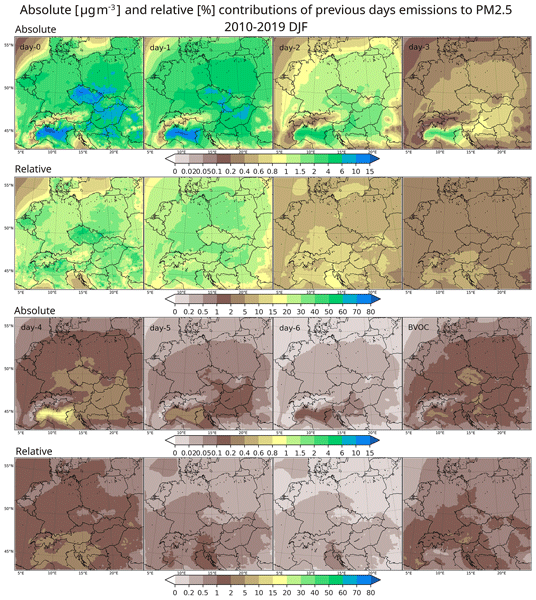
Abstract. Fine particulate matter (PM2.5) pollution remains a critical health issue in Europe. While numerous studies have quantified the spatio-sectoral sources of urban PM, the temporal origin has received minimum attention. This study addresses this gap by developing a novel Temporal Source Apportionment approach within the CAMx chemical transport model to quantify the long-term contributions of emissions from the preceding 14 days to PM concentrations, focusing on the 2010–2019 period and Central Europe. The results show that current-day emissions dominate winter PM2.5, contributing 30–60% on average, while day-1 emissions add further 20–30%. Contributions decrease with emission age, falling below 5% after three days and becoming negligible beyond seven days. Secondary inorganic aerosols and primary organic aerosols exhibit similar patterns, although for winter nitrate levels, the highest contribution comes from day-1 emissions, reflecting the time needed for chemical formation. Summer contributions are smaller due to enhanced mixing and faster removal, whereas biogenic emissions also contribute largely giving anthropogenic emissions a smaller role. Importantly, while the average contribution of older emissions is low, occasional episodes show substantial impacts: day-4 emissions can contribute up to 10%, and even week-old emissions can add 2% in winter. These findings emphasize that adverse air quality episodes are influenced not only by same-day emissions but also by pollution accumulated from previous days resulting from past emissions. Effective mitigation policies on PM pollution must therefore consider reducing emissions several days in advance of predicted pollution episodes, rather than relying solely on same-day interventions.
-
Notice on discussion status
The requested preprint has a corresponding peer-reviewed final revised paper. You are encouraged to refer to the final revised version.
-
Preprint
(68236 KB)
-
Supplement
(85591 KB)
-
The requested preprint has a corresponding peer-reviewed final revised paper. You are encouraged to refer to the final revised version.
- Preprint
(68236 KB) - Metadata XML
-
Supplement
(85591 KB) - BibTeX
- EndNote
- Final revised paper


Journal article(s) based on this preprint
Interactive discussion
Status: closed
- RC1: 'Comment on egusphere-2025-4972', Anonymous Referee #3, 21 Dec 2025
-
RC2: 'Comment on egusphere-2025-4972', Anonymous Referee #2, 22 Dec 2025
The present manuscript by Peter Huszár and co-workers described a novel Temporal Source Apportionment approach within the CAMx chemical transport model to address the absolute and relative role of emissions from previous days on PM2.5 pollution. The research results showed that the contribution of previous emissions to PM2.5 concentrations gradually decreases by days. These conclusions drawn are similar to our common sense. The results of this study not only enrich the basic knowledge in the field of atmospheric chemistry models, but also provide scientific support for the development of refined PM2.5 control strategies. The following issues still need to be clarified by the authors. 1. As shown in Fig 1, the author “split emissions into 14 artificial "temporal sectors" corresponding to one day within 14 day period and this means that emissions from each of these 14 "sectors" occur once in 14 days." In my opinion, such "emissions” is a continuous behavior. Why it occured once in 14 days. So, the approach is an important issue that requires clarification.
2. What is the mean of "DJF" and "JJA"?
3. The resuls showed in Figure 13-18, two noticeable sudden changes in May and October from the relative contribution of emissions from day-X can be observed, why?
4. why the contributions of previous days emissions to PM2.5 and aerosol components were disscussed only during summer and winter?
Citation: https://doi.org/10.5194/egusphere-2025-4972-RC2 -
AC1: 'Final authors response to all referee comments on egusphere-2025-4972', Peter Huszar, 15 Jan 2026
The comment was uploaded in the form of a supplement: https://egusphere.copernicus.org/preprints/2025/egusphere-2025-4972/egusphere-2025-4972-AC1-supplement.pdf


Interactive discussion
Status: closed
-
RC1: 'Comment on egusphere-2025-4972', Anonymous Referee #3, 21 Dec 2025
General Comments
This study focuses on the critical scientific gap in the temporal source apportionment of fine particulate matter (PM2.5) pollution in Central Europe. It innovatively introduces the Temporal Source Apportionment (TSA) method, combined with the CAMx chemical transport model, to investigate the contribution of emissions from the past 14 days to the PM2.5 and its components concentrations on a given day. This method fills the gap in existing studies that have insufficient attention to the temporal dimension of pollution, quantifying the impact of historical emissions accumulation on pollution events. The study offers new insights into regional air pollution with strong scientific and practical significance. The results show that current-day emissions dominate winter PM2.5 pollution, while past emissions also play an important role in pollution formation, especially under adverse meteorological conditions. These findings provide valuable insights for pollution control policies, emphasizing the importance of emission reductions several days in advance.
However, the study also has some limitations, particularly the significant underestimation of pollutant concentrations by the model, which may affect the quantitative assessment of past emission contributions. Additionally, the limitations of the emission inventory may also influence the results. Some of the model assumptions and the credibility of the findings need further clarification to strengthen the reliability of the conclusions. I recommend minor revision.
Specific Comments
1.Data validation
The model validation shows a systematic underestimation of PM2.5 and NO2 concentrations. This issue should be discussed more explicitly in the Discussion section. In particular, the authors should clarify how such underestimation may influence both absolute and relative contributions of past emissions, and whether the relative temporal patterns are expected to remain robust despite these biases.
2.Methodology
The 14-day emission tagging strategy is effective in revealing temporal dynamics. However, further clarification is needed regarding how overlapping contributions within the 14-day cycle are treated (e.g., interactions between day-0 and day-1 emissions). In addition, a more detailed discussion of how meteorological conditions modulate the estimated emission contributions would improve the methodological transparency.
3.Results analysis
The finding that current-day emissions dominate winter PM2.5 concentrations, while past emissions remain important under stagnant conditions, is compelling. Additional discussion on the generality and variability of this behavior under different urban meteorological regimes would further strengthen the results, especially for low wind speed and stable boundary layer conditions.
4.Lines 1–15 (Abstract)
The description of the novelty of the Temporal Source Apportionment approach is relatively general. It would be helpful to more clearly distinguish TSA from existing PSAT-based or age-distribution approaches and explicitly state the added value of this method.
5.Lines 25–40 (Introduction)
While the review of regional and long-range transport studies is comprehensive, the distinction between previous short-term event-based temporal studies and the lack of long-term statistical analyses remains somewhat unclear. Clarifying this distinction would better position the contribution of the present work.
6.Lines 105–115
The use of a two-mode aerosol scheme in CAMx may limit the representation of aerosol aging processes. A brief discussion of this limitation and its potential implications would be appropriate.
7.Lines 180–190
Given the systematic underestimation of PM concentrations, the magnitude of model bias across different seasons and between urban and rural stations should be quantified more clearly.
8.Lines 270–275
The rapid decay of ammonium contributions is closely linked to its chemical formation pathways. A comparative discussion with sulfate and nitrate behavior would help contextualize this result.
9.Lines 325–330 (Figure 12)
The substantial inter-city differences in day-0 contributions would benefit from quantitative support using meteorological indicators such as wind speed or boundary layer height.
10.Lines 425–430
The attribution of inter-city differences in day-0 contributions to ventilation conditions is plausible but not directly demonstrated. Additional quantitative evidence or references are recommended.
11.Figures 4–11 and 14–18
Many figures exhibit highly similar spatial patterns and temporal decay structures, which may give an impression of redundancy. The authors are encouraged to assess whether all figures are necessary in the main text, or whether some results could be summarized schematically or moved to the Supplement.
Technical Corrections
1.The term PM2.5 is sometimes written without proper subscript formatting (e.g., Lines 5, 405). Consistent use of PM2.5 is recommended throughout the manuscript. In Figure 12, “PM25” should be corrected to “PM2.5”.
2.Figures 1 and 2 Axis labels should be made clearer to improve readability.
3.Units and symbols
Concentration units are inconsistently written (e.g., μg/m³, μgm⁻³, ugm-3). Please standardize unit notation across the text and all figures.
4.Line 150
The full name of NMVOC should be defined at its first occurrence.
5.Line 215
Typographical error: “dye to” should be corrected to “due to”.
6.Line 291
“majority of SOA” should be revised to “the majority of SOA”.
7.Lines 412–414
Typographical error: “therefor” should be corrected to “therefore”.
8.Reference formatting
Instances of “Karlický et a., 2020” should be corrected to “Karlický et al., 2020”.
9.Lines 81–83
Subject–verb agreement error: “Xie et al. (2023) has chosen …” should be revised to “Xie et al. (2023) have chosen …”.
Citation: https://doi.org/10.5194/egusphere-2025-4972-RC1 -
RC2: 'Comment on egusphere-2025-4972', Anonymous Referee #2, 22 Dec 2025
The present manuscript by Peter Huszár and co-workers described a novel Temporal Source Apportionment approach within the CAMx chemical transport model to address the absolute and relative role of emissions from previous days on PM2.5 pollution. The research results showed that the contribution of previous emissions to PM2.5 concentrations gradually decreases by days. These conclusions drawn are similar to our common sense. The results of this study not only enrich the basic knowledge in the field of atmospheric chemistry models, but also provide scientific support for the development of refined PM2.5 control strategies. The following issues still need to be clarified by the authors. 1. As shown in Fig 1, the author “split emissions into 14 artificial "temporal sectors" corresponding to one day within 14 day period and this means that emissions from each of these 14 "sectors" occur once in 14 days." In my opinion, such "emissions” is a continuous behavior. Why it occured once in 14 days. So, the approach is an important issue that requires clarification.
2. What is the mean of "DJF" and "JJA"?
3. The resuls showed in Figure 13-18, two noticeable sudden changes in May and October from the relative contribution of emissions from day-X can be observed, why?
4. why the contributions of previous days emissions to PM2.5 and aerosol components were disscussed only during summer and winter?
Citation: https://doi.org/10.5194/egusphere-2025-4972-RC2 -
AC1: 'Final authors response to all referee comments on egusphere-2025-4972', Peter Huszar, 15 Jan 2026
The comment was uploaded in the form of a supplement: https://egusphere.copernicus.org/preprints/2025/egusphere-2025-4972/egusphere-2025-4972-AC1-supplement.pdf
Peer review completion


Journal article(s) based on this preprint
Viewed
| HTML | XML | Total | Supplement | BibTeX | EndNote | |
|---|---|---|---|---|---|---|
| 311 | 158 | 29 | 498 | 135 | 26 | 24 |
- HTML: 311
- PDF: 158
- XML: 29
- Total: 498
- Supplement: 135
- BibTeX: 26
- EndNote: 24
Viewed (geographical distribution)
| Country | # | Views | % |
|---|
| Total: | 0 |
| HTML: | 0 |
| PDF: | 0 |
| XML: | 0 |
- 1
Lukáš Bartík
Jan Karlický
Alvaro Patricio Prieto Perez
The requested preprint has a corresponding peer-reviewed final revised paper. You are encouraged to refer to the final revised version.
- Preprint
(68236 KB) - Metadata XML
-
Supplement
(85591 KB) - BibTeX
- EndNote
- Final revised paper
General Comments
This study focuses on the critical scientific gap in the temporal source apportionment of fine particulate matter (PM2.5) pollution in Central Europe. It innovatively introduces the Temporal Source Apportionment (TSA) method, combined with the CAMx chemical transport model, to investigate the contribution of emissions from the past 14 days to the PM2.5 and its components concentrations on a given day. This method fills the gap in existing studies that have insufficient attention to the temporal dimension of pollution, quantifying the impact of historical emissions accumulation on pollution events. The study offers new insights into regional air pollution with strong scientific and practical significance. The results show that current-day emissions dominate winter PM2.5 pollution, while past emissions also play an important role in pollution formation, especially under adverse meteorological conditions. These findings provide valuable insights for pollution control policies, emphasizing the importance of emission reductions several days in advance.
However, the study also has some limitations, particularly the significant underestimation of pollutant concentrations by the model, which may affect the quantitative assessment of past emission contributions. Additionally, the limitations of the emission inventory may also influence the results. Some of the model assumptions and the credibility of the findings need further clarification to strengthen the reliability of the conclusions. I recommend minor revision.
Specific Comments
1.Data validation
The model validation shows a systematic underestimation of PM2.5 and NO2 concentrations. This issue should be discussed more explicitly in the Discussion section. In particular, the authors should clarify how such underestimation may influence both absolute and relative contributions of past emissions, and whether the relative temporal patterns are expected to remain robust despite these biases.
2.Methodology
The 14-day emission tagging strategy is effective in revealing temporal dynamics. However, further clarification is needed regarding how overlapping contributions within the 14-day cycle are treated (e.g., interactions between day-0 and day-1 emissions). In addition, a more detailed discussion of how meteorological conditions modulate the estimated emission contributions would improve the methodological transparency.
3.Results analysis
The finding that current-day emissions dominate winter PM2.5 concentrations, while past emissions remain important under stagnant conditions, is compelling. Additional discussion on the generality and variability of this behavior under different urban meteorological regimes would further strengthen the results, especially for low wind speed and stable boundary layer conditions.
4.Lines 1–15 (Abstract)
The description of the novelty of the Temporal Source Apportionment approach is relatively general. It would be helpful to more clearly distinguish TSA from existing PSAT-based or age-distribution approaches and explicitly state the added value of this method.
5.Lines 25–40 (Introduction)
While the review of regional and long-range transport studies is comprehensive, the distinction between previous short-term event-based temporal studies and the lack of long-term statistical analyses remains somewhat unclear. Clarifying this distinction would better position the contribution of the present work.
6.Lines 105–115
The use of a two-mode aerosol scheme in CAMx may limit the representation of aerosol aging processes. A brief discussion of this limitation and its potential implications would be appropriate.
7.Lines 180–190
Given the systematic underestimation of PM concentrations, the magnitude of model bias across different seasons and between urban and rural stations should be quantified more clearly.
8.Lines 270–275
The rapid decay of ammonium contributions is closely linked to its chemical formation pathways. A comparative discussion with sulfate and nitrate behavior would help contextualize this result.
9.Lines 325–330 (Figure 12)
The substantial inter-city differences in day-0 contributions would benefit from quantitative support using meteorological indicators such as wind speed or boundary layer height.
10.Lines 425–430
The attribution of inter-city differences in day-0 contributions to ventilation conditions is plausible but not directly demonstrated. Additional quantitative evidence or references are recommended.
11.Figures 4–11 and 14–18
Many figures exhibit highly similar spatial patterns and temporal decay structures, which may give an impression of redundancy. The authors are encouraged to assess whether all figures are necessary in the main text, or whether some results could be summarized schematically or moved to the Supplement.
Technical Corrections
1.The term PM2.5 is sometimes written without proper subscript formatting (e.g., Lines 5, 405). Consistent use of PM2.5 is recommended throughout the manuscript. In Figure 12, “PM25” should be corrected to “PM2.5”.
2.Figures 1 and 2 Axis labels should be made clearer to improve readability.
3.Units and symbols
Concentration units are inconsistently written (e.g., μg/m³, μgm⁻³, ugm-3). Please standardize unit notation across the text and all figures.
4.Line 150
The full name of NMVOC should be defined at its first occurrence.
5.Line 215
Typographical error: “dye to” should be corrected to “due to”.
6.Line 291
“majority of SOA” should be revised to “the majority of SOA”.
7.Lines 412–414
Typographical error: “therefor” should be corrected to “therefore”.
8.Reference formatting
Instances of “Karlický et a., 2020” should be corrected to “Karlický et al., 2020”.
9.Lines 81–83
Subject–verb agreement error: “Xie et al. (2023) has chosen …” should be revised to “Xie et al. (2023) have chosen …”.