
the Creative Commons Attribution 4.0 License.
the Creative Commons Attribution 4.0 License.
 | 02 Dec 2025
Historical Evolution of Snowpack Capacity to Buffer Rain-on-Snow Runoff in a Large Columbia River Headwaters Basin
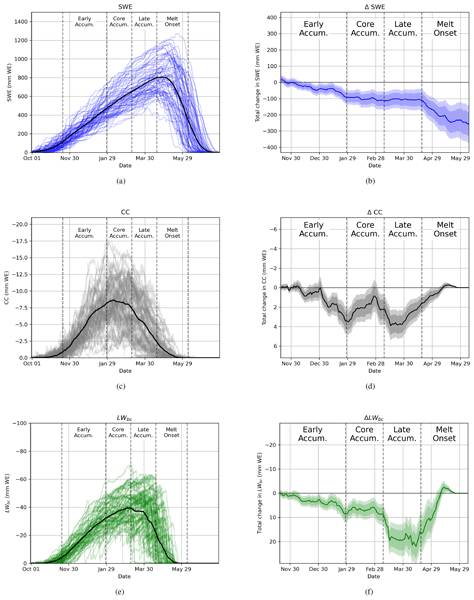
Abstract. Rainfall during the snow season plays an increasingly important role in flood risk as climate warms and extreme events become more frequent. However, a given sized rain-on-snow (ROS) event can yield outcomes ranging from flooding to no runoff, depending partly on the snowpack’s antecedent cold content and capillary retention forces. Here, we analyze the seasonal evolution of the snowpack’s physical state over a 72-year period to assess long-term changes in its capacity to buffer runoff from liquid water input. We use ERA-5 Land data to force a snowpack model that tracks the layer-by-layer development of heat, mass, and structural framework of the snowpack throughout the snow season. We test our approach in a large Columbia River headwaters basin in NW Montana, USA. We evaluate cold content and total capillary retention of the snowpack to determine long term trends in Liquid Water Buffering Capacity (LWbc) as it evolves throughout the snow season. The LWbc of the snowpack exhibited robust long-term declines across all elevation bands, despite high intra- and interannual variability. The largest declines occurred during the Spring period, trending downward across the historical period by 43% to 80% depending on the elevation band. The core five weeks of mid-winter showed no trending change of LWbc, and in fact demonstrated an increase in cold content over the 72 years. Our findings demonstrate that changes in the snowpack’s ability to buffer runoff, including dependencies on local basin factors related to snowpack seasonality and elevation, are a key component of evolving ROS risk.
-
Notice on discussion status
The requested preprint has a corresponding peer-reviewed final revised paper. You are encouraged to refer to the final revised version.
-
Preprint
(2142 KB)
-
The requested preprint has a corresponding peer-reviewed final revised paper. You are encouraged to refer to the final revised version.
- Preprint
(2142 KB) - Metadata XML
- BibTeX
- EndNote
- Final revised paper


Journal article(s) based on this preprint
Interactive discussion
Status: closed
-
RC1: 'Comment on egusphere-2025-4971', Anonymous Referee #1, 26 Jan 2026
- AC1: 'Reply on RC1', J. Brown, 20 Mar 2026
-
RC2: 'Comment on egusphere-2025-4971', Anonymous Referee #2, 30 Jan 2026
Please see the attached file outlining my recommendations.
- AC2: 'Reply on RC2', J. Brown, 20 Mar 2026
-
CC1: 'Comment on egusphere-2025-4971', Paul Nicknish, 21 Feb 2026
I thought this was an interesting paper and I liked the approach taken. One question I had reading through the preprint is what controls whether LW_bc recovers to nonzero values (and the timescale of this recovery) after hitting 0 mm WE. Whether or not the snowpack hits LW_bc = 0 mm WE is an important part of its evolution, and (at least a) qualitative discussion around its behavior could help improve the manuscript.
Citation: https://doi.org/10.5194/egusphere-2025-4971-CC1 - AC3: 'Reply on CC1', J. Brown, 20 Mar 2026
Peer review completion


Interactive discussion
Status: closed
-
RC1: 'Comment on egusphere-2025-4971', Anonymous Referee #1, 26 Jan 2026
In this paper, the seasonal evolution of a mountain snowpack’s physical state is analyzed over a 72-year period by means of a physics-based snowpack model to assess long-term changes in its capacity to buffer runoff from liquid water input. The manuscript is well-written and I only have a few minor comments.
Abstract:
- 12: I recommend to mention the model that is used already here by name.
Introduction:
- 67 - 69: „Broad regional-scale“: can you specify what size you mean with this? Is your „large Columbia headwaters basin“ of this size, or larger/smaller? Does „... not only computationally impractical but may obscure the importance of transient and localized processes“ also apply to the latter, or not? Please clarify.
Methods:
- 78: What Do you mean with „undeveloped“ forest?
- 93: Maybe better begin new sentence with „With this resolution …“.
- 94: Maybe better insert „snow allocation and surface hydrology model“.
- 95: The Swiss meteo data processing tool’s name is „MeteoIO“.
- 125: Which values did you obtain for the irreducible water saturation?
Results:
- 226/Figure 5: Here you mean „Late accumulation period“, right? Better replace „Early Spring“.
- 230: Better replace „fall“ with the term you defined earlier (159 - 161): „Early Accumulation“.
- 231: „Early Accumulation“ should be „Late Accuumulation“ here, right? And the dates, as defined earlier: March 9 to April 17. Better stay consistent (see 159 - 161).
Appendix:
- Figure A1: Add units to (a) and (b).
- 503: Refer to method mentioned earlier (regression, Pan et al., 2003), or insert again here so that the origin of the factor becomes clear.
Citation: https://doi.org/10.5194/egusphere-2025-4971-RC1 - AC1: 'Reply on RC1', J. Brown, 20 Mar 2026
-
RC2: 'Comment on egusphere-2025-4971', Anonymous Referee #2, 30 Jan 2026
Please see the attached file outlining my recommendations.
- AC2: 'Reply on RC2', J. Brown, 20 Mar 2026
-
CC1: 'Comment on egusphere-2025-4971', Paul Nicknish, 21 Feb 2026
I thought this was an interesting paper and I liked the approach taken. One question I had reading through the preprint is what controls whether LW_bc recovers to nonzero values (and the timescale of this recovery) after hitting 0 mm WE. Whether or not the snowpack hits LW_bc = 0 mm WE is an important part of its evolution, and (at least a) qualitative discussion around its behavior could help improve the manuscript.
Citation: https://doi.org/10.5194/egusphere-2025-4971-CC1 - AC3: 'Reply on CC1', J. Brown, 20 Mar 2026
Peer review completion
Journal article(s) based on this preprint
Model code and software
snowpack-buffering-capacity Joel Brown https://doi.org/10.5281/zenodo.17290309
Viewed
| HTML | XML | Total | BibTeX | EndNote | |
|---|---|---|---|---|---|
| 1,846 | 824 | 228 | 2,898 | 173 | 140 |
- HTML: 1,846
- PDF: 824
- XML: 228
- Total: 2,898
- BibTeX: 173
- EndNote: 140
Viewed (geographical distribution)
| Country | # | Views | % |
|---|
| Total: | 0 |
| HTML: | 0 |
| PDF: | 0 |
| XML: | 0 |
- 1

Joel T. Harper
The requested preprint has a corresponding peer-reviewed final revised paper. You are encouraged to refer to the final revised version.
- Preprint
(2142 KB) - Metadata XML
In this paper, the seasonal evolution of a mountain snowpack’s physical state is analyzed over a 72-year period by means of a physics-based snowpack model to assess long-term changes in its capacity to buffer runoff from liquid water input. The manuscript is well-written and I only have a few minor comments.
Abstract:
- 12: I recommend to mention the model that is used already here by name.
Introduction:
- 67 - 69: „Broad regional-scale“: can you specify what size you mean with this? Is your „large Columbia headwaters basin“ of this size, or larger/smaller? Does „... not only computationally impractical but may obscure the importance of transient and localized processes“ also apply to the latter, or not? Please clarify.
Methods:
- 78: What Do you mean with „undeveloped“ forest?
- 93: Maybe better begin new sentence with „With this resolution …“.
- 94: Maybe better insert „snow allocation and surface hydrology model“.
- 95: The Swiss meteo data processing tool’s name is „MeteoIO“.
- 125: Which values did you obtain for the irreducible water saturation?
Results:
- 226/Figure 5: Here you mean „Late accumulation period“, right? Better replace „Early Spring“.
- 230: Better replace „fall“ with the term you defined earlier (159 - 161): „Early Accumulation“.
- 231: „Early Accumulation“ should be „Late Accuumulation“ here, right? And the dates, as defined earlier: March 9 to April 17. Better stay consistent (see 159 - 161).
Appendix:
- Figure A1: Add units to (a) and (b).
- 503: Refer to method mentioned earlier (regression, Pan et al., 2003), or insert again here so that the origin of the factor becomes clear.