
the Creative Commons Attribution 4.0 License.
the Creative Commons Attribution 4.0 License.
 | 16 Oct 2025
Storm-Resolving Models Advance Atmospheric Blocking Simulations and Climate Change Insights
Abstract. Atmospheric blocking is a key driver of midlatitude weather extremes, including heatwaves and cold spells. Yet general circulation models (GCMs) still struggle to capture the frequency, persistence, and spatial characteristics of blocking. Here, we evaluate atmospheric blocking in next-generation storm-resolving Earth system models from the nextGEMS, EERIE, and DestinE projects, focusing on ICON and IFS-FESOM with ~10 km atmospheric and ~5 km ocean grid spacing. We also provide first insights into the IFS-FESOM under SSP3-7.0 forcing.
Blocking frequency, duration, and size are assessed in historical simulations spanning 30 years for IFS and 27 years for ICON, relative to ERA5 reanalysis and a CMIP6 multi-model ensemble of eight models. We further examine links between blocking biases and the background flow, sea surface temperatures (SSTs), and storm-tracks. Performance varies regionally and seasonally: IFS, particularly in its atmosphere-only configuration, reproduces blocking frequency and jet structure more realistically than coupled IFS and ICON over the North Atlantic and North Pacific. ICON shows larger winter biases, including overly zonal jets and underestimated Euro-Atlantic blocking compared to IFS. Several biases identified in the CMIP6 models persist in the storm-resolving models or are even amplified, showing that higher resolution alone does not consistently result in better blocking representation. Atmosphere-only experiments (IFS AMIP) highlight the strong influence of sea surface temperatures (SSTs) and the sensitivity of blocking to ocean–atmosphere coupling. We find a positive relationship between blocking frequency and storm-track activity in JJA in the CMIP6 models, which is weaker or absent in the storm-resolving models.
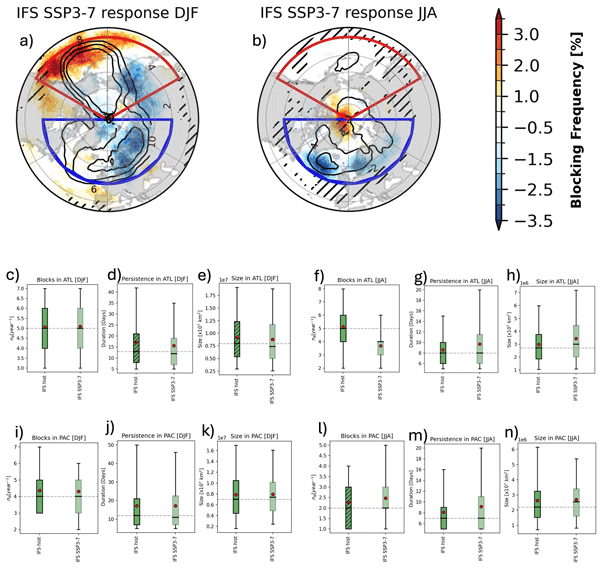
Under SSP3-7.0, IFS projects reduced winter blocking at high latitudes (e.g., northern Europe) and reduced summer blocking frequency over the North Atlantic, northern Europe, and Russia. Changes in magnitude, spatial pattern, and persistence are often of the same order as the model biases, indicating that projected blocking responses are difficult to disentangle from systematic errors related to jet structure, SST biases, and storm-track activity. Overall, storm-resolving models show local improvements in blocking representation, particularly when forced with realistic SSTs. However, coupled simulations still exhibit large biases, underlining the need for further development of ocean–atmosphere coupling representation. These findings highlight both the potential and the current limitations of storm-resolving models for simulating and projecting persistent weather extremes in a warming climate.
Competing interests: At least one of the (co-)authors is a member of the editorial board of Weather and Climate Dynamics. The authors have no other competing interests to declare.
Publisher's note: Copernicus Publications remains neutral with regard to jurisdictional claims made in the text, published maps, institutional affiliations, or any other geographical representation in this paper. While Copernicus Publications makes every effort to include appropriate place names, the final responsibility lies with the authors. Views expressed in the text are those of the authors and do not necessarily reflect the views of the publisher.-
Notice on discussion status
The requested preprint has a corresponding peer-reviewed final revised paper. You are encouraged to refer to the final revised version.
-
Preprint
(6339 KB)
-
Supplement
(2195 KB)
-
The requested preprint has a corresponding peer-reviewed final revised paper. You are encouraged to refer to the final revised version.
- Preprint
(6339 KB) - Metadata XML
-
Supplement
(2195 KB) - BibTeX
- EndNote
- Final revised paper


Journal article(s) based on this preprint
Interactive discussion
Status: closed
- RC1: 'Comment on egusphere-2025-4969', Mika Rantanen, 19 Nov 2025
-
RC2: 'Comment on egusphere-2025-4969', Anonymous Referee #2, 12 Dec 2025
The comment was uploaded in the form of a supplement: https://egusphere.copernicus.org/preprints/2025/egusphere-2025-4969/egusphere-2025-4969-RC2-supplement.pdf
-
AC1: 'Comment on egusphere-2025-4969', Edgar Dolores Tesillos, 23 Jan 2026
We sincerely thank the reviewers for their time and constructive comments, which have substantially improved the clarity and quality of our manuscript. In the attached document, we address each comment and question in a point-by-point manner. Reviewers’ comments are shown in black, and our responses are provided in blue.
Peer review completion


Interactive discussion
Status: closed
-
RC1: 'Comment on egusphere-2025-4969', Mika Rantanen, 19 Nov 2025
Review of WCD manuscript egusphere-2025-4969 “Storm-Resolving Models Advance Atmospheric Blocking Simulations and Climate Change” by Edgar Dolores-Tesillos et al.
Climate modelling is increasingly moving toward higher spatial resolution, and recent initiatives such as NextGEMS and Climate DT are at the forefront in this development. These projects use kilometre-scale global simulations based on the ICON and IFS modelling systems, producing among the most advanced high-resolution climate model datasets available to the research community at the moment.
As these simulations from Climate DT are becoming more and more available, it is likely that they will play an important role in future climate change assessments due to their ability to better resolve and represent atmospheric key processes such as convection and cyclone structures. Therefore, evaluating the systematic biases of these models is essential. This manuscript contributes to that effort by assessing blocking characteristics in ICON and IFS models. Thus, I believe that this manuscript provides a timely and valuable addition to the literature, and it will be useful for future studies, for example those assessing changes in windstorm frequency or intensity in these high-resolution models.
The authors analyze blocking characteristics and storm tracks from ICON and IFS historical simulations, as well as IFS atmosphere-only (AMIP) simulations, and compare them against ERA5 reanalysis for both northern hemisphere winter and summer seasons. They also compare the results with the CMIP6 ensemble mean. Overall, the study finds that the higher resolution in ICON and IFS models does not necessarily translate to reduced biases in blocking and storm track features. The IFS AMIP simulation, which uses observed sea surface temperatures (SSTs), exhibits the smallest biases, highlighting the importance of realistic SSTs in coupled climate model simulations.
I think the paper was well written, although some sections such as Discussion felt a bit too lengthy. I was also a bit puzzled about the differences between NextGEMS and Climate DT projects and model simulations. As I am by no means an expert on blocking dynamics, I provided only some minor comments related to the presentation and readability of the paper. I hope that the other reviewers can comment more on the methodological choices. Overall, I am happy to recommend publication of this paper after my relatively minor comments have been addressed.
Minor comments:
- It wasn’t entirely clear for me what the differences are between NextGEMS and Climate DT simulations. Is the IFS FESOM SSP3-7.0 that you analysed the same simulation that will be used also in Climate DT? (it wasn't marked with star in Table 1). In the Supplementary material (Fig. S5-S6) you analysed the ICON NextGEMS and ICON DestinE SSP3-7.0. Is the only difference between them the atmospheric resolution? For example, one clarifying paragraph about the differences between NextGEMS and Climate DT / DestinE could work here.
- As far as I know, the Climate DT project also uses the IFS-NEMO model, which has a different ocean component (NEMO model) than in IFS-FESOM. Why didn’t you analyse that model in this paper? It might be worth mentioning why it has been left out.
- Throughout the results section, you talk about the North Atlantic and North Pacific basins but it seems that these domains cover the land as well, so they effectively mean the whole hemispheres. For example, Fig. 2a “Blocks in ATL”: does that include the whole hemisphere from -90° to 90°E, and not just the North Atlantic ocean basin?
- The discussion section is relatively lengthy. It could help readability to divide it into smaller subsections, and maybe condense the text if you find that possible.
- Title. When I finished reading the paper, I was honestly a bit disappointed about the models’ skill in reproducing the blocking and storm track features, given the enormous effort put in these digital twin activities. The biases in many variables, especially in SSTs, were very pronounced in IFS and ICON hist runs. Overall, I got the feeling that the new high-resolution models do not appear to outperform the CMIP6 models. In this light, for me, the title “Storm-Resolving Models Advance Atmospheric Blocking Simulations” seems somewhat optimistic.
Line-by-line comments:
L90: What does “energetically consistent climate” mean?
Table 1. Maybe add one column for the years in the periods?
L163: Storm-tracks
Fig. 2 caption: "the extent of the basins is shown as dashed lines." I did not see any dashed lines in Fig. 1. See also minor comment #2 about the basins. Also, the dashed line in Fig. 2 which seems to be the ERA5 median, is missing from the caption.
L231: Table 4? Same also in L237.
Fig. 3: Is the colorbar value -10 correct? The scale seems otherwise to go with 1 m/s interval. Same for Fig. 8.
Fig. 4: The panels do not have b) but the caption has. Same in Fig. 9.
L276: Maybe add that the northward shift of storm tracks in the Pacific seems to occur in western Pacific only.
L304: What is the Atlantic frequency bias in ICON? I cannot see it from Fig. 6c.
L309: whereas CMIP6 exhibits longer durations. For me, it seems that the duration in CMIP6 in the Pacific (Fig. 7e) is the same as in other models.
L311: ICON frequency overestimation is true only for high latitudes, but these boxplots (in Fig. 7) show the values for the whole domain, right? So can you actually use that argument as there is underestimation over the lower latitudes in the Pacific (Fig. 6c).
L338: The slightly negative wind bias southwest of Greenland seems to be a very minor feature, and the increased blocking in my opinion is more over southeast of Greenland (Fig. 6a) where the bias in winds is positive (Fig. 8a). But is positive wind bias consistent with increased blocking in the region then? Overall I think the wind biases near Greenland are very consistent between all three models.
L340: Should be maybe Figs. 8b,c
L340: Reduced blocking? I don’t see reduced blocking southeast of Greenland in Fig. 6 in these models.
L347: The broader jet is present also in the CMIP6 ensemble. Aren’t the CMIP6 jet biases in the Pacific somewhat opposite to that in IFS hist? Fig. 8a vs. 8d?
L369: I think negative SST anomalies are basically everywhere in the North Atlantic in IFS hist so they are not just co-located with positive blocking biases. The interpretation starting from L370 (low SSTs -> favoring high pressure systems) seems to hold only in the high-latitude North Atlantic. The relationship is pretty much the opposite in the Pacific and absent in ICON so I’m not sure how robust the interpretation is.
L393: Maybe you mean here bias maximum?
Fig. 11 title: Do you mean spatial correlation of blocking biases vs. storm-track biases? The first “biases” was missing which is why I first thought you meant the absolute blocking and not its bias.
Fig. 11. Is the correlation calculated for ocean-only?
L435: The reduced blocking in Fig. 12b (JJA) seems to be co-located with the North Atlantic warming hole (Fig. 13d). Thus, I do not really agree with your reasoning about the warmer North Atlantic in this context.
Fig. 13. The colorbar scale in e-f is not symmetric around zero. I would put that symmetric to have balanced view of the biases.
Figs. S5 and S6. I don't understand these figures. Why does the caption say biases? I thought the b) and c) panels represent the response for climate change (i.e. SSP3–7.0 2020-2049 minus historical)? i.e. similar to Fig. 12a-b but for ICON model. If that's the case, shouldn't the comparison be against the model's historical simulation and not ERA5, given the biases?
Citation: https://doi.org/10.5194/egusphere-2025-4969-RC1 -
RC2: 'Comment on egusphere-2025-4969', Anonymous Referee #2, 12 Dec 2025
The comment was uploaded in the form of a supplement: https://egusphere.copernicus.org/preprints/2025/egusphere-2025-4969/egusphere-2025-4969-RC2-supplement.pdf
-
AC1: 'Comment on egusphere-2025-4969', Edgar Dolores Tesillos, 23 Jan 2026
We sincerely thank the reviewers for their time and constructive comments, which have substantially improved the clarity and quality of our manuscript. In the attached document, we address each comment and question in a point-by-point manner. Reviewers’ comments are shown in black, and our responses are provided in blue.
Peer review completion
Journal article(s) based on this preprint
Viewed
| HTML | XML | Total | Supplement | BibTeX | EndNote | |
|---|---|---|---|---|---|---|
| 3,104 | 1,596 | 202 | 4,902 | 367 | 181 | 170 |
- HTML: 3,104
- PDF: 1,596
- XML: 202
- Total: 4,902
- Supplement: 367
- BibTeX: 181
- EndNote: 170
Viewed (geographical distribution)
| Country | # | Views | % |
|---|
| Total: | 0 |
| HTML: | 0 |
| PDF: | 0 |
| XML: | 0 |
- 1
Edgar Dolores-Tesillos

Olivia Martius
Stephan Pfahl
The requested preprint has a corresponding peer-reviewed final revised paper. You are encouraged to refer to the final revised version.
- Preprint
(6339 KB) - Metadata XML
-
Supplement
(2195 KB) - BibTeX
- EndNote
- Final revised paper
Review of WCD manuscript egusphere-2025-4969 “Storm-Resolving Models Advance Atmospheric Blocking Simulations and Climate Change” by Edgar Dolores-Tesillos et al.
Climate modelling is increasingly moving toward higher spatial resolution, and recent initiatives such as NextGEMS and Climate DT are at the forefront in this development. These projects use kilometre-scale global simulations based on the ICON and IFS modelling systems, producing among the most advanced high-resolution climate model datasets available to the research community at the moment.
As these simulations from Climate DT are becoming more and more available, it is likely that they will play an important role in future climate change assessments due to their ability to better resolve and represent atmospheric key processes such as convection and cyclone structures. Therefore, evaluating the systematic biases of these models is essential. This manuscript contributes to that effort by assessing blocking characteristics in ICON and IFS models. Thus, I believe that this manuscript provides a timely and valuable addition to the literature, and it will be useful for future studies, for example those assessing changes in windstorm frequency or intensity in these high-resolution models.
The authors analyze blocking characteristics and storm tracks from ICON and IFS historical simulations, as well as IFS atmosphere-only (AMIP) simulations, and compare them against ERA5 reanalysis for both northern hemisphere winter and summer seasons. They also compare the results with the CMIP6 ensemble mean. Overall, the study finds that the higher resolution in ICON and IFS models does not necessarily translate to reduced biases in blocking and storm track features. The IFS AMIP simulation, which uses observed sea surface temperatures (SSTs), exhibits the smallest biases, highlighting the importance of realistic SSTs in coupled climate model simulations.
I think the paper was well written, although some sections such as Discussion felt a bit too lengthy. I was also a bit puzzled about the differences between NextGEMS and Climate DT projects and model simulations. As I am by no means an expert on blocking dynamics, I provided only some minor comments related to the presentation and readability of the paper. I hope that the other reviewers can comment more on the methodological choices. Overall, I am happy to recommend publication of this paper after my relatively minor comments have been addressed.
Minor comments:
Line-by-line comments:
L90: What does “energetically consistent climate” mean?
Table 1. Maybe add one column for the years in the periods?
L163: Storm-tracks
Fig. 2 caption: "the extent of the basins is shown as dashed lines." I did not see any dashed lines in Fig. 1. See also minor comment #2 about the basins. Also, the dashed line in Fig. 2 which seems to be the ERA5 median, is missing from the caption.
L231: Table 4? Same also in L237.
Fig. 3: Is the colorbar value -10 correct? The scale seems otherwise to go with 1 m/s interval. Same for Fig. 8.
Fig. 4: The panels do not have b) but the caption has. Same in Fig. 9.
L276: Maybe add that the northward shift of storm tracks in the Pacific seems to occur in western Pacific only.
L304: What is the Atlantic frequency bias in ICON? I cannot see it from Fig. 6c.
L309: whereas CMIP6 exhibits longer durations. For me, it seems that the duration in CMIP6 in the Pacific (Fig. 7e) is the same as in other models.
L311: ICON frequency overestimation is true only for high latitudes, but these boxplots (in Fig. 7) show the values for the whole domain, right? So can you actually use that argument as there is underestimation over the lower latitudes in the Pacific (Fig. 6c).
L338: The slightly negative wind bias southwest of Greenland seems to be a very minor feature, and the increased blocking in my opinion is more over southeast of Greenland (Fig. 6a) where the bias in winds is positive (Fig. 8a). But is positive wind bias consistent with increased blocking in the region then? Overall I think the wind biases near Greenland are very consistent between all three models.
L340: Should be maybe Figs. 8b,c
L340: Reduced blocking? I don’t see reduced blocking southeast of Greenland in Fig. 6 in these models.
L347: The broader jet is present also in the CMIP6 ensemble. Aren’t the CMIP6 jet biases in the Pacific somewhat opposite to that in IFS hist? Fig. 8a vs. 8d?
L369: I think negative SST anomalies are basically everywhere in the North Atlantic in IFS hist so they are not just co-located with positive blocking biases. The interpretation starting from L370 (low SSTs -> favoring high pressure systems) seems to hold only in the high-latitude North Atlantic. The relationship is pretty much the opposite in the Pacific and absent in ICON so I’m not sure how robust the interpretation is.
L393: Maybe you mean here bias maximum?
Fig. 11 title: Do you mean spatial correlation of blocking biases vs. storm-track biases? The first “biases” was missing which is why I first thought you meant the absolute blocking and not its bias.
Fig. 11. Is the correlation calculated for ocean-only?
L435: The reduced blocking in Fig. 12b (JJA) seems to be co-located with the North Atlantic warming hole (Fig. 13d). Thus, I do not really agree with your reasoning about the warmer North Atlantic in this context.
Fig. 13. The colorbar scale in e-f is not symmetric around zero. I would put that symmetric to have balanced view of the biases.
Figs. S5 and S6. I don't understand these figures. Why does the caption say biases? I thought the b) and c) panels represent the response for climate change (i.e. SSP3–7.0 2020-2049 minus historical)? i.e. similar to Fig. 12a-b but for ICON model. If that's the case, shouldn't the comparison be against the model's historical simulation and not ERA5, given the biases?