
the Creative Commons Attribution 4.0 License.
the Creative Commons Attribution 4.0 License.
 | 17 Oct 2025
Filamentogenesis and Filamentolysis of a Light Filament: Dynamic Processes in the Near-Surface Ocean Under Tidal Forcing
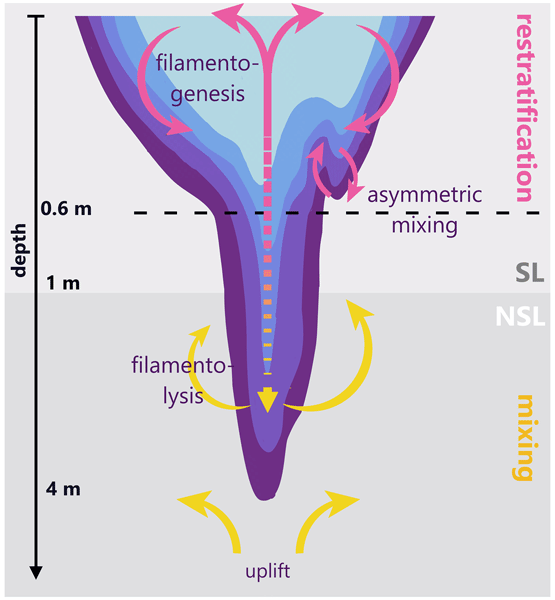
Abstract. This study investigates the dynamics and evolution of a light filament embedded within a tidal mixing front, focusing on its spatial and temporal evolution in the near-surface layer (0.1–10 m) of the water column. A high-resolution, multi-sensor synoptic dataset, consisting of surface drifters, a drifting sensor chain, and an autonomous surface vehicle equipped with an Acoustic Doppler Current Profiler, temperature, and conductivity sensors, was used to observe patterns of divergence, vorticity, and vertical velocities, avoiding high temporospatial aliasing. The measurements resolved three phases of the filament occurring on length scales of O(0.1–2 km) and time scales of minutes to one hour: I) establishment of the filament in the overlying first meter and filamentolysis < 1 m, II) the ongoing filamentolysis in the lower NSL induced filamentogenesis above 0.6 m, III) restratification of the upper 0.6 m. Vertical velocities ranged between ± 20 m.d-1 with pronounced asymmetric responses on the filament boundaries due to the coupling of filamentary and tide-induced vertical motions. In phase III, stratification allowed for increased heat uptake within the filament. These investigations highlight the role of the overlooked top surface layer in potentially altering the energy, heat, and gas budget of the ocean, which is critical for understanding the air-sea interface in the context of climate change.
-
Notice on discussion status
The requested preprint has a corresponding peer-reviewed final revised paper. You are encouraged to refer to the final revised version.
-
Preprint
(2349 KB)
-
The requested preprint has a corresponding peer-reviewed final revised paper. You are encouraged to refer to the final revised version.
- Preprint
(2349 KB) - Metadata XML
- BibTeX
- EndNote
- Final revised paper


Journal article(s) based on this preprint
Interactive discussion
Status: closed
-
RC1: 'Comment on egusphere-2025-4953', Anonymous Referee #1, 17 Jan 2026
The comment was uploaded in the form of a supplement: https://egusphere.copernicus.org/preprints/2025/egusphere-2025-4953/egusphere-2025-4953-RC1-supplement.pdfCitation: https://doi.org/
10.5194/egusphere-2025-4953-RC1 -
AC2: 'Reply on RC1', Michelle Albinus, 15 May 2026
Dear Reviewer,
thank your so much for your very helpful comments and suggestions. I tried to answer your questions and to adjust the manuscript in a way it may be a valueable contribution to the scientific community. I hope that now you see more potential in accepting this manuscript for the special issue. Thank you so much!
Kind regards,Michelle Albinus
-
AC2: 'Reply on RC1', Michelle Albinus, 15 May 2026
-
RC2: 'Comment on egusphere-2025-4953', Anonymous Referee #2, 16 Feb 2026
This manuscript describes a multi-sensor observation of a light-filament in the North Sea. It demonstrates this filament’s life cycle in great detail, combining multiple observational methods. The description of the filament is thorough. The data processing is sound. I recommend the paper’s publication with some minor comments.
Main comments:
- The authors acknowledge that the tidal flow speed-up and slow-down provide spurious convergence and divergence values. And they can be in constructive or destructive interference with the filament's divergence. I would like this to be more quantitative. How much divergence is due to tidal flow alone? In plots about divergence, a rough value of tidal divergence and its phase is useful to guide the reader to understand when they are in constructive and destructive interference. The estimate for tidal flow could come from the model that the authors used to get the SSH estimate in their data processing.
- I think we have the opposite understanding of what ``filementogenesis'' is. I take it as processes that sharpen the filament/front, increasing its density/velocity gradient. That means, divergent flow at the light filament center is frontolytic. I can see opinions might differ on the definition because this paper is looking at a light filament, the opposite of the more commonly studied dense filament. The authors can make their own choice here, but should take a paragraph at the beginning of the paper to define the terminology in precise detail.
Minor comments:
- NSL is not defined anywhere as far as I can see.
- Line 27: What makes the anticyclonic strain zone anticyclonic? Strain is defined to be independent of vorticity. In this case, is the vorticity due to the shelf jet? For someone not familiar with the North Sea, some more description would be helpful.
- Line 28: For the light filament, does the ASC subduct the light anomaly? The classic picture paints it to spread the light anomaly on top with frontal divergence. From what I understood, that's what the observation shows in this paper as well.
- Line 59: Johnson et al. 2024 is nowhere to be found in the reference list.
- Line 91: Using km to describe the resolution might be better at such a resolution.
- Line 375: synoptic usually means O(1000 km), which this paper is not.
- Line 377: What does "capture the kinetic energy'" means? Fronts usually convert PE to KE.
Citation: https://doi.org/10.5194/egusphere-2025-4953-RC2 -
AC1: 'Reply on RC2', Michelle Albinus, 16 Mar 2026
Dear reviewer,
first of all, thank you so much for attending in reviewing this manuscript. We feel honored and are thankful for your comments and recommendations, that will improve our work and make the manuscript a valuable contribution to the scientific community. Thank you particularly for assessing this manuscript positively. We have read your review carefully and prepared a rebuttal to clearly assign our responses and adjustments to your comments. We hope that we could refer to your questions sufficiently and look forward to your response.
Kind regards,
Michelle Albinus et al.
-
EC1: 'Comment on egusphere-2025-4953', Peter S. Liss, 15 May 2026
I encourage submission of the manuscript, revised to meet the detailed comments of the referees.
Citation: https://doi.org/10.5194/egusphere-2025-4953-EC1
Peer review completion


Interactive discussion
Status: closed
-
RC1: 'Comment on egusphere-2025-4953', Anonymous Referee #1, 17 Jan 2026
The comment was uploaded in the form of a supplement: https://egusphere.copernicus.org/preprints/2025/egusphere-2025-4953/egusphere-2025-4953-RC1-supplement.pdf
-
AC2: 'Reply on RC1', Michelle Albinus, 15 May 2026
Dear Reviewer,
thank your so much for your very helpful comments and suggestions. I tried to answer your questions and to adjust the manuscript in a way it may be a valueable contribution to the scientific community. I hope that now you see more potential in accepting this manuscript for the special issue. Thank you so much!
Kind regards,Michelle Albinus
-
AC2: 'Reply on RC1', Michelle Albinus, 15 May 2026
-
RC2: 'Comment on egusphere-2025-4953', Anonymous Referee #2, 16 Feb 2026
This manuscript describes a multi-sensor observation of a light-filament in the North Sea. It demonstrates this filament’s life cycle in great detail, combining multiple observational methods. The description of the filament is thorough. The data processing is sound. I recommend the paper’s publication with some minor comments.
Main comments:
- The authors acknowledge that the tidal flow speed-up and slow-down provide spurious convergence and divergence values. And they can be in constructive or destructive interference with the filament's divergence. I would like this to be more quantitative. How much divergence is due to tidal flow alone? In plots about divergence, a rough value of tidal divergence and its phase is useful to guide the reader to understand when they are in constructive and destructive interference. The estimate for tidal flow could come from the model that the authors used to get the SSH estimate in their data processing.
- I think we have the opposite understanding of what ``filementogenesis'' is. I take it as processes that sharpen the filament/front, increasing its density/velocity gradient. That means, divergent flow at the light filament center is frontolytic. I can see opinions might differ on the definition because this paper is looking at a light filament, the opposite of the more commonly studied dense filament. The authors can make their own choice here, but should take a paragraph at the beginning of the paper to define the terminology in precise detail.
Minor comments:
- NSL is not defined anywhere as far as I can see.
- Line 27: What makes the anticyclonic strain zone anticyclonic? Strain is defined to be independent of vorticity. In this case, is the vorticity due to the shelf jet? For someone not familiar with the North Sea, some more description would be helpful.
- Line 28: For the light filament, does the ASC subduct the light anomaly? The classic picture paints it to spread the light anomaly on top with frontal divergence. From what I understood, that's what the observation shows in this paper as well.
- Line 59: Johnson et al. 2024 is nowhere to be found in the reference list.
- Line 91: Using km to describe the resolution might be better at such a resolution.
- Line 375: synoptic usually means O(1000 km), which this paper is not.
- Line 377: What does "capture the kinetic energy'" means? Fronts usually convert PE to KE.
Citation: https://doi.org/10.5194/egusphere-2025-4953-RC2 -
AC1: 'Reply on RC2', Michelle Albinus, 16 Mar 2026
Dear reviewer,
first of all, thank you so much for attending in reviewing this manuscript. We feel honored and are thankful for your comments and recommendations, that will improve our work and make the manuscript a valuable contribution to the scientific community. Thank you particularly for assessing this manuscript positively. We have read your review carefully and prepared a rebuttal to clearly assign our responses and adjustments to your comments. We hope that we could refer to your questions sufficiently and look forward to your response.
Kind regards,
Michelle Albinus et al.
-
EC1: 'Comment on egusphere-2025-4953', Peter S. Liss, 15 May 2026
I encourage submission of the manuscript, revised to meet the detailed comments of the referees.
Citation: https://doi.org/10.5194/egusphere-2025-4953-EC1
Peer review completion
Journal article(s) based on this preprint
Data sets
ADCP current measurements (600 kHz) from autonomous surface vehicle on 05.08.2023 during RV HEINCKE cruise HE626 M. Albinus et al. https://doi.org/10.1594/PANGAEA.973117
High-resolution measurements of essential climate variables in the North Sea from the autonomous surface vehicle HALOBATES during RV Heincke cruise HE626 [dataset] S. M. Ayim et al. https://doi.pangaea.de/10.1594/PANGAEA.972989
Physical oceanography during RV HEINCKE cruise HE626 [dataset]. S. Tippenhauer et al. https://doi.org/10.1594/PANGAEA.963643
NWSHELF_ANALYSISFORECAST_PHY_004_013 E.U. Copernicus Marine Service Information https://doi.org/10.48670/moi-00054
Viewed
| HTML | XML | Total | BibTeX | EndNote | |
|---|---|---|---|---|---|
| 1,629 | 758 | 162 | 2,549 | 182 | 228 |
- HTML: 1,629
- PDF: 758
- XML: 162
- Total: 2,549
- BibTeX: 182
- EndNote: 228
Viewed (geographical distribution)
| Country | # | Views | % |
|---|
| Total: | 0 |
| HTML: | 0 |
| PDF: | 0 |
| XML: | 0 |
- 1
Michelle Albinus

Thomas H. Badewien
Lisa Gassen
Oliver Wurl
Jens Meyerjürgens
The requested preprint has a corresponding peer-reviewed final revised paper. You are encouraged to refer to the final revised version.
- Preprint
(2349 KB) - Metadata XML