
the Creative Commons Attribution 4.0 License.
the Creative Commons Attribution 4.0 License.
 | 20 Nov 2025
Ensemble simulation of the Last Glacial Maximum marine biogeochemistry and atmospheric pCO2 drawdown due to the soft-tissue biological carbon pump
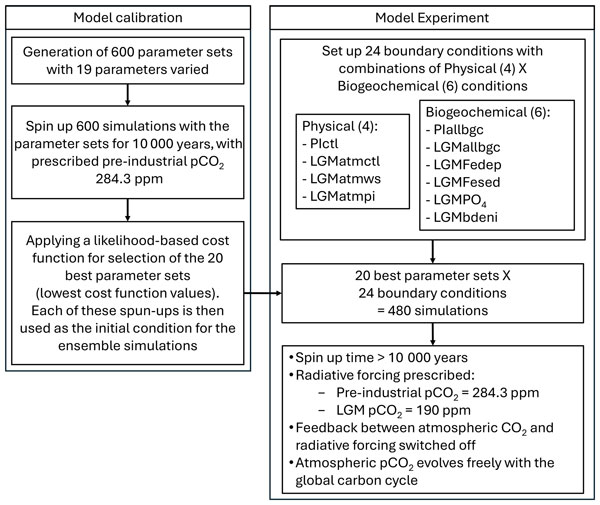
Abstract. During the Last Glacial Maximum (LGM), atmospheric pCO2 was approximately 90 ppm lower than in the pre-industrial era. Several hypotheses have been proposed to explain this difference, including changes in nutrient supply, increased iron input to the ocean, and variations in overturning circulation strength driven by differences in wind stress and atmospheric moisture diffusivity. Current modeling approaches that simulate LGM marine biogeochemistry typically use parameter sets calibrated under pre-industrial conditions, assuming that these parameter values are generic and independent of environmental conditions. This could introduce uncertainty due to the imperfect knowledge of the values that should be assigned to the parameters for the LGM environment. The extent to which this uncertainty affects the simulated LGM marine biogeochemistry remains unclear. In this study, we employ an optimality-based variable stoichiometry plankton ecosystem model coupled with a 3D Earth system model to simulate LGM conditions. We conduct sensitivity analyses with 24 combinations of marine biogeochemical (reduced benthic denitrification rate, decreased sedimentary iron input, a higher PO43− inventory, and increased atmospheric iron deposition) and physical boundary conditions (changes in wind stress pattern and increased meridional moisture diffusivity over the Southern Ocean). For each combination, we perform 20 simulations using 20 biogeochemical parameter sets selected out of 600 – each calibrated against present-day observations and representing pre-industrial biogeochemistry about equally well – resulting in a total of 480 simulations. Our results show that changes in iron input exert the most profound influence on marine biogeochemistry, but reduced sedimentary input counteracts the contribution of enhanced atmospheric deposition to pCO2 drawdown. Changes in macro-nutrient alone have limited effects, owing to co-limitation effects and the variable stoichiometry in our model. The impact of physical conditions on biogeochemical tracers varies, depending on the specific biogeochemical settings. We found that the changes in carbon to nutrient ratios in particulate organic matter are positively correlated with the changes in Fe supply, and could amplify the effect of Fe availability on changes in the atmospheric pCO2. Compared to pre-industrial reference conditions, atmospheric pCO2 under full LGM conditions decreases by 36 to 58 ppm across the 20 simulations. The difference between the maximum and minimum glacial pCO2 decreases amounts to 50 % of the 43 ppm average decrease. These findings highlight that although the 20 parameter sets similarly reproduce pre-industrial marine biogeochemistry, significant variance remains in the marine biogeochemical and atmospheric pCO2 responses to LGM forcings.
-
Notice on discussion status
The requested preprint has a corresponding peer-reviewed final revised paper. You are encouraged to refer to the final revised version.
-
Preprint
(3179 KB)
-
Supplement
(443 KB)
-
The requested preprint has a corresponding peer-reviewed final revised paper. You are encouraged to refer to the final revised version.
- Preprint
(3179 KB) - Metadata XML
-
Supplement
(443 KB) - BibTeX
- EndNote
- Final revised paper


Journal article(s) based on this preprint
Interactive discussion
Status: closed
-
RC1: 'Comment on egusphere-2025-4907', Anonymous Referee #1, 16 Feb 2026
- AC1: 'Reply on RC1', Chia-Te Chien, 27 Apr 2026
-
RC2: 'Comment on egusphere-2025-4907', Anonymous Referee #2, 20 Mar 2026
- AC2: 'Reply on RC2', Chia-Te Chien, 27 Apr 2026
Peer review completion


Interactive discussion
Status: closed
-
RC1: 'Comment on egusphere-2025-4907', Anonymous Referee #1, 16 Feb 2026
The authors present a study that aims to address the uncertainty in simulated LGM climate, particularly where biogeochemical parameters are set to pre-industrial conditions. The study is very thorough, exploring a wide range of parameter combinations, sensitivity experiments corresponding to different physical and biogeochemical settings, and variable stoichiometry. I find the paper very interesting, as it highlights the large variance in simulated pCO₂ responses arising from different parameter calibrations under LGM forcings.
The authors show that, out of all combinations, iron flux exerts the most profound influence on marine biogeochemistry. However, it is important to distinguish the contributions of increased aeolian dust deposition and decreased sedimentary input, as they contribute oppositely to CO₂ drawdown.
Overall, I consider this study a valuable contribution to Earth System Dynamics, subject to the comments outlined below.
General comments:
The manuscript is well written in terms of the structure. However, it is heavily results-focused, with numerous numerical values presented, while the overarching message and broader implications are somewhat buried. Carbon dioxide removal (CDR) is mentioned in the Introduction, but this motivation is not revisited in the Discussion or future directions. Reconnecting the findings more explicitly to this framing would strengthen the manuscript.
Section 4.2 is too brief for such an important topic. There is little discussion in the context of previous studies, particularly regarding winds, which have been widely investigated, but also moisture diffusivity, which represents a relatively new perspective. A more detailed comparison with the existing literature would help better contextualise the findings.
Line 103: Why was higher moisture diffusivity chosen, and how does the wind pattern differ? An explanation is required here.
Line 315: No influence of winds? That is surprising. Providing some explanation would be useful here.
Lines 386–387: This statement appears somewhat speculative. A supporting time series figure could help substantiate this claim.
Specific comments:
Line 27: "Last Glacial Maximum" (LGM).
Lines 27-30: It would be worth mentioning the low CO₂ values explicitly, including how much lower they were and compared to which baseline.
Lines 30-31: Relevant references should be added for these processes (lower SST and higher solubility). The same applies to orbital parameters mentioned in Line 101.
Line 104: How was a 120 m lower sea level configured while keeping bathymetry the same? Since bathymetry is an important LGM-specific parameter (e.g., Nickelsen et al., 2015; Somes et al., 2017), some clarification would be useful.
Line 121: Typo "the".
Line 126: Last how many years?
Line 180: I may have missed the definition of '*-' used from here onward? What does it denote?
Section 3.1: Why is LGMFedep compared first with PIallbgc? Would it not be more appropriate to first compare it with one of the LGM simulations to isolate the impact within the same climatic background?
Line 344: Typo "Wighting"
Line 455: It would be worth mentioning the range of decline reported in other models and experiments.
Line 457-461: Why is this not compared with the previously simulated (and rather large) range of CO₂ drawdown from increased iron deposition?
Line 460: It would be worth referring to a figure here.
Citation: https://doi.org/10.5194/egusphere-2025-4907-RC1 - AC1: 'Reply on RC1', Chia-Te Chien, 27 Apr 2026
-
RC2: 'Comment on egusphere-2025-4907', Anonymous Referee #2, 20 Mar 2026
- AC2: 'Reply on RC2', Chia-Te Chien, 27 Apr 2026
Peer review completion
Journal article(s) based on this preprint
Data sets
Code and data for: Chien et al., Ensemble simulation of the Last Glacial Maximum marine biogeochemistry and atmospheric pCO2 drawdown due to the soft-tissue biological carbon pump Chia-Te Chien https://doi.org/10.5281/zenodo.16630196
Model code and software
Code and data for: Chien et al., Ensemble simulation of the Last Glacial Maximum marine biogeochemistry and atmospheric pCO2 drawdown due to the soft-tissue biological carbon pump Chia-Te Chien https://doi.org/10.5281/zenodo.16630196
Viewed
| HTML | XML | Total | Supplement | BibTeX | EndNote | |
|---|---|---|---|---|---|---|
| 1,768 | 705 | 157 | 2,630 | 302 | 166 | 179 |
- HTML: 1,768
- PDF: 705
- XML: 157
- Total: 2,630
- Supplement: 302
- BibTeX: 166
- EndNote: 179
Viewed (geographical distribution)
| Country | # | Views | % |
|---|
| Total: | 0 |
| HTML: | 0 |
| PDF: | 0 |
| XML: | 0 |
- 1

Markus Pahlow
Christopher J. Somes
Markus Schartau
Andreas Oschlies
The requested preprint has a corresponding peer-reviewed final revised paper. You are encouraged to refer to the final revised version.
- Preprint
(3179 KB) - Metadata XML
-
Supplement
(443 KB) - BibTeX
- EndNote
- Final revised paper
The authors present a study that aims to address the uncertainty in simulated LGM climate, particularly where biogeochemical parameters are set to pre-industrial conditions. The study is very thorough, exploring a wide range of parameter combinations, sensitivity experiments corresponding to different physical and biogeochemical settings, and variable stoichiometry. I find the paper very interesting, as it highlights the large variance in simulated pCO₂ responses arising from different parameter calibrations under LGM forcings.
The authors show that, out of all combinations, iron flux exerts the most profound influence on marine biogeochemistry. However, it is important to distinguish the contributions of increased aeolian dust deposition and decreased sedimentary input, as they contribute oppositely to CO₂ drawdown.
Overall, I consider this study a valuable contribution to Earth System Dynamics, subject to the comments outlined below.
General comments:
The manuscript is well written in terms of the structure. However, it is heavily results-focused, with numerous numerical values presented, while the overarching message and broader implications are somewhat buried. Carbon dioxide removal (CDR) is mentioned in the Introduction, but this motivation is not revisited in the Discussion or future directions. Reconnecting the findings more explicitly to this framing would strengthen the manuscript.
Section 4.2 is too brief for such an important topic. There is little discussion in the context of previous studies, particularly regarding winds, which have been widely investigated, but also moisture diffusivity, which represents a relatively new perspective. A more detailed comparison with the existing literature would help better contextualise the findings.
Line 103: Why was higher moisture diffusivity chosen, and how does the wind pattern differ? An explanation is required here.
Line 315: No influence of winds? That is surprising. Providing some explanation would be useful here.
Lines 386–387: This statement appears somewhat speculative. A supporting time series figure could help substantiate this claim.
Specific comments:
Line 27: "Last Glacial Maximum" (LGM).
Lines 27-30: It would be worth mentioning the low CO₂ values explicitly, including how much lower they were and compared to which baseline.
Lines 30-31: Relevant references should be added for these processes (lower SST and higher solubility). The same applies to orbital parameters mentioned in Line 101.
Line 104: How was a 120 m lower sea level configured while keeping bathymetry the same? Since bathymetry is an important LGM-specific parameter (e.g., Nickelsen et al., 2015; Somes et al., 2017), some clarification would be useful.
Line 121: Typo "the".
Line 126: Last how many years?
Line 180: I may have missed the definition of '*-' used from here onward? What does it denote?
Section 3.1: Why is LGMFedep compared first with PIallbgc? Would it not be more appropriate to first compare it with one of the LGM simulations to isolate the impact within the same climatic background?
Line 344: Typo "Wighting"
Line 455: It would be worth mentioning the range of decline reported in other models and experiments.
Line 457-461: Why is this not compared with the previously simulated (and rather large) range of CO₂ drawdown from increased iron deposition?
Line 460: It would be worth referring to a figure here.