
the Creative Commons Attribution 4.0 License.
the Creative Commons Attribution 4.0 License.
 | 15 Oct 2025
Detecting transitions and quantifying differences in two SST datasets using spatial permutation entropy
Abstract. Weather prediction systems rely on the vast amounts of data continuously generated by Earth modeling and monitoring systems, and efficient data analysis techniques are needed to track changes and compare datasets. Here we show that a nonlinear quantifier, the spatial permutation entropy (SPE), is useful to characterize spatio-temporal complex data, allowing detailed analysis at different scales. Specifically, we use SPE to analyze ERA5 and NOAA OI v2 sea surface temperature (SST) anomalies in two key regions, Nino3.4 and Gulf Stream. We perform a quantitative comparison of these two SST products and find that SPE detects differences at short spatial scales (<1 degree). We also identify several transitions, including a transition that occurs in 2007 when ERA5 changed its sea–surface boundary condition to OSTIA, in 2013 when OSTIA updated the background error covariances, and in 2021 when NOAA SST changed satellite, from MeteOp–A to MeteOp–C. We also show that these transitions are not detected by standard distance and cross-correlation methods.
-
Notice on discussion status
The requested preprint has a corresponding peer-reviewed final revised paper. You are encouraged to refer to the final revised version.
-
Preprint
(1476 KB)
-
The requested preprint has a corresponding peer-reviewed final revised paper. You are encouraged to refer to the final revised version.
- Preprint
(1476 KB) - Metadata XML
- BibTeX
- EndNote
- Final revised paper


Journal article(s) based on this preprint
Interactive discussion
Status: closed
-
RC1: 'Comment on egusphere-2025-4879', Anonymous Referee #1, 26 Nov 2025
-
AC1: 'Reply on RC1', Juan Gancio, 16 Dec 2025
The comment was uploaded in the form of a supplement: https://egusphere.copernicus.org/preprints/2025/egusphere-2025-4879/egusphere-2025-4879-AC1-supplement.pdf
-
AC1: 'Reply on RC1', Juan Gancio, 16 Dec 2025
-
RC2: 'Comment on egusphere-2025-4879', Anonymous Referee #2, 27 Nov 2025
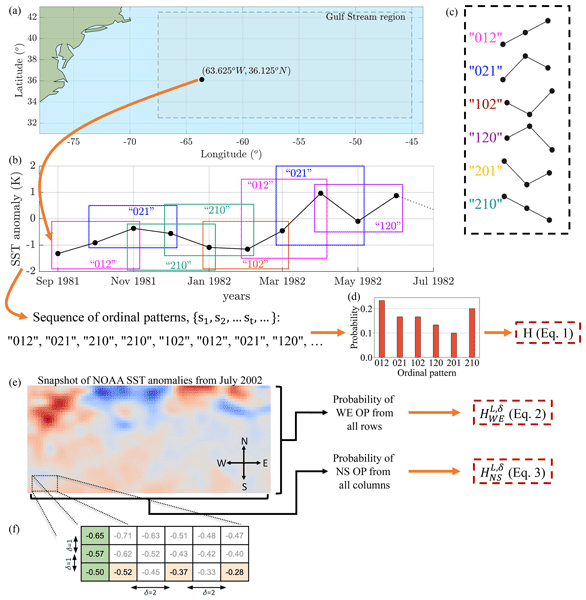
This work presents the results of the computation of the Spatial Permutation Entropy (SPE) on two different sea-surface temperature datasets (ERA5 and NOAA OI v2), for two different regions (Nino3.4 and Gulf Stream regions). This tool has not yet been applied on climate data in this setting and it allows to detect some temporal transitions in the datasets. There are mainly two parts to the results: the first part exposes how to detect temporal transitions in the datasets from temporal transitions in the SPEs (Sec. 4.1) and the second part compares the two datasets on the basis of their respective SPEs (Sec. 4.2).
Overall, it seems also that this tool can provide some interesting insights about the spatiotemporal structure of the datasets, but precise conclusions and concrete results about the efficiency of the method are lacking or, at least, not clearly exposed. I would not recommend publication without major revisions because of this.
Major comments:
The authors claim that the proposed method (SPE + PELT) allows to detect temporal transitions in datasets. There is an effort to estimate the robustness of the detection of change points but a general assessment of the success rate is missing: if the goal is to provide a method to detect transitions in a given dataset, there should be an estimation of the number of transitions that the method will indeed detect. There is no estimation of the number of changes that the method did not detect (one transition is actually detected from the time series of SMI_{NS}, but not from H_{NS}, lines 216-217), even though the detected changes are all linked to some changes in the methodology to produce the datasets.
The two datasets considered in this work are also compared, but I do not really understand what is the conclusion of this comparison. The detected change points (except one) are those detected from H’s time series, so is there any additional conclusion with respect to Sec. 4.1? It is mentioned that there are small-scales differences between the two datasets (which can be expected, to some extent), can we conclude that the datasets are not reliable at these scales? If yes, how to identify a scale above which the datasets agree sufficiently ? I also wonder how does this technique compare with a Fourier or spectral analysis of the datasets.
Minor comments:
1. A smaller SPE is systematically interpreted as a more pronounced gradient because ordered patterns like ‘0123’ would be more frequent. This is probably correct in most cases, but is it always true ? The fact that non-ordered patterns like ‘2031’ become more frequent is also consistent with a smaller SPE, in contradiction with the more pronounced gradient interpretation. Did previous studies on SPE establish that we can confidently interpret a decrease in the SPE as an increase of the gradient ?
2. I feel like some context about the physics of the SST in the studied regions is missing to understand some of the interpretations. For example, why asymmetries in the increase of the SST lead on one hand to a decrease of H_{WE} in the El Niño region, and to an increase of H_{WE} in the Gulf stream region on the other hand ? Why the behavior of H_{WE} is expected to be different for delta = 1 and delta = 8 for El Niño (lines 194-200) ? Why H_{NS} with delta = 8 cannot capture the NS gradients appropriately (lines 198-200) ?
3. There is no uncertainty quantification on the SPE, so that we do not know if some observed trends are really relevant. For example, are the trends in H_{WE} in Fig. 4a and 4d really significant ? In addition, these trends are qualitatively consistent with the mentioned asymmetries in the increase of the SST, but are these asymmetries really the cause of these trends ? (lines 177-184). It would be interesting to analyze which patterns become prevalent to give some sound basis for these explanations.
4. The PELT algorithm contains a penalty parameter P which must be chosen and a method is proposed to test with respect to P the robustness of the detection of change points. I find it difficult to understand precisely the different steps of the method, and therefore to assess its effectiveness. For example, how is used the 99.5th percentile of P* (line 344) ? How precisely are the surrogates used in this method ? Change points are considered robust if their R is larger than the median value of R (lines 350-351), does that mean that half of the points change points are robust ?
5. It would increase the readability if all details about the results presented (which value of delta is used, which region is considered) were indicated on the Figures themselves (in particular for Fig. 3, Fig. 4, Fig. 5, Fig. 6, Fig.7 and Fig. 8), next to each subplot. Ideally, this would appear even if there is only value of delta or one region considered in the Figure. This information is available in the captions, but the comparison of Figures would be easier if they were more visually explicit.
Technical comments
Explicit formulas for H_{WE} and H_{NS} would be appreciable, since these are the main quantities in the paper.
Line 101: is the j index of p_j(t) the same index as the j index of X_{ij} ?
Lines 145-157: it would increase the readability if this paragraph on the details of PELT and its penalty parameter is moved to the appendix (so that everything about PELT is in the appendix)
Lines 185-186: which dataset is used here to compute the SST anomaly ? Could this influence the results ?
Line 191: I do not understand what ‘reflecting the north-south gradients that occur as the equatorial zone is warmer than the north-south edges of the region’ means. How can there be a uniform pattern across the region if the central part is warmer than the edges ?
Line 199: why \delta = 8 is equivalent to each word spanning 6° ? I would say that each word spans 2°, in agreement with what is written in line 205.
Lines 185-200: has this analysis been done for the Gulf stream region ? Are the conclusions the same ?
Line 205: write → right
Lines 216-222: El Niño is written differently 3 times
Line 221: should Fig. 7e be Fig. 7i ?
Line 223: should ‘relative constant’ be ‘relatively constant’ ?
Line 238: there seems to be a verb missing in the sentence ‘Increased cloud coverage in this region during winters could difficult infrared measurement’
Line 243: the acronym CPD should be explained before the appendix
Lines 245-285 (Sec. 4.3): the discussion in this Section seems to be partly redundant with Appendix A, and difficult to understand without reading first this Appendix. Could it be moved to the Appendix ?
Line 291: what models are referred to ?
Citation: https://doi.org/10.5194/egusphere-2025-4879-RC2 - AC2: 'Reply on RC2', Juan Gancio, 16 Dec 2025


Interactive discussion
Status: closed
-
RC1: 'Comment on egusphere-2025-4879', Anonymous Referee #1, 26 Nov 2025
-
AC1: 'Reply on RC1', Juan Gancio, 16 Dec 2025
The comment was uploaded in the form of a supplement: https://egusphere.copernicus.org/preprints/2025/egusphere-2025-4879/egusphere-2025-4879-AC1-supplement.pdf
-
AC1: 'Reply on RC1', Juan Gancio, 16 Dec 2025
-
RC2: 'Comment on egusphere-2025-4879', Anonymous Referee #2, 27 Nov 2025
This work presents the results of the computation of the Spatial Permutation Entropy (SPE) on two different sea-surface temperature datasets (ERA5 and NOAA OI v2), for two different regions (Nino3.4 and Gulf Stream regions). This tool has not yet been applied on climate data in this setting and it allows to detect some temporal transitions in the datasets. There are mainly two parts to the results: the first part exposes how to detect temporal transitions in the datasets from temporal transitions in the SPEs (Sec. 4.1) and the second part compares the two datasets on the basis of their respective SPEs (Sec. 4.2).
Overall, it seems also that this tool can provide some interesting insights about the spatiotemporal structure of the datasets, but precise conclusions and concrete results about the efficiency of the method are lacking or, at least, not clearly exposed. I would not recommend publication without major revisions because of this.
Major comments:
The authors claim that the proposed method (SPE + PELT) allows to detect temporal transitions in datasets. There is an effort to estimate the robustness of the detection of change points but a general assessment of the success rate is missing: if the goal is to provide a method to detect transitions in a given dataset, there should be an estimation of the number of transitions that the method will indeed detect. There is no estimation of the number of changes that the method did not detect (one transition is actually detected from the time series of SMI_{NS}, but not from H_{NS}, lines 216-217), even though the detected changes are all linked to some changes in the methodology to produce the datasets.
The two datasets considered in this work are also compared, but I do not really understand what is the conclusion of this comparison. The detected change points (except one) are those detected from H’s time series, so is there any additional conclusion with respect to Sec. 4.1? It is mentioned that there are small-scales differences between the two datasets (which can be expected, to some extent), can we conclude that the datasets are not reliable at these scales? If yes, how to identify a scale above which the datasets agree sufficiently ? I also wonder how does this technique compare with a Fourier or spectral analysis of the datasets.
Minor comments:
1. A smaller SPE is systematically interpreted as a more pronounced gradient because ordered patterns like ‘0123’ would be more frequent. This is probably correct in most cases, but is it always true ? The fact that non-ordered patterns like ‘2031’ become more frequent is also consistent with a smaller SPE, in contradiction with the more pronounced gradient interpretation. Did previous studies on SPE establish that we can confidently interpret a decrease in the SPE as an increase of the gradient ?
2. I feel like some context about the physics of the SST in the studied regions is missing to understand some of the interpretations. For example, why asymmetries in the increase of the SST lead on one hand to a decrease of H_{WE} in the El Niño region, and to an increase of H_{WE} in the Gulf stream region on the other hand ? Why the behavior of H_{WE} is expected to be different for delta = 1 and delta = 8 for El Niño (lines 194-200) ? Why H_{NS} with delta = 8 cannot capture the NS gradients appropriately (lines 198-200) ?
3. There is no uncertainty quantification on the SPE, so that we do not know if some observed trends are really relevant. For example, are the trends in H_{WE} in Fig. 4a and 4d really significant ? In addition, these trends are qualitatively consistent with the mentioned asymmetries in the increase of the SST, but are these asymmetries really the cause of these trends ? (lines 177-184). It would be interesting to analyze which patterns become prevalent to give some sound basis for these explanations.
4. The PELT algorithm contains a penalty parameter P which must be chosen and a method is proposed to test with respect to P the robustness of the detection of change points. I find it difficult to understand precisely the different steps of the method, and therefore to assess its effectiveness. For example, how is used the 99.5th percentile of P* (line 344) ? How precisely are the surrogates used in this method ? Change points are considered robust if their R is larger than the median value of R (lines 350-351), does that mean that half of the points change points are robust ?
5. It would increase the readability if all details about the results presented (which value of delta is used, which region is considered) were indicated on the Figures themselves (in particular for Fig. 3, Fig. 4, Fig. 5, Fig. 6, Fig.7 and Fig. 8), next to each subplot. Ideally, this would appear even if there is only value of delta or one region considered in the Figure. This information is available in the captions, but the comparison of Figures would be easier if they were more visually explicit.
Technical comments
Explicit formulas for H_{WE} and H_{NS} would be appreciable, since these are the main quantities in the paper.
Line 101: is the j index of p_j(t) the same index as the j index of X_{ij} ?
Lines 145-157: it would increase the readability if this paragraph on the details of PELT and its penalty parameter is moved to the appendix (so that everything about PELT is in the appendix)
Lines 185-186: which dataset is used here to compute the SST anomaly ? Could this influence the results ?
Line 191: I do not understand what ‘reflecting the north-south gradients that occur as the equatorial zone is warmer than the north-south edges of the region’ means. How can there be a uniform pattern across the region if the central part is warmer than the edges ?
Line 199: why \delta = 8 is equivalent to each word spanning 6° ? I would say that each word spans 2°, in agreement with what is written in line 205.
Lines 185-200: has this analysis been done for the Gulf stream region ? Are the conclusions the same ?
Line 205: write → right
Lines 216-222: El Niño is written differently 3 times
Line 221: should Fig. 7e be Fig. 7i ?
Line 223: should ‘relative constant’ be ‘relatively constant’ ?
Line 238: there seems to be a verb missing in the sentence ‘Increased cloud coverage in this region during winters could difficult infrared measurement’
Line 243: the acronym CPD should be explained before the appendix
Lines 245-285 (Sec. 4.3): the discussion in this Section seems to be partly redundant with Appendix A, and difficult to understand without reading first this Appendix. Could it be moved to the Appendix ?
Line 291: what models are referred to ?
Citation: https://doi.org/10.5194/egusphere-2025-4879-RC2 - AC2: 'Reply on RC2', Juan Gancio, 16 Dec 2025
Peer review completion


Journal article(s) based on this preprint
Viewed
| HTML | XML | Total | BibTeX | EndNote | |
|---|---|---|---|---|---|
| 1,542 | 777 | 191 | 2,510 | 113 | 162 |
- HTML: 1,542
- PDF: 777
- XML: 191
- Total: 2,510
- BibTeX: 113
- EndNote: 162
Viewed (geographical distribution)
| Country | # | Views | % |
|---|
| Total: | 0 |
| HTML: | 0 |
| PDF: | 0 |
| XML: | 0 |
- 1
Giulio Tirabassi
Cristina Masoller
Marcelo Barreiro
The requested preprint has a corresponding peer-reviewed final revised paper. You are encouraged to refer to the final revised version.
- Preprint
(1476 KB) - Metadata XML
Find comments in the attached PDF.