
the Creative Commons Attribution 4.0 License.
the Creative Commons Attribution 4.0 License.
 | 16 Oct 2025
Future volcanic eruptions may delay the recovery of lower stratospheric ozone over Antarctica and Southern Hemisphere mid-latitudes
Abstract. Sporadic explosive volcanic eruptions can inject large amounts of sulfur into the stratosphere, which forms volcanic sulfate aerosols with the potential to affect stratospheric ozone chemistry. Future volcanic eruptions have been represented in climate projection studies with varying degrees of realism despite their potential importance for polar ozone recovery. Climate projections typically use a constant volcanic forcing based on a historical average, which very likely underestimates the magnitude of future volcanic forcing and ignores the sporadic nature of volcanic eruptions. In this study, we use stochastic volcanic eruption scenarios and a plume-aerosol-chemistry-climate model (UKESM-VPLUME) to assess the effect of future volcanic sulfur injections on lower stratospheric ozone recovery over Antarctica and Southern Hemisphere mid-latitudes. We find that sporadic eruptions can delay Antarctic total column ozone recovery by up to five years, though this delay is relatively small when compared with the long-term ozone recovery timescale. Large-magnitude eruptions occurring before mid-century can, however, episodically cause more substantial delays in the recovery. Based on a composite analysis we show that the ozone response to volcanic sulfate aerosols over Antarctica and Southern Hemisphere mid-latitudes weakens over the 21st century due to declining chlorofluorocarbon concentrations. Overall, our findings underscore the need for fully interactive volcanic aerosol-chemistry coupling to assess the resilience of the Antarctic ozone layer in response to future volcanic eruptions and other stratospheric perturbation events. Our results also support previous calls for sustained monitoring of stratospheric composition and ozone-depleting processes to better anticipate and attribute changes in ozone recovery.
-
Notice on discussion status
The requested preprint has a corresponding peer-reviewed final revised paper. You are encouraged to refer to the final revised version.
-
Preprint
(4600 KB)
-
Supplement
(3883 KB)
-
The requested preprint has a corresponding peer-reviewed final revised paper. You are encouraged to refer to the final revised version.
- Preprint
(4600 KB) - Metadata XML
-
Supplement
(3883 KB) - BibTeX
- EndNote
- Final revised paper


Journal article(s) based on this preprint
Interactive discussion
Status: closed
-
RC1: 'Comment on egusphere-2025-4860', Anonymous Referee #1, 28 Nov 2025
-
AC1: 'Reply on RC1', May M. M. Chim, 04 Mar 2026
The comment was uploaded in the form of a supplement: https://egusphere.copernicus.org/preprints/2025/egusphere-2025-4860/egusphere-2025-4860-AC1-supplement.pdf
-
AC1: 'Reply on RC1', May M. M. Chim, 04 Mar 2026
-
RC2: 'Comment on egusphere-2025-4860', Anonymous Referee #2, 08 Dec 2025
Ozone recovery is a topic of great interest not only to scientists but also to the general public. In recent years, several unusually strong Antarctic ozone holes have occurred, posing challenges to our understanding of their driving mechanisms. Volcanic eruptions are known to cause ozone loss through the injection of aerosols, water vapour, and halogen species. An important and timely question is therefore: How will future volcanic eruptions affect projections of ozone recovery? The authors address this by conducting experiments with the plume-aerosol-chemistry-climate model (UKESM-PLUME) under different future volcanic eruption scenarios, analysing the resulting ozone loss and its contribution to delays in Southern Hemisphere ozone recovery. The topic is interesting, well-motivated, and suitable for ACP. My major concern, however, lies in the estimated delay (~5 years) in ozone recovery due to volcanic eruptions. The model shows substantial deviations from observations in its simulation of ozone loss following a major volcanic eruption. My detailed comments are below.
Major comments:
- The authors have clearly shown the limitations of UKESM1.1. Both the timing (Fig. 7) and amplitude (Fig. 6c) of ozone loss, as well as the spread and amplitude of SAOD (Fig. 6a, 6c), differ considerably from observations. Importantly, volcanic impacts on ozone loss appear to be overestimated (Fig. 6d) in both the Antarctic and Arctic. How do there limitations influence the projection of ozone recovery date and the estmated delcay attributed to volcanic eruptions?
- The authors use the 1978-1982 mean October TCO as the historical baseline. Is a 5-year average sufficient? What is the year-to-year variability of October TCO during this period? This uncertainty may propagate to the estimated return year.
Specific comments:
-
Line 65: At the end of the sentence (before the full stop), add something like “and cause additional chemical ozone loss (eg., Santee et al., 2023)”
Santee, M. L., Manney, G. L., Lambert, A., Millán, L. F., Livesey, N. J., Pitts, M. C., et al. (2024). The influence of stratospheric hydration from the Hunga eruption on chemical processing in the 2023 Antarctic vortex. Journal of Geophysical Research: Atmospheres, 129, e2023JD040687. **https://doi.org/10.1029/2023JD040687**
-
Figure 1: It is misleading by putting “leading to net ozone formation in the stratosphere” for future volanic eruption. Volcanic eruptions increase aerosol surface area density for heterogeneous reaction, promoting heterogeneous reactions that lead to ozone loss. This mechanism should be similar under present-day and future scenarios.
-
Line 77 and elsewhere: Klobas et al., 2017 is cited in the text but missing from the Reference list.
-
Line 134: How is the stratospheric aerosol prescribed in the NOVOLC run? Is it based on background levels during the volcanic quiet period?
-
Line 194: Formatting is inconsistent after “odd oxygen”.
-
Figure 6c: A typo here. “TOC” in legend should be “TCO”. The NIWA-BS line shows a decrease in 1992 summer, but the UKESM line shows an increase. How does the UKESM line in Fig. 6c relate to Fig. 6d?
-
Line 252: “with a magnitude comparable to NIWA-BS total column ozone loss (Fig. 6c to 6f).” Fig. 6c does not show ozone loss in the 1992 summer; it should be removed from this comparison.
-
Figure 7: What do the colored shadings represent? The authors state that UKESM reproduces the October Antarctic TCO reasonably well, which I agree with. However, the October differences between NOVOLC and VOLC, which are important to quantifying volcanic impacts, are not discussed.
Citation: https://doi.org/10.5194/egusphere-2025-4860-RC2 -
AC2: 'Reply on RC2', May M. M. Chim, 04 Mar 2026
The comment was uploaded in the form of a supplement: https://egusphere.copernicus.org/preprints/2025/egusphere-2025-4860/egusphere-2025-4860-AC2-supplement.pdf
Peer review completion


Interactive discussion
Status: closed
-
RC1: 'Comment on egusphere-2025-4860', Anonymous Referee #1, 28 Nov 2025
Review of “Future volcanic eruptions may delay the recovery of lower stratospheric O3 over Antarctica and Southern Hemisphere mid-latitudes” by Chim et al.
This manuscript used the model simulation output from Chim et al. (2023) to investigate how sporadic volcanic eruptions impact the O3 recovery in the coming decades. The topic is of interest to the research community and ACP readers. The use of stochastic volcanic eruption scenarios is an advantage of this study over previous studies using a constant background volcanic emission. Also, the analysis based on four different O3 recovery indicators are very useful to understand this problem from different perspectives. However, current model evaluation results do not present a very solidity of using this model version on O3 studies, thus casting doubts on the validity of the results and conclusions. Besides, the structure of the manuscript does not look reasonable. Figure 2 to 7 are all used for model evaluations. Especially, the main conclusion of the manuscript is on volcanic impacts on O3 recovery, but the conclusion draws mostly based on table 2, plus figure 8-9, from which the results does not look that convincing to corroborate the main conclusion of the paper. Some of the texts describing the figures and table 2 are not accurate also cast doubt on the validity of the conclusion. The mechanism investigation is quite limit only based on figure 10. Based on these concerns, at least major revisions are needed to improve the quality of the manuscript.
Below lists the detailed major and specific comments:
Major comments
- The introduction section should be largely improved. L49-62, L69-86 and figure 1 can be merged and shortened, these are well known basic knowledge on O3 chemistry. Instead, L64-L67 only very shortly mention the advance of the study field, but volcanic halogen and water vapour lead to strong O3 depletion, thus have a large impact on O3 recovery. Many modelling studies already investigated these but are completely missing in this manuscript.
- two median scenarios with small-magnitude eruptions only (VOLC50-1s and VOLC50-2s) are mentioned, but none of the figure showed any results of these experiments except for table 2, why? And no results and discussions addressed the question of “evaluate the effects of small-magnitude eruptions”.
- The Pinatubo eruption erupted at a specific latitude-longitude location, but it needs to inject across 13 latitude bands to allow aerosols to be distributed correctly. This cast doubts on the validity of the model ability to simulate the eruptions. As for other eruptions, did you also use wider latitude bands? And different eruptions need different latitude bands? As The distribution of the aerosol is one of the key factors that affecting the regional O3 responses.
- Why VSL chlorine and bromine compounds are mentioned and discussed even more than the volcanic halogen emissions, which lead to stratosphere halogen injections more than background emissions and have a larger post-eruption impact on stratospheric O3. Is this reasonable?
- The analysis methods can lead to biased understand on evaluating the model and showing O3 impacts. Why different number of months are used for calculating cumulative O3 loss between Antarctica and SH mid-latitude. Why model evaluations are against with other models or CMIP6 multi model mean? There are observations, even used in the cited reference in Keeble et al. 2021, like SWOOSH. Results also show large difference between models, what are these differences mean? What impact do they have on the O3 recovery? There should be important aspects for understanding the validity of using the model on this study and shown results of O3 responses, but not discussed. Figure 7 also shows the timing of the modelled Antarctic O3 hole deviate largely from historical observations, and it was mentioned in the paper that another version of UKESM simulate O3 correctly. Does these mean this model version cannot simulate O3 reasonably? The conclusion the texts based on these figures does not read that convincing for the conclusion on the validity of the model.
- Table 2 shows the metrics to evaluate O3 recovery, but only VOLC98 shows consistent delay based on all the metrics, other eruption clusters sometimes show an earlier recovery. For VOLC98, there are way more strong volcanic eruptions in 2050-2075 with high Antarctica SO2 loadings as shown in Fig. 2, while the O3 recovery metric is also mostly fall in this range 2058-2066, then how can you exclude that the delay of O3 recovery metric is just due to these short episodic large eruptions, especially the huge tropical eruption in 2056 with 114 Tg of SO2 emission? VOLC50-1 and VOLC50-2 is used, but it’s not clear whether large or small eruptions affect the results. For O3 mass deficit to 220 DU, VOLC2.5 and VOLC98 show a delay, but other scenarios all show an earlier recovery, why? For O3 mass deficit to 175 DU, VOLC2.5 show an even longer delay compared to VOLC50-1S and VOLC50-2s and even VOLC98, while VOLC50-1 even show an earlier recovery. For O3 hole area to 220 DU (unit also in DU?), why 2058 (2058-2059) for NOVOLC, but 2059 (2058-2059) for VOLC50-2S, considering this uncertainty, are three members enough for this? These questions/inconsistencies make it not convincing on the main conclusion of the paper. The table is not that intuitive for range comparison, can be changed into a more illustrative figure.
Specific comments
Figure 1 does not add important information to the text and the impact of volcanic eruptions on O3, not that needed.
Table 1 is not that necessary, the Tg of SO2 per year can be just mentioned in the text. Need to mention more information regarding volcanic distributions and location etc. can be found in which figure/table in Chim et al., 2023. Then readers can easily know where to find this details that are useful for understanding the method.
Figure 2 suggest adding latitude range also in the figure, then readers don’t need to find it in the text.
L175: access -> assess.
L190: confusing “October-mean”.
L194-196: different font.
L196-200: “October to March” for Antarctica but 12 months for SH mid-latitude cumulative O3 loss calculation, any O3 increase in any months that counteract the O3 loss effect in mid-latitude? Then it’s not apple-to-apple comparison, will this contribute to a biased understanding on results shown in Fig. 10?
L207-208 “2-year window prior to the eruption” Any double eruptions within several years? How did you deal with this? As the former eruption can elevate the pre-eruption background conditions.
Fig. 3: why do you only show comparisons for Antarctica in October? How different are they for annual mean Antarctica? How other regions look like in October? Besides, observed annual mean SH mid-latitudes O3 is higher compared to modelled one, does it have a stronger SH mid-latitude O3 depletion (whether in Oct.?) due to hinder of aerosols transport to Antarctica as written in L276-278? These can be used to understand the inconsistency between observations and model.
Fig. 4 and 5: Here only shows model inter-comparisons, why not comparoing with observations, like that shown in Keeble et l., 2021? And what these model differences mean?
L253-254: what impacts does this modelled prolonged Antarctic O3 loss have on the O3 recovery results?
Fig. 6: c) why TOC near 1992 is so different between NIWA-BS and UKESM?
- f) there is a huge positive anomaly between UKESM and NIWA-BS in NH mid to polar latitudes, does this mean a shortened impact of volcanic eruptions on NH O3? Above, a modelled prolonged Antarctic O3 loss was mentioned, why? Understand these might be quite useful to understand the ability of model simulation on O3. Besides, how to understand their impacts on the interpretation of the modelled O3 recovery results?
L276-278: may hinder the transport? Where is the assessment based on the data used?
L281-285: Many boxes do not show a delayed recovery and even an advanced recovery, thus looks quite different to the texts written here. It seems all experiments show a delayed recovery based on O3 mass deficit (175 DU) except for VOLC50-1, but O3 mass deficit (220 DU) show quite contradictory results for different experiments, why it’s so different when using different threshold?
Fig. 8: 3-year moving mean plots are shown, but none of the texts mentioned these subplots. The difference between control and experiments are not that clear with 3-year moving mean. What does these subplots mean when compared to the 30-year moving mean results?
L306-307: any model data analysis to confirm this?
L311-312: but O3 mass deficit (220 DU and 175 DU) in table 2 also shows later years for VOLC2.5 compared to NOVOLC.
L317-318: October Antarctica (Fig. 8) vs annual mean global and mid-latitude (Fig. S1), Is the comparison reasonable?
L324-325: is this event dominated the O3 impact and the delayed O3 recovery result?
L327-328 the Antarctic O3 hole area is highly variable between ensemble members, then more members are need to study this?
L320-331: this paragraph describes Fig. 9, but only a few sentences are based on Fig. 9. It looks like Fig. 9 does not show a clear difference between VOLC and NOVOLC, except for VOLC98. However, VOLC98 has several large eruptions in 2040-2060, the delayed recovery can be just due to these eruptions especially the 2056 eruption with 114 Tg SO2 emissions.
L348: refer to Fig. 2b.
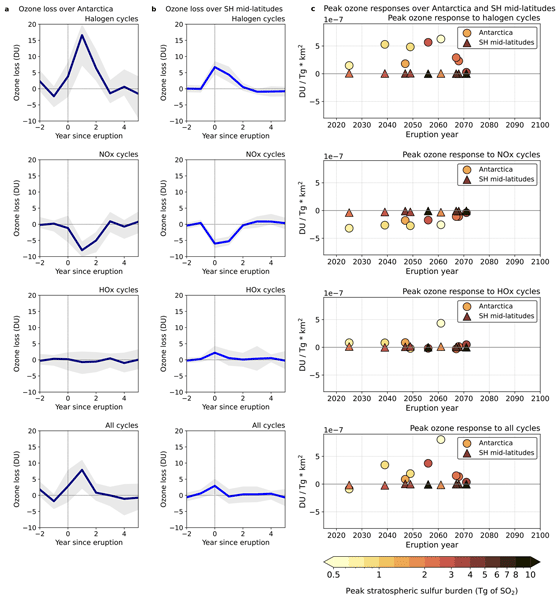
Section 3.3 and Fig. 10: it’s not clear what’s the connection of these content to the main conclusion of the delayed O3 recovery and comparison between Antarctica and mid-latitude changes. Does different response along time due to background O3 and halogen or other chemical family changes in different latitudes?
L378: “depends on the eruption timing, latitude and aerosol distribution in the stochastic scenarios”, the figures do not provide support on this conclusion.
L387: why loading so small but comparable O3 hole size?
L391: is it accurate to say “contrast”, as the settings are very different. In this study, the delayed O3 recovery can be dominated by a huge eruption at that time, but Naik et al., 2017 used constant emissions.
L392-393: how much loading in the Antarctica? This is important for the O3 change in Antarctica.
L395-396: “leads to an earlier recovery of global stratospheric O3”, this seems to be the case in your VOLC2.5 scenario.
L396-397: can be wrong, as the difference can be dominated by a large difference in Antarctica aerosol loading mass.
L400-402: then is this model version appropriate for this study?
L424-425: different sign in the text and in Fig. S10, makes it harder to understand.
L436-437: already written in the introduction. Volcanic halogen emissions can lead to significant O3 depletion and delayed O3 recovery, there are already modelling studies simulated co-emission of halogen with sulfur, which should be discussed more in depth. Besides, modelling studies on Hunga eruption (like Fleming et al., 2024, JGRA; Zhu et al., 2022, ACP; Zhuo et al., 2025, ACP) showed significant O3 impact from water vapor emissions, this is also very important for understanding the delayed O3 recovery but is completely missing in the discussion.
L461-463: not clear where does it show in the paper?
Citation: https://doi.org/10.5194/egusphere-2025-4860-RC1 -
AC1: 'Reply on RC1', May M. M. Chim, 04 Mar 2026
The comment was uploaded in the form of a supplement: https://egusphere.copernicus.org/preprints/2025/egusphere-2025-4860/egusphere-2025-4860-AC1-supplement.pdf
-
RC2: 'Comment on egusphere-2025-4860', Anonymous Referee #2, 08 Dec 2025
Ozone recovery is a topic of great interest not only to scientists but also to the general public. In recent years, several unusually strong Antarctic ozone holes have occurred, posing challenges to our understanding of their driving mechanisms. Volcanic eruptions are known to cause ozone loss through the injection of aerosols, water vapour, and halogen species. An important and timely question is therefore: How will future volcanic eruptions affect projections of ozone recovery? The authors address this by conducting experiments with the plume-aerosol-chemistry-climate model (UKESM-PLUME) under different future volcanic eruption scenarios, analysing the resulting ozone loss and its contribution to delays in Southern Hemisphere ozone recovery. The topic is interesting, well-motivated, and suitable for ACP. My major concern, however, lies in the estimated delay (~5 years) in ozone recovery due to volcanic eruptions. The model shows substantial deviations from observations in its simulation of ozone loss following a major volcanic eruption. My detailed comments are below.
Major comments:
- The authors have clearly shown the limitations of UKESM1.1. Both the timing (Fig. 7) and amplitude (Fig. 6c) of ozone loss, as well as the spread and amplitude of SAOD (Fig. 6a, 6c), differ considerably from observations. Importantly, volcanic impacts on ozone loss appear to be overestimated (Fig. 6d) in both the Antarctic and Arctic. How do there limitations influence the projection of ozone recovery date and the estmated delcay attributed to volcanic eruptions?
- The authors use the 1978-1982 mean October TCO as the historical baseline. Is a 5-year average sufficient? What is the year-to-year variability of October TCO during this period? This uncertainty may propagate to the estimated return year.
Specific comments:
-
Line 65: At the end of the sentence (before the full stop), add something like “and cause additional chemical ozone loss (eg., Santee et al., 2023)”
Santee, M. L., Manney, G. L., Lambert, A., Millán, L. F., Livesey, N. J., Pitts, M. C., et al. (2024). The influence of stratospheric hydration from the Hunga eruption on chemical processing in the 2023 Antarctic vortex. Journal of Geophysical Research: Atmospheres, 129, e2023JD040687. **https://doi.org/10.1029/2023JD040687**
-
Figure 1: It is misleading by putting “leading to net ozone formation in the stratosphere” for future volanic eruption. Volcanic eruptions increase aerosol surface area density for heterogeneous reaction, promoting heterogeneous reactions that lead to ozone loss. This mechanism should be similar under present-day and future scenarios.
-
Line 77 and elsewhere: Klobas et al., 2017 is cited in the text but missing from the Reference list.
-
Line 134: How is the stratospheric aerosol prescribed in the NOVOLC run? Is it based on background levels during the volcanic quiet period?
-
Line 194: Formatting is inconsistent after “odd oxygen”.
-
Figure 6c: A typo here. “TOC” in legend should be “TCO”. The NIWA-BS line shows a decrease in 1992 summer, but the UKESM line shows an increase. How does the UKESM line in Fig. 6c relate to Fig. 6d?
-
Line 252: “with a magnitude comparable to NIWA-BS total column ozone loss (Fig. 6c to 6f).” Fig. 6c does not show ozone loss in the 1992 summer; it should be removed from this comparison.
-
Figure 7: What do the colored shadings represent? The authors state that UKESM reproduces the October Antarctic TCO reasonably well, which I agree with. However, the October differences between NOVOLC and VOLC, which are important to quantifying volcanic impacts, are not discussed.
Citation: https://doi.org/10.5194/egusphere-2025-4860-RC2 -
AC2: 'Reply on RC2', May M. M. Chim, 04 Mar 2026
The comment was uploaded in the form of a supplement: https://egusphere.copernicus.org/preprints/2025/egusphere-2025-4860/egusphere-2025-4860-AC2-supplement.pdf
Peer review completion
Journal article(s) based on this preprint
Interactive computing environment
Code Man Mei Chim https://github.com/maychim/volc_ozone
Viewed
| HTML | XML | Total | Supplement | BibTeX | EndNote | |
|---|---|---|---|---|---|---|
| 3,269 | 1,661 | 215 | 5,145 | 425 | 167 | 178 |
- HTML: 3,269
- PDF: 1,661
- XML: 215
- Total: 5,145
- Supplement: 425
- BibTeX: 167
- EndNote: 178
Viewed (geographical distribution)
| Country | # | Views | % |
|---|
| Total: | 0 |
| HTML: | 0 |
| PDF: | 0 |
| XML: | 0 |
- 1

Nathan Luke Abraham
Thomas J. Aubry
Ben Johnson
Hella Garny
Susan Solomon
Anja Schmidt
The requested preprint has a corresponding peer-reviewed final revised paper. You are encouraged to refer to the final revised version.
- Preprint
(4600 KB) - Metadata XML
-
Supplement
(3883 KB) - BibTeX
- EndNote
- Final revised paper
Review of “Future volcanic eruptions may delay the recovery of lower stratospheric O3 over Antarctica and Southern Hemisphere mid-latitudes” by Chim et al.
This manuscript used the model simulation output from Chim et al. (2023) to investigate how sporadic volcanic eruptions impact the O3 recovery in the coming decades. The topic is of interest to the research community and ACP readers. The use of stochastic volcanic eruption scenarios is an advantage of this study over previous studies using a constant background volcanic emission. Also, the analysis based on four different O3 recovery indicators are very useful to understand this problem from different perspectives. However, current model evaluation results do not present a very solidity of using this model version on O3 studies, thus casting doubts on the validity of the results and conclusions. Besides, the structure of the manuscript does not look reasonable. Figure 2 to 7 are all used for model evaluations. Especially, the main conclusion of the manuscript is on volcanic impacts on O3 recovery, but the conclusion draws mostly based on table 2, plus figure 8-9, from which the results does not look that convincing to corroborate the main conclusion of the paper. Some of the texts describing the figures and table 2 are not accurate also cast doubt on the validity of the conclusion. The mechanism investigation is quite limit only based on figure 10. Based on these concerns, at least major revisions are needed to improve the quality of the manuscript.
Below lists the detailed major and specific comments:
Major comments
Specific comments
Figure 1 does not add important information to the text and the impact of volcanic eruptions on O3, not that needed.
Table 1 is not that necessary, the Tg of SO2 per year can be just mentioned in the text. Need to mention more information regarding volcanic distributions and location etc. can be found in which figure/table in Chim et al., 2023. Then readers can easily know where to find this details that are useful for understanding the method.
Figure 2 suggest adding latitude range also in the figure, then readers don’t need to find it in the text.
L175: access -> assess.
L190: confusing “October-mean”.
L194-196: different font.
L196-200: “October to March” for Antarctica but 12 months for SH mid-latitude cumulative O3 loss calculation, any O3 increase in any months that counteract the O3 loss effect in mid-latitude? Then it’s not apple-to-apple comparison, will this contribute to a biased understanding on results shown in Fig. 10?
L207-208 “2-year window prior to the eruption” Any double eruptions within several years? How did you deal with this? As the former eruption can elevate the pre-eruption background conditions.
Fig. 3: why do you only show comparisons for Antarctica in October? How different are they for annual mean Antarctica? How other regions look like in October? Besides, observed annual mean SH mid-latitudes O3 is higher compared to modelled one, does it have a stronger SH mid-latitude O3 depletion (whether in Oct.?) due to hinder of aerosols transport to Antarctica as written in L276-278? These can be used to understand the inconsistency between observations and model.
Fig. 4 and 5: Here only shows model inter-comparisons, why not comparoing with observations, like that shown in Keeble et l., 2021? And what these model differences mean?
L253-254: what impacts does this modelled prolonged Antarctic O3 loss have on the O3 recovery results?
Fig. 6: c) why TOC near 1992 is so different between NIWA-BS and UKESM?
L276-278: may hinder the transport? Where is the assessment based on the data used?
L281-285: Many boxes do not show a delayed recovery and even an advanced recovery, thus looks quite different to the texts written here. It seems all experiments show a delayed recovery based on O3 mass deficit (175 DU) except for VOLC50-1, but O3 mass deficit (220 DU) show quite contradictory results for different experiments, why it’s so different when using different threshold?
Fig. 8: 3-year moving mean plots are shown, but none of the texts mentioned these subplots. The difference between control and experiments are not that clear with 3-year moving mean. What does these subplots mean when compared to the 30-year moving mean results?
L306-307: any model data analysis to confirm this?
L311-312: but O3 mass deficit (220 DU and 175 DU) in table 2 also shows later years for VOLC2.5 compared to NOVOLC.
L317-318: October Antarctica (Fig. 8) vs annual mean global and mid-latitude (Fig. S1), Is the comparison reasonable?
L324-325: is this event dominated the O3 impact and the delayed O3 recovery result?
L327-328 the Antarctic O3 hole area is highly variable between ensemble members, then more members are need to study this?
L320-331: this paragraph describes Fig. 9, but only a few sentences are based on Fig. 9. It looks like Fig. 9 does not show a clear difference between VOLC and NOVOLC, except for VOLC98. However, VOLC98 has several large eruptions in 2040-2060, the delayed recovery can be just due to these eruptions especially the 2056 eruption with 114 Tg SO2 emissions.
L348: refer to Fig. 2b.
Section 3.3 and Fig. 10: it’s not clear what’s the connection of these content to the main conclusion of the delayed O3 recovery and comparison between Antarctica and mid-latitude changes. Does different response along time due to background O3 and halogen or other chemical family changes in different latitudes?
L378: “depends on the eruption timing, latitude and aerosol distribution in the stochastic scenarios”, the figures do not provide support on this conclusion.
L387: why loading so small but comparable O3 hole size?
L391: is it accurate to say “contrast”, as the settings are very different. In this study, the delayed O3 recovery can be dominated by a huge eruption at that time, but Naik et al., 2017 used constant emissions.
L392-393: how much loading in the Antarctica? This is important for the O3 change in Antarctica.
L395-396: “leads to an earlier recovery of global stratospheric O3”, this seems to be the case in your VOLC2.5 scenario.
L396-397: can be wrong, as the difference can be dominated by a large difference in Antarctica aerosol loading mass.
L400-402: then is this model version appropriate for this study?
L424-425: different sign in the text and in Fig. S10, makes it harder to understand.
L436-437: already written in the introduction. Volcanic halogen emissions can lead to significant O3 depletion and delayed O3 recovery, there are already modelling studies simulated co-emission of halogen with sulfur, which should be discussed more in depth. Besides, modelling studies on Hunga eruption (like Fleming et al., 2024, JGRA; Zhu et al., 2022, ACP; Zhuo et al., 2025, ACP) showed significant O3 impact from water vapor emissions, this is also very important for understanding the delayed O3 recovery but is completely missing in the discussion.
L461-463: not clear where does it show in the paper?