
the Creative Commons Attribution 4.0 License.
the Creative Commons Attribution 4.0 License.
 | 04 Dec 2025
Systematic Assessment of the RFI Environment in Passive Microwave Bands for Earth Observation from 6 to 200 GHz
Abstract. Radio Frequency Interference (RFI) is spreading worldwide, affecting numerous Earth Observation (EO) instruments. Among these, microwave radiometers play an essential role, providing critical measurements for climate monitoring, weather forecasting, and numerous other applications. In order to plan for future satellite missions and fully exploit currently available measurements, it is crucial to study the contamination levels at bands where radiometers operate. This work presents the Earth Observation RFI Scanner (EORFIScan), an RFI detection system for EO products that combines multiple RFI detection techniques in order to reduce missed detections. This software has been used to survey several passive microwave bands from 6 GHz up to 200 GHz, including both exclusive and shared bands. Analysis and validation of this method is presented for the year 2022. The resulting RFI probability maps show significant contamination in the bands up to and including 18.7 GHz. A few brightness temperatures in the range of 350–400 K have been observed at 23.8 GHz and one at 36.5 GHz, which suggest the presence of man-made emissions. At higher frequencies, RFI contamination is not clearly visible in the analysed data. Comparisons with simulated radiances from a numerical weather prediction model are presented as a way to evaluate the RFI detection, finding that flagged observations are typically warmer than model simulations, as would be expected for RFI. It is clear from the results presented that RFI is already a concern for users at lower frequency passive microwave bands, and it is recommended that real-time monitoring systems are developed to keep an eye on the evolving threat of RFI in EO bands.
-
Notice on discussion status
The requested preprint has a corresponding peer-reviewed final revised paper. You are encouraged to refer to the final revised version.
-
Preprint
(23550 KB)
-
The requested preprint has a corresponding peer-reviewed final revised paper. You are encouraged to refer to the final revised version.
- Preprint
(23550 KB) - Metadata XML
- BibTeX
- EndNote
- Final revised paper


Journal article(s) based on this preprint
Interactive discussion
Status: closed
-
RC1: 'Comment on egusphere-2025-4838', Anonymous Referee #3, 30 Jan 2026
-
AC1: 'Reply on RC1', Raul Onrubia, 28 Apr 2026
Thank you very much for your review and for your in-depth feedback. As a general point, the authors agree that there was previously a mismatch between the scope of the article implied by the title and the results presented. Due to this fair criticism, the title and abstract have been modified as seen below, and the conclusions have been tempered accordingly. In the following, the authors’ responses are given in italics.
General assessment
The manuscript addresses an important and timely problem: the impact of radio-frequency interference on passive microwave observations across a broad frequency range. The topic is clearly relevant for the Earth observation and NWP communities, and the attempt to apply a consistent framework across instruments and bands is valuable.
However, the paper sits uneasily between a methods paper and an application or survey paper. Large parts are devoted to describing the EORFIScan framework, while the results and validation resemble a collection of case studies. This mixed focus leads to ambiguity in scope and weakens the conclusions. The manuscript does not yet provide the level of methodological validation expected for a methods paper, nor the statistical robustness implied by a systematic global survey.
RFI indicators, geophysical variability, and resolution effects
A central issue concerns the specificity of the “RFI indicators” used in EORFIScan. The applied techniques, intensity thresholds, polarization ratios, spatial variability, high-pass filtering, and multi-channel regression residuals, are well established in passive microwave processing. In particular, the spatial variability and image enhancement filters are mathematically equivalent to edge-detection operators commonly used to identify coastlines, sea-ice margins, and other sharp geophysical gradients.
The manuscript itself acknowledges that many detections coincide with sea-ice edges, coastal upwelling regions, and complex terrain. While combining multiple indicators may reduce missed detections, the paper does not convincingly demonstrate that the resulting flags are specific to man-made interference rather than natural surface variability. Given that the conclusions rely heavily on spatial pattern interpretation, this ambiguity is problematic.
- The title and abstract emphasize a survey from 6 to 200 GHz. In practice, the most detailed analysis and validation focus on frequencies below about 20 GHz. For higher frequencies, conclusions are largely negative and not supported by comparable quantitative analysis. This mismatch weakens the narrative and makes the use of the term “systematic” in the title potentially misleading, as the validation is neither statistically nor methodologically systematic across the full frequency range. The title “Assessment of the RFI Environment in Key Passive Microwave Bands for Earth Observation” and manuscript content have been modified to reflect all this.
This concern is amplified by resolution issues. The study combines data from AMSR2, AMSU-A, MWHS-2, and AMR-C, which differ substantially in spatial resolution, scan geometry, and antenna characteristics. It is unclear whether the data are resolution-matched before applying spatial operators, or whether antenna pattern effects are treated consistently. Without resolution harmonization (e.g. Backus–Gilbert or equivalent approaches), edge-based methods are particularly prone to artefacts. Many of the strongest “RFI probability” features occur precisely in regions where such effects are expected to be largest, making it difficult to separate true RFI from instrumental or sampling artefacts.
- The study does not combine data from the instruments. It follows the same approach for all instruments to generate the thresholds and flag the data; the thresholds for each instrument are derived exclusively from its own data. Added clarification to the manuscript.
Interpretation and validation using departures
The comparison with NWP background departures is one of the strongest elements of the paper. The swath-level examples in Figure 10 are convincing and show that many flagged observations correspond to strong, localized positive departures that are hard to explain by geophysical variability alone. These examples demonstrate that the framework can identify genuine RFI.
At the same time, this validation is limited to a single day, a restricted region, and mainly low-frequency AMSR2 channels. While illustrative, it does not support the broader claim of a systematic assessment across frequencies, instruments, and time. Aggregated statistics are presented later, but departure-based validation is not applied consistently or extensively enough to underpin the global conclusions.
- Thank you for the positive feedback on this aspect of the manuscript. It is a fair criticism that the NWP-based validation is limited and not entirely ’systematic.’ The authors felt that it would be overkill to show the same figures for all channels, including the ones with no persistent RFI, hence our analysis was limited to the low-frequency channels of AMSR2. This is now made explicit in the text, and the word ’systematic’ has been removed in the title to reflect to article’s more limited scope.
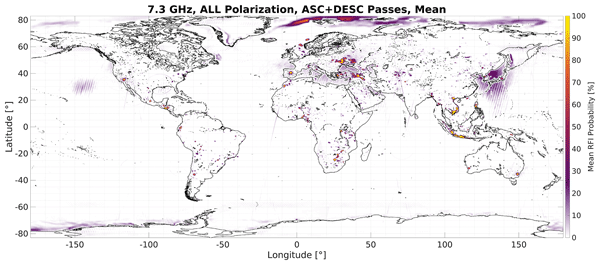
The interpretation of the RFI probability maps is further hindered by the graphical presentation. In particular, the colour scales used in Figures 5 and 6 make it difficult to clearly identify contaminated areas and to compare signals across frequencies.
- The authors agree to the observation. We thought about this problem before the submission and had two solutions: 1) logarithmic plots, so low probabilities can be better observed, however this becomes confusing in the same plot, since areas might seem visually more contaminated. 2) different colour scales, however there will be visual confusion between plots; For instance, if figure 5f) get a different colour scale, it might visually seem that the false alarms are at the same level that the RFI contamination levels than the same plots in the figure. These plots aim to be intercompared, and both alternatives would be confusing for the reader.
Validation strategy and supporting data
The use of RTTOV-SCATT NWP simulations for validation is appropriate and well established. However, quantitative validation is limited to a subset of channels and periods, while conclusions for higher frequencies rely largely on the absence of visually obvious signals. Detection limits and false alarm rates are discussed only qualitatively, and no rigorous performance metrics are provided.
- There is greater evaluation presented in the Duncan & Bormann contract report that is cited herein. As now stated in the abstract, we focus on the 6-19 GHz bands of AMSR2 because these were the only ones with persistent and widespread RFI that was corroborated. While we could show lots of empty maps of the higher frequencies, it feels fair to the authors to state that (excepting the rare cases mentioned of 23 & 36 GHz RFI) we focus on the interesting bands for presenting analysis.
The lack of ground truth is acknowledged, but this makes it especially important to demonstrate that flagged signals cannot be explained by plausible geophysical or modelling errors. In several cases, particularly near coasts, ice edges, and complex terrain, the manuscript itself attributes detections to surface effects, raising questions about the robustness of the detection framework.
- Setting thresholds for RFI detection techniques implies a trade-off between false detections and miss-detections. Trying to detect weak RFIs, the ones that are not easily detected and might be ingested by processing pipelines, comes to the price of having false alarms. In the case of the possible upwelling areas, the variation of brightness temperature could be caused by the change in the sea surface temperature (1016/j.csr.2014.03.012 and 10.1016/j.dsr2.2017.01.005). The temperature anomaly is around 4 K after long averaging time, which in a single product might be difficult to observe.Including these areas as a mask to avoid false positives would lead to miss-detections if an RFI appears. Using auxiliary data (such as chlorophyl maps sea surface temperature maps, etc.) might lead to remove these false alarms, however this software has been designed to be included in NRT pipelines and to rely the least possible in external data.Regarding the sea ice edge false alarms, to the authors knowledge, the ARTIST algorithm performs very well in conditions where the ice–open-water contrast is strong, especially in the Arctic marginal ice zone (10.5194/tc-13-3261-2019). It is out of the scope of the project to outperform a well stablished sea ice concentration algorithm. Thresholds could be softened to reduce the false alarms, but that will come at the price or increasing the misdetections.
The discussion of oceanic RFI would also benefit from external constraints. Although shipping and offshore infrastructure are mentioned as likely sources, no independent datasets such as AIS ship tracking are used to support these interpretations, despite their availability.
- We have added a citation to the recently published Scanlon et al., which links direct-broadcast signals and some ground sources to RFI signals over sea at low AMSR2 frequences. In that paper, the mechanism for direct-broadcast is made explicitly, but the ground sources are admittedly inferred in that study, as they are here. While linking some of these point sources we have identified directly with external datasets is a worthy goal, the authors feel this would best be treated in a separate study, as that would be a significant amount of work
Frequency coverage and title consistency
The title and abstract emphasize a survey from 6 to 200 GHz. In practice, the most detailed analysis and validation focus on frequencies below about 20 GHz. For higher frequencies, conclusions are largely negative and not supported by comparable quantitative analysis. This mismatch weakens the narrative and makes the use of the term “systematic” in the title potentially misleading, as the validation is neither statistically nor methodologically systematic across the full frequency range.
See above.
Reproducibility and AMT data policy
Finally, the study does not meet AMT requirements for reproducibility. Although the processing steps are described, the EORFIScan implementation, thresholds, coefficients, and configuration choices are not made available. Neither code nor processed datasets are publicly accessible. For a methods-oriented paper proposing a general-purpose detection framework, this is a serious limitation, as independent reproduction and verification are not possible.
- BUFR format is not publicly available, but other data formats (which actually contain more auxiliary data) are. The threshold coefficients and the function that generates the thresholds with all necessary data, functions and one example script has been uploaded to Zenodo (10.5281/ZENODO.19727331). The appropriate section informing on this has been added after conclusions with all data and data sources linked.
Citation: https://doi.org/10.5194/egusphere-2025-4838-AC1
-
AC1: 'Reply on RC1', Raul Onrubia, 28 Apr 2026
-
RC2: 'Comment on egusphere-2025-4838', Anonymous Referee #4, 27 Feb 2026
This study introduces a radio frequency interference (RFI) detection system for Earth observation products, which combines multiple RFI detection techniques to reduce missed detections. The system evaluated the RFI environment in the passive microwave frequency band for ground observation at 6-200GHz,and analysis and validation of it is presented for the year 2022. Overall, the manuscript was well written, however, some of the issues (as stated below) need to be solved/ clarified:
1. Five RFI techniques are listed in the manuscript: Intensity algorithm, Polarization ratio, Spatial Variability, Image Enhancement and Generalized RFI Index. In this paper, Polarization Ratio Method only applies to the AMSR2 instrument, and what methods are applied for other instruments respectively? Sometimes, the same method may not be suitable for all surface types.
2. P12 Line 251: “Furthermore, after discarding measurements potentially affected by sun glint, observations over 350 K were stored along with their latitude, longitude and date per each frequency band.”
P15 Line 301:“Analysis of the AMSR2 measurements at 23.8 GHz highlighted instances in which the measured brightness temperature was between 350 K and 400 K which indicates presence of RFI. Some of those observations are due to by sun glint effects, and they were discarded from the analysis.”
How to distinguish whether the observations with brightness temperature values between 350-400K are affected by RFI or sun glint effects? On a specific surface of the Earth or within a certain range of sun glint angles?
Are only those AMSR2 observations at 23.8GHz affected by sun glint? What about other frequencies or instruments?
3. Figures 5 and 6 show mean RFI probability maps for selected channels from the four instruments considered, covering the frequency range 6.9 GHz to 183 GHz.
Although the RFI signal at 23.8GHz is not as significant as other low-frequency channels (Figures 5), those observations over 350 K were grouped in clusters and are listed in the Table 3. The locations of all RFI at 23.8 GHz showed in Figures 8 does not seem to match the ones in Figure 5(e). And a similar situation exists for 36.5 GHz (Figure 6(b) & Figures 8).
4. BC term in Equation 13: Are the values of BC term different for different channels? Is the average value of BC term at different channels about 5K?
-
AC2: 'Reply on RC2', Raul Onrubia, 28 Apr 2026
Thank you very much for your in-depth feedback. In the following, the authors’ responses are given in italics.
This study introduces a radio frequency interference (RFI) detection system for Earth observation products, which combines multiple RFI detection techniques to reduce missed detections. The system evaluated the RFI environment in the passive microwave frequency band for ground observation at 6-200GHz,and analysis and validation of it is presented for the year 2022. Overall, the manuscript was well written, however, some of the issues (as stated below) need to be solved/ clarified:
Five RFI techniques are listed in the manuscript: Intensity algorithm, Polarization ratio,Spatial Variability,Image Enhancement and Generalized RFI Index. In this paper, Polarization Ratio Method only applies to the AMSR2 instrument, and what methods are applied for other instruments respectively? Sometimes, the same method may not be suitable for all surface types.
- Clarified in the techniques list.
P12 Line 251: “Furthermore, after discarding measurements potentially affected by sun glint, observations over 350 K were stored along with their latitude, longitude and date per each frequency band.” P15 Line 301:“Analysis of the AMSR2 measurements at 23.8 GHz highlighted instances in which the measured brightness temperature was between 350 K and 400 K which indicates presence of RFI. Some of those observations are due to by sun glint effects, and they were discarded from the analysis.” How to distinguish whether the observations with brightness temperature values between 350-400K are affected by RFI or sun glint effects? On a specific surface of the Earth or within a certain range of sun glint angles? Are only those AMSR2 observations at 23.8GHz affected by sun glint? What about other frequencies or instruments?
- During the data processing we found observations at 23.8 GHz over 350K spread along latitudinal bands, whose latitude changed along the month. Checking the viewer in https://images.remss.com/amsr/amsr2_data_daily.html for wind speed or sea surface temperature, plots show the typical gaps of orbits not fully overlapping, but also some other rounded gaps that correspond to areas prone to sun glint effects. These latitudes matched the latitudes where the aforementioned and change from month to month. Furthermore, some observations seen over sea ice in Antarctica showed “bumps” in the same location for all frequencies from 23.8 and above. The fact that was present in multiple consecutive bands quite separated between them intuitively discarded a man-made emission. Brightness temperatures were abnormally high, for the surrounding continent, and shown the typical “bump” shape of an isolated RFI, so natural geophysical variability was also discarded. The latitude matched the latitude of potential sun glint, so this hypothesis was accepted.It is indeed risky to assume that it was the reflection of the sun over the sea ice; however, authors do not find any other explanation to this abnormal situation.Added information on this, and clarified that it is a hypothesis.
Figures 5 and 6 show mean RFI probability maps for selected channels from the four instruments considered, covering the frequency range 6.9 GHz to 183 GHz. Although the RFI signal at 23.8GHz is not as significant as other low-frequency channels (Figures 5), those observations over 350 K were grouped in clusters and are listed in the Table 3. The locations of all RFI at 23.8 GHz showed in Figures 8 does not seem to match the ones in Figure 5(e). And a similar situation exists for 36.5 GHz (Figure 6(b) & Figures 8).
- The number of contaminated observations is proportionally low to the total number of observations collocated to a cell. Furthermore, the smaller antenna swath makes adjacent cells not to contain any contaminated observations, and therefore they do not show the typical “bump”. As consequence of both, the effect of these observations in the maps can’t be distinguished from the detection noise. Added clarification.
BCterm in Equation 13: Are the values of BC term different for different channels? Is the average value of BC term at different channels about 5K?
- Yes, the BC term is different for each channel on each instrument. By ’several channels’ here we did not mean all channels. The text has been modified to say ‘channel-dependent’ and ‘roughly 2-5 K’ to clarify this for readers.
Citation: https://doi.org/10.5194/egusphere-2025-4838-AC2
-
AC2: 'Reply on RC2', Raul Onrubia, 28 Apr 2026
Peer review completion


Interactive discussion
Status: closed
-
RC1: 'Comment on egusphere-2025-4838', Anonymous Referee #3, 30 Jan 2026
General assessment
The manuscript addresses an important and timely problem: the impact of radio-frequency interference on passive microwave observations across a broad frequency range. The topic is clearly relevant for the Earth observation and NWP communities, and the attempt to apply a consistent framework across instruments and bands is valuable.
However, the paper sits uneasily between a methods paper and an application or survey paper. Large parts are devoted to describing the EORFIScan framework, while the results and validation resemble a collection of case studies. This mixed focus leads to ambiguity in scope and weakens the conclusions. The manuscript does not yet provide the level of methodological validation expected for a methods paper, nor the statistical robustness implied by a systematic global survey.
RFI indicators, geophysical variability, and resolution effects
A central issue concerns the specificity of the “RFI indicators” used in EORFIScan. The applied techniques, intensity thresholds, polarization ratios, spatial variability, high-pass filtering, and multi-channel regression residuals, are well established in passive microwave processing. In particular, the spatial variability and image enhancement filters are mathematically equivalent to edge-detection operators commonly used to identify coastlines, sea-ice margins, and other sharp geophysical gradients.
The manuscript itself acknowledges that many detections coincide with sea-ice edges, coastal upwelling regions, and complex terrain. While combining multiple indicators may reduce missed detections, the paper does not convincingly demonstrate that the resulting flags are specific to man-made interference rather than natural surface variability. Given that the conclusions rely heavily on spatial pattern interpretation, this ambiguity is problematic.
This concern is amplified by resolution issues. The study combines data from AMSR2, AMSU-A, MWHS-2, and AMR-C, which differ substantially in spatial resolution, scan geometry, and antenna characteristics. It is unclear whether the data are resolution-matched before applying spatial operators, or whether antenna pattern effects are treated consistently. Without resolution harmonization (e.g. Backus–Gilbert or equivalent approaches), edge-based methods are particularly prone to artefacts. Many of the strongest “RFI probability” features occur precisely in regions where such effects are expected to be largest, making it difficult to separate true RFI from instrumental or sampling artefacts.
Interpretation and validation using departures
The comparison with NWP background departures is one of the strongest elements of the paper. The swath-level examples in Figure 10 are convincing and show that many flagged observations correspond to strong, localized positive departures that are hard to explain by geophysical variability alone. These examples demonstrate that the framework can identify genuine RFI.
At the same time, this validation is limited to a single day, a restricted region, and mainly low-frequency AMSR2 channels. While illustrative, it does not support the broader claim of a systematic assessment across frequencies, instruments, and time. Aggregated statistics are presented later, but departure-based validation is not applied consistently or extensively enough to underpin the global conclusions.
The interpretation of the RFI probability maps is further hindered by the graphical presentation. In particular, the colour scales used in Figures 5 and 6 make it difficult to clearly identify contaminated areas and to compare signals across frequencies.
Validation strategy and supporting data
The use of RTTOV-SCATT NWP simulations for validation is appropriate and well established. However, quantitative validation is limited to a subset of channels and periods, while conclusions for higher frequencies rely largely on the absence of visually obvious signals. Detection limits and false alarm rates are discussed only qualitatively, and no rigorous performance metrics are provided.
The lack of ground truth is acknowledged, but this makes it especially important to demonstrate that flagged signals cannot be explained by plausible geophysical or modelling errors. In several cases, particularly near coasts, ice edges, and complex terrain, the manuscript itself attributes detections to surface effects, raising questions about the robustness of the detection framework.
The discussion of oceanic RFI would also benefit from external constraints. Although shipping and offshore infrastructure are mentioned as likely sources, no independent datasets such as AIS ship tracking are used to support these interpretations, despite their availability.
Frequency coverage and title consistency
The title and abstract emphasize a survey from 6 to 200 GHz. In practice, the most detailed analysis and validation focus on frequencies below about 20 GHz. For higher frequencies, conclusions are largely negative and not supported by comparable quantitative analysis. This mismatch weakens the narrative and makes the use of the term “systematic” in the title potentially misleading, as the validation is neither statistically nor methodologically systematic across the full frequency range.
Reproducibility and AMT data policy
Finally, the study does not meet AMT requirements for reproducibility. Although the processing steps are described, the EORFIScan implementation, thresholds, coefficients, and configuration choices are not made available. Neither code nor processed datasets are publicly accessible. For a methods-oriented paper proposing a general-purpose detection framework, this is a serious limitation, as independent reproduction and verification are not possible.
Citation: https://doi.org/10.5194/egusphere-2025-4838-RC1 -
AC1: 'Reply on RC1', Raul Onrubia, 28 Apr 2026
Thank you very much for your review and for your in-depth feedback. As a general point, the authors agree that there was previously a mismatch between the scope of the article implied by the title and the results presented. Due to this fair criticism, the title and abstract have been modified as seen below, and the conclusions have been tempered accordingly. In the following, the authors’ responses are given in italics.
General assessment
The manuscript addresses an important and timely problem: the impact of radio-frequency interference on passive microwave observations across a broad frequency range. The topic is clearly relevant for the Earth observation and NWP communities, and the attempt to apply a consistent framework across instruments and bands is valuable.
However, the paper sits uneasily between a methods paper and an application or survey paper. Large parts are devoted to describing the EORFIScan framework, while the results and validation resemble a collection of case studies. This mixed focus leads to ambiguity in scope and weakens the conclusions. The manuscript does not yet provide the level of methodological validation expected for a methods paper, nor the statistical robustness implied by a systematic global survey.
RFI indicators, geophysical variability, and resolution effects
A central issue concerns the specificity of the “RFI indicators” used in EORFIScan. The applied techniques, intensity thresholds, polarization ratios, spatial variability, high-pass filtering, and multi-channel regression residuals, are well established in passive microwave processing. In particular, the spatial variability and image enhancement filters are mathematically equivalent to edge-detection operators commonly used to identify coastlines, sea-ice margins, and other sharp geophysical gradients.
The manuscript itself acknowledges that many detections coincide with sea-ice edges, coastal upwelling regions, and complex terrain. While combining multiple indicators may reduce missed detections, the paper does not convincingly demonstrate that the resulting flags are specific to man-made interference rather than natural surface variability. Given that the conclusions rely heavily on spatial pattern interpretation, this ambiguity is problematic.
- The title and abstract emphasize a survey from 6 to 200 GHz. In practice, the most detailed analysis and validation focus on frequencies below about 20 GHz. For higher frequencies, conclusions are largely negative and not supported by comparable quantitative analysis. This mismatch weakens the narrative and makes the use of the term “systematic” in the title potentially misleading, as the validation is neither statistically nor methodologically systematic across the full frequency range. The title “Assessment of the RFI Environment in Key Passive Microwave Bands for Earth Observation” and manuscript content have been modified to reflect all this.
This concern is amplified by resolution issues. The study combines data from AMSR2, AMSU-A, MWHS-2, and AMR-C, which differ substantially in spatial resolution, scan geometry, and antenna characteristics. It is unclear whether the data are resolution-matched before applying spatial operators, or whether antenna pattern effects are treated consistently. Without resolution harmonization (e.g. Backus–Gilbert or equivalent approaches), edge-based methods are particularly prone to artefacts. Many of the strongest “RFI probability” features occur precisely in regions where such effects are expected to be largest, making it difficult to separate true RFI from instrumental or sampling artefacts.
- The study does not combine data from the instruments. It follows the same approach for all instruments to generate the thresholds and flag the data; the thresholds for each instrument are derived exclusively from its own data. Added clarification to the manuscript.
Interpretation and validation using departures
The comparison with NWP background departures is one of the strongest elements of the paper. The swath-level examples in Figure 10 are convincing and show that many flagged observations correspond to strong, localized positive departures that are hard to explain by geophysical variability alone. These examples demonstrate that the framework can identify genuine RFI.
At the same time, this validation is limited to a single day, a restricted region, and mainly low-frequency AMSR2 channels. While illustrative, it does not support the broader claim of a systematic assessment across frequencies, instruments, and time. Aggregated statistics are presented later, but departure-based validation is not applied consistently or extensively enough to underpin the global conclusions.
- Thank you for the positive feedback on this aspect of the manuscript. It is a fair criticism that the NWP-based validation is limited and not entirely ’systematic.’ The authors felt that it would be overkill to show the same figures for all channels, including the ones with no persistent RFI, hence our analysis was limited to the low-frequency channels of AMSR2. This is now made explicit in the text, and the word ’systematic’ has been removed in the title to reflect to article’s more limited scope.
The interpretation of the RFI probability maps is further hindered by the graphical presentation. In particular, the colour scales used in Figures 5 and 6 make it difficult to clearly identify contaminated areas and to compare signals across frequencies.
- The authors agree to the observation. We thought about this problem before the submission and had two solutions: 1) logarithmic plots, so low probabilities can be better observed, however this becomes confusing in the same plot, since areas might seem visually more contaminated. 2) different colour scales, however there will be visual confusion between plots; For instance, if figure 5f) get a different colour scale, it might visually seem that the false alarms are at the same level that the RFI contamination levels than the same plots in the figure. These plots aim to be intercompared, and both alternatives would be confusing for the reader.
Validation strategy and supporting data
The use of RTTOV-SCATT NWP simulations for validation is appropriate and well established. However, quantitative validation is limited to a subset of channels and periods, while conclusions for higher frequencies rely largely on the absence of visually obvious signals. Detection limits and false alarm rates are discussed only qualitatively, and no rigorous performance metrics are provided.
- There is greater evaluation presented in the Duncan & Bormann contract report that is cited herein. As now stated in the abstract, we focus on the 6-19 GHz bands of AMSR2 because these were the only ones with persistent and widespread RFI that was corroborated. While we could show lots of empty maps of the higher frequencies, it feels fair to the authors to state that (excepting the rare cases mentioned of 23 & 36 GHz RFI) we focus on the interesting bands for presenting analysis.
The lack of ground truth is acknowledged, but this makes it especially important to demonstrate that flagged signals cannot be explained by plausible geophysical or modelling errors. In several cases, particularly near coasts, ice edges, and complex terrain, the manuscript itself attributes detections to surface effects, raising questions about the robustness of the detection framework.
- Setting thresholds for RFI detection techniques implies a trade-off between false detections and miss-detections. Trying to detect weak RFIs, the ones that are not easily detected and might be ingested by processing pipelines, comes to the price of having false alarms. In the case of the possible upwelling areas, the variation of brightness temperature could be caused by the change in the sea surface temperature (1016/j.csr.2014.03.012 and 10.1016/j.dsr2.2017.01.005). The temperature anomaly is around 4 K after long averaging time, which in a single product might be difficult to observe.Including these areas as a mask to avoid false positives would lead to miss-detections if an RFI appears. Using auxiliary data (such as chlorophyl maps sea surface temperature maps, etc.) might lead to remove these false alarms, however this software has been designed to be included in NRT pipelines and to rely the least possible in external data.Regarding the sea ice edge false alarms, to the authors knowledge, the ARTIST algorithm performs very well in conditions where the ice–open-water contrast is strong, especially in the Arctic marginal ice zone (10.5194/tc-13-3261-2019). It is out of the scope of the project to outperform a well stablished sea ice concentration algorithm. Thresholds could be softened to reduce the false alarms, but that will come at the price or increasing the misdetections.
The discussion of oceanic RFI would also benefit from external constraints. Although shipping and offshore infrastructure are mentioned as likely sources, no independent datasets such as AIS ship tracking are used to support these interpretations, despite their availability.
- We have added a citation to the recently published Scanlon et al., which links direct-broadcast signals and some ground sources to RFI signals over sea at low AMSR2 frequences. In that paper, the mechanism for direct-broadcast is made explicitly, but the ground sources are admittedly inferred in that study, as they are here. While linking some of these point sources we have identified directly with external datasets is a worthy goal, the authors feel this would best be treated in a separate study, as that would be a significant amount of work
Frequency coverage and title consistency
The title and abstract emphasize a survey from 6 to 200 GHz. In practice, the most detailed analysis and validation focus on frequencies below about 20 GHz. For higher frequencies, conclusions are largely negative and not supported by comparable quantitative analysis. This mismatch weakens the narrative and makes the use of the term “systematic” in the title potentially misleading, as the validation is neither statistically nor methodologically systematic across the full frequency range.
See above.
Reproducibility and AMT data policy
Finally, the study does not meet AMT requirements for reproducibility. Although the processing steps are described, the EORFIScan implementation, thresholds, coefficients, and configuration choices are not made available. Neither code nor processed datasets are publicly accessible. For a methods-oriented paper proposing a general-purpose detection framework, this is a serious limitation, as independent reproduction and verification are not possible.
- BUFR format is not publicly available, but other data formats (which actually contain more auxiliary data) are. The threshold coefficients and the function that generates the thresholds with all necessary data, functions and one example script has been uploaded to Zenodo (10.5281/ZENODO.19727331). The appropriate section informing on this has been added after conclusions with all data and data sources linked.
Citation: https://doi.org/10.5194/egusphere-2025-4838-AC1
-
AC1: 'Reply on RC1', Raul Onrubia, 28 Apr 2026
-
RC2: 'Comment on egusphere-2025-4838', Anonymous Referee #4, 27 Feb 2026
This study introduces a radio frequency interference (RFI) detection system for Earth observation products, which combines multiple RFI detection techniques to reduce missed detections. The system evaluated the RFI environment in the passive microwave frequency band for ground observation at 6-200GHz,and analysis and validation of it is presented for the year 2022. Overall, the manuscript was well written, however, some of the issues (as stated below) need to be solved/ clarified:
1. Five RFI techniques are listed in the manuscript: Intensity algorithm, Polarization ratio, Spatial Variability, Image Enhancement and Generalized RFI Index. In this paper, Polarization Ratio Method only applies to the AMSR2 instrument, and what methods are applied for other instruments respectively? Sometimes, the same method may not be suitable for all surface types.
2. P12 Line 251: “Furthermore, after discarding measurements potentially affected by sun glint, observations over 350 K were stored along with their latitude, longitude and date per each frequency band.”
P15 Line 301:“Analysis of the AMSR2 measurements at 23.8 GHz highlighted instances in which the measured brightness temperature was between 350 K and 400 K which indicates presence of RFI. Some of those observations are due to by sun glint effects, and they were discarded from the analysis.”
How to distinguish whether the observations with brightness temperature values between 350-400K are affected by RFI or sun glint effects? On a specific surface of the Earth or within a certain range of sun glint angles?
Are only those AMSR2 observations at 23.8GHz affected by sun glint? What about other frequencies or instruments?
3. Figures 5 and 6 show mean RFI probability maps for selected channels from the four instruments considered, covering the frequency range 6.9 GHz to 183 GHz.
Although the RFI signal at 23.8GHz is not as significant as other low-frequency channels (Figures 5), those observations over 350 K were grouped in clusters and are listed in the Table 3. The locations of all RFI at 23.8 GHz showed in Figures 8 does not seem to match the ones in Figure 5(e). And a similar situation exists for 36.5 GHz (Figure 6(b) & Figures 8).
4. BC term in Equation 13: Are the values of BC term different for different channels? Is the average value of BC term at different channels about 5K?
-
AC2: 'Reply on RC2', Raul Onrubia, 28 Apr 2026
Thank you very much for your in-depth feedback. In the following, the authors’ responses are given in italics.
This study introduces a radio frequency interference (RFI) detection system for Earth observation products, which combines multiple RFI detection techniques to reduce missed detections. The system evaluated the RFI environment in the passive microwave frequency band for ground observation at 6-200GHz,and analysis and validation of it is presented for the year 2022. Overall, the manuscript was well written, however, some of the issues (as stated below) need to be solved/ clarified:
Five RFI techniques are listed in the manuscript: Intensity algorithm, Polarization ratio,Spatial Variability,Image Enhancement and Generalized RFI Index. In this paper, Polarization Ratio Method only applies to the AMSR2 instrument, and what methods are applied for other instruments respectively? Sometimes, the same method may not be suitable for all surface types.
- Clarified in the techniques list.
P12 Line 251: “Furthermore, after discarding measurements potentially affected by sun glint, observations over 350 K were stored along with their latitude, longitude and date per each frequency band.” P15 Line 301:“Analysis of the AMSR2 measurements at 23.8 GHz highlighted instances in which the measured brightness temperature was between 350 K and 400 K which indicates presence of RFI. Some of those observations are due to by sun glint effects, and they were discarded from the analysis.” How to distinguish whether the observations with brightness temperature values between 350-400K are affected by RFI or sun glint effects? On a specific surface of the Earth or within a certain range of sun glint angles? Are only those AMSR2 observations at 23.8GHz affected by sun glint? What about other frequencies or instruments?
- During the data processing we found observations at 23.8 GHz over 350K spread along latitudinal bands, whose latitude changed along the month. Checking the viewer in https://images.remss.com/amsr/amsr2_data_daily.html for wind speed or sea surface temperature, plots show the typical gaps of orbits not fully overlapping, but also some other rounded gaps that correspond to areas prone to sun glint effects. These latitudes matched the latitudes where the aforementioned and change from month to month. Furthermore, some observations seen over sea ice in Antarctica showed “bumps” in the same location for all frequencies from 23.8 and above. The fact that was present in multiple consecutive bands quite separated between them intuitively discarded a man-made emission. Brightness temperatures were abnormally high, for the surrounding continent, and shown the typical “bump” shape of an isolated RFI, so natural geophysical variability was also discarded. The latitude matched the latitude of potential sun glint, so this hypothesis was accepted.It is indeed risky to assume that it was the reflection of the sun over the sea ice; however, authors do not find any other explanation to this abnormal situation.Added information on this, and clarified that it is a hypothesis.
Figures 5 and 6 show mean RFI probability maps for selected channels from the four instruments considered, covering the frequency range 6.9 GHz to 183 GHz. Although the RFI signal at 23.8GHz is not as significant as other low-frequency channels (Figures 5), those observations over 350 K were grouped in clusters and are listed in the Table 3. The locations of all RFI at 23.8 GHz showed in Figures 8 does not seem to match the ones in Figure 5(e). And a similar situation exists for 36.5 GHz (Figure 6(b) & Figures 8).
- The number of contaminated observations is proportionally low to the total number of observations collocated to a cell. Furthermore, the smaller antenna swath makes adjacent cells not to contain any contaminated observations, and therefore they do not show the typical “bump”. As consequence of both, the effect of these observations in the maps can’t be distinguished from the detection noise. Added clarification.
BCterm in Equation 13: Are the values of BC term different for different channels? Is the average value of BC term at different channels about 5K?
- Yes, the BC term is different for each channel on each instrument. By ’several channels’ here we did not mean all channels. The text has been modified to say ‘channel-dependent’ and ‘roughly 2-5 K’ to clarify this for readers.
Citation: https://doi.org/10.5194/egusphere-2025-4838-AC2
-
AC2: 'Reply on RC2', Raul Onrubia, 28 Apr 2026
Peer review completion
Journal article(s) based on this preprint
Viewed
| HTML | XML | Total | BibTeX | EndNote | |
|---|---|---|---|---|---|
| 1,763 | 1,899 | 148 | 3,810 | 142 | 159 |
- HTML: 1,763
- PDF: 1,899
- XML: 148
- Total: 3,810
- BibTeX: 142
- EndNote: 159
Viewed (geographical distribution)
| Country | # | Views | % |
|---|
| Total: | 0 |
| HTML: | 0 |
| PDF: | 0 |
| XML: | 0 |
- 1
Cited


Roger Oliva

Niels Bormann
Jose Barbosa
Ioannis Nestoras
Adriano Jordão
Flavio Jorge
Juliette Challot
Yan Soldo
The requested preprint has a corresponding peer-reviewed final revised paper. You are encouraged to refer to the final revised version.
- Preprint
(23550 KB) - Metadata XML
General assessment
The manuscript addresses an important and timely problem: the impact of radio-frequency interference on passive microwave observations across a broad frequency range. The topic is clearly relevant for the Earth observation and NWP communities, and the attempt to apply a consistent framework across instruments and bands is valuable.
However, the paper sits uneasily between a methods paper and an application or survey paper. Large parts are devoted to describing the EORFIScan framework, while the results and validation resemble a collection of case studies. This mixed focus leads to ambiguity in scope and weakens the conclusions. The manuscript does not yet provide the level of methodological validation expected for a methods paper, nor the statistical robustness implied by a systematic global survey.
RFI indicators, geophysical variability, and resolution effects
A central issue concerns the specificity of the “RFI indicators” used in EORFIScan. The applied techniques, intensity thresholds, polarization ratios, spatial variability, high-pass filtering, and multi-channel regression residuals, are well established in passive microwave processing. In particular, the spatial variability and image enhancement filters are mathematically equivalent to edge-detection operators commonly used to identify coastlines, sea-ice margins, and other sharp geophysical gradients.
The manuscript itself acknowledges that many detections coincide with sea-ice edges, coastal upwelling regions, and complex terrain. While combining multiple indicators may reduce missed detections, the paper does not convincingly demonstrate that the resulting flags are specific to man-made interference rather than natural surface variability. Given that the conclusions rely heavily on spatial pattern interpretation, this ambiguity is problematic.
This concern is amplified by resolution issues. The study combines data from AMSR2, AMSU-A, MWHS-2, and AMR-C, which differ substantially in spatial resolution, scan geometry, and antenna characteristics. It is unclear whether the data are resolution-matched before applying spatial operators, or whether antenna pattern effects are treated consistently. Without resolution harmonization (e.g. Backus–Gilbert or equivalent approaches), edge-based methods are particularly prone to artefacts. Many of the strongest “RFI probability” features occur precisely in regions where such effects are expected to be largest, making it difficult to separate true RFI from instrumental or sampling artefacts.
Interpretation and validation using departures
The comparison with NWP background departures is one of the strongest elements of the paper. The swath-level examples in Figure 10 are convincing and show that many flagged observations correspond to strong, localized positive departures that are hard to explain by geophysical variability alone. These examples demonstrate that the framework can identify genuine RFI.
At the same time, this validation is limited to a single day, a restricted region, and mainly low-frequency AMSR2 channels. While illustrative, it does not support the broader claim of a systematic assessment across frequencies, instruments, and time. Aggregated statistics are presented later, but departure-based validation is not applied consistently or extensively enough to underpin the global conclusions.
The interpretation of the RFI probability maps is further hindered by the graphical presentation. In particular, the colour scales used in Figures 5 and 6 make it difficult to clearly identify contaminated areas and to compare signals across frequencies.
Validation strategy and supporting data
The use of RTTOV-SCATT NWP simulations for validation is appropriate and well established. However, quantitative validation is limited to a subset of channels and periods, while conclusions for higher frequencies rely largely on the absence of visually obvious signals. Detection limits and false alarm rates are discussed only qualitatively, and no rigorous performance metrics are provided.
The lack of ground truth is acknowledged, but this makes it especially important to demonstrate that flagged signals cannot be explained by plausible geophysical or modelling errors. In several cases, particularly near coasts, ice edges, and complex terrain, the manuscript itself attributes detections to surface effects, raising questions about the robustness of the detection framework.
The discussion of oceanic RFI would also benefit from external constraints. Although shipping and offshore infrastructure are mentioned as likely sources, no independent datasets such as AIS ship tracking are used to support these interpretations, despite their availability.
Frequency coverage and title consistency
The title and abstract emphasize a survey from 6 to 200 GHz. In practice, the most detailed analysis and validation focus on frequencies below about 20 GHz. For higher frequencies, conclusions are largely negative and not supported by comparable quantitative analysis. This mismatch weakens the narrative and makes the use of the term “systematic” in the title potentially misleading, as the validation is neither statistically nor methodologically systematic across the full frequency range.
Reproducibility and AMT data policy
Finally, the study does not meet AMT requirements for reproducibility. Although the processing steps are described, the EORFIScan implementation, thresholds, coefficients, and configuration choices are not made available. Neither code nor processed datasets are publicly accessible. For a methods-oriented paper proposing a general-purpose detection framework, this is a serious limitation, as independent reproduction and verification are not possible.