
the Creative Commons Attribution 4.0 License.
the Creative Commons Attribution 4.0 License.
 | 04 Dec 2025
Investigation of Aerosol Transport Flux Structure over Beijing Based on Lidar Observations and the Impact of Dust Transport on Air Quality
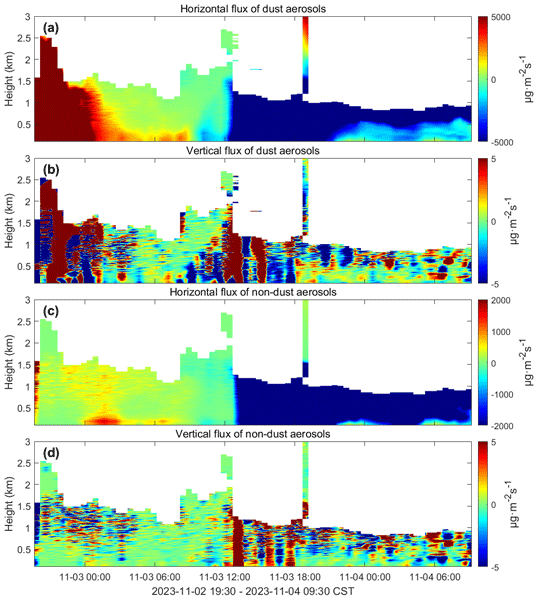
Abstract. The origins, spatial distribution, and diffusion mechanisms of aerosols hold practical guiding significance for regional haze governance. The vertical and horizontal fluxes of aerosols serve as effective parameters for assessing the diffusion efficiency of aerosols, but they are less exploited due to insufficient observations. This study uses polarization lidar to differentiate between the aerosol sources of dust and non-dust and to estimate the mass concentration profiles of each. Combining the wind profiles acquired from Doppler wind lidar, the vertical and horizontal fluxes profiles of two type aerosols are calculated. This approach is designed to account for the influence of local aerosol transport mechanisms on air pollution, enabling a more precise reflection of the internal variations within a particular region. A winter haze event in Beijing from November 2nd to November 4th, 2023 was analyzed to distinguish the vertical distribution of and mass concentration and fluxe of aerosols brought by dust transported from the northwest monsoon and those from anthropogenic emissions within the North China plain area. Further analysis of different wind zones revealed that the aerosol concentration and fluxes from urban areas (regions with a higher density of anthropogenic sources) can be used to assess the local pollutant diffusion capacity, as well as the influence of vertical turbulence on ground PM10 concentrations. Taking Beijing as an example, this study investigated the diffusion characteristics of urban aerosols, ultimately providing technical means and data references for early warning of urban air pollution and assessment of air pollution control measures.
-
Notice on discussion status
The requested preprint has a corresponding peer-reviewed final revised paper. You are encouraged to refer to the final revised version.
-
Preprint
(2706 KB)
-
The requested preprint has a corresponding peer-reviewed final revised paper. You are encouraged to refer to the final revised version.
- Preprint
(2706 KB) - Metadata XML
- BibTeX
- EndNote
- Final revised paper


Journal article(s) based on this preprint
Interactive discussion
Status: closed
-
RC1: 'Comment on egusphere-2025-4789', Anonymous Referee #1, 19 Dec 2025
-
AC1: 'Reply on RC1', Longlong Wang, 28 Jan 2026
We would like to thank the reviewer for the careful handling and valuable guidance throughout the review process, which have played a crucial role in polishing the paper and ensuring its academic rigor. They are listed one by one in attached letter and corresponding revisions have been made in the manuscript.
-
AC1: 'Reply on RC1', Longlong Wang, 28 Jan 2026
-
RC2: 'Comment on egusphere-2025-4789', Anonymous Referee #2, 22 Dec 2025
The paper by Tian et al. investigates the aerosol transport flux structure over Beijing, focusing on a single haze event in November 2023, in order to understand the mechanisms of air pollution. Polarization lidar and Doppler wind lidar observations are used to differentiate and quantify the vertical and horizontal fluxes of dust and non-dust aerosols. The emission and diffusion characteristics of pollutants were found to be influenced by meteorological factors such as the wind shear, planetary boundary layer height etc. The authors conclude that this multi-source observation and flux calculation methodology can be utilized for early warming, monitoring and assessment of air pollution.
Combining polarization and Doppler wind lidar observations has been successfully used in the past to study aerosol fluxes. With respect to that, I believe that the authors should extend their literature review (more information below). Overall, the study is of interest, however, the paper needs to undergo major revisions prior to its publication.
Major comments
- The paper focuses on a single haze event to investigate aerosol fluxes. This limitation has been recognized by the authors (e.g., line 570), however, I would recommend to discuss the reasons behind this choice in a greater detail, otherwise the study appears to be only of local interest.
- There is a major assumption that all non-dust aerosol is of anthropogenic origin. Already from the abstract the authors state that “the vertical and horizontal fluxes profiles of two type aerosols are calculated” (lines 18-19), referring to dust and non-dust aerosol (line 17). This is misleading for several reasons. To begin with, dust is an aerosol type but non-dust is a category. In addition, non-dust aerosol can also include natural aerosol, such as sea salt or volcanic aerosol. The authors recognize this assumption but only at the conclusions (lines 572-574). The assumption and implications should be already discussed before the results.
- The results section is highly descriptive, meaning that the authors describe the specific temporal and spatial evolution of the 38h pollution event in Beijing in a great detail. In addition, the description goes from parameter to parameter rather than following a day/time narration. I suggest to revise and shorten the descriptive parts.
- Figure 1 needs improvements. Please provide the figure in better quality and enlarge the fonts as the axis are very hard to read. It seems to me that the axis start is at 11-02 at 18:00 local time. However, in line 241 authors refer to measurements on the 00:00 CST on November 2nd, which is not shown in the figure. Also, the PM2.5/PM10 ratio of 0.8 (line 242) is not shown in Fig.1a. Is this intentional? If so, please state it.
Minor comments
- In the introduction I missed literature references such as Wandinger et al. 2004.
- Line 47: replace “propagation” with “transport” or “transfer”.
- Lines 236-239: Please introduce Fig.1 fully, before discussing the different subplots.
- Line 244 and throughout the manuscript: replace “figure” with “Fig.”.
- Line 245: Abbreviation “RCS532” is explained only later in line 255.
- Line 249: replace “typical” with “irregularly-shaped”.
- Line 325: “played crucial roles” to what- please rephrase or complete the sentence.
- Line 331: legends states that PM observations start from 00:00 on Nov 2 and the lidar data from 19:30 and yet the plots are right above each other, giving the false impression that they refer to the same time period. The end time also differs. Please correct this taking into account the major comments above.
- Line 350: “based on the depolarization signal …” please mention again the method, i.e., POLIPHON
- Lines 350-353: Dust is not predominantly located at higher altitudes, i.e., on Nov 2 and Nov 3 (around 12:00 CST) it reaches the “surface”. Please rephrase the statement accordingly, including height boundaries (e.g., lower atmospheric layer).
- Figure 3 is very difficult to read. Please make the central map smaller and enlarge and enumerate all the plots around it. This will also improve the discussion in lines 354-361. The x-axis legend is missing.
- Line 367: remove the double dot.
- Line 370: if possible, use either CST or UTC
- Line 421: “Compared to the study of near-surface aerosol fluxes” what do the authors refer to? If to another study it should be clearly stated and cited.
- Line 440-441: “indicating that… field” that is expected, please rephrase the statement
- Lines 474-477: To which figure do the authors refer to? The description provided does not match any of the subplots of Fig. 7. Please clarify.
- Lines 478-480: Again, please mention the figure you refer to.
- Please consider making your research data available by depositing them in a FAIR-aligned repository (e.g., Zenodo).
- I have noticed several issues with the literature section, please make sure all your entries are listed correctly.
Citation: https://doi.org/10.5194/egusphere-2025-4789-RC2 -
AC2: 'Reply on RC2', Longlong Wang, 28 Jan 2026
We would like to thank the reviewer for the careful handling and valuable guidance throughout the review process, which have played a crucial role in polishing the paper and ensuring its academic rigor. We have fully addressed all the requirements and are listed one by one in attached letter and corresponding revisions have been made in the manuscript.


Interactive discussion
Status: closed
-
RC1: 'Comment on egusphere-2025-4789', Anonymous Referee #1, 19 Dec 2025
General comment
This work use Lidar measurements to investigate vertical and horizontal fluxes of aerosol in a specific event discussing how this approach may be useful to gain information on air quality. The topic is of interest and suitable for the Journal but some aspects are not clear, including why limiting the study to a single event. I suggest to consider the paper for publication after a revision step addressing my comments.
Specific comments
One aspect that should be discussed i show the single case illustrated in this work has been selected and why it has not been decided to investigate several cases to make a more robust analysis as it is usually done in studies of fluxes.
One of the difference compared to in-situ eddy-covariance is the variable height. In measurements at a fixed height there is a certain footprint that influence measurements of vertical fluxes and it is possible to understand the role of ground level sources inside the footprint. With the approach proposed here it is possible to estimate the spatial representativeness of the measurements? I imagine that this would be depending on height so that local ground source will have a smaller and smaller influence at higher levels. This aspect should be mentioned.
Lines 97-100. Actually eddy-covariance is not included in ACTRIS measurements even if they are sometimes done in ACTRIS stations.
Line 145. Why the azimuth range is limited to 300°? Could this influence the calculation of horizontal fluxes or having some blind zones?
In section 2.3. The notation used with v vertical velocity is quite unusual and confounding because this is generally used w in all eddy-covariance studies that I have seen. In line 221 m’(z) is repeated two time. In addition, it would be mentioned clearly what is the data acquisition frequency in measurements of fluctuations. The fluctuations are measured on which volume? It is small enough to include the vortices mainly contributing to fluxes or there is some kind of losses due to spatial or temporal averages.
Line 403. I do not see how this work could help in studying aerosol transformation mechanisms.
Line 501. Better Meteorological factors exert a significant effect on aerosol concentrations. This because there is not any real regulation nor an effect on emissions at the sources.
Citation: https://doi.org/10.5194/egusphere-2025-4789-RC1 -
AC1: 'Reply on RC1', Longlong Wang, 28 Jan 2026
We would like to thank the reviewer for the careful handling and valuable guidance throughout the review process, which have played a crucial role in polishing the paper and ensuring its academic rigor. They are listed one by one in attached letter and corresponding revisions have been made in the manuscript.
-
AC1: 'Reply on RC1', Longlong Wang, 28 Jan 2026
-
RC2: 'Comment on egusphere-2025-4789', Anonymous Referee #2, 22 Dec 2025
The paper by Tian et al. investigates the aerosol transport flux structure over Beijing, focusing on a single haze event in November 2023, in order to understand the mechanisms of air pollution. Polarization lidar and Doppler wind lidar observations are used to differentiate and quantify the vertical and horizontal fluxes of dust and non-dust aerosols. The emission and diffusion characteristics of pollutants were found to be influenced by meteorological factors such as the wind shear, planetary boundary layer height etc. The authors conclude that this multi-source observation and flux calculation methodology can be utilized for early warming, monitoring and assessment of air pollution.
Combining polarization and Doppler wind lidar observations has been successfully used in the past to study aerosol fluxes. With respect to that, I believe that the authors should extend their literature review (more information below). Overall, the study is of interest, however, the paper needs to undergo major revisions prior to its publication.
Major comments
- The paper focuses on a single haze event to investigate aerosol fluxes. This limitation has been recognized by the authors (e.g., line 570), however, I would recommend to discuss the reasons behind this choice in a greater detail, otherwise the study appears to be only of local interest.
- There is a major assumption that all non-dust aerosol is of anthropogenic origin. Already from the abstract the authors state that “the vertical and horizontal fluxes profiles of two type aerosols are calculated” (lines 18-19), referring to dust and non-dust aerosol (line 17). This is misleading for several reasons. To begin with, dust is an aerosol type but non-dust is a category. In addition, non-dust aerosol can also include natural aerosol, such as sea salt or volcanic aerosol. The authors recognize this assumption but only at the conclusions (lines 572-574). The assumption and implications should be already discussed before the results.
- The results section is highly descriptive, meaning that the authors describe the specific temporal and spatial evolution of the 38h pollution event in Beijing in a great detail. In addition, the description goes from parameter to parameter rather than following a day/time narration. I suggest to revise and shorten the descriptive parts.
- Figure 1 needs improvements. Please provide the figure in better quality and enlarge the fonts as the axis are very hard to read. It seems to me that the axis start is at 11-02 at 18:00 local time. However, in line 241 authors refer to measurements on the 00:00 CST on November 2nd, which is not shown in the figure. Also, the PM2.5/PM10 ratio of 0.8 (line 242) is not shown in Fig.1a. Is this intentional? If so, please state it.
Minor comments
- In the introduction I missed literature references such as Wandinger et al. 2004.
- Line 47: replace “propagation” with “transport” or “transfer”.
- Lines 236-239: Please introduce Fig.1 fully, before discussing the different subplots.
- Line 244 and throughout the manuscript: replace “figure” with “Fig.”.
- Line 245: Abbreviation “RCS532” is explained only later in line 255.
- Line 249: replace “typical” with “irregularly-shaped”.
- Line 325: “played crucial roles” to what- please rephrase or complete the sentence.
- Line 331: legends states that PM observations start from 00:00 on Nov 2 and the lidar data from 19:30 and yet the plots are right above each other, giving the false impression that they refer to the same time period. The end time also differs. Please correct this taking into account the major comments above.
- Line 350: “based on the depolarization signal …” please mention again the method, i.e., POLIPHON
- Lines 350-353: Dust is not predominantly located at higher altitudes, i.e., on Nov 2 and Nov 3 (around 12:00 CST) it reaches the “surface”. Please rephrase the statement accordingly, including height boundaries (e.g., lower atmospheric layer).
- Figure 3 is very difficult to read. Please make the central map smaller and enlarge and enumerate all the plots around it. This will also improve the discussion in lines 354-361. The x-axis legend is missing.
- Line 367: remove the double dot.
- Line 370: if possible, use either CST or UTC
- Line 421: “Compared to the study of near-surface aerosol fluxes” what do the authors refer to? If to another study it should be clearly stated and cited.
- Line 440-441: “indicating that… field” that is expected, please rephrase the statement
- Lines 474-477: To which figure do the authors refer to? The description provided does not match any of the subplots of Fig. 7. Please clarify.
- Lines 478-480: Again, please mention the figure you refer to.
- Please consider making your research data available by depositing them in a FAIR-aligned repository (e.g., Zenodo).
- I have noticed several issues with the literature section, please make sure all your entries are listed correctly.
Citation: https://doi.org/10.5194/egusphere-2025-4789-RC2 -
AC2: 'Reply on RC2', Longlong Wang, 28 Jan 2026
We would like to thank the reviewer for the careful handling and valuable guidance throughout the review process, which have played a crucial role in polishing the paper and ensuring its academic rigor. We have fully addressed all the requirements and are listed one by one in attached letter and corresponding revisions have been made in the manuscript.
Peer review completion


Journal article(s) based on this preprint
Viewed
| HTML | XML | Total | BibTeX | EndNote | |
|---|---|---|---|---|---|
| 427 | 185 | 38 | 650 | 45 | 50 |
- HTML: 427
- PDF: 185
- XML: 38
- Total: 650
- BibTeX: 45
- EndNote: 50
Viewed (geographical distribution)
| Country | # | Views | % |
|---|
| Total: | 0 |
| HTML: | 0 |
| PDF: | 0 |
| XML: | 0 |
- 1
Zhengguo Tian
Si Liu
Cheng Yao
Tong Lu
Weijie Zou
Zhenping Yin
Bin Zhang
Daru Chen
Zhichao Bu
Yubao Chen
Xuan Wang
The requested preprint has a corresponding peer-reviewed final revised paper. You are encouraged to refer to the final revised version.
- Preprint
(2706 KB) - Metadata XML
General comment
This work use Lidar measurements to investigate vertical and horizontal fluxes of aerosol in a specific event discussing how this approach may be useful to gain information on air quality. The topic is of interest and suitable for the Journal but some aspects are not clear, including why limiting the study to a single event. I suggest to consider the paper for publication after a revision step addressing my comments.
Specific comments
One aspect that should be discussed i show the single case illustrated in this work has been selected and why it has not been decided to investigate several cases to make a more robust analysis as it is usually done in studies of fluxes.
One of the difference compared to in-situ eddy-covariance is the variable height. In measurements at a fixed height there is a certain footprint that influence measurements of vertical fluxes and it is possible to understand the role of ground level sources inside the footprint. With the approach proposed here it is possible to estimate the spatial representativeness of the measurements? I imagine that this would be depending on height so that local ground source will have a smaller and smaller influence at higher levels. This aspect should be mentioned.
Lines 97-100. Actually eddy-covariance is not included in ACTRIS measurements even if they are sometimes done in ACTRIS stations.
Line 145. Why the azimuth range is limited to 300°? Could this influence the calculation of horizontal fluxes or having some blind zones?
In section 2.3. The notation used with v vertical velocity is quite unusual and confounding because this is generally used w in all eddy-covariance studies that I have seen. In line 221 m’(z) is repeated two time. In addition, it would be mentioned clearly what is the data acquisition frequency in measurements of fluctuations. The fluctuations are measured on which volume? It is small enough to include the vortices mainly contributing to fluxes or there is some kind of losses due to spatial or temporal averages.
Line 403. I do not see how this work could help in studying aerosol transformation mechanisms.
Line 501. Better Meteorological factors exert a significant effect on aerosol concentrations. This because there is not any real regulation nor an effect on emissions at the sources.