
the Creative Commons Attribution 4.0 License.
the Creative Commons Attribution 4.0 License.
 | 23 Oct 2025
First Nationwide Analysis of Riming Using Vertical Observations from the Operational German C-Band Radar Network
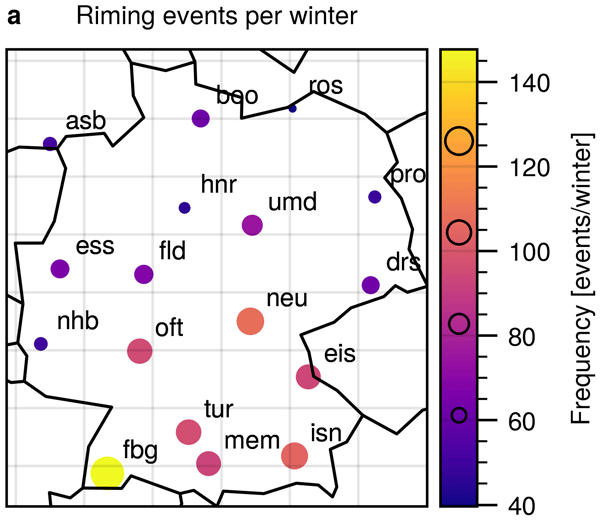
Abstract. The 17 operational German C-band polarimetric weather radars routinely perform a vertical "birdbath" scan, which has so far primarily been used for calibration of differential moments. In this study, we transfer a retrieval algorithm for the rime fraction of snowflakes – originally developed for Ka-band cloud research radars – to the operational birdbath scan. This retrieval, which relies on the increase in detected mean Doppler velocity, serves as our benchmark. To validate the transfer of the retrieval, we apply it to a "mockup" birdbath dataset, constructed by downsampling cloud radar data to match the resolution of the operational birdbath scan. In addition, we present a new clutter filter and a melting layer detection algorithm for the operational birdbath scan. Finding good agreement between mockup and benchmark datasets, we apply the new retrieval to radar data recorded during the winters of 2021 to 2024. This results in a nationwide map of riming events in wintertime clouds. There is a north-south gradient in the riming distribution, which can be linked to Germany's precipitation climatology. Notably, we show that the occurrence of riming events correlates more strongly with precipitation intensity than with the total number of precipitation hours across sites. The temperature distribution associated with riming is consistently between -15 °C and 0 °C at all sites, except for the Feldberg site, which hints at a possible orographic effect. This study demonstrates that the operational birdbath scan of C-Band weather radars can be used for the retrieval of microphysical processes. Corresponding solutions, challenges and methods to transfer retrieval algorithms from research cloud radars to the operational weather radars are discussed.
Competing interests: Michael Frech is employed by the German Weather Service, the operator of the 17 operational radars
Publisher's note: Copernicus Publications remains neutral with regard to jurisdictional claims made in the text, published maps, institutional affiliations, or any other geographical representation in this paper. While Copernicus Publications makes every effort to include appropriate place names, the final responsibility lies with the authors. Views expressed in the text are those of the authors and do not necessarily reflect the views of the publisher.-
Notice on discussion status
The requested preprint has a corresponding peer-reviewed final revised paper. You are encouraged to refer to the final revised version.
-
Preprint
(7980 KB)
-
The requested preprint has a corresponding peer-reviewed final revised paper. You are encouraged to refer to the final revised version.
- Preprint
(7980 KB) - Metadata XML
- BibTeX
- EndNote
- Final revised paper


Journal article(s) based on this preprint
Interactive discussion
Status: closed
-
RC1: 'Comment on egusphere-2025-4679', Anonymous Referee #1, 17 Nov 2025
- AC1: 'Reply on RC1', Paul Ockenfuss, 30 Dec 2025
-
RC2: 'Comment on egusphere-2025-4679', Anonymous Referee #2, 27 Nov 2025
- AC2: 'Reply on RC2', Paul Ockenfuss, 30 Dec 2025
Peer review completion


Interactive discussion
Status: closed
-
RC1: 'Comment on egusphere-2025-4679', Anonymous Referee #1, 17 Nov 2025
- AC1: 'Reply on RC1', Paul Ockenfuss, 30 Dec 2025
-
RC2: 'Comment on egusphere-2025-4679', Anonymous Referee #2, 27 Nov 2025
- AC2: 'Reply on RC2', Paul Ockenfuss, 30 Dec 2025
Peer review completion
Journal article(s) based on this preprint
Viewed
| HTML | XML | Total | BibTeX | EndNote | |
|---|---|---|---|---|---|
| 729 | 569 | 108 | 1,406 | 94 | 86 |
- HTML: 729
- PDF: 569
- XML: 108
- Total: 1,406
- BibTeX: 94
- EndNote: 86
Viewed (geographical distribution)
| Country | # | Views | % |
|---|
| Total: | 0 |
| HTML: | 0 |
| PDF: | 0 |
| XML: | 0 |
- 1
Paul Ockenfuß

Michael Frech
Mathias Gergely
Stefan Kneifel
The requested preprint has a corresponding peer-reviewed final revised paper. You are encouraged to refer to the final revised version.
- Preprint
(7980 KB) - Metadata XML
Please see my review attached.