
the Creative Commons Attribution 4.0 License.
the Creative Commons Attribution 4.0 License.
 | 21 Oct 2025
Earth’s magnetosheath: A comparison of plasma flow direction between models and observations
Abstract. Observations of the plasma flow direction in the Earth’s magnetosheath are compared with the help of three analytical magnetic-field models, namely Kobel and Flückiger (1994), Romashets and Vandas (2019), and Vandas and Romashets (2019), which all assume current-free fields in the magnetosheath. 47 magnetosheath passages by spacecraft are analyzed in detail and performance of the models are evaluated. It is concluded that the performances are comparable and that they are satisfactory on average. Therefore, a usage of the model by Kobel and Flückiger (1994) is recommended, because it is the simplest one and yields results much faster.
-
Notice on discussion status
The requested preprint has a corresponding peer-reviewed final revised paper. You are encouraged to refer to the final revised version.
-
Preprint
(695 KB)
-
The requested preprint has a corresponding peer-reviewed final revised paper. You are encouraged to refer to the final revised version.
- Preprint
(695 KB) - Metadata XML
- BibTeX
- EndNote
- Final revised paper


Journal article(s) based on this preprint
Interactive discussion
Status: closed
-
RC1: 'Comment on egusphere-2025-4672', Anonymous Referee #1, 02 Nov 2025
-
AC1: 'Reply on RC1', Evgeny Romashets, 02 Nov 2025
We thank the referee for the valuable comments and suggestions.
We shall incorporate them into a revised version.Citation: https://doi.org/10.5194/egusphere-2025-4672-AC1
-
AC1: 'Reply on RC1', Evgeny Romashets, 02 Nov 2025
-
RC2: 'Comment on egusphere-2025-4672', Anonymous Referee #2, 30 Nov 2025
Referee report on 'Earth’s magnetosheath: A comparison of plasma flow direction between models and observations', by Vandas and Romashets
This manuscript describes comparisons of model magnetosheath magnetic field (from three different analytic models) as a proxy for the bulk plasma velocity (for radial IMF) against the observed magnetosheath velocity, for a few dozen magnetosheath traversals. The comparisons are performed to ascertain which analytic model performs best. This is an interesting study to assess the various analytic models in the scientific literature. However, there are several questions to be answered and some needed clarifications before this manuscript can be considered to be publishable in Annales Geophysicae. These are described in detail below.
- In general, there are several qualitative and subjective judgmental comments such as ‘performances are comparable’, ‘comparisons are satisfactory’, and ‘reported a fairly good agreement’. It would be helpful to the reader if such comments had more quantitative support. For example, does ‘fairly good agreement’ mean within 10%? Or within a factor of 2? Or something else??
- The description of the selection criteria in Lines 100-102 appears to be incomplete. For example, what quantitative criterion was used for the selected cases to be close to radial IMF (or aligned with the solar wind flow)? What criterion was used for the steadiness of the IMF during the magnetosheath pass? Are there any other applied criteria?
- Related to the previous point – if these cases occurred during times of nearly radial IMF, it was expected that the magnetosheath magnetic field and velocity components would be similar to each other. Instead, the sample intervals in Figs. 1,2 show several changes in the sign (polarity) of By, Bz that are not seen in the velocity components. Please explain in the manuscript why the magnetic field and velocity components are so different.
- For the comparisons between models and observations, how do the authors match model boundary crossings with the actual crossings? In general, model and observed boundary crossings are co-located in a statistical sense. Not so much during individual traversals.
- Related to the previous point, how did the authors treat multiple crossings of boundary during a given pass? Is this part of the selection criteria for the data set? Additional details regarding the selection criteria would be helpful for the reader.
Spreiter and Rizzi (Acta Astro., 1974) describe how a field aligned flow in the solar wind is field-aligned everywhere; and their references show that this was known as early as 1960 (and perhaps earlier). Some other potentially relevant references not mentioned in the manuscript are provided below.
Other suggested references:
Farrugia, C. J., et al. (2010), Magnetosheath for almost-aligned solar wind magnetic field and flow vectors: Wind observations across the dawnside magnetosheath at X = −12 Re, J. Geophys. Res., 115, A08227, doi:10.1029/2009JA015128.
Merka, J., A. Szabo, J. Safranková, and Z. Nemecek (2003), Earth's bow shock and magnetopause in the case of a field-aligned upstream flow: Observation and model comparison, J. Geophys. Res., 108(A7), 1269, doi:10.1029/2002JA009697.
Pi, G., J.-H. Shue, K. Grygorov, H.-M. Li, Z. Němeček, J. Šafránková, Y.-H. Yang, and K. Wang (2017), Evolution of the magnetic field structure outside the magnetopause under radial IMF conditions, J. Geophys. Res., 122, 4051–4063, doi:10.1002/2015JA021809.
Samsonov, A., Z. Němeček, J. Šafránková, K. Jelínek (2012), Why does the subsolar magnetopause move sunward for radial interplanetary magnetic field?, J. Geophys. Res., 117, doi:10.1029/2011JA017429.
Shue, J.-H., J.-K. Chao, P. Song, J.P. McFadden, A. Suvorova, V. Angelopoulos, K.H. Glassmeier, and F. Plaschke (2009), Anomalous magnetosheath flows and distorted subsolar magnetopause for radial interplanetary magnetic fields, Geophys. Res. Lett., 36, L18112, doi:10.1029/2009GL039842.
Spreiter, J.R., and A.W. Rizzi (1974), Aligned magnetohydrodynamic solution for solar wind flow past the earth’s magnetosphere, Acta Astron., 1, 15–35, doi:10.1016/0094-5765(74)90006-X.
Minor suggested edits (technical corrections):
Line 35: hypotheses -> hypothesis
Line 38: ‘in hands here’ -> ‘in hand’
Line 41: procede -> proceed
Line 56: way -> method
Lines 56, 95, 107: abberated -> aberrated
Line 165: ‘models better describes’ -> ‘models better describe’
Line 168: ‘much more faster’ -> ‘much faster’
Figures: Please consider using different colors. Individuals with red-green color-blindness may not be able to discriminate between the different traces.
Citation: https://doi.org/10.5194/egusphere-2025-4672-RC2 -
AC2: 'Reply on RC2', Evgeny Romashets, 30 Nov 2025
Dear Referee,
Thank you for valuable comments and corrections.
We agree and will modify the manuscript accordingly.
Authors
Citation: https://doi.org/10.5194/egusphere-2025-4672-AC2


Interactive discussion
Status: closed
-
RC1: 'Comment on egusphere-2025-4672', Anonymous Referee #1, 02 Nov 2025
Referee Report on EGUsphere Preprint 2025-4672 entitled “Earth’s magnetosheath: A comparison of plasma flow direction between models and observations”
This is a simple, yet interesting, paper that compares observations of magnetosheath magnetic fields and plasma flow directions with the predictions of simple analytical models for these parameters. The paper will eventually be suitable for publication, but there are some important tasks to be completed before it can be published.
The first task is to properly reference past research. Both Howe and Binsack (JGR, 77, 3334, 1972) and Crooker et al. (JGR, 89, 9711, 1984) have compared flow directions within the magnetosheath with theoretical and model predictions. They are not referenced in the present paper.
The present paper finds discrepancies between observed flows and model predictions, particularly in the vicinity of the magnetopause, but makes no attempt to explain why this might be the case. The authors should consider the various predictions described by Crooker et al. and see if these help explain their results.
The authors scale magnetopause and bow shock positions by the solar wind dynamic pressure, but they must surely be aware that magnetic reconnection and erosion cause the magnetopause (and therefore the bow shock) to move inward during periods of southward IMF orientation. They should note that they are ignoring this effect near line 73.
The authors tell where the bow shock and magnetopause shapes come from for Magnetic field model 2 and 3, but there is no statement about this for Magnetic field model 1 in the vicinity of line 80.
In Section 3, the authors report that they require bow shock and magnetopause crossings to be clearly identifiable, but they do not tell what they do when there are multiple magnetopause and bow shock crossings. Which one do they choose?
The authors shift solar wind observations to the bow shock nose, but how do they shift them to match spacecraft observations further downstream? Some of the intervals in Table 1 occur near the terminators.
Could the authors please comment on what the typical cause of high delta? Is it a poor prediction for the flow direction in the Y-Z plane or a poor predictions of VX?
Successful prediction of magnetosheath parameters may depend on the location of the solar wind monitor. Monitors far off the sun-Earth line may not see the features that reach Earth. Can the authors please present the dependence of delta on the distance of the solar wind monitor from the Sun-Earth line?
Reconnection at the magnetopause may affect plasma flow patterns in the magnetosheath. Could the authors please present the dependence of delta on the north/south component of the IMF orientation?
Magnetic fiield directions and strengths may be more important in the magnetosheath when the solar wind Mach number is low. Could the authors please present the dependence of delta on the solar wind Mach number?
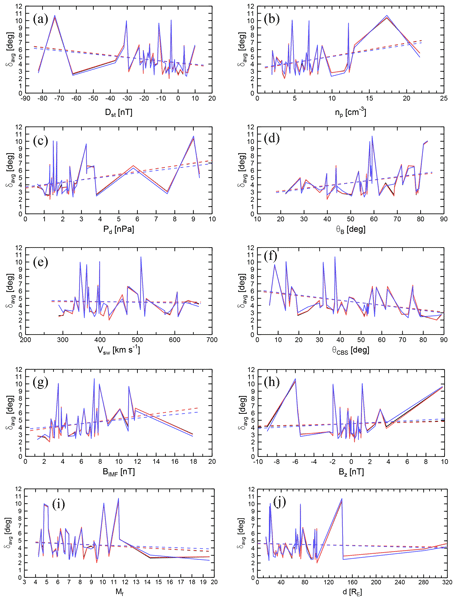
The dashed line ‘fits’ to the point in each panel of Figure 6 are not very compelling. The authors should provide the correlation coefficients for each fit.
It would be good if the authors make an effort to explain why the discrepancies between observed and predicted flow direction are greatest in the subsolar magnetosheath for large cone angle.
Citation: https://doi.org/10.5194/egusphere-2025-4672-RC1 -
AC1: 'Reply on RC1', Evgeny Romashets, 02 Nov 2025
We thank the referee for the valuable comments and suggestions.
We shall incorporate them into a revised version.Citation: https://doi.org/10.5194/egusphere-2025-4672-AC1
-
AC1: 'Reply on RC1', Evgeny Romashets, 02 Nov 2025
-
RC2: 'Comment on egusphere-2025-4672', Anonymous Referee #2, 30 Nov 2025
Referee report on 'Earth’s magnetosheath: A comparison of plasma flow direction between models and observations', by Vandas and Romashets
This manuscript describes comparisons of model magnetosheath magnetic field (from three different analytic models) as a proxy for the bulk plasma velocity (for radial IMF) against the observed magnetosheath velocity, for a few dozen magnetosheath traversals. The comparisons are performed to ascertain which analytic model performs best. This is an interesting study to assess the various analytic models in the scientific literature. However, there are several questions to be answered and some needed clarifications before this manuscript can be considered to be publishable in Annales Geophysicae. These are described in detail below.
- In general, there are several qualitative and subjective judgmental comments such as ‘performances are comparable’, ‘comparisons are satisfactory’, and ‘reported a fairly good agreement’. It would be helpful to the reader if such comments had more quantitative support. For example, does ‘fairly good agreement’ mean within 10%? Or within a factor of 2? Or something else??
- The description of the selection criteria in Lines 100-102 appears to be incomplete. For example, what quantitative criterion was used for the selected cases to be close to radial IMF (or aligned with the solar wind flow)? What criterion was used for the steadiness of the IMF during the magnetosheath pass? Are there any other applied criteria?
- Related to the previous point – if these cases occurred during times of nearly radial IMF, it was expected that the magnetosheath magnetic field and velocity components would be similar to each other. Instead, the sample intervals in Figs. 1,2 show several changes in the sign (polarity) of By, Bz that are not seen in the velocity components. Please explain in the manuscript why the magnetic field and velocity components are so different.
- For the comparisons between models and observations, how do the authors match model boundary crossings with the actual crossings? In general, model and observed boundary crossings are co-located in a statistical sense. Not so much during individual traversals.
- Related to the previous point, how did the authors treat multiple crossings of boundary during a given pass? Is this part of the selection criteria for the data set? Additional details regarding the selection criteria would be helpful for the reader.
Spreiter and Rizzi (Acta Astro., 1974) describe how a field aligned flow in the solar wind is field-aligned everywhere; and their references show that this was known as early as 1960 (and perhaps earlier). Some other potentially relevant references not mentioned in the manuscript are provided below.
Other suggested references:
Farrugia, C. J., et al. (2010), Magnetosheath for almost-aligned solar wind magnetic field and flow vectors: Wind observations across the dawnside magnetosheath at X = −12 Re, J. Geophys. Res., 115, A08227, doi:10.1029/2009JA015128.
Merka, J., A. Szabo, J. Safranková, and Z. Nemecek (2003), Earth's bow shock and magnetopause in the case of a field-aligned upstream flow: Observation and model comparison, J. Geophys. Res., 108(A7), 1269, doi:10.1029/2002JA009697.
Pi, G., J.-H. Shue, K. Grygorov, H.-M. Li, Z. Němeček, J. Šafránková, Y.-H. Yang, and K. Wang (2017), Evolution of the magnetic field structure outside the magnetopause under radial IMF conditions, J. Geophys. Res., 122, 4051–4063, doi:10.1002/2015JA021809.
Samsonov, A., Z. Němeček, J. Šafránková, K. Jelínek (2012), Why does the subsolar magnetopause move sunward for radial interplanetary magnetic field?, J. Geophys. Res., 117, doi:10.1029/2011JA017429.
Shue, J.-H., J.-K. Chao, P. Song, J.P. McFadden, A. Suvorova, V. Angelopoulos, K.H. Glassmeier, and F. Plaschke (2009), Anomalous magnetosheath flows and distorted subsolar magnetopause for radial interplanetary magnetic fields, Geophys. Res. Lett., 36, L18112, doi:10.1029/2009GL039842.
Spreiter, J.R., and A.W. Rizzi (1974), Aligned magnetohydrodynamic solution for solar wind flow past the earth’s magnetosphere, Acta Astron., 1, 15–35, doi:10.1016/0094-5765(74)90006-X.
Minor suggested edits (technical corrections):
Line 35: hypotheses -> hypothesis
Line 38: ‘in hands here’ -> ‘in hand’
Line 41: procede -> proceed
Line 56: way -> method
Lines 56, 95, 107: abberated -> aberrated
Line 165: ‘models better describes’ -> ‘models better describe’
Line 168: ‘much more faster’ -> ‘much faster’
Figures: Please consider using different colors. Individuals with red-green color-blindness may not be able to discriminate between the different traces.
Citation: https://doi.org/10.5194/egusphere-2025-4672-RC2 -
AC2: 'Reply on RC2', Evgeny Romashets, 30 Nov 2025
Dear Referee,
Thank you for valuable comments and corrections.
We agree and will modify the manuscript accordingly.
Authors
Citation: https://doi.org/10.5194/egusphere-2025-4672-AC2
Peer review completion


Journal article(s) based on this preprint
Viewed
| HTML | XML | Total | BibTeX | EndNote | |
|---|---|---|---|---|---|
| 244 | 78 | 32 | 354 | 79 | 69 |
- HTML: 244
- PDF: 78
- XML: 32
- Total: 354
- BibTeX: 79
- EndNote: 69
Viewed (geographical distribution)
| Country | # | Views | % |
|---|
| Total: | 0 |
| HTML: | 0 |
| PDF: | 0 |
| XML: | 0 |
- 1
Marek Vandas
Evgeny Romashets
The requested preprint has a corresponding peer-reviewed final revised paper. You are encouraged to refer to the final revised version.
- Preprint
(695 KB) - Metadata XML
Referee Report on EGUsphere Preprint 2025-4672 entitled “Earth’s magnetosheath: A comparison of plasma flow direction between models and observations”
This is a simple, yet interesting, paper that compares observations of magnetosheath magnetic fields and plasma flow directions with the predictions of simple analytical models for these parameters. The paper will eventually be suitable for publication, but there are some important tasks to be completed before it can be published.
The first task is to properly reference past research. Both Howe and Binsack (JGR, 77, 3334, 1972) and Crooker et al. (JGR, 89, 9711, 1984) have compared flow directions within the magnetosheath with theoretical and model predictions. They are not referenced in the present paper.
The present paper finds discrepancies between observed flows and model predictions, particularly in the vicinity of the magnetopause, but makes no attempt to explain why this might be the case. The authors should consider the various predictions described by Crooker et al. and see if these help explain their results.
The authors scale magnetopause and bow shock positions by the solar wind dynamic pressure, but they must surely be aware that magnetic reconnection and erosion cause the magnetopause (and therefore the bow shock) to move inward during periods of southward IMF orientation. They should note that they are ignoring this effect near line 73.
The authors tell where the bow shock and magnetopause shapes come from for Magnetic field model 2 and 3, but there is no statement about this for Magnetic field model 1 in the vicinity of line 80.
In Section 3, the authors report that they require bow shock and magnetopause crossings to be clearly identifiable, but they do not tell what they do when there are multiple magnetopause and bow shock crossings. Which one do they choose?
The authors shift solar wind observations to the bow shock nose, but how do they shift them to match spacecraft observations further downstream? Some of the intervals in Table 1 occur near the terminators.
Could the authors please comment on what the typical cause of high delta? Is it a poor prediction for the flow direction in the Y-Z plane or a poor predictions of VX?
Successful prediction of magnetosheath parameters may depend on the location of the solar wind monitor. Monitors far off the sun-Earth line may not see the features that reach Earth. Can the authors please present the dependence of delta on the distance of the solar wind monitor from the Sun-Earth line?
Reconnection at the magnetopause may affect plasma flow patterns in the magnetosheath. Could the authors please present the dependence of delta on the north/south component of the IMF orientation?
Magnetic fiield directions and strengths may be more important in the magnetosheath when the solar wind Mach number is low. Could the authors please present the dependence of delta on the solar wind Mach number?
The dashed line ‘fits’ to the point in each panel of Figure 6 are not very compelling. The authors should provide the correlation coefficients for each fit.
It would be good if the authors make an effort to explain why the discrepancies between observed and predicted flow direction are greatest in the subsolar magnetosheath for large cone angle.