
the Creative Commons Attribution 4.0 License.
the Creative Commons Attribution 4.0 License.
 | 06 Oct 2025
On the relevance of molecular diffusion for travel time distributions inferred from different water isotopes
Abstract. Water isotopes are a tool of choice for assessing travel time distributions of water and chemical species in soils, aquifers and rivers. However, the question of whether different water isotopes tag the same travel time distributions of the water molecule, or whether the inferred travel time distribution is specific to the chosen water isotope, remains under debate. Here we conjecture that the latter is correct. We state that (a) travel time distributions of water and any tracer reflect the spectrum of fluid velocities and diffusive/dispersive mixing between the flow lines connecting the system in- and outlet, and (b) the self-diffusion coefficients of deuterium, tritium and 18O differ by as much as 10 %. Using particle tracking simulations, we show that these differences do indeed affect the variance of the travel time distribution – as one would expect for well-mixed advective-dispersive transport. Moreover, our simulations suggest that in the case of imperfect mixing, also the average travel time becomes sensitive to the differences in self-diffusion coefficients. We find that when advective trapping occurs in low conductive zones, an isotope with a smaller diffusion coefficient remains there for longer times compared to a substance exhibiting faster diffusion. This implies that for imperfectly mixed transport, average transit times ultimately increase with a decreasing self-diffusion coefficient: deuterium has the longest average travel time, followed by tritium, followed by 18O. Depending on the type of simulated system, we find differences in average travel times ranging from 10 days to more than 2 years. As these differences are in relative terms of order 5–10 %, one could be tempted to erroneously explain them as measurement errors. Our findings suggest instead that these differences are physics based. These differences persist and even grow with increasing space and time scales, rather than being averaged out. We thus conclude that travel time distributions inferred from O-H isotopes of the water molecule are conditioned by the chosen water isotope.
Competing interests: At least one of the (co-)authors is a member of the editorial board of Hydrology and Earth System Sciences. The peer-review process was guided by an independent editor, and the authors also have no other competing interests to declare.
Publisher's note: Copernicus Publications remains neutral with regard to jurisdictional claims made in the text, published maps, institutional affiliations, or any other geographical representation in this paper. While Copernicus Publications makes every effort to include appropriate place names, the final responsibility lies with the authors. Views expressed in the text are those of the authors and do not necessarily reflect the views of the publisher.-
Notice on discussion status
The requested preprint has a corresponding peer-reviewed final revised paper. You are encouraged to refer to the final revised version.
-
Preprint
(1354 KB)
-
The requested preprint has a corresponding peer-reviewed final revised paper. You are encouraged to refer to the final revised version.
- Preprint
(1354 KB) - Metadata XML
- BibTeX
- EndNote
- Final revised paper


Journal article(s) based on this preprint
Interactive discussion
Status: closed
-
RC1: 'Comment on egusphere-2025-4656', Markus Hrachowitz, 06 Nov 2025
-
AC1: 'Reply on RC1', Erwin Zehe, 20 Nov 2025
Reply to the review by Markus Hrachowitz
Reviewer MH: The manuscript “On the relevance of molecular diffusion for travel time distributions inferred from different water isotopes” by Zehe et al. addresses a so far, at least for studies at larger spatial scales, rarely considered aspect of tracer circulation and its potential effects on water ages and its distributions. Conceived as a modelling study, the experiment is very well designed and quite comprehensive in its extent, analyzing a broad spectrum of potential scenarios. The manuscript is similarly well written, logically structured and, due to clear explanations, easy to follow. Overall, I will be more than glad to eventually see this study published. However, I think the manuscript could be further strengthened by considering the following rather minor points:
Reply EZ: On behalf of all co-authors, I thank Markus Hrachowitz for his insightful assessment of our work and his constructive recommendations.
Reviewer MH: (1) Many different model runs with changing structures of the spatial domains (scenarios A-C), tracers (2H, 3H, 18O), hydraulic conductivities, Peclet numbers, etc. were executed. This is very well described and an excellent approach as it analyses many different aspects and influences on the experiment. However, the results of these model runs are reported in somewhat of a rush and with little detail. I think that systematically showing the results of all model runs – at least as figures in the Supplementary Material – and to provide some more detail in the descriptions of the results will benefit the analysis as it will allow the reader to appreciate these different aspects much more.
Reply EZ: We agree that the results section is maybe a little bit too condensed. In the revised manuscript we will happily go to a greater detail and provide additional Figures, when necessary, in the Annex, to make the study comprehensive and fully accessible.
Reviewer MH: (2) Related to (1), I also think that the Figures can benefit from being developed a bit more systematically and carefully, so that they are easily readable and consistent in their respective structures across the individual experiments. For example, it is unclear why for scenario A the results of 3H and 18O are not shown in Figure 4. I believe its is important to show the entire sequence of results – even if they do not exhibit major differences between the runs – to allow the reader a complete assessment. Similarly, why are estimates of RThyd only given in Figure 4 for scenario A but not in Figures 5-7 for the other scenarios? Overall, the figures will benefit from a more consistent structure and appearance. In other words, while figure 4 shows mean(T) and RThyd as annotations next to the graphs, and hydraulic conductivities in the legend, the subsequent figures show mean(T) in the legend (omitting RThyd) and definitions of the model runs, i.e. L, Pe, var next to the graphs in the figures. These inconsistencies bring unnecessary “noise” into the manuscript.
Reply EZ: We omitted the TTD of 3H and 18O for scenario A, because the differences compared to 2H were not large. Yet, we fully agree with the reviewer here, and thus will happily revise the figures assuring a more consistent appearance as requested. We particularly think that the comparison of the mean travel time mean(T) inferred from the tracer breakthrough and the hydraulic retention times RThyd is informative and needs to be presented for all cases. The same applies to hydraulic conductivities (their mean and variance).
Reviewer MH: In addition, it will be good to increase symbol sizes at least in the legends, as right now the individual model runs are difficult to discern in the individual figures. Also make sure to include (a), (b), (c)… labels for sub-figures. Right now, it is not always immediately clear which subfigure is which. The figures could also benefit from the use of more systematic colour schemes throughout the manuscript.
Reply EZ: We agree that the symbols were actually too small, and we will assure a more consistent color coding in the revised manuscript.
Reviewer MH: (3) This is a study that builds exclusively on model experiments. That is fine. However, I think it would benefit the manuscript if a stronger link to experimental studies with real world data is established to allow the reader to place the results into a wider context. While the authors refer to previous studies by Stewart et al. and Rodriguez et al. to frame their work, it is surprising that they do not refer to a recent study by Wang et al. (2023). In that study we found considerable evidence that the considerable differences in 3H and 18O estimates of water ages reported by Stewart et al. (2010), are to a large extent an artefact of the choice of model type used by Stewart et al. (2010) and the cites studies therein. Overall, the study by Wang et al. (2023) found that 18O and 3H result in estimates of water ages that are broadly consistent, with estimates from 18O even showing older (!) ages and thus the opposite of what was reported by Rodriguez et al. and here in the results of this study. Thus, discussion of the results found here in the context of the results reported by Wang et al. (2023) will give the reader a much more complete picture of the current state-of-the-art.
Reply EZ: Our work is indeed a theoretical study, though case A is motivated by lab experiments by Elhanati et al (in press; https://doi.org/10.5194/egusphere-2025-3365), though the dimensions are a little bit different. Yet the results can be easily scaled to the dimension of the experiment, and we will do so in the revised manuscript.
We must admit that the main reason for this study was the discussion between Mike Stewart and Julian Klaus, when Mike Stewart (https://doi.org/10.5194/hess-25-6333-2021) commented on the paper of Rodriguez et al., which was co-authored by the main author these days. Our argument was basically that HDO and HTO are two times the same molecule, so there is no physical reason why travel time distributions of HDO and HTO may be different. After a while we realized, they are not the same! There is a difference in mass and in the (self-)diffusion coefficient, and these differences may in case of imperfect mixing, even cause difference in average travel times. Thus, our study is in a certain way a late acknowledgment that Mike Stewart had a point.
That said, we absolutely agree that we missed the opportunity to reflect our findings, against the truly very interesting work of Wang et al (2023). What we understood from this work so far, is that the water ages inferred from 18O and 3H with SAS were largely consistent, while related differences were substantial, when using a convolution model. So obviously, we must be very precise about the methods which have been used to infer travel times, otherwise one might compare apples with oranges. As far as we understood the study, it relies on a smart, HRU based hydrological model structure. While this makes much sense, such a structure is per default not sensitive to differences arising from different diffusion coefficients, which requires a spatially distributed velocity field. We will further elaborate on this in the revised manuscript.
Detailed suggestions:
Reviewer MH: p.1,l.15: not clear what is meant by “assessing…chemical species…”. Perhaps rephrase
Reply EZ : maybe better of “water and tracers”
Reviewer MH: p.2,l.48-50: ok, but the concept was also already known and used before that, e.g. Eriksson (1958), Bolin and Rodhe (1973). Perhaps good to include these references, as well
Reply EZ : You are never too old to learn, I was not aware of these studies. We will happily acknowledge those in the revised manuscript.
Reviewer MH: p.2,l.61-64: not sure if this is a valid generalization. The dependence of water ages on water supply has been known for quite a while (e.g. Nir, 1973) and even explicitly accounted for in time-variable formulations of transfer function approaches (e.g. Niemi, 1977). Please rephrase and include the references.
Reply EZ : Sorry for being unclear. We refer here exclusively to the use of transfer functions in the partially saturated zone. We will clarify this in the revised manuscript.
Reviewer MH: p.3l.82ff: I think a more precise formulation of the history of the various concepts here would benefit the manuscript. Early studies approached the question in fact with both approaches. While indeed many of them relied on time-invariant or time-variant transfer functions (see e.g. review by McGuire and McDonnell, 2006), many others used methods that are equivalent to the SAS function approach, such as the many studies of hydro-chemical dynamics based on the Birkenes and HBV models (Christophersen and Wright, 1981; Christophersen et al., 1982; Seip et al., 1985; de Groisbois et al., 1988; Hooper et al., 1988; Barnes and Bonell, 1996) and in particular nicely illustrated by Fig. 1 in Bergström et al. (1985). The same is true for Hrachowitz et al. (2013) that is now cited as a transfer function based study. This is factually incorrect. In that study we estimated water ages based on tracking tracers through the systems using “mixing coefficients”, which are functionally the same things as the SAS-approach with piecewise linear age sampling distributions (see Hrachowitz et al., 2016 and Benettin et al., 2022 for more detail).
Reply EZ : Fair enough. We will happily elaborate in more detail on the history of both concepts and acknowledge the proposed, relevant work.
Reviewer MH:P3.l.89: probably better to replace Hrachowitz et al. (2010) by Hrachowitz et al. (2021)
Reply EZ : Thanks, we will change the references accordingly.
Reviewer MH: P3.l.89: p.3,l.103-105: true, but this is likely an artefact due to the choice of model by Stewart et al. (2010, 2021) and the studies cited therein. A detailed comprehensive demonstration thereof can be found in a recent study by Wang et al. (2023), who found broadly equivalent magnitudes of water ages inferred from 3H and 18O. Would be good to rephrase and add the perspectives by Wang et al. (2023)
Reply EZ . We will happily address this key issue in the revised manuscript. However, in this context it is also important that Rodriguez et al. found differences in mean water ages in the Weiherbach, although they are both based on SAS.
Reviewer MH: p.3,l.107: Nice!! This is really excellent.
Reply EZ: Thanks.
Reviewer MH: p.3,l.130ff: please rephrase and add Wang et al. (2023)
Reply EZ: With pleasure.
Reviewer MH: p.4,l.137: this is a very useful and clearly described section. One additional thing that I personally would find useful would be to include an explicit description of the difference between self-diffusion and molecular diffusion. After reading this section I am still not sure whether they are the same thing or not and if not, what the difference is.
Reply EZ: We are glad that this is helpful and agree that the distinction is misleading. Molecular diffusion relates to Brownian motion/diffusive motion of a solute, e.g., Br- in water, we speak of two different chemicals. Self-diffusion relates to Brownian motion/diffusive motion of water isotopologues (HDO, TDO, 18OHH) in water H2O. So, it is the same chemical but not the same molecule.
Reviewer MH: p.3,l: p.10,figure 3: I do not understand the legend in the bottom row. How can particle numbers Np be negative?
Reply EZ: This is indeed misleading. The numbers are normalized with the total number of particles - the maximum number is thus one (all particles past through). We will explain this in the revised manuscript
Reviewer MH: p.11,l.304-306: ok, purely technically seen the mean(T) are larger. But given that the difference is ≤1%, how significant/relevant is it?
Reply EZ: Well observed, one would indeed be inclined to classify this as not significant.
Reviewer MH: p.11,l.326 and elsewhere: the term “average” is somewhat ambiguous as it can refer to any measure of central tendency, i.e. mean, median or mode. Thus, please replace accordingly for clarity.
Reply EZ: When using the term average, we generally refer to the arithmetic mean as an estimator of the expected value (the first central moment). We will be precise about that in the revised manuscript,
Reviewer MH: In addition, it would be good to provide the actual values for the different tracers and show the TTDs – either in Figure 4 or in the supplementary material.
Reply EZ: Brilliant idea, we will do so.
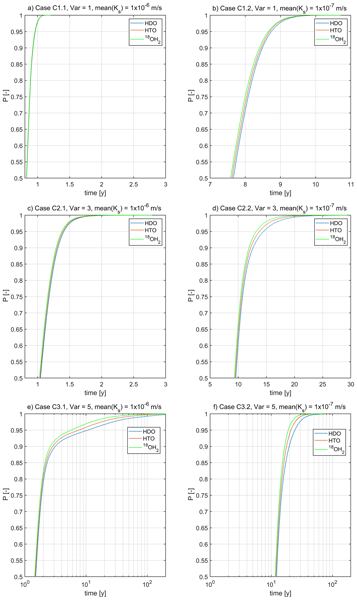
Reviewer MH: p.12, p.333ff: given that the TTDs of the individual tracers in figures 5-7 are largely indiscernible and plotting on top of each other, it may be good to also show them with log-scale axes to better grasp the differences. In addition, the exclusive focus on mean(T) may conceal other effects. Thus, perhaps it is interesting to also report and discuss differences in young and old quantiles or the medians.
Reply EZ: Excellent idea, we will do so in the revised manuscript.
Reviewer MH: p.13,l.358: how was the RThyd exactly calculated here? Is it based on the flow weighted averages of the upper and lower layers? Does it make a difference whether it is flow weighted?
Reply EZ: This was calculated by dividing the total storage volume in the pore space by the volumetric flow rate. This assumes perfect mixing. It makes a difference when doing this separately in the high and low conductive zone.
Reviewer MH: p.14,l.395-396: ok, but for context it would also be good to mention that this is only ~2%
Reply EZ: absolutely correct, we will stress this.
Reviewer MH: p.17,l.429-433: also here, reference to the results of Wang et al. (2023) is required to provide a full picture.
Reply EZ: absolutely correct, we will stress this. At the end the relative difference matters
Thank you for this interesting contribution!
Best regards,
Markus Hrachowitz
Thank you very much again for the insightful comments,Erwin Zehe
References:
Elhanati, D., Zehe, E., Dror, I., and Berkowitz, B.: Transport behavior displayed by water isotopes and potential implications for assessment of catchment properties, EGUsphere [preprint], https://doi.org/10.5194/egusphere-2025-3365, 2025, in press for HESS.
Citation: https://doi.org/10.5194/egusphere-2025-4656-AC1
-
AC1: 'Reply on RC1', Erwin Zehe, 20 Nov 2025
-
RC2: 'Comment on egusphere-2025-4656', Anonymous Referee #2, 15 Dec 2025
The paper investigates the relevance of molecular
diffusion for travel times of water isotopes.
The authors conduct a numerical study of flow and
transport in different two-dimensional media at the
continuum (Darcy) scale. A medium with a low-conductivity
inclusion (scenario 1), a two-layer medium (scenario 2,
flow aligned with the layering) and a multiGaussian medium (scenario 3)
with three different logK variances (1, 3, 5) are considered. Transport
is solved by particle tracking. In scenarios 1 and 3 only
relatively minor differences are observed between the travel time
distributions for tracers with different diffusion coefficients.
The largest difference is observed in scenario 2, which
is characterized by a high and and a low-K layer. It is argued that
the difference is physical and not "measurement errors".
While for scenario 2, the difference seems to be significant and
quite clear based on the matrix-diffusion type scenario the authors chose,
this is less clear for scenario 3. In the following a provide a few
comments that may be useful to the authors.Comments.
- It is not clear why the authors go in such a length through the example of
Taylor dispersion in a tube, first, because it has been extensively studied in
the literature (references are missing, though) and second, because
dispersion in porous media does in general not behave like Taylor
dispersion, see the textbook by Bear (Dynamics of
Flow in Porous Media), and the papers by de Jong and Saffman for
example, among many others. If the authors want to make the point
that the Taylor dispersion coefficient is inversely proportional to
the diffusion coefficient (dispersion in porous media
is not), I suggest to shorten this paragraph
significantly, and state only Eq. 3 (corrected either by using the
correct coefficients or by using a proportional sign, not an equal
sign).- At first it is surprising that the authors have not found a larger difference
for the low-K inclusion scenario, which is also a matrix diffusion-type
scenario. However, the conductivity contrast may not be large enough so that
advection in the inclusion still dominates over diffusion. The authors could
check this.- In general, for pure matrix diffusion, the residence time in the low-K
or immobile zone is proportional to the characteristic diffusion time
tau = w^2/D (with w the size of the matrix, or inclusion or layer) and D the
diffusion coefficient. Thus, the diffusion coefficient clearly has an
impact on travel times. This can be seen when one considers breakthrough
curves in fractured media, for example, that are characterized by a
t^(-3/2)-decay (for instantaneous tracer injection) and a cut-off at tau,
which depends on the diffusion coefficient and determines the mean travel
time, etc.- For scenario 3, a 3% difference is found in the mean breakthrough time that
may as well be an effect due to the finite number of particles
used in the numerical simulations. Have the authors conducted
an analysis of the impact of the particle number on the estimate,
for example, of the mean travel time?Specific comments:
- line 149: The molecular diffusion coefficient decreases with
increasing viscosity and not with viscosity.- line 153: factor -> rate.
- Eq. 3 is a proportionality and not an equality.
- lines 213-216: It is not clear what the authors want to say
here. They are considering linear transport throughout the whole
manuscript. Non-Fickian does not mean non-linear.- lines 221-222: What is meant by the "symmetry of perfect mixing" and
how is it broken by non-Fickian transport?- Section 2.2: Some more details on the numerical simulations are
needed. For example: What scheme is used for the discretization of Eq. 5?
What scheme is used for the interpolation of velocity? What is the
size of the time step? How many particles are used?- line 258: A discretization of 0.2 m for a correlation length of 1 m
seems to be quite coarse. Are the results for the flow field
independent of the grid size, specifically for the large logK variance?- line 259: Which equation is solved by "CATLFOW" and what numerical
method is used?- line 262: How did the authors upscale the medium of Elhanati et
al. (2025)?- line 314: What is the value for the total pore volume and how is it
determined?- lines 356-357: How is the hydraulic retention time defined here?
Citation: https://doi.org/10.5194/egusphere-2025-4656-RC2 -
AC3: 'Reply on RC2', Erwin Zehe, 23 Dec 2025
Reviewer: The paper investigates the relevance of molecular diffusion for travel times of water isotopes. The authors conduct a numerical study of flow and transport in different two-dimensional media at the continuum (Darcy) scale. A medium with a low-conductivity inclusion (scenario 1), a two-layer medium (scenario 2, flow aligned with the layering) and a multiGaussian medium (scenario 3) with three different logK variances (1, 3, 5) are considered. Transport is solved by particle tracking. In scenarios 1 and 3 only relatively minor differences are observed between the travel time distributions for tracers with different diffusion coefficients. The largest difference is observed in scenario 2, which is characterized by a high and a low-K layer. It is argued that the difference is physical and not "measurement errors".
While for scenario 2, the difference seems to be significant and quite clear based on the matrix-diffusion type scenario the authors chose, this is less clear for scenario 3. In the following a provide a few comments that may be useful to the authors.
Reply EZ: On behalf of all co-authors, I thank the anonymous reviewer for her/his insightful assessment of our work and her/his constructive recommendations. The main reason for this study was the discussion between Mike Stewart and Julian Klaus, when Mike Stewart (https://doi.org/10.5194/hess-25-6333-2021) commented on the paper of Rodriguez et al., which was co-authored by the main author these days. Our argument was basically that HDO and HTO are two times the same molecule, so there is no physical reason why travel time distributions of HDO and HTO may be different. After a while we realized, they are not the same! There is a difference in mass and in the (self-)diffusion coefficient, and these differences may in case of imperfect mixing, even cause difference in average travel times. Thus, our study is in a certain way a late acknowledgment that Mike Stewart had a point.
Reviewer: It is not clear why the authors go in such a length through the example of Taylor dispersion in a tube, first, because it has been extensively studied in the literature (references are missing, though) and second, because dispersion in porous media does in general not behave like Taylor dispersion, see the textbook by Bear (Dynamics of Flow in Porous Media), and the papers by de Jong and Saffman for example, among many others. If the authors want to make the point that the Taylor dispersion coefficient is inversely proportional to the diffusion coefficient (dispersion in porous media is not), I suggest to shorten this paragraph significantly, and state only Eq. 3 (corrected either by using the correct coefficients or by using a proportional sign, not an equal sign).
Reply EZ: We of course agree with the reviewer that dispersion in a porous medium is more complex than Taylor dispersion. In fact, we stated this in our manuscript. We also agree with the reviewer that Taylor dispersion is well documented in the literature. We added these details because we suspect that some members of the catchment tracer community may not be aware of this concept, nor the fact that the molecular diffusion coefficient affects in the case of perfect mixing the variance in the tracer travel time distribution, while it does not affect the mean travel time. In the revised manuscript we might move this part to the appendix, depending on the recommendation of the editor.
Reviewer:- At first it is surprising that the authors have not found a larger difference for the low-K inclusion scenario, which is also a matrix diffusion-type scenario. However, the conductivity contrast may not be large enough so that advection in the inclusion still dominates over diffusion. The authors could check this.
Reply EZ: Good point, we’ll happily check this, also by re-running simulations and checking the Peclet numbers.
Reviewer:- In general, for pure matrix diffusion, the residence time in the low-K or immobile zone is proportional to the characteristic diffusion time tau = w^2/D (with w the size of the matrix, or inclusion or layer) and D the diffusion coefficient. Thus, the diffusion coefficient clearly has an impact on travel times. This can be seen when one considers breakthrough curves in fractured media, for example, that are characterized by a t^(-3/2)-decay (for instantaneous tracer injection) and a cut-off at tau, which depends on the diffusion coefficient and determines the mean travel time, etc. .
Reply EZ: Very valid point. When using the 50% of correlation length to estimate “w” the diffusive time scale tau ranges for the isotopes between 2.07 108s (2390 days) for 18O and 2.44 108s (2829 days) for 2H, which is a difference of order 20%. So, one would clearly expect a difference in average travel times due to the different cutoff times. We will happily add this point to the revised manuscript. However, we do not see that this point contradicts our main line of argument, as transport in fractured bedrock implies imperfect mixing due to preferential flow and a long tailing.
Reviewer: For scenario 3, a 3% difference is found in the mean breakthrough time that may as well be an effect due to the finite number of particles used in the numerical simulations. Have the authors conducted an analysis of the impact of the particle number on the estimate, for example, of the mean travel time?
Reply EZ: We will double-check the dependence on the number of particles (105). Note that all simulations were conducted until the last particle left the downstream domain outlet.
Specific comments:
Reviewer: line 149: The molecular diffusion coefficient decreases with increasing viscosity and not with viscosity.
Reply EZ: Indeed, thanks for pointing this out.
Reviewer: line 153: factor -> rate. - Eq. 3 is a proportionality and not an equality.
Reply EZ: We will add the correct coefficients.
Reviewer:- lines 213-216: It is not clear what the authors want to say here. They are considering linear transport throughout the whole manuscript. Non-Fickian does not mean non-linear.
Reply EZ: In the ADE advection and dispersion are independent terms, which implies that the molecular diffusion coefficients does not affect average travel times in the case of perfect mixing. We will revise this passage and remove the term “linear” as it is misleading.
Reviewer:- lines 221-222: What is meant by the "symmetry of perfect mixing" and how is it broken by non-Fickian transport?
Reply EZ: We simply meant that perfect mixing leads to a symmetrical, non-skewed travel distance distribution, which non-Fickian transport causes a skewed travel distance distribution. We will revise this passage accordingly.
Reviewer:- Section 2.2: Some more details on the numerical simulations are needed. For example: What scheme is used for the discretization of Eq. 5? What scheme is used for the interpolation of velocity? What is the size of the time step? How many particles are used?
Reply EZ: We happily provide these details in the revised manuscript. Velocities were interpolated to the particle positions from the for nearest neighboring grid points using inverses distance weighting (Roth and Hammel, 1996). Particle steps were conducted using a two point Runge-Kutta scheme suggested by Roth and Hammel (1996). Time steps set to the 10% of ratio of the grid size divided by the maximum darcy velocity or porosity. Particle number were 105.
Reviewer:- line 258: A discretization of 0.2 m for a correlation length of 1 m seems to be quite coarse. Are the results for the flow field independent of the grid size, specifically for the large logK variance?
Reply EZ: We think that the discretization is appropriate to the problem. The underlying numerical simulations were already used and thoroughly tested in the studies of Zehe et al. (2021) and Edery et al. (2014).
Reviewer: line 259: Which equation is solved by "CATLFOW" and what numerical method is used?
Reply EZ: Sorry for omitting this. Catflow solves the 2d potential based form of the Richards equation on an orthogonal curvilinear grid, using a mass conservative Picard iteration (Celia et al., 1990). It may thus account address flow saturated as well as partially saturated media.
Reviewer: line 262: How did the authors upscale the medium of Elhanati et al. (2025)?
Reply EZ: Scenario 1 is motivated by the setup of Elhanati, however the hydraulic conductivity values of the media in the model were not taken from the experiment. We will explain this in the revised manuscript.
Reviewer: line 314: What is the value for the total pore volume and how is it determined?
Reply EZ: We multiplied the local porosity with the volume of each grid cell and summed this up over the entire domain. In the third dimension we assumed the same extend as in the vertical. We will provide these details in the revised manuscript.
Reviewer: lines 356-357: How is the hydraulic retention time defined here?
Reply EZ: We divided the pore volume by the averaged volumetric flow. The latter was calculated may averaging the volumetric flow in each grid cell.
References:
CELIA, M. A., BOULOUTAS, E. T., and ZARBA, R. L.: A General Mass-Conservative Numerical-Solution For The Unsaturated Flow Equation, Water Resources Research, 26, 1483-1496, 1990.
Edery, Y., Guadagnini, A., Scher, H., and Berkowitz, B.: Origins of anomalous transport in heterogeneous media: Structural and dynamic controls, Water Resources Research, 50, 1490-1505, 10.1002/2013wr015111, 2014.
Roth, K. and Hammel, K.: Transport of conservative chemical through an unsaturated two-dimensional Miller-similar medium with steady state flow, Water Resources Research, 32, 1653-1663, 1996.
Zehe, E., Loritz, R., Edery, Y., and Berkowitz, B.: Preferential pathways for fluid and solutes in heterogeneous groundwater systems: self-organization, entropy, work, Hydrology and Earth System Sciences, 25, 5337-5353, 10.5194/hess-25-5337-2021, 2021.
Citation: https://doi.org/10.5194/egusphere-2025-4656-AC3
-
AC3: 'Reply on RC2', Erwin Zehe, 23 Dec 2025
-
RC3: 'Comment on egusphere-2025-4656', Michael Stewart, 17 Dec 2025
This excellent paper (‘On the relevance of molecular diffusion for travel time distributions inferred from different water isotopes’, E. Zehe et al.) reports on the travel time distributions expected for different self-diffusion coefficients of 1H2H16O, 1H3H16O and 1H218O in varied environments. While transport variations with different water isotopes might have been expected, this is the first study to quantify the effects in various situations. The paper is structured as a modelling study simulating the transport of the isotopic molecules in three scenarios representing different hydraulic conductivity fields. The paper is concise, logically constructed and well written.
The abstract is clear and complete. The Introduction focuses the contribution appropriately. I am not qualified to judge whether the three scenarios considered adequately explore the different transport effects to be expected for the isotopic molecules, but relative effects of up to 10% in travel times are demonstrated. The figures could be improved, I found them difficult to read and unpredictable in content. Referencing is full and complete.
The novel approach adds to a current controversy on whether the use of seasonally variable tracers (e.g. 18O, 2H) leads to truncation of catchment travel times compared to the use of radioactive tracers (e.g. 3H) (Rodriguez et al., 2021; Stewart et al., 2021). While Rodriguez et al. (2021) obtained similar results for 2H and 3H for the Weierbach Catchment, Luxembourg, using SAS-function models, the mean transit times for both were only about 3 years. This suggests that a possible explanation for the concurrence of the results with deuterium and tritium is that there was simply not much older water in the Weierbach Catchment (i.e. no long tail of older ages) which if present could have been detected by tritium but not deuterium (Stewart et al., 2021). However, Wang et al. (2023) reported mean transit times of 11-17 years with the SAS-function method for 18O in the Neckar Catchment, Southern Germany, even longer than those inferred using 3H (11-13 years), showing that the truncation effect noted by Stewart et al. (2010, 2021) does not apply to isotope data analysed using SAS-function models. Instead the truncation effect noted by Stewart et al. (2010) is attributed to the methods used to infer the mean transit times from isotope data in earlier studies (sine wave and convolution integral methods for 18O and convolution integral method for 3H).
References
Rodriguez, N.B., Pfister, L., Zehe, E., and Klaus, J. (2021): A comparison of catchment travel times and storage deduced from deuterium and tritium tracers using StorAge Selection functions. Hydrology and Earth System Sciences, 25, 401-428.
Stewart, M.K., Morgenstern, U., and McDonnell, J.J. (2010): Truncation of stream residence time: how the use of stable isotopes hasskewed our concept of streamwater age and origin. Hydrological Processes, 24, 1646-1659.
Stewart, M.K., Morgenstern, U., and Cartwright, I. (2021): Comment on “A comparison of catchment travel times and storage deduced from deuterium and tritium tracers using StorAge Selection functions” by Rodriguez et al. (2021). Hydrology and Earth System Sciences, 25, 6333-6338.
Wang, S., Hrachowitz, M., Schoups, G., and Stumpp, C. (2023): Stable water isotopes and tritium tracers tell the same tale: no evidence for underestimation of catchment transit times inferred by sotopes in StorAge Selection (SAS)-function models. Hydrology and Earth System Sciences, 27(6), 3083-3114.
Citation: https://doi.org/10.5194/egusphere-2025-4656-RC3 -
AC2: 'Reply on RC3', Erwin Zehe, 23 Dec 2025
Reply to the review by Mike Stewart
Reviewer MS: This excellent paper (‘On the relevance of molecular diffusion for travel time distributions inferred from different water isotopes’, E. Zehe et al.) reports on the travel time distributions expected for different self-diffusion coefficients of 1H2H16O, 1H3H16O and 1H218O in varied environments. While transport variations with different water isotopes might have been expected, this is the first study to quantify the effects in various situations. The paper is structured as a modelling study simulating the transport of the isotopic molecules in three scenarios representing different hydraulic conductivity fields. The paper is concise, logically constructed and well written.
The abstract is clear and complete. The Introduction focuses the contribution appropriately. I am not qualified to judge whether the three scenarios considered adequately explore the different transport effects to be expected for the isotopic molecules, but relative effects of up to 10% in travel times are demonstrated. The figures could be improved, I found them difficult to read and unpredictable in content. Referencing is full and complete.
Reply EZ: We are extremely grateful to Mike Stewart for his insightful assessment of our work and his constructive recommendations. We will naturally improve the figures, as already stated in our reply to Markus Hrachowitz.
Reviewer MS: The novel approach adds to a current controversy on whether the use of seasonally variable tracers (e.g. 18O, 2H) leads to truncation of catchment travel times compared to the use of radioactive tracers (e.g. 3H) (Rodriguez et al., 2021; Stewart et al., 2021). While Rodriguez et al. (2021) obtained similar results for 2H and 3H for the Weierbach Catchment, Luxembourg, using SAS-function models, the mean transit times for both were only about 3 years. This suggests that a possible explanation for the concurrence of the results with deuterium and tritium is that there was simply not much older water in the Weierbach Catchment (i.e. no long tail of older ages) which if present could have been detected by tritium but not deuterium (Stewart et al., 2021).
Reply EZ: We agree that the absence of very old water in the Weierbach likely explains the moderate difference in the average travel times of 2H and 3H reported by Rodriguez et al. (2021). Our recent work suggests that these differences are physically based and can be explained by the different self-diffusion coefficients of both molecules in combination with anomalous transport. The Weiherbach is in fact highly susceptible to preferential flow phenomena both in the partially saturated zone (Sprenger et al. 2016) and as well as in the weathered shist layers controlling rainfall runoff generation in this setting (Loritz et al. 2017). We will add this point in the revised manuscript.
On a broader context, we note that the main reason for this study was the discussion between the reviewer Mike Stewart and Julian Klaus, when Mike Stewart (https://doi.org/10.5194/hess-25-6333-2021) commented on the paper of Rodriguez et al.. Our argument was basically that HDO and HTO are two times the same molecule, so there is no physical reason why travel time distributions of HDO and HTO may be different. In our recent study we show they are not the same! There is a difference in mass and in the (self-)diffusion coefficient, and these differences may in case of imperfect mixing, even cause difference in average travel times. This is because the different diffusion coefficients matter, particularly in the case of a long tailing, which is a manifestation of anomalous transport (Elhanati et al., 2025).
Reply MS: However, Wang et al. (2023) reported mean transit times of 11-17 years with the SAS-function method for 18O in the Neckar Catchment, Southern Germany, even longer than those inferred using 3H (11-13 years), showing that the truncation effect noted by Stewart et al. (2010, 2021) does not apply to isotope data analysed using SAS-function models. Instead the truncation effect noted by Stewart et al. (2010) is attributed to the methods used to infer the mean transit times from isotope data in earlier studies (sine wave and convolution integral methods for 18O and convolution integral method for 3H).
Reply EZ: We absolutely agree with MS that our findings need to be reflected against the very interesting work of Wang et al (2023). What we understood from this work is that the water ages inferred from 18O and 3H with SAS were largely consistent even in the present of old water, while related differences were substantial, when using a convolution model in combination with a sine wave approach. Obviously, we must be very precise about the methods which have been used to infer travel times, otherwise one might compare apples with oranges. As far as we understood the study, it relies on a smart, HRU based hydrological model structure. While this makes much sense, such a structure is per default not sensitive to differences arising from different diffusion coefficients, which requires a spatially distributed velocity field. We will further elaborate on this in the revised manuscript.
References reviewer
Rodriguez, N.B., Pfister, L., Zehe, E., and Klaus, J. (2021): A comparison of catchment travel times and storage deduced from deuterium and tritium tracers using StorAge Selection functions. Hydrology and Earth System Sciences, 25, 401-428.
Stewart, M.K., Morgenstern, U., and McDonnell, J.J. (2010): Truncation of stream residence time: how the use of stable isotopes hasskewed our concept of streamwater age and origin. Hydrological Processes, 24, 1646-1659.
Stewart, M.K., Morgenstern, U., and Cartwright, I. (2021): Comment on “A comparison of catchment travel times and storage deduced from deuterium and tritium tracers using StorAge Selection functions” by Rodriguez et al. (2021). Hydrology and Earth System Sciences, 25, 6333-6338.
Wang, S., Hrachowitz, M., Schoups, G., and Stumpp, C. (2023): Stable water isotopes and tritium tracers tell the same tale: no evidence for underestimation of catchment transit times inferred by sotopes in StorAge Selection (SAS)-function models. Hydrology and Earth System Sciences, 27(6), 3083-3114.
Citation: https://doi.org/10.5194/egusphere-2025-4656-RC3
References authors
Elhanati, D., Zehe, E., Dror, I., and Berkowitz, B.: Transport behavior displayed by water isotopes and potential implications for assessment of catchment properties, Hydrology and Earth System Sciences, 29, 6577-6587, 10.5194/hess-29-6577-2025, 2025.
Sprenger M., Seeger S., Blume T., Weiler M.: Travel times in the vadose zone: variability in space and time. Water Resour. Res., 52 (8),5727-5754, doi: 10.1002/2015WR018077, 2016.
Loritz, R., Hassler, S. K., Jackisch, C., Allroggen, N., van Schaik, L., Wienhöfer, J., and Zehe, E.: Picturing and modeling catchments by representative hillslopes, Hydrol. Earth Syst. Sci., 21, 1225-1249, 10.5194/hess-21-1225-2017, 2017.
Citation: https://doi.org/10.5194/egusphere-2025-4656-AC2
-
AC2: 'Reply on RC3', Erwin Zehe, 23 Dec 2025
Peer review completion


Interactive discussion
Status: closed
-
RC1: 'Comment on egusphere-2025-4656', Markus Hrachowitz, 06 Nov 2025
The manuscript “On the relevance of molecular diffusion for travel time distributions inferred from different water isotopes” by Zehe et al. addresses a so far, at least for studies at larger spatial scales, rarely considered aspect of tracer circulation and its potential effects on water ages and its distributions. Conceived as a modelling study, the experiment is very well designed and quite comprehensive in its extent, analyzing a broad spectrum of potential scenarios. The manuscript is similarly well written, logically structured and, due to clear explanations, easy to follow. Overall, I will be more than glad to eventually see this study published. However, I think the manuscript could be further strengthened by considering the following rather minor points:
(1) Many different model runs with changing structures of the spatial domains (scenarios A-C), tracers (2H, 3H, 18O), hydraulic conductivities, Peclet numbers, etc. were executed. This is very well described and an excellent approach as it analyses many different aspects and influences on the experiment. However, the results of these model runs are reported in somewhat of a rush and with little detail. I think that systematically showing the results of all model runs – at least as figures in the Supplementary Material – and to provide some more detail in the descriptions of the results will benefit the analysis as it will allow the reader to appreciate these different aspects much more.
(2) Related to (1), I also think that the Figures can benefit from being developed a bit more systematically and carefully, so that they are easily readable and consistent in their respective structures across the individual experiments. For example, it is unclear why for scenario A the results of 3H and 18O are not shown in Figure 4. I believe its is important to show the entire sequence of results – even if they do not exhibit major differences between the runs – to allow the reader a complete assessment. Similarly, why are estimates of RThyd only given in Figure 4 for scenario A but not in Figures 5-7 for the other scenarios? Overall, the figures will benefit from a more consistent structure and appearance. In other words, while figure 4 shows mean(T) and RThyd as annotations next to the graphs, and hydraulic conductivities in the legend, the subsequent figures show mean(T) in the legend (omitting RThyd) and definitions of the model runs, i.e. L, Pe, var next to the graphs in the figures. These inconsistencies bring unnecessary “noise” into the manuscript.
In addition, it will be good to increase symbol sizes at least in the legends, as right now the individual model runs are difficult to discern in the individual figures. Also make sure to include (a), (b), (c)… labels for sub-figures. Right now, it is not always immediately clear which subfigure is which. The figures could also benefit from the use of more systematic colour schemes throughout the manuscript.
(3) This is a study that builds exclusively on model experiments. That is fine. However, I think it would benefit the manuscript if a stronger link to experimental studies with real world data is established to allow the reader to place the results into a wider context. While the authors refer to previous studies by Stewart et al. and Rodriguez et al. to frame their work, it is surprising that they do not refer to a recent study by Wang et al. (2023). In that study we found considerable evidence that the considerable differences in 3H and 18O estimates of water ages reported by Stewart et al. (2010), are to a large extent an artefact of the choice of model type used by Stewart et al. (2010) and the cites studies therein. Overall, the study by Wang et al. (2023) found that 18O and 3H result in estimates of water ages that are broadly consistent, with estimates from 18O even showing older (!) ages and thus the opposite of what was reported by Rodriguez et al. and here in the results of this study. Thus, discussion of the results found here in the context of the results reported by Wang et al. (2023) will give the reader a much more complete picture of the current state-of-the-art.
Detailed suggestions:
p.1,l.15: not clear what is meant by “assessing…chemical species…”. Perhaps rephrase
p.2,l.48-50: ok, but the concept was also already known and used before that, e.g. Eriksson (1958), Bolin and Rodhe (1973). Perhaps good to include these references, as well
p.2,l.61-64: not sure if this is a valid generalization. The dependence of water ages on water supply has been known for quite a while (e.g. Nir, 1973) and even explicitly accounted for in time-variable formulations of transfer function approaches (e.g. Niemi, 1977). Please rephrase and include the references.
p.3l.82ff: I think a more precise formulation of the history of the various concepts here would benefit the manuscript. Early studies approached the question in fact with both approaches. While indeed many of them relied on time-invariant or time-variant transfer functions (see e.g. review by McGuire and McDonnell, 2006), many others used methods that are equivalent to the SAS function approach, such as the many studies of hydro-chemical dynamics based on the Birkenes and HBV models (Christophersen and Wright, 1981; Christophersen et al., 1982; Seip et al., 1985; de Groisbois et al., 1988; Hooper et al., 1988; Barnes and Bonell, 1996) and in particular nicely illustrated by Fig. 1 in Bergström et al. (1985). The same is true for Hrachowitz et al. (2013) that is now cited as a transfer function based study. This is factually incorrect. In that study we estimated water ages based on tracking tracers through the systems using “mixing coefficients”, which are functionally the same things as the SAS-approach with piecewise linear age sampling distributions (see Hrachowitz et al., 2016 and Benettin et al., 2022 for more detail).
P3.l.89: probably better to replace Hrachowitz et al. (2010) by Hrachowitz et al. (2021)
p.3,l.103-105: true, but this is likely an artefact due to the choice of model by Stewart et al. (2010, 2021) and the studies cited therein. A detailed comprehensive demonstration thereof can be found in a recent study by Wang et al. (2023), who found broadly equivalent magnitudes of water ages inferred from 3H and 18O. Would be good to rephrase and add the perspectives by Wang et al. (2023)
p.3,l.107: Nice!! This is really excellent.
p.3,l.130ff: please rephrase and add Wang et al. (2023)
p.4,l.137: this is a very useful and clearly described section. One additional thing that I personally would find useful would be to include an explicit description of the difference between self-diffusion and molecular diffusion. After reading this section I am still not sure whether they are the same thing or not and if not, what the difference is.
p.10,figure 3: I do not understand the legend in the bottom row. How can particle numbers Np be negative?
p.11,l.304-306: ok, purely technically seen the mean(T) are larger. But given that the difference is ≤1%, how significant/relevant is it?
p.11,l.326 and elsewhere: the term “average” is somewhat ambiguous as it can refer to any measure of central tendency, i.e. mean, median or mode. Thus, please replace accordingly for clarity.
In addition, it would be good to provide the actual values for the different tracers and show the TTDs – either in Figure 4 or in the supplementary material.
p.12, p.333ff: given that the TTDs of the individual tracers in figures 5-7 are largely indiscernible and plotting on top of each other, it may be good to also show them with log-scale axes to better grasp the differences. In addition, the exclusive focus on mean(T) may conceal other effects. Thus, perhaps it is interesting to also report and discuss differences in young and old quantiles or the medians.
p.13,l.358: how was the RThyd exactly calculated here? Is it based on the flow weighted averages of the upper and lower layers? Does it make a difference whether it is flow weighted?
p.14,l.395-396: ok, but for context it would also be good to mention that this is only ~2%
p.17,l.429-433: also here, reference to the results of Wang et al. (2023) is required to provide a full picture.
Thank you for this interesting contribution!
Best regards,
Markus Hrachowitz
References:
Barnes, C. and Bonell, M. (1996): Application of unit hydrograph techniques to solute transport in catchments, Hydrol. Process., 10, 793–802
Benettin, P., Rodriguez, N. B., Sprenger, M., Kim, M., Klaus, J.,Harman, C. J., Van Der Velde, Y., Hrachowitz, M., Botter, G., McGuire, K. J., Kirchner, J. W., Rinaldo A., McDonnell, J.J. (2022): Transit time estimation in catchments: Recent developments and future directions, Water Resour. Res., 58, e2022WR033096
Bergström, S., Carlsson, B., Sandberg, G., and Maxe, L. (1985): Integrated modelling of runoff, alkalinity, and pH on a daily basis, Hydrol. Res., 16, 89–104
Bolin, B. and Rodhe, H. (1973): A note on the concepts of age distribution and transit time in natural reservoirs, Tellus, 25, 58–62
Christophersen, N. and Wright, R. F. (1981): Sulfate budget and a model for sulfate concentrations in stream water at Birkenes, a small forested catchment in southernmost Norway, Water Resour. Res., 17, 377–389;
Christophersen, N., Seip, H. M., and Wright, R. F. (1982): A model for streamwater chemistry at Birkenes, Norway,Water Resour. Res., 18, 977–996
De Grosbois, E., Hooper, R. P., and Christophersen, N. (1988): A multisignal automatic calibration methodology for hydrochemical models: a case study of the Birkenes model, Water Resour. Res., 24, 1299–1307
Eriksson, E. (1958): The possible use of tritium for estimating groundwater storage, Tellus, 10, 472–478
Hooper, R. P., Stone, A., Christophersen, N., de Grosbois, E., and Seip, H. M. (1988): Assessing the Birkenes model of stream acidification using a multisignal calibration methodology, Water Resour. Res., 24, 1308–1316
Hrachowitz, M., Benettin, P., Van Breukelen, B. M., Fovet, O., Howden, N. J., Ruiz, L., Van Der Velde, Y., and Wade, A. J. (2016): Transit times – The link between hydrology and water quality at the catchment scale, WIRES Water, 3, 629–657
Hrachowitz, M., Stockinger, M., Coenders-Gerrits, M., van der Ent, R., Bogena, H., Lücke, A., and Stumpp, C. (2021): Reduction of vegetation-accessible water storage capacity after deforestation affects catchment travel time distributions and increases young water fractions in a headwater catchment, Hydrol. Earth Syst. Sci., 25, 4887–4915
McGuire, K. J. and McDonnell, J. J. (2006): A review and evaluation of catchment transit time modeling, J. Hydrol., 330, 543–563,
Niemi, A. J. (1977): Residence time distributions of variable flow processes, The Int. J. Appl. Radiat. Is., 28, 855–860
Nir, A. (1973): Tracer relations in mixed lakes in non-steady state, J. Hydrol., 19, 33–41
Seip, H. M., Seip, R., Dillon, P. J., and Grosbois, E. D. (1985): Model of sulphate concentration in a small stream in the Harp Lake catchment, Ontario, Can. J. Fish. Aquat. Sci., 42, 927–937
Wang, S., Hrachowitz, M., Schoups, G., and Stumpp, C. (2023): Stable water isotopes and tritium tracers tell the same tale: no evidence for underestimation of catchment transit times inferred by stable isotopes in StorAge Selection (SAS)-function models. Hydrology and Earth System Sciences, 27(16), 3083-3114.
Citation: https://doi.org/10.5194/egusphere-2025-4656-RC1 -
AC1: 'Reply on RC1', Erwin Zehe, 20 Nov 2025
Reply to the review by Markus Hrachowitz
Reviewer MH: The manuscript “On the relevance of molecular diffusion for travel time distributions inferred from different water isotopes” by Zehe et al. addresses a so far, at least for studies at larger spatial scales, rarely considered aspect of tracer circulation and its potential effects on water ages and its distributions. Conceived as a modelling study, the experiment is very well designed and quite comprehensive in its extent, analyzing a broad spectrum of potential scenarios. The manuscript is similarly well written, logically structured and, due to clear explanations, easy to follow. Overall, I will be more than glad to eventually see this study published. However, I think the manuscript could be further strengthened by considering the following rather minor points:
Reply EZ: On behalf of all co-authors, I thank Markus Hrachowitz for his insightful assessment of our work and his constructive recommendations.
Reviewer MH: (1) Many different model runs with changing structures of the spatial domains (scenarios A-C), tracers (2H, 3H, 18O), hydraulic conductivities, Peclet numbers, etc. were executed. This is very well described and an excellent approach as it analyses many different aspects and influences on the experiment. However, the results of these model runs are reported in somewhat of a rush and with little detail. I think that systematically showing the results of all model runs – at least as figures in the Supplementary Material – and to provide some more detail in the descriptions of the results will benefit the analysis as it will allow the reader to appreciate these different aspects much more.
Reply EZ: We agree that the results section is maybe a little bit too condensed. In the revised manuscript we will happily go to a greater detail and provide additional Figures, when necessary, in the Annex, to make the study comprehensive and fully accessible.
Reviewer MH: (2) Related to (1), I also think that the Figures can benefit from being developed a bit more systematically and carefully, so that they are easily readable and consistent in their respective structures across the individual experiments. For example, it is unclear why for scenario A the results of 3H and 18O are not shown in Figure 4. I believe its is important to show the entire sequence of results – even if they do not exhibit major differences between the runs – to allow the reader a complete assessment. Similarly, why are estimates of RThyd only given in Figure 4 for scenario A but not in Figures 5-7 for the other scenarios? Overall, the figures will benefit from a more consistent structure and appearance. In other words, while figure 4 shows mean(T) and RThyd as annotations next to the graphs, and hydraulic conductivities in the legend, the subsequent figures show mean(T) in the legend (omitting RThyd) and definitions of the model runs, i.e. L, Pe, var next to the graphs in the figures. These inconsistencies bring unnecessary “noise” into the manuscript.
Reply EZ: We omitted the TTD of 3H and 18O for scenario A, because the differences compared to 2H were not large. Yet, we fully agree with the reviewer here, and thus will happily revise the figures assuring a more consistent appearance as requested. We particularly think that the comparison of the mean travel time mean(T) inferred from the tracer breakthrough and the hydraulic retention times RThyd is informative and needs to be presented for all cases. The same applies to hydraulic conductivities (their mean and variance).
Reviewer MH: In addition, it will be good to increase symbol sizes at least in the legends, as right now the individual model runs are difficult to discern in the individual figures. Also make sure to include (a), (b), (c)… labels for sub-figures. Right now, it is not always immediately clear which subfigure is which. The figures could also benefit from the use of more systematic colour schemes throughout the manuscript.
Reply EZ: We agree that the symbols were actually too small, and we will assure a more consistent color coding in the revised manuscript.
Reviewer MH: (3) This is a study that builds exclusively on model experiments. That is fine. However, I think it would benefit the manuscript if a stronger link to experimental studies with real world data is established to allow the reader to place the results into a wider context. While the authors refer to previous studies by Stewart et al. and Rodriguez et al. to frame their work, it is surprising that they do not refer to a recent study by Wang et al. (2023). In that study we found considerable evidence that the considerable differences in 3H and 18O estimates of water ages reported by Stewart et al. (2010), are to a large extent an artefact of the choice of model type used by Stewart et al. (2010) and the cites studies therein. Overall, the study by Wang et al. (2023) found that 18O and 3H result in estimates of water ages that are broadly consistent, with estimates from 18O even showing older (!) ages and thus the opposite of what was reported by Rodriguez et al. and here in the results of this study. Thus, discussion of the results found here in the context of the results reported by Wang et al. (2023) will give the reader a much more complete picture of the current state-of-the-art.
Reply EZ: Our work is indeed a theoretical study, though case A is motivated by lab experiments by Elhanati et al (in press; https://doi.org/10.5194/egusphere-2025-3365), though the dimensions are a little bit different. Yet the results can be easily scaled to the dimension of the experiment, and we will do so in the revised manuscript.
We must admit that the main reason for this study was the discussion between Mike Stewart and Julian Klaus, when Mike Stewart (https://doi.org/10.5194/hess-25-6333-2021) commented on the paper of Rodriguez et al., which was co-authored by the main author these days. Our argument was basically that HDO and HTO are two times the same molecule, so there is no physical reason why travel time distributions of HDO and HTO may be different. After a while we realized, they are not the same! There is a difference in mass and in the (self-)diffusion coefficient, and these differences may in case of imperfect mixing, even cause difference in average travel times. Thus, our study is in a certain way a late acknowledgment that Mike Stewart had a point.
That said, we absolutely agree that we missed the opportunity to reflect our findings, against the truly very interesting work of Wang et al (2023). What we understood from this work so far, is that the water ages inferred from 18O and 3H with SAS were largely consistent, while related differences were substantial, when using a convolution model. So obviously, we must be very precise about the methods which have been used to infer travel times, otherwise one might compare apples with oranges. As far as we understood the study, it relies on a smart, HRU based hydrological model structure. While this makes much sense, such a structure is per default not sensitive to differences arising from different diffusion coefficients, which requires a spatially distributed velocity field. We will further elaborate on this in the revised manuscript.
Detailed suggestions:
Reviewer MH: p.1,l.15: not clear what is meant by “assessing…chemical species…”. Perhaps rephrase
Reply EZ : maybe better of “water and tracers”
Reviewer MH: p.2,l.48-50: ok, but the concept was also already known and used before that, e.g. Eriksson (1958), Bolin and Rodhe (1973). Perhaps good to include these references, as well
Reply EZ : You are never too old to learn, I was not aware of these studies. We will happily acknowledge those in the revised manuscript.
Reviewer MH: p.2,l.61-64: not sure if this is a valid generalization. The dependence of water ages on water supply has been known for quite a while (e.g. Nir, 1973) and even explicitly accounted for in time-variable formulations of transfer function approaches (e.g. Niemi, 1977). Please rephrase and include the references.
Reply EZ : Sorry for being unclear. We refer here exclusively to the use of transfer functions in the partially saturated zone. We will clarify this in the revised manuscript.
Reviewer MH: p.3l.82ff: I think a more precise formulation of the history of the various concepts here would benefit the manuscript. Early studies approached the question in fact with both approaches. While indeed many of them relied on time-invariant or time-variant transfer functions (see e.g. review by McGuire and McDonnell, 2006), many others used methods that are equivalent to the SAS function approach, such as the many studies of hydro-chemical dynamics based on the Birkenes and HBV models (Christophersen and Wright, 1981; Christophersen et al., 1982; Seip et al., 1985; de Groisbois et al., 1988; Hooper et al., 1988; Barnes and Bonell, 1996) and in particular nicely illustrated by Fig. 1 in Bergström et al. (1985). The same is true for Hrachowitz et al. (2013) that is now cited as a transfer function based study. This is factually incorrect. In that study we estimated water ages based on tracking tracers through the systems using “mixing coefficients”, which are functionally the same things as the SAS-approach with piecewise linear age sampling distributions (see Hrachowitz et al., 2016 and Benettin et al., 2022 for more detail).
Reply EZ : Fair enough. We will happily elaborate in more detail on the history of both concepts and acknowledge the proposed, relevant work.
Reviewer MH:P3.l.89: probably better to replace Hrachowitz et al. (2010) by Hrachowitz et al. (2021)
Reply EZ : Thanks, we will change the references accordingly.
Reviewer MH: P3.l.89: p.3,l.103-105: true, but this is likely an artefact due to the choice of model by Stewart et al. (2010, 2021) and the studies cited therein. A detailed comprehensive demonstration thereof can be found in a recent study by Wang et al. (2023), who found broadly equivalent magnitudes of water ages inferred from 3H and 18O. Would be good to rephrase and add the perspectives by Wang et al. (2023)
Reply EZ . We will happily address this key issue in the revised manuscript. However, in this context it is also important that Rodriguez et al. found differences in mean water ages in the Weiherbach, although they are both based on SAS.
Reviewer MH: p.3,l.107: Nice!! This is really excellent.
Reply EZ: Thanks.
Reviewer MH: p.3,l.130ff: please rephrase and add Wang et al. (2023)
Reply EZ: With pleasure.
Reviewer MH: p.4,l.137: this is a very useful and clearly described section. One additional thing that I personally would find useful would be to include an explicit description of the difference between self-diffusion and molecular diffusion. After reading this section I am still not sure whether they are the same thing or not and if not, what the difference is.
Reply EZ: We are glad that this is helpful and agree that the distinction is misleading. Molecular diffusion relates to Brownian motion/diffusive motion of a solute, e.g., Br- in water, we speak of two different chemicals. Self-diffusion relates to Brownian motion/diffusive motion of water isotopologues (HDO, TDO, 18OHH) in water H2O. So, it is the same chemical but not the same molecule.
Reviewer MH: p.3,l: p.10,figure 3: I do not understand the legend in the bottom row. How can particle numbers Np be negative?
Reply EZ: This is indeed misleading. The numbers are normalized with the total number of particles - the maximum number is thus one (all particles past through). We will explain this in the revised manuscript
Reviewer MH: p.11,l.304-306: ok, purely technically seen the mean(T) are larger. But given that the difference is ≤1%, how significant/relevant is it?
Reply EZ: Well observed, one would indeed be inclined to classify this as not significant.
Reviewer MH: p.11,l.326 and elsewhere: the term “average” is somewhat ambiguous as it can refer to any measure of central tendency, i.e. mean, median or mode. Thus, please replace accordingly for clarity.
Reply EZ: When using the term average, we generally refer to the arithmetic mean as an estimator of the expected value (the first central moment). We will be precise about that in the revised manuscript,
Reviewer MH: In addition, it would be good to provide the actual values for the different tracers and show the TTDs – either in Figure 4 or in the supplementary material.
Reply EZ: Brilliant idea, we will do so.
Reviewer MH: p.12, p.333ff: given that the TTDs of the individual tracers in figures 5-7 are largely indiscernible and plotting on top of each other, it may be good to also show them with log-scale axes to better grasp the differences. In addition, the exclusive focus on mean(T) may conceal other effects. Thus, perhaps it is interesting to also report and discuss differences in young and old quantiles or the medians.
Reply EZ: Excellent idea, we will do so in the revised manuscript.
Reviewer MH: p.13,l.358: how was the RThyd exactly calculated here? Is it based on the flow weighted averages of the upper and lower layers? Does it make a difference whether it is flow weighted?
Reply EZ: This was calculated by dividing the total storage volume in the pore space by the volumetric flow rate. This assumes perfect mixing. It makes a difference when doing this separately in the high and low conductive zone.
Reviewer MH: p.14,l.395-396: ok, but for context it would also be good to mention that this is only ~2%
Reply EZ: absolutely correct, we will stress this.
Reviewer MH: p.17,l.429-433: also here, reference to the results of Wang et al. (2023) is required to provide a full picture.
Reply EZ: absolutely correct, we will stress this. At the end the relative difference matters
Thank you for this interesting contribution!
Best regards,
Markus Hrachowitz
Thank you very much again for the insightful comments,Erwin Zehe
References:
Elhanati, D., Zehe, E., Dror, I., and Berkowitz, B.: Transport behavior displayed by water isotopes and potential implications for assessment of catchment properties, EGUsphere [preprint], https://doi.org/10.5194/egusphere-2025-3365, 2025, in press for HESS.
Citation: https://doi.org/10.5194/egusphere-2025-4656-AC1
-
AC1: 'Reply on RC1', Erwin Zehe, 20 Nov 2025
-
RC2: 'Comment on egusphere-2025-4656', Anonymous Referee #2, 15 Dec 2025
The paper investigates the relevance of molecular
diffusion for travel times of water isotopes.
The authors conduct a numerical study of flow and
transport in different two-dimensional media at the
continuum (Darcy) scale. A medium with a low-conductivity
inclusion (scenario 1), a two-layer medium (scenario 2,
flow aligned with the layering) and a multiGaussian medium (scenario 3)
with three different logK variances (1, 3, 5) are considered. Transport
is solved by particle tracking. In scenarios 1 and 3 only
relatively minor differences are observed between the travel time
distributions for tracers with different diffusion coefficients.
The largest difference is observed in scenario 2, which
is characterized by a high and and a low-K layer. It is argued that
the difference is physical and not "measurement errors".
While for scenario 2, the difference seems to be significant and
quite clear based on the matrix-diffusion type scenario the authors chose,
this is less clear for scenario 3. In the following a provide a few
comments that may be useful to the authors.Comments.
- It is not clear why the authors go in such a length through the example of
Taylor dispersion in a tube, first, because it has been extensively studied in
the literature (references are missing, though) and second, because
dispersion in porous media does in general not behave like Taylor
dispersion, see the textbook by Bear (Dynamics of
Flow in Porous Media), and the papers by de Jong and Saffman for
example, among many others. If the authors want to make the point
that the Taylor dispersion coefficient is inversely proportional to
the diffusion coefficient (dispersion in porous media
is not), I suggest to shorten this paragraph
significantly, and state only Eq. 3 (corrected either by using the
correct coefficients or by using a proportional sign, not an equal
sign).- At first it is surprising that the authors have not found a larger difference
for the low-K inclusion scenario, which is also a matrix diffusion-type
scenario. However, the conductivity contrast may not be large enough so that
advection in the inclusion still dominates over diffusion. The authors could
check this.- In general, for pure matrix diffusion, the residence time in the low-K
or immobile zone is proportional to the characteristic diffusion time
tau = w^2/D (with w the size of the matrix, or inclusion or layer) and D the
diffusion coefficient. Thus, the diffusion coefficient clearly has an
impact on travel times. This can be seen when one considers breakthrough
curves in fractured media, for example, that are characterized by a
t^(-3/2)-decay (for instantaneous tracer injection) and a cut-off at tau,
which depends on the diffusion coefficient and determines the mean travel
time, etc.- For scenario 3, a 3% difference is found in the mean breakthrough time that
may as well be an effect due to the finite number of particles
used in the numerical simulations. Have the authors conducted
an analysis of the impact of the particle number on the estimate,
for example, of the mean travel time?Specific comments:
- line 149: The molecular diffusion coefficient decreases with
increasing viscosity and not with viscosity.- line 153: factor -> rate.
- Eq. 3 is a proportionality and not an equality.
- lines 213-216: It is not clear what the authors want to say
here. They are considering linear transport throughout the whole
manuscript. Non-Fickian does not mean non-linear.- lines 221-222: What is meant by the "symmetry of perfect mixing" and
how is it broken by non-Fickian transport?- Section 2.2: Some more details on the numerical simulations are
needed. For example: What scheme is used for the discretization of Eq. 5?
What scheme is used for the interpolation of velocity? What is the
size of the time step? How many particles are used?- line 258: A discretization of 0.2 m for a correlation length of 1 m
seems to be quite coarse. Are the results for the flow field
independent of the grid size, specifically for the large logK variance?- line 259: Which equation is solved by "CATLFOW" and what numerical
method is used?- line 262: How did the authors upscale the medium of Elhanati et
al. (2025)?- line 314: What is the value for the total pore volume and how is it
determined?- lines 356-357: How is the hydraulic retention time defined here?
Citation: https://doi.org/10.5194/egusphere-2025-4656-RC2 -
AC3: 'Reply on RC2', Erwin Zehe, 23 Dec 2025
Reviewer: The paper investigates the relevance of molecular diffusion for travel times of water isotopes. The authors conduct a numerical study of flow and transport in different two-dimensional media at the continuum (Darcy) scale. A medium with a low-conductivity inclusion (scenario 1), a two-layer medium (scenario 2, flow aligned with the layering) and a multiGaussian medium (scenario 3) with three different logK variances (1, 3, 5) are considered. Transport is solved by particle tracking. In scenarios 1 and 3 only relatively minor differences are observed between the travel time distributions for tracers with different diffusion coefficients. The largest difference is observed in scenario 2, which is characterized by a high and a low-K layer. It is argued that the difference is physical and not "measurement errors".
While for scenario 2, the difference seems to be significant and quite clear based on the matrix-diffusion type scenario the authors chose, this is less clear for scenario 3. In the following a provide a few comments that may be useful to the authors.
Reply EZ: On behalf of all co-authors, I thank the anonymous reviewer for her/his insightful assessment of our work and her/his constructive recommendations. The main reason for this study was the discussion between Mike Stewart and Julian Klaus, when Mike Stewart (https://doi.org/10.5194/hess-25-6333-2021) commented on the paper of Rodriguez et al., which was co-authored by the main author these days. Our argument was basically that HDO and HTO are two times the same molecule, so there is no physical reason why travel time distributions of HDO and HTO may be different. After a while we realized, they are not the same! There is a difference in mass and in the (self-)diffusion coefficient, and these differences may in case of imperfect mixing, even cause difference in average travel times. Thus, our study is in a certain way a late acknowledgment that Mike Stewart had a point.
Reviewer: It is not clear why the authors go in such a length through the example of Taylor dispersion in a tube, first, because it has been extensively studied in the literature (references are missing, though) and second, because dispersion in porous media does in general not behave like Taylor dispersion, see the textbook by Bear (Dynamics of Flow in Porous Media), and the papers by de Jong and Saffman for example, among many others. If the authors want to make the point that the Taylor dispersion coefficient is inversely proportional to the diffusion coefficient (dispersion in porous media is not), I suggest to shorten this paragraph significantly, and state only Eq. 3 (corrected either by using the correct coefficients or by using a proportional sign, not an equal sign).
Reply EZ: We of course agree with the reviewer that dispersion in a porous medium is more complex than Taylor dispersion. In fact, we stated this in our manuscript. We also agree with the reviewer that Taylor dispersion is well documented in the literature. We added these details because we suspect that some members of the catchment tracer community may not be aware of this concept, nor the fact that the molecular diffusion coefficient affects in the case of perfect mixing the variance in the tracer travel time distribution, while it does not affect the mean travel time. In the revised manuscript we might move this part to the appendix, depending on the recommendation of the editor.
Reviewer:- At first it is surprising that the authors have not found a larger difference for the low-K inclusion scenario, which is also a matrix diffusion-type scenario. However, the conductivity contrast may not be large enough so that advection in the inclusion still dominates over diffusion. The authors could check this.
Reply EZ: Good point, we’ll happily check this, also by re-running simulations and checking the Peclet numbers.
Reviewer:- In general, for pure matrix diffusion, the residence time in the low-K or immobile zone is proportional to the characteristic diffusion time tau = w^2/D (with w the size of the matrix, or inclusion or layer) and D the diffusion coefficient. Thus, the diffusion coefficient clearly has an impact on travel times. This can be seen when one considers breakthrough curves in fractured media, for example, that are characterized by a t^(-3/2)-decay (for instantaneous tracer injection) and a cut-off at tau, which depends on the diffusion coefficient and determines the mean travel time, etc. .
Reply EZ: Very valid point. When using the 50% of correlation length to estimate “w” the diffusive time scale tau ranges for the isotopes between 2.07 108s (2390 days) for 18O and 2.44 108s (2829 days) for 2H, which is a difference of order 20%. So, one would clearly expect a difference in average travel times due to the different cutoff times. We will happily add this point to the revised manuscript. However, we do not see that this point contradicts our main line of argument, as transport in fractured bedrock implies imperfect mixing due to preferential flow and a long tailing.
Reviewer: For scenario 3, a 3% difference is found in the mean breakthrough time that may as well be an effect due to the finite number of particles used in the numerical simulations. Have the authors conducted an analysis of the impact of the particle number on the estimate, for example, of the mean travel time?
Reply EZ: We will double-check the dependence on the number of particles (105). Note that all simulations were conducted until the last particle left the downstream domain outlet.
Specific comments:
Reviewer: line 149: The molecular diffusion coefficient decreases with increasing viscosity and not with viscosity.
Reply EZ: Indeed, thanks for pointing this out.
Reviewer: line 153: factor -> rate. - Eq. 3 is a proportionality and not an equality.
Reply EZ: We will add the correct coefficients.
Reviewer:- lines 213-216: It is not clear what the authors want to say here. They are considering linear transport throughout the whole manuscript. Non-Fickian does not mean non-linear.
Reply EZ: In the ADE advection and dispersion are independent terms, which implies that the molecular diffusion coefficients does not affect average travel times in the case of perfect mixing. We will revise this passage and remove the term “linear” as it is misleading.
Reviewer:- lines 221-222: What is meant by the "symmetry of perfect mixing" and how is it broken by non-Fickian transport?
Reply EZ: We simply meant that perfect mixing leads to a symmetrical, non-skewed travel distance distribution, which non-Fickian transport causes a skewed travel distance distribution. We will revise this passage accordingly.
Reviewer:- Section 2.2: Some more details on the numerical simulations are needed. For example: What scheme is used for the discretization of Eq. 5? What scheme is used for the interpolation of velocity? What is the size of the time step? How many particles are used?
Reply EZ: We happily provide these details in the revised manuscript. Velocities were interpolated to the particle positions from the for nearest neighboring grid points using inverses distance weighting (Roth and Hammel, 1996). Particle steps were conducted using a two point Runge-Kutta scheme suggested by Roth and Hammel (1996). Time steps set to the 10% of ratio of the grid size divided by the maximum darcy velocity or porosity. Particle number were 105.
Reviewer:- line 258: A discretization of 0.2 m for a correlation length of 1 m seems to be quite coarse. Are the results for the flow field independent of the grid size, specifically for the large logK variance?
Reply EZ: We think that the discretization is appropriate to the problem. The underlying numerical simulations were already used and thoroughly tested in the studies of Zehe et al. (2021) and Edery et al. (2014).
Reviewer: line 259: Which equation is solved by "CATLFOW" and what numerical method is used?
Reply EZ: Sorry for omitting this. Catflow solves the 2d potential based form of the Richards equation on an orthogonal curvilinear grid, using a mass conservative Picard iteration (Celia et al., 1990). It may thus account address flow saturated as well as partially saturated media.
Reviewer: line 262: How did the authors upscale the medium of Elhanati et al. (2025)?
Reply EZ: Scenario 1 is motivated by the setup of Elhanati, however the hydraulic conductivity values of the media in the model were not taken from the experiment. We will explain this in the revised manuscript.
Reviewer: line 314: What is the value for the total pore volume and how is it determined?
Reply EZ: We multiplied the local porosity with the volume of each grid cell and summed this up over the entire domain. In the third dimension we assumed the same extend as in the vertical. We will provide these details in the revised manuscript.
Reviewer: lines 356-357: How is the hydraulic retention time defined here?
Reply EZ: We divided the pore volume by the averaged volumetric flow. The latter was calculated may averaging the volumetric flow in each grid cell.
References:
CELIA, M. A., BOULOUTAS, E. T., and ZARBA, R. L.: A General Mass-Conservative Numerical-Solution For The Unsaturated Flow Equation, Water Resources Research, 26, 1483-1496, 1990.
Edery, Y., Guadagnini, A., Scher, H., and Berkowitz, B.: Origins of anomalous transport in heterogeneous media: Structural and dynamic controls, Water Resources Research, 50, 1490-1505, 10.1002/2013wr015111, 2014.
Roth, K. and Hammel, K.: Transport of conservative chemical through an unsaturated two-dimensional Miller-similar medium with steady state flow, Water Resources Research, 32, 1653-1663, 1996.
Zehe, E., Loritz, R., Edery, Y., and Berkowitz, B.: Preferential pathways for fluid and solutes in heterogeneous groundwater systems: self-organization, entropy, work, Hydrology and Earth System Sciences, 25, 5337-5353, 10.5194/hess-25-5337-2021, 2021.
Citation: https://doi.org/10.5194/egusphere-2025-4656-AC3
-
AC3: 'Reply on RC2', Erwin Zehe, 23 Dec 2025
-
RC3: 'Comment on egusphere-2025-4656', Michael Stewart, 17 Dec 2025
This excellent paper (‘On the relevance of molecular diffusion for travel time distributions inferred from different water isotopes’, E. Zehe et al.) reports on the travel time distributions expected for different self-diffusion coefficients of 1H2H16O, 1H3H16O and 1H218O in varied environments. While transport variations with different water isotopes might have been expected, this is the first study to quantify the effects in various situations. The paper is structured as a modelling study simulating the transport of the isotopic molecules in three scenarios representing different hydraulic conductivity fields. The paper is concise, logically constructed and well written.
The abstract is clear and complete. The Introduction focuses the contribution appropriately. I am not qualified to judge whether the three scenarios considered adequately explore the different transport effects to be expected for the isotopic molecules, but relative effects of up to 10% in travel times are demonstrated. The figures could be improved, I found them difficult to read and unpredictable in content. Referencing is full and complete.
The novel approach adds to a current controversy on whether the use of seasonally variable tracers (e.g. 18O, 2H) leads to truncation of catchment travel times compared to the use of radioactive tracers (e.g. 3H) (Rodriguez et al., 2021; Stewart et al., 2021). While Rodriguez et al. (2021) obtained similar results for 2H and 3H for the Weierbach Catchment, Luxembourg, using SAS-function models, the mean transit times for both were only about 3 years. This suggests that a possible explanation for the concurrence of the results with deuterium and tritium is that there was simply not much older water in the Weierbach Catchment (i.e. no long tail of older ages) which if present could have been detected by tritium but not deuterium (Stewart et al., 2021). However, Wang et al. (2023) reported mean transit times of 11-17 years with the SAS-function method for 18O in the Neckar Catchment, Southern Germany, even longer than those inferred using 3H (11-13 years), showing that the truncation effect noted by Stewart et al. (2010, 2021) does not apply to isotope data analysed using SAS-function models. Instead the truncation effect noted by Stewart et al. (2010) is attributed to the methods used to infer the mean transit times from isotope data in earlier studies (sine wave and convolution integral methods for 18O and convolution integral method for 3H).
References
Rodriguez, N.B., Pfister, L., Zehe, E., and Klaus, J. (2021): A comparison of catchment travel times and storage deduced from deuterium and tritium tracers using StorAge Selection functions. Hydrology and Earth System Sciences, 25, 401-428.
Stewart, M.K., Morgenstern, U., and McDonnell, J.J. (2010): Truncation of stream residence time: how the use of stable isotopes hasskewed our concept of streamwater age and origin. Hydrological Processes, 24, 1646-1659.
Stewart, M.K., Morgenstern, U., and Cartwright, I. (2021): Comment on “A comparison of catchment travel times and storage deduced from deuterium and tritium tracers using StorAge Selection functions” by Rodriguez et al. (2021). Hydrology and Earth System Sciences, 25, 6333-6338.
Wang, S., Hrachowitz, M., Schoups, G., and Stumpp, C. (2023): Stable water isotopes and tritium tracers tell the same tale: no evidence for underestimation of catchment transit times inferred by sotopes in StorAge Selection (SAS)-function models. Hydrology and Earth System Sciences, 27(6), 3083-3114.
Citation: https://doi.org/10.5194/egusphere-2025-4656-RC3 -
AC2: 'Reply on RC3', Erwin Zehe, 23 Dec 2025
Reply to the review by Mike Stewart
Reviewer MS: This excellent paper (‘On the relevance of molecular diffusion for travel time distributions inferred from different water isotopes’, E. Zehe et al.) reports on the travel time distributions expected for different self-diffusion coefficients of 1H2H16O, 1H3H16O and 1H218O in varied environments. While transport variations with different water isotopes might have been expected, this is the first study to quantify the effects in various situations. The paper is structured as a modelling study simulating the transport of the isotopic molecules in three scenarios representing different hydraulic conductivity fields. The paper is concise, logically constructed and well written.
The abstract is clear and complete. The Introduction focuses the contribution appropriately. I am not qualified to judge whether the three scenarios considered adequately explore the different transport effects to be expected for the isotopic molecules, but relative effects of up to 10% in travel times are demonstrated. The figures could be improved, I found them difficult to read and unpredictable in content. Referencing is full and complete.
Reply EZ: We are extremely grateful to Mike Stewart for his insightful assessment of our work and his constructive recommendations. We will naturally improve the figures, as already stated in our reply to Markus Hrachowitz.
Reviewer MS: The novel approach adds to a current controversy on whether the use of seasonally variable tracers (e.g. 18O, 2H) leads to truncation of catchment travel times compared to the use of radioactive tracers (e.g. 3H) (Rodriguez et al., 2021; Stewart et al., 2021). While Rodriguez et al. (2021) obtained similar results for 2H and 3H for the Weierbach Catchment, Luxembourg, using SAS-function models, the mean transit times for both were only about 3 years. This suggests that a possible explanation for the concurrence of the results with deuterium and tritium is that there was simply not much older water in the Weierbach Catchment (i.e. no long tail of older ages) which if present could have been detected by tritium but not deuterium (Stewart et al., 2021).
Reply EZ: We agree that the absence of very old water in the Weierbach likely explains the moderate difference in the average travel times of 2H and 3H reported by Rodriguez et al. (2021). Our recent work suggests that these differences are physically based and can be explained by the different self-diffusion coefficients of both molecules in combination with anomalous transport. The Weiherbach is in fact highly susceptible to preferential flow phenomena both in the partially saturated zone (Sprenger et al. 2016) and as well as in the weathered shist layers controlling rainfall runoff generation in this setting (Loritz et al. 2017). We will add this point in the revised manuscript.
On a broader context, we note that the main reason for this study was the discussion between the reviewer Mike Stewart and Julian Klaus, when Mike Stewart (https://doi.org/10.5194/hess-25-6333-2021) commented on the paper of Rodriguez et al.. Our argument was basically that HDO and HTO are two times the same molecule, so there is no physical reason why travel time distributions of HDO and HTO may be different. In our recent study we show they are not the same! There is a difference in mass and in the (self-)diffusion coefficient, and these differences may in case of imperfect mixing, even cause difference in average travel times. This is because the different diffusion coefficients matter, particularly in the case of a long tailing, which is a manifestation of anomalous transport (Elhanati et al., 2025).
Reply MS: However, Wang et al. (2023) reported mean transit times of 11-17 years with the SAS-function method for 18O in the Neckar Catchment, Southern Germany, even longer than those inferred using 3H (11-13 years), showing that the truncation effect noted by Stewart et al. (2010, 2021) does not apply to isotope data analysed using SAS-function models. Instead the truncation effect noted by Stewart et al. (2010) is attributed to the methods used to infer the mean transit times from isotope data in earlier studies (sine wave and convolution integral methods for 18O and convolution integral method for 3H).
Reply EZ: We absolutely agree with MS that our findings need to be reflected against the very interesting work of Wang et al (2023). What we understood from this work is that the water ages inferred from 18O and 3H with SAS were largely consistent even in the present of old water, while related differences were substantial, when using a convolution model in combination with a sine wave approach. Obviously, we must be very precise about the methods which have been used to infer travel times, otherwise one might compare apples with oranges. As far as we understood the study, it relies on a smart, HRU based hydrological model structure. While this makes much sense, such a structure is per default not sensitive to differences arising from different diffusion coefficients, which requires a spatially distributed velocity field. We will further elaborate on this in the revised manuscript.
References reviewer
Rodriguez, N.B., Pfister, L., Zehe, E., and Klaus, J. (2021): A comparison of catchment travel times and storage deduced from deuterium and tritium tracers using StorAge Selection functions. Hydrology and Earth System Sciences, 25, 401-428.
Stewart, M.K., Morgenstern, U., and McDonnell, J.J. (2010): Truncation of stream residence time: how the use of stable isotopes hasskewed our concept of streamwater age and origin. Hydrological Processes, 24, 1646-1659.
Stewart, M.K., Morgenstern, U., and Cartwright, I. (2021): Comment on “A comparison of catchment travel times and storage deduced from deuterium and tritium tracers using StorAge Selection functions” by Rodriguez et al. (2021). Hydrology and Earth System Sciences, 25, 6333-6338.
Wang, S., Hrachowitz, M., Schoups, G., and Stumpp, C. (2023): Stable water isotopes and tritium tracers tell the same tale: no evidence for underestimation of catchment transit times inferred by sotopes in StorAge Selection (SAS)-function models. Hydrology and Earth System Sciences, 27(6), 3083-3114.
Citation: https://doi.org/10.5194/egusphere-2025-4656-RC3
References authors
Elhanati, D., Zehe, E., Dror, I., and Berkowitz, B.: Transport behavior displayed by water isotopes and potential implications for assessment of catchment properties, Hydrology and Earth System Sciences, 29, 6577-6587, 10.5194/hess-29-6577-2025, 2025.
Sprenger M., Seeger S., Blume T., Weiler M.: Travel times in the vadose zone: variability in space and time. Water Resour. Res., 52 (8),5727-5754, doi: 10.1002/2015WR018077, 2016.
Loritz, R., Hassler, S. K., Jackisch, C., Allroggen, N., van Schaik, L., Wienhöfer, J., and Zehe, E.: Picturing and modeling catchments by representative hillslopes, Hydrol. Earth Syst. Sci., 21, 1225-1249, 10.5194/hess-21-1225-2017, 2017.
Citation: https://doi.org/10.5194/egusphere-2025-4656-AC2
-
AC2: 'Reply on RC3', Erwin Zehe, 23 Dec 2025
Peer review completion
Journal article(s) based on this preprint
Viewed
| HTML | XML | Total | BibTeX | EndNote | |
|---|---|---|---|---|---|
| 983 | 376 | 106 | 1,465 | 65 | 84 |
- HTML: 983
- PDF: 376
- XML: 106
- Total: 1,465
- BibTeX: 65
- EndNote: 84
Viewed (geographical distribution)
| Country | # | Views | % |
|---|
| Total: | 0 |
| HTML: | 0 |
| PDF: | 0 |
| XML: | 0 |
- 1

Laurent Pfister
Dan Elhanati
Brian Berkowitz
The requested preprint has a corresponding peer-reviewed final revised paper. You are encouraged to refer to the final revised version.
- Preprint
(1354 KB) - Metadata XML
The manuscript “On the relevance of molecular diffusion for travel time distributions inferred from different water isotopes” by Zehe et al. addresses a so far, at least for studies at larger spatial scales, rarely considered aspect of tracer circulation and its potential effects on water ages and its distributions. Conceived as a modelling study, the experiment is very well designed and quite comprehensive in its extent, analyzing a broad spectrum of potential scenarios. The manuscript is similarly well written, logically structured and, due to clear explanations, easy to follow. Overall, I will be more than glad to eventually see this study published. However, I think the manuscript could be further strengthened by considering the following rather minor points:
(1) Many different model runs with changing structures of the spatial domains (scenarios A-C), tracers (2H, 3H, 18O), hydraulic conductivities, Peclet numbers, etc. were executed. This is very well described and an excellent approach as it analyses many different aspects and influences on the experiment. However, the results of these model runs are reported in somewhat of a rush and with little detail. I think that systematically showing the results of all model runs – at least as figures in the Supplementary Material – and to provide some more detail in the descriptions of the results will benefit the analysis as it will allow the reader to appreciate these different aspects much more.
(2) Related to (1), I also think that the Figures can benefit from being developed a bit more systematically and carefully, so that they are easily readable and consistent in their respective structures across the individual experiments. For example, it is unclear why for scenario A the results of 3H and 18O are not shown in Figure 4. I believe its is important to show the entire sequence of results – even if they do not exhibit major differences between the runs – to allow the reader a complete assessment. Similarly, why are estimates of RThyd only given in Figure 4 for scenario A but not in Figures 5-7 for the other scenarios? Overall, the figures will benefit from a more consistent structure and appearance. In other words, while figure 4 shows mean(T) and RThyd as annotations next to the graphs, and hydraulic conductivities in the legend, the subsequent figures show mean(T) in the legend (omitting RThyd) and definitions of the model runs, i.e. L, Pe, var next to the graphs in the figures. These inconsistencies bring unnecessary “noise” into the manuscript.
In addition, it will be good to increase symbol sizes at least in the legends, as right now the individual model runs are difficult to discern in the individual figures. Also make sure to include (a), (b), (c)… labels for sub-figures. Right now, it is not always immediately clear which subfigure is which. The figures could also benefit from the use of more systematic colour schemes throughout the manuscript.
(3) This is a study that builds exclusively on model experiments. That is fine. However, I think it would benefit the manuscript if a stronger link to experimental studies with real world data is established to allow the reader to place the results into a wider context. While the authors refer to previous studies by Stewart et al. and Rodriguez et al. to frame their work, it is surprising that they do not refer to a recent study by Wang et al. (2023). In that study we found considerable evidence that the considerable differences in 3H and 18O estimates of water ages reported by Stewart et al. (2010), are to a large extent an artefact of the choice of model type used by Stewart et al. (2010) and the cites studies therein. Overall, the study by Wang et al. (2023) found that 18O and 3H result in estimates of water ages that are broadly consistent, with estimates from 18O even showing older (!) ages and thus the opposite of what was reported by Rodriguez et al. and here in the results of this study. Thus, discussion of the results found here in the context of the results reported by Wang et al. (2023) will give the reader a much more complete picture of the current state-of-the-art.
Detailed suggestions:
p.1,l.15: not clear what is meant by “assessing…chemical species…”. Perhaps rephrase
p.2,l.48-50: ok, but the concept was also already known and used before that, e.g. Eriksson (1958), Bolin and Rodhe (1973). Perhaps good to include these references, as well
p.2,l.61-64: not sure if this is a valid generalization. The dependence of water ages on water supply has been known for quite a while (e.g. Nir, 1973) and even explicitly accounted for in time-variable formulations of transfer function approaches (e.g. Niemi, 1977). Please rephrase and include the references.
p.3l.82ff: I think a more precise formulation of the history of the various concepts here would benefit the manuscript. Early studies approached the question in fact with both approaches. While indeed many of them relied on time-invariant or time-variant transfer functions (see e.g. review by McGuire and McDonnell, 2006), many others used methods that are equivalent to the SAS function approach, such as the many studies of hydro-chemical dynamics based on the Birkenes and HBV models (Christophersen and Wright, 1981; Christophersen et al., 1982; Seip et al., 1985; de Groisbois et al., 1988; Hooper et al., 1988; Barnes and Bonell, 1996) and in particular nicely illustrated by Fig. 1 in Bergström et al. (1985). The same is true for Hrachowitz et al. (2013) that is now cited as a transfer function based study. This is factually incorrect. In that study we estimated water ages based on tracking tracers through the systems using “mixing coefficients”, which are functionally the same things as the SAS-approach with piecewise linear age sampling distributions (see Hrachowitz et al., 2016 and Benettin et al., 2022 for more detail).
P3.l.89: probably better to replace Hrachowitz et al. (2010) by Hrachowitz et al. (2021)
p.3,l.103-105: true, but this is likely an artefact due to the choice of model by Stewart et al. (2010, 2021) and the studies cited therein. A detailed comprehensive demonstration thereof can be found in a recent study by Wang et al. (2023), who found broadly equivalent magnitudes of water ages inferred from 3H and 18O. Would be good to rephrase and add the perspectives by Wang et al. (2023)
p.3,l.107: Nice!! This is really excellent.
p.3,l.130ff: please rephrase and add Wang et al. (2023)
p.4,l.137: this is a very useful and clearly described section. One additional thing that I personally would find useful would be to include an explicit description of the difference between self-diffusion and molecular diffusion. After reading this section I am still not sure whether they are the same thing or not and if not, what the difference is.
p.10,figure 3: I do not understand the legend in the bottom row. How can particle numbers Np be negative?
p.11,l.304-306: ok, purely technically seen the mean(T) are larger. But given that the difference is ≤1%, how significant/relevant is it?
p.11,l.326 and elsewhere: the term “average” is somewhat ambiguous as it can refer to any measure of central tendency, i.e. mean, median or mode. Thus, please replace accordingly for clarity.
In addition, it would be good to provide the actual values for the different tracers and show the TTDs – either in Figure 4 or in the supplementary material.
p.12, p.333ff: given that the TTDs of the individual tracers in figures 5-7 are largely indiscernible and plotting on top of each other, it may be good to also show them with log-scale axes to better grasp the differences. In addition, the exclusive focus on mean(T) may conceal other effects. Thus, perhaps it is interesting to also report and discuss differences in young and old quantiles or the medians.
p.13,l.358: how was the RThyd exactly calculated here? Is it based on the flow weighted averages of the upper and lower layers? Does it make a difference whether it is flow weighted?
p.14,l.395-396: ok, but for context it would also be good to mention that this is only ~2%
p.17,l.429-433: also here, reference to the results of Wang et al. (2023) is required to provide a full picture.
Thank you for this interesting contribution!
Best regards,
Markus Hrachowitz
References:
Barnes, C. and Bonell, M. (1996): Application of unit hydrograph techniques to solute transport in catchments, Hydrol. Process., 10, 793–802
Benettin, P., Rodriguez, N. B., Sprenger, M., Kim, M., Klaus, J.,Harman, C. J., Van Der Velde, Y., Hrachowitz, M., Botter, G., McGuire, K. J., Kirchner, J. W., Rinaldo A., McDonnell, J.J. (2022): Transit time estimation in catchments: Recent developments and future directions, Water Resour. Res., 58, e2022WR033096
Bergström, S., Carlsson, B., Sandberg, G., and Maxe, L. (1985): Integrated modelling of runoff, alkalinity, and pH on a daily basis, Hydrol. Res., 16, 89–104
Bolin, B. and Rodhe, H. (1973): A note on the concepts of age distribution and transit time in natural reservoirs, Tellus, 25, 58–62
Christophersen, N. and Wright, R. F. (1981): Sulfate budget and a model for sulfate concentrations in stream water at Birkenes, a small forested catchment in southernmost Norway, Water Resour. Res., 17, 377–389;
Christophersen, N., Seip, H. M., and Wright, R. F. (1982): A model for streamwater chemistry at Birkenes, Norway,Water Resour. Res., 18, 977–996
De Grosbois, E., Hooper, R. P., and Christophersen, N. (1988): A multisignal automatic calibration methodology for hydrochemical models: a case study of the Birkenes model, Water Resour. Res., 24, 1299–1307
Eriksson, E. (1958): The possible use of tritium for estimating groundwater storage, Tellus, 10, 472–478
Hooper, R. P., Stone, A., Christophersen, N., de Grosbois, E., and Seip, H. M. (1988): Assessing the Birkenes model of stream acidification using a multisignal calibration methodology, Water Resour. Res., 24, 1308–1316
Hrachowitz, M., Benettin, P., Van Breukelen, B. M., Fovet, O., Howden, N. J., Ruiz, L., Van Der Velde, Y., and Wade, A. J. (2016): Transit times – The link between hydrology and water quality at the catchment scale, WIRES Water, 3, 629–657
Hrachowitz, M., Stockinger, M., Coenders-Gerrits, M., van der Ent, R., Bogena, H., Lücke, A., and Stumpp, C. (2021): Reduction of vegetation-accessible water storage capacity after deforestation affects catchment travel time distributions and increases young water fractions in a headwater catchment, Hydrol. Earth Syst. Sci., 25, 4887–4915
McGuire, K. J. and McDonnell, J. J. (2006): A review and evaluation of catchment transit time modeling, J. Hydrol., 330, 543–563,
Niemi, A. J. (1977): Residence time distributions of variable flow processes, The Int. J. Appl. Radiat. Is., 28, 855–860
Nir, A. (1973): Tracer relations in mixed lakes in non-steady state, J. Hydrol., 19, 33–41
Seip, H. M., Seip, R., Dillon, P. J., and Grosbois, E. D. (1985): Model of sulphate concentration in a small stream in the Harp Lake catchment, Ontario, Can. J. Fish. Aquat. Sci., 42, 927–937
Wang, S., Hrachowitz, M., Schoups, G., and Stumpp, C. (2023): Stable water isotopes and tritium tracers tell the same tale: no evidence for underestimation of catchment transit times inferred by stable isotopes in StorAge Selection (SAS)-function models. Hydrology and Earth System Sciences, 27(16), 3083-3114.