
the Creative Commons Attribution 4.0 License.
the Creative Commons Attribution 4.0 License.
 | 23 Oct 2025
Carbon dioxide release driven by organic carbon in minerogenic salt marshes
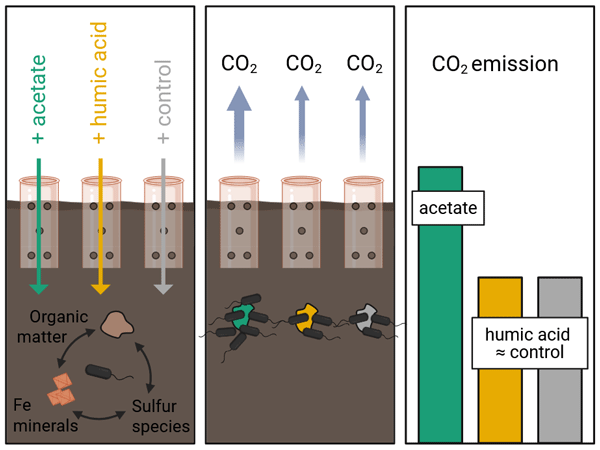
Abstract. Coastal wetlands play an important role in the global carbon cycle by sequestering carbon (referred to as “blue carbon”). At the same time, organic carbon (OC) in the subsurface is decomposed, releasing greenhouse gases (GHGs) such as carbon dioxide (CO2) and methane (CH4). To predict how this carbon balance in salt marshes will change under future climate scenarios (e.g., higher temperatures, sea level rise), it is essential to understand the controls on OC decomposition in these systems. Here, we investigated OC turnover and CO2 release in a minerogenic salt marsh at the Wadden Sea, Germany. We first characterized the porewater and sediment of a pioneer marsh and adjoining intertidal flat to identify key biogeochemical processes. We then performed an in situ experiment by injecting two OC sources (labile (acetate)/complex (humic acid)) and subsequently monitored GHG release over four injection cycles along with subsurface geochemistry. Overall, we found that the microbially mediated CO2 release was limited by OC availability and composition, and not by electron acceptor availability, as evidenced by the presence of aqueous sulfate (SO42-) at all depths and the lack of CH4. Following the addition of labile OC, CO2 release in the pioneer marsh increased by up to 47.4 ± 36.4 % compared to the control, with a generally similar trend in the intertidal flat. The CO2 release from the complex OC treatment was similar to the control. The results of our work improve understanding of minerogenic salt marsh OC dynamics in temperate zones and enable better prediction of future changes.
-
Notice on discussion status
The requested preprint has a corresponding peer-reviewed final revised paper. You are encouraged to refer to the final revised version.
-
Preprint
(2636 KB)
-
Supplement
(1746 KB)
-
The requested preprint has a corresponding peer-reviewed final revised paper. You are encouraged to refer to the final revised version.
- Preprint
(2636 KB) - Metadata XML
-
Supplement
(1746 KB) - BibTeX
- EndNote
- Final revised paper


Journal article(s) based on this preprint
Interactive discussion
Status: closed
-
RC1: 'Comment on egusphere-2025-4621', Anonymous Referee #1, 05 Dec 2025
- AC1: 'Reply on RC1', Prachi Joshi, 02 Feb 2026
-
RC2: 'Comment on egusphere-2025-4621', Anonymous Referee #2, 22 Dec 2025
Referee 2 Report on EGUSPHERE-2025-4621
Overall Assessment:
This manuscript presents a comprehensive in situ investigation of organic carbon (OC) turnover and CO₂ release in minerogenic salt marsh sediments of the Wadden Sea. By integrating porewater and solid-phase geochemistry, microbial functional analyses, and an OC manipulation experiment, the authors address an important and timely question: whether OC decomposition in salt marshes is primarily limited by electron acceptor availability or by OC availability and composition.
The study is methodologically sound, data-rich, and clearly written. The focus on European minerogenic marshes is particularly valuable given the predominance of organogenic systems in the literature. The main conclusion, that OC composition and availability dominate over electron acceptor availability in controlling CO₂ release, is compelling, but in several places overstated and would benefit from more nuanced framing.
Overall recommendation: Major revision.
Specific Comments below:
Abstract: Lines 22–26
The Abstract concludes that microbial CO₂ release was not limited by electron acceptor availability, based on sulfate presence and absence of CH₄. This conclusion is strong relative to the evidence presented.
Suggestion to rephrase to indicate the relative importance rather than absolute:
“Electron acceptor availability was unlikely to be the primary limiting factor under the conditions studied”.
Introduction:
Line 29 rephrase to “at the interface between land and the open sea”
The Introduction is well written and provides a thorough background but does not clearly state the hypotheses for the study.
It is also unclear whether differences between pioneer marsh and intertidal flat were hypothesized a priori
Suggestions: Explicitly state hypotheses at the end of the Introduction and clarify whether spatial contrasts are expected mechanistically or are primarily comparative.
Methods:
The experimental section and the OC manipulation experiment is well designed and described in details. But the ecological relevance of the injected OC concentrations requires a bit clarification. Also explicitly state that the experiment targets short-term process responses, not long-term carbon budgets.
Results:
Several statements in the Results section interpret mechanisms rather than reporting observations.
My suggestion restricts the results to direction and magnitude of change, statistical significance and variability observed, and move the mechanistic interpretation to the Discussion section.
Lines 285–286; 345
The absence of detectable CH₄ is an important result. Report the CH₄ detection limit and also clarify whether CH₄ was assessed both in porewater and as surface fluxes.
Lines 294-307
The bromide tracer convincingly demonstrates limited physical washout, but the definition of residual fraction is not immediately clear. Provide a simple equation defining residual fraction in methods or results rather than Supplement.
Discussion:
The Discussion repeatedly concludes that electron acceptor availability did not limit OC decomposition (Lines 494–538; 545–548).
The authors move from:
“Fe(II) is present / increases
To
“Electron acceptor availability did not limit OC decomposition”
The paragraph (Lines 514–527) is well written and appropriate. However, elevated Fe(II) may indicate enhanced reduction rates rather than absence of limitation. So elevated Fe(II) tells that iron reduction is happening faster now. It does not prove that iron was never limiting or constraining the system. The authors conclude that electron acceptors are not limiting (strong statement) and OC alone controls decomposition (very strong statement).
Authors need to be cautious about this and rephrase and moderate the the interpretation throughout the manuscript to emphasize that OC availability and composition dominated process rates under the conditions studied, rather than concluding that electron acceptor availability was generally non-limiting.
Statistical reporting and methods are briefly described, but replication and model structure are not fully transparent. State sample sizes per treatment zone, and injection cycle, also specify whether error bars represent SD or SE
Conclusion:
The Conclusions are strong but occasionally extend beyond the scope of the experiment.
Emphasize that findings reflect short-term OC inputs and reduce a bit to sharpen the conclusion.
Minor Comments:
Line 31–36: Global carbon burial statistics could be shortened.
Line 305–307: Simplify wording of residual fraction definition.
Ensure consistent color coding for treatments across all figures.
Line 381: Avoid reflexive phrasing such as “we are aware that”.
Recommendation
This manuscript is a strong and valuable contribution to coastal biogeochemistry specially to carbon cycling in minerogenic salt marshes. With moderated claims regarding electron acceptor limitation, clearer hypothesis framing, and improved separation of Results and Discussion, it should be suitable for publication.
Citation: https://doi.org/10.5194/egusphere-2025-4621-RC2 - AC2: 'Reply on RC2', Prachi Joshi, 02 Feb 2026
-
AC3: 'Comment on egusphere-2025-4621', Prachi Joshi, 02 Feb 2026
As the Editorial team asked us to use the initials for the names of the authors in the CRediT authorship contribution statement, we propose the following change:
CRediT authorship contribution statement
NK: Investigation, Methodology, Formal Analysis, Visualization, Writing – Original Draft Preparation, Conceptualization. FR: Investigation, Writing – Review & Editing. JK: Methodology, Writing – Review & Editing. RK: Methodology, Writing – Review & Editing. AK: Writing – Review & Editing, Funding Acquisition. PJ: Conceptualization, Funding Acquisition, Supervision, Project Administration, Writing – Review & Editing.
Citation: https://doi.org/10.5194/egusphere-2025-4621-AC3


Interactive discussion
Status: closed
-
RC1: 'Comment on egusphere-2025-4621', Anonymous Referee #1, 05 Dec 2025
This manuscript presents a well-designed and timely study investigating controls on organic carbon (OC) decomposition and CO₂ release in minerogenic salt marsh sediments of the Wadden Sea. The work addresses an important gap in the blue carbon literature, which has historically focused on peat-dominated North American marshes. The combination of detailed geochemical characterisation with an in situ organic carbon manipulation experiment is innovative and provides new insight into the relative roles of electron acceptors and OC quality in regulating greenhouse gas dynamics.
The manuscript is generally well written, logically structured, and well-grounded in relevant biogeochemical literature. The conclusions are consequential and should interest the coastal biogeochemistry, blue carbon, and wetland modelling communities.
However, several aspects of the experimental design, interpretation, statistics, and framing require clarification or strengthening before publication. Some assumptions remain insufficiently justified, and a few conclusions appear stronger than the presented evidence supports.
Major Comments:
- The conclusion that electron acceptor availability, particularly sulphate, does not limit organic carbon (OC) decomposition is not fully supported by the data presented. First, the study relies solely on concentration profiles of sulphate, Fe(II), and O₂, but concentrations alone cannot indicate whether terminal electron acceptors (TEAs) were saturating or limiting for microbial respiration; resolving TEA limitation requires information on rates of sulphate and iron reduction or O₂ fluxes, which were not measured. Additionally, the OC addition experiment demonstrates stimulation of CO₂ production by acetate but does not distinguish whether this reflects true OC limitation or an unquantified shift in TEA-dependent respiration pathways, since no sulphate or iron-reduction rate measurements were performed to assess potential changes in electron acceptor turnover. To strengthen the conclusion, the authors should either moderate their claim or provide additional justification such as discussion of expected TEA turnover dynamics in minerogenic marshes, reaction–transport considerations, or clear reasoning as to why concentration data alone can rule out TEA limitation. As written, the conclusion overstates what can be confidently inferred from the available evidence and should acknowledge these uncertainties.
- The interpretation that methanogenesis is absent, and therefore that electron acceptors are non-limiting, relies heavily on the lack of detected CH₄ in porewater and flux measurements. However, several alternative explanations for CH₄ absence are not considered. Methane produced at depth can be rapidly consumed by anaerobic oxidation of methane (AOM), or physically flushed from the sediment via tidal exchange before detection. In addition, the manuscript does not report detection limits for dissolved CH₄ or flux measurements, making it unclear whether low but non-zero methanogenesis could have gone undetected. To strengthen the argument, the authors should discuss these potential CH₄ sink processes and provide analytical detection limits or moderate the conclusion to reflect these uncertainties, as the current data cannot rule out methanogenesis or CH₄ cycling within the system.
- The OC manipulation experiment provides valuable insight into short-term microbial responses to labile and complex carbon additions. However, each injection cycle spans only 48 hours and represents an instantaneous, high-concentration OC pulse. Natural OC inputs, such as root exudation, plant litter deposition, or episodic eutrophication, occur over much longer and more variable temporal scales, and microbial communities may respond differently to varying OC inputs. To avoid over-extrapolating short-term dynamics to ecosystem scale processes, the manuscript should more explicitly discuss how these pulse-style experiments relate to natural OC supply regimes and the extent to which the observed responses can/cannot be generalized to longer-term carbon cycling or environmental change scenarios.
Specific comments:
Lines 40-42: This statement is very general. Authors should mention which climate-driven processes, such as temperature, sea-level rise, vegetation shifts, storm frequency, are most relevant to OC turnover in minerogenic marshes. This would help frame the specific hypothesis tested later in the manuscript.
Lines 64-68: This is a key knowledge gap the study is addressing. I would suggest explaining in more detail examples of the work in European Saltmarshes with respect to TEA turnover and not GHG emissions.
Lines 56 – 59: I suggest clarifying why minerogenic sediments might differ from organogenic ones here. For example, in TOC content, mineral surface area, or porewater exchange, would better justify the hypothesis. This distinction is central to the paper, but it’s currently presented it in broad terms.
Lines 59-61: I suggest rewording this text to focus on how previous work has focused on locations that are biogeochemically different to the current study and mention the geographic locations as an aside. Currently this text could be misinterpreted as implying that previous work is geographically narrow or uninformative. Explaining how the U.S. sites differ biogeochemically (peat-dominated, high TOC, strongly reducing conditions) would prevent oversimplification and more clearly position the present study as filling a genuine gap.
Lines 91-95: I suggest including quantitative information here. The current phrasing provides qualitative differences but lacks quantitative information (inundation duration, frequency, elevation relative to MHW). Hydrology strongly influences redox conditions and solute transport and providing explicit values or ranges would help readers assess how representative and comparable the two zones are.
Lines 111-115: Were actions taken to reduce compaction? Push-core sampling can cause compression or smearing, especially in fine-grained sediments. This text would benefit from a short note on steps taken to minimise disturbance.
Lines 175-177: It would be useful for the readers to know the chamber volume here.
Line 195: Should be ‘inner diameter of 2.5 cm, and a length of 10 cm’
Lines 246-248: This section lacks detail for the reader to appreciate what numerical analysis was carried out. I appreciate all the details of statistical analysis is provided in the supplement, but some of the important information should be provided within the main body of the text. As a minimum, a summary of the statistical workflow should be included in the main text.
Line 315: ‘for the’ is repeated
Line 341: ‘Complimentarily’ is not an appropriate word here. Something like ‘Similarly’ or ‘In comparison’ should be used
Line 496: Typo ‘decreasing to 0mM below.’
Line 503: I suggest rewording ‘We speculate’. Speculation is not something that’s encouraged in scientific work.
Line 623: should be ‘led’ instead of ‘lead’
Line 627: ‘was much higher’ should be ‘were much higher’
Figures 4-8: Statistically significant differences should be denoted on the figures. It is common practice to place italics letters above bars in such comparison to show statistical groupings. This makes it easier for the reader to very quickly determine the statistical differences, if any are present.
Citation: https://doi.org/10.5194/egusphere-2025-4621-RC1 - AC1: 'Reply on RC1', Prachi Joshi, 02 Feb 2026
-
RC2: 'Comment on egusphere-2025-4621', Anonymous Referee #2, 22 Dec 2025
Referee 2 Report on EGUSPHERE-2025-4621
Overall Assessment:
This manuscript presents a comprehensive in situ investigation of organic carbon (OC) turnover and CO₂ release in minerogenic salt marsh sediments of the Wadden Sea. By integrating porewater and solid-phase geochemistry, microbial functional analyses, and an OC manipulation experiment, the authors address an important and timely question: whether OC decomposition in salt marshes is primarily limited by electron acceptor availability or by OC availability and composition.
The study is methodologically sound, data-rich, and clearly written. The focus on European minerogenic marshes is particularly valuable given the predominance of organogenic systems in the literature. The main conclusion, that OC composition and availability dominate over electron acceptor availability in controlling CO₂ release, is compelling, but in several places overstated and would benefit from more nuanced framing.
Overall recommendation: Major revision.
Specific Comments below:
Abstract: Lines 22–26
The Abstract concludes that microbial CO₂ release was not limited by electron acceptor availability, based on sulfate presence and absence of CH₄. This conclusion is strong relative to the evidence presented.
Suggestion to rephrase to indicate the relative importance rather than absolute:
“Electron acceptor availability was unlikely to be the primary limiting factor under the conditions studied”.
Introduction:
Line 29 rephrase to “at the interface between land and the open sea”
The Introduction is well written and provides a thorough background but does not clearly state the hypotheses for the study.
It is also unclear whether differences between pioneer marsh and intertidal flat were hypothesized a priori
Suggestions: Explicitly state hypotheses at the end of the Introduction and clarify whether spatial contrasts are expected mechanistically or are primarily comparative.
Methods:
The experimental section and the OC manipulation experiment is well designed and described in details. But the ecological relevance of the injected OC concentrations requires a bit clarification. Also explicitly state that the experiment targets short-term process responses, not long-term carbon budgets.
Results:
Several statements in the Results section interpret mechanisms rather than reporting observations.
My suggestion restricts the results to direction and magnitude of change, statistical significance and variability observed, and move the mechanistic interpretation to the Discussion section.
Lines 285–286; 345
The absence of detectable CH₄ is an important result. Report the CH₄ detection limit and also clarify whether CH₄ was assessed both in porewater and as surface fluxes.
Lines 294-307
The bromide tracer convincingly demonstrates limited physical washout, but the definition of residual fraction is not immediately clear. Provide a simple equation defining residual fraction in methods or results rather than Supplement.
Discussion:
The Discussion repeatedly concludes that electron acceptor availability did not limit OC decomposition (Lines 494–538; 545–548).
The authors move from:
“Fe(II) is present / increases
To
“Electron acceptor availability did not limit OC decomposition”
The paragraph (Lines 514–527) is well written and appropriate. However, elevated Fe(II) may indicate enhanced reduction rates rather than absence of limitation. So elevated Fe(II) tells that iron reduction is happening faster now. It does not prove that iron was never limiting or constraining the system. The authors conclude that electron acceptors are not limiting (strong statement) and OC alone controls decomposition (very strong statement).
Authors need to be cautious about this and rephrase and moderate the the interpretation throughout the manuscript to emphasize that OC availability and composition dominated process rates under the conditions studied, rather than concluding that electron acceptor availability was generally non-limiting.
Statistical reporting and methods are briefly described, but replication and model structure are not fully transparent. State sample sizes per treatment zone, and injection cycle, also specify whether error bars represent SD or SE
Conclusion:
The Conclusions are strong but occasionally extend beyond the scope of the experiment.
Emphasize that findings reflect short-term OC inputs and reduce a bit to sharpen the conclusion.
Minor Comments:
Line 31–36: Global carbon burial statistics could be shortened.
Line 305–307: Simplify wording of residual fraction definition.
Ensure consistent color coding for treatments across all figures.
Line 381: Avoid reflexive phrasing such as “we are aware that”.
Recommendation
This manuscript is a strong and valuable contribution to coastal biogeochemistry specially to carbon cycling in minerogenic salt marshes. With moderated claims regarding electron acceptor limitation, clearer hypothesis framing, and improved separation of Results and Discussion, it should be suitable for publication.
Citation: https://doi.org/10.5194/egusphere-2025-4621-RC2 - AC2: 'Reply on RC2', Prachi Joshi, 02 Feb 2026
-
AC3: 'Comment on egusphere-2025-4621', Prachi Joshi, 02 Feb 2026
As the Editorial team asked us to use the initials for the names of the authors in the CRediT authorship contribution statement, we propose the following change:
CRediT authorship contribution statement
NK: Investigation, Methodology, Formal Analysis, Visualization, Writing – Original Draft Preparation, Conceptualization. FR: Investigation, Writing – Review & Editing. JK: Methodology, Writing – Review & Editing. RK: Methodology, Writing – Review & Editing. AK: Writing – Review & Editing, Funding Acquisition. PJ: Conceptualization, Funding Acquisition, Supervision, Project Administration, Writing – Review & Editing.
Citation: https://doi.org/10.5194/egusphere-2025-4621-AC3
Peer review completion


Journal article(s) based on this preprint
Data sets
Carbon dioxide release driven by organic carbon in minerogenic salt marshes Nora Kainz, Franziska Raab, L. Joëlle Kubeneck, Ruben Kretzschmar, Andreas Kappler, Prachi Joshi http://zenodo.org/doi/10.5281/zenodo.17136252
Viewed
| HTML | XML | Total | Supplement | BibTeX | EndNote | |
|---|---|---|---|---|---|---|
| 766 | 442 | 109 | 1,317 | 159 | 60 | 83 |
- HTML: 766
- PDF: 442
- XML: 109
- Total: 1,317
- Supplement: 159
- BibTeX: 60
- EndNote: 83
Viewed (geographical distribution)
| Country | # | Views | % |
|---|
| Total: | 0 |
| HTML: | 0 |
| PDF: | 0 |
| XML: | 0 |
- 1
Nora Kainz
Franziska Raab
L. Joëlle Kubeneck
Ruben Kretzschmar
Andreas Kappler
The requested preprint has a corresponding peer-reviewed final revised paper. You are encouraged to refer to the final revised version.
- Preprint
(2636 KB) - Metadata XML
-
Supplement
(1746 KB) - BibTeX
- EndNote
- Final revised paper
This manuscript presents a well-designed and timely study investigating controls on organic carbon (OC) decomposition and CO₂ release in minerogenic salt marsh sediments of the Wadden Sea. The work addresses an important gap in the blue carbon literature, which has historically focused on peat-dominated North American marshes. The combination of detailed geochemical characterisation with an in situ organic carbon manipulation experiment is innovative and provides new insight into the relative roles of electron acceptors and OC quality in regulating greenhouse gas dynamics.
The manuscript is generally well written, logically structured, and well-grounded in relevant biogeochemical literature. The conclusions are consequential and should interest the coastal biogeochemistry, blue carbon, and wetland modelling communities.
However, several aspects of the experimental design, interpretation, statistics, and framing require clarification or strengthening before publication. Some assumptions remain insufficiently justified, and a few conclusions appear stronger than the presented evidence supports.
Major Comments:
Specific comments:
Lines 40-42: This statement is very general. Authors should mention which climate-driven processes, such as temperature, sea-level rise, vegetation shifts, storm frequency, are most relevant to OC turnover in minerogenic marshes. This would help frame the specific hypothesis tested later in the manuscript.
Lines 64-68: This is a key knowledge gap the study is addressing. I would suggest explaining in more detail examples of the work in European Saltmarshes with respect to TEA turnover and not GHG emissions.
Lines 56 – 59: I suggest clarifying why minerogenic sediments might differ from organogenic ones here. For example, in TOC content, mineral surface area, or porewater exchange, would better justify the hypothesis. This distinction is central to the paper, but it’s currently presented it in broad terms.
Lines 59-61: I suggest rewording this text to focus on how previous work has focused on locations that are biogeochemically different to the current study and mention the geographic locations as an aside. Currently this text could be misinterpreted as implying that previous work is geographically narrow or uninformative. Explaining how the U.S. sites differ biogeochemically (peat-dominated, high TOC, strongly reducing conditions) would prevent oversimplification and more clearly position the present study as filling a genuine gap.
Lines 91-95: I suggest including quantitative information here. The current phrasing provides qualitative differences but lacks quantitative information (inundation duration, frequency, elevation relative to MHW). Hydrology strongly influences redox conditions and solute transport and providing explicit values or ranges would help readers assess how representative and comparable the two zones are.
Lines 111-115: Were actions taken to reduce compaction? Push-core sampling can cause compression or smearing, especially in fine-grained sediments. This text would benefit from a short note on steps taken to minimise disturbance.
Lines 175-177: It would be useful for the readers to know the chamber volume here.
Line 195: Should be ‘inner diameter of 2.5 cm, and a length of 10 cm’
Lines 246-248: This section lacks detail for the reader to appreciate what numerical analysis was carried out. I appreciate all the details of statistical analysis is provided in the supplement, but some of the important information should be provided within the main body of the text. As a minimum, a summary of the statistical workflow should be included in the main text.
Line 315: ‘for the’ is repeated
Line 341: ‘Complimentarily’ is not an appropriate word here. Something like ‘Similarly’ or ‘In comparison’ should be used
Line 496: Typo ‘decreasing to 0mM below.’
Line 503: I suggest rewording ‘We speculate’. Speculation is not something that’s encouraged in scientific work.
Line 623: should be ‘led’ instead of ‘lead’
Line 627: ‘was much higher’ should be ‘were much higher’
Figures 4-8: Statistically significant differences should be denoted on the figures. It is common practice to place italics letters above bars in such comparison to show statistical groupings. This makes it easier for the reader to very quickly determine the statistical differences, if any are present.