
the Creative Commons Attribution 4.0 License.
the Creative Commons Attribution 4.0 License.
 | 20 Oct 2025
Technical note: Including non-evaporative fluxes enhances the accuracy of isotope-based soil evaporation estimates
Abstract. Accurately estimating soil water evaporation is essential for quantifying terrestrial water and energy. Isotope-based methods are useful but often rely on steady-state (SS) soil water storage assumptions or non-steady-state (NSS) models that ignore non-evaporative fluxes (such as infiltration and transpiration), leading to mass balance errors. Here, we introduce a new framework, named ISONEVA (ISOtope based soil water evaporation estimation considers dynamic soil water storage and Non-EVAporative fluxes), adapted from lake evaporation models to account for both evaporative and non-evaporative fluxes in soils under dynamic soil water storage. Validation under virtual and field scenarios demonstrated that ISONEVA improved evaporation estimates by 54.1%–83.6% (virtual) and 54.5%–92.4% (field) compared to traditional SS and NSS models. Furthermore, ISONEVA estimated a plausible upper limit of the E/ET ratio (0.139), encompassing the observed value (0.126), whereas SS and NSS methods severely underestimated (0.037) or were unable to produce a limit under field validation. These results highlight the critical role of dynamic soil water storage and non-evaporative fluxes in isotope-based soil water evaporation estimates, offering a robust framework for long-term assessments and informing future coupled land surface modeling efforts.
-
Notice on discussion status
The requested preprint has a corresponding peer-reviewed final revised paper. You are encouraged to refer to the final revised version.
-
Preprint
(1190 KB)
-
The requested preprint has a corresponding peer-reviewed final revised paper. You are encouraged to refer to the final revised version.
- Preprint
(1190 KB) - Metadata XML
- BibTeX
- EndNote
- Final revised paper


Journal article(s) based on this preprint
Interactive discussion
Status: closed
-
RC1: 'Comment on egusphere-2025-4614', Anonymous Referee #1, 04 Nov 2025
-
AC1: 'Reply on RC1', Han Fu, 30 Nov 2025
Dear Reviewer#1,
Thank you so much for the feedback. These comments improved the quality of our manuscript. Below we provide detailed point-by-point responses to all comments. Reviewer comments are highlighted in boldface and italic. Our responses are in normal texts.
Sincerely,
Han Fu (on behalf of all authors)
General comments
1.The derivation assumes that the isotopic composition of infiltration and transpiration fluxes can be characterized or estimated. It would be useful to clarify how these terms are treated in the virtual and field validations (e.g., assumed, measured, or derived), to guide future applications.
Thank you for this comment. The derivation indeed requires these fluxes to be characterized, and our framework is designed for practical application. In field settings, the isotopic composition of infiltration is taken directly from rainfall measurements. The isotopic composition of transpiration and percolation are derived from direct measurements of the topsoil water, based on the well-founded assumption that these processes do not induce significant isotopic fractionation. This makes the method readily applicable using standard field campaign data. By contrast, for our virtual experiments using the MOIST model, these fluxes are not assumed but are instead generated by the model’s internal simulation of water and isotope transport. The rainfall isotopic composition is provided as an artificial input randomly ranged between -50‰ and -10‰, and the model calculates the resulting isotopic compositions of infiltration, transpiration, and percolation. This allows for a controlled validation of the derivation under known conditions.
We will add a clarification to Lines 145-150 to explicitly explain how these isotopic flux terms are treated in the virtual validation: “ In the virtual experiment, the MOIST model generates the isotopic composition for all fluxes such as evaporation and percolation from the simulated topsoil water, while rainfall isotopic composition is provided as a direct input.”; and in the field validation (Lines 240-245): “In our framework, the isotopic composition of infiltration is set equal to that of rainfall, as the latter is a standard measurement during field campaigns. For the combined flux of transpiration and percolation, we assign the isotopic composition of the topsoil layer. This is justified because (1) neither process is expected to cause significant isotopic fractionation, and (2) the isotopic composition of topsoil water is directly measurable.”.
2. It would be helpful to specify how the reference (SS/NSS) estimates are computed, using identical inputs and time steps as ISONEVA? Stating this clearly will reinforce that the improvement is method-based rather than data-driven.
Thank you for raising this important point. We confirm that in both virtual and field validations, the SS and NSS estimates are computed using identical inputs, time steps, and initial/final conditions as the ISONEVA method. This ensures a fair comparison, confirming that the performance improvement is indeed method-based rather than data-driven.
We will add this clarification to Line 258: “In both the virtual and field validations, SS and NSS are applied using the same inputs, temporal resolution, and initial and final soil water and isotope profiles as the ISONEVA method. This ensures a fair comparison, confirming that the performance improvement is indeed method-based rather than input data-driven.”
3. The authors may wish to briefly discuss practical considerations when applying ISONEVA (e.g., data availability for soil isotopes and water fluxes, time resolution needed for ΔS estimation). It is better to explore how ISONEVA could be coupled with land surface or isotope-enabled models. This would help readers judge where the method is most applicable.
Thank you for your comments. We will add these statements to discuss practical considerations in Section 4.2: “The practical application of ISONEVA requires measurements of topsoil water content and isotopic composition at the beginning and end of a period (tinitial and tfinal), alongside basic meteorological data (e.g., air temperature and relative humidity). A key advantage is that the method does not rely on direct, and often difficult, measurements of soil evaporation, transpiration, or percolation fluxes. For accurate estimation, the time interval between tinitial and tfinal must be sufficiently long to capture a meaningful change in soil water storage; our virtual tests confirm that a monthly timescale is generally appropriate. ISONEVA is particularly well-suited for environments with intermittent rainfall, where precipitation events trigger measurable changes in topsoil water storage and isotopic composition. By contrast, the method cannot compute E/P in extremely arid conditions where a lack of rainfall (P = 0). Furthermore, ISONEVA offers a valuable pathway for model evaluation and integration. It can be coupled with isotope-enabled land surface models to provide benchmark trajectories of soil water and isotopes for evaluating model performance or to directly constrain model-estimated E/P ratios.”.
Minor comments:
1. Figure 1: Please clarify what dash arrows refer to?Thank you for your comments. The dashed arrows indicate that the direction of the flux Q may reverse depending on soil water gradients (e.g., downward percolation after rainfall or upward movement during large evaporation). We will add this clarification to the figure caption: “Figure 1. Schematic of the topsoil control volume and the fluxes in the ISONEVA water and isotope mass balance. P, E, and Q denote precipitation, evaporation, and percolation fluxes, respectively. The dashed arrows indicate that Q can be directed downward (solid arrows) or upward (dash arrows) depending on the soil water potential gradients.”
2. Figure 3: Please make the font larger. Additionally, the color contrast between model results and observations could be enhanced for clarity.
Thank you for your comments. The font of Figure 3 has been enlarged and attatched in the supplement.
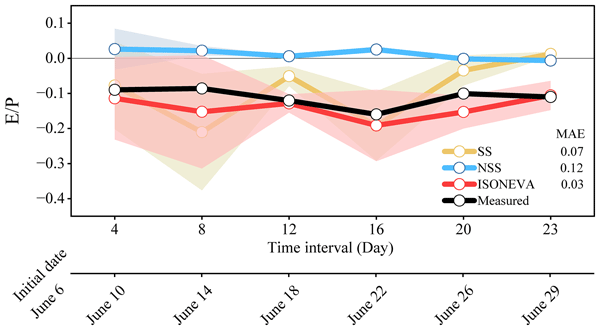
3. Figure 6: Why the beginning and ending data points are missing in the NSS curve.
Thanks for raising this point. We will add this explanation after Line 341: “NSS did not converge for the first and last evaluation intervals because the method assumes that changes in soil water storage are driven solely by evaporation. This assumption is violated when the observed soil water and isotope data reflect additional processes, such as infiltration or strong isotopic perturbations. The spiking experiment at the field site caused large shifts in topsoil isotopic composition that cannot be reconciled within the NSS framework, leading to failure in estimating E/P for these intervals.”.
4. Appendix A: The derivation of ISONEVA are pure equations. Adding explanations would be helpful for readers to understand.
Thank you for your comments. To help readers follow the derivation, we briefly summarize each step in Appendix A. For easier reading symbols and equations, we have uploaded explanations as the supplement.
-
AC1: 'Reply on RC1', Han Fu, 30 Nov 2025
-
RC2: 'Comment on egusphere-2025-4614', Anonymous Referee #2, 14 Nov 2025
General Comments
This study addresses key challenges in estimating soil evaporation using isotopic methods by proposing the ISONEVA framework. The research incorporates dynamic soil moisture storage and non-evaporation fluxes (such as infiltration and transpiration), representing a theoretical improvement over traditional steady-state (SS) and non-steady-state (NSS) methods. ISONEVA requires minimal data (primarily soil moisture content, isotopic composition, and basic meteorological data), making it more suitable for large-scale applications compared to methods like eddy covariance and sap flow. The study provides a conservative upper limit estimation method for the evapotranspiration (E/ET) ratio, offering valuable insights for water resource management. From this perspective, I find this research highly interesting. However, some scientific concerns prevent me from supporting publication at the current paper stage, though I encourage the authors to refine it further.
The fundamental contradiction between theoretical assumptions and mass balance principles. Problem identification: The author assumes that the isotopic composition of infiltration water matches that of surface soil water. This assumption exhibits significant physical inconsistencies. In real soil systems, after precipitation infiltration, new water mixes with existing soil water in an uneven process. The isotopic composition of infiltration water should be a product of mixing precipitation and soil water, not simply equal to surface soil water. Particularly after rainfall events, infiltration water should more closely resemble the isotopic characteristics of precipitation. While the author emphasizes "ensuring soil water and isotopic mass balance," this assumption inherently violates the principle of isotopic mass conservation. Such a flawed premise leads to systematic overestimation or underestimation of infiltration-induced isotopic loss after rainfall events, thereby compromising the accuracy of the E/P ratio. The positive results from virtual experiments may stem from MOIST model's adoption of identical assumptions rather than the validity of this particular hypothesis.
In the virtual experiment section, simulated data were generated using the MOIST model to validate the ISONEVA method. The ISONEVA and MOIST models may share similar physical assumptions (such as the treatment of infiltration isotope ratios), resulting in what essentially becomes self-validation. The soil's initial isotopic uniformity in the virtual experiment was set at 0‰ (an idealized condition absent in natural environments). Precipitation isotopic values were artificially assigned between-50‰ and-10‰, with insufficient consideration for natural variability. This validation design fails to properly assess the method's applicability under real-world complex conditions and may significantly overestimate ISONEVA's accuracy. The "superiority" demonstrated in Figures 4 and 5 likely reflects differences in methodological assumptions rather than actual precision.
The field validation process inadequately addressed critical data gaps and uncertainties. For atmospheric water vapor isotope data, the study employed substitute data from Vienna. Although sensitivity tests were conducted in Appendix B, these analyses only examined variations within Vienna's measurement range. Despite geographical proximity, the Swiss EPFL and Vienna differ in atmospheric circulation patterns, water vapor sources, and seasonal characteristics. The atmospheric water vapor isotope composition is critical for the Craig-Gordon model, and this substitution may introduce systematic bias. ISONEVA's Mean Absolute Error (MAE) of 0.04 might be inflated due to inherent uncertainties in input data. The "slight underestimation" of the E/ET ratio (0.103 versus observed 0.126) could partly stem from atmospheric isotope data deviations. Appendix B's sensitivity analysis (Table B1) shows E/P estimates fluctuating between-0.1 and-0.12, indicating method sensitivity to atmospheric isotope data. However, this uncertainty was not properly incorporated into the final error estimates. Beyond these three major issues, the study should address: 1) The optimization process's uncertainties may significantly outweigh methodological differences, yet results are presented as "mean ± standard deviation" without adequately discussing algorithm limitations; 2) Lack of systematic analysis of optimal thickness variations under different soil textures, precipitation patterns, and vegetation conditions. This limitation restricts the method's universal applicability, making it difficult for users to determine appropriate sampling depth for their specific research areas. The assumption that "surface soil root water uptake dominates non-evaporation flux Q" does not hold in many ecosystems, significantly reducing ISONEVA's practicality as an ET allocation tool. Consequently, the "upper limit" estimates may substantially deviate from actual values in numerous scenarios.
Therefore, the manuscript has several significant shortcomings in methodological clarity, validation rigor, data interpretation, and presentation. The derivations and assumptions are sometimes opaque, the virtual and field validations lack sufficient sensitivity analyses, and key limitations (e.g., scalability and parameter uncertainties) are not adequately addressed. These issues undermine the reproducibility and broader applicability of ISONEVA. While the concept is promising, substantial revisions are needed to strengthen the scientific foundation and ensure the method's robustness for practical use. The manuscript is not suitable for publication in its current form but could be reconsidered after major revisions.
Citation: https://doi.org/10.5194/egusphere-2025-4614-RC2 -
AC2: 'Reply on RC2', Han Fu, 30 Nov 2025
Dear Reviewer#2,
Thank you so much for the feedback. These comments improved the quality of our manuscript. Below we provide detailed point-by-point responses to all comments. Reviewer comments are highlighted in boldface and italic. Our responses are in normal texts.
Sincerely,
Han Fu (on behalf of all authors)General comments
1. The fundamental contradiction between theoretical assumptions and mass balance principles. Problem identification: The author assumes that the isotopic composition of infiltration water matches that of surface soil water. This assumption exhibits significant physical inconsistencies. In real soil systems, after precipitation infiltration, new water mixes with existing soil water in an uneven process. The isotopic composition of infiltration water should be a product of mixing precipitation and soil water, not simply equal to surface soil water. Particularly after rainfall events, infiltration water should more closely resemble the isotopic characteristics of precipitation. While the author emphasizes "ensuring soil water and isotopic mass balance," this assumption inherently violates the principle of isotopic mass conservation. Such a flawed premise leads to systematic overestimation or underestimation of infiltration-induced isotopic loss after rainfall events, thereby compromising the accuracy of the E/P ratio. The positive results from virtual experiments may stem from MOIST model's adoption of identical assumptions rather than the validity of this particular hypothesis.Thank you for your detailed comment regarding the theoretical assumptions. We believe the perceived contradiction stems from a confusion between the infiltration and percolation fluxes, and we appreciate the chance to clarify.
- Assumption for Infiltration (I): We define the isotopic composition of infiltration to be equal to that of precipitation (δI = δP). This aligns with the standard practice the reviewer mentions.
- Assumption for Percolation (Q): We define the isotopic composition of the outgoing percolation flux to be equal to that of the well-mixed topsoil water (Figure 1). This is the “well-mixed reactor” assumption, a foundational concept in solute transport (e.g., Ads et al., 2025; Braud et al., 2005; Haverd and Cuntz, 2010; Zhou et al., 2021) and isotope hydrology (e.g., Gonfiantini, 1986).
The isotopic composition of the topsoil layer, obtained through periodic measurement, inherently represents the integrated result of all mixing processes between incoming precipitation and pre-existing soil water over the sampling interval. Therefore, assigning this bulk value to the percolation flux is a physically consistent application of the control-volume approach and a standard practice for representing the output of a well-mixed system. We will amend the text to make this critical distinction between I and Q much more explicit.
[Please check the supplement for FIgure 1. ]
Because the isotopic composition of the topsoil layer is measured periodically, each measurement already incorporates the integrated mixing of incoming precipitation with pre-existing soil water during the interval between two sampling campaigns. Therefore, assigning topsoil layer isotopic compositions to percolation flux is a physically consistent representation of control-volume mass balance, rather than a flawed assumption.
To avoid further misunderstanding, we will add Figure 1 and clarifying text after Line 67: “The isotopic composition of the outgoing percolation flux is set equal to that of the topsoil layer. This employs the well-established “well-mixed” control-volume assumption, where the measured topsoil composition inherently reflects the integrated mixing of new precipitation with pre-existing soil water, defines the composition of water leaving the volume. This approach is standard in isotope hydrology (e.g., Ads et al., 2025; Braud et al., 2005; Haverd and Cuntz, 2010; Zhou et al., 2021) and in isotope-based evaporation studies of open-water bodies (e.g., Gonfiantini, 1986).”
In the virtual experiments, the process-based model MOIST served solely as a forward simulator to generate internally consistent soil water and isotope profiles. While MOIST and the analytical methods all employ a well-mixed assumption for the topsoil, this commonality is not the source of ISONEVA’s superior performance. For each evaluation window, ISONEVA, SS, and NSS were applied identically, using the same initial and final states generated by MOIST and derived from the same foundational equations (Eqs. 7-8). Therefore, the enhanced performance of ISONEVA stems solely from its more rigorous enforcement of water and isotope mass balance at the topsoil layer scale, a distinction that sets it apart from the SS and NSS methods.
2. In the virtual experiment section, simulated data were generated using the MOIST model to validate the ISONEVA method. The ISONEVA and MOIST models may share similar physical assumptions (such as the treatment of infiltration isotope ratios), resulting in what essentially becomes self-validation. The soil's initial isotopic uniformity in the virtual experiment was set at 0‰ (an idealized condition absent in natural environments). Precipitation isotopic values were artificially assigned between-50‰ and-10‰, with insufficient consideration for natural variability. This validation design fails to properly assess the method's applicability under real-world complex conditions and may significantly overestimate ISONEVA's accuracy. The "superiority" demonstrated in Figures 4 and 5 likely reflects differences in methodological assumptions rather than actual precision.
Thank you for your thoughtful comments on the virtual experiment design. We appreciate the opportunity to clarify our methodology and its purpose.
(1) Clarification on model assumptions and “self-validation”
We agree that transparency about shared assumptions is critical. The isotopic composition of the outgoing percolation flux is indeed represented similarly in MOIST and the analytical methods (ISONEVA, SS, and NSS). However, this is a standard “well-mixed reactor” assumption for a control volume, widely used in hydrological and isotope transport modeling (e.g., Braud et al., 2005; Zhou et al., 2021).
Because this same assumption is foundational to all three methods being compared (ISONEVA, SS, and NSS), it establishes a common basis for evaluation. The performance differences between them, therefore, cannot be attributed to this shared premise. Instead, the comparison isolates the effect of how each method enforces water and isotope mass balance, demonstrating that ISONEVA is more rigorous.
(2) Purpose and value of the virtual benchmark experiment
The reviewer rightly points out that the virtual experiment uses simplified and idealized conditions. We designed it specifically for this purpose: to serve as a controlled benchmark where the “true” water and isotope balances are known exactly. Such benchmarks are a fundamental step in model development, as they are the only way to objectively test a method’s theoretical correctness and intrinsic accuracy before confronting the immense complexities of the real world.
Demonstrating that ISONEVA outperforms SS and NSS under these controlled conditions is a necessary first step that validates its core logic. We fully acknowledge that its performance in natural settings, with their full complexity and heterogeneity, is a separate question. One that we explicitly address in our subsequent field validation across diverse sites.
We will add following clarifications after Line 212: “This virtual experiment serves as a controlled benchmark to evaluate the performance of ISONEVA against the SS and NSS methods under conditions where the true water and isotope balance is known. It is designed to test our core hypothesis: by integrating both evaporative and non-evaporative fluxes, ISONEVA’s more rigorous enforcement of mass conservation yields more accurate E/P estimates than the existing approaches.”
(3) Initial isotopic uniformity (0‰) and precipitation ranges (-50‰ to -10‰) do not bias results toward ISONEVA.
The experimental parameters, including the homogeneous initial condition (0‰) and the wide range of precipitation isotopes (-50‰ to -10‰), were deliberately chosen to create a stringent and interpretable benchmark. The initial homogeneity isolates the flux-driven dynamics, and the specific value of 0‰ is inconsequential, as the methods are sensitive to isotopic differencing. The broad spectrum of precipitation values is designed to test the operational limits of each method under evaluation.
The initial soil-water isotopic value merely sets a baseline and does not influence the relative performance of the diagnostic methods, because ISONEVA, SS, and NSS all use the same initial and final profiles for each comparison. Likewise, the chosen precipitation isotope range was selected simply to ensure a clear and detectable isotopic signal. What matters is that MOIST produces realistic, dynamically evolving soil-water and isotope profiles, which provide a consistent and rigorous basis for evaluating all three methods under identical conditions.
Consequently, the superior performance of ISONEVA is due to its physically consistent treatment of water storage change and isotopic mass balance, whereas SS and NSS neglect one or both components. All three methods ultimately originate from the same governing equations (Eqs. 7 and 8), but SS omit the consideration of dynamic soil water storage of topsoil layer (∂V/∂t = 0) and NSS ignores non-evaporative fluxes (∂V/∂t ≠ 0} but considers evaporative flux only) that required for a correct reverse estimation of E/P. Both omissions violate the full water and isotope mass-balance requirements for a correct reverse estimation of E/P. Thus, the improved accuracy of ISONEVA reflects methodological robustness rather than any advantage derived from initial conditions or MOIST’s setup.
3. The field validation process inadequately addressed critical data gaps and uncertainties. For atmospheric water vapor isotope data, the study employed substitute data from Vienna. Although sensitivity tests were conducted in Appendix B, these analyses only examined variations within Vienna's measurement range. Despite geographical proximity, the Swiss EPFL and Vienna differ in atmospheric circulation patterns, water vapor sources, and seasonal characteristics. The atmospheric water vapor isotope composition is critical for the Craig-Gordon model, and this substitution may introduce systematic bias. ISONEVA's Mean Absolute Error (MAE) of 0.04 might be inflated due to inherent uncertainties in input data. The "slight underestimation" of the E/ET ratio (0.103 versus observed 0.126) could partly stem from atmospheric isotope data deviations. Appendix B's sensitivity analysis (Table B1) shows E/P estimates fluctuating between-0.1 and-0.12, indicating method sensitivity to atmospheric isotope data. However, this uncertainty was not properly incorporated into the final error estimates.
Thank you for this insightful comment regarding the use of non-local atmospheric water vapor isotope data and its potential impact on our field validation. We appreciate you highlighting this important source of uncertainty.
You are correct that site-specific vapor measurements are ideal, and we acknowledge that using data from Vienna is a limitation, which we will state more explicitly in the revised manuscript. This approach is, however, a common practice in isotope hydrology when local monitoring is unavailable, like using precipitation data from the nearest GNIP station.
To address the potential for systematic bias, we would like to clarify a few points:
- Spatial coherence: While local meteorological patterns differ, both EPFL and Vienna reside within the mid-latitude westerly belt. As shown in global studies (e.g., Galewsky et al., 2016), central European stations exhibit a relatively narrow range of vapor δ18O values (typically -25‰ to -15‰) due to the homogenizing effect of large-scale circulation. This provides a physical basis for believing the Vienna data are a reasonable proxy.
- Robustness of sensitivity analysis: Our sensitivity tests in Appendix B explored a vapor isotope range (-27‰ to -13‰ for δ18O) that far exceeds the climatological difference expected between these two sites. The resulting variation in the E/P estimate was modest (from -0.10 to -0.12), demonstrating that the method’s output is not highly sensitive to even extreme variations in this input.
- Fairness of the comparison: Crucially, the same Vienna vapor data were used as input for the SS, NSS, and ISONEVA methods. Therefore, any potential bias introduced would affect all three methods equally. The consistent outperformance of ISONEVA under this common framework indicates that its superiority is a result of its methodological advances, not the specific vapor data used.
In conclusion, while we agree that local vapor data would further strengthen the validation, we are confident that the practical approach taken, combined with the extensive sensitivity analysis and the fair, comparative nature of the test, robustly supports our main finding: that ISONEVA provides a more accurate and mass-balance-consistent estimate of E/P than the existing SS and NSS approaches.
To clarify, we will add following clarifications after Line 258: “As supported by global vapor isotope studies (e.g., Galewsky et al., 2016), central European stations like Vienna exhibit spatially coherent δ18O values, typically clustering between -25‰ and -15‰ due to the region’s dominant westerly circulation. Since the EPFL site in Lausanne is situated within this same meteorological regime, we expect its vapor composition to fall within this characteristic range. To be conservative, our sensitivity analysis tested an even wider range (-27‰ to -13‰), which far exceeds the plausible climatological difference between the two locations. The modest variation in results under this extreme span confirms that our findings are robust to the uncertainties associated with using Vienna data.”
To further strengthen the rigor of the study, we will incorporate vapor isotope uncertainty into the final E/P estimate in Line 347: “Accounting for vapor isotope uncertainty (±0.02 in E/P), the ISONEVA estimate becomes 0.103 ± 0.02, which agrees well to the observed value (0.126).”
Specific comments:
1. The optimization process's uncertainties may significantly outweigh methodological differences, yet results are presented as "mean ± standard deviation" without adequately discussing algorithm limitations.Thank you for the comments regarding the potential uncertainties associated with optimization algorithms. We would like to clarify that the optimization in ISONEVA is a low-dimensional and bounded problem whose objective function (Eq. 25) is fully determined by water and isotope mass balance constraints.
Although we used a Genetic Algorithm (GA) as a general-purpose solver, the problem is sufficiently simple that the solution is effectively deterministic. Repeated optimization runs consistently converged to the same solution with negligible numerical variance. This numerical uncertainty can be much smaller than the methodological differences under the long-time interval (monthly), as demonstrated in Figures 4 and 5.
To further clarify, we will add following sentences after Line 362: “Although we used a Genetic Algorithm (GA) as a general-purpose solver, the problem is sufficiently simple that the solution is effectively deterministic. Repeated optimization runs consistently converged to the same solution with negligible numerical variance. This numerical uncertainty can be much smaller than the methodological differences under a long period (Figures 4 and 5).”
2. Lack of systematic analysis of optimal thickness variations under different soil textures, precipitation patterns, and vegetation conditions. This limitation restricts the method's universal applicability, making it difficult for users to determine appropriate sampling depth for their specific research areas.
Thank you for this valuable comment. We agree that a systematic analysis of the optimal sampling depth under all environmental conditions is an important research topic. However, such a comprehensive parameterization is beyond the scope of this methodological introduction, as it would require an extensive global dataset not currently available.
We would like to clarify that the choice of a topsoil sampling depth is a pre-existing consideration for all isotope-based evaporation methods (including SS and NSS), not a new limitation introduced by ISONEVA. The convention of using the upper 5-10 cm is well-established in the literature, as this depth generally captures the dynamics of the evaporating zone. Our virtual experiment’s finding of an optimal depth near 8 cm aligns with and reinforces this common practice.
Therefore, while we acknowledge that fine-tuning could be explored in future work, the standard 5-10 cm range provides a robust and widely applicable sampling guideline for applying ISONEVA and similar methods in the field.
To clarify this point, we will add following statement after Line 405: “The optimal depth inferred from the virtual experiment reflects the specific soil properties (light clay) and relatively frequent rainfall conditions (at least one rainfall event during the E/P approximation period). This optimal depth should not be interpreted as universally applicable, particularly in extremely arid environments. Broader cross-ecosystem generalization would require multi-site field datasets and represent an important direction for future research.”
3. The assumption that "surface soil root water uptake dominates non-evaporation flux Q" does not hold in many ecosystems, significantly reducing ISONEVA's practicality as an ET allocation tool. Consequently, the "upper limit" estimates may substantially deviate from actual values in numerous scenarios.
Thank you for the comment. We would like to clarify that we do not assume that root water uptake in real ecosystems is universally dominated by the topsoil layer. This assumption is used solely to construct a conservative upper bound on T/ET, which representing the maximum plausible transpiration fraction under the most favorable isotopic contrast. In other words, if all root water uptake were hypothetically concentrated within the topsoil layer, the corresponding E/ET value would define a physically reasonable upper limit.
This upper-bound estimate is not intended to reflect actual ecosystem conditions. Rather, it provides a physically constrained boundary that real T/ET values cannot exceed. The fact that many ecosystems exhibit deeper root water uptake does not invalidate this boundary; it simply means that actual E/ET values will fall below the upper limit obtained from ISONEVA.
Furthermore, ET partitioning is not the primary objective of ISONEVA. The core function of ISONEVA is to infer the integrated E/P ratio over a given time interval from topsoil water content and isotopic composition dynamics. The upper-bound T/ET estimate is an optional diagnostic derived from E/P, and it is only applicable when E/P can be reliably estimated. Under extremely arid conditions like no rainfall occurs (P = 0), ISONEVA cannot calculate E/P (because the derivation of ISONEVA is based on P > 0) and thus cannot provide ET partitioning. Consequently, the upper-bound T/ET estimate is not intended for application in arid regions.To make it clearer, we will revise the manuscript to explicitly clarify the purpose and interpretation of this assumption after Line 271:“The assumption that root water uptake occurs predominantly in the topsoil layer is used solely to construct a conservative upper boundary for T/ET. This boundary represents the maximum plausible transpiration fraction that is consistent with water and isotope mass balance, and it should not be interpreted as reflecting actual root water uptake patterns in specific ecosystems. In addition, under extremely arid conditions without rainfall input (P = 0), ISONEVA is unable to calculate E/P and therefore cannot provide ET partitioning. Consequently, the upper-bound T/ET estimate is not intended for application in arid regions.”
References
Ads, A., Tziolas, N., Chrysikopoulos, C. V., Zhang, T. J., and Al Shehhi, M. R.: Quantitative analysis of water, heat, and salinity dynamics during bare soil evaporation, J Hydrol, 662, https://doi.org/10.1016/j.jhydrol.2025.133841, 2025.
Braud, I., Bariac, T., Gaudet, J. P., and Vauclin, M.: SiSPAT-Isotope, a coupled heat, water and stable isotope (HDO and H 218O) transport model for bare soil. Part I. Model description and first verifications, J Hydrol, 309, 277–300, https://doi.org/10.1016/j.jhydrol.2004.12.013, 2005.
Galewsky, J., Steen-Larsen, H. C., Field, R. D., Worden, J., Risi, C., and Schneider, M.: Stable isotopes in atmospheric water vapor and applications to the hydrologic cycle, Reviews of Geophysics, 54, 809–865, https://doi.org/10.1002/2015RG000512, 2016.
Gonfiantini, R.: Handbook of environmental isotope geochemistry: The terrestrial environment, B Volume 2, vol. 18, edited by: Fritz, P. and Fontes, J. Ch., Elsevier, Armsterdam, 113–168, 1986.
Haverd, V. and Cuntz, M.: Soil-Litter-Iso: A one-dimensional model for coupled transport of heat, water and stable isotopes in soil with a litter layer and root extraction, J Hydrol, 388, 438–455, https://doi.org/10.1016/j.jhydrol.2010.05.029, 2010.
Zhou, T., Šimůnek, J., and Braud, I.: Adapting HYDRUS-1D to simulate the transport of soil water isotopes with evaporation fractionation, Environmental Modelling and Software, 143, https://doi.org/10.1016/j.envsoft.2021.105118, 2021.
-
AC2: 'Reply on RC2', Han Fu, 30 Nov 2025
Peer review completion


Interactive discussion
Status: closed
-
RC1: 'Comment on egusphere-2025-4614', Anonymous Referee #1, 04 Nov 2025
This technical note presents a new isotope-based framework (ISONEVA) that accounts for dynamic soil water storage and non-evaporative fluxes (e.g., infiltration, transpiration) in estimating soil evaporation. The study clearly identifies and addresses a long-standing issue in isotope-based evaporation methods, which is mass balance errors from neglecting non-evaporative fluxes. Based on a conceptual structure from lake evaporation modelling, the proposed model incorporates more hydrological components. The topic is highly relevant to hydrology, ecohydrology, and isotope applications, and it fits well within the scope of Hydrology and Earth System Sciences.
Overall, I find this to be a novel, clearly written, and methodologically sound contribution. The technical note successfully demonstrates that ISONEVA improves the realism and accuracy of isotope-based soil water evaporation estimates. The framework could have broad implications and a strong contribution to the isotope hydrology community.
General comments:
- The derivation assumes that the isotopic composition of infiltration and transpiration fluxes can be characterized or estimated. It would be useful to clarify how these terms are treated in the virtual and field validations (e.g., assumed, measured, or derived), to guide future applications.
- It would be helpful to specify how the reference (SS/NSS) estimates are computed, using identical inputs and time steps as ISONEVA? Stating this clearly will reinforce that the improvement is method-based rather than data-driven.
- The authors may wish to briefly discuss practical considerations when applying ISONEVA (e.g., data availability for soil isotopes and water fluxes, time resolution needed for ΔS estimation). It is better to explore how ISONEVA could be coupled with land surface or isotope-enabled models. This would help readers judge where the method is most applicable.
Figures and appendix:
Figure 1: Please clarify what dash arrows refer to?
Figure 3: Please make the font larger. Additionally, the color contrast between model results and observations could be enhanced for clarity.
Figure 6: Why the beginning and ending data points are missing in the NSS curve.
Appendix A: The derivation of ISONEVA are pure equations. Adding explanations would be helpful for readers to understand.
Citation: https://doi.org/10.5194/egusphere-2025-4614-RC1 -
AC1: 'Reply on RC1', Han Fu, 30 Nov 2025
Dear Reviewer#1,
Thank you so much for the feedback. These comments improved the quality of our manuscript. Below we provide detailed point-by-point responses to all comments. Reviewer comments are highlighted in boldface and italic. Our responses are in normal texts.
Sincerely,
Han Fu (on behalf of all authors)
General comments
1.The derivation assumes that the isotopic composition of infiltration and transpiration fluxes can be characterized or estimated. It would be useful to clarify how these terms are treated in the virtual and field validations (e.g., assumed, measured, or derived), to guide future applications.
Thank you for this comment. The derivation indeed requires these fluxes to be characterized, and our framework is designed for practical application. In field settings, the isotopic composition of infiltration is taken directly from rainfall measurements. The isotopic composition of transpiration and percolation are derived from direct measurements of the topsoil water, based on the well-founded assumption that these processes do not induce significant isotopic fractionation. This makes the method readily applicable using standard field campaign data. By contrast, for our virtual experiments using the MOIST model, these fluxes are not assumed but are instead generated by the model’s internal simulation of water and isotope transport. The rainfall isotopic composition is provided as an artificial input randomly ranged between -50‰ and -10‰, and the model calculates the resulting isotopic compositions of infiltration, transpiration, and percolation. This allows for a controlled validation of the derivation under known conditions.
We will add a clarification to Lines 145-150 to explicitly explain how these isotopic flux terms are treated in the virtual validation: “ In the virtual experiment, the MOIST model generates the isotopic composition for all fluxes such as evaporation and percolation from the simulated topsoil water, while rainfall isotopic composition is provided as a direct input.”; and in the field validation (Lines 240-245): “In our framework, the isotopic composition of infiltration is set equal to that of rainfall, as the latter is a standard measurement during field campaigns. For the combined flux of transpiration and percolation, we assign the isotopic composition of the topsoil layer. This is justified because (1) neither process is expected to cause significant isotopic fractionation, and (2) the isotopic composition of topsoil water is directly measurable.”.
2. It would be helpful to specify how the reference (SS/NSS) estimates are computed, using identical inputs and time steps as ISONEVA? Stating this clearly will reinforce that the improvement is method-based rather than data-driven.
Thank you for raising this important point. We confirm that in both virtual and field validations, the SS and NSS estimates are computed using identical inputs, time steps, and initial/final conditions as the ISONEVA method. This ensures a fair comparison, confirming that the performance improvement is indeed method-based rather than data-driven.
We will add this clarification to Line 258: “In both the virtual and field validations, SS and NSS are applied using the same inputs, temporal resolution, and initial and final soil water and isotope profiles as the ISONEVA method. This ensures a fair comparison, confirming that the performance improvement is indeed method-based rather than input data-driven.”
3. The authors may wish to briefly discuss practical considerations when applying ISONEVA (e.g., data availability for soil isotopes and water fluxes, time resolution needed for ΔS estimation). It is better to explore how ISONEVA could be coupled with land surface or isotope-enabled models. This would help readers judge where the method is most applicable.
Thank you for your comments. We will add these statements to discuss practical considerations in Section 4.2: “The practical application of ISONEVA requires measurements of topsoil water content and isotopic composition at the beginning and end of a period (tinitial and tfinal), alongside basic meteorological data (e.g., air temperature and relative humidity). A key advantage is that the method does not rely on direct, and often difficult, measurements of soil evaporation, transpiration, or percolation fluxes. For accurate estimation, the time interval between tinitial and tfinal must be sufficiently long to capture a meaningful change in soil water storage; our virtual tests confirm that a monthly timescale is generally appropriate. ISONEVA is particularly well-suited for environments with intermittent rainfall, where precipitation events trigger measurable changes in topsoil water storage and isotopic composition. By contrast, the method cannot compute E/P in extremely arid conditions where a lack of rainfall (P = 0). Furthermore, ISONEVA offers a valuable pathway for model evaluation and integration. It can be coupled with isotope-enabled land surface models to provide benchmark trajectories of soil water and isotopes for evaluating model performance or to directly constrain model-estimated E/P ratios.”.
Minor comments:
1. Figure 1: Please clarify what dash arrows refer to?Thank you for your comments. The dashed arrows indicate that the direction of the flux Q may reverse depending on soil water gradients (e.g., downward percolation after rainfall or upward movement during large evaporation). We will add this clarification to the figure caption: “Figure 1. Schematic of the topsoil control volume and the fluxes in the ISONEVA water and isotope mass balance. P, E, and Q denote precipitation, evaporation, and percolation fluxes, respectively. The dashed arrows indicate that Q can be directed downward (solid arrows) or upward (dash arrows) depending on the soil water potential gradients.”
2. Figure 3: Please make the font larger. Additionally, the color contrast between model results and observations could be enhanced for clarity.
Thank you for your comments. The font of Figure 3 has been enlarged and attatched in the supplement.
3. Figure 6: Why the beginning and ending data points are missing in the NSS curve.
Thanks for raising this point. We will add this explanation after Line 341: “NSS did not converge for the first and last evaluation intervals because the method assumes that changes in soil water storage are driven solely by evaporation. This assumption is violated when the observed soil water and isotope data reflect additional processes, such as infiltration or strong isotopic perturbations. The spiking experiment at the field site caused large shifts in topsoil isotopic composition that cannot be reconciled within the NSS framework, leading to failure in estimating E/P for these intervals.”.
4. Appendix A: The derivation of ISONEVA are pure equations. Adding explanations would be helpful for readers to understand.
Thank you for your comments. To help readers follow the derivation, we briefly summarize each step in Appendix A. For easier reading symbols and equations, we have uploaded explanations as the supplement.
-
RC2: 'Comment on egusphere-2025-4614', Anonymous Referee #2, 14 Nov 2025
General Comments
This study addresses key challenges in estimating soil evaporation using isotopic methods by proposing the ISONEVA framework. The research incorporates dynamic soil moisture storage and non-evaporation fluxes (such as infiltration and transpiration), representing a theoretical improvement over traditional steady-state (SS) and non-steady-state (NSS) methods. ISONEVA requires minimal data (primarily soil moisture content, isotopic composition, and basic meteorological data), making it more suitable for large-scale applications compared to methods like eddy covariance and sap flow. The study provides a conservative upper limit estimation method for the evapotranspiration (E/ET) ratio, offering valuable insights for water resource management. From this perspective, I find this research highly interesting. However, some scientific concerns prevent me from supporting publication at the current paper stage, though I encourage the authors to refine it further.
The fundamental contradiction between theoretical assumptions and mass balance principles. Problem identification: The author assumes that the isotopic composition of infiltration water matches that of surface soil water. This assumption exhibits significant physical inconsistencies. In real soil systems, after precipitation infiltration, new water mixes with existing soil water in an uneven process. The isotopic composition of infiltration water should be a product of mixing precipitation and soil water, not simply equal to surface soil water. Particularly after rainfall events, infiltration water should more closely resemble the isotopic characteristics of precipitation. While the author emphasizes "ensuring soil water and isotopic mass balance," this assumption inherently violates the principle of isotopic mass conservation. Such a flawed premise leads to systematic overestimation or underestimation of infiltration-induced isotopic loss after rainfall events, thereby compromising the accuracy of the E/P ratio. The positive results from virtual experiments may stem from MOIST model's adoption of identical assumptions rather than the validity of this particular hypothesis.
In the virtual experiment section, simulated data were generated using the MOIST model to validate the ISONEVA method. The ISONEVA and MOIST models may share similar physical assumptions (such as the treatment of infiltration isotope ratios), resulting in what essentially becomes self-validation. The soil's initial isotopic uniformity in the virtual experiment was set at 0‰ (an idealized condition absent in natural environments). Precipitation isotopic values were artificially assigned between-50‰ and-10‰, with insufficient consideration for natural variability. This validation design fails to properly assess the method's applicability under real-world complex conditions and may significantly overestimate ISONEVA's accuracy. The "superiority" demonstrated in Figures 4 and 5 likely reflects differences in methodological assumptions rather than actual precision.
The field validation process inadequately addressed critical data gaps and uncertainties. For atmospheric water vapor isotope data, the study employed substitute data from Vienna. Although sensitivity tests were conducted in Appendix B, these analyses only examined variations within Vienna's measurement range. Despite geographical proximity, the Swiss EPFL and Vienna differ in atmospheric circulation patterns, water vapor sources, and seasonal characteristics. The atmospheric water vapor isotope composition is critical for the Craig-Gordon model, and this substitution may introduce systematic bias. ISONEVA's Mean Absolute Error (MAE) of 0.04 might be inflated due to inherent uncertainties in input data. The "slight underestimation" of the E/ET ratio (0.103 versus observed 0.126) could partly stem from atmospheric isotope data deviations. Appendix B's sensitivity analysis (Table B1) shows E/P estimates fluctuating between-0.1 and-0.12, indicating method sensitivity to atmospheric isotope data. However, this uncertainty was not properly incorporated into the final error estimates. Beyond these three major issues, the study should address: 1) The optimization process's uncertainties may significantly outweigh methodological differences, yet results are presented as "mean ± standard deviation" without adequately discussing algorithm limitations; 2) Lack of systematic analysis of optimal thickness variations under different soil textures, precipitation patterns, and vegetation conditions. This limitation restricts the method's universal applicability, making it difficult for users to determine appropriate sampling depth for their specific research areas. The assumption that "surface soil root water uptake dominates non-evaporation flux Q" does not hold in many ecosystems, significantly reducing ISONEVA's practicality as an ET allocation tool. Consequently, the "upper limit" estimates may substantially deviate from actual values in numerous scenarios.
Therefore, the manuscript has several significant shortcomings in methodological clarity, validation rigor, data interpretation, and presentation. The derivations and assumptions are sometimes opaque, the virtual and field validations lack sufficient sensitivity analyses, and key limitations (e.g., scalability and parameter uncertainties) are not adequately addressed. These issues undermine the reproducibility and broader applicability of ISONEVA. While the concept is promising, substantial revisions are needed to strengthen the scientific foundation and ensure the method's robustness for practical use. The manuscript is not suitable for publication in its current form but could be reconsidered after major revisions.
Citation: https://doi.org/10.5194/egusphere-2025-4614-RC2 -
AC2: 'Reply on RC2', Han Fu, 30 Nov 2025
Dear Reviewer#2,
Thank you so much for the feedback. These comments improved the quality of our manuscript. Below we provide detailed point-by-point responses to all comments. Reviewer comments are highlighted in boldface and italic. Our responses are in normal texts.
Sincerely,
Han Fu (on behalf of all authors)General comments
1. The fundamental contradiction between theoretical assumptions and mass balance principles. Problem identification: The author assumes that the isotopic composition of infiltration water matches that of surface soil water. This assumption exhibits significant physical inconsistencies. In real soil systems, after precipitation infiltration, new water mixes with existing soil water in an uneven process. The isotopic composition of infiltration water should be a product of mixing precipitation and soil water, not simply equal to surface soil water. Particularly after rainfall events, infiltration water should more closely resemble the isotopic characteristics of precipitation. While the author emphasizes "ensuring soil water and isotopic mass balance," this assumption inherently violates the principle of isotopic mass conservation. Such a flawed premise leads to systematic overestimation or underestimation of infiltration-induced isotopic loss after rainfall events, thereby compromising the accuracy of the E/P ratio. The positive results from virtual experiments may stem from MOIST model's adoption of identical assumptions rather than the validity of this particular hypothesis.Thank you for your detailed comment regarding the theoretical assumptions. We believe the perceived contradiction stems from a confusion between the infiltration and percolation fluxes, and we appreciate the chance to clarify.
- Assumption for Infiltration (I): We define the isotopic composition of infiltration to be equal to that of precipitation (δI = δP). This aligns with the standard practice the reviewer mentions.
- Assumption for Percolation (Q): We define the isotopic composition of the outgoing percolation flux to be equal to that of the well-mixed topsoil water (Figure 1). This is the “well-mixed reactor” assumption, a foundational concept in solute transport (e.g., Ads et al., 2025; Braud et al., 2005; Haverd and Cuntz, 2010; Zhou et al., 2021) and isotope hydrology (e.g., Gonfiantini, 1986).
The isotopic composition of the topsoil layer, obtained through periodic measurement, inherently represents the integrated result of all mixing processes between incoming precipitation and pre-existing soil water over the sampling interval. Therefore, assigning this bulk value to the percolation flux is a physically consistent application of the control-volume approach and a standard practice for representing the output of a well-mixed system. We will amend the text to make this critical distinction between I and Q much more explicit.
[Please check the supplement for FIgure 1. ]
Because the isotopic composition of the topsoil layer is measured periodically, each measurement already incorporates the integrated mixing of incoming precipitation with pre-existing soil water during the interval between two sampling campaigns. Therefore, assigning topsoil layer isotopic compositions to percolation flux is a physically consistent representation of control-volume mass balance, rather than a flawed assumption.
To avoid further misunderstanding, we will add Figure 1 and clarifying text after Line 67: “The isotopic composition of the outgoing percolation flux is set equal to that of the topsoil layer. This employs the well-established “well-mixed” control-volume assumption, where the measured topsoil composition inherently reflects the integrated mixing of new precipitation with pre-existing soil water, defines the composition of water leaving the volume. This approach is standard in isotope hydrology (e.g., Ads et al., 2025; Braud et al., 2005; Haverd and Cuntz, 2010; Zhou et al., 2021) and in isotope-based evaporation studies of open-water bodies (e.g., Gonfiantini, 1986).”
In the virtual experiments, the process-based model MOIST served solely as a forward simulator to generate internally consistent soil water and isotope profiles. While MOIST and the analytical methods all employ a well-mixed assumption for the topsoil, this commonality is not the source of ISONEVA’s superior performance. For each evaluation window, ISONEVA, SS, and NSS were applied identically, using the same initial and final states generated by MOIST and derived from the same foundational equations (Eqs. 7-8). Therefore, the enhanced performance of ISONEVA stems solely from its more rigorous enforcement of water and isotope mass balance at the topsoil layer scale, a distinction that sets it apart from the SS and NSS methods.
2. In the virtual experiment section, simulated data were generated using the MOIST model to validate the ISONEVA method. The ISONEVA and MOIST models may share similar physical assumptions (such as the treatment of infiltration isotope ratios), resulting in what essentially becomes self-validation. The soil's initial isotopic uniformity in the virtual experiment was set at 0‰ (an idealized condition absent in natural environments). Precipitation isotopic values were artificially assigned between-50‰ and-10‰, with insufficient consideration for natural variability. This validation design fails to properly assess the method's applicability under real-world complex conditions and may significantly overestimate ISONEVA's accuracy. The "superiority" demonstrated in Figures 4 and 5 likely reflects differences in methodological assumptions rather than actual precision.
Thank you for your thoughtful comments on the virtual experiment design. We appreciate the opportunity to clarify our methodology and its purpose.
(1) Clarification on model assumptions and “self-validation”
We agree that transparency about shared assumptions is critical. The isotopic composition of the outgoing percolation flux is indeed represented similarly in MOIST and the analytical methods (ISONEVA, SS, and NSS). However, this is a standard “well-mixed reactor” assumption for a control volume, widely used in hydrological and isotope transport modeling (e.g., Braud et al., 2005; Zhou et al., 2021).
Because this same assumption is foundational to all three methods being compared (ISONEVA, SS, and NSS), it establishes a common basis for evaluation. The performance differences between them, therefore, cannot be attributed to this shared premise. Instead, the comparison isolates the effect of how each method enforces water and isotope mass balance, demonstrating that ISONEVA is more rigorous.
(2) Purpose and value of the virtual benchmark experiment
The reviewer rightly points out that the virtual experiment uses simplified and idealized conditions. We designed it specifically for this purpose: to serve as a controlled benchmark where the “true” water and isotope balances are known exactly. Such benchmarks are a fundamental step in model development, as they are the only way to objectively test a method’s theoretical correctness and intrinsic accuracy before confronting the immense complexities of the real world.
Demonstrating that ISONEVA outperforms SS and NSS under these controlled conditions is a necessary first step that validates its core logic. We fully acknowledge that its performance in natural settings, with their full complexity and heterogeneity, is a separate question. One that we explicitly address in our subsequent field validation across diverse sites.
We will add following clarifications after Line 212: “This virtual experiment serves as a controlled benchmark to evaluate the performance of ISONEVA against the SS and NSS methods under conditions where the true water and isotope balance is known. It is designed to test our core hypothesis: by integrating both evaporative and non-evaporative fluxes, ISONEVA’s more rigorous enforcement of mass conservation yields more accurate E/P estimates than the existing approaches.”
(3) Initial isotopic uniformity (0‰) and precipitation ranges (-50‰ to -10‰) do not bias results toward ISONEVA.
The experimental parameters, including the homogeneous initial condition (0‰) and the wide range of precipitation isotopes (-50‰ to -10‰), were deliberately chosen to create a stringent and interpretable benchmark. The initial homogeneity isolates the flux-driven dynamics, and the specific value of 0‰ is inconsequential, as the methods are sensitive to isotopic differencing. The broad spectrum of precipitation values is designed to test the operational limits of each method under evaluation.
The initial soil-water isotopic value merely sets a baseline and does not influence the relative performance of the diagnostic methods, because ISONEVA, SS, and NSS all use the same initial and final profiles for each comparison. Likewise, the chosen precipitation isotope range was selected simply to ensure a clear and detectable isotopic signal. What matters is that MOIST produces realistic, dynamically evolving soil-water and isotope profiles, which provide a consistent and rigorous basis for evaluating all three methods under identical conditions.
Consequently, the superior performance of ISONEVA is due to its physically consistent treatment of water storage change and isotopic mass balance, whereas SS and NSS neglect one or both components. All three methods ultimately originate from the same governing equations (Eqs. 7 and 8), but SS omit the consideration of dynamic soil water storage of topsoil layer (∂V/∂t = 0) and NSS ignores non-evaporative fluxes (∂V/∂t ≠ 0} but considers evaporative flux only) that required for a correct reverse estimation of E/P. Both omissions violate the full water and isotope mass-balance requirements for a correct reverse estimation of E/P. Thus, the improved accuracy of ISONEVA reflects methodological robustness rather than any advantage derived from initial conditions or MOIST’s setup.
3. The field validation process inadequately addressed critical data gaps and uncertainties. For atmospheric water vapor isotope data, the study employed substitute data from Vienna. Although sensitivity tests were conducted in Appendix B, these analyses only examined variations within Vienna's measurement range. Despite geographical proximity, the Swiss EPFL and Vienna differ in atmospheric circulation patterns, water vapor sources, and seasonal characteristics. The atmospheric water vapor isotope composition is critical for the Craig-Gordon model, and this substitution may introduce systematic bias. ISONEVA's Mean Absolute Error (MAE) of 0.04 might be inflated due to inherent uncertainties in input data. The "slight underestimation" of the E/ET ratio (0.103 versus observed 0.126) could partly stem from atmospheric isotope data deviations. Appendix B's sensitivity analysis (Table B1) shows E/P estimates fluctuating between-0.1 and-0.12, indicating method sensitivity to atmospheric isotope data. However, this uncertainty was not properly incorporated into the final error estimates.
Thank you for this insightful comment regarding the use of non-local atmospheric water vapor isotope data and its potential impact on our field validation. We appreciate you highlighting this important source of uncertainty.
You are correct that site-specific vapor measurements are ideal, and we acknowledge that using data from Vienna is a limitation, which we will state more explicitly in the revised manuscript. This approach is, however, a common practice in isotope hydrology when local monitoring is unavailable, like using precipitation data from the nearest GNIP station.
To address the potential for systematic bias, we would like to clarify a few points:
- Spatial coherence: While local meteorological patterns differ, both EPFL and Vienna reside within the mid-latitude westerly belt. As shown in global studies (e.g., Galewsky et al., 2016), central European stations exhibit a relatively narrow range of vapor δ18O values (typically -25‰ to -15‰) due to the homogenizing effect of large-scale circulation. This provides a physical basis for believing the Vienna data are a reasonable proxy.
- Robustness of sensitivity analysis: Our sensitivity tests in Appendix B explored a vapor isotope range (-27‰ to -13‰ for δ18O) that far exceeds the climatological difference expected between these two sites. The resulting variation in the E/P estimate was modest (from -0.10 to -0.12), demonstrating that the method’s output is not highly sensitive to even extreme variations in this input.
- Fairness of the comparison: Crucially, the same Vienna vapor data were used as input for the SS, NSS, and ISONEVA methods. Therefore, any potential bias introduced would affect all three methods equally. The consistent outperformance of ISONEVA under this common framework indicates that its superiority is a result of its methodological advances, not the specific vapor data used.
In conclusion, while we agree that local vapor data would further strengthen the validation, we are confident that the practical approach taken, combined with the extensive sensitivity analysis and the fair, comparative nature of the test, robustly supports our main finding: that ISONEVA provides a more accurate and mass-balance-consistent estimate of E/P than the existing SS and NSS approaches.
To clarify, we will add following clarifications after Line 258: “As supported by global vapor isotope studies (e.g., Galewsky et al., 2016), central European stations like Vienna exhibit spatially coherent δ18O values, typically clustering between -25‰ and -15‰ due to the region’s dominant westerly circulation. Since the EPFL site in Lausanne is situated within this same meteorological regime, we expect its vapor composition to fall within this characteristic range. To be conservative, our sensitivity analysis tested an even wider range (-27‰ to -13‰), which far exceeds the plausible climatological difference between the two locations. The modest variation in results under this extreme span confirms that our findings are robust to the uncertainties associated with using Vienna data.”
To further strengthen the rigor of the study, we will incorporate vapor isotope uncertainty into the final E/P estimate in Line 347: “Accounting for vapor isotope uncertainty (±0.02 in E/P), the ISONEVA estimate becomes 0.103 ± 0.02, which agrees well to the observed value (0.126).”
Specific comments:
1. The optimization process's uncertainties may significantly outweigh methodological differences, yet results are presented as "mean ± standard deviation" without adequately discussing algorithm limitations.Thank you for the comments regarding the potential uncertainties associated with optimization algorithms. We would like to clarify that the optimization in ISONEVA is a low-dimensional and bounded problem whose objective function (Eq. 25) is fully determined by water and isotope mass balance constraints.
Although we used a Genetic Algorithm (GA) as a general-purpose solver, the problem is sufficiently simple that the solution is effectively deterministic. Repeated optimization runs consistently converged to the same solution with negligible numerical variance. This numerical uncertainty can be much smaller than the methodological differences under the long-time interval (monthly), as demonstrated in Figures 4 and 5.
To further clarify, we will add following sentences after Line 362: “Although we used a Genetic Algorithm (GA) as a general-purpose solver, the problem is sufficiently simple that the solution is effectively deterministic. Repeated optimization runs consistently converged to the same solution with negligible numerical variance. This numerical uncertainty can be much smaller than the methodological differences under a long period (Figures 4 and 5).”
2. Lack of systematic analysis of optimal thickness variations under different soil textures, precipitation patterns, and vegetation conditions. This limitation restricts the method's universal applicability, making it difficult for users to determine appropriate sampling depth for their specific research areas.
Thank you for this valuable comment. We agree that a systematic analysis of the optimal sampling depth under all environmental conditions is an important research topic. However, such a comprehensive parameterization is beyond the scope of this methodological introduction, as it would require an extensive global dataset not currently available.
We would like to clarify that the choice of a topsoil sampling depth is a pre-existing consideration for all isotope-based evaporation methods (including SS and NSS), not a new limitation introduced by ISONEVA. The convention of using the upper 5-10 cm is well-established in the literature, as this depth generally captures the dynamics of the evaporating zone. Our virtual experiment’s finding of an optimal depth near 8 cm aligns with and reinforces this common practice.
Therefore, while we acknowledge that fine-tuning could be explored in future work, the standard 5-10 cm range provides a robust and widely applicable sampling guideline for applying ISONEVA and similar methods in the field.
To clarify this point, we will add following statement after Line 405: “The optimal depth inferred from the virtual experiment reflects the specific soil properties (light clay) and relatively frequent rainfall conditions (at least one rainfall event during the E/P approximation period). This optimal depth should not be interpreted as universally applicable, particularly in extremely arid environments. Broader cross-ecosystem generalization would require multi-site field datasets and represent an important direction for future research.”
3. The assumption that "surface soil root water uptake dominates non-evaporation flux Q" does not hold in many ecosystems, significantly reducing ISONEVA's practicality as an ET allocation tool. Consequently, the "upper limit" estimates may substantially deviate from actual values in numerous scenarios.
Thank you for the comment. We would like to clarify that we do not assume that root water uptake in real ecosystems is universally dominated by the topsoil layer. This assumption is used solely to construct a conservative upper bound on T/ET, which representing the maximum plausible transpiration fraction under the most favorable isotopic contrast. In other words, if all root water uptake were hypothetically concentrated within the topsoil layer, the corresponding E/ET value would define a physically reasonable upper limit.
This upper-bound estimate is not intended to reflect actual ecosystem conditions. Rather, it provides a physically constrained boundary that real T/ET values cannot exceed. The fact that many ecosystems exhibit deeper root water uptake does not invalidate this boundary; it simply means that actual E/ET values will fall below the upper limit obtained from ISONEVA.
Furthermore, ET partitioning is not the primary objective of ISONEVA. The core function of ISONEVA is to infer the integrated E/P ratio over a given time interval from topsoil water content and isotopic composition dynamics. The upper-bound T/ET estimate is an optional diagnostic derived from E/P, and it is only applicable when E/P can be reliably estimated. Under extremely arid conditions like no rainfall occurs (P = 0), ISONEVA cannot calculate E/P (because the derivation of ISONEVA is based on P > 0) and thus cannot provide ET partitioning. Consequently, the upper-bound T/ET estimate is not intended for application in arid regions.To make it clearer, we will revise the manuscript to explicitly clarify the purpose and interpretation of this assumption after Line 271:“The assumption that root water uptake occurs predominantly in the topsoil layer is used solely to construct a conservative upper boundary for T/ET. This boundary represents the maximum plausible transpiration fraction that is consistent with water and isotope mass balance, and it should not be interpreted as reflecting actual root water uptake patterns in specific ecosystems. In addition, under extremely arid conditions without rainfall input (P = 0), ISONEVA is unable to calculate E/P and therefore cannot provide ET partitioning. Consequently, the upper-bound T/ET estimate is not intended for application in arid regions.”
References
Ads, A., Tziolas, N., Chrysikopoulos, C. V., Zhang, T. J., and Al Shehhi, M. R.: Quantitative analysis of water, heat, and salinity dynamics during bare soil evaporation, J Hydrol, 662, https://doi.org/10.1016/j.jhydrol.2025.133841, 2025.
Braud, I., Bariac, T., Gaudet, J. P., and Vauclin, M.: SiSPAT-Isotope, a coupled heat, water and stable isotope (HDO and H 218O) transport model for bare soil. Part I. Model description and first verifications, J Hydrol, 309, 277–300, https://doi.org/10.1016/j.jhydrol.2004.12.013, 2005.
Galewsky, J., Steen-Larsen, H. C., Field, R. D., Worden, J., Risi, C., and Schneider, M.: Stable isotopes in atmospheric water vapor and applications to the hydrologic cycle, Reviews of Geophysics, 54, 809–865, https://doi.org/10.1002/2015RG000512, 2016.
Gonfiantini, R.: Handbook of environmental isotope geochemistry: The terrestrial environment, B Volume 2, vol. 18, edited by: Fritz, P. and Fontes, J. Ch., Elsevier, Armsterdam, 113–168, 1986.
Haverd, V. and Cuntz, M.: Soil-Litter-Iso: A one-dimensional model for coupled transport of heat, water and stable isotopes in soil with a litter layer and root extraction, J Hydrol, 388, 438–455, https://doi.org/10.1016/j.jhydrol.2010.05.029, 2010.
Zhou, T., Šimůnek, J., and Braud, I.: Adapting HYDRUS-1D to simulate the transport of soil water isotopes with evaporation fractionation, Environmental Modelling and Software, 143, https://doi.org/10.1016/j.envsoft.2021.105118, 2021.
-
AC2: 'Reply on RC2', Han Fu, 30 Nov 2025
Peer review completion
Journal article(s) based on this preprint
Model code and software
ISONEVA codes with virtual and field dataset Han Fu https://doi.org/10.5281/zenodo.17119369
Viewed
| HTML | XML | Total | BibTeX | EndNote | |
|---|---|---|---|---|---|
| 771 | 292 | 129 | 1,192 | 89 | 83 |
- HTML: 771
- PDF: 292
- XML: 129
- Total: 1,192
- BibTeX: 89
- EndNote: 83
Viewed (geographical distribution)
| Country | # | Views | % |
|---|
| Total: | 0 |
| HTML: | 0 |
| PDF: | 0 |
| XML: | 0 |
- 1
Han Fu
Ming Gao
Huijie Li
Daniele Penna
Junming Liu
Bingcheng Si
Wenxiu Zou

The requested preprint has a corresponding peer-reviewed final revised paper. You are encouraged to refer to the final revised version.
- Preprint
(1190 KB) - Metadata XML
This technical note presents a new isotope-based framework (ISONEVA) that accounts for dynamic soil water storage and non-evaporative fluxes (e.g., infiltration, transpiration) in estimating soil evaporation. The study clearly identifies and addresses a long-standing issue in isotope-based evaporation methods, which is mass balance errors from neglecting non-evaporative fluxes. Based on a conceptual structure from lake evaporation modelling, the proposed model incorporates more hydrological components. The topic is highly relevant to hydrology, ecohydrology, and isotope applications, and it fits well within the scope of Hydrology and Earth System Sciences.
Overall, I find this to be a novel, clearly written, and methodologically sound contribution. The technical note successfully demonstrates that ISONEVA improves the realism and accuracy of isotope-based soil water evaporation estimates. The framework could have broad implications and a strong contribution to the isotope hydrology community.
General comments:
Figures and appendix:
Figure 1: Please clarify what dash arrows refer to?
Figure 3: Please make the font larger. Additionally, the color contrast between model results and observations could be enhanced for clarity.
Figure 6: Why the beginning and ending data points are missing in the NSS curve.
Appendix A: The derivation of ISONEVA are pure equations. Adding explanations would be helpful for readers to understand.