
the Creative Commons Attribution 4.0 License.
the Creative Commons Attribution 4.0 License.
 | 05 Oct 2025
Spatial heterogeneity of soil organic matter and microbial community composition across ice-wedge polygons and soil layers in Arctic lowland tundra
Abstract. Permafrost soils are highly vulnerable to climate change. Yet, carbon-flux forecasts for ice-wedge polygon tundra ecosystems remain uncertain due to pronounced spatial heterogeneity at both terrain and pedon scales. In this study, we investigated how soil organic matter pools, microbial community structure, and potential enzymatic activities vary across two spatial dimensions: polygon geomorphology (low-, flat-, and high-centered polygons) and soil layers (organic topsoil, mineral subsoil, cryoturbated material, and upper permafrost).
Polygon-specific signatures of SOM and microbial profiles persisted across all layers, and layer- specific effects were consistent across polygon morphologies. Low-centered polygons differed markedly from the other polygon types, exhibiting lower bioavailability of organic matter, smaller microbial abundance, and reduced potential for hydrolytic degradation. Organic topsoils were most distinct from mineral subsoils in their SOM composition and from permafrost in their microbial community structure. They also functioned as microbial hotspots, showing the highest abundances and enzyme activities. Once thawed, permafrost SOM may also become rapidly mobilized due to its quantity, composition, and considerable potential for hydrolytic degradation.
Taken together, our findings suggest that gradients in organic matter and redox conditions structured the variations found at both spatial scales. Anticipated polygon transitions, active-layer deepening, and abrupt thaw with climate change, are therefore likely to interactively accelerate soil carbon losses. We propose that distinguishing low-centered polygons from other polygon types, and organic topsoils from deeper soil layers, provides a tractable framework for scaling soil processes across the spatially heterogeneous Arctic lowland tundra.
-
Notice on discussion status
The requested preprint has a corresponding peer-reviewed final revised paper. You are encouraged to refer to the final revised version.
-
Preprint
(1287 KB)
-
Supplement
(1979 KB)
-
The requested preprint has a corresponding peer-reviewed final revised paper. You are encouraged to refer to the final revised version.
- Preprint
(1287 KB) - Metadata XML
-
Supplement
(1979 KB) - BibTeX
- EndNote
- Final revised paper


Journal article(s) based on this preprint
Interactive discussion
Status: closed
-
RC1: 'Comment on egusphere-2025-4603', Anonymous Referee #1, 09 Nov 2025
-
AC1: 'Reply on RC1', Victoria Martin, 23 Dec 2025
We thank the reviewer for the thorough evaluation of our manuscript.
We have carefully addressed all comments point by point in the uploaded response letter, indicating how each remark will be considered in the revised manuscript.Best regards,
Victoria Martin (corresponding author)
on behalf of all co-authors
-
AC1: 'Reply on RC1', Victoria Martin, 23 Dec 2025
-
RC2: 'Comment on egusphere-2025-4603', Anonymous Referee #2, 24 Nov 2025
The authors compare biogeochemical and microbial community properties among ice-wedge polygons in Arctic tundra and identify disparate compositions in saturated, low-centered polygons and organic horizons across all topographic features. Their contemporary analysis of SOM quality (from pyrolysis GC-MS), microbial community composition, and hydrolytic soil enzyme activities provides an integrated description of SOM turnover potential that both expand on previous reports from individual polygonal features and provide a self-consistent dataset for future modeling. I offer some suggestions for structural improvements that may help focus this manuscript.
Major comments
The Introduction section conscientiously reviews almost 75 years of permafrost soil science, but it could be better focused on a hypothesis or specific, mechanistic research question. The final paragraph of this section (lines 122-131) includes a list of questions about biogeochemical correlations across polygons and soil layers but does not describe a strategy to demonstrate causal relationships that would support the desired mechanistic insights. Is there an intrinsic model of the biogeochemical processes motivating this research that could be explicitly described and tested here to enhance the impact of this impressive work?
Section 3.1 & Figure 2. What factors from the pyrolysis GC-MS analyses contributed to the variation among SOM contents in LCP and organic soil samples? Were specific features heavily weighted in the principal components that can be identified to gain insight into the composition? Are these the same factors identified in LME analysis (Figures S3 & S4)?
Figure 4. Were the final community members related to known saprotrophs, endophytes, or ectomycorrhizal fungi? This distribution affects the interpretation of their potential physiological roles. The FungalTraits database may be useful here.
Section 4.1 The Discussion should be based on interpreting the present Results. Consider omitting text that speculates on tundra processes without connecting to Results. Alternatively, sections like lines 555-560 that discuss potential Archaea-mediated biochemical processes could be bolstered by reference to specific community composition results. See also lines 613-630
The Conclusions section is unusually long, and it includes significant Discussion text. This section should not introduce any new material; therefore, authors should carefully consider omitting any sentences that include citations. As Josh Schimel recommends in his excellent book "Writing Science" (Oxford) this section should concisely reiterate the from Methods & Results, answer key questions posed in the Introduction, and demonstrate how those answers have advanced understanding of the topic. I suggest shortening and rewriting this section to address those three items.
Minor comments:
Introduction: It is not necessary to cite the same paper multiple times in a paragraph, particularly in successive sentences.
Line 62. While HCP and FCP soil may be 'dry' compared to 'LCP' soil, both soils have high SWC compared to typical agricultural or temperate ecosystem soils. This affects diffusion, substrate availability, and microbial growth and should be noted.
Section 2.3. What was learned from the isotopic signature analysis performed here?
Lines 87-88. What were the bulk densities of the sampled soils? I could not readily find this information by searching the main text or supplemental materials. Did the SIPRE corer cause compression of the soil layers in the thawed LCPs?
Section 2.5 Was the depth of sequence coverage from multiplexed SSU rRNA and ITS2 gene amplicon sequencing sufficient to characterize the community diversity in all samples?
Line 510-511. Some discussion of the role of pyrolysis GC-MS results in inferring organic matter quality is warranted here.
References: Citations to non-journal articles like the "Field Book for Describing and Sampling Soils" need to be updated with sufficient information for the reader to find the resource.
Citation: https://doi.org/10.5194/egusphere-2025-4603-RC2 -
AC2: 'Reply on RC2', Victoria Martin, 23 Dec 2025
We thank the reviewer for providing insightful comments on the manuscript.
A point-by-point response to each comment is provided in the attached response letter, outlining our planned changes in the revised manuscript.Best regards,
Victoria Martin
on behalf of all co-authors
-
AC2: 'Reply on RC2', Victoria Martin, 23 Dec 2025
Peer review completion


Interactive discussion
Status: closed
-
RC1: 'Comment on egusphere-2025-4603', Anonymous Referee #1, 09 Nov 2025
Martin and colleagues explore the microbial and soil organic matter characteristics of different types of polygonal grounds (low, flat and high centered polygons) and different soil layers within each polygon type from the organic topsoil to the transient permafrost layer. This descriptive study characterizes the soil environment through a variety of methods, giving a detailed overview of chemical and microbial members of the different layers, and even some functional potential through enzymatic assays. The authors’ methodology is mostly robust – although I lack the ability to judge the appropriateness of the pyrolysis procedure –, care was taken to handle the unbalanced nature of the experimental design inherent to the sampling strategy, and the detailed supplements answer many of the questions that may arise while reading the main text. All in all I appreciated reading this manuscript and look forward to reading the following publications including deeper samples.
The content of the text is well-structured, the authors do not overreach or speculate beyond what the results warrant, and the selection of literature is appropriate to support the claims. My only concern regarding the flow of text is that the conclusions seem a little disconnected from the general tone of the study, going a bit abruptly from descriptive to prospective – perhaps an additional paragraph towards the end of the discussion that would discuss the relevance of the findings for upscaling and for the permafrost carbon-climate feedback could help smoothing this transition. Not being a native English speaker I will not judge the quality of the writing, but it reads well and appears sound, though some wording could be improved (see line by line comments below).
I understand the rationale for not focusing on the polygon:layer interaction, and therefore showing the results separately with different tables/PCAs for polygon type or layer, but much of the text revolves back to the interactions (e.g. some things are consistent through LCP except in the organic layer). In addition, these interactions are themselves one of the main questions the study addresses, so I think perhaps this needs to be rethought. For instance there are instances where it is not possible for the reader to know how a variable changes across the layers of a given polygon type because the data is presented as summaries either by layer or by polygon type.
Detailed comments:
Introduction
L108-111: I agree, but I would have liked to see more literature on permafrost microbial ecology in the introduction, considering it is a large part of the results of this study. The introduction could also benefit from a bit of rationale on why the authors wanted to focus on fungi and bacteria, and not microbial eukaryotes or viruses.
L123-127: The first two questions could be merged into the same question, as the “across scales” component is in fact addressed by using the polygon*layer design.
Methods
Figure 1: I would suggest to add a depiction (or schematic) of polygons and soil layers, as well as a brief graphical summary of the number of samples per polygon/layer type, to better explain the experimental design
L164-165: Fix reference
L175-176: I find it very sad after traveling and bringing all the equipment there including a SIPRE corer to stop drilling in the transition layer. The phrasing suggests this was not the case though, so I'm looking forward to seeing the microbial and SOM data on the deeper samples from this field work, but it would have been nice to have them included here.
L176: Here and later: “see Supplementary” - there are 55 pages of Supplementary, please refer more specifically to the relevant section, figure, table, etc.
L186: Here and earlier, please clarify the cleanliness/sterility precautions taken to limit cross-contamination during sampling and homogenizing. Permafrost samples have notoriously low microbial biomass thus are sensitive to contamination.
L190: Please clarify what is meant with “carefully thawed”, compared to simply thawed at 4°C
L215: Please clarify here what these modifications were (I know it’s in the supplements)
L220: Here or in supplement, please clarify how much PhiX was added to the sequencing run.
L220 / Supplementary L117: It would be very helpful to know what range of dilution factors were necessary to dilute the extracts to 0.5 ng/µl. This could have strong impacts on inhibition between high biomass organic topsoil layers likely in the range of 50-200ng/µl and low biomass permafrost samples that may not even attain 0.5ng/µl undiluted.
L229-230: Was there a particular reason not to use all of the 200-250 bp of the reads before the drop in quality for 16S, increasing the overlap to the entire target region?
L235: BioProject is not available as of review date. There is a notice for possible errors on the SRA website due to US government funding cuts and it could be due to this, or it is not yet released publicly. I would further suggest checking whether Horizon2020 mandates the use of EU services and consider uploading the data to ENA instead.
L236: Although ddPCR should be less sensitive to inhibition than qPCR, was there any step taken to assess differences in inhibition across samples? I'm aware of the inhibitor removal step mentioned in supplements but that did not mention testing for inhibition afterwards
L246-248: I am unsure whether this was carried out on the rarefied reads, the raw reads, or the rarefied+CLR reads? Please transfer the section on the handling of contaminants and on rarefaction from Supplements to main text (Lines 144-153) as this is critical information, and clarify. In addition, 543 sequences per sample is a very low amount at which to rarefy, I would be curious as to the distribution of reads per sample, and about whether the rarefied table was created out of one random rarefaction or averaged across multiple rarefactions: a single rarefaction at a low threshold likely leads to the removal of multiple rare species for samples with high total read count and thus bias in alpha diversity estimates linked with sequencing depth – which is partly mitigated by averaging multiple rarefactions.
L254: The biological relevance of ASV-level alpha diversity for fungal ITS is questionable, as the variability within this region leads to identifying individuals of the same "species" as multiple ASVs and thus inflates diversity (possibly differently across samples based on the number of individuals). A different clustering approach than DADA2, a post-DADA2 clustering of the denoised ASVs, or estimates of alpha diversity based on taxonomically resolved species/genera would all be better options here.
L254-255: This is a bit unclear to me. Does "unfiltered" refer to the removal of rare species? How about rarefaction and clr-transformation, which of those were carried out on the dataset used for alpha-diversity estimates?
L258: Manganese-peroxidase or phenol oxidase would seem relevant to the study system especially considering the expected differences in water-logging, was there a particular rationale in selecting only hydrolytic and not oxidative enzymes for activity measurements? If so, please clarify
L264: I’m not sure where to put this so I just mention it at the mention of P values. Throughout Supplementary: please harmonize the presentation of P values. Currently some low values are shown as <0.0001, some others as < 2.2 e-16. I would suggest using <0.0001 for anything lower
L266: I appreciate the authors' effort in providing processed data in a usable format. For reproducibility purposes, I would recommend that in addition to the RData objects the data is made available in more interoperable and long-lasting format e.g. txt/csv/tsv. A RData object containing a phyloseq object is likely to become incompatible with some future versions of phyloseq or future major versions of R, while text files remain readable independent of software.
I would also appreciate the inclusion of data prior to processing - namely prior to rarefaction and clr-transformation.
Ideally code should also be provided, but the two points above would be a good improvement without requiring much extra work.L273: I appreciate the authors' attention to the handling of their unbalanced design.
L278: Can you clarify if a table or SI table summarizes when this was the case?
L281: What is the rationale behind using Bonferroni correction for non-parametric posthoc tests but not in the case of parametric posthoc tests? Surely Tukey is overly conservative in both cases and could be used for the parametric EMM posthoc comparisons as well.
L285-286: I do not see in Alteio 2021 that it would be recommended to apply centre-log transformation in addition to rarefaction but instead as an alternative method of normalizing for uneven read numbers. Can you clarify whether CLR was carried out after rarefaction?
L288-294: I am a little bit confused by the analyses carried out here, because I do not understand why a euclidean distance matrix would be created prior to PCA. If all statistical analyses were performed (betadisper, permanova, pairwise permanova) on the euclidean distance matrixes, why use PCA for visualization rather than PCoA or NMDS to ordinate the distance matrix itself? It's also more likely that the data supports the less stringent assumptions of PCoA/NMDS than PCA.
L296-299: Beyond that, homogeneous dispersion is a statistical assumption of PERMANOVA as homoscedasticity is an assumption of ANOVA. Similarly, ANOVA is robust to heteroscedasticity and non-normality of model residuals in the case of a balanced design but deviation from the assumptions quickly becomes more problematic when the design is unbalanced. I would suggest mentioning the betadisper tests before the PERMANOVA to reflect that this is an assumption.
Results
L306-307: But not moisture? One would intuitively expect LCPs to be wetter, if not water-logged. Is there a reason this would not be the case, for instance sampling in September close to maximum ALT, or after particularly dry weather? When there are many parameters to present, I understand, it's a bit harder, but don't you think it's better to avoid words like “several” here and in other instances below and be more specific?
L323-324: The sentence reads like methods.
L350: Here and throughout, replace adonis with PERMANOVA. adonis is just the function name in vegan and pairwise.adonis is just a wrapper that creates pairwise subsets of the data, runs adonis on the subsets, then gathers the test results and applies eventual p-value adjustments
L351: Posthoc test results are hard to read in the figure legend, could they be included instead next to the ordinations? I think the betadisper results are not necessary here and could be instead in supplements
L360-L362: Again isn't it a method rather than a result already mentioned in the concerned section?
L362: I would suggest "semi-quantitatively" instead, ddPCR is not devoid of the biases inherent to all PCR approaches, and even if a PCR+ddPCR proxy is better than PCR+qPCR it remains a semi-quantitative approach.
L366-367: Isn't that in part because the V4 region is not ideal for archaea, notably in terms of resolution?
L373-374: I do not see the rationale in normalizing gene copy numbers per g SOC, particularly when there are so massive differences in SOC between the layers? I understand it for EEA, but for bacterial abundances?
L381: See comment above, I won't suggest to rewrite throughout to reflect that even with corrections this remains semi-quantitative, but a compromise could be to use brackets around "absolute"
L383-384: This table and Supplementary Table 9 are extremely hard to read. The presence of both uncertainty and order of magnitude, combined to the layer * polygon interaction makes it very difficult to compare numbers across groups. Notably it is not easy to say which phyla are the most abundant overall and whether this varies between polygons or soil layers. I appreciate that the authors provide these data, but think the absolute numbers would be better presented as text / CSV files in the Zenodo repository, while the data themselves would be more easily conveyed to the reader by summarizing them into a heatmap or taxa summary barplots.
L384 and throughout: "reduced" can be mistaken with the redox reduced, I would suggest to use "decreased" or another synonym
L386: Here I was wondering whether this may be linked to simply higher microbial biomass in LCP-organic, but the microbial biomass data is provided either as means across polygon type or means across layers, so I could not find that information. Also,
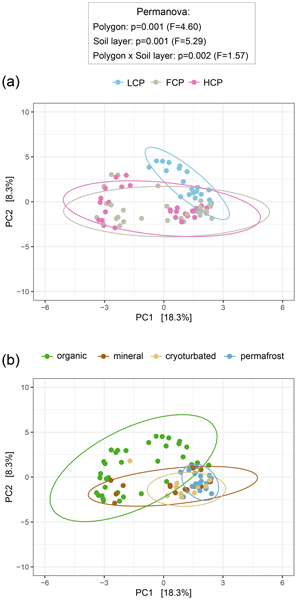
Figure 3: Combining different shapes, ellipse line types and colours may help visualizing the differences due to interaction such as very distinct LCP organic topsoil communities.
L403: “inhomogeneous” → “heterogeneous”?
L414-415: This could be a true effect, but this could also be a side effect of artefacts from less successful DNA extraction in the permafrost layers, or PCR biases due to differential inhibition across layer leading to a higher sequencing depth in the organic layer. It would be useful to have the raw (before filtering/rarefaction/CLR) sequencing depth available somewhere and how it associates or not with variables such as alpha diversity metrics.
L427-429: Does that exceed the fact that microbial biomass in general is higher in the organic soils?
L429: “Supplementary Table 9” → This should be “Supplementary Table 8”, correct?
L430: “Caldisericota” Is this correctly assigned? Cryosericota is often observed in permafrost samples but was renamed into a new candidate phylum from Caldiserica
L430-431: Can you clarify what order of magnitude is meant with “notably high” here? A few % is not uncommon but more than that may suggest issues in bioinformatics processing.
L434-436: This is high, but in line with previous findings in permafrost systems.
L446: Not a clear sentence.
L450: See earlier comments on appropriateness of ASV-level estimates of fungal alpha diversity, this may simply reflect a combination of intraspecific variability and higher number of individuals
Figure 4: The loadings – especially of PC1 – are extremely low for fungal communities, I think another visualization than PCA may help with better depicting the differences among the communities
Discussion
L508: Yet soil moisture was the same in LCP than in the other polygons, why?
L527-528: Yes, but these LCPs are also covered by Eriophorum, which aerenchymae channel oxygen at depth in the soil layer. It would have been good to have some insights into root density and potential oxidative enzymatic activities.
I would also suggest referring to Freeman et al 2001 when discussing phenol oxidase in peat soilsL541-542: Since the LCP/HCP are supposed to be cyclic, such differences would have most likely disappeared when integrating over longer periods of time, for instance by going deeper into the permafrost layer and not just in the transition layer. Using the deeper layers for this study would have been a very nice way to test this statement
L584: Presumably other soil layers than the permafrost should also be oxygen-limited, at least in the LCP no? Would it be possible to get an indication of the typical water table depth in the different polygons?
L591: Nothing wrong with this, but why not include the non-pyrolysis soil chemistry variables e.g. SOC, pH, moisture etc. into the input variables of the PCA and then refer to their loading on PC1 instead?
L596-597: Regardless of polygon type? One would expect high phenolic content in sphagnum peat, no?
L602-605: Though not so much nitrogen in this case, contrary to suggested in Keuper et al 2012 where it was explicitly suggested to accumulate in the transition layer. Would the authors care to speculate about this discrepancy?
L626: One may argue that the 50% of fungi not identified to phylum level in the permafrost samples have some grounds to dispute this assumption
L627-628: Yes, but this is also challenged, see for instance Hewitt et al 2020 doi:10.1111/nph.16235 on deep scavenging of permafrost-table N by mycorrhiza
Conclusions
L650-651: I'm not totally on board with that conclusion. For one, plant cover is loosely considered here, with only a brief mention of dominant vegetation in SI Table 1, after which it is not distinguished from other factors underlying the presence and different types of polygons. As the authors well know, Sphagnum, Carex and Eriophorum co-occur in the Arctic across a variety of systems that are not polygons.
Then I fail to see in the manuscript what would warrant focusing on plant cover or redox rather than on microbial communities, the direction of the suggested causal link does not seem very strongly supported. Does the paper really need this statement?L652-657: This paragraph and the next are largely duplicates.
L656-657 / 664-665: Assuming ice-wedge evolution indeed follows a unidirectional shift, do we have evidence that this shift is accelerating? Otherwise we may not witness accelerated soil carbon losses and we've been observing these losses and attributing them to FCP/HCP normal functioning until now.
Continuous permafrost in a region with MAAT around -10 does not strike me as on the verge of immediate thawing, although the data mentioned are rather old and MAAT may be a couple of degrees higher nowadays. That being said I'm not familiar enough with the literature on ice wedge cycling to assess what triggers the shift from LCP to HCP and whether it is now happening faster than it has been in the last decades.
L682: “microbial feedbacks”: Considering the focus of the manuscript on microbial community composition, I am missing some references to the modalities of microbial community assembly and coalescence and how this may or may not affect microbial processes upon thaw. I'm thinking of the work on community-functioning relationships that took off over the last 7 years e.g. Knoblauch 2018, Monteux 2020, Doherty 2020, Marushchak 2021, Doherty 2025, Starr 2025
L683-685: So, is there still any sense in distinguishing FCP and HCP based on the extensive assessment produced here? I’m missing a little bit of this, and perhaps something similar for the soil layers: say if I come to the Arctic as a microbial ecologist, do I need to worry much about whether I’m sampling cryoturbated or transient permafrost layers, or is it enough if I just focus on the organic/mineral distinction?
Supplements:SI Table 3: the formatting could be optimized so it is not 8 pages long
SI Table 8, 9 and 11: Please include test statistics and not just P values, as is the case in other tables. Please also include test statistics when the P values are above 0.05.
SI Table 8,9: In the “Soil layer” and “Interactive effects” columns the post-hoc tests are replaced by less informative text, please keep the presentation consistent across columns and tables 8-9
Citation: https://doi.org/10.5194/egusphere-2025-4603-RC1 -
AC1: 'Reply on RC1', Victoria Martin, 23 Dec 2025
We thank the reviewer for the thorough evaluation of our manuscript.
We have carefully addressed all comments point by point in the uploaded response letter, indicating how each remark will be considered in the revised manuscript.Best regards,
Victoria Martin (corresponding author)
on behalf of all co-authors
-
AC1: 'Reply on RC1', Victoria Martin, 23 Dec 2025
-
RC2: 'Comment on egusphere-2025-4603', Anonymous Referee #2, 24 Nov 2025
The authors compare biogeochemical and microbial community properties among ice-wedge polygons in Arctic tundra and identify disparate compositions in saturated, low-centered polygons and organic horizons across all topographic features. Their contemporary analysis of SOM quality (from pyrolysis GC-MS), microbial community composition, and hydrolytic soil enzyme activities provides an integrated description of SOM turnover potential that both expand on previous reports from individual polygonal features and provide a self-consistent dataset for future modeling. I offer some suggestions for structural improvements that may help focus this manuscript.
Major comments
The Introduction section conscientiously reviews almost 75 years of permafrost soil science, but it could be better focused on a hypothesis or specific, mechanistic research question. The final paragraph of this section (lines 122-131) includes a list of questions about biogeochemical correlations across polygons and soil layers but does not describe a strategy to demonstrate causal relationships that would support the desired mechanistic insights. Is there an intrinsic model of the biogeochemical processes motivating this research that could be explicitly described and tested here to enhance the impact of this impressive work?
Section 3.1 & Figure 2. What factors from the pyrolysis GC-MS analyses contributed to the variation among SOM contents in LCP and organic soil samples? Were specific features heavily weighted in the principal components that can be identified to gain insight into the composition? Are these the same factors identified in LME analysis (Figures S3 & S4)?
Figure 4. Were the final community members related to known saprotrophs, endophytes, or ectomycorrhizal fungi? This distribution affects the interpretation of their potential physiological roles. The FungalTraits database may be useful here.
Section 4.1 The Discussion should be based on interpreting the present Results. Consider omitting text that speculates on tundra processes without connecting to Results. Alternatively, sections like lines 555-560 that discuss potential Archaea-mediated biochemical processes could be bolstered by reference to specific community composition results. See also lines 613-630
The Conclusions section is unusually long, and it includes significant Discussion text. This section should not introduce any new material; therefore, authors should carefully consider omitting any sentences that include citations. As Josh Schimel recommends in his excellent book "Writing Science" (Oxford) this section should concisely reiterate the from Methods & Results, answer key questions posed in the Introduction, and demonstrate how those answers have advanced understanding of the topic. I suggest shortening and rewriting this section to address those three items.
Minor comments:
Introduction: It is not necessary to cite the same paper multiple times in a paragraph, particularly in successive sentences.
Line 62. While HCP and FCP soil may be 'dry' compared to 'LCP' soil, both soils have high SWC compared to typical agricultural or temperate ecosystem soils. This affects diffusion, substrate availability, and microbial growth and should be noted.
Section 2.3. What was learned from the isotopic signature analysis performed here?
Lines 87-88. What were the bulk densities of the sampled soils? I could not readily find this information by searching the main text or supplemental materials. Did the SIPRE corer cause compression of the soil layers in the thawed LCPs?
Section 2.5 Was the depth of sequence coverage from multiplexed SSU rRNA and ITS2 gene amplicon sequencing sufficient to characterize the community diversity in all samples?
Line 510-511. Some discussion of the role of pyrolysis GC-MS results in inferring organic matter quality is warranted here.
References: Citations to non-journal articles like the "Field Book for Describing and Sampling Soils" need to be updated with sufficient information for the reader to find the resource.
Citation: https://doi.org/10.5194/egusphere-2025-4603-RC2 -
AC2: 'Reply on RC2', Victoria Martin, 23 Dec 2025
We thank the reviewer for providing insightful comments on the manuscript.
A point-by-point response to each comment is provided in the attached response letter, outlining our planned changes in the revised manuscript.Best regards,
Victoria Martin
on behalf of all co-authors
-
AC2: 'Reply on RC2', Victoria Martin, 23 Dec 2025
Peer review completion
Journal article(s) based on this preprint
Viewed
| HTML | XML | Total | Supplement | BibTeX | EndNote | |
|---|---|---|---|---|---|---|
| 1,247 | 643 | 90 | 1,980 | 437 | 101 | 140 |
- HTML: 1,247
- PDF: 643
- XML: 90
- Total: 1,980
- Supplement: 437
- BibTeX: 101
- EndNote: 140
Viewed (geographical distribution)
| Country | # | Views | % |
|---|
| Total: | 0 |
| HTML: | 0 |
| PDF: | 0 |
| XML: | 0 |
- 1
Victoria Martin

Cornelia Rottensteiner
Hannes Schmidt
Moritz Mohrlok
Julia Horak
Carolina Urbina-Malo
Julia Wagner
Willeke A' Campo
Luca Durstewitz
Niek Jesse Speetjens
Rachele Lodi
Bela Hausmann
Michael Fritz
Gustaf Hugelius
Andreas Richter
The requested preprint has a corresponding peer-reviewed final revised paper. You are encouraged to refer to the final revised version.
- Preprint
(1287 KB) - Metadata XML
-
Supplement
(1979 KB) - BibTeX
- EndNote
- Final revised paper
Martin and colleagues explore the microbial and soil organic matter characteristics of different types of polygonal grounds (low, flat and high centered polygons) and different soil layers within each polygon type from the organic topsoil to the transient permafrost layer. This descriptive study characterizes the soil environment through a variety of methods, giving a detailed overview of chemical and microbial members of the different layers, and even some functional potential through enzymatic assays. The authors’ methodology is mostly robust – although I lack the ability to judge the appropriateness of the pyrolysis procedure –, care was taken to handle the unbalanced nature of the experimental design inherent to the sampling strategy, and the detailed supplements answer many of the questions that may arise while reading the main text. All in all I appreciated reading this manuscript and look forward to reading the following publications including deeper samples.
The content of the text is well-structured, the authors do not overreach or speculate beyond what the results warrant, and the selection of literature is appropriate to support the claims. My only concern regarding the flow of text is that the conclusions seem a little disconnected from the general tone of the study, going a bit abruptly from descriptive to prospective – perhaps an additional paragraph towards the end of the discussion that would discuss the relevance of the findings for upscaling and for the permafrost carbon-climate feedback could help smoothing this transition. Not being a native English speaker I will not judge the quality of the writing, but it reads well and appears sound, though some wording could be improved (see line by line comments below).
I understand the rationale for not focusing on the polygon:layer interaction, and therefore showing the results separately with different tables/PCAs for polygon type or layer, but much of the text revolves back to the interactions (e.g. some things are consistent through LCP except in the organic layer). In addition, these interactions are themselves one of the main questions the study addresses, so I think perhaps this needs to be rethought. For instance there are instances where it is not possible for the reader to know how a variable changes across the layers of a given polygon type because the data is presented as summaries either by layer or by polygon type.
Detailed comments:
Introduction
L108-111: I agree, but I would have liked to see more literature on permafrost microbial ecology in the introduction, considering it is a large part of the results of this study. The introduction could also benefit from a bit of rationale on why the authors wanted to focus on fungi and bacteria, and not microbial eukaryotes or viruses.
L123-127: The first two questions could be merged into the same question, as the “across scales” component is in fact addressed by using the polygon*layer design.
Methods
Figure 1: I would suggest to add a depiction (or schematic) of polygons and soil layers, as well as a brief graphical summary of the number of samples per polygon/layer type, to better explain the experimental design
L164-165: Fix reference
L175-176: I find it very sad after traveling and bringing all the equipment there including a SIPRE corer to stop drilling in the transition layer. The phrasing suggests this was not the case though, so I'm looking forward to seeing the microbial and SOM data on the deeper samples from this field work, but it would have been nice to have them included here.
L176: Here and later: “see Supplementary” - there are 55 pages of Supplementary, please refer more specifically to the relevant section, figure, table, etc.
L186: Here and earlier, please clarify the cleanliness/sterility precautions taken to limit cross-contamination during sampling and homogenizing. Permafrost samples have notoriously low microbial biomass thus are sensitive to contamination.
L190: Please clarify what is meant with “carefully thawed”, compared to simply thawed at 4°C
L215: Please clarify here what these modifications were (I know it’s in the supplements)
L220: Here or in supplement, please clarify how much PhiX was added to the sequencing run.
L220 / Supplementary L117: It would be very helpful to know what range of dilution factors were necessary to dilute the extracts to 0.5 ng/µl. This could have strong impacts on inhibition between high biomass organic topsoil layers likely in the range of 50-200ng/µl and low biomass permafrost samples that may not even attain 0.5ng/µl undiluted.
L229-230: Was there a particular reason not to use all of the 200-250 bp of the reads before the drop in quality for 16S, increasing the overlap to the entire target region?
L235: BioProject is not available as of review date. There is a notice for possible errors on the SRA website due to US government funding cuts and it could be due to this, or it is not yet released publicly. I would further suggest checking whether Horizon2020 mandates the use of EU services and consider uploading the data to ENA instead.
L236: Although ddPCR should be less sensitive to inhibition than qPCR, was there any step taken to assess differences in inhibition across samples? I'm aware of the inhibitor removal step mentioned in supplements but that did not mention testing for inhibition afterwards
L246-248: I am unsure whether this was carried out on the rarefied reads, the raw reads, or the rarefied+CLR reads? Please transfer the section on the handling of contaminants and on rarefaction from Supplements to main text (Lines 144-153) as this is critical information, and clarify. In addition, 543 sequences per sample is a very low amount at which to rarefy, I would be curious as to the distribution of reads per sample, and about whether the rarefied table was created out of one random rarefaction or averaged across multiple rarefactions: a single rarefaction at a low threshold likely leads to the removal of multiple rare species for samples with high total read count and thus bias in alpha diversity estimates linked with sequencing depth – which is partly mitigated by averaging multiple rarefactions.
L254: The biological relevance of ASV-level alpha diversity for fungal ITS is questionable, as the variability within this region leads to identifying individuals of the same "species" as multiple ASVs and thus inflates diversity (possibly differently across samples based on the number of individuals). A different clustering approach than DADA2, a post-DADA2 clustering of the denoised ASVs, or estimates of alpha diversity based on taxonomically resolved species/genera would all be better options here.
L254-255: This is a bit unclear to me. Does "unfiltered" refer to the removal of rare species? How about rarefaction and clr-transformation, which of those were carried out on the dataset used for alpha-diversity estimates?
L258: Manganese-peroxidase or phenol oxidase would seem relevant to the study system especially considering the expected differences in water-logging, was there a particular rationale in selecting only hydrolytic and not oxidative enzymes for activity measurements? If so, please clarify
L264: I’m not sure where to put this so I just mention it at the mention of P values. Throughout Supplementary: please harmonize the presentation of P values. Currently some low values are shown as <0.0001, some others as < 2.2 e-16. I would suggest using <0.0001 for anything lower
L266: I appreciate the authors' effort in providing processed data in a usable format. For reproducibility purposes, I would recommend that in addition to the RData objects the data is made available in more interoperable and long-lasting format e.g. txt/csv/tsv. A RData object containing a phyloseq object is likely to become incompatible with some future versions of phyloseq or future major versions of R, while text files remain readable independent of software.
I would also appreciate the inclusion of data prior to processing - namely prior to rarefaction and clr-transformation.
Ideally code should also be provided, but the two points above would be a good improvement without requiring much extra work.
L273: I appreciate the authors' attention to the handling of their unbalanced design.
L278: Can you clarify if a table or SI table summarizes when this was the case?
L281: What is the rationale behind using Bonferroni correction for non-parametric posthoc tests but not in the case of parametric posthoc tests? Surely Tukey is overly conservative in both cases and could be used for the parametric EMM posthoc comparisons as well.
L285-286: I do not see in Alteio 2021 that it would be recommended to apply centre-log transformation in addition to rarefaction but instead as an alternative method of normalizing for uneven read numbers. Can you clarify whether CLR was carried out after rarefaction?
L288-294: I am a little bit confused by the analyses carried out here, because I do not understand why a euclidean distance matrix would be created prior to PCA. If all statistical analyses were performed (betadisper, permanova, pairwise permanova) on the euclidean distance matrixes, why use PCA for visualization rather than PCoA or NMDS to ordinate the distance matrix itself? It's also more likely that the data supports the less stringent assumptions of PCoA/NMDS than PCA.
L296-299: Beyond that, homogeneous dispersion is a statistical assumption of PERMANOVA as homoscedasticity is an assumption of ANOVA. Similarly, ANOVA is robust to heteroscedasticity and non-normality of model residuals in the case of a balanced design but deviation from the assumptions quickly becomes more problematic when the design is unbalanced. I would suggest mentioning the betadisper tests before the PERMANOVA to reflect that this is an assumption.
Results
L306-307: But not moisture? One would intuitively expect LCPs to be wetter, if not water-logged. Is there a reason this would not be the case, for instance sampling in September close to maximum ALT, or after particularly dry weather? When there are many parameters to present, I understand, it's a bit harder, but don't you think it's better to avoid words like “several” here and in other instances below and be more specific?
L323-324: The sentence reads like methods.
L350: Here and throughout, replace adonis with PERMANOVA. adonis is just the function name in vegan and pairwise.adonis is just a wrapper that creates pairwise subsets of the data, runs adonis on the subsets, then gathers the test results and applies eventual p-value adjustments
L351: Posthoc test results are hard to read in the figure legend, could they be included instead next to the ordinations? I think the betadisper results are not necessary here and could be instead in supplements
L360-L362: Again isn't it a method rather than a result already mentioned in the concerned section?
L362: I would suggest "semi-quantitatively" instead, ddPCR is not devoid of the biases inherent to all PCR approaches, and even if a PCR+ddPCR proxy is better than PCR+qPCR it remains a semi-quantitative approach.
L366-367: Isn't that in part because the V4 region is not ideal for archaea, notably in terms of resolution?
L373-374: I do not see the rationale in normalizing gene copy numbers per g SOC, particularly when there are so massive differences in SOC between the layers? I understand it for EEA, but for bacterial abundances?
L381: See comment above, I won't suggest to rewrite throughout to reflect that even with corrections this remains semi-quantitative, but a compromise could be to use brackets around "absolute"
L383-384: This table and Supplementary Table 9 are extremely hard to read. The presence of both uncertainty and order of magnitude, combined to the layer * polygon interaction makes it very difficult to compare numbers across groups. Notably it is not easy to say which phyla are the most abundant overall and whether this varies between polygons or soil layers. I appreciate that the authors provide these data, but think the absolute numbers would be better presented as text / CSV files in the Zenodo repository, while the data themselves would be more easily conveyed to the reader by summarizing them into a heatmap or taxa summary barplots.
L384 and throughout: "reduced" can be mistaken with the redox reduced, I would suggest to use "decreased" or another synonym
L386: Here I was wondering whether this may be linked to simply higher microbial biomass in LCP-organic, but the microbial biomass data is provided either as means across polygon type or means across layers, so I could not find that information. Also,
Figure 3: Combining different shapes, ellipse line types and colours may help visualizing the differences due to interaction such as very distinct LCP organic topsoil communities.
L403: “inhomogeneous” → “heterogeneous”?
L414-415: This could be a true effect, but this could also be a side effect of artefacts from less successful DNA extraction in the permafrost layers, or PCR biases due to differential inhibition across layer leading to a higher sequencing depth in the organic layer. It would be useful to have the raw (before filtering/rarefaction/CLR) sequencing depth available somewhere and how it associates or not with variables such as alpha diversity metrics.
L427-429: Does that exceed the fact that microbial biomass in general is higher in the organic soils?
L429: “Supplementary Table 9” → This should be “Supplementary Table 8”, correct?
L430: “Caldisericota” Is this correctly assigned? Cryosericota is often observed in permafrost samples but was renamed into a new candidate phylum from Caldiserica
L430-431: Can you clarify what order of magnitude is meant with “notably high” here? A few % is not uncommon but more than that may suggest issues in bioinformatics processing.
L434-436: This is high, but in line with previous findings in permafrost systems.
L446: Not a clear sentence.
L450: See earlier comments on appropriateness of ASV-level estimates of fungal alpha diversity, this may simply reflect a combination of intraspecific variability and higher number of individuals
Figure 4: The loadings – especially of PC1 – are extremely low for fungal communities, I think another visualization than PCA may help with better depicting the differences among the communities
Discussion
L508: Yet soil moisture was the same in LCP than in the other polygons, why?
L527-528: Yes, but these LCPs are also covered by Eriophorum, which aerenchymae channel oxygen at depth in the soil layer. It would have been good to have some insights into root density and potential oxidative enzymatic activities.
I would also suggest referring to Freeman et al 2001 when discussing phenol oxidase in peat soils
L541-542: Since the LCP/HCP are supposed to be cyclic, such differences would have most likely disappeared when integrating over longer periods of time, for instance by going deeper into the permafrost layer and not just in the transition layer. Using the deeper layers for this study would have been a very nice way to test this statement
L584: Presumably other soil layers than the permafrost should also be oxygen-limited, at least in the LCP no? Would it be possible to get an indication of the typical water table depth in the different polygons?
L591: Nothing wrong with this, but why not include the non-pyrolysis soil chemistry variables e.g. SOC, pH, moisture etc. into the input variables of the PCA and then refer to their loading on PC1 instead?
L596-597: Regardless of polygon type? One would expect high phenolic content in sphagnum peat, no?
L602-605: Though not so much nitrogen in this case, contrary to suggested in Keuper et al 2012 where it was explicitly suggested to accumulate in the transition layer. Would the authors care to speculate about this discrepancy?
L626: One may argue that the 50% of fungi not identified to phylum level in the permafrost samples have some grounds to dispute this assumption
L627-628: Yes, but this is also challenged, see for instance Hewitt et al 2020 doi:10.1111/nph.16235 on deep scavenging of permafrost-table N by mycorrhiza
Conclusions
L650-651: I'm not totally on board with that conclusion. For one, plant cover is loosely considered here, with only a brief mention of dominant vegetation in SI Table 1, after which it is not distinguished from other factors underlying the presence and different types of polygons. As the authors well know, Sphagnum, Carex and Eriophorum co-occur in the Arctic across a variety of systems that are not polygons.
Then I fail to see in the manuscript what would warrant focusing on plant cover or redox rather than on microbial communities, the direction of the suggested causal link does not seem very strongly supported. Does the paper really need this statement?
L652-657: This paragraph and the next are largely duplicates.
L656-657 / 664-665: Assuming ice-wedge evolution indeed follows a unidirectional shift, do we have evidence that this shift is accelerating? Otherwise we may not witness accelerated soil carbon losses and we've been observing these losses and attributing them to FCP/HCP normal functioning until now.
Continuous permafrost in a region with MAAT around -10 does not strike me as on the verge of immediate thawing, although the data mentioned are rather old and MAAT may be a couple of degrees higher nowadays. That being said I'm not familiar enough with the literature on ice wedge cycling to assess what triggers the shift from LCP to HCP and whether it is now happening faster than it has been in the last decades.
L682: “microbial feedbacks”: Considering the focus of the manuscript on microbial community composition, I am missing some references to the modalities of microbial community assembly and coalescence and how this may or may not affect microbial processes upon thaw. I'm thinking of the work on community-functioning relationships that took off over the last 7 years e.g. Knoblauch 2018, Monteux 2020, Doherty 2020, Marushchak 2021, Doherty 2025, Starr 2025
L683-685: So, is there still any sense in distinguishing FCP and HCP based on the extensive assessment produced here? I’m missing a little bit of this, and perhaps something similar for the soil layers: say if I come to the Arctic as a microbial ecologist, do I need to worry much about whether I’m sampling cryoturbated or transient permafrost layers, or is it enough if I just focus on the organic/mineral distinction?
Supplements:
SI Table 3: the formatting could be optimized so it is not 8 pages long
SI Table 8, 9 and 11: Please include test statistics and not just P values, as is the case in other tables. Please also include test statistics when the P values are above 0.05.
SI Table 8,9: In the “Soil layer” and “Interactive effects” columns the post-hoc tests are replaced by less informative text, please keep the presentation consistent across columns and tables 8-9