
the Creative Commons Attribution 4.0 License.
the Creative Commons Attribution 4.0 License.
 | 04 Oct 2025
Towards Retrieving Cloud Top Entrainment Velocities from MISR Cloud Motion Vectors
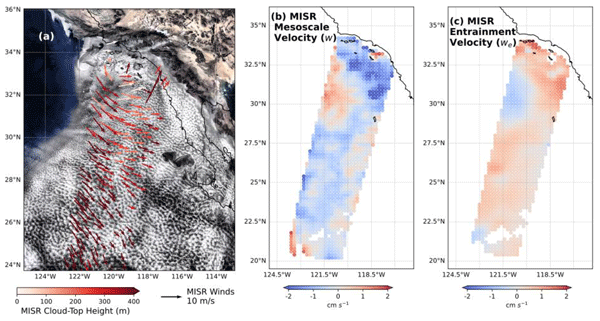
Abstract. Although important, direct retrievals of entrainment rates in cloud-topped planetary boundary layer (PBL) remain elusive. Here we present a novel technique for retrieving cloud-top entrainment velocities using only Multi-angle Imaging Spectro-Radiometer (MISR) stereoscopic retrievals of cloud-motion vectors (CMVs) and cloud-top heights (CTHs). Mesoscale vertical air velocity at CTH is diagnosed from the continuity equation and then used to derive entrainment velocities from the PBL mass-budget equation. The uncertainties in the utilized CTHs and CMVs are propagated to derive systematic and random retrieval uncertainties. The algorithm is demonstrated through a case of marine stratocumulus deck off the California coast, with comparisons made against the output from European Center for Medium-range Weather Forecasting (ECMWF) reanalysis model (ERA5). MISR low-cloud CTH for this case were lower than the ERA5 reported PBL depth by 189 ± 87 m. These differences in cloud top heights partly modulate the differences in the ERA5 and MISR horizontal winds, with larger differences in meridional over zonal wind components. Average difference between ERA5 and MISR derived mesoscale vertical air motion at cloud top was 0.140.73 cm s-1, while the same for entrainment rate was -0.090.46 cm s-1. Fractional uncertainty is lower than 25 % when the retrieved mesoscale vertical air motion is stronger than ±0.04 cm s-1 and entrainment velocities are stronger than 0.03 cm s-1. These results showcase the ability to derive mesoscale vertical air motion and entrainment rates from MISR observations and motivate its extension to a generate a global climatology leveraging its full 23-year record (2000–2022).
-
Notice on discussion status
The requested preprint has a corresponding peer-reviewed final revised paper. You are encouraged to refer to the final revised version.
-
Preprint
(15280 KB)
-
The requested preprint has a corresponding peer-reviewed final revised paper. You are encouraged to refer to the final revised version.
- Preprint
(15280 KB) - Metadata XML
- BibTeX
- EndNote
- Final revised paper


Journal article(s) based on this preprint
Interactive discussion
Status: closed
-
RC1: 'Comment on egusphere-2025-4564', Anonymous Referee #1, 24 Nov 2025
-
AC2: 'Reply on RC1', Virendra Ghate, 16 Jan 2026
We thank the reviewer for providing detailed and thorough review of the manuscript. Addressing the reviewer comments has led to substantial improvements to the manuscript. Please find attached our point-by-point response to the reviewer comments. Thank you.
-
AC2: 'Reply on RC1', Virendra Ghate, 16 Jan 2026
-
RC2: 'Comment on egusphere-2025-4564', Anonymous Referee #2, 27 Nov 2025
Review comments on
Towards Retrieving Cloud Top Entrainment Velocities from MISR Cloud Motion Vectors
by A. Mitra and V.P. Ghate
This is an interesting study and well-written manuscript that describes and tests a new physically based technique for retrieving vertical and entrainment velocities at the top of a stratocumulus layer over the ocean using cloud motion vectors. It is an achievement to estimate the vertical velocity and entrainment velocity „strictly grounded within the observations“. The work is methodical, the results demonstrate the potential usefulness of the new approach, and the manuscript is well-structured. Entrainment velocity is an important parameter for understanding and modelling ABL processes, and the exchange of heat, moisture, and pollutants at the earth’s surface as well as at the top of the ABL. The manuscript presents a valuable work that is both timely and important, and will be a significant contribution to the field.
Major limitation:
One significant drawback of the current study is the use of ERA5 as a reference for the satellite retrievals. ABL, low-level clouds, and top entrainment are examples of small-scale processes that are poorly resolved in the reanalysis and depend on highly uncertain model physics (parameterization schemes). It is not very compelling to evaluate direct estimations of CTH, w, and we based on satellite data using reanalysis as a reference.
Furthermore, the rationale for data selection is somewhat illogical since it stresses that the new approach eliminates the need for reanalysis to provide vertical air velocity. This is a noteworthy development, however, it is unclear why ERA5 may then be used as a reference.
Minor comments:
Line 12-13: “output from European Center for Medium-range Weather Forecasting (ECMWF) reanalysis model (ERA5)“ -> „European Centre for Medium-range Weather Forecasting (ECMWF) reanalysis (ERA5)“
ERA5 provides reanalysis fields derived from a combination of observations and modelling, and as such cannot be considered as model output. The model used in a chain of processes to produce the reanalysis is IFS.Line 19: „a generate a global climatology“ -> „generate a global climatology“
Page 13 – It should be mentioned here already that ERA5 estimates of cloud top height are higher and less spatially variable than MISR CTH.
Line 42: Explanation of what a Twin Otter is and some reference to its use in meteorological observation should be added. The same is valid for AUS.
Line 55: „of of“ -> „of“
Line 74: „the retrieval method can be extended to the global“ - Can it also be applied over land?
Line 207: Please remove „model“ here, and also remove „model output“ from Table 1.
Citation: https://doi.org/10.5194/egusphere-2025-4564-RC2 -
AC1: 'Reply on RC2', Virendra Ghate, 16 Jan 2026
We thank the reviewer for providing detailed comments on the manuscript. Addressing these comments has led to substantial improvements to the manuscript. Please find attached our point-by-point response to all of reviewer comments. Thank you.
-
AC1: 'Reply on RC2', Virendra Ghate, 16 Jan 2026
Peer review completion


Interactive discussion
Status: closed
-
RC1: 'Comment on egusphere-2025-4564', Anonymous Referee #1, 24 Nov 2025
The manuscript describes a novel method for calculating entrainment rates (W_e) in marine stratocumulus cloud regimes, with the use of cloud top height and winds estimates from MISR. The methodology is sound, and the new W_e has the advantage of not relying on numerical weather predictions of wind speed and large-scale velocity. Moreover, MISR winds allow for the estimation of vertical velocity. The method is unique and offers a valuable independent estimation. In general, it is an interesting and well written paper.
Specific comments
- My general criticism is on the way uncertainties are estimated from observations and the use of ERA-5 reanalysis to lend confidence to the MISR W_e. Comparisons against ERA-5 are problematic because a numerical model cannot validate observations. Indeed, if ERA-5 outputs were accurate enough, then independent satellite observations would be unnecessary. At the very best, the comparison with ERA-5 is a sanity check, which should not be used to make inferences about accuracy of different satellite datasets. Another aspect to consider is how the PBL height from ERA-5 is estimated, which is based on the bulk Richardson number method. Von Engeln and Teixeira (2013) show that this PBL height underestimates the inversion height derived from the relative humidity (RH) profile by more than 200 m in the subtropics. Instead, they conclude that the bulk Richardson method for deriving PBL height might be more representative of the cloud base height. Considering a typical cloud depth of around 200 m- 400 m, I would estimate a low bias in ERA-5 PBL height to be around the same range. The PBL height issue could be remediated by estimating the inversion height applying the method(s) described in Von Engeln and Teixeira (2013). Possibly, the new PBL height would also impact the selection of the vertical level for extracting the vertical velocity from the model. Even if these corrections are implemented, the central issue of validating MISR retrievals with reanalysis model outputs remains. Ideally, one would validate the data with lidar/radar observations and/or radiosondes. But I am not sure if these datasets actually exist for the period of study in the manuscript. Without a more rigorous validation dataset, the authors should revise the manuscript to state that the results are reasonable, but I don’t think enough evidence is provided to: a) validate the magnitude of W_e, and b) to determine that MISR W_e is better than methods derived from the mixed-layer budget equation and retrievals from MODIS/GOES.
- MISR vs GOES/MODIS: I fully agree with the authors about the crucial differences between MISR and satellite infrared sensors, and the advantages of the MISR products (independent of weather models and directly estimated from geometric considerations). Having said that, the manuscript needs to provide more compelling evidence that MISR retrievals of cloud height in the boundary layer show real improvements relative to MODIS/GOES in terms of bias and/or root mean square errors. As described in comment #1, the use of ERA-5 PBL height is not ideal for validating satellite-based height. Also, table 1 and Mitra et al. (2021) show that for clouds with tops < 5km, MISR is biased low by 240 m, whereas the MODIS bias is + 60 m. Along the same lines, an analysis we conducted in LaRC using GOES-15 retrievals demonstrated that GOES-15 cloud top height are nearly unbiased relative to radar data collected over the Northeast Pacific Ocean (RMSE< 200m, Painemal et al. 2017).
- All in all, this is a nice paper with an interesting method for deriving entrainment rates from MISR. My suggestion to the authors is to revise the manuscript and clarify that no rigorous validation of the retrievals are provided with independent datasets (instead of models) and therefore, uncertainties cannot be estimated with the necessary detail.
- Other publications: I was a bit surprised that entrainment rates from other methods were not discussed and compared with the MISR rates (Cadwell et al., Faloona et al., Ghate et al, Wood and Bretherton from the reference section). For instance, all these studies derive W_e< 1 cm/s; is this consistent with the results from MISR? Also, Cadwell et al. resolve the diurnal cycle, and therefore, Terra overpass time can be matched with their diurnal cycle figure. Moreover, Painemal et al. (2017) resolve the diurnal cycle over the same region of study and computed spatial maps for different hours. In sum, there is enough available references that should be discussed in the context of estimating and validating entrainment rates. Cadwell et al. and Painemal et al. 2017 that entrainment rates can be, at times, slightly negatives (it is not clear to me whether this is issue associated with the mixed-layer budget equation). Lastly, the entrainment rates in Painemal et al. (2017) were validated over the Western North Atlantic by Tornow et al. (2022) with the use of airborne observations.
Other comments:
It would be easier to extract quantitative information from the figures if the authors adopt a color scale/palette with discrete colors (e.g. 12 or 14 colors).
Line 35, Grosvenor et al. does not explicitly analyze the effect of entrainment.
Line 50, the citation does not exist.
Line 55 Minnis et al does not discuss entrainment rates.
Line 58: you mean “offers a unique dataset”?
Line 96: you mean “The above equation is integrated…”
Line 127 and equation (11). Could you be more explicit about the way equation (11) is derived?
Line 150. Why is the standard deviation a measure of error?
Line 158, what is sampling uncertainty?
Line 171 and eq (22). “A” is already used for advection. Please, use a different symbol for denoting area.
Line 178, you mean eq. (22)?
Table 1: For SatCORPS GOES, the satellite is GOES-15, and the pixel resolution is 4km at nadir. The 8km resolution refers to a subsampling (every other pixel) applied to the map, but the pixel resolution is 4km. Also, the nominal uncertainty of 500 m does not seem correct for boundary layer clouds (cloud tops < 3km).
Page 11. A common way of removing noise in the geophysical fields is smoothing the variables using digital filters before estimating spatial gradients. Is spatial noise a relevant issue in the calculation of advection and divergence?
Line 273 “However negative CTH will need to be converted to heights over the geoid for retrieval calculations in further iterations of this technique..” How about pixels with cloud tops below 250 m? (it seems implausible that the cloud tops could be lower than 250 m). Does it mean that MISR CTH are always biased low? A 200 m underestimation could impact estimates from equation (4).
Line 299-301. I agree, infrared-based cloud top heights are biased under the presence of cirrus. However, this effect should be modest over the NE Pacific, especially if pixels with cloud heights > 3km or temp< 0˚C are removed from the analysis.
Lines 310-313: I don’t disagree that the MISR sampling of about 17 km is within the typical cloud object size in open/closed cells clouds. But I do not know if this really matters as it is unknown the spatial variability/scale of entrainment rates or vertical velocity.
In light of comment # 1, the analysis in Figure 7 is not a validation of the MISR-based products. Since divergence is assumed constant with height, perhaps one could use ASCAT winds (9:30 LT morning pass) to compute divergence and compare it with its MISR counterpart.
Product vs retrieval: I have the impression that the MISR entrainment rate is a product, not a retrieval.
References
- von Engeln, A., and J. Teixeira, 2013: A Planetary Boundary Layer Height Climatology Derived from ECMWF Reanalysis Data. J. Climate, 26, 6575–6590, https://doi.org/10.1175/JCLI-D-12-00385.1.
- Painemal,, K.-M. Xu, R. Palikonda, and P. Minnis (2017), Entrainment rate diurnal cycle in marine stratiform clouds estimated from geostationary satellite retrievals and a meteorological forecast model, Geophys. Res. Lett., 44, 7482–7489, doi:10.1002/2017GL074481.
- Tornow, F., Ackerman, A. S., Fridlind, A. M., Cairns, B., Crosbie, E. C., Kirschler, S., et al. (2022), Dilution of boundary layer cloud condensation nucleus concentrations by free tropospheric entrainment during marine cold air outbreaks, Geophysical Research Letters, 49, e2022GL098444.
Citation: https://doi.org/10.5194/egusphere-2025-4564-RC1 -
AC2: 'Reply on RC1', Virendra Ghate, 16 Jan 2026
We thank the reviewer for providing detailed and thorough review of the manuscript. Addressing the reviewer comments has led to substantial improvements to the manuscript. Please find attached our point-by-point response to the reviewer comments. Thank you.
-
RC2: 'Comment on egusphere-2025-4564', Anonymous Referee #2, 27 Nov 2025
Review comments on
Towards Retrieving Cloud Top Entrainment Velocities from MISR Cloud Motion Vectors
by A. Mitra and V.P. Ghate
This is an interesting study and well-written manuscript that describes and tests a new physically based technique for retrieving vertical and entrainment velocities at the top of a stratocumulus layer over the ocean using cloud motion vectors. It is an achievement to estimate the vertical velocity and entrainment velocity „strictly grounded within the observations“. The work is methodical, the results demonstrate the potential usefulness of the new approach, and the manuscript is well-structured. Entrainment velocity is an important parameter for understanding and modelling ABL processes, and the exchange of heat, moisture, and pollutants at the earth’s surface as well as at the top of the ABL. The manuscript presents a valuable work that is both timely and important, and will be a significant contribution to the field.
Major limitation:
One significant drawback of the current study is the use of ERA5 as a reference for the satellite retrievals. ABL, low-level clouds, and top entrainment are examples of small-scale processes that are poorly resolved in the reanalysis and depend on highly uncertain model physics (parameterization schemes). It is not very compelling to evaluate direct estimations of CTH, w, and we based on satellite data using reanalysis as a reference.
Furthermore, the rationale for data selection is somewhat illogical since it stresses that the new approach eliminates the need for reanalysis to provide vertical air velocity. This is a noteworthy development, however, it is unclear why ERA5 may then be used as a reference.
Minor comments:
Line 12-13: “output from European Center for Medium-range Weather Forecasting (ECMWF) reanalysis model (ERA5)“ -> „European Centre for Medium-range Weather Forecasting (ECMWF) reanalysis (ERA5)“
ERA5 provides reanalysis fields derived from a combination of observations and modelling, and as such cannot be considered as model output. The model used in a chain of processes to produce the reanalysis is IFS.Line 19: „a generate a global climatology“ -> „generate a global climatology“
Page 13 – It should be mentioned here already that ERA5 estimates of cloud top height are higher and less spatially variable than MISR CTH.
Line 42: Explanation of what a Twin Otter is and some reference to its use in meteorological observation should be added. The same is valid for AUS.
Line 55: „of of“ -> „of“
Line 74: „the retrieval method can be extended to the global“ - Can it also be applied over land?
Line 207: Please remove „model“ here, and also remove „model output“ from Table 1.
Citation: https://doi.org/10.5194/egusphere-2025-4564-RC2 -
AC1: 'Reply on RC2', Virendra Ghate, 16 Jan 2026
We thank the reviewer for providing detailed comments on the manuscript. Addressing these comments has led to substantial improvements to the manuscript. Please find attached our point-by-point response to all of reviewer comments. Thank you.
-
AC1: 'Reply on RC2', Virendra Ghate, 16 Jan 2026
Peer review completion
Journal article(s) based on this preprint
Viewed
| HTML | XML | Total | BibTeX | EndNote | |
|---|---|---|---|---|---|
| 908 | 847 | 106 | 1,861 | 87 | 81 |
- HTML: 908
- PDF: 847
- XML: 106
- Total: 1,861
- BibTeX: 87
- EndNote: 81
Viewed (geographical distribution)
| Country | # | Views | % |
|---|
| Total: | 0 |
| HTML: | 0 |
| PDF: | 0 |
| XML: | 0 |
- 1
Arka Mitra

The requested preprint has a corresponding peer-reviewed final revised paper. You are encouraged to refer to the final revised version.
- Preprint
(15280 KB) - Metadata XML
The manuscript describes a novel method for calculating entrainment rates (W_e) in marine stratocumulus cloud regimes, with the use of cloud top height and winds estimates from MISR. The methodology is sound, and the new W_e has the advantage of not relying on numerical weather predictions of wind speed and large-scale velocity. Moreover, MISR winds allow for the estimation of vertical velocity. The method is unique and offers a valuable independent estimation. In general, it is an interesting and well written paper.
Specific comments
Other comments:
It would be easier to extract quantitative information from the figures if the authors adopt a color scale/palette with discrete colors (e.g. 12 or 14 colors).
Line 35, Grosvenor et al. does not explicitly analyze the effect of entrainment.
Line 50, the citation does not exist.
Line 55 Minnis et al does not discuss entrainment rates.
Line 58: you mean “offers a unique dataset”?
Line 96: you mean “The above equation is integrated…”
Line 127 and equation (11). Could you be more explicit about the way equation (11) is derived?
Line 150. Why is the standard deviation a measure of error?
Line 158, what is sampling uncertainty?
Line 171 and eq (22). “A” is already used for advection. Please, use a different symbol for denoting area.
Line 178, you mean eq. (22)?
Table 1: For SatCORPS GOES, the satellite is GOES-15, and the pixel resolution is 4km at nadir. The 8km resolution refers to a subsampling (every other pixel) applied to the map, but the pixel resolution is 4km. Also, the nominal uncertainty of 500 m does not seem correct for boundary layer clouds (cloud tops < 3km).
Page 11. A common way of removing noise in the geophysical fields is smoothing the variables using digital filters before estimating spatial gradients. Is spatial noise a relevant issue in the calculation of advection and divergence?
Line 273 “However negative CTH will need to be converted to heights over the geoid for retrieval calculations in further iterations of this technique..” How about pixels with cloud tops below 250 m? (it seems implausible that the cloud tops could be lower than 250 m). Does it mean that MISR CTH are always biased low? A 200 m underestimation could impact estimates from equation (4).
Line 299-301. I agree, infrared-based cloud top heights are biased under the presence of cirrus. However, this effect should be modest over the NE Pacific, especially if pixels with cloud heights > 3km or temp< 0˚C are removed from the analysis.
Lines 310-313: I don’t disagree that the MISR sampling of about 17 km is within the typical cloud object size in open/closed cells clouds. But I do not know if this really matters as it is unknown the spatial variability/scale of entrainment rates or vertical velocity.
In light of comment # 1, the analysis in Figure 7 is not a validation of the MISR-based products. Since divergence is assumed constant with height, perhaps one could use ASCAT winds (9:30 LT morning pass) to compute divergence and compare it with its MISR counterpart.
Product vs retrieval: I have the impression that the MISR entrainment rate is a product, not a retrieval.
References