
the Creative Commons Attribution 4.0 License.
the Creative Commons Attribution 4.0 License.
 | 18 Sep 2025
A top-down evaluation of bottom-up estimates to reduce uncertainty in methane emissions from Arctic wetlands
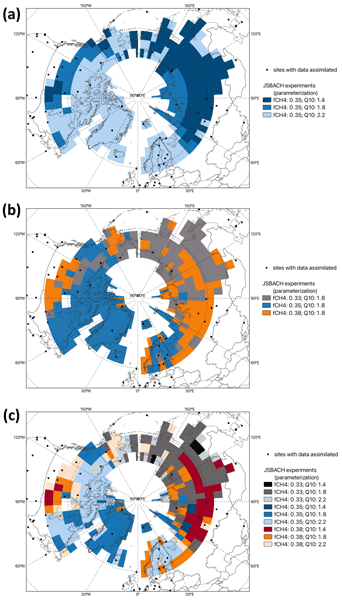
Abstract. Wetlands are a major natural source of atmospheric CH4, however, accurately estimating their emissions is difficult due to the complex biogeochemical interactions and spatial heterogeneity of wetland environments. This study explores how a combination of atmospheric inverse and process-based modelling can reduce the discrepancy in Arctic wetland estimates between bottom-up and top-down approaches. We employed the Jena CarboScope global inversion system, incorporating prior wetland fluxes simulated by the JSBACH land surface model, which is part of the Max Planck Institute Earth System Model (MPI-ESM). We conducted a series of inversion experiments, each incorporating JSBACH-generated CH4 fluxes based on different CH4 production Q10 values to test the temperature sensitivity of emissions. Additionally, we examined the impact of changing the baseline fCH4 fraction value, which defines the fraction of anaerobically mineralized carbon converted to CH4, while keeping all other JSBACH and inversion settings constant. Our findings show that, at a pan-Arctic scale, using a CH4 Q10 value of 1.8 produces the best agreement between the two approaches. However, no single Q10 value yielded optimal agreement between the simulated fluxes and the fluxes inferred from atmospheric observations across all subregions. Instead, the best performance varied spatially, with different CH4 production Q10 values and baseline fCH4 fraction leading to a better flux agreement in specific areas. These results highlight the importance of using regionally specific parameters to more accurately estimate wetland CH4 emissions, and the potential of employing atmospheric inversions to guide bottom-up process models towards regionally representative parameter settings.
-
Notice on discussion status
The requested preprint has a corresponding peer-reviewed final revised paper. You are encouraged to refer to the final revised version.
-
Preprint
(1656 KB)
-
The requested preprint has a corresponding peer-reviewed final revised paper. You are encouraged to refer to the final revised version.
- Preprint
(1656 KB) - Metadata XML
- BibTeX
- EndNote
- Final revised paper


Journal article(s) based on this preprint
Interactive discussion
Status: closed
-
RC1: 'Comment on egusphere-2025-4467', Anonymous Referee #1, 07 Nov 2025
-
AC1: 'Reply on RC1', Luana Basso, 06 Feb 2026
We appreciate all the comments and valuable suggestions we have received on our manuscript. All comments from the reviewer have now been carefully addressed. The attached PDF provides a complete point-by-point response.
On behalf of all the co-authors,
-
AC1: 'Reply on RC1', Luana Basso, 06 Feb 2026
-
RC2: 'Comment on egusphere-2025-4467', Anonymous Referee #2, 16 Jan 2026
The comment was uploaded in the form of a supplement: https://egusphere.copernicus.org/preprints/2025/egusphere-2025-4467/egusphere-2025-4467-RC2-supplement.pdf
-
AC2: 'Reply on RC2', Luana Basso, 06 Feb 2026
We appreciate all the comments and valuable suggestions we have received on our manuscript. All comments from the reviewer have now been carefully addressed. The attached PDF provides a complete point-by-point response.
On behalf of all the co-authors,
Luana S. Basso
-
AC2: 'Reply on RC2', Luana Basso, 06 Feb 2026
Peer review completion


Interactive discussion
Status: closed
-
RC1: 'Comment on egusphere-2025-4467', Anonymous Referee #1, 07 Nov 2025
Please refer to my comments in the attached file.
-
AC1: 'Reply on RC1', Luana Basso, 06 Feb 2026
We appreciate all the comments and valuable suggestions we have received on our manuscript. All comments from the reviewer have now been carefully addressed. The attached PDF provides a complete point-by-point response.
On behalf of all the co-authors,
-
AC1: 'Reply on RC1', Luana Basso, 06 Feb 2026
-
RC2: 'Comment on egusphere-2025-4467', Anonymous Referee #2, 16 Jan 2026
The comment was uploaded in the form of a supplement: https://egusphere.copernicus.org/preprints/2025/egusphere-2025-4467/egusphere-2025-4467-RC2-supplement.pdf
-
AC2: 'Reply on RC2', Luana Basso, 06 Feb 2026
We appreciate all the comments and valuable suggestions we have received on our manuscript. All comments from the reviewer have now been carefully addressed. The attached PDF provides a complete point-by-point response.
On behalf of all the co-authors,
Luana S. Basso
-
AC2: 'Reply on RC2', Luana Basso, 06 Feb 2026
Peer review completion
Journal article(s) based on this preprint
Viewed
| HTML | XML | Total | BibTeX | EndNote | |
|---|---|---|---|---|---|
| 3,150 | 683 | 100 | 3,933 | 91 | 90 |
- HTML: 3,150
- PDF: 683
- XML: 100
- Total: 3,933
- BibTeX: 91
- EndNote: 90
Viewed (geographical distribution)
| Country | # | Views | % |
|---|
| Total: | 0 |
| HTML: | 0 |
| PDF: | 0 |
| XML: | 0 |
- 1

Goran Georgievski
Victor Brovkin
Christian Beer
Christian Rödenbeck
Mathias Göckede
The requested preprint has a corresponding peer-reviewed final revised paper. You are encouraged to refer to the final revised version.
- Preprint
(1656 KB) - Metadata XML
Please refer to my comments in the attached file.