
the Creative Commons Attribution 4.0 License.
the Creative Commons Attribution 4.0 License.
 | 19 Sep 2025
River floods in the Anthropocene impact sea-floor geochemistry, pollutants and bacterial communities in coastal systems
Abstract. This study examines the sedimentary and microbial responses offshore the Marche Region (Italy) to the September 2022 flood, one of the most severe recent hydrological events, which delivered large amounts of sediment and anthropogenic contaminants to the Adriatic Sea. We employed a multidisciplinary approach integrating sedimentology, geochemistry, organic matter analysis, pollutant assessments (Polycyclic Aromatic Hydrocarbons, PAHs and Poly- and Perfluorinated alkyl substances, PFASs), and benthic microbial community structure. Sediments collected five days post-event offshore six river mouths reveal that flood deposits, ranging from fine sand to coarse silt, were largely confined within the nearshore zone down to the 15 m isobath. This distribution reflects intense riverine inputs and a brief windstorm-enhanced coastal circulation that generated patchy, temporary sediment accumulations in the prodelta sector. Heavy metal concentrations remained below regulatory thresholds, whereas organic pollutants were heterogeneously distributed, with peaks offshore urban and industrial zones. PAH signatures indicate mixed pyrogenic and petrogenic sources, while next-generation PFASs (6:2FTS) showed localized but severe contamination linked to upstream industrial activities. Simultaneously, the flood introduced strong spatial heterogeneity in benthic bacterial communities, with sediment texture and organic matter content driving compositional shifts. Freshwater-associated taxa became prominent in offshore deposits, highlighting riverine sedimentary imprints. Despite the flood's magnitude onshore, its offshore sedimentary and ecological signatures were spatially limited and ephemeral. These findings underscore the ecological significance of episodic sediment and contaminant inputs, while highlighting the challenges in detecting such transient events in the marine stratigraphic record.
-
Notice on discussion status
The requested preprint has a corresponding peer-reviewed final revised paper. You are encouraged to refer to the final revised version.
-
Preprint
(2519 KB)
-
Supplement
(586 KB)
-
The requested preprint has a corresponding peer-reviewed final revised paper. You are encouraged to refer to the final revised version.
- Preprint
(2519 KB) - Metadata XML
-
Supplement
(586 KB) - BibTeX
- EndNote
- Final revised paper


Journal article(s) based on this preprint
Interactive discussion
Status: closed
-
RC1: 'Comment on egusphere-2025-4423', Anonymous Referee #1, 08 Dec 2025
-
AC1: 'Reply on RC1', Irene Sammartino, 26 Jan 2026
We thank the Reviewer1 for the careful and constructive evaluation of our manuscript. We appreciate the recognition of the value of the dataset, the rapid post-event sampling strategy, and the relevance of the multidisciplinary approach. Below, we address each comment in the order raised by the Reviewer1 and describe how the manuscript has been revised accordingly (Reviewer comments are marked with blue italics).
-This manuscript investigates the sedimentary and microbial responses to the September 2022 Marche Region flood, an extreme hydrological event that delivered substantial sediment and anthropogenic contaminants to the Adriatic Sea. By combining sedimentology, geochemistry, pollution analyses (PAHs, PFAS), and microbial community data, the study tackles a scientifically relevant problem within the scope of the journal. The dataset is valuable, and the rapid post-event sampling is a notable strength. The paper clearly contributes new insights by assembling existing methods and observations into an integrated framework.
The conceptual foundation is solid. However, the manuscript is overly long, making the key findings difficult to extract. Several sections would benefit from re-organization, and some contextual or secondary material, such as methodological background in section 3.6, should be moved to the Supplementary Information to streamline the main narrative. My main criticism is the incomplete integration of multidisciplinary perspectives. Datasets are mostly presented in isolation, so a stronger cross-disciplinary discussion is needed. For example, directly relating microbial changes to meteo-oceanographic data would better link processes to observations. If deeper integration is not possible, the manuscript should prioritize figures and methods that highlight the central components; crucially, Fig. 12 appears too late.We agree with the Reviewer1 and have substantially streamlined and reorganized the manuscript. In the revised version we i) reduced the overall length of the text, particularly in the Introduction and Discussion; ii) summarized the Methods section and moved detailed methodological descriptions to the Supplementary Information; iii) condensed the meteo-oceanographic background and relocated part of it to the event description and Supplementary Information; and iv) reduced the number of figures by removing the former Figure 1 and merging its information into the revised Figure 6.
Also, we have revised the Discussion to improve cross-disciplinary integration. Specifically we restructured the Discussion around a single integrative conceptual framework (Figure 11), which explicitly links sediment transport processes, contaminant redistribution, and microbial community responses. We strengthened the links between sediment grain size, depositional environments, pollutant behavior (PAHs vs. PFASs), and benthic microbial community structure. We clarified that our objective is to identify spatial associations driven by flood-induced sediment dynamics, rather than to infer direct causality. This approach provides a more cohesive interpretation while remaining consistent with the scope of the data.
Finally, we reduced the prominence of the meteorological and oceanographic data in the main text, moving much of this content to the Supplementary Information as contextual support. We clarified that no original numerical modeling was performed, and these datasets are used as interpretative aids rather than core analyses. The figure 12 has been renumbered as Fig. 11 and repositioned at the start of the Discussion section to serve as a guiding framework for the interpretation of results.
-Methods require clearer definitions and traceability to meet reproducibility standards. Additionally, the title overstates the interpretive breadth of the manuscript and should be revised to better reflect the scope of the results.
We addressed this by clarifying key methodological aspects and improving traceability. In particular, we clearly define the criteria used to distinguish flood deposits from pre-flood sediments (sediment fabric, grain size, color, organic matter content, and stratigraphic position). We clarified how many samples were analyzed for each dataset (sedimentology, geochemistry, PAHs, PFASs, microbial communities). To address this, we also added a summary table in the Supplementary Information detailing sample numbers and analytical details. Detailed analytical protocols and model data descriptions were moved to the Supplementary Information to maintain clarity while preserving reproducibility.
Finally, we have revised the title to better reflect the event-scale scope of the study and the observational nature of the results, emphasizing short-term sediment and contaminant redistribution and associated microbial responses.
-Despite the criticisms, the manuscript has strong potential to analyze an interesting short-term impact of river floods on delta regions. A more concise presentation, clearer methods, improved figures, and better integration of modeling outputs as context for the observations would substantially strengthen the paper and its contribution to understanding episodic sediment and contaminant delivery in coastal systems.
I therefore recommend major revisions, focusing on the aspects stated above.We sincerely thank the reviewers for their thorough and constructive feedback, which has been invaluable in improving the manuscript. We agree that a more concise presentation, clearer methods, enhanced figures, and stronger integration of modeling outputs are essential to strengthen the paper’s clarity and impact. Accordingly, we have extensively revised the manuscript to i) streamline the text for improved readability and focus on key findings; ii) clarify and expand methodological descriptions to ensure reproducibility; iii) redesign figures for greater clarity and earlier placement of critical integrative visuals; iv) refocus the meteorological and oceanographic modeling data to better contextualize the sedimentary and microbial observations, with stronger integration in the Discussion.
We believe these revisions have substantially enhanced the manuscript’s contribution to understanding the short-term impacts of river floods on coastal delta systems and their episodic sediment and contaminant delivery.
-Specific comments:
Figure 1 lacks a legend for geological formations and does not name formations in the figure. Sampling sites use "yellow dots" without station names or codes, hindering cross-referencing. The inset of "geochemical provinces" is redundant or requires a full explanation in a separate figure, as its color scheme duplicates that of the main map.
We updated Figure 1 and move information on the geochemical provinces into figure 6 to improve data readability.
-Figure 2 is overloaded and unclear. Label panels explicitly (e.g., a, b, c) and ensure captions describe each panel. Define key elements such as chlorophyll a concentrations, site codes, and color scales. Label the flood event on the x-axis in hours for clarity.Figure 2 has been revised to improve data readability clarifying site codes and color scales. To enhance the narrative flow, this figure has been moved earlier in the manuscript and is now presented as the new Figure 1.
-The criteria distinguishing “flood deposits” from “pre-flood deposits” are not clearly defined and need clarification.
We clearly defined the criteria in the Methods section based on sediment texture, color, organic content, and sedimentary structures supported by illustrative figures.-Clarify how many sediment samples were analyzed for pollutants and how this differs from geochemical analyses. Summarizing this in a supplementary table would aid reader comprehension.
We added a new supplementary table with all the analyses performed on the 2022 river flood and underlying sediments.
-Section 3.6 does not make it clear how the meteorological and oceanographic datasets were actually used. At present, the authors appear to have extracted outputs from existing models without performing any substantive processing or analysis of their own. This relates directly to my general comment: why not integrate these datasets with the observed stratigraphy to build even a simple process-based model of the event? Doing so would substantially strengthen the manuscript and make the overall interpretation more robust. This integration is attempted in Fig. 12, but it comes too late in the manuscript. If this is out of the scope, then I would move this data to the SI.We thank the reviewer for highlighting this important point. We acknowledge that the meteorological and oceanographic data presented in Section 3.6 are based on existing model outputs and in-situ observations without extensive new quantitative processing. Given the observational nature and scope of our study, performing a dedicated process-based numerical model of the event was beyond our resources and objectives. However, to address your concern, we have revised the manuscript to: i) clarify in Section 3.6 the nature of the meteorological and oceanographic data as contextual background supporting the interpretation of sediment and contaminant transport patterns; ii) move most of the detailed meteorological and oceanographic datasets and related figures to the Supplementary Information, thereby streamlining the main text;; and iv) importantly, we have advanced the conceptual integration of these data with observed sedimentological and microbial results by repositioning and expanding the conceptual model figure (now Fig. 11) earlier in the Discussion. This model visually and narratively links the hydrodynamic conditions to the stratigraphic and ecological observations, strengthening the interpretative framework without requiring a formal numerical model.
-Results. The results bring together all the different factors, which, as far as I know, have not been assembled in this way before. In this sense, this study is new in its multidisciplinary scope.
We thank the reviewer for recognizing the novelty of our multidisciplinary approach. Indeed, one of the main strengths of our study is the integrated analysis of sedimentological, geochemical, contaminant, and microbial datasets. We believe this holistic perspective significantly advances understanding of flood impacts on coastal systems.-Figure 4: Clarify where satellite-derived chlorophyll a shading is shown, and include it in the legends if relevant.
The chlorophyll data are shown in the new figure 1.
-The Discussion repeats several results rather than synthesizing them, which further contributes to the sense of fragmentation. A more integrative, interpretation-focused discussion would significantly improve the manuscript’s reading pace.The Discussion has been rewritten to minimize repetition and emphasize synthesis and integration, focusing on the conceptual model and interdisciplinary connections for smoother, more coherent reading.
-In the discussion, the disciplinary components remain mostly detached. The manuscript is strong in its geochemical, microbiological, and pollutant analyses. Yet, the meteo-oceanographic component is comparatively weak and does not provide the mechanistic support needed for some of the arguments you make. As it stands, the modeling should probably be removed from the main text and treated as supplementary contextual information, useful for the Discussion but not framed as a core analytical component.We thank the reviewer for this insightful observation. In response, we have substantially revised the Discussion section to improve the integration of the meteo-oceanographic perspective with the sedimentological, geochemical, and microbial analyses. Specifically, the first subsection of the Discussion now explicitly highlights how oceanographic conditions, including hydrodynamics and wind-driven currents, controlled the patchy dispersion and selective deposition of sediments and their grain size distribution. This sets the stage for understanding downstream effects on contaminant transport and microbial community structure, thereby creating a more cohesive narrative that links physical processes to chemical and biological responses.
Regarding the modeling component, we appreciate the suggestion to move detailed model outputs to the Supplementary Information. We have done so to streamline the main text and avoid overemphasizing modeling as a core analytical method. Instead, we use the modeling results as supporting contextual information to reinforce mechanistic interpretations presented in the Discussion.
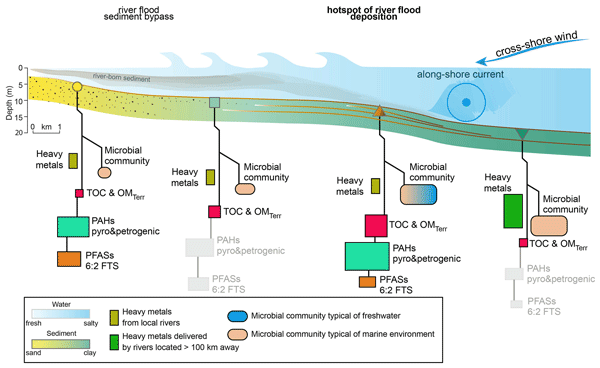
-Move Figure 12 earlier, as it is essential for following the narrative.Done
Citation: https://doi.org/10.5194/egusphere-2025-4423-AC1
-
AC1: 'Reply on RC1', Irene Sammartino, 26 Jan 2026
-
RC2: 'Comment on egusphere-2025-4423', Anonymous Referee #2, 29 Dec 2025
This manuscript by Pellegrini et al. presents a comprehensive and multidisciplinary investigation of sedimentary, geochemical, and microbial responses to a recent flood event in a coastal system. The topic is timely and highly relevant in the context of rapid environmental and climatic change, and the dataset is potentially valuable. However, several major issues need to be addressed before the manuscript can be considered for publication.
Major comments:
- I suggest the authors to reconsider the title. The study focuses on a single flood event within one coastal system, and therefore the current framing is overly broad.
- The manuscript lacks some temporal and spatial extension to fully emphasize the broader significance of the findings. For example, based on the presented results, what might be the potential impacts of major flood events on coastal systems globally over decadal timescales? Alternatively, how might the historical recurrence of flood events in the studied region have shaped the local biogeochemical environment and microbial assemblages over longer timescales?
- The authors point out the flood event has an ephemeral impact, which is reasonable for a single event. However, I am curious whether repeated flood events could exert cumulative or long-term effects on sedimentary biogeochemistry, contaminant retention, and microbial-mediated processes.
- I expect to see more discussion about grain-size controls on offshore enrichment of PAHs, microbial communities, and organic matter. The source, transport pathways, and ultimate fate of flood-derived sediments are likewise strongly grain-size dependent, and this relationship is currently underdeveloped in the manuscript.
- Last but perhaps most important, the overall narrative remains broad but fragmented. The interactions among the components discussed (seafloor geochemistry, contaminants, and bacterial communities), and their combined implications for coastal biogeochemical functioning, are insufficiently integrated.
Minor comments:
L75: In addition to low reactivity and primary productivity, could organic carbon preservation also be influenced by microbial priming effects and sediment resuspension?
L97: I did not find a clear discussion later in the manuscript on how contaminants influence microbial community development, despite this being implied here.
L146: Was grain-size distribution explicitly considered during sampling? Upper and lower portions of event deposits often differ markedly in grain size, organic matter content, and contaminant load. Using a single sample to represent the entire event deposit may therefore be insufficient.
L174: TOC measurements appear to be insufficiently described.
L364: The description of these patterns would be more appropriate in the Discussion section, where underlying mechanisms can be better explored.
L480: If flood-transported material accumulates preferentially at the 10–15 m isobath, does this imply the existence of distinct pollutant sinks or biogeochemical environments? If so, what are the broader implications for material cycling and pollution management?
L516: Overall, the discussion of bacterial communities remains weakly connected to the other results. While spatial differences in bacterial assemblages are expected given variable sediment inputs, do these differences imply mechanistic changes in biogeochemical cycling?
Figure comments:
Figures 1 & 2: The maps and overlapping information is visually overwhelming. Perhaps consider integrating key elements into a single figure, or presenting multiple panels with a consistent and simplified layout.
Figure 3: Sampling depth and vertical resolution are not clearly indicated. Additionally, lithological information from other sites should be shown for comparison. Panel labels (a, b, c) are missing.
Figure 12: Indicating sedimentation hotspots directly on the figure would help readers grasp the main spatial patterns.
Citation: https://doi.org/10.5194/egusphere-2025-4423-RC2 -
AC2: 'Reply on RC2', Irene Sammartino, 26 Jan 2026
We thank Reviewer 2 for the careful reading of the manuscript and for the constructive comments, which significantly helped to improve the focus, structure, and overall integration of the study. Below, we address each comment from Reviewer 2 (highlighted in blue italics) point by point.
-This manuscript by Pellegrini et al. presents a comprehensive and multidisciplinary investigation of sedimentary, geochemical, and microbial responses to a recent flood event in a coastal system. The topic is timely and highly relevant in the context of rapid environmental and climatic change, and the dataset is potentially valuable. However, several major issues need to be addressed before the manuscript can be considered for publication.
We thank Reviewer2 for the careful reading of the manuscript and for the constructive comments, which helped us to substantially improve the focus, structure, and integration of the study. Below we address each comment point by point.
-Major comments:
-I suggest the authors to reconsider the title. The study focuses on a single flood event within one coastal system, and therefore the current framing is overly broad.
We agree with the reviewer that the original title overstated the scope of the study. In response, we have revised the title to explicitly reflect the event-based nature of the work and its focus on a single extreme flood event in a Mediterranean coastal system. The new title emphasizes short-term responses and process-based linkages rather than broad generalization, ensuring closer alignment with the data and interpretations presented.
-The manuscript lacks some temporal and spatial extension to fully emphasize the broader significance of the findings. For example, based on the presented results, what might be the potential impacts of major flood events on coastal systems globally over decadal timescales? Alternatively, how might the historical recurrence of flood events in the studied region have shaped the local biogeochemical environment and microbial assemblages over longer timescales?
We acknowledge this point and have addressed it by expanding Section 5.3 of the Discussion, where we explicitly place our results within a broader temporal and spatial context. While our dataset captures a single flood event, we discuss how repeated high-magnitude floods, expected to increase under future climate scenarios, may cumulatively influence coastal contaminant retention and benthic microbial assemblages over seasonal to multiannual timescales. In this framework, the present study provides a process-based snapshot that helps constrain the mechanisms through which episodic flood-driven sedimentation may contribute to longer-term coastal ecosystem evolution when such events recur.
-The authors point out the flood event has an ephemeral impact, which is reasonable for a single event. However, I am curious whether repeated flood events could exert cumulative or long-term effects on sedimentary biogeochemistry, contaminant retention, and microbial-mediated processes.
We fully agree and have now made this distinction clearer in the revised manuscript. Although the sedimentary imprint of the September 2022 flood was ephemeral and spatially limited, we explicitly discuss how the cumulative impact of repeated flood events depends on the variable preservation of individual deposits and their partial reworking by subsequent hydrodynamic forcing. Sediment erosion under coastal depositional processes may further complicate the prediction of cumulative effects over time. Over longer timescales, this intermittent but recurrent delivery of fine-grained, organic-rich material and contaminants may drive non-linear changes in prodelta biogeochemistry and microbial-mediated processes. These points are now more explicitly developed in Sections 5.3 and in the Conclusions.
-I expect to see more discussion about grain-size controls on offshore enrichment of PAHs, microbial communities, and organic matter. The source, transport pathways, and ultimate fate of flood-derived sediments are likewise strongly grain-size dependent, and this relationship is currently underdeveloped in the manuscript.
We appreciate this suggestion and have substantially strengthened the manuscript in this respect. Grain size is explicitly used as the main integrative framework linking sediment transport, contaminant redistribution, and microbial community structure. The Discussion has been reorganized so that the first section establishes the grain-size-dependent sediment transport and deposition pathways, which then cascade into pollutant partitioning (PAHs vs. PFASs) and benthic microbial responses. We now emphasize that the offshore enrichment of PAHs, organic matter, and flood-influenced microbial taxa is fundamentally controlled by the preferential transport and accumulation of fine-grained, organic-rich sediments in the prodelta.
-Last but perhaps most important, the overall narrative remains broad but fragmented. The interactions among the components discussed (seafloor geochemistry, contaminants, and bacterial communities), and their combined implications for coastal biogeochemical functioning, are insufficiently integrated.
We agree with this assessment and have substantially revised the Discussion to improve cross-disciplinary integration. The revised manuscript adopts a clearer narrative thread, in which physical sediment dynamics, particularly grain-size sorting and hydrodynamic confinement, provide the mechanistic basis for understanding contaminant behavior and microbial community reorganization. This integrative framework is synthesized in a revised conceptual model (now Fig. 11), which is introduced earlier in the Discussion and explicitly used to connect sedimentology, geochemistry, pollutants, and microbiology. As a result, the manuscript now places greater emphasis on coupled processes and their combined implications for coastal biogeochemical functioning.
-Minor commentsL75: In addition to low reactivity and primary productivity, could organic carbon preservation also be influenced by microbial priming effects and sediment resuspension?
We have expanded the discussion on organic carbon preservation to include potential microbial priming effects and sediment resuspension, which may also modulate carbon dynamics in flood-affected sediments. This has been added in the Introduction and further addressed in the Discussion (Section 5.3).
-L97: I did not find a clear discussion later in the manuscript on how contaminants influence microbial community development, despite this being implied here.
We acknowledge that the link between contaminants and microbial community development was not sufficiently emphasized. We have now included a clearer discussion on how pollutant presence, especially PAHs and PFAS, may shape microbial assemblages by selecting for tolerant or specialized taxa. This is detailed in Sections 4.3 and 5.3
-L146: Was grain-size distribution explicitly considered during sampling? Upper and lower portions of event deposits often differ markedly in grain size, organic matter content, and contaminant load. Using a single sample to represent the entire event deposit may therefore be insufficient.
During sampling, we systematically followed coastal-to-offshore transects starting at the river mouth and moving seaward. We visually identified the flood deposit based on sedimentary fabric and continued sampling along the transect until the flood deposit was no longer evident. Therefore, sampling stations represent a spatial gradient capturing the extent of the flood deposit, which naturally ended before the outermost stations in some transects (e.g., four stations with the last lacking flood deposits). The absence of terrigenous organic matter in offshore stations further confirms that the flood deposit was not present beyond a certain distance from the river mouth.
-L174: TOC measurements appear to be insufficiently described.
The Methods section has been revised to provide detailed information on sample preparation, analytical techniques, and quality control procedures for TOC analysis.
-L364: The description of these patterns would be more appropriate in the Discussion section, where underlying mechanisms can be better explored.
We appreciate this suggestion and have moved the detailed description of observed patterns from the Results section to the Discussion to better explore the underlying mechanisms and their implications.
-L480: If flood-transported material accumulates preferentially at the 10–15 m isobath, does this imply the existence of distinct pollutant sinks or biogeochemical environments? If so, what are the broader implications for material cycling and pollution management?
This is a valuable point. We have expanded the Discussion to elaborate on the existence of pollutant sinks at the 10–15 m isobath, characterizing these zones as biogeochemically distinct depositional environments with implications for contaminant cycling and management strategies in coastal areas.
-L516: Overall, the discussion of bacterial communities remains weakly connected to the other results. While spatial differences in bacterial assemblages are expected given variable sediment inputs, do these differences imply mechanistic changes in biogeochemical cycling?
We acknowledge the relative weakness in connecting bacterial community patterns to broader biogeochemical processes. The revised manuscript now emphasizes mechanistic links between microbial assemblage shifts and sediment and contaminant characteristics, highlighting potential impacts on nutrient cycling and ecosystem functioning (Section 5.3).
-Figure comments:
Figures 1 & 2: The maps and overlapping information is visually overwhelming. Perhaps consider integrating key elements into a single figure, or presenting multiple panels with a consistent and simplified layout. Figure 3: Sampling depth and vertical resolution are not clearly indicated. Additionally, lithological information from other sites should be shown for comparison. Panel labels (a, b, c) are missing. Figure 12: Indicating sedimentation hotspots directly on the figure would help readers grasp the main spatial patterns.
We have streamlined and updated the figures to improve clarity and better support the manuscript. Figures 1 and 2 have been integrated, with geochemical provinces now shown in Figure 6, and what was formerly Figure 2 is now Figure 1, including enhanced details to aid interpretation. Figure 3 has been improved by adding panel labels and clarifying that both sedimentary logs and SEM observations refer to the same uppermost 0–2 cm interval used for geochemical, pollutant, and microbial analyses. Minor adjustments have also been made to other figures following Reviewer 2's suggestions.
Citation: https://doi.org/10.5194/egusphere-2025-4423-AC2
Peer review completion


Interactive discussion
Status: closed
-
RC1: 'Comment on egusphere-2025-4423', Anonymous Referee #1, 08 Dec 2025
This manuscript investigates the sedimentary and microbial responses to the September 2022 Marche Region flood, an extreme hydrological event that delivered substantial sediment and anthropogenic contaminants to the Adriatic Sea. By combining sedimentology, geochemistry, pollution analyses (PAHs, PFAS), and microbial community data, the study tackles a scientifically relevant problem within the scope of the journal. The dataset is valuable, and the rapid post-event sampling is a notable strength. The paper clearly contributes new insights by assembling existing methods and observations into an integrated framework.
The conceptual foundation is solid. However, the manuscript is overly long, making the key findings difficult to extract. Several sections would benefit from re-organization, and some contextual or secondary material, such as methodological background in section 3.6, should be moved to the Supplementary Information to streamline the main narrative.My main criticism is the incomplete integration of multidisciplinary perspectives. Datasets are mostly presented in isolation, so a stronger cross-disciplinary discussion is needed. For example, directly relating microbial changes to meteo-oceanographic data would better link processes to observations. If deeper integration is not possible, the manuscript should prioritize figures and methods that highlight the central components; crucially, Fig. 12 appears too late.
Methods require clearer definitions and traceability to meet reproducibility standards. Additionally, the title overstates the interpretive breadth of the manuscript and should be revised to better reflect the scope of the results.
Despite the criticisms, the manuscript has strong potential to analyze an interesting short-term impact of river floods on delta regions. A more concise presentation, clearer methods, improved figures, and better integration of modeling outputs as context for the observations would substantially strengthen the paper and its contribution to understanding episodic sediment and contaminant delivery in coastal systems.
I therefore recommend major revisions, focusing on the aspects stated above.
Specific comments:
Figure 1 lacks a legend for geological formations and does not name formations in the figure. Sampling sites use "yellow dots" without station names or codes, hindering cross-referencing. The inset of "geochemical provinces" is redundant or requires a full explanation in a separate figure, as its color scheme duplicates that of the main map.
Figure 2 is overloaded and unclear. Label panels explicitly (e.g., a, b, c) and ensure captions describe each panel. Define key elements such as chlorophyll a concentrations, site codes, and color scales. Label the flood event on the x-axis in hours for clarity.
The criteria distinguishing “flood deposits” from “pre-flood deposits” are not clearly defined and need clarification.
Clarify how many sediment samples were analyzed for pollutants and how this differs from geochemical analyses. Summarizing this in a supplementary table would aid reader comprehension.
Section 3.6 does not make it clear how the meteorological and oceanographic datasets were actually used. At present, the authors appear to have extracted outputs from existing models without performing any substantive processing or analysis of their own. This relates directly to my general comment: why not integrate these datasets with the observed stratigraphy to build even a simple process-based model of the event? Doing so would substantially strengthen the manuscript and make the overall interpretation more robust. This integration is attempted in Fig. 12, but it comes too late in the manuscript. If this is out of the scope, then I would move this data to the SI.
Results. The results bring together all the different factors, which, as far as I know, have not been assembled in this way before. In this sense, this study is new in its multidisciplinary scope.
Figure 4: Clarify where satellite-derived chlorophyll a shading is shown, and include it in the legends if relevant.
The Discussion repeats several results rather than synthesizing them, which further contributes to the sense of fragmentation. A more integrative, interpretation-focused discussion would significantly improve the manuscript’s reading pace.
In the discussion, the disciplinary components remain mostly detached. The manuscript is strong in its geochemical, microbiological, and pollutant analyses. Yet, the meteo-oceanographic component is comparatively weak and does not provide the mechanistic support needed for some of the arguments you make. As it stands, the modeling should probably be removed from the main text and treated as supplementary contextual information, useful for the Discussion but not framed as a core analytical component.
Move Figure 12 earlier, as it is essential for following the narrative.Citation: https://doi.org/10.5194/egusphere-2025-4423-RC1 -
AC1: 'Reply on RC1', Irene Sammartino, 26 Jan 2026
We thank the Reviewer1 for the careful and constructive evaluation of our manuscript. We appreciate the recognition of the value of the dataset, the rapid post-event sampling strategy, and the relevance of the multidisciplinary approach. Below, we address each comment in the order raised by the Reviewer1 and describe how the manuscript has been revised accordingly (Reviewer comments are marked with blue italics).
-This manuscript investigates the sedimentary and microbial responses to the September 2022 Marche Region flood, an extreme hydrological event that delivered substantial sediment and anthropogenic contaminants to the Adriatic Sea. By combining sedimentology, geochemistry, pollution analyses (PAHs, PFAS), and microbial community data, the study tackles a scientifically relevant problem within the scope of the journal. The dataset is valuable, and the rapid post-event sampling is a notable strength. The paper clearly contributes new insights by assembling existing methods and observations into an integrated framework.
The conceptual foundation is solid. However, the manuscript is overly long, making the key findings difficult to extract. Several sections would benefit from re-organization, and some contextual or secondary material, such as methodological background in section 3.6, should be moved to the Supplementary Information to streamline the main narrative. My main criticism is the incomplete integration of multidisciplinary perspectives. Datasets are mostly presented in isolation, so a stronger cross-disciplinary discussion is needed. For example, directly relating microbial changes to meteo-oceanographic data would better link processes to observations. If deeper integration is not possible, the manuscript should prioritize figures and methods that highlight the central components; crucially, Fig. 12 appears too late.We agree with the Reviewer1 and have substantially streamlined and reorganized the manuscript. In the revised version we i) reduced the overall length of the text, particularly in the Introduction and Discussion; ii) summarized the Methods section and moved detailed methodological descriptions to the Supplementary Information; iii) condensed the meteo-oceanographic background and relocated part of it to the event description and Supplementary Information; and iv) reduced the number of figures by removing the former Figure 1 and merging its information into the revised Figure 6.
Also, we have revised the Discussion to improve cross-disciplinary integration. Specifically we restructured the Discussion around a single integrative conceptual framework (Figure 11), which explicitly links sediment transport processes, contaminant redistribution, and microbial community responses. We strengthened the links between sediment grain size, depositional environments, pollutant behavior (PAHs vs. PFASs), and benthic microbial community structure. We clarified that our objective is to identify spatial associations driven by flood-induced sediment dynamics, rather than to infer direct causality. This approach provides a more cohesive interpretation while remaining consistent with the scope of the data.
Finally, we reduced the prominence of the meteorological and oceanographic data in the main text, moving much of this content to the Supplementary Information as contextual support. We clarified that no original numerical modeling was performed, and these datasets are used as interpretative aids rather than core analyses. The figure 12 has been renumbered as Fig. 11 and repositioned at the start of the Discussion section to serve as a guiding framework for the interpretation of results.
-Methods require clearer definitions and traceability to meet reproducibility standards. Additionally, the title overstates the interpretive breadth of the manuscript and should be revised to better reflect the scope of the results.
We addressed this by clarifying key methodological aspects and improving traceability. In particular, we clearly define the criteria used to distinguish flood deposits from pre-flood sediments (sediment fabric, grain size, color, organic matter content, and stratigraphic position). We clarified how many samples were analyzed for each dataset (sedimentology, geochemistry, PAHs, PFASs, microbial communities). To address this, we also added a summary table in the Supplementary Information detailing sample numbers and analytical details. Detailed analytical protocols and model data descriptions were moved to the Supplementary Information to maintain clarity while preserving reproducibility.
Finally, we have revised the title to better reflect the event-scale scope of the study and the observational nature of the results, emphasizing short-term sediment and contaminant redistribution and associated microbial responses.
-Despite the criticisms, the manuscript has strong potential to analyze an interesting short-term impact of river floods on delta regions. A more concise presentation, clearer methods, improved figures, and better integration of modeling outputs as context for the observations would substantially strengthen the paper and its contribution to understanding episodic sediment and contaminant delivery in coastal systems.
I therefore recommend major revisions, focusing on the aspects stated above.We sincerely thank the reviewers for their thorough and constructive feedback, which has been invaluable in improving the manuscript. We agree that a more concise presentation, clearer methods, enhanced figures, and stronger integration of modeling outputs are essential to strengthen the paper’s clarity and impact. Accordingly, we have extensively revised the manuscript to i) streamline the text for improved readability and focus on key findings; ii) clarify and expand methodological descriptions to ensure reproducibility; iii) redesign figures for greater clarity and earlier placement of critical integrative visuals; iv) refocus the meteorological and oceanographic modeling data to better contextualize the sedimentary and microbial observations, with stronger integration in the Discussion.
We believe these revisions have substantially enhanced the manuscript’s contribution to understanding the short-term impacts of river floods on coastal delta systems and their episodic sediment and contaminant delivery.
-Specific comments:
Figure 1 lacks a legend for geological formations and does not name formations in the figure. Sampling sites use "yellow dots" without station names or codes, hindering cross-referencing. The inset of "geochemical provinces" is redundant or requires a full explanation in a separate figure, as its color scheme duplicates that of the main map.
We updated Figure 1 and move information on the geochemical provinces into figure 6 to improve data readability.
-Figure 2 is overloaded and unclear. Label panels explicitly (e.g., a, b, c) and ensure captions describe each panel. Define key elements such as chlorophyll a concentrations, site codes, and color scales. Label the flood event on the x-axis in hours for clarity.Figure 2 has been revised to improve data readability clarifying site codes and color scales. To enhance the narrative flow, this figure has been moved earlier in the manuscript and is now presented as the new Figure 1.
-The criteria distinguishing “flood deposits” from “pre-flood deposits” are not clearly defined and need clarification.
We clearly defined the criteria in the Methods section based on sediment texture, color, organic content, and sedimentary structures supported by illustrative figures.-Clarify how many sediment samples were analyzed for pollutants and how this differs from geochemical analyses. Summarizing this in a supplementary table would aid reader comprehension.
We added a new supplementary table with all the analyses performed on the 2022 river flood and underlying sediments.
-Section 3.6 does not make it clear how the meteorological and oceanographic datasets were actually used. At present, the authors appear to have extracted outputs from existing models without performing any substantive processing or analysis of their own. This relates directly to my general comment: why not integrate these datasets with the observed stratigraphy to build even a simple process-based model of the event? Doing so would substantially strengthen the manuscript and make the overall interpretation more robust. This integration is attempted in Fig. 12, but it comes too late in the manuscript. If this is out of the scope, then I would move this data to the SI.We thank the reviewer for highlighting this important point. We acknowledge that the meteorological and oceanographic data presented in Section 3.6 are based on existing model outputs and in-situ observations without extensive new quantitative processing. Given the observational nature and scope of our study, performing a dedicated process-based numerical model of the event was beyond our resources and objectives. However, to address your concern, we have revised the manuscript to: i) clarify in Section 3.6 the nature of the meteorological and oceanographic data as contextual background supporting the interpretation of sediment and contaminant transport patterns; ii) move most of the detailed meteorological and oceanographic datasets and related figures to the Supplementary Information, thereby streamlining the main text;; and iv) importantly, we have advanced the conceptual integration of these data with observed sedimentological and microbial results by repositioning and expanding the conceptual model figure (now Fig. 11) earlier in the Discussion. This model visually and narratively links the hydrodynamic conditions to the stratigraphic and ecological observations, strengthening the interpretative framework without requiring a formal numerical model.
-Results. The results bring together all the different factors, which, as far as I know, have not been assembled in this way before. In this sense, this study is new in its multidisciplinary scope.
We thank the reviewer for recognizing the novelty of our multidisciplinary approach. Indeed, one of the main strengths of our study is the integrated analysis of sedimentological, geochemical, contaminant, and microbial datasets. We believe this holistic perspective significantly advances understanding of flood impacts on coastal systems.-Figure 4: Clarify where satellite-derived chlorophyll a shading is shown, and include it in the legends if relevant.
The chlorophyll data are shown in the new figure 1.
-The Discussion repeats several results rather than synthesizing them, which further contributes to the sense of fragmentation. A more integrative, interpretation-focused discussion would significantly improve the manuscript’s reading pace.The Discussion has been rewritten to minimize repetition and emphasize synthesis and integration, focusing on the conceptual model and interdisciplinary connections for smoother, more coherent reading.
-In the discussion, the disciplinary components remain mostly detached. The manuscript is strong in its geochemical, microbiological, and pollutant analyses. Yet, the meteo-oceanographic component is comparatively weak and does not provide the mechanistic support needed for some of the arguments you make. As it stands, the modeling should probably be removed from the main text and treated as supplementary contextual information, useful for the Discussion but not framed as a core analytical component.We thank the reviewer for this insightful observation. In response, we have substantially revised the Discussion section to improve the integration of the meteo-oceanographic perspective with the sedimentological, geochemical, and microbial analyses. Specifically, the first subsection of the Discussion now explicitly highlights how oceanographic conditions, including hydrodynamics and wind-driven currents, controlled the patchy dispersion and selective deposition of sediments and their grain size distribution. This sets the stage for understanding downstream effects on contaminant transport and microbial community structure, thereby creating a more cohesive narrative that links physical processes to chemical and biological responses.
Regarding the modeling component, we appreciate the suggestion to move detailed model outputs to the Supplementary Information. We have done so to streamline the main text and avoid overemphasizing modeling as a core analytical method. Instead, we use the modeling results as supporting contextual information to reinforce mechanistic interpretations presented in the Discussion.
-Move Figure 12 earlier, as it is essential for following the narrative.Done
Citation: https://doi.org/10.5194/egusphere-2025-4423-AC1
-
AC1: 'Reply on RC1', Irene Sammartino, 26 Jan 2026
-
RC2: 'Comment on egusphere-2025-4423', Anonymous Referee #2, 29 Dec 2025
This manuscript by Pellegrini et al. presents a comprehensive and multidisciplinary investigation of sedimentary, geochemical, and microbial responses to a recent flood event in a coastal system. The topic is timely and highly relevant in the context of rapid environmental and climatic change, and the dataset is potentially valuable. However, several major issues need to be addressed before the manuscript can be considered for publication.
Major comments:
- I suggest the authors to reconsider the title. The study focuses on a single flood event within one coastal system, and therefore the current framing is overly broad.
- The manuscript lacks some temporal and spatial extension to fully emphasize the broader significance of the findings. For example, based on the presented results, what might be the potential impacts of major flood events on coastal systems globally over decadal timescales? Alternatively, how might the historical recurrence of flood events in the studied region have shaped the local biogeochemical environment and microbial assemblages over longer timescales?
- The authors point out the flood event has an ephemeral impact, which is reasonable for a single event. However, I am curious whether repeated flood events could exert cumulative or long-term effects on sedimentary biogeochemistry, contaminant retention, and microbial-mediated processes.
- I expect to see more discussion about grain-size controls on offshore enrichment of PAHs, microbial communities, and organic matter. The source, transport pathways, and ultimate fate of flood-derived sediments are likewise strongly grain-size dependent, and this relationship is currently underdeveloped in the manuscript.
- Last but perhaps most important, the overall narrative remains broad but fragmented. The interactions among the components discussed (seafloor geochemistry, contaminants, and bacterial communities), and their combined implications for coastal biogeochemical functioning, are insufficiently integrated.
Minor comments:
L75: In addition to low reactivity and primary productivity, could organic carbon preservation also be influenced by microbial priming effects and sediment resuspension?
L97: I did not find a clear discussion later in the manuscript on how contaminants influence microbial community development, despite this being implied here.
L146: Was grain-size distribution explicitly considered during sampling? Upper and lower portions of event deposits often differ markedly in grain size, organic matter content, and contaminant load. Using a single sample to represent the entire event deposit may therefore be insufficient.
L174: TOC measurements appear to be insufficiently described.
L364: The description of these patterns would be more appropriate in the Discussion section, where underlying mechanisms can be better explored.
L480: If flood-transported material accumulates preferentially at the 10–15 m isobath, does this imply the existence of distinct pollutant sinks or biogeochemical environments? If so, what are the broader implications for material cycling and pollution management?
L516: Overall, the discussion of bacterial communities remains weakly connected to the other results. While spatial differences in bacterial assemblages are expected given variable sediment inputs, do these differences imply mechanistic changes in biogeochemical cycling?
Figure comments:
Figures 1 & 2: The maps and overlapping information is visually overwhelming. Perhaps consider integrating key elements into a single figure, or presenting multiple panels with a consistent and simplified layout.
Figure 3: Sampling depth and vertical resolution are not clearly indicated. Additionally, lithological information from other sites should be shown for comparison. Panel labels (a, b, c) are missing.
Figure 12: Indicating sedimentation hotspots directly on the figure would help readers grasp the main spatial patterns.
Citation: https://doi.org/10.5194/egusphere-2025-4423-RC2 -
AC2: 'Reply on RC2', Irene Sammartino, 26 Jan 2026
We thank Reviewer 2 for the careful reading of the manuscript and for the constructive comments, which significantly helped to improve the focus, structure, and overall integration of the study. Below, we address each comment from Reviewer 2 (highlighted in blue italics) point by point.
-This manuscript by Pellegrini et al. presents a comprehensive and multidisciplinary investigation of sedimentary, geochemical, and microbial responses to a recent flood event in a coastal system. The topic is timely and highly relevant in the context of rapid environmental and climatic change, and the dataset is potentially valuable. However, several major issues need to be addressed before the manuscript can be considered for publication.
We thank Reviewer2 for the careful reading of the manuscript and for the constructive comments, which helped us to substantially improve the focus, structure, and integration of the study. Below we address each comment point by point.
-Major comments:
-I suggest the authors to reconsider the title. The study focuses on a single flood event within one coastal system, and therefore the current framing is overly broad.
We agree with the reviewer that the original title overstated the scope of the study. In response, we have revised the title to explicitly reflect the event-based nature of the work and its focus on a single extreme flood event in a Mediterranean coastal system. The new title emphasizes short-term responses and process-based linkages rather than broad generalization, ensuring closer alignment with the data and interpretations presented.
-The manuscript lacks some temporal and spatial extension to fully emphasize the broader significance of the findings. For example, based on the presented results, what might be the potential impacts of major flood events on coastal systems globally over decadal timescales? Alternatively, how might the historical recurrence of flood events in the studied region have shaped the local biogeochemical environment and microbial assemblages over longer timescales?
We acknowledge this point and have addressed it by expanding Section 5.3 of the Discussion, where we explicitly place our results within a broader temporal and spatial context. While our dataset captures a single flood event, we discuss how repeated high-magnitude floods, expected to increase under future climate scenarios, may cumulatively influence coastal contaminant retention and benthic microbial assemblages over seasonal to multiannual timescales. In this framework, the present study provides a process-based snapshot that helps constrain the mechanisms through which episodic flood-driven sedimentation may contribute to longer-term coastal ecosystem evolution when such events recur.
-The authors point out the flood event has an ephemeral impact, which is reasonable for a single event. However, I am curious whether repeated flood events could exert cumulative or long-term effects on sedimentary biogeochemistry, contaminant retention, and microbial-mediated processes.
We fully agree and have now made this distinction clearer in the revised manuscript. Although the sedimentary imprint of the September 2022 flood was ephemeral and spatially limited, we explicitly discuss how the cumulative impact of repeated flood events depends on the variable preservation of individual deposits and their partial reworking by subsequent hydrodynamic forcing. Sediment erosion under coastal depositional processes may further complicate the prediction of cumulative effects over time. Over longer timescales, this intermittent but recurrent delivery of fine-grained, organic-rich material and contaminants may drive non-linear changes in prodelta biogeochemistry and microbial-mediated processes. These points are now more explicitly developed in Sections 5.3 and in the Conclusions.
-I expect to see more discussion about grain-size controls on offshore enrichment of PAHs, microbial communities, and organic matter. The source, transport pathways, and ultimate fate of flood-derived sediments are likewise strongly grain-size dependent, and this relationship is currently underdeveloped in the manuscript.
We appreciate this suggestion and have substantially strengthened the manuscript in this respect. Grain size is explicitly used as the main integrative framework linking sediment transport, contaminant redistribution, and microbial community structure. The Discussion has been reorganized so that the first section establishes the grain-size-dependent sediment transport and deposition pathways, which then cascade into pollutant partitioning (PAHs vs. PFASs) and benthic microbial responses. We now emphasize that the offshore enrichment of PAHs, organic matter, and flood-influenced microbial taxa is fundamentally controlled by the preferential transport and accumulation of fine-grained, organic-rich sediments in the prodelta.
-Last but perhaps most important, the overall narrative remains broad but fragmented. The interactions among the components discussed (seafloor geochemistry, contaminants, and bacterial communities), and their combined implications for coastal biogeochemical functioning, are insufficiently integrated.
We agree with this assessment and have substantially revised the Discussion to improve cross-disciplinary integration. The revised manuscript adopts a clearer narrative thread, in which physical sediment dynamics, particularly grain-size sorting and hydrodynamic confinement, provide the mechanistic basis for understanding contaminant behavior and microbial community reorganization. This integrative framework is synthesized in a revised conceptual model (now Fig. 11), which is introduced earlier in the Discussion and explicitly used to connect sedimentology, geochemistry, pollutants, and microbiology. As a result, the manuscript now places greater emphasis on coupled processes and their combined implications for coastal biogeochemical functioning.
-Minor commentsL75: In addition to low reactivity and primary productivity, could organic carbon preservation also be influenced by microbial priming effects and sediment resuspension?
We have expanded the discussion on organic carbon preservation to include potential microbial priming effects and sediment resuspension, which may also modulate carbon dynamics in flood-affected sediments. This has been added in the Introduction and further addressed in the Discussion (Section 5.3).
-L97: I did not find a clear discussion later in the manuscript on how contaminants influence microbial community development, despite this being implied here.
We acknowledge that the link between contaminants and microbial community development was not sufficiently emphasized. We have now included a clearer discussion on how pollutant presence, especially PAHs and PFAS, may shape microbial assemblages by selecting for tolerant or specialized taxa. This is detailed in Sections 4.3 and 5.3
-L146: Was grain-size distribution explicitly considered during sampling? Upper and lower portions of event deposits often differ markedly in grain size, organic matter content, and contaminant load. Using a single sample to represent the entire event deposit may therefore be insufficient.
During sampling, we systematically followed coastal-to-offshore transects starting at the river mouth and moving seaward. We visually identified the flood deposit based on sedimentary fabric and continued sampling along the transect until the flood deposit was no longer evident. Therefore, sampling stations represent a spatial gradient capturing the extent of the flood deposit, which naturally ended before the outermost stations in some transects (e.g., four stations with the last lacking flood deposits). The absence of terrigenous organic matter in offshore stations further confirms that the flood deposit was not present beyond a certain distance from the river mouth.
-L174: TOC measurements appear to be insufficiently described.
The Methods section has been revised to provide detailed information on sample preparation, analytical techniques, and quality control procedures for TOC analysis.
-L364: The description of these patterns would be more appropriate in the Discussion section, where underlying mechanisms can be better explored.
We appreciate this suggestion and have moved the detailed description of observed patterns from the Results section to the Discussion to better explore the underlying mechanisms and their implications.
-L480: If flood-transported material accumulates preferentially at the 10–15 m isobath, does this imply the existence of distinct pollutant sinks or biogeochemical environments? If so, what are the broader implications for material cycling and pollution management?
This is a valuable point. We have expanded the Discussion to elaborate on the existence of pollutant sinks at the 10–15 m isobath, characterizing these zones as biogeochemically distinct depositional environments with implications for contaminant cycling and management strategies in coastal areas.
-L516: Overall, the discussion of bacterial communities remains weakly connected to the other results. While spatial differences in bacterial assemblages are expected given variable sediment inputs, do these differences imply mechanistic changes in biogeochemical cycling?
We acknowledge the relative weakness in connecting bacterial community patterns to broader biogeochemical processes. The revised manuscript now emphasizes mechanistic links between microbial assemblage shifts and sediment and contaminant characteristics, highlighting potential impacts on nutrient cycling and ecosystem functioning (Section 5.3).
-Figure comments:
Figures 1 & 2: The maps and overlapping information is visually overwhelming. Perhaps consider integrating key elements into a single figure, or presenting multiple panels with a consistent and simplified layout. Figure 3: Sampling depth and vertical resolution are not clearly indicated. Additionally, lithological information from other sites should be shown for comparison. Panel labels (a, b, c) are missing. Figure 12: Indicating sedimentation hotspots directly on the figure would help readers grasp the main spatial patterns.
We have streamlined and updated the figures to improve clarity and better support the manuscript. Figures 1 and 2 have been integrated, with geochemical provinces now shown in Figure 6, and what was formerly Figure 2 is now Figure 1, including enhanced details to aid interpretation. Figure 3 has been improved by adding panel labels and clarifying that both sedimentary logs and SEM observations refer to the same uppermost 0–2 cm interval used for geochemical, pollutant, and microbial analyses. Minor adjustments have also been made to other figures following Reviewer 2's suggestions.
Citation: https://doi.org/10.5194/egusphere-2025-4423-AC2
Peer review completion
Journal article(s) based on this preprint
Viewed
| HTML | XML | Total | Supplement | BibTeX | EndNote | |
|---|---|---|---|---|---|---|
| 2,894 | 938 | 117 | 3,949 | 168 | 75 | 83 |
- HTML: 2,894
- PDF: 938
- XML: 117
- Total: 3,949
- Supplement: 168
- BibTeX: 75
- EndNote: 83
Viewed (geographical distribution)
| Country | # | Views | % |
|---|
| Total: | 0 |
| HTML: | 0 |
| PDF: | 0 |
| XML: | 0 |
- 1
Claudio Pellegrini
Marco Basili

Tommaso Tesi
Emanuela Frapiccini
Grazia Marina Quero
Sarah Pizzini
Roberta Zangrando
Gianmarco Luna
Sara Catena
Naomi Massaccesi
Fabio Trincardi
Andrea Gallerani
Jacopo Chiggiato
The requested preprint has a corresponding peer-reviewed final revised paper. You are encouraged to refer to the final revised version.
- Preprint
(2519 KB) - Metadata XML
-
Supplement
(586 KB) - BibTeX
- EndNote
- Final revised paper
The conceptual foundation is solid. However, the manuscript is overly long, making the key findings difficult to extract. Several sections would benefit from re-organization, and some contextual or secondary material, such as methodological background in section 3.6, should be moved to the Supplementary Information to streamline the main narrative.
Methods require clearer definitions and traceability to meet reproducibility standards. Additionally, the title overstates the interpretive breadth of the manuscript and should be revised to better reflect the scope of the results.
Despite the criticisms, the manuscript has strong potential to analyze an interesting short-term impact of river floods on delta regions. A more concise presentation, clearer methods, improved figures, and better integration of modeling outputs as context for the observations would substantially strengthen the paper and its contribution to understanding episodic sediment and contaminant delivery in coastal systems.
I therefore recommend major revisions, focusing on the aspects stated above.
Specific comments:
Figure 1 lacks a legend for geological formations and does not name formations in the figure. Sampling sites use "yellow dots" without station names or codes, hindering cross-referencing. The inset of "geochemical provinces" is redundant or requires a full explanation in a separate figure, as its color scheme duplicates that of the main map.
Figure 2 is overloaded and unclear. Label panels explicitly (e.g., a, b, c) and ensure captions describe each panel. Define key elements such as chlorophyll a concentrations, site codes, and color scales. Label the flood event on the x-axis in hours for clarity.
The criteria distinguishing “flood deposits” from “pre-flood deposits” are not clearly defined and need clarification.
Clarify how many sediment samples were analyzed for pollutants and how this differs from geochemical analyses. Summarizing this in a supplementary table would aid reader comprehension.
Section 3.6 does not make it clear how the meteorological and oceanographic datasets were actually used. At present, the authors appear to have extracted outputs from existing models without performing any substantive processing or analysis of their own. This relates directly to my general comment: why not integrate these datasets with the observed stratigraphy to build even a simple process-based model of the event? Doing so would substantially strengthen the manuscript and make the overall interpretation more robust. This integration is attempted in Fig. 12, but it comes too late in the manuscript. If this is out of the scope, then I would move this data to the SI.
Results. The results bring together all the different factors, which, as far as I know, have not been assembled in this way before. In this sense, this study is new in its multidisciplinary scope.
Figure 4: Clarify where satellite-derived chlorophyll a shading is shown, and include it in the legends if relevant.
The Discussion repeats several results rather than synthesizing them, which further contributes to the sense of fragmentation. A more integrative, interpretation-focused discussion would significantly improve the manuscript’s reading pace.
In the discussion, the disciplinary components remain mostly detached. The manuscript is strong in its geochemical, microbiological, and pollutant analyses. Yet, the meteo-oceanographic component is comparatively weak and does not provide the mechanistic support needed for some of the arguments you make. As it stands, the modeling should probably be removed from the main text and treated as supplementary contextual information, useful for the Discussion but not framed as a core analytical component.
Move Figure 12 earlier, as it is essential for following the narrative.