
the Creative Commons Attribution 4.0 License.
the Creative Commons Attribution 4.0 License.
 | 17 Oct 2025
An Observation-Based Methodology and Application for Future Atmosphere Secondary Pollution Control via an Atmospheric Oxidation Capacity Path Tracing Approach
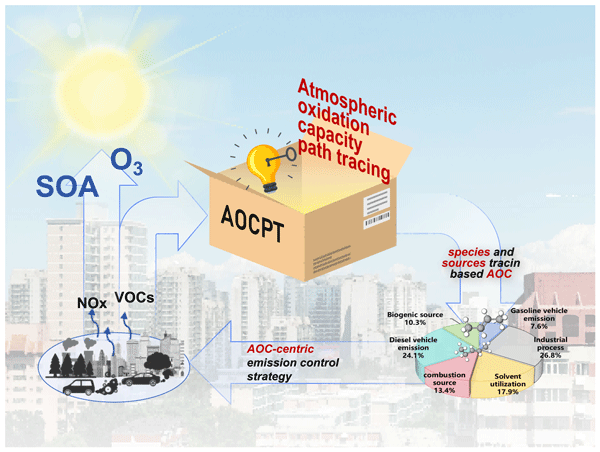
Abstract. As China's emission reduction efforts enter a plateau phase due to the slow decline of secondary pollutants, existing control strategies face diminishing returns. Atmospheric Oxidation Capacity (AOC), a key driver of secondary pollutant formation, represents a critical yet underutilized target for more effective control. The Atmospheric Oxidation Capacity Path Tracing (AOCPT) approach was proposed in this study. This approach quantitatively traces AOC to its precursors and sources, thereby facilitating the coordinated control of secondary pollution, by integrating three modules: a Radiation Equivalent Oxidation Capacity (REOC) method to quantify precursor species contributions, a Relative Incremental AOC (RIA) metric derived from a coupled box-receptor model to assess source impacts, and a modified source apportionment technique to resolve the respective contributions of both precursor species and sources to AOC. Successfully validated in a field study in Changzhi, China, AOCPT identified industrial processes (26.8 %) and diesel vehicle emissions (24.1 %) as the dominant AOC sources in a case city, driven largely by their trans-2-butene emissions (49.3 % and 20.6 % of total trans-2-butene, respectively). Crucially, secondary organic aerosols (SOA) were inadvertently enhanced by ozone (O3)-targeted abatement, an AOC-centric strategy enables the co-mitigation of both pollutants. By enabling the precise regulation of AOC through direct quantification of precursor and source roles, the AOCPT approach facilitates the synergistic control of secondary pollutants. It provides a robust technical pathway and theoretical foundation to overcome current challenges in air quality management.
-
Notice on discussion status
The requested preprint has a corresponding peer-reviewed final revised paper. You are encouraged to refer to the final revised version.
-
Preprint
(3071 KB)
-
Supplement
(1868 KB)
-
The requested preprint has a corresponding peer-reviewed final revised paper. You are encouraged to refer to the final revised version.
- Preprint
(3071 KB) - Metadata XML
-
Supplement
(1868 KB) - BibTeX
- EndNote
- Final revised paper


Journal article(s) based on this preprint
Interactive discussion
Status: closed
-
RC1: 'Comment on egusphere-2025-4355', Anonymous Referee #1, 17 Dec 2025
-
AC1: 'Reply on RC1', Yulong Yan, 04 Jan 2026
We sincerely thank Reviewer #1 for the positive evaluation and constructive comments. In response to the specific comments, we have carefully revised the manuscript. Detailed point-by-point responses to all comments have been provided in the attached supplement file ("Detailed Response to Reviewers #1.pdf").
-
AC1: 'Reply on RC1', Yulong Yan, 04 Jan 2026
-
RC2: 'Comment on egusphere-2025-4355', Anonymous Referee #2, 30 Dec 2025
The manuscript of “An Observation-Based Methodology and Application for Future Atmosphere Secondary Pollution Control via an Atmospheric Oxidation Capacity Path Tracing Approach” presents a novel "Atmospheric Oxidation Capacity Path Tracing" (AOCPT) approach to address the persistent challenge of synergetic O₃ and PM2.5 control in industrial regions. The methodology is scientifically sound, and the manuscript is generally well-written. But before publication, some details need to be explained. Overall, it is recommended to make minor modifications.
1. Can this AOCPT approach be directly applied to other seasons (e.g., winter, when AOC is lower) or non-industrial urban areas?
2. For REOC parameters, the conversion efficiencies α and β are critical. Please provide the screening criteria for the reaction pathways used and perform a sensitivity analysis to show how variations in these parameters affect the overall AOC conclusions.
3. Whether the contents in similar color boxes in Part 2 and Part 3 were similarly meaning? if yes, added legend in fig.1. otherwise, distinguish in differ box colors.
4. The descriptions of Fig. S in manuscript were incorrect, and check them throughout manuscript.
5. For better clarity, please label the sub-figures using letters such as (a), (b), etc. Additionally, the bar chart showing the contributions of different oxidizing agent pathways should not be parallel to the time axis. I suggest replacing this bar chart with a pie chart to improve readability.
6. The manuscript contains an excessive number of figures. I recommend moving some figures to the Supporting Information (SI), such as Fig. 2 and Fig. 4 etc.
7. The manuscript contains many long and complex sentences, which significantly hinder readability. I suggest the authors revise the text by breaking down complex structures into shorter, more reader-friendly sentences to ensure the scientific findings are communicated clearly.Citation: https://doi.org/10.5194/egusphere-2025-4355-RC2 -
AC2: 'Reply on RC2', Yulong Yan, 04 Jan 2026
We sincerely thank Reviewer #2 for the insightful suggestions and constructive comments. In response to the specific comments, we have carefully revised the manuscript, particularly regarding the method's applicability, parameter robustness, and visual presentation. Detailed point-by-point responses to all comments have been provided in the attached supplement file ("Detailed Response to Reviewers #2.pdf").
-
AC2: 'Reply on RC2', Yulong Yan, 04 Jan 2026


Interactive discussion
Status: closed
-
RC1: 'Comment on egusphere-2025-4355', Anonymous Referee #1, 17 Dec 2025
The manuscript titled “An Observation-Based Methodology and Application for Future Atmospheric Secondary Pollution Control via an Atmospheric Oxidation Capacity Path Tracing Approach” establishes a framework that can analyze the dominant precursors and sources of AOC. The results provide improved technical pathways for mitigating secondary pollution. I recommend acceptance after the following issues are addressed.
- Abstract: (1) Some sentences are too complex, such as “This approach quantitatively traces AOC to its precursors and sources, thereby facilitating the coordinated control of secondary pollution, by integrating three modules … to assess source impacts, and a modified source apportionment technique to resolve the respective contributions of both precursor species and sources to AOC.” in lines 26-34. Please simplify corresponding texts or cut them into several short sentences. (2) The AOCPT approach was applied in Changzhi rather than validated; therefore, the description “successfully validated in a field study in Changzhi” in line 34 should be revised. (3) the description of the application results is insufficient. Please provide additional relevant details.
- The second and third paragraphs in the Introduction section should be simplified, and the structure should be further adjusted to make it more logical. And add the applied details in the last paragraph.
- Introduce the QA/QC about sample and analysis.
- Section 2.2 could be divided into four sub-sections for more clearly.
- Section 2.2 Part 1: Please define the meaning of in Equation (S3) and provide the data sources for and . It would also be better if the authors could assess the uncertainty of the calculated initial concentration data using this method.
- Section 2.2 Part 3: 81 compounds were analyzed during field measurement, but only 38 VOCs were input into the PMF model. Please explain the selection principles. To what extent does the smaller number of compounds used in source apportionment affect the accuracy of analyzing AOC sources?
- Line 329-331: Please explain the reasons.
- What is the reason for the inconsistent units of the vertical axes in the three sub-figures shown in Figure 3? Please make it uniform if possible.
- In terms of the AOC sensitivity analysis, vehicle and industrial emissions are the prioritized control sources. Whether these sources are also important for O3 and SOA formation? Please clarify it.
- Species inputs in PMF and F0AM are all in the gas phase, whereas SOA is an aerosol component. Please clarify how you calculated the source sensitivities of SOA.
- Please supplement the scope of application, limitations, or sources of uncertainty for the AOC approach proposed in this paper.
- The English could be improved to more clearly express the research. For example, (1) line 288: 30% higher; (2) line 289-292: delete “undervalued the concentration of alkene”; (3) line 292-293: delete “the VOCs consumed to”; (4) line 354-356: also the reason why; (5) line 362-365: rewrite these two sentences; (6) line 424: This study used the REOC concept to unify; (7) line 425-428: this sentence was confused; (8) line 438: what was the difference between “REOC metric” and “REOC concept”; (9) line 459-465: re-describe the VOC source apportionment results; (10) Collectively? (11) line 473: delete “which the location of the research case”; (12) line 663 and 667: Critically and crucially? (3) too much “Especially”.
Citation: https://doi.org/10.5194/egusphere-2025-4355-RC1 -
AC1: 'Reply on RC1', Yulong Yan, 04 Jan 2026
We sincerely thank Reviewer #1 for the positive evaluation and constructive comments. In response to the specific comments, we have carefully revised the manuscript. Detailed point-by-point responses to all comments have been provided in the attached supplement file ("Detailed Response to Reviewers #1.pdf").
-
RC2: 'Comment on egusphere-2025-4355', Anonymous Referee #2, 30 Dec 2025
The manuscript of “An Observation-Based Methodology and Application for Future Atmosphere Secondary Pollution Control via an Atmospheric Oxidation Capacity Path Tracing Approach” presents a novel "Atmospheric Oxidation Capacity Path Tracing" (AOCPT) approach to address the persistent challenge of synergetic O₃ and PM2.5 control in industrial regions. The methodology is scientifically sound, and the manuscript is generally well-written. But before publication, some details need to be explained. Overall, it is recommended to make minor modifications.
1. Can this AOCPT approach be directly applied to other seasons (e.g., winter, when AOC is lower) or non-industrial urban areas?
2. For REOC parameters, the conversion efficiencies α and β are critical. Please provide the screening criteria for the reaction pathways used and perform a sensitivity analysis to show how variations in these parameters affect the overall AOC conclusions.
3. Whether the contents in similar color boxes in Part 2 and Part 3 were similarly meaning? if yes, added legend in fig.1. otherwise, distinguish in differ box colors.
4. The descriptions of Fig. S in manuscript were incorrect, and check them throughout manuscript.
5. For better clarity, please label the sub-figures using letters such as (a), (b), etc. Additionally, the bar chart showing the contributions of different oxidizing agent pathways should not be parallel to the time axis. I suggest replacing this bar chart with a pie chart to improve readability.
6. The manuscript contains an excessive number of figures. I recommend moving some figures to the Supporting Information (SI), such as Fig. 2 and Fig. 4 etc.
7. The manuscript contains many long and complex sentences, which significantly hinder readability. I suggest the authors revise the text by breaking down complex structures into shorter, more reader-friendly sentences to ensure the scientific findings are communicated clearly.Citation: https://doi.org/10.5194/egusphere-2025-4355-RC2 -
AC2: 'Reply on RC2', Yulong Yan, 04 Jan 2026
We sincerely thank Reviewer #2 for the insightful suggestions and constructive comments. In response to the specific comments, we have carefully revised the manuscript, particularly regarding the method's applicability, parameter robustness, and visual presentation. Detailed point-by-point responses to all comments have been provided in the attached supplement file ("Detailed Response to Reviewers #2.pdf").
-
AC2: 'Reply on RC2', Yulong Yan, 04 Jan 2026
Peer review completion


Journal article(s) based on this preprint
Viewed
| HTML | XML | Total | Supplement | BibTeX | EndNote | |
|---|---|---|---|---|---|---|
| 883 | 274 | 74 | 1,231 | 253 | 35 | 52 |
- HTML: 883
- PDF: 274
- XML: 74
- Total: 1,231
- Supplement: 253
- BibTeX: 35
- EndNote: 52
Viewed (geographical distribution)
| Country | # | Views | % |
|---|
| Total: | 0 |
| HTML: | 0 |
| PDF: | 0 |
| XML: | 0 |
- 1
Ke Yue
Yulong Yan
Yueyuan Niu
Jiaqi Dong
Chao Yang
Yongqian Zhou
Danning Wang
Junjie Li
Zhen Li
Lin Peng
The requested preprint has a corresponding peer-reviewed final revised paper. You are encouraged to refer to the final revised version.
- Preprint
(3071 KB) - Metadata XML
-
Supplement
(1868 KB) - BibTeX
- EndNote
- Final revised paper
The manuscript titled “An Observation-Based Methodology and Application for Future Atmospheric Secondary Pollution Control via an Atmospheric Oxidation Capacity Path Tracing Approach” establishes a framework that can analyze the dominant precursors and sources of AOC. The results provide improved technical pathways for mitigating secondary pollution. I recommend acceptance after the following issues are addressed.