
the Creative Commons Attribution 4.0 License.
the Creative Commons Attribution 4.0 License.
 | 21 Oct 2025
Improving Thermodynamic Nudging in the E3SM Atmosphere Model Version 2 (EAMv2): Strategy and Hindcast Skills on Weather Systems
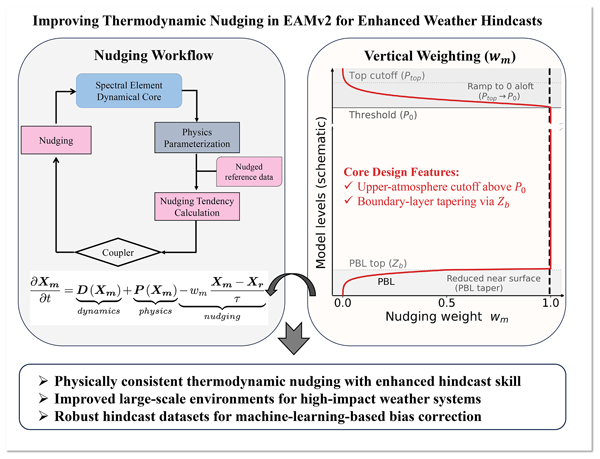
Abstract. Nudging techniques are commonly employed to constrain atmospheric simulations toward observed states, facilitating model evaluation and sensitivity studies. However, if applied improperly—particularly to thermodynamic variables such as temperature and humidity—nudging can distort physical processes and introduce spurious biases, undermining the credibility of the simulations. This study presents an improved nudging implementation that applies vertically modulated tendencies to reduce adverse impacts on model physics. The framework is tested in version 2 of the Energy Exascale Earth System Model (EAMv2) using a suite of hindcast simulations nudged toward ERA5 reanalysis. We systematically evaluate the individual and combined effects of nudging wind, temperature, and humidity fields on the model’s ability to represent large-scale atmospheric states and high-impact weather systems. Results show that the revised strategy—particularly when nudging temperature and humidity at selected levels—enhances hindcast skill by improving agreement with ERA5 without degrading the hydrological cycle or precipitation processes. Additional improvements in surface temperature, outgoing longwave radiation, and precipitation biases are achieved through targeted nudging of land surface variables. The proposed approach strengthens the representation of large-scale conditions relevant to tropical cyclones, atmospheric rivers, and extratropical cyclones in the low-resolution EAMv2. These findings demonstrate that carefully designed thermodynamic nudging, especially of temperature and humidity, improves the realism of constrained simulations and broadens the utility of nudged EAMv2 for atmospheric modeling, machine learning, and high-impact weather research.
-
Notice on discussion status
The requested preprint has a corresponding peer-reviewed final revised paper. You are encouraged to refer to the final revised version.
-
Preprint
(42745 KB)
-
The requested preprint has a corresponding peer-reviewed final revised paper. You are encouraged to refer to the final revised version.
- Preprint
(42745 KB) - Metadata XML
- BibTeX
- EndNote
- Final revised paper


Journal article(s) based on this preprint
Interactive discussion
Status: closed
-
RC1: 'Comment on egusphere-2025-4277', Anonymous Referee #1, 19 Nov 2025
-
AC1: 'Reply on RC1', Shixuan Zhang, 13 Jan 2026
On behalf of all coauthors, we thank the reviewer for the careful and constructive review of our manuscript. All comments have been addressed in detail, and the manuscript has been revised accordingly. A point-by-point response to all reviewer comments is provided in the attached PDF supplement, where reviewer comments are labeled as RC and our responses as AR.
We believe that the revisions have significantly improved the manuscript, and we are grateful to the reviewer for the insightful suggestions.
-
AC1: 'Reply on RC1', Shixuan Zhang, 13 Jan 2026
-
RC2: 'Comment on egusphere-2025-4277', Anonymous Referee #2, 28 Nov 2025
The manuscript proposes an improved nudging strategy for EAMv2 based on vertically modulated tendencies, aiming to mitigate distortions of physical processes caused by improperly designed nudging of temperature and humidity. Overall, this study addresses a practical problem in constrained atmospheric modeling and demonstrates a certain degree of innovation. Despite these positive aspects, several important elements of nudging implementation are insufficiently documented. In addition, some key conclusions would benefit from additional sensitivity experiments to better demonstrate the robustness and general applicability of the proposed method. In summary, this work represents a contribution with practical value and some novelty. I recommend that the manuscript undergo major revision prior to publication.
Major Comments:
- Nudging is intended to steer the model state toward the observed state and typically involves weighting parameters in both space and time. However, the methodological description in Section 2.2 only addresses vertical spatial weighting. In the authors’ experiments, each model grid point obtains an interpolated value at every integration time step. For observations with longer temporal intervals, is also derived through spatial and temporal interpolation in order to perform nudging? If so, could this introduce additional errors for highly nonlinear variables such as water vapor? The authors are encouraged to provide a more detailed explanation of the horizontal spatial weighting and temporal weighting schemes. In general, observations should exert a smooth and continuous influence before and after the observation time to avoid excessive shocks to the model. Furthermore, it is currently unclear whether a relaxation coefficient is included to control the rate at which the nudging tendency is introduced into the model state. If such a parameter exists, it should also be explicitly specified and described.
- According to the authors’ description, the proposed nudging configuration appears conceptually similar to the grid-nudging approach used in WRF, in which ERA5 is treated as pseudo-observations and interpolated to each model grid point to compute the local nudging tendency. If this is indeed the case, the physical meaning and practical role of the spatial influence weighting become difficult to interpret, since each grid point already possesses its own “true” value derived from ERA5. The authors should clarify how the spatial influence weighting operates within this framework and explain its necessity and impact when the nudging target field is already defined at every grid point.
- For the third group of experiments, it is recommended to include additional nudging experiments using the original formulation in Eq. (2). I noticed in Fig. 3 that, particularly for temperature (c3, c4) and water vapor (d1–d4), the errors near the lower and upper boundaries of the atmosphere are noticeably larger than those in the mid-troposphere. I would like to know how the assimilation results would appear when the original vertical weighting scheme is applied, and to quantitatively assess the improvement achieved by the revised vertical weighting approach.
Minor Comments:
- Table 1: The variables for the second group of experiments are incorrectly labeled.
- Line 165: ERA5 data are interpolated to a 30-minute interval, while the temporal coefficients for the upper atmosphere and surface are set to 6 hours and 1 hour, respectively. What is the rationale for choosing these specific settings?
- Line 185: Could the authors further explain why the precipitation magnitude becomes smaller after assimilating Q?
- Figure 2b: Compared with DNDG-UV, DNDG-UVT shows reduced RMSE in LWCF, CLDTOT, and PRECT. However, why does DNDG-UVTQ exhibit a noticeably larger RMSE in these variables compared to DNDG-UVQ? Could the authors provide some discussion for this contrasting behavior?
- Line 205: The relatively large errors in cloud, precipitation, and radiation variables may be partly attributed to the low-pass filtering nature of nudging, which can smooth out local temperature and moisture gradients. This filtering effect may be particularly detrimental to diagnostic variables with strong nonlinear characteristics, such as cloud, precipitation, and radiative fluxes, leading to amplified errors in their representation.
- Line 210: I remain cautious about the authors’ conclusion that overly constraining thermodynamic fields necessarily damages the model’s physical consistency. Although ERA5 is designed to be as physically consistent as possible, it does not guarantee strict consistency across all scales and variables. ERA5 is still a product of data assimilation under model constraints, and different variables are not assimilated simultaneously, which can lead to residual imbalances and physical inconsistencies. Therefore, conclusions based solely on comparison with ERA5 may not be fully convincing.
- A more reliable approach would be to conduct OSSE experiments, in which pseudo-observations are generated from EAMv2 forecasts, followed by nudging hindcast experiments and systematic evaluation. This would provide a more robust basis for assessing the physical consistency of the proposed nudging strategy.
- Figure 3: The errors at different vertical levels should be analyzed in conjunction with the prescribed vertical weighting scheme, as discussed in Major Comment 3.
- Section 4.2: add description of the parameter settings used for nudging the surface variables
- Figure 9: Full-variable nudging (red line) appears to suppress the peak of the seasonal cycle of the GPI, please provide an explanation
Citation: https://doi.org/10.5194/egusphere-2025-4277-RC2 -
AC2: 'Reply on RC2', Shixuan Zhang, 13 Jan 2026
On behalf of all coauthors, we thank the reviewer for the careful and constructive review of our manuscript. All comments have been addressed in detail, and the manuscript has been revised accordingly. A point-by-point response to all reviewer comments is provided in the attached PDF supplement, where reviewer comments are labeled as RC and our responses as AR.
We believe that the revisions have significantly improved the manuscript, and we are grateful to the reviewer for the insightful suggestions.
Peer review completion


Interactive discussion
Status: closed
-
RC1: 'Comment on egusphere-2025-4277', Anonymous Referee #1, 19 Nov 2025
The manuscript is overall well written, logically structured, and presents a useful and innovative nudging strategy with clear relevance to atmospheric modeling and constrained simulations. The methodological development is meaningful, and the results are generally convincing. I only have several minor comments and requests for clarification that I believe will further strengthen the manuscript.
Equation3. It seems that “1 Pa” in the equation may actually refer to 1 hPa. Please verify whether this is a typographical error.
In addition, how sensitive are the results to the choice of P_0 ? It would be beneficial if the authors could provide guidance, or at least discuss strategies, for choosing P_0 , especially for readers who might apply the method in different models.Line 133-135. The nudging tendency term is calculated and applied at different locations in the model. Could the authors explain the reasoning behind this choice?
Is there a specific numerical or physical advantage to computing and applying the tendency at different places?Line 304-307. The speculation here is interesting. Could the authors be more specific about what type of microphysics tuning that is applied in the free-running configuration but cannot be to the nudged simulations? Relatedly, this raises a broader question about other sub-grid tuning (e.g., CAPE relaxation time in the convection scheme). The authors may wish to expand their discussion on how such tuning parameters might interact with or influence nudging behavior.
Figure 1. For DNDG-UVQ and DNDG-UVTQ, the reported PCC values (0.79 and 0.82) are already quite high. It may help to comment on whether such high correlations are expected or what they imply about the baseline model behavior.
Figure 2. What does the “STRESS MAG” stand for?Moreover, it does not appear to be listed in Table B1. please clarify or include the relevant information.
Figure 5. Why is the analysis limited to December 1, 2010 to November 30, 2011?
A short justification would help the reader understand this choice.Figure 6. The NDG-UVQT_SRF1 experiment does not seem to substantially improve PRECT. Could the authors explain why this might be the case?
Figure 10 seems to indicate that nudging temperature and humidity does not significantly change the result. Could the authors elaborate on why the impact is relatively small here?
Citation: https://doi.org/10.5194/egusphere-2025-4277-RC1 -
AC1: 'Reply on RC1', Shixuan Zhang, 13 Jan 2026
On behalf of all coauthors, we thank the reviewer for the careful and constructive review of our manuscript. All comments have been addressed in detail, and the manuscript has been revised accordingly. A point-by-point response to all reviewer comments is provided in the attached PDF supplement, where reviewer comments are labeled as RC and our responses as AR.
We believe that the revisions have significantly improved the manuscript, and we are grateful to the reviewer for the insightful suggestions.
-
AC1: 'Reply on RC1', Shixuan Zhang, 13 Jan 2026
-
RC2: 'Comment on egusphere-2025-4277', Anonymous Referee #2, 28 Nov 2025
The manuscript proposes an improved nudging strategy for EAMv2 based on vertically modulated tendencies, aiming to mitigate distortions of physical processes caused by improperly designed nudging of temperature and humidity. Overall, this study addresses a practical problem in constrained atmospheric modeling and demonstrates a certain degree of innovation. Despite these positive aspects, several important elements of nudging implementation are insufficiently documented. In addition, some key conclusions would benefit from additional sensitivity experiments to better demonstrate the robustness and general applicability of the proposed method. In summary, this work represents a contribution with practical value and some novelty. I recommend that the manuscript undergo major revision prior to publication.
Major Comments:
- Nudging is intended to steer the model state toward the observed state and typically involves weighting parameters in both space and time. However, the methodological description in Section 2.2 only addresses vertical spatial weighting. In the authors’ experiments, each model grid point obtains an interpolated value at every integration time step. For observations with longer temporal intervals, is also derived through spatial and temporal interpolation in order to perform nudging? If so, could this introduce additional errors for highly nonlinear variables such as water vapor? The authors are encouraged to provide a more detailed explanation of the horizontal spatial weighting and temporal weighting schemes. In general, observations should exert a smooth and continuous influence before and after the observation time to avoid excessive shocks to the model. Furthermore, it is currently unclear whether a relaxation coefficient is included to control the rate at which the nudging tendency is introduced into the model state. If such a parameter exists, it should also be explicitly specified and described.
- According to the authors’ description, the proposed nudging configuration appears conceptually similar to the grid-nudging approach used in WRF, in which ERA5 is treated as pseudo-observations and interpolated to each model grid point to compute the local nudging tendency. If this is indeed the case, the physical meaning and practical role of the spatial influence weighting become difficult to interpret, since each grid point already possesses its own “true” value derived from ERA5. The authors should clarify how the spatial influence weighting operates within this framework and explain its necessity and impact when the nudging target field is already defined at every grid point.
- For the third group of experiments, it is recommended to include additional nudging experiments using the original formulation in Eq. (2). I noticed in Fig. 3 that, particularly for temperature (c3, c4) and water vapor (d1–d4), the errors near the lower and upper boundaries of the atmosphere are noticeably larger than those in the mid-troposphere. I would like to know how the assimilation results would appear when the original vertical weighting scheme is applied, and to quantitatively assess the improvement achieved by the revised vertical weighting approach.
Minor Comments:
- Table 1: The variables for the second group of experiments are incorrectly labeled.
- Line 165: ERA5 data are interpolated to a 30-minute interval, while the temporal coefficients for the upper atmosphere and surface are set to 6 hours and 1 hour, respectively. What is the rationale for choosing these specific settings?
- Line 185: Could the authors further explain why the precipitation magnitude becomes smaller after assimilating Q?
- Figure 2b: Compared with DNDG-UV, DNDG-UVT shows reduced RMSE in LWCF, CLDTOT, and PRECT. However, why does DNDG-UVTQ exhibit a noticeably larger RMSE in these variables compared to DNDG-UVQ? Could the authors provide some discussion for this contrasting behavior?
- Line 205: The relatively large errors in cloud, precipitation, and radiation variables may be partly attributed to the low-pass filtering nature of nudging, which can smooth out local temperature and moisture gradients. This filtering effect may be particularly detrimental to diagnostic variables with strong nonlinear characteristics, such as cloud, precipitation, and radiative fluxes, leading to amplified errors in their representation.
- Line 210: I remain cautious about the authors’ conclusion that overly constraining thermodynamic fields necessarily damages the model’s physical consistency. Although ERA5 is designed to be as physically consistent as possible, it does not guarantee strict consistency across all scales and variables. ERA5 is still a product of data assimilation under model constraints, and different variables are not assimilated simultaneously, which can lead to residual imbalances and physical inconsistencies. Therefore, conclusions based solely on comparison with ERA5 may not be fully convincing.
- A more reliable approach would be to conduct OSSE experiments, in which pseudo-observations are generated from EAMv2 forecasts, followed by nudging hindcast experiments and systematic evaluation. This would provide a more robust basis for assessing the physical consistency of the proposed nudging strategy.
- Figure 3: The errors at different vertical levels should be analyzed in conjunction with the prescribed vertical weighting scheme, as discussed in Major Comment 3.
- Section 4.2: add description of the parameter settings used for nudging the surface variables
- Figure 9: Full-variable nudging (red line) appears to suppress the peak of the seasonal cycle of the GPI, please provide an explanation
Citation: https://doi.org/10.5194/egusphere-2025-4277-RC2 -
AC2: 'Reply on RC2', Shixuan Zhang, 13 Jan 2026
On behalf of all coauthors, we thank the reviewer for the careful and constructive review of our manuscript. All comments have been addressed in detail, and the manuscript has been revised accordingly. A point-by-point response to all reviewer comments is provided in the attached PDF supplement, where reviewer comments are labeled as RC and our responses as AR.
We believe that the revisions have significantly improved the manuscript, and we are grateful to the reviewer for the insightful suggestions.
Peer review completion
Journal article(s) based on this preprint
Data sets
Analysis scripts and dataset for Zhang et. al. (2025) Shixuan Zhang https://doi.org/10.5281/zenodo.16816258
Model code and software
E3SM Model Code for Zhang et. al. (2025) E3SM Developers and Shixuan Zhang https://doi.org/10.5281/zenodo.16815018
Viewed
| HTML | XML | Total | BibTeX | EndNote | |
|---|---|---|---|---|---|
| 695 | 514 | 99 | 1,308 | 68 | 73 |
- HTML: 695
- PDF: 514
- XML: 99
- Total: 1,308
- BibTeX: 68
- EndNote: 73
Viewed (geographical distribution)
| Country | # | Views | % |
|---|
| Total: | 0 |
| HTML: | 0 |
| PDF: | 0 |
| XML: | 0 |
- 1

Bryce E. Harrop
Aniruddha Bora
George Karniadakis
Khemraj Shukla
Kai Zhang
The requested preprint has a corresponding peer-reviewed final revised paper. You are encouraged to refer to the final revised version.
- Preprint
(42745 KB) - Metadata XML
The manuscript is overall well written, logically structured, and presents a useful and innovative nudging strategy with clear relevance to atmospheric modeling and constrained simulations. The methodological development is meaningful, and the results are generally convincing. I only have several minor comments and requests for clarification that I believe will further strengthen the manuscript.
Equation3. It seems that “1 Pa” in the equation may actually refer to 1 hPa. Please verify whether this is a typographical error.
In addition, how sensitive are the results to the choice of P_0 ? It would be beneficial if the authors could provide guidance, or at least discuss strategies, for choosing P_0 , especially for readers who might apply the method in different models.
Line 133-135. The nudging tendency term is calculated and applied at different locations in the model. Could the authors explain the reasoning behind this choice?
Is there a specific numerical or physical advantage to computing and applying the tendency at different places?
Line 304-307. The speculation here is interesting. Could the authors be more specific about what type of microphysics tuning that is applied in the free-running configuration but cannot be to the nudged simulations? Relatedly, this raises a broader question about other sub-grid tuning (e.g., CAPE relaxation time in the convection scheme). The authors may wish to expand their discussion on how such tuning parameters might interact with or influence nudging behavior.
Figure 1. For DNDG-UVQ and DNDG-UVTQ, the reported PCC values (0.79 and 0.82) are already quite high. It may help to comment on whether such high correlations are expected or what they imply about the baseline model behavior.
Figure 2. What does the “STRESS MAG” stand for?Moreover, it does not appear to be listed in Table B1. please clarify or include the relevant information.
Figure 5. Why is the analysis limited to December 1, 2010 to November 30, 2011?
A short justification would help the reader understand this choice.
Figure 6. The NDG-UVQT_SRF1 experiment does not seem to substantially improve PRECT. Could the authors explain why this might be the case?
Figure 10 seems to indicate that nudging temperature and humidity does not significantly change the result. Could the authors elaborate on why the impact is relatively small here?