
the Creative Commons Attribution 4.0 License.
the Creative Commons Attribution 4.0 License.
 | 20 Oct 2025
Dynamics of island mass effect – Part II: Phytoplankton physiological responses
Abstract. Island mass effect (IME) refers to the phenomenon of elevated chlorophyll a ([Chla]) concentrations around islands, often extending hundreds of kilometers into oligotrophic waters. In this study, we explore the physiological responses and changes in phytoplankton community composition within island mass effect (IME) zones, providing insights into the drivers and ecological impacts of this phenomenon. Here, we study IMEs associated with four different island groups over six-month periods to illustrate how satellite-derived physiological parameters could be used to further our mechanistic understanding of IME. We use a combination of satellite-derived physiological indices and in situ bio-optical data collected during the Tara Pacific expedition. We examine mechanisms such as nutrient enrichment and ecological succession that underpin the IME. Our results demonstrate that phytoplankton populations within IME zones experience, on average, reduced physiological stress compared to the surrounding open ocean, likely due to an alleviation of iron limitation. Hence, recurring iron enrichment may be a significant factor of IME across the South Pacific Subtropical Ocean. In some cases, we also detected signatures of decreased phytoplankton stress due to macronutrient limitation associated with local upwellings and increased vertical mixing, highlighting the role of physical processes in supplying macronutrients to the photic zone. While iron enrichment seems to originate mostly from terrigenous/reef inputs, macronutrients can be both from terrigenous/reef origin or vertical entrainment of nutrient-rich deep water to the surface ocean. We also show that IME is often associated with changes in pigment ratios, which indicates changes in phytoplankton community composition. These findings underscore the complex interplay between nutrient availability, community composition, and physiological stress in shaping IME, offering new perspectives on this phenomenon and its ecological significance.
-
Notice on discussion status
The requested preprint has a corresponding peer-reviewed final revised paper. You are encouraged to refer to the final revised version.
-
Preprint
(44305 KB)
-
Supplement
(88182 KB)
-
The requested preprint has a corresponding peer-reviewed final revised paper. You are encouraged to refer to the final revised version.
- Preprint
(44305 KB) - Metadata XML
-
Supplement
(88182 KB) - BibTeX
- EndNote
- Final revised paper


Journal article(s) based on this preprint
Interactive discussion
Status: closed
-
RC1: 'Comment on egusphere-2025-4261', Anonymous Referee #1, 21 Nov 2025
-
AC1: 'Reply on RC1', Guillaume Bourdin, 13 Feb 2026
We thank reviewer #1 for a thorough and constructive review. This review helped us to significantly improve the manuscript particularly the interpretation of the nutrient stress dynamics that is the main scope of this study. All comments have been addressed and are accessible in the attached document.
-
AC1: 'Reply on RC1', Guillaume Bourdin, 13 Feb 2026
-
RC2: 'Comment on egusphere-2025-4261', Anonymous Referee #2, 25 Dec 2025
The manuscript investigated the physiological responses of phytoplankton assemblages by inland mass effects (IME) utilizing both satellite and in situ data. The paper presented a comprehensive and valuable dataset collected during the Tara Pacific expedition and evaluated the impact of IME on physiological responses primarily through satellite analysis. This paper offers valuable insights into IME, contributing to a better understanding of the coastal marine ecosystem. However, I have the following concerns that the authors should address:
Major comment No.1
It seems to me that this study did not sufficiently evaluate changes in phytoplankton community composition. While pigment ratios are indeed investigated through HPLC analysis, such as the ratio of photo-protective carotenoid concentrations or photosynthetic carotenoid concentrations relative to chlorophyll a concentrations, this analysis does not constitute a comprehensive evaluation of phytoplankton community composition. These ratios fluctuate in response to light, nutrient, and iron availability, even in the absence of significant changes in the phytoplankton community itself. Consequently, the sentences representing phytoplankton community composition in the Abstract of Line 5 and the Section 3.3 Characteristics of phytoplankton communities from bio-optical signals are not sound in their current form.
Major comment No.2
The rationale behind utilizing POLYMER for atmospheric correction in this study remains unclear. In recent years, other studies have demonstrated that OC-SMART (Fan et al., 2012) offers superior atmospheric correction in optically complex coastal waters. Therefore, it would be a good idea to explain the specific reasons that led to the selection of POLYMER as the atmospheric correction method.
Major comment No.3
In this study, ocean color sensors from MODIS/Aqua, MODIS/Terra, VIIRS/Suomi-NPP, VIIRS/JSPP, and OLCI/Sentinel3A&B were utilized. However, each sensor possesses a distinct resolution. MODIS, VIIRS, and OLCI have resolutions of 1 km, 750 m, and 300 m, respectively. For the match-up analysis, it is unclear which relation was evaluated. Were the 1 km resolution data after merging evaluated? If so, the process of merging satellite data to achieve a 1 km resolution is not explicitly detailed in the provided information. Additionally, only OLCI and VIIRS were employed for bbp analysis. Given the high-resolution requirements in coastal regions, only OLCI, which is equipped with fluorescence sensors, was deemed suitable for this purpose.
To enhance the clarity of the study, it would be beneficial to include a diagram of chlorophyll in the Appendix’s Figure A3 because the accuracy of chlorophyll propagates to subsequent parameter estimation. Additionally, it is recommended to cite Brewin et al. (2015) for statistical analysis.
Citation: https://doi.org/10.5194/egusphere-2025-4261-RC2 -
AC2: 'Reply on RC2', Guillaume Bourdin, 13 Feb 2026
We thank reviewer #2 for raising important points regarding satellite data processing and the use of pigment ratio as indicator of phytoplankton community composition. All comments have been addressed or answered and are accessible in the attached document.
-
AC2: 'Reply on RC2', Guillaume Bourdin, 13 Feb 2026
Peer review completion


Interactive discussion
Status: closed
-
RC1: 'Comment on egusphere-2025-4261', Anonymous Referee #1, 21 Nov 2025
GENERAL COMMENTS
This manuscript offers a valuable contribution to understanding island mass effects (IME) in the South Pacific by integrating satellite observations with in situ measurements from the Tara Pacific expedition to examine phytoplankton dynamics across four archipelagos. Its multi-platform approach, inclusion of both macronutrients and trace metals (notably iron), and evidence for reduced phytoplankton physiological stress within IME zones collectively strengthen the case for iron, as well as macronutrients, enrichment from terrigenous/reef inputs or local upwelling as key drivers of observed patterns. However, major revisions are needed to improve clarity, methodological transparency, and data presentation. With focused revisions addressing these issues, the manuscript has strong potential to advance our understanding of nutrient dynamics and phytoplankton ecology in oceanic island systems.
SPECIFIC COMMENTS
- I recommend adding a regional chlorophyll-a map that shows the locations of all four study archipelagos to provide geographic context for readers.
- The authors analyze nutrient concentrations across three zones: coastal IME, advected IME-affected waters, and oligotrophic waters. However, the zone definitions (lines 653-658) are currently relegated to an appendix but should be moved to the main Materials and Methods section, as they are key to the study design.
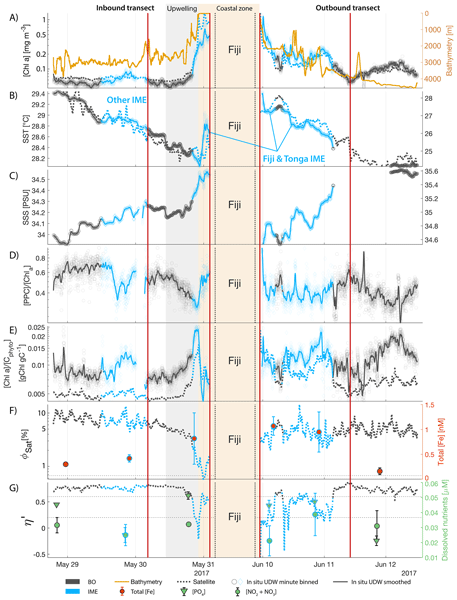
- The nutrient data presentation is confusing and potentially inconsistent. In Figure 3, the beige shading indicates the coastal zone, yet Figure C1 shows macronutrient and iron concentrations for Fiji's coastal IME that do not appear in the transect in Figure 3. Furthermore, the "Other IME" detected around May 29, 5 PM, appears to correspond to a different island not visible in the track shown in Figure 4. Please clarify these discrepancies and ensure consistency between figures. The authors might consider indicating the boundaries of the track shown in Fig 4 using vertical lines in Fig 3.
- The definition of upwelling-affected zones based solely on surface variables requires clarification. While the authors note that Fiji's shallower nutricline should produce a clearer upwelling signal, Figure 3 shows increased dissolved iron in the IME/upwelling region but not for DIN or phosphate. Given the spatial proximity of iron and macronutrient sampling stations (both seemingly influenced by upwelling) the differential nutrient response warrants discussion. Consider addressing potential mechanisms that may explain these patterns.
- I suggest relocating Table 4 to the Results and Discussion section and converted from qualitative to quantitative format. Specifically, include metrics such as: magnitude of biomass increases, relative intensity of upwelling effects between Society Islands and Fiji, extent of iron enrichment, and other quantifiable comparisons that would strengthen the analysis. The current color coding effectively highlights different IME characteristics between islands and should be retained.
- Please carefully review all references to figures and appendix materials to ensure they are accurate and consistent throughout the manuscript (see examples in “Technical corrections”).
TECHNICAL CORRECTIONS
Line 1: Remove "([Chla])" because the acronym is not used later in the abstract.
Line 3: The IME acronym is already defined in line 1; remove the redundant definition.
Lines 4–7: Consider combining the two sentences, for example: “Here, we study IMEs associated with four South Pacific subtropical archipelagos over six-month periods. We use a combination of satellite-derived physiological indices and in situ bio-optical data collected during the Tara Pacific expedition (year) to further our mechanistic understanding of IME.”
Line 4: Replace “four different island groups” with “four South Pacific subtropical archipelagos.”
Line 6: Italicize in situ here and throughout the manuscript.
Lines 6–7: Insert the year of the Tara Pacific expedition.
Line 8: Replace “on average” with “typically.”
Line 10: Replace “in some cases” with “In specific regions.”
Line 15: Change “indicates” to “indicate.”
Line 36: Provide a reference for the statement “variations in [Chla] can result from changes in phytoplankton biomass, community composition.”
Line 37: Define the SST acronym at first use (it was not defined in line 24).
Line 43: The phrase “or its inverse” is unclear. Since Table 3 uses the Chla/Cphyto ratio, define that ratio directly.
Lines 54–57: Split this sentence into two to improve clarity.
Line 59: Replace “island groups” with “archipelagos” and “latitude and longitude” with “geographical position.”
Line 60: Replace “and consequently” with “which.”
Lines 61–62: “Approach” is repeated; replace one instance with a synonym.
Line 67: Consider adding a semicolon after “2016–2018.Line 84: Replace “gradients of changes in community” with “gradients in community.”
Line 97: Add the missing semicolon: “i.e., 550 nm; Chase et al., 2013.”
Line 100: Remove the semicolon after “particle size.”
Table 2: Remove “only” from the table title.
Line 102: PAR should be “photosynthetically active radiation,” not “available.”
Line 104: Define the NASA SeaBASS acronym or simply refer the reader to Bourdin and Boss (2016). Also consider introducing the sentence with “Finally, we collected…”.Line 112: “four six-month-long sequences of satellite images”: are the dates identical for the 4 islands? What are they? Temporal resolution? (8-day mentioned but not until section 2.4 and mostly 2.5).
Line170-176: to clarify. Should there be hats on the min/max values?
Line 114: Revise citation format to “Steinmetz et al., 2011; last access: 2023-12-22” (remove the second “Steinmetz”).
Line 122: Rephrase as “Following Bourdin et al. (2025),”.
Line 123: The BO acronym was not defined at first use.
Line 131: At line 102, iPAR was defined as “radiation,” not “radiance.”
Lines 178–181: Consider merging the two sentences, as the idea that satellite estimates were calibrated with in situ measurements from the underway system is repeated.Line 203: in section 2.6 clarify that the IME is detected on 8-day maps. Where does 2025 individual IME realizations come from? 8-day over 6 months for 728 islands+reefs (table 1) gives 16,744 realizations; if 4 islands only 92.
Line 215: Replace “along” with “during.”
Line 228: The difference in centroids appears to indicate only that the IME is stronger; the connection to iron is unclear.
Lines 242–243: Figure 2 does not distinguish which Rapa Nui IME points correspond to austral summer versus winter; please clarify.
Line 246: The statement that all IMEs except Rapa Nui’s show moderate increases in bbp443 and thus biomass is not visible to me; please verify. I think some of the Fig 2 conclusions are overblown like this one (even if corrected) or “characterized by reduced n’” etc. Fig 2 is only the first 2 components so “suggests” this but doesn’t “show” it. To check if this is true overall the authors should need not a PCA retaining only the first 2 modes, but box plots contrasting IME/BO for n’ or bbp433 for instance.Line 257: Specify “High concentrations of what?”
Line 262: Instead of directing the reader to Gardner et al., 2006; Behrenfeld and Boss, 2006, please reference Table 2, where descriptions and citations are already included.Lines 264-265: should not be a decrease in SST and SSS but decrease in SST and increase in SSS.
Line 264: Rephrase as “Fig. 6 in Bourdin et al. (2025).”
Line 265: A change of 0.2 °C and 0.1 PSU may be insufficient evidence for two distinct water masses; reconsider this claim.
Line 291: Consider rephrasing as “2025); however, bbp was not due…”.
Line 306: Clarify what “subsurface population” refers to—subsurface phytoplankton?
Lines 311–317: The text first states that upwelling is the main macronutrient source west of Fiji, then that terrigenous inputs are significant. Consider revising if both sources are important. The fact that N and P are higher at coastal regions does not indicate that terrigenous inputs are a significant source, or this should be better explained (upwelling occurs a little further offshore perhaps?)
Line 319: Figure B1 corresponds to Rapa Nui, not Fiji.
Line 328: Figure B5 corresponds to Samoa, not Fiji.
Lines 351–353: The longitudinal gradient in total iron concentration is stated to be shown in “Fig. 3, B1, B3, and B5,” but this pattern is only clearly visible in Fig. C1. Please correct the figure reference.
Lines 377–380 and Fig. D1: Comparisons between zones are difficult because the y-axes differ between panels; consider standardizing axes.
Lines 380–389: Appendix D contains only Figure D1; refer directly to the figure rather than “the figure and the appendix.”
Lines 390–405: Figure 5 is referenced seven times in 15 lines; consolidate where possible.Line 415: The authors state that delta phy sat (between IME and BO) decreased over time and approached 0, but line 421 says that phy sat was significantly lower in IME relative to BO even during the bloom demise. Unless I’m missing something, this is contradictory.
Line 424: Consider referring readers to Figure E3 here.
Line 443: Delete “, where Σ(30 m isobath area) is plotted against IMEarea” and simply reference Fig. 7A.
Lines 445–449: Rephrase for clarity. Suggested: “The Σ(30 m isobath area) effectively predicts the potential minimum IME area using a second-order polynomial model (dashed blue line in Fig. 7A), whereas island size alone is an unreliable predictor due to large variability in IME area for a given Σ(30 m isobath area).” Consider adding the equation directly to Figure 7.
Lines 450–451: The word “enrichment” is repeated three times; revise to avoid repetition.Lines 483–487: This sentence is too long; divide it into two for clarity.
Line 488: using islands as natural nutrient enrichments that “could be studied”, this has been done quite a bit already. Cf PlumeEx for Galapagos (eg https://doi.org/10.1016/S0967-0645(98)00019-8) or KEOPS for the Kerguelen (eg https://doi.org/10.1016/j.dsr2.2008.01.002).
FIGURES AND TABLES:
Table 1: Some percentages in pie charts are unreadable, please consider showing only major components. In the caption, consider rephrasing “Island geomorphic types were determined following Nunn et al. (2016).”
Table 2: Remove “only” from the caption.
All tables: Consider bolding the first row to highlight column headers.Figure 4: The authors should consider keeping the same colorbars left and right where possible (ie except for SST where values are too different between south and northwest of Fiji). Being able to compare both sides of the island would be valuable.
Figure 6: Define in the caption what the shaded area represents. Same for Figures E1-E3Several figures: would be good to remind the reader what variables represent in the caption. This is done well in Fig. 3 but less in Fig. 4 (remind that quantum yield is iron stress) and not at all in Fig. 5 (eg “Chl normalized by Chl a”, add “indicative of red algae” etc).
Figures B7 and D1: Please clarify what the asterisks represent. Consider adding this information to the figure legend or caption.
Figure C1: The error bars are not defined. Please specify what they represent (e.g., standard deviation, standard error, 95% confidence intervals).
General recommendation: Ensure all figures include complete information needed for interpretation, including clear definitions of symbols, error bars, statistical indicators, and any other notation used.
Citation: https://doi.org/10.5194/egusphere-2025-4261-RC1 -
AC1: 'Reply on RC1', Guillaume Bourdin, 13 Feb 2026
We thank reviewer #1 for a thorough and constructive review. This review helped us to significantly improve the manuscript particularly the interpretation of the nutrient stress dynamics that is the main scope of this study. All comments have been addressed and are accessible in the attached document.
-
AC1: 'Reply on RC1', Guillaume Bourdin, 13 Feb 2026
-
RC2: 'Comment on egusphere-2025-4261', Anonymous Referee #2, 25 Dec 2025
The manuscript investigated the physiological responses of phytoplankton assemblages by inland mass effects (IME) utilizing both satellite and in situ data. The paper presented a comprehensive and valuable dataset collected during the Tara Pacific expedition and evaluated the impact of IME on physiological responses primarily through satellite analysis. This paper offers valuable insights into IME, contributing to a better understanding of the coastal marine ecosystem. However, I have the following concerns that the authors should address:
Major comment No.1
It seems to me that this study did not sufficiently evaluate changes in phytoplankton community composition. While pigment ratios are indeed investigated through HPLC analysis, such as the ratio of photo-protective carotenoid concentrations or photosynthetic carotenoid concentrations relative to chlorophyll a concentrations, this analysis does not constitute a comprehensive evaluation of phytoplankton community composition. These ratios fluctuate in response to light, nutrient, and iron availability, even in the absence of significant changes in the phytoplankton community itself. Consequently, the sentences representing phytoplankton community composition in the Abstract of Line 5 and the Section 3.3 Characteristics of phytoplankton communities from bio-optical signals are not sound in their current form.
Major comment No.2
The rationale behind utilizing POLYMER for atmospheric correction in this study remains unclear. In recent years, other studies have demonstrated that OC-SMART (Fan et al., 2012) offers superior atmospheric correction in optically complex coastal waters. Therefore, it would be a good idea to explain the specific reasons that led to the selection of POLYMER as the atmospheric correction method.
Major comment No.3
In this study, ocean color sensors from MODIS/Aqua, MODIS/Terra, VIIRS/Suomi-NPP, VIIRS/JSPP, and OLCI/Sentinel3A&B were utilized. However, each sensor possesses a distinct resolution. MODIS, VIIRS, and OLCI have resolutions of 1 km, 750 m, and 300 m, respectively. For the match-up analysis, it is unclear which relation was evaluated. Were the 1 km resolution data after merging evaluated? If so, the process of merging satellite data to achieve a 1 km resolution is not explicitly detailed in the provided information. Additionally, only OLCI and VIIRS were employed for bbp analysis. Given the high-resolution requirements in coastal regions, only OLCI, which is equipped with fluorescence sensors, was deemed suitable for this purpose.
To enhance the clarity of the study, it would be beneficial to include a diagram of chlorophyll in the Appendix’s Figure A3 because the accuracy of chlorophyll propagates to subsequent parameter estimation. Additionally, it is recommended to cite Brewin et al. (2015) for statistical analysis.
Citation: https://doi.org/10.5194/egusphere-2025-4261-RC2 -
AC2: 'Reply on RC2', Guillaume Bourdin, 13 Feb 2026
We thank reviewer #2 for raising important points regarding satellite data processing and the use of pigment ratio as indicator of phytoplankton community composition. All comments have been addressed or answered and are accessible in the attached document.
-
AC2: 'Reply on RC2', Guillaume Bourdin, 13 Feb 2026
Peer review completion
Journal article(s) based on this preprint
Data sets
Dynamics of island mass effect: detection input & output data Guillaume Bourdin https://zenodo.org/records/17156826?token=eyJhbGciOiJIUzUxMiIsImlhdCI6MTcyNDcyMDYwNSwiZXhwIjoxNzU0MDA2Mzk5fQ.eyJpZCI6IjA1MGI3NTg2LTZhZWYtNGNhZS05N2RmLWFmM2EzNmY5MjI5OCIsImRhdGEiOnt9LCJyYW5kb20iOiIxNmIyOTEyMzM3MDg5OTFiYjFhYTI2NTE3OWE4MDNjNyJ9.nR3PZTNTATjdVHS-IDV66JU3E78r3kCr1SYqwO9cpOEYzVlgvf5QonYKL-mtf_E-6Dj7tIHRIod9F6rSiJU3yA
Dynamics of island mass effect: multi-satellite binning package Guillaume Bourdin https://zenodo.org/records/13376825
Viewed
| HTML | XML | Total | Supplement | BibTeX | EndNote | |
|---|---|---|---|---|---|---|
| 948 | 620 | 114 | 1,682 | 208 | 80 | 84 |
- HTML: 948
- PDF: 620
- XML: 114
- Total: 1,682
- Supplement: 208
- BibTeX: 80
- EndNote: 84
Viewed (geographical distribution)
| Country | # | Views | % |
|---|
| Total: | 0 |
| HTML: | 0 |
| PDF: | 0 |
| XML: | 0 |
- 1
Guillaume Bourdin

Lee Karp-Boss
Fabien Lombard
Gabriel Gorsky
Emmanuel Boss
The requested preprint has a corresponding peer-reviewed final revised paper. You are encouraged to refer to the final revised version.
- Preprint
(44305 KB) - Metadata XML
-
Supplement
(88182 KB) - BibTeX
- EndNote
- Final revised paper
GENERAL COMMENTS
This manuscript offers a valuable contribution to understanding island mass effects (IME) in the South Pacific by integrating satellite observations with in situ measurements from the Tara Pacific expedition to examine phytoplankton dynamics across four archipelagos. Its multi-platform approach, inclusion of both macronutrients and trace metals (notably iron), and evidence for reduced phytoplankton physiological stress within IME zones collectively strengthen the case for iron, as well as macronutrients, enrichment from terrigenous/reef inputs or local upwelling as key drivers of observed patterns. However, major revisions are needed to improve clarity, methodological transparency, and data presentation. With focused revisions addressing these issues, the manuscript has strong potential to advance our understanding of nutrient dynamics and phytoplankton ecology in oceanic island systems.
SPECIFIC COMMENTS
- I recommend adding a regional chlorophyll-a map that shows the locations of all four study archipelagos to provide geographic context for readers.
- The authors analyze nutrient concentrations across three zones: coastal IME, advected IME-affected waters, and oligotrophic waters. However, the zone definitions (lines 653-658) are currently relegated to an appendix but should be moved to the main Materials and Methods section, as they are key to the study design.
- The nutrient data presentation is confusing and potentially inconsistent. In Figure 3, the beige shading indicates the coastal zone, yet Figure C1 shows macronutrient and iron concentrations for Fiji's coastal IME that do not appear in the transect in Figure 3. Furthermore, the "Other IME" detected around May 29, 5 PM, appears to correspond to a different island not visible in the track shown in Figure 4. Please clarify these discrepancies and ensure consistency between figures. The authors might consider indicating the boundaries of the track shown in Fig 4 using vertical lines in Fig 3.
- The definition of upwelling-affected zones based solely on surface variables requires clarification. While the authors note that Fiji's shallower nutricline should produce a clearer upwelling signal, Figure 3 shows increased dissolved iron in the IME/upwelling region but not for DIN or phosphate. Given the spatial proximity of iron and macronutrient sampling stations (both seemingly influenced by upwelling) the differential nutrient response warrants discussion. Consider addressing potential mechanisms that may explain these patterns.
- I suggest relocating Table 4 to the Results and Discussion section and converted from qualitative to quantitative format. Specifically, include metrics such as: magnitude of biomass increases, relative intensity of upwelling effects between Society Islands and Fiji, extent of iron enrichment, and other quantifiable comparisons that would strengthen the analysis. The current color coding effectively highlights different IME characteristics between islands and should be retained.
- Please carefully review all references to figures and appendix materials to ensure they are accurate and consistent throughout the manuscript (see examples in “Technical corrections”).
TECHNICAL CORRECTIONS
Line 1: Remove "([Chla])" because the acronym is not used later in the abstract.
Line 3: The IME acronym is already defined in line 1; remove the redundant definition.
Lines 4–7: Consider combining the two sentences, for example: “Here, we study IMEs associated with four South Pacific subtropical archipelagos over six-month periods. We use a combination of satellite-derived physiological indices and in situ bio-optical data collected during the Tara Pacific expedition (year) to further our mechanistic understanding of IME.”
Line 4: Replace “four different island groups” with “four South Pacific subtropical archipelagos.”
Line 6: Italicize in situ here and throughout the manuscript.
Lines 6–7: Insert the year of the Tara Pacific expedition.
Line 8: Replace “on average” with “typically.”
Line 10: Replace “in some cases” with “In specific regions.”
Line 15: Change “indicates” to “indicate.”
Line 36: Provide a reference for the statement “variations in [Chla] can result from changes in phytoplankton biomass, community composition.”
Line 37: Define the SST acronym at first use (it was not defined in line 24).
Line 43: The phrase “or its inverse” is unclear. Since Table 3 uses the Chla/Cphyto ratio, define that ratio directly.
Lines 54–57: Split this sentence into two to improve clarity.
Line 59: Replace “island groups” with “archipelagos” and “latitude and longitude” with “geographical position.”
Line 60: Replace “and consequently” with “which.”
Lines 61–62: “Approach” is repeated; replace one instance with a synonym.
Line 67: Consider adding a semicolon after “2016–2018.Line 84: Replace “gradients of changes in community” with “gradients in community.”
Line 97: Add the missing semicolon: “i.e., 550 nm; Chase et al., 2013.”
Line 100: Remove the semicolon after “particle size.”
Table 2: Remove “only” from the table title.
Line 102: PAR should be “photosynthetically active radiation,” not “available.”
Line 104: Define the NASA SeaBASS acronym or simply refer the reader to Bourdin and Boss (2016). Also consider introducing the sentence with “Finally, we collected…”.
Line 112: “four six-month-long sequences of satellite images”: are the dates identical for the 4 islands? What are they? Temporal resolution? (8-day mentioned but not until section 2.4 and mostly 2.5).
Line170-176: to clarify. Should there be hats on the min/max values?
Line 114: Revise citation format to “Steinmetz et al., 2011; last access: 2023-12-22” (remove the second “Steinmetz”).
Line 122: Rephrase as “Following Bourdin et al. (2025),”.
Line 123: The BO acronym was not defined at first use.
Line 131: At line 102, iPAR was defined as “radiation,” not “radiance.”
Lines 178–181: Consider merging the two sentences, as the idea that satellite estimates were calibrated with in situ measurements from the underway system is repeated.
Line 203: in section 2.6 clarify that the IME is detected on 8-day maps. Where does 2025 individual IME realizations come from? 8-day over 6 months for 728 islands+reefs (table 1) gives 16,744 realizations; if 4 islands only 92.
Line 215: Replace “along” with “during.”
Line 228: The difference in centroids appears to indicate only that the IME is stronger; the connection to iron is unclear.
Lines 242–243: Figure 2 does not distinguish which Rapa Nui IME points correspond to austral summer versus winter; please clarify.
Line 246: The statement that all IMEs except Rapa Nui’s show moderate increases in bbp443 and thus biomass is not visible to me; please verify. I think some of the Fig 2 conclusions are overblown like this one (even if corrected) or “characterized by reduced n’” etc. Fig 2 is only the first 2 components so “suggests” this but doesn’t “show” it. To check if this is true overall the authors should need not a PCA retaining only the first 2 modes, but box plots contrasting IME/BO for n’ or bbp433 for instance.
Line 257: Specify “High concentrations of what?”
Line 262: Instead of directing the reader to Gardner et al., 2006; Behrenfeld and Boss, 2006, please reference Table 2, where descriptions and citations are already included.
Lines 264-265: should not be a decrease in SST and SSS but decrease in SST and increase in SSS.
Line 264: Rephrase as “Fig. 6 in Bourdin et al. (2025).”
Line 265: A change of 0.2 °C and 0.1 PSU may be insufficient evidence for two distinct water masses; reconsider this claim.
Line 291: Consider rephrasing as “2025); however, bbp was not due…”.
Line 306: Clarify what “subsurface population” refers to—subsurface phytoplankton?
Lines 311–317: The text first states that upwelling is the main macronutrient source west of Fiji, then that terrigenous inputs are significant. Consider revising if both sources are important. The fact that N and P are higher at coastal regions does not indicate that terrigenous inputs are a significant source, or this should be better explained (upwelling occurs a little further offshore perhaps?)
Line 319: Figure B1 corresponds to Rapa Nui, not Fiji.
Line 328: Figure B5 corresponds to Samoa, not Fiji.
Lines 351–353: The longitudinal gradient in total iron concentration is stated to be shown in “Fig. 3, B1, B3, and B5,” but this pattern is only clearly visible in Fig. C1. Please correct the figure reference.
Lines 377–380 and Fig. D1: Comparisons between zones are difficult because the y-axes differ between panels; consider standardizing axes.
Lines 380–389: Appendix D contains only Figure D1; refer directly to the figure rather than “the figure and the appendix.”
Lines 390–405: Figure 5 is referenced seven times in 15 lines; consolidate where possible.
Line 415: The authors state that delta phy sat (between IME and BO) decreased over time and approached 0, but line 421 says that phy sat was significantly lower in IME relative to BO even during the bloom demise. Unless I’m missing something, this is contradictory.
Line 424: Consider referring readers to Figure E3 here.
Line 443: Delete “, where Σ(30 m isobath area) is plotted against IMEarea” and simply reference Fig. 7A.
Lines 445–449: Rephrase for clarity. Suggested: “The Σ(30 m isobath area) effectively predicts the potential minimum IME area using a second-order polynomial model (dashed blue line in Fig. 7A), whereas island size alone is an unreliable predictor due to large variability in IME area for a given Σ(30 m isobath area).” Consider adding the equation directly to Figure 7.
Lines 450–451: The word “enrichment” is repeated three times; revise to avoid repetition.
Lines 483–487: This sentence is too long; divide it into two for clarity.
Line 488: using islands as natural nutrient enrichments that “could be studied”, this has been done quite a bit already. Cf PlumeEx for Galapagos (eg https://doi.org/10.1016/S0967-0645(98)00019-8) or KEOPS for the Kerguelen (eg https://doi.org/10.1016/j.dsr2.2008.01.002).
FIGURES AND TABLES:
Table 1: Some percentages in pie charts are unreadable, please consider showing only major components. In the caption, consider rephrasing “Island geomorphic types were determined following Nunn et al. (2016).”
Table 2: Remove “only” from the caption.
All tables: Consider bolding the first row to highlight column headers.
Figure 4: The authors should consider keeping the same colorbars left and right where possible (ie except for SST where values are too different between south and northwest of Fiji). Being able to compare both sides of the island would be valuable.
Figure 6: Define in the caption what the shaded area represents. Same for Figures E1-E3
Several figures: would be good to remind the reader what variables represent in the caption. This is done well in Fig. 3 but less in Fig. 4 (remind that quantum yield is iron stress) and not at all in Fig. 5 (eg “Chl normalized by Chl a”, add “indicative of red algae” etc).
Figures B7 and D1: Please clarify what the asterisks represent. Consider adding this information to the figure legend or caption.
Figure C1: The error bars are not defined. Please specify what they represent (e.g., standard deviation, standard error, 95% confidence intervals).
General recommendation: Ensure all figures include complete information needed for interpretation, including clear definitions of symbols, error bars, statistical indicators, and any other notation used.