
the Creative Commons Attribution 4.0 License.
the Creative Commons Attribution 4.0 License.
 | 10 Sep 2025
Deriving Cropland N2O Emissions from Space-Based NO2 Observations
Abstract. Croplands are the largest anthropogenic source of nitrous oxide (N2O), a potent greenhouse gas and ozone-depleting substance. Agricultural emissions produce small atmospheric signals with high spatiotemporal variability presenting a large observational challenge. If capable, space-based observations could characterize cropland N2O emissions from farmlands across the world. No current satellite can resolve near-surface N2O variations from cropland emissions. However, satellite observations of nitrogen dioxide (NO2), a component of NOx along with nitric oxide (NO), capture cropland emissions. NO, which quickly converts to NO2 in the atmosphere, and N2O are co-emitted from soils. Both gases are produced by microbial soil processes, and are emitted in large amounts as a result of excess nitrogen from applied fertilizer. Given their co-emission in croplands, we ask: Can satellite NO2 observations be used to infer N2O emissions? We examine coincident airborne N2O and NO2 measurements downwind of California croplands to characterize N2O:NOx emission relationships from farms. We use these emission ratios to transform estimates of agricultural NOx emissions derived from space-based TROPOMI NO2 observations to N2O emissions. We compare these estimates to independent ground and airborne studies in the US Corn Belt and Mississippi River Valley. Space-based estimates are broadly consistent with these ground and airborne studies, suggesting that satellite NO2 observations can be used to infer cropland N2O emissions. Further refinement of a NO2 proxy approach for cropland N2O emissions has the potential to expand observational capabilities to constrain regional and global cropland N2O emissions and inform process models.
Competing interests: At least one of the (co-)authors is a member of the editorial board of Atmospheric Chemistry and Physics. The peer-review process was guided by an independent editor, and the authors also have no other competing interests to declare.
Publisher's note: Copernicus Publications remains neutral with regard to jurisdictional claims made in the text, published maps, institutional affiliations, or any other geographical representation in this paper. While Copernicus Publications makes every effort to include appropriate place names, the final responsibility lies with the authors. Views expressed in the text are those of the authors and do not necessarily reflect the views of the publisher.-
Notice on discussion status
The requested preprint has a corresponding peer-reviewed final revised paper. You are encouraged to refer to the final revised version.
-
Preprint
(848 KB)
-
The requested preprint has a corresponding peer-reviewed final revised paper. You are encouraged to refer to the final revised version.
- Preprint
(848 KB) - Metadata XML
- BibTeX
- EndNote
- Final revised paper


Journal article(s) based on this preprint
Interactive discussion
Status: closed
- RC1: 'Comment on egusphere-2025-4201', Anonymous Referee #1, 14 Oct 2025
-
RC2: 'Comment on egusphere-2025-4201', Anonymous Referee #2, 26 Nov 2025
This manuscript presents an interesting approach for estimating cropland N₂O emissions using satellite-based NO₂ data. The authors attempt to derive N₂O emissions via the N₂O:NOₓ ratio. While this is an ambitious effort, the results in their current form are not yet convincing.
From the perspective of nitrogen cycling processes, soil NO and N₂O emissions are governed by different functional genes and enzymes. For instance, soil N₂O emissions are primarily controlled by the N₂O reduction gene (nosZ), whereas NO emissions are regulated by nirK or nirS genes. These genes and enzymes are activated under different soil moisture and oxygen conditions, leading to subsequent gas emissions (Fig.4 in Oswald et al., 2013). After being emitted from the soil to atmosphere, the conversion of NO to NO₂ depends on ozone (O₃) concentrations and is often incomplete. Therefore, the NO–NO₂–O₃ triad is typically studied together in atmospheric chemistry. The authors attempt to estimate column NOₓ concentrations from satellite NO₂ data and then calculate N₂O concentrations using the N₂O:NOₓ ratio. This process involves substantial uncertainties that should be carefully quantified at each step.
Here are some technical comments:
- The title of the Introduction: remove the colon.
- L97: and NOₓ?.
- Section 2 could be merged with the Introduction for better flow.
- L105–129: How were the N₂O and NOₓ emissions validated as originating specifically from cropland? Column concentrations represent a mixture of sources, including direct ground emissions and vertical or horizontal transport from adjacent areas. These concentrations are highly influenced by micrometeorological conditions such as wind speed, wind direction, and surface activities.
- L153–154: The value appears quite high and may only be applicable to regions or hotspots with high NOₓ and N₂O emissions.
- The title of Section 3 could be revised to “Materials and Methods.”
- L171–186: The current comparisons are not sufficiently convincing. The authors are encouraged to include more site-to-site comparisons—at least five sites, in my view.
- Units should be expressed as nmol m⁻² s⁻¹.
- L279: “N2O” should be formatted as N₂O.
- The uncertainty in the N₂O flux calculations should be quantified.
- The potential applications of the space-based N₂O flux method should be further discussed.
Reference:
Oswald, R., Behrendt, T., Ermel, M., Wu, D., Su, H., Cheng, Y., ... & Trebs, I. (2013). HONO emissions from soil bacteria as a major source of atmospheric reactive nitrogen. Science, 341(6151), 1233-1235.
Citation: https://doi.org/10.5194/egusphere-2025-4201-RC2 -
AC1: 'Response to Reviewers (Response document attached)', Taylor Adams, 22 Jan 2026
Dear Editor and Reviewers,
We would like to sincerely thank you for your constructive evaluation of our manuscript “Deriving Cropland N2O Emissions from Space-Based NO2 Observations”.
We appreciate your comments and suggestions. We have revised our manuscript thoroughly in response to your comments, and believe the changes strengthen its presentation and scientific contribution.
Some of the most relevant changes we made are:
- Updated our analysis to now include both NO and NO2 when determining N2O:NOx emission ratios (rather than determining N2O:NO2 emission ratios initially)
- Improved the description of our box model to include clarifying details.
- Added a new supplement, including a sensitivity analysis that details how different assumptions about NOx lifetime and deposition velocity influence results. In the supplement, we now also include N2O emission estimates and comparison for both our approaches to characterize N2O:NOx emissions ratios. We find no significant difference between these approaches in emission ratio distribution or final results.
Attached, we outline how and where changes were made in the manuscript. We have highlighted all modifications in the revised manuscript using track changes, which includes a couple other editorial corrections/improvements.
Sincerely,
Taylor Adams
On behalf of all authors.
Peer review completion


Interactive discussion
Status: closed
-
RC1: 'Comment on egusphere-2025-4201', Anonymous Referee #1, 14 Oct 2025
In their paper, Adams, Plant and Kort propose to use NO2 space observations to estimate N2O emissions from farmlands. The paper is well written, has a good set of references and was a pleasure to read. The comparisons with three very different measurement approaches, as shown in Fig 3, is clearly illustrating the potential of the approach. I have a couple of points which I would like to see addressed before the paper is ready to be published.
The method relies on two key steps, first the determination of soil emissions based on satellite columns, and secondly the link between NOx and N2O emission fluxes. Several questions came up related to these two steps.
In the paper, NOx/N2O emission and NO2/N2O concentration ratios are not always clearly distinguished, but emissions are not the same as concentrations and lifetime and NO/NO2 chemical conversion plays a role. It would be good to be more precise at several locations, and describe in more detail how measured concentration ratios are computed back to emission ratios.
l 122: "we assume all the emitted soil NOx (primarily NO) has converted in the atmosphere to NO2, ..". "The inverse of our ratios is directly comparable to literature NO:N2O molecular emissions ratios."
Why is this assumption made? This is a potential source of systematic error. Normally the concentration of NO2 is larger than NO, but this depends on the chemical regime, distance from the source and availability of ozone. Also the soil NO/NO2 emission ratio may play a role. Using a chemistry-transport model could lead to more accurate results.l 117: "To isolate cropland regions, analysis is restricted to locations >0.04° (~3.7 – 4.4 km) from regions with emissions in the top 1% of the National Emissions Inventory (NEI) (Strum et al., 2017), and to periods when the aircraft was below 500m elevation."
Pollution from isolated large sources can easily travel long distances (20-100 km). Is this assumption justified and effective in removing non-agricultural contributions? How well are agricultural emissions separated from the other emissions (industry, traffic etc)?The explanation of the box model, section 4 equation 1, was confusing, and more discussion (maybe even a figure) could be helpful to increase confidence. The first two terms refer to advection. This would require computing gradients along the wind direction: when downwind concentrations are higher than upwind concentrations this indicates that emissions occur. The authors refer to a delta(NO2) as "the mean TROPOMI NO2 column enhancement (molecule/m2) above the background abundance, which we define as the 5th percentile of NO2 abundance in the domain of interest". But this is not the same as a gradient? Please explain more clearly how this is implemented.
The authors distinguish deposition and lifetime. How important is the direct deposition term? Normally I expect the reaction with OH to dominate. Please add some more detail on how the lifetime is approximated.
TROPOMI is analysed on a daily basis. However, box model emission results based on daily observations may be very noisy. Is noise a problem, especially when comparing with campaigns with just a few days of observations. Is this a problem?
The emission ratio results are shown in Fig.1. A very broad range of values is observed, from close to 0 to well above 1. This is an important results, and shows that the proposed methodology will not provide good results everywhere. Basically the authors suggest that these differences average out when looking at larger regions. But is this really the case?
Are N2O/NO2 ratios expected to be similar in other parts/regions of the world? Can the ratios determined for the San Joaquin valley be used in the other domains in central US (Iowa etc) discussed in Fig.3 ? As mentioned, ratios will depend on moisture, vegetation and soil type, vertiliser use which may vary from one region to another and is also time dependent. This may potentially cause significant biases in the results for a given target region.In the conclusion: "As presented here, the largest source of uncertainty in the estimated N2O emissions derives from the large variability in the observed airborne N2O:NOx emissions ratio. Improved understanding and definition of this ratio, and what controls variation, could improve the fidelity of this proxy approach. "
This seems to point towards potential improvements in the methodology. If parameters like soil type, land, moisture and rainfall could be correlated with the emission ratios then this could improve the emission estimates and generalise the method to other regions. Please add some comments at the end of the conclusion how the method may be improved in the future.Citation: https://doi.org/10.5194/egusphere-2025-4201-RC1 -
RC2: 'Comment on egusphere-2025-4201', Anonymous Referee #2, 26 Nov 2025
This manuscript presents an interesting approach for estimating cropland N₂O emissions using satellite-based NO₂ data. The authors attempt to derive N₂O emissions via the N₂O:NOₓ ratio. While this is an ambitious effort, the results in their current form are not yet convincing.
From the perspective of nitrogen cycling processes, soil NO and N₂O emissions are governed by different functional genes and enzymes. For instance, soil N₂O emissions are primarily controlled by the N₂O reduction gene (nosZ), whereas NO emissions are regulated by nirK or nirS genes. These genes and enzymes are activated under different soil moisture and oxygen conditions, leading to subsequent gas emissions (Fig.4 in Oswald et al., 2013). After being emitted from the soil to atmosphere, the conversion of NO to NO₂ depends on ozone (O₃) concentrations and is often incomplete. Therefore, the NO–NO₂–O₃ triad is typically studied together in atmospheric chemistry. The authors attempt to estimate column NOₓ concentrations from satellite NO₂ data and then calculate N₂O concentrations using the N₂O:NOₓ ratio. This process involves substantial uncertainties that should be carefully quantified at each step.
Here are some technical comments:
- The title of the Introduction: remove the colon.
- L97: and NOₓ?.
- Section 2 could be merged with the Introduction for better flow.
- L105–129: How were the N₂O and NOₓ emissions validated as originating specifically from cropland? Column concentrations represent a mixture of sources, including direct ground emissions and vertical or horizontal transport from adjacent areas. These concentrations are highly influenced by micrometeorological conditions such as wind speed, wind direction, and surface activities.
- L153–154: The value appears quite high and may only be applicable to regions or hotspots with high NOₓ and N₂O emissions.
- The title of Section 3 could be revised to “Materials and Methods.”
- L171–186: The current comparisons are not sufficiently convincing. The authors are encouraged to include more site-to-site comparisons—at least five sites, in my view.
- Units should be expressed as nmol m⁻² s⁻¹.
- L279: “N2O” should be formatted as N₂O.
- The uncertainty in the N₂O flux calculations should be quantified.
- The potential applications of the space-based N₂O flux method should be further discussed.
Reference:
Oswald, R., Behrendt, T., Ermel, M., Wu, D., Su, H., Cheng, Y., ... & Trebs, I. (2013). HONO emissions from soil bacteria as a major source of atmospheric reactive nitrogen. Science, 341(6151), 1233-1235.
Citation: https://doi.org/10.5194/egusphere-2025-4201-RC2 -
AC1: 'Response to Reviewers (Response document attached)', Taylor Adams, 22 Jan 2026
Dear Editor and Reviewers,
We would like to sincerely thank you for your constructive evaluation of our manuscript “Deriving Cropland N2O Emissions from Space-Based NO2 Observations”.
We appreciate your comments and suggestions. We have revised our manuscript thoroughly in response to your comments, and believe the changes strengthen its presentation and scientific contribution.
Some of the most relevant changes we made are:
- Updated our analysis to now include both NO and NO2 when determining N2O:NOx emission ratios (rather than determining N2O:NO2 emission ratios initially)
- Improved the description of our box model to include clarifying details.
- Added a new supplement, including a sensitivity analysis that details how different assumptions about NOx lifetime and deposition velocity influence results. In the supplement, we now also include N2O emission estimates and comparison for both our approaches to characterize N2O:NOx emissions ratios. We find no significant difference between these approaches in emission ratio distribution or final results.
Attached, we outline how and where changes were made in the manuscript. We have highlighted all modifications in the revised manuscript using track changes, which includes a couple other editorial corrections/improvements.
Sincerely,
Taylor Adams
On behalf of all authors.
Peer review completion
Journal article(s) based on this preprint
Viewed
| HTML | XML | Total | BibTeX | EndNote | |
|---|---|---|---|---|---|
| 5,062 | 734 | 133 | 5,929 | 139 | 155 |
- HTML: 5,062
- PDF: 734
- XML: 133
- Total: 5,929
- BibTeX: 139
- EndNote: 155
Viewed (geographical distribution)
| Country | # | Views | % |
|---|
| Total: | 0 |
| HTML: | 0 |
| PDF: | 0 |
| XML: | 0 |
- 1

Genevieve Plant
Eric A. Kort
The requested preprint has a corresponding peer-reviewed final revised paper. You are encouraged to refer to the final revised version.
- Preprint
(848 KB) - Metadata XML
In their paper, Adams, Plant and Kort propose to use NO2 space observations to estimate N2O emissions from farmlands. The paper is well written, has a good set of references and was a pleasure to read. The comparisons with three very different measurement approaches, as shown in Fig 3, is clearly illustrating the potential of the approach. I have a couple of points which I would like to see addressed before the paper is ready to be published.
The method relies on two key steps, first the determination of soil emissions based on satellite columns, and secondly the link between NOx and N2O emission fluxes. Several questions came up related to these two steps.
In the paper, NOx/N2O emission and NO2/N2O concentration ratios are not always clearly distinguished, but emissions are not the same as concentrations and lifetime and NO/NO2 chemical conversion plays a role. It would be good to be more precise at several locations, and describe in more detail how measured concentration ratios are computed back to emission ratios.
l 122: "we assume all the emitted soil NOx (primarily NO) has converted in the atmosphere to NO2, ..". "The inverse of our ratios is directly comparable to literature NO:N2O molecular emissions ratios."
Why is this assumption made? This is a potential source of systematic error. Normally the concentration of NO2 is larger than NO, but this depends on the chemical regime, distance from the source and availability of ozone. Also the soil NO/NO2 emission ratio may play a role. Using a chemistry-transport model could lead to more accurate results.
l 117: "To isolate cropland regions, analysis is restricted to locations >0.04° (~3.7 – 4.4 km) from regions with emissions in the top 1% of the National Emissions Inventory (NEI) (Strum et al., 2017), and to periods when the aircraft was below 500m elevation."
Pollution from isolated large sources can easily travel long distances (20-100 km). Is this assumption justified and effective in removing non-agricultural contributions? How well are agricultural emissions separated from the other emissions (industry, traffic etc)?
The explanation of the box model, section 4 equation 1, was confusing, and more discussion (maybe even a figure) could be helpful to increase confidence. The first two terms refer to advection. This would require computing gradients along the wind direction: when downwind concentrations are higher than upwind concentrations this indicates that emissions occur. The authors refer to a delta(NO2) as "the mean TROPOMI NO2 column enhancement (molecule/m2) above the background abundance, which we define as the 5th percentile of NO2 abundance in the domain of interest". But this is not the same as a gradient? Please explain more clearly how this is implemented.
The authors distinguish deposition and lifetime. How important is the direct deposition term? Normally I expect the reaction with OH to dominate. Please add some more detail on how the lifetime is approximated.
TROPOMI is analysed on a daily basis. However, box model emission results based on daily observations may be very noisy. Is noise a problem, especially when comparing with campaigns with just a few days of observations. Is this a problem?
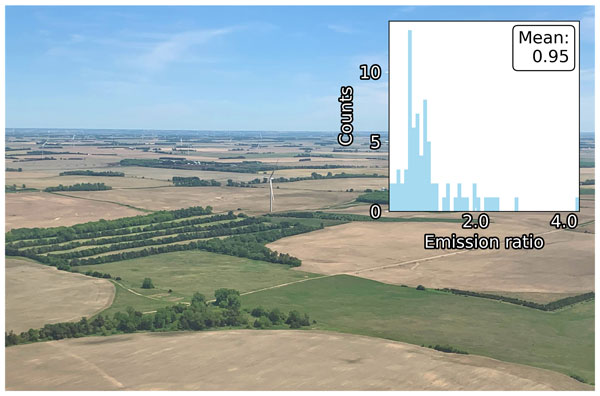
The emission ratio results are shown in Fig.1. A very broad range of values is observed, from close to 0 to well above 1. This is an important results, and shows that the proposed methodology will not provide good results everywhere. Basically the authors suggest that these differences average out when looking at larger regions. But is this really the case?
Are N2O/NO2 ratios expected to be similar in other parts/regions of the world? Can the ratios determined for the San Joaquin valley be used in the other domains in central US (Iowa etc) discussed in Fig.3 ? As mentioned, ratios will depend on moisture, vegetation and soil type, vertiliser use which may vary from one region to another and is also time dependent. This may potentially cause significant biases in the results for a given target region.
In the conclusion: "As presented here, the largest source of uncertainty in the estimated N2O emissions derives from the large variability in the observed airborne N2O:NOx emissions ratio. Improved understanding and definition of this ratio, and what controls variation, could improve the fidelity of this proxy approach. "
This seems to point towards potential improvements in the methodology. If parameters like soil type, land, moisture and rainfall could be correlated with the emission ratios then this could improve the emission estimates and generalise the method to other regions. Please add some comments at the end of the conclusion how the method may be improved in the future.