
the Creative Commons Attribution 4.0 License.
the Creative Commons Attribution 4.0 License.
 | 04 Sep 2025
Higher tree diversity reduces critical slowing down in the Amazon forest
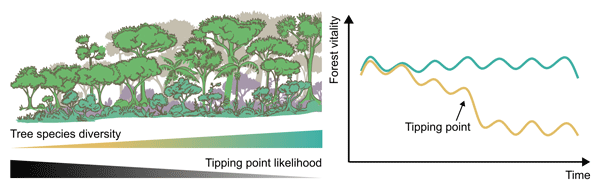
Abstract. The Amazon forest is influenced by strong feedback loops between its biotic and abiotic components. Local forest loss increases CO2 emissions, which, in turn, drives climate change, raising temperatures and reducing rainfall, causing further forest loss. Additionally, forest loss disrupts important forest-rainfall cycles, threatening the overall forest stability. These feedbacks make the system vulnerable to tipping points, where parts of the forest could transition to a degraded state. Critical slowing down is an early warning indicator for approaching tipping points, as it indicates slower recovery to short-term disturbances. However, the role of tree species diversity in this process is yet to be clarified. Furthermore, it is highly uncertain how the relation between tree species diversity and critical slowing down varies with spatial scales. To examine how tree species diversity impacts critical slowing down across multiple spatial scales, we used modelled tree species diversity data at the alpha (local), beta (asynchrony across local communities), and gamma (regional) scales. We quantified critical slowing down on the same scales using temporal autocorrelation trends in monthly satellite-derived vegetation productivity time series over 2001–2019. Our findings reveal more pronounced slowing down at the alpha level (25 km²) compared to the gamma level (209,903 km²), indicating that Amazonian tipping points are more likely to occur locally than regionally or basin-wide. We also observe significant but weak positive linear relationships between tree species diversity and stability at both alpha and beta scales. This emphasizes both the importance of biodiversity conservation at multiple spatial scales and the complexity of understanding the stability of the Amazon forest.
-
Notice on discussion status
The requested preprint has a corresponding peer-reviewed final revised paper. You are encouraged to refer to the final revised version.
-
Preprint
(3283 KB)
-
The requested preprint has a corresponding peer-reviewed final revised paper. You are encouraged to refer to the final revised version.
- Preprint
(3283 KB) - Metadata XML
- BibTeX
- EndNote
- Final revised paper


Journal article(s) based on this preprint
Interactive discussion
Status: closed
-
RC1: 'Comment on egusphere-2025-4148', Anonymous Referee #1, 08 Sep 2025
-
AC1: 'Reply on RC1', Johanna Van Passel, 09 Feb 2026
The authors would like to thank the reviewer for their feedback and for providing insightful recommendations on improving the motivation of the study and the clarity of the text. We have responded to the reviewer's comments in the pdf attached.
-
AC1: 'Reply on RC1', Johanna Van Passel, 09 Feb 2026
-
RC2: 'Comment on egusphere-2025-4148', Anonymous Referee #2, 22 Jan 2026
This manuscript provides a valuable multi-scale analysis of the relationship between tree species diversity and ecosystem stability in the Amazon using satellite-based indicators of critical slowing down. The study is generally well structured and clearly written, with high-quality figures and a commendable effort in data integration and analysis. However, in its current form, several issues in the Methods and Results sections require further clarification. My primary concerns are outlined below.
(1) Limitations of EVI-based indicators
As EVI primarily reflects canopy greenness and phenological dynamics, increases in temporal autocorrelation (TAC) should be interpreted as changes in ecosystem functioning rather than as direct evidence of structural degradation or imminent forest collapse. It is unclear why the analysis relies on a single vegetation index. The authors are encouraged to justify the exclusive use of EVI and to discuss whether incorporating additional indicators (e.g., NDVI, SIF) could improve the robustness of the results.(2) Uncertainty in climate datasets
The manuscript lacks sufficient description of the climate datasets used in the analysis. Please specify which climate products were adopted and provide justification for their selection. Given that different climate datasets may yield differing causal relationships, an assessment or discussion of climate data uncertainty and its potential influence on the causal analysis would strengthen the study.(3) Weak explanatory power in Figure 3
Although the relationships shown in Figure 3 are statistically significant at the alpha and beta scales, their explanatory power is very low (marginal R² = 0.01–0.02). This raises the question of whether such weak correlations are sufficient to support the conclusions regarding the stabilizing role of tree diversity.Citation: https://doi.org/10.5194/egusphere-2025-4148-RC2 -
AC2: 'Reply on RC2', Johanna Van Passel, 09 Feb 2026
The authors would like to thank the reviewer for their feedback and for providing insightful recommendations on improving the motivation of the study and the clarity of the text. We have responded to the reviewer's comments in the pdf attached.
-
AC2: 'Reply on RC2', Johanna Van Passel, 09 Feb 2026
Peer review completion


Interactive discussion
Status: closed
-
RC1: 'Comment on egusphere-2025-4148', Anonymous Referee #1, 08 Sep 2025
General comments:
This manuscript titled “Higher tree diversity reduces critical slowing down in the Amazon forest” presents an interesting study investigating the response of the globally most important forest ecosystem to climate change. To this end, the authors simulate changes in tree species diversity and composition under different scenarios varying in spatial (alpha, beta, gamma) scale. Their findings highlight the critical link between biodiversity and ecosystem stability and thus should have important implications for Amazon forest biodiversity conservation.
Generally, I believe that this is an excellent study based on proper statistical analysis given the complexity of the stability and diversity data being investigated across multiple spatial scales. However, I must admit that when reading through the manuscript at times I was a bit confused about the jargon with regard to the hypothesis investigated in this study. For instance, in L55 you refer to the insurance hypothesis by specifically stating “diversity may increase stability by reducing critical slowing down or the likelihood of tipping points.” Later on, in L71 you expect “a positive correlation between diversity and stability, or a negative correlation between diversity and critical slowing down”. Hence, while it is clear what relationship (negative/positive) you are referring to it might still be worth to improve the clarity of a few sentences by following the logic of arguments. Having said this, I would further recommend rephrasing the title to something more intelligible like “Higher tree diversity reduces the likelihood of Amazon tipping points”. While this might represent a minor issue, I would emphasize the need of further clarifying some details with regard to the methodology applied in this study. Specifically, I am not fully convinced about the following points (listed by line numbers): (i) application of temporal autocorrelation (TAC-1), seasonality index (L117-121) and cumulative water deficit (L166-172); (ii) derivation of alpha stability as the negative value of the TAC(+0.1) trend in the EVI time series (135-145); (iii) representation of causal relationships (alpha, beta, gamma) in the conceptual structural equation model (L195 and L259-263).
Specific comments:
First, if I understand correctly you have extracted monthly EVI images from 2001 to 2019 from the daily Moderate Resolution Imaging Spectrometer (MODIS) and used the decomposed remainder (of the seasonal and trend decomposition) to calculate the lag-1 autocorrelation with a moving window length of five years. While I have applied this method myself and do appreciated its value for investigating temporal correlations among biophysical parameters with their environmental drivers, I do wonder why you did not investigate (or at least mention) any other lags (1/3/6/12 months) in the time-series. Usually, one would expect recurring seasonal (e.g., 6 months or annual) pattern between vegetation parameters and climatic drivers (e.g. Hofhansl et al., 2012), which could be investigated by further computing partial autocorrelations and cross-correlation functions (i.e., ACF and CCF, sensu Venables & Ripley 2002).
Second, I can see why you want to avoid a negative number in the denominator of equation (L135) and you mention the additional analysis being based on a subsection of the dataset (and results presented in the appendix A) but I am still not convinced that the resulting values are representative of shifts in ecosystem function (L393). Hence, while I do concur with the assumption that the pattern detected in the analysis is related to signals in remotely sensed EVI patterns and associated shifts in phenology (L390-393) I would expect that this might be related to short-term fluctuations (in mainly canopy characteristics) rather than long-term dynamics (representing shifts in functional species composition) due to tree mortality.
Third, you indicate that the assumptions for linear regression, such as the linearity of the data, normality of the residuals, homogeneity of residuals variance, and independence of the error terms, have been checked, and that none of them were violated (L204-207) but I am still not fully convinced it is feasible to throw in seemingly related variables, such as alpha, beta, gamma diversity into one and the same structural equation model (even when using piecewise SEM and accounting for random effects, such as “region ID” (L212). Given that tree species richness in this study is being based on model predictions rather than plot measurements wouldn’t be alpha, beta, and gamma diversity therefore be auto correlated and thus violate the assumptions of independence anyway?
Having said that, several foregoing studies have highlighted that the Amazon is more likely to experience local transitions to a degraded state in response to multiple and linked environmental and anthropogenic factors (Franco et al., 2025) rather than to result in a systematic break-down (Rammig et al., 2010).
Nevertheless, I do believe that this analysis represents a valuable contribution to the scientific debate about the fate of the Amazon forest in response to both natural and anthropogenic disturbance, but as indicated above, I would recommend adding clarifying details on the applied methodology (see the specific points raised above) and to further stress the underlying aspects regarding the presentation of the study findings so that the reader could follow the line of arguments presented in the main text in a clear and concise manner.
References (to be considered):
Franco, M.A., Rizzo, L.V., Teixeira, M.J. et al. How climate change and deforestation interact in the transformation of the Amazon rainforest. Nat Commun 16, 7944 (2025). https://doi.org/10.1038/s41467-025-63156-0
Hofhansl, F., J. Kobler, J. Ofner, S. Drage, E.-M. Pölz, and W. Wanek (2014), Sensitivity of tropical forest aboveground productivity to climate anomalies in SW Costa Rica, Global Biogeochem. Cycles, 28, 1437–1454, doi:10.1002/2014GB004934
Rammig, A., Jupp, T., Thonicke, K., Tietjen, B., Heinke, J., Ostberg, S., Lucht, W., Cramer, W. and Cox, P. (2010), Estimating the risk of Amazonian forest dieback. New Phytologist, 187: 694-706. https://doi.org/10.1111/j.1469-8137.2010.03318.x
Venables WN, Ripley BD (2002). Modern Applied Statistics with S, series Statistics and Computing. Springer, New York, NY. doi:10.1007/978-0-387-21706-2
Citation: https://doi.org/10.5194/egusphere-2025-4148-RC1 -
AC1: 'Reply on RC1', Johanna Van Passel, 09 Feb 2026
The authors would like to thank the reviewer for their feedback and for providing insightful recommendations on improving the motivation of the study and the clarity of the text. We have responded to the reviewer's comments in the pdf attached.
-
AC1: 'Reply on RC1', Johanna Van Passel, 09 Feb 2026
-
RC2: 'Comment on egusphere-2025-4148', Anonymous Referee #2, 22 Jan 2026
This manuscript provides a valuable multi-scale analysis of the relationship between tree species diversity and ecosystem stability in the Amazon using satellite-based indicators of critical slowing down. The study is generally well structured and clearly written, with high-quality figures and a commendable effort in data integration and analysis. However, in its current form, several issues in the Methods and Results sections require further clarification. My primary concerns are outlined below.
(1) Limitations of EVI-based indicators
As EVI primarily reflects canopy greenness and phenological dynamics, increases in temporal autocorrelation (TAC) should be interpreted as changes in ecosystem functioning rather than as direct evidence of structural degradation or imminent forest collapse. It is unclear why the analysis relies on a single vegetation index. The authors are encouraged to justify the exclusive use of EVI and to discuss whether incorporating additional indicators (e.g., NDVI, SIF) could improve the robustness of the results.(2) Uncertainty in climate datasets
The manuscript lacks sufficient description of the climate datasets used in the analysis. Please specify which climate products were adopted and provide justification for their selection. Given that different climate datasets may yield differing causal relationships, an assessment or discussion of climate data uncertainty and its potential influence on the causal analysis would strengthen the study.(3) Weak explanatory power in Figure 3
Although the relationships shown in Figure 3 are statistically significant at the alpha and beta scales, their explanatory power is very low (marginal R² = 0.01–0.02). This raises the question of whether such weak correlations are sufficient to support the conclusions regarding the stabilizing role of tree diversity.Citation: https://doi.org/10.5194/egusphere-2025-4148-RC2 -
AC2: 'Reply on RC2', Johanna Van Passel, 09 Feb 2026
The authors would like to thank the reviewer for their feedback and for providing insightful recommendations on improving the motivation of the study and the clarity of the text. We have responded to the reviewer's comments in the pdf attached.
-
AC2: 'Reply on RC2', Johanna Van Passel, 09 Feb 2026
Peer review completion
Journal article(s) based on this preprint
Viewed
| HTML | XML | Total | BibTeX | EndNote | |
|---|---|---|---|---|---|
| 5,447 | 788 | 125 | 6,360 | 115 | 127 |
- HTML: 5,447
- PDF: 788
- XML: 125
- Total: 6,360
- BibTeX: 115
- EndNote: 127
Viewed (geographical distribution)
| Country | # | Views | % |
|---|
| Total: | 0 |
| HTML: | 0 |
| PDF: | 0 |
| XML: | 0 |
- 1
Johanna Van Passel

Koenraad Van Meerbeek
Paulo N. Bernardino
Wanda De Keersmaecker
Stef Lhermitte
Bianca F. Rius
Ben Somers
The requested preprint has a corresponding peer-reviewed final revised paper. You are encouraged to refer to the final revised version.
- Preprint
(3283 KB) - Metadata XML
General comments:
This manuscript titled “Higher tree diversity reduces critical slowing down in the Amazon forest” presents an interesting study investigating the response of the globally most important forest ecosystem to climate change. To this end, the authors simulate changes in tree species diversity and composition under different scenarios varying in spatial (alpha, beta, gamma) scale. Their findings highlight the critical link between biodiversity and ecosystem stability and thus should have important implications for Amazon forest biodiversity conservation.
Generally, I believe that this is an excellent study based on proper statistical analysis given the complexity of the stability and diversity data being investigated across multiple spatial scales. However, I must admit that when reading through the manuscript at times I was a bit confused about the jargon with regard to the hypothesis investigated in this study. For instance, in L55 you refer to the insurance hypothesis by specifically stating “diversity may increase stability by reducing critical slowing down or the likelihood of tipping points.” Later on, in L71 you expect “a positive correlation between diversity and stability, or a negative correlation between diversity and critical slowing down”. Hence, while it is clear what relationship (negative/positive) you are referring to it might still be worth to improve the clarity of a few sentences by following the logic of arguments. Having said this, I would further recommend rephrasing the title to something more intelligible like “Higher tree diversity reduces the likelihood of Amazon tipping points”. While this might represent a minor issue, I would emphasize the need of further clarifying some details with regard to the methodology applied in this study. Specifically, I am not fully convinced about the following points (listed by line numbers): (i) application of temporal autocorrelation (TAC-1), seasonality index (L117-121) and cumulative water deficit (L166-172); (ii) derivation of alpha stability as the negative value of the TAC(+0.1) trend in the EVI time series (135-145); (iii) representation of causal relationships (alpha, beta, gamma) in the conceptual structural equation model (L195 and L259-263).
Specific comments:
First, if I understand correctly you have extracted monthly EVI images from 2001 to 2019 from the daily Moderate Resolution Imaging Spectrometer (MODIS) and used the decomposed remainder (of the seasonal and trend decomposition) to calculate the lag-1 autocorrelation with a moving window length of five years. While I have applied this method myself and do appreciated its value for investigating temporal correlations among biophysical parameters with their environmental drivers, I do wonder why you did not investigate (or at least mention) any other lags (1/3/6/12 months) in the time-series. Usually, one would expect recurring seasonal (e.g., 6 months or annual) pattern between vegetation parameters and climatic drivers (e.g. Hofhansl et al., 2012), which could be investigated by further computing partial autocorrelations and cross-correlation functions (i.e., ACF and CCF, sensu Venables & Ripley 2002).
Second, I can see why you want to avoid a negative number in the denominator of equation (L135) and you mention the additional analysis being based on a subsection of the dataset (and results presented in the appendix A) but I am still not convinced that the resulting values are representative of shifts in ecosystem function (L393). Hence, while I do concur with the assumption that the pattern detected in the analysis is related to signals in remotely sensed EVI patterns and associated shifts in phenology (L390-393) I would expect that this might be related to short-term fluctuations (in mainly canopy characteristics) rather than long-term dynamics (representing shifts in functional species composition) due to tree mortality.
Third, you indicate that the assumptions for linear regression, such as the linearity of the data, normality of the residuals, homogeneity of residuals variance, and independence of the error terms, have been checked, and that none of them were violated (L204-207) but I am still not fully convinced it is feasible to throw in seemingly related variables, such as alpha, beta, gamma diversity into one and the same structural equation model (even when using piecewise SEM and accounting for random effects, such as “region ID” (L212). Given that tree species richness in this study is being based on model predictions rather than plot measurements wouldn’t be alpha, beta, and gamma diversity therefore be auto correlated and thus violate the assumptions of independence anyway?
Having said that, several foregoing studies have highlighted that the Amazon is more likely to experience local transitions to a degraded state in response to multiple and linked environmental and anthropogenic factors (Franco et al., 2025) rather than to result in a systematic break-down (Rammig et al., 2010).
Nevertheless, I do believe that this analysis represents a valuable contribution to the scientific debate about the fate of the Amazon forest in response to both natural and anthropogenic disturbance, but as indicated above, I would recommend adding clarifying details on the applied methodology (see the specific points raised above) and to further stress the underlying aspects regarding the presentation of the study findings so that the reader could follow the line of arguments presented in the main text in a clear and concise manner.
References (to be considered):
Franco, M.A., Rizzo, L.V., Teixeira, M.J. et al. How climate change and deforestation interact in the transformation of the Amazon rainforest. Nat Commun 16, 7944 (2025). https://doi.org/10.1038/s41467-025-63156-0
Hofhansl, F., J. Kobler, J. Ofner, S. Drage, E.-M. Pölz, and W. Wanek (2014), Sensitivity of tropical forest aboveground productivity to climate anomalies in SW Costa Rica, Global Biogeochem. Cycles, 28, 1437–1454, doi:10.1002/2014GB004934
Rammig, A., Jupp, T., Thonicke, K., Tietjen, B., Heinke, J., Ostberg, S., Lucht, W., Cramer, W. and Cox, P. (2010), Estimating the risk of Amazonian forest dieback. New Phytologist, 187: 694-706. https://doi.org/10.1111/j.1469-8137.2010.03318.x
Venables WN, Ripley BD (2002). Modern Applied Statistics with S, series Statistics and Computing. Springer, New York, NY. doi:10.1007/978-0-387-21706-2