
the Creative Commons Attribution 4.0 License.
the Creative Commons Attribution 4.0 License.
 | 16 Sep 2025
Mesoscale modulation of marine boundary layer water vapor isotopologues during EUREC4A
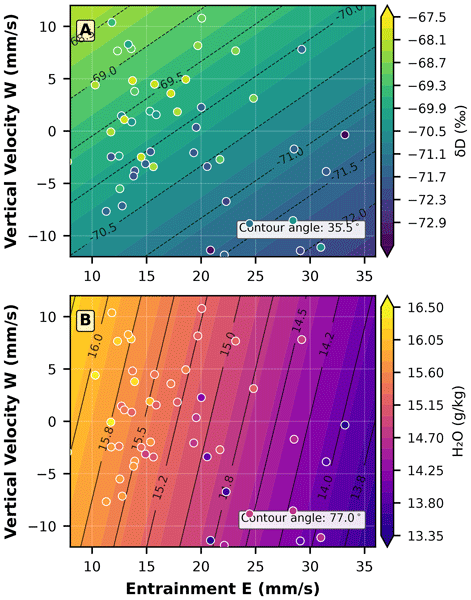
Abstract. Shallow cumulus clouds in trade-wind regions remain a major source of uncertainty in climate projections, with conflicting hypotheses about how mesoscale circulations affect boundary layer moisture. We analyze water vapor isotopologue measurements from the EUREC4A campaign to quantify mesoscale modulation of marine boundary layer humidity and composition. Surface δD measurements from R/V Meteor show remarkably strong sensitivity to mesoscale vertical motions, responding 7.5 times more strongly than humidity when normalized by observed standard deviations. Mesoscale upward motion counteracts entrainment-driven isotopic depletion with an efficiency of 1.19, meaning 1 mm s-1 of vertical velocity more than cancels the isotopic effect of 1 mm s-1 of entrainment. The strongest correlations between vertical velocity and both δD (r ≈ 0.52) and mixing ratio (r ≈ 0.39) occur within ±200 m of the subcloud layer (SCL) top. A flux-form mixed-layer model reproduces these asymmetric responses, providing mechanistic understanding of how mesoscale circulations fundamentally modulate boundary layer moisture processes.
-
Notice on discussion status
The requested preprint has a corresponding peer-reviewed final revised paper. You are encouraged to refer to the final revised version.
-
Preprint
(5873 KB)
-
The requested preprint has a corresponding peer-reviewed final revised paper. You are encouraged to refer to the final revised version.
- Preprint
(5873 KB) - Metadata XML
- BibTeX
- EndNote
- Final revised paper


Journal article(s) based on this preprint
Interactive discussion
Status: closed
-
RC1: 'Comment on egusphere-2025-4128', Anonymous Referee #1, 27 Oct 2025
The comment was uploaded in the form of a supplement: https://egusphere.copernicus.org/preprints/2025/egusphere-2025-4128/egusphere-2025-4128-RC1-supplement.pdfCitation: https://doi.org/
10.5194/egusphere-2025-4128-RC1 -
RC2: 'Comment on egusphere-2025-4128', Anonymous Referee #2, 11 Nov 2025
The comment was uploaded in the form of a supplement: https://egusphere.copernicus.org/preprints/2025/egusphere-2025-4128/egusphere-2025-4128-RC2-supplement.pdf
-
AC1: 'Comment on egusphere-2025-4128', Joe Galewsky, 09 Jan 2026
We thank the reviewers for their comments. Based on their feedback, we have significantly revised the manuscript. Most notably, we have updated our mixed-layer model to include hydrometeor-vapor isotopic exchange, which resolves the physical discrepancies noted by Reviewer 2. We have also refined our statistical analysis to use standardized regression coefficients as suggested by Reviewer 1, and corrected the citation errors. These changes have strengthened the physical interpretation of the results. Our detailed responses are attached as a PDF.
Peer review completion


Interactive discussion
Status: closed
-
RC1: 'Comment on egusphere-2025-4128', Anonymous Referee #1, 27 Oct 2025
The comment was uploaded in the form of a supplement: https://egusphere.copernicus.org/preprints/2025/egusphere-2025-4128/egusphere-2025-4128-RC1-supplement.pdf
-
RC2: 'Comment on egusphere-2025-4128', Anonymous Referee #2, 11 Nov 2025
The comment was uploaded in the form of a supplement: https://egusphere.copernicus.org/preprints/2025/egusphere-2025-4128/egusphere-2025-4128-RC2-supplement.pdf
-
AC1: 'Comment on egusphere-2025-4128', Joe Galewsky, 09 Jan 2026
We thank the reviewers for their comments. Based on their feedback, we have significantly revised the manuscript. Most notably, we have updated our mixed-layer model to include hydrometeor-vapor isotopic exchange, which resolves the physical discrepancies noted by Reviewer 2. We have also refined our statistical analysis to use standardized regression coefficients as suggested by Reviewer 1, and corrected the citation errors. These changes have strengthened the physical interpretation of the results. Our detailed responses are attached as a PDF.
Peer review completion
Journal article(s) based on this preprint
Viewed
| HTML | XML | Total | BibTeX | EndNote | |
|---|---|---|---|---|---|
| 10,570 | 568 | 178 | 11,316 | 173 | 208 |
- HTML: 10,570
- PDF: 568
- XML: 178
- Total: 11,316
- BibTeX: 173
- EndNote: 208
Viewed (geographical distribution)
| Country | # | Views | % |
|---|
| Total: | 0 |
| HTML: | 0 |
| PDF: | 0 |
| XML: | 0 |
- 1
Sebastian A. Los
The requested preprint has a corresponding peer-reviewed final revised paper. You are encouraged to refer to the final revised version.
- Preprint
(5873 KB) - Metadata XML