
the Creative Commons Attribution 4.0 License.
the Creative Commons Attribution 4.0 License.
 | 02 Sep 2025
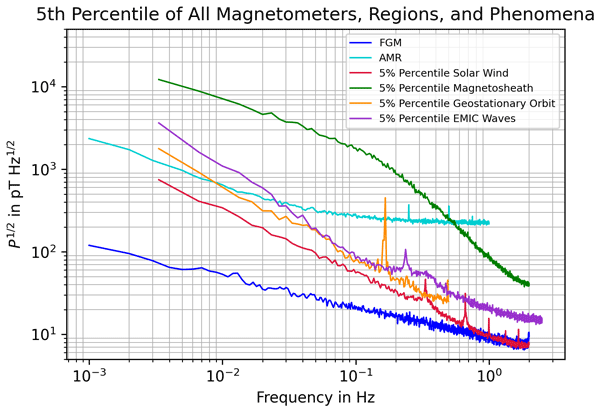
Comparison of noise levels of different magnetometer types and space environments
Abstract. The plasma environment around Earth has markedly different characteristics of the magnetic field across distinct spatial regions. In the solar wind, beyond Earth's magnetic influence, the magnetic field is relatively low and less fluctuating. In contrast, the magnetosheath – the region between the bow shock and the magnetopause – is characterized by significantly more turbulent magnetic fields. Within the magnetosphere, the magnetic field can go up to tens of thousands of nanotesla (nT). Traditionally, 5 fluxgate magnetometers have been the standard instrument for space-based magnetic field measurements. However, in recent years, alternative technologies such as anisotropic magnetoresistive (AMR) sensors and optically pumped magnetometers have been proposed and, in some cases, deployed. This study compares the noise performances of two magnetometers, a fluxgate and an AMR, by evaluating their amplitude spectral density measurements across various near-Earth regions of space. The potential of each sensor type for investigating specific phenomena is also evaluated.
-
Notice on discussion status
The requested preprint has a corresponding peer-reviewed final revised paper. You are encouraged to refer to the final revised version.
-
Preprint
(1464 KB)
-
The requested preprint has a corresponding peer-reviewed final revised paper. You are encouraged to refer to the final revised version.
- Preprint
(1464 KB) - Metadata XML
- BibTeX
- EndNote
- Final revised paper


Journal article(s) based on this preprint
Interactive discussion
Status: closed
-
RC1: 'Comment on egusphere-2025-4095', Anonymous Referee #1, 05 Oct 2025
The comment was uploaded in the form of a supplement: https://egusphere.copernicus.org/preprints/2025/egusphere-2025-4095/egusphere-2025-4095-RC1-supplement.pdfCitation: https://doi.org/
10.5194/egusphere-2025-4095-RC1 -
AC2: 'Reply on RC1', Gerlinde Timmermann, 10 Nov 2025
- AC3: 'Reply on AC2', Gerlinde Timmermann, 10 Nov 2025
-
AC2: 'Reply on RC1', Gerlinde Timmermann, 10 Nov 2025
-
RC2: 'Comment on egusphere-2025-4095', Anonymous Referee #2, 25 Oct 2025
General note
The work is devoted to investigation of noise characteristics of FGM and AMR sensors designed for onboard satellite installation. Suitability of these sensors for different measurement scenarios is analyzed.
Manuscript is well written. Scientific approach is rigorous. Conclusions are proved by results of analysis performed.
Specific note
My only note concerns presentation of the results in Table 1. Usually, experimental data figures are presented in such a way that last significant digit corresponds to the confidence level of the measurement result. I wonder if an accuracy of results presented in Table 1 corresponds to seven significant digits.
Citation: https://doi.org/10.5194/egusphere-2025-4095-RC2 -
AC1: 'Reply on RC2', Gerlinde Timmermann, 30 Oct 2025
We thank the referee for reviewing the paper and for the valuable feedback! Concerning the specific note about the accuracy of the measurements given in Table 1, that is a valid point and now everything is rounded to full pT.
Citation: https://doi.org/10.5194/egusphere-2025-4095-AC1
-
AC1: 'Reply on RC2', Gerlinde Timmermann, 30 Oct 2025
Peer review completion


Interactive discussion
Status: closed
-
RC1: 'Comment on egusphere-2025-4095', Anonymous Referee #1, 05 Oct 2025
The comment was uploaded in the form of a supplement: https://egusphere.copernicus.org/preprints/2025/egusphere-2025-4095/egusphere-2025-4095-RC1-supplement.pdf
-
AC2: 'Reply on RC1', Gerlinde Timmermann, 10 Nov 2025
- AC3: 'Reply on AC2', Gerlinde Timmermann, 10 Nov 2025
-
AC2: 'Reply on RC1', Gerlinde Timmermann, 10 Nov 2025
-
RC2: 'Comment on egusphere-2025-4095', Anonymous Referee #2, 25 Oct 2025
General note
The work is devoted to investigation of noise characteristics of FGM and AMR sensors designed for onboard satellite installation. Suitability of these sensors for different measurement scenarios is analyzed.
Manuscript is well written. Scientific approach is rigorous. Conclusions are proved by results of analysis performed.
Specific note
My only note concerns presentation of the results in Table 1. Usually, experimental data figures are presented in such a way that last significant digit corresponds to the confidence level of the measurement result. I wonder if an accuracy of results presented in Table 1 corresponds to seven significant digits.
Citation: https://doi.org/10.5194/egusphere-2025-4095-RC2 -
AC1: 'Reply on RC2', Gerlinde Timmermann, 30 Oct 2025
We thank the referee for reviewing the paper and for the valuable feedback! Concerning the specific note about the accuracy of the measurements given in Table 1, that is a valid point and now everything is rounded to full pT.
Citation: https://doi.org/10.5194/egusphere-2025-4095-AC1
-
AC1: 'Reply on RC2', Gerlinde Timmermann, 30 Oct 2025
Peer review completion
Journal article(s) based on this preprint
Viewed
| HTML | XML | Total | BibTeX | EndNote | |
|---|---|---|---|---|---|
| 2,178 | 980 | 105 | 3,263 | 114 | 145 |
- HTML: 2,178
- PDF: 980
- XML: 105
- Total: 3,263
- BibTeX: 114
- EndNote: 145
Viewed (geographical distribution)
| Country | # | Views | % |
|---|
| Total: | 0 |
| HTML: | 0 |
| PDF: | 0 |
| XML: | 0 |
- 1
Gerlinde Timmermann

David Fischer
Hans-Ulrich Auster
Ingo Richter
Benjamin Grison
Ferdinand Plaschke
The requested preprint has a corresponding peer-reviewed final revised paper. You are encouraged to refer to the final revised version.
- Preprint
(1464 KB) - Metadata XML