
the Creative Commons Attribution 4.0 License.
the Creative Commons Attribution 4.0 License.
 | 01 Sep 2025
Dynamic quantification of methane emissions at facility scale using laser tomography: demonstration of a farm deployment
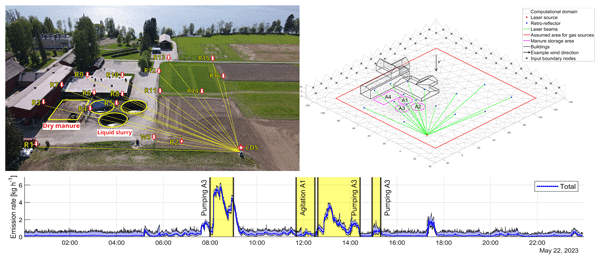
Abstract. Detecting and quantifying greenhouse gas (GHG) emissions is essential for understanding global GHG budgets, updating emission inventories, and evaluating climate change mitigation efforts. Most anthropogenic emissions occur at the scale of facilities, and emission distribution in time and space relates to facility operations. This paper focuses on a novel GHG monitoring technique referred to as laser dispersion tomography (LDT). It uses sequential multi-beam open-path laser dispersion spectroscopy measurements and wind data to infer dynamic GHG concentration and source maps at facility scale. In this work, the use of LDT for monitoring methane emissions in agriculture is demonstrated by deploying it on an operational farm. For this aim, computational methods used in data analysis of LDT are also further developed. Particularly, we introduce spatial constraints to the tomographic reconstruction based on prior knowledge on potential source locations – information often available in facility-scale GHG monitoring applications – and investigate numerically whether such constraints could improve the tolerance of LDT to effects of conditions typical in farm environments, such as complex wind fields caused by buildings and interfering external emission sources. The results of numerical studies indicate that including spatial constraints reduces the uncertainty and improves the reliability of source quantification in such conditions. In the experimental study, dynamic emission patterns caused by various operations in the farm, such as slurry and dry manure management, are well captured, both temporally and spatially. The results support the feasibility of LDT as a tool for robust quantification of GHG mass emission rates at farms, especially when the spatial constraining of sources is possible. Owing to the fine spatial and temporal resolution of LDT, we foresee its use in improving GHG emission inventories through fine parametrization, and also its extension to other GHGs and other sectors contributing to global emissions.
-
Notice on discussion status
The requested preprint has a corresponding peer-reviewed final revised paper. You are encouraged to refer to the final revised version.
-
Preprint
(32764 KB)
-
Supplement
(2814 KB)
-
The requested preprint has a corresponding peer-reviewed final revised paper. You are encouraged to refer to the final revised version.
- Preprint
(32764 KB) - Metadata XML
-
Supplement
(2814 KB) - BibTeX
- EndNote
- Final revised paper


Journal article(s) based on this preprint
Interactive discussion
Status: closed
-
RC1: 'Comment on egusphere-2025-3977', Anonymous Referee #1, 08 Dec 2025
-
AC1: 'Please find attached our response to the reviewers.', Kenneth Scheel, 13 Mar 2026
The comment was uploaded in the form of a supplement: https://egusphere.copernicus.org/preprints/2025/egusphere-2025-3977/egusphere-2025-3977-AC1-supplement.pdf
-
AC1: 'Please find attached our response to the reviewers.', Kenneth Scheel, 13 Mar 2026
-
RC2: 'Comment on egusphere-2025-3977', Hossein Maazallahi, 15 Feb 2026
-
AC1: 'Please find attached our response to the reviewers.', Kenneth Scheel, 13 Mar 2026
The comment was uploaded in the form of a supplement: https://egusphere.copernicus.org/preprints/2025/egusphere-2025-3977/egusphere-2025-3977-AC1-supplement.pdf
-
AC1: 'Please find attached our response to the reviewers.', Kenneth Scheel, 13 Mar 2026
Peer review completion


Interactive discussion
Status: closed
-
RC1: 'Comment on egusphere-2025-3977', Anonymous Referee #1, 08 Dec 2025
The manuscript showcases the time resolved measurement of methane emissions from a dairy farm (on the facility level, with a potential for spatial attribution). It describes the full process, starting with a brief description of the optical technique itself, continuing with the modelling of the atmospheric transport and arriving at the inversion framework. The authors do a great job at clearly separating the setup specific part of the model (observation model) and the general part (evolution model) which improves the accessibility and relevance for different communities (in-situ, remote sensing, etc.). The manuscript goes on to include synthetic studies as well as demonstrations with real data. The study is quite extensive and an uncommon example of combining all the above in a single manuscript. Since the topic of inferring greenhouse gas emissions from concentration measurements in general and from path-average concentration measurements in particular is highly relevant to this journal, I recommend publishing the manuscript after addressing some minor issues. Is summed those up in two general points (concerning the literature overview and the general research question) and multiple line-by-line comments.
Literature overview:
I feel that your overview of the spectroscopic methods is too limited. It ignores at least the following techniques:
NIR long open-path FTIR techniques [1-2], which do not suffer from the limited range as MIR FTIR due to higher brightness.
Dual Comb Spectroscopy (DCS), which was even already employed for different emission estimations, including from cattle [3-4]
Other methods utilizing frequency combs or super-continuum sources [5]There is also a wider context of tomography using path averaged measurements of gas concentration retrieved from optical measurements going back more than two decades, which would be fair to mention here somehow. Difficult to pick a single one, but for example [6].
Finally, it seems reasonable to mention other projects with similar methodology, even if the trace gas under analysis or the scale differs. For example [7].
General research question:
Likely as a result of the manuscript being so extensive and addressing so many facets, I feel that at multiple points the concrete research question is a bit unclear. I try to point some of these situations out in my line-by-line comments below. I encourage the authors to try to phrase their research questions precisely and go over the manuscript again, removing details where it is maybe not necessary and adding where the main message needs it.
Line-by-line comments:
- L. 47: “high-resolution” is a very flexible term, and seems a bit arbitrary here. I would estimate that the employed resolutions roughly span 5.0 1/cm to 5.0E-3 1/cm, ranging from grating spectrometers via FTIR to most laser solutions and DCS. Maybe you can be a bit more precise here with what you mean?
- L. 48: Tedeschi is an odd choice for the general statement (not limited to methane or emissions from agriculture) concerning the development of high resolution optical gas concentration.
- L. 53: The limited range is more due to low source brightness then coherence in my understanding.
- L. 54: A citation for the developing hyperspectral remote sensing instruments is needed here. In the context of methane emissions [8] might be an option.
- L. 100: Please state a clear and precise summary of the technical data of your system or at least a single publication where this is provided in a concise manner.
- L. 116: Typing “ppm x m” as ppm.m seems at leastodd to me.
- L. 275f: What do the two noise components describe, in particular the “ 1 % of the difference between the maximum and minimum values of the simulated measurements”?
- L. 302f: Citation for the COMSOL model?
- L. 311ff: I am not certain on this, but your arguments for novelty seem to be things that models like GRAMM/GRAL (e.g. [9]) do for a while now. Is this the case? If so, what makes your approach novel? And why are you not using a model like GRAMM/GRAL to describe the atmospheric transport but write your own? I would suggest you address these questions at a suitable place in your manuscript.
- L. 343: Is N_A your Nbar from Table 2?
- L. 361 & Fig. 4: In my opinion the different colour bar in the 5th column is misleading. If you feel that a plot with a shared colour bar might be underselling your work, then maybe consider printing the integrated emissions in the top right corner of each plot in column 4-6.
- L. 370f: Your argument with the approximate wind field model comes up multiple times in the manuscript and it is not always clear to me. In a synthetic study, I would assume that you still have a correct description of your “physics”, assuming the model was used for forward modelling and inversion. Is this not the case? Also, in any case, is this not more a case of your windspeed measurements giving you not the full information on the local wind field?
- L. 418ff: That the spatial extent of the reconstructed source in A4 is only half the width of the true source is just a result of the (spatial) constraints that you put on your “unconstrained” emission model right? Same as with the difficulty for the unconstrained model to allow for two different emission spots – you supress that possibility to make it more stable/solve the degeneracy of the ill-posed inversion problem?
- L. 432: See also comment to L. 370f. Some explanation why the misrepresentation gives you the correct magnitude of model error would be beneficial.
- L. 433: Language. Because “it is” trapped…
- L. 434f: This points again to the point which is unclear to me about the misrepresentation of the wind fields in the synthetic study. Are there different models at work?
- L. 452: Why did you not include May 21st? This would provide a good test for your method if there is not a large amount of prior knowledge on the emissions (spatial emission pattern and emission time). Including this for the stated reason makes this seem like pretext.
- L. 462f: I think your choice of taking the background from the first two days of measurements requires a bit more explanation. Over the course of three weeks the background can of course change. Can you provide an argument/measurement data that the background did not increase during this time period in a way that it significantly interfered in relation with the scale of enhancements you were targeting?
- Fig. 10: I would like to see a more thorough addressing of all the other peaks. A4 shows emissions all the time. Are they real or artefacts? Are the emissions of A4 during the agitation event of A3 real or misallocation?
- L. 496 and Fig 11: The scale of (potential?) misrepresentation between A3 and A4 seems to be similar between Fig 10 and Fig 11.
- L. 512 and Fig. 12: I am not fully convinced that the more flat emissions for A4 is only a result of the removed pile. You always argued with the misrepresentation of the wind fields – could this also be a result of a different wind situation where your model fits better and shows less erratic behaviour? Is this a general observation for all the days after removal of the pile? I feel this needs more argumentation.
- L. 526ff: Neither the mechanism of release (trapped bubbles) nor agitation by heavy rainfall or similar seem to be directly part of your study. To me you mix too much your own measurements, results and conclusions with those of others.
- L. 533f: “The emission rates inferred correlate very well with the known activity windows.” I do not necessarily agree with this statement, since you only looked at those activity windows (for example ignored the measurements on May 21st.) and in general your timetrace shows (summed) emissions at nearly any time. So please be more precise here what you are actually stating.
- L. 534ff: I also don’t agree with the statement of the dropping emissions here. Around 14:00 is a time period where a similar low emission is measured. Or it could be a function of other parameters (drop height?). Also I don’t understand why this is important. It seems only relevant if you want to infer in detail the release mechanism on a microscopic level? More general speaking, I think in this paragraph the research question at hand gets a bit muddled.
- L. 543: “These signals disappear after the manure pile is removed” – This is a good point which addresses partially earlier questions of mine, but I would encourage you to address this concisely in more detail in the context of the remarks above.
- L. 555-558: This seems to be the actual main question of your discussion to me, because it is mainly the question “what are real emissions and what are artefacts?”. But I think it requires a more structured argumentation.
- L. 584f: The constrained source model should always be more reliable since you add a lot of additional information.
References:
[1] Schmitt, T. D., Kuhn, J., Kleinschek, R., Löw, B. A., Schmitt, S., Cranton, W., Schmidt, M., Vardag, S. N., Hase, F., Griffith, D. W. T., and Butz, A.: An open-path observatory for greenhouse gases based on near-infrared Fourier transform spectroscopy, Atmos. Meas. Tech., 16, 6097–6110, https://doi.org/10.5194/amt-16-6097-2023, 2023.
[2] Deutscher, N. M., Naylor, T. A., Caldow, C. G. R., McDougall, H. L., Carter, A. G., and Griffith, D. W. T.: Performance of an open-path near-infrared measurement system for measurements of CO2 and CH4 during extended field trials, Atmos. Meas. Tech., 14, 3119–3130, https://doi.org/10.5194/amt-14-3119-2021, 2021.
[3] D. I. Herman, C. Weerasekara, L. C. Hutcherson, F. R. Giorgetta, K. C. Cossel, E. M. Waxman, G. M. Colacion, N. R. Newbury, S. M. Welch, B. D. DePaola, I. Coddington, E. A. Santos, B. R. Washburn, Precise multispecies agricultural gas flux determined using broadband open-path dual-comb spectroscopy. Sci. Adv. 7, eabe9765 (2021).
[4] Weerasekara, C., Morris, L. C., Malarich, N. A., Giorgetta, F. R., Herman, D. I., Cossel, K. C., Newbury, N. R., Owensby, C. E., Welch, S. M., Blaga, C., DePaola, B. D., Coddington, I., Washburn, B. R., and Santos, E. A.: Using open-path dual-comb spectroscopy to monitor methane emissions from simulated grazing cattle, Atmos. Meas. Tech., 17, 6107–6117, https://doi.org/10.5194/amt-17-6107-2024, 2024.
[5] Roderik Krebbers, Kees van Kempen, Yueyu Lin, Joris Meurs, Lisanne Hendriks, Ralf Aben, José R. Paranaiba, Christian Fritz, Annelies J. Veraart, Amir Khodabakhsh, Simona M. Cristescu, Ultra-broadband coherent open-path spectroscopy for multi-gas monitoring in wastewater treatment, Environmental Science and Ecotechnology, Volume 25, 2025, https://doi.org/10.1016/j.ese.2025.100554. (https://www.sciencedirect.com/science/article/pii/S2666498425000328)
[6] Irene Pundt, DOAS tomography for the localisation and quantification of anthropogenic air pollution, Anal Bioanal Chem (2006) 385: 18–21, DOI 10.1007/s00216-005-0205-4, 2006
[7] Lian, J., Bréon, F.-M., Broquet, G., Zaccheo, T. S., Dobler, J., Ramonet, M., Staufer, J., Santaren, D., Xueref-Remy, I., and Ciais, P.: Analysis of temporal and spatial variability of atmospheric CO2 concentration within Paris from the GreenLITE™ laser imaging experiment, Atmos. Chem. Phys., 19, 13809–13825, https://doi.org/10.5194/acp-19-13809-2019, 2019.
[8] M Knapp et al 2023 Environ. Res. Lett. 18 044030, DOI: 10.1088/1748-9326/acc346
[9] Brunner, D., Suter, I., Bernet, L., Constantin, L., Grange, S. K., Rubli, P., Li, J., Chen, J., Bigi, A., and Emmenegger, L.: Building-resolving simulations of anthropogenic and biospheric CO2 in the city of Zurich with GRAMM/GRAL, Atmos. Chem. Phys., 25, 14387–14410, https://doi.org/10.5194/acp-25-14387-2025, 2025.
Citation: https://doi.org/10.5194/egusphere-2025-3977-RC1 -
AC1: 'Please find attached our response to the reviewers.', Kenneth Scheel, 13 Mar 2026
The comment was uploaded in the form of a supplement: https://egusphere.copernicus.org/preprints/2025/egusphere-2025-3977/egusphere-2025-3977-AC1-supplement.pdf
-
RC2: 'Comment on egusphere-2025-3977', Hossein Maazallahi, 15 Feb 2026
-
AC1: 'Please find attached our response to the reviewers.', Kenneth Scheel, 13 Mar 2026
The comment was uploaded in the form of a supplement: https://egusphere.copernicus.org/preprints/2025/egusphere-2025-3977/egusphere-2025-3977-AC1-supplement.pdf
-
AC1: 'Please find attached our response to the reviewers.', Kenneth Scheel, 13 Mar 2026
Peer review completion
Journal article(s) based on this preprint
Viewed
| HTML | XML | Total | Supplement | BibTeX | EndNote | |
|---|---|---|---|---|---|---|
| 5,641 | 1,717 | 102 | 7,460 | 251 | 118 | 147 |
- HTML: 5,641
- PDF: 1,717
- XML: 102
- Total: 7,460
- Supplement: 251
- BibTeX: 118
- EndNote: 147
Viewed (geographical distribution)
| Country | # | Views | % |
|---|
| Total: | 0 |
| HTML: | 0 |
| PDF: | 0 |
| XML: | 0 |
- 1

Elias Vänskä
Damien Weidmann
Aku Ursin
The requested preprint has a corresponding peer-reviewed final revised paper. You are encouraged to refer to the final revised version.
- Preprint
(32764 KB) - Metadata XML
-
Supplement
(2814 KB) - BibTeX
- EndNote
- Final revised paper
The manuscript showcases the time resolved measurement of methane emissions from a dairy farm (on the facility level, with a potential for spatial attribution). It describes the full process, starting with a brief description of the optical technique itself, continuing with the modelling of the atmospheric transport and arriving at the inversion framework. The authors do a great job at clearly separating the setup specific part of the model (observation model) and the general part (evolution model) which improves the accessibility and relevance for different communities (in-situ, remote sensing, etc.). The manuscript goes on to include synthetic studies as well as demonstrations with real data. The study is quite extensive and an uncommon example of combining all the above in a single manuscript. Since the topic of inferring greenhouse gas emissions from concentration measurements in general and from path-average concentration measurements in particular is highly relevant to this journal, I recommend publishing the manuscript after addressing some minor issues. Is summed those up in two general points (concerning the literature overview and the general research question) and multiple line-by-line comments.
Literature overview:
I feel that your overview of the spectroscopic methods is too limited. It ignores at least the following techniques:
NIR long open-path FTIR techniques [1-2], which do not suffer from the limited range as MIR FTIR due to higher brightness.
Dual Comb Spectroscopy (DCS), which was even already employed for different emission estimations, including from cattle [3-4]
Other methods utilizing frequency combs or super-continuum sources [5]
There is also a wider context of tomography using path averaged measurements of gas concentration retrieved from optical measurements going back more than two decades, which would be fair to mention here somehow. Difficult to pick a single one, but for example [6].
Finally, it seems reasonable to mention other projects with similar methodology, even if the trace gas under analysis or the scale differs. For example [7].
General research question:
Likely as a result of the manuscript being so extensive and addressing so many facets, I feel that at multiple points the concrete research question is a bit unclear. I try to point some of these situations out in my line-by-line comments below. I encourage the authors to try to phrase their research questions precisely and go over the manuscript again, removing details where it is maybe not necessary and adding where the main message needs it.
Line-by-line comments:
References:
[1] Schmitt, T. D., Kuhn, J., Kleinschek, R., Löw, B. A., Schmitt, S., Cranton, W., Schmidt, M., Vardag, S. N., Hase, F., Griffith, D. W. T., and Butz, A.: An open-path observatory for greenhouse gases based on near-infrared Fourier transform spectroscopy, Atmos. Meas. Tech., 16, 6097–6110, https://doi.org/10.5194/amt-16-6097-2023, 2023.
[2] Deutscher, N. M., Naylor, T. A., Caldow, C. G. R., McDougall, H. L., Carter, A. G., and Griffith, D. W. T.: Performance of an open-path near-infrared measurement system for measurements of CO2 and CH4 during extended field trials, Atmos. Meas. Tech., 14, 3119–3130, https://doi.org/10.5194/amt-14-3119-2021, 2021.
[3] D. I. Herman, C. Weerasekara, L. C. Hutcherson, F. R. Giorgetta, K. C. Cossel, E. M. Waxman, G. M. Colacion, N. R. Newbury, S. M. Welch, B. D. DePaola, I. Coddington, E. A. Santos, B. R. Washburn, Precise multispecies agricultural gas flux determined using broadband open-path dual-comb spectroscopy. Sci. Adv. 7, eabe9765 (2021).
[4] Weerasekara, C., Morris, L. C., Malarich, N. A., Giorgetta, F. R., Herman, D. I., Cossel, K. C., Newbury, N. R., Owensby, C. E., Welch, S. M., Blaga, C., DePaola, B. D., Coddington, I., Washburn, B. R., and Santos, E. A.: Using open-path dual-comb spectroscopy to monitor methane emissions from simulated grazing cattle, Atmos. Meas. Tech., 17, 6107–6117, https://doi.org/10.5194/amt-17-6107-2024, 2024.
[5] Roderik Krebbers, Kees van Kempen, Yueyu Lin, Joris Meurs, Lisanne Hendriks, Ralf Aben, José R. Paranaiba, Christian Fritz, Annelies J. Veraart, Amir Khodabakhsh, Simona M. Cristescu, Ultra-broadband coherent open-path spectroscopy for multi-gas monitoring in wastewater treatment, Environmental Science and Ecotechnology, Volume 25, 2025, https://doi.org/10.1016/j.ese.2025.100554. (https://www.sciencedirect.com/science/article/pii/S2666498425000328)
[6] Irene Pundt, DOAS tomography for the localisation and quantification of anthropogenic air pollution, Anal Bioanal Chem (2006) 385: 18–21, DOI 10.1007/s00216-005-0205-4, 2006
[7] Lian, J., Bréon, F.-M., Broquet, G., Zaccheo, T. S., Dobler, J., Ramonet, M., Staufer, J., Santaren, D., Xueref-Remy, I., and Ciais, P.: Analysis of temporal and spatial variability of atmospheric CO2 concentration within Paris from the GreenLITE™ laser imaging experiment, Atmos. Chem. Phys., 19, 13809–13825, https://doi.org/10.5194/acp-19-13809-2019, 2019.
[8] M Knapp et al 2023 Environ. Res. Lett. 18 044030, DOI: 10.1088/1748-9326/acc346
[9] Brunner, D., Suter, I., Bernet, L., Constantin, L., Grange, S. K., Rubli, P., Li, J., Chen, J., Bigi, A., and Emmenegger, L.: Building-resolving simulations of anthropogenic and biospheric CO2 in the city of Zurich with GRAMM/GRAL, Atmos. Chem. Phys., 25, 14387–14410, https://doi.org/10.5194/acp-25-14387-2025, 2025.