
the Creative Commons Attribution 4.0 License.
the Creative Commons Attribution 4.0 License.
 | 15 Sep 2025
On moist ocean-atmosphere coupling mechanisms
Abstract. We investigate mechanisms governing moist energy exchanges at the atmosphere-ocean interface in global Earth system models. The goal of this work is to overcome deficiencies like energy fixers and unphysical thermodynamic formulations and designs that are commonly used in modern models. For example, while the ocean surface evaporation is one of the most significant climatological drivers, its representation in numerical models may not be physically accurate. In particular, existing schemes give an incorrect atmospheric air temperature tendency during evaporation events. To remedy this, starting from first principles, we develop a new mechanism for the ocean-atmosphere moist energy transfers. It utilizes consistent thermodynamics of water species, distributes latent heat of evaporation in a physically plausible way, and avoids reliance on artificial energy fixers. The temperature and water mass tendencies are used to formulate a set of ordinary differential equations (ODEs) representing a simple box model of ocean-air exchange. We investigate the properties of the ODEs representing the proposed mechanism and compare them against those derived from the current designs of the Energy Exascale Earth System Model (E3SM). The proposed simplified box model highlights the advantages of our approach in capturing physically appropriate atmospheric temperature changes during evaporation while conserving energy.
-
Notice on discussion status
The requested preprint has a corresponding peer-reviewed final revised paper. You are encouraged to refer to the final revised version.
-
Preprint
(1580 KB)
-
The requested preprint has a corresponding peer-reviewed final revised paper. You are encouraged to refer to the final revised version.
- Preprint
(1580 KB) - Metadata XML
- BibTeX
- EndNote
- Final revised paper


Journal article(s) based on this preprint
Interactive discussion
Status: closed
-
RC1: 'Comment on egusphere-2025-3966', Thomas Bendall, 14 Nov 2025
- AC1: 'Reply on RC2', Oksana Guba, 04 Mar 2026
-
RC2: 'Comment on egusphere-2025-3966', Anonymous Referee #2, 06 Feb 2026
Review of “On moist ocean-atmosphere coupling mechanisms” by Oguba et al.
This manuscript deals with the details of energy changes associated with water mass exchanges between the ocean and atmosphere. The authors derive energy conservation equations associated with evaporation and precipitation and outline simplifications made in a numerical model (E3SM), and how energy/mass fixers account for those. Instead of investigating the effects of the simplifications in model simulations they go on with exploring the behaviour of the ODEs arising from their different conservation equations. It turns out that the equations underlying E3SM imply unrealistic temperature drifts to reach equilibrium, but they stop there. There is no discussion of implications of their results for the model and the climate it simulates. This makes the manuscript a not so satisfying read as it stands.
Major point #1: After lengthy derivations the reader is left without an interpretation of the results. How do these results impact the simulations of E3SM? I would assume the energetic inconsistencies will introduce a spurious drift but it remains unclear how large this is and what impact it has. This is unsatisfying and I would encourage the authors to explore this more to make the paper more relevant. Ideally, they would conduct model simulations in the spirit of Harrop et al. (2022) to explore the magnitude of the impact of the described energetic inconsistencies.
Major point #2: Despite the lengthy derivations important specifications are missing. In section 2.2.1, there needs to be a discussion on reference temperature. It seems the authors are employing C scale as otherwise their equations would not work. But they should keep in mind that a meteorologist would expect K scale. There also is no discussion of the assumed reference state of water: it appears it is ice at 0 deg C. Lauritzen discussed the equivalence of different choices for the reference state in detail, but here it needs to be specified at least. Furthermore, in line 109 not even Lv and Lf are identified as latent heats of evaporation and fusion. Moreover, it is not said that Lv and Lf are taken as their constant values at 0 deg C (I think) rather than being temperature-dependent. Note also that Mayer et al. (2017) described in some detail the energy changes associated with phase changes as well as the formulation with constant vs variable latent heats.
Minor points:
Line 42: What do the authors mean by “climatological energy trends”?
Line 97: “both the” – space missing
Table 1: in the current model, shouldn’t the energy fluxes received by the atmosphere be scaled by cp_dry?
Line 221: Why do the authors choose delta_K for condensation rate and not delta_C?
Line 296: the authors seem quite confident that eq. (12) is “more correct” than eq. (25), where the difference lies in the use of different specific heats for the evaporated water mass. They seem to assume that the energy required to make evaporation happen is taken equally from the main water mass and the evaporated water mass delta_V (when delta_V is already vaporous). The described processes in nature happen at the same time, and so it is not entirely clear why the sequence of events as insinuated by eq. (25) is the correct one? Can the authors elaborate why this is the more appropriate view on the ongoing processes?
Line 378: in->is; also replace “.” with “,” later on that line.
Line 391: typo in “globally”
Line 397: a similar ref to Harrop et al. has already been made further above.
Citation: https://doi.org/10.5194/egusphere-2025-3966-RC2 - AC1: 'Reply on RC2', Oksana Guba, 04 Mar 2026
Peer review completion


Interactive discussion
Status: closed
-
RC1: 'Comment on egusphere-2025-3966', Thomas Bendall, 14 Nov 2025
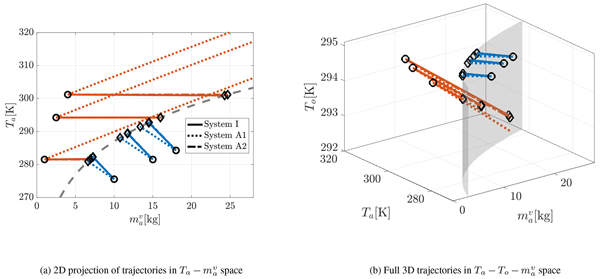
The manuscript investigates sets of idealised equations used to describe the energy exchanges at an atmosphere-ocean interface in an Earth System model associated with evaporation of the ocean's liquid water into atmospheric vapor, and the condensation and subsequent precipitation of atmospheric vapor into the ocean. Three sets of equation are derived for a simple box model: System I derives some equations from ''unapproximated'' thermodynamics, System A1 attempts to emulate the behaviour of E3SM including energy fixers, while A2 makes the same thermodynamic simplifications as A1 but omits the energy fixers. Some characteristics of the solutions of these equation sets are then investigated numerically.This paper is an attempt to understand a challenging and important issue in Earth System modelling: how to quantify the errors associated with thermodynamic simplifications made when coupling together different Earth System components, in the hope that this can lead to improvements in the modelled thermodynamics. The paper is well-written, so it is not too difficult to follow the mathematical derivations of the idealised equation sets, and I have no concerns about the quality of the work. The two most significant contributions of the paper are (a) the clear presentation of how evaporation from the ocean should be treated with unapproximated thermodynamics, and (b) the illustration of possible consequences of approximate treatments. My main suggestion is that the paper arrives at interesting results from the numerical experiments (particularly for System A1), but there isn't much discussion that links this back to expected behaviour in Earth System Models. For instance, the results suggest that System A1's evaporation process is unstable, so if possible it would be helpful to see discussion about how E3SM avoids this.
I have included a full list of minor corrections / suggestions in the attached PDF.- AC1: 'Reply on RC2', Oksana Guba, 04 Mar 2026
-
RC2: 'Comment on egusphere-2025-3966', Anonymous Referee #2, 06 Feb 2026
Review of “On moist ocean-atmosphere coupling mechanisms” by Oguba et al.
This manuscript deals with the details of energy changes associated with water mass exchanges between the ocean and atmosphere. The authors derive energy conservation equations associated with evaporation and precipitation and outline simplifications made in a numerical model (E3SM), and how energy/mass fixers account for those. Instead of investigating the effects of the simplifications in model simulations they go on with exploring the behaviour of the ODEs arising from their different conservation equations. It turns out that the equations underlying E3SM imply unrealistic temperature drifts to reach equilibrium, but they stop there. There is no discussion of implications of their results for the model and the climate it simulates. This makes the manuscript a not so satisfying read as it stands.
Major point #1: After lengthy derivations the reader is left without an interpretation of the results. How do these results impact the simulations of E3SM? I would assume the energetic inconsistencies will introduce a spurious drift but it remains unclear how large this is and what impact it has. This is unsatisfying and I would encourage the authors to explore this more to make the paper more relevant. Ideally, they would conduct model simulations in the spirit of Harrop et al. (2022) to explore the magnitude of the impact of the described energetic inconsistencies.
Major point #2: Despite the lengthy derivations important specifications are missing. In section 2.2.1, there needs to be a discussion on reference temperature. It seems the authors are employing C scale as otherwise their equations would not work. But they should keep in mind that a meteorologist would expect K scale. There also is no discussion of the assumed reference state of water: it appears it is ice at 0 deg C. Lauritzen discussed the equivalence of different choices for the reference state in detail, but here it needs to be specified at least. Furthermore, in line 109 not even Lv and Lf are identified as latent heats of evaporation and fusion. Moreover, it is not said that Lv and Lf are taken as their constant values at 0 deg C (I think) rather than being temperature-dependent. Note also that Mayer et al. (2017) described in some detail the energy changes associated with phase changes as well as the formulation with constant vs variable latent heats.
Minor points:
Line 42: What do the authors mean by “climatological energy trends”?
Line 97: “both the” – space missing
Table 1: in the current model, shouldn’t the energy fluxes received by the atmosphere be scaled by cp_dry?
Line 221: Why do the authors choose delta_K for condensation rate and not delta_C?
Line 296: the authors seem quite confident that eq. (12) is “more correct” than eq. (25), where the difference lies in the use of different specific heats for the evaporated water mass. They seem to assume that the energy required to make evaporation happen is taken equally from the main water mass and the evaporated water mass delta_V (when delta_V is already vaporous). The described processes in nature happen at the same time, and so it is not entirely clear why the sequence of events as insinuated by eq. (25) is the correct one? Can the authors elaborate why this is the more appropriate view on the ongoing processes?
Line 378: in->is; also replace “.” with “,” later on that line.
Line 391: typo in “globally”
Line 397: a similar ref to Harrop et al. has already been made further above.
Citation: https://doi.org/10.5194/egusphere-2025-3966-RC2 - AC1: 'Reply on RC2', Oksana Guba, 04 Mar 2026
Peer review completion
Journal article(s) based on this preprint
Viewed
| HTML | XML | Total | BibTeX | EndNote | |
|---|---|---|---|---|---|
| 3,427 | 454 | 98 | 3,979 | 68 | 94 |
- HTML: 3,427
- PDF: 454
- XML: 98
- Total: 3,979
- BibTeX: 68
- EndNote: 94
Viewed (geographical distribution)
| Country | # | Views | % |
|---|
| Total: | 0 |
| HTML: | 0 |
| PDF: | 0 |
| XML: | 0 |
- 1

Arjun Sharma
Mark A. Taylor
Peter A. Bosler
Erika L. Roesler
The requested preprint has a corresponding peer-reviewed final revised paper. You are encouraged to refer to the final revised version.
- Preprint
(1580 KB) - Metadata XML
I have included a full list of minor corrections / suggestions in the attached PDF.