
the Creative Commons Attribution 4.0 License.
the Creative Commons Attribution 4.0 License.
 | 26 Aug 2025
Interplay of North Atlantic Freshening and Deep Convection During the Last Deglaciation Constrained by Iberian Speleothems
Abstract. The last deglaciation featured abrupt climate shifts driven by interactions among Earth system components, notably retreating ice sheets and meltwater input. While globally detected, the magnitude, timing, and sequence of North Atlantic source events remain uncertain. We present a Uranium-Thorium-dated stalagmite from northwestern Iberia spanning 24–12 ka BP, capturing both the impact of North Atlantic meltwater on surface ocean chemistry and regional air temperature changes. Our record reveals primarily gradual meltwater inflow during the Last Glacial Maximum and early deglaciation (about 20.8–18.2 ka BP), followed by abrupt increases during Heinrich Stadial 1. An abrupt cooling lags the first meltwater pulse by ca. 850 years, unlike later pulses. This evolving relationship between meltwater and cooling provides new constraints on the changing sensitivity of deep Atlantic convection to meltwater input throughout the deglaciation.
-
Notice on discussion status
The requested preprint has a corresponding peer-reviewed final revised paper. You are encouraged to refer to the final revised version.
-
Preprint
(7263 KB)
-
The requested preprint has a corresponding peer-reviewed final revised paper. You are encouraged to refer to the final revised version.
- Preprint
(7263 KB) - Metadata XML
- BibTeX
- EndNote
- Final revised paper


Journal article(s) based on this preprint
Interactive discussion
Status: closed
-
RC1: 'Comment on egusphere-2025-3911', Anonymous Referee #1, 23 Sep 2025
The manuscript by Endres et al. presents a high-resolution, Th/U-dated speleothem record from northwestern Iberia spanning 24-12 ka BP. The analyzed proxies are used to reconstruct North Atlantic surface ocean freshening (δ18O values) and regional temperature changes (δ13C) during the last deglaciation. The authors identify major freshening events during Heinrich Stadial 1, and claim that the initial cooling response lagged the first meltwater pulse by approximately 850 years, suggesting evolving AMOC sensitivity to freshwater forcing. Overall, the study provides interesting new constraints on the temporal relationship between ice sheet meltwater discharge and Atlantic Meridional Overturning Circulation strength. The manuscript is overall well-written and the analytical methods are sound. Also the interpretation of the proxies is based on an intensive work of the research group in that area. However, I have some comments on the description of statistical aspects including propagation of uncertainties as well as the discussion of the regional relevance of the results. Overall, the line of arguments could benefit from restructuring the discussion by re-integrating parts of the extended appendices back into the main text. It is a bit exhausting to repeatedly having to switch back and forth between main text and appendix, also given that the main text is not so long.
Other comments:
- Age model. The authors state that they have optimized the age model by using the Sr/Mg ratio in the stalagmite. Please discuss a little but further why this approach is valid at this coastal location, where one could expect a significant and varying influence of sea spray, that could affect the Sr/Mg ratio as well. Also provide more details what has been exactly done and how the age model has been optimized. Have you smoothed the Sr/Mg ratio prior correlation analysis with growth rate? What was the highest correlation coefficient? How does this approach influence the finally given uncertainties of the age model (and then, the uncertainties of the break/changepoints).
- Breakpoints/Changepoints. The outcomes of the study rely strongly on statistical time series analysis and the correct propagation of uncertainties. It is however unclear to me, how the age model uncertainties have been propagated into the uncertainties of the break/change point analysis. The resulting change/breakpoints are also only given in a table. It would be beneficial to visualize the timing of the events in the stalagmite also in Figure 3. Please also improve the quality of Figure 3, the discussed “drops” or other events in the δ13C record are not visible in the Figure, possibly because the y axis is too small. Please improve and make it easier for the reader to follow your arguments…
- Meltwater model results. I am not a modeler and after reading the manuscript the relevance of the meltwater/tracer modeling is still unclear to me. I feel like the main conclusions could also be drawn without all this effort..? If I could follow the manuscript correctly, the model results are mainly part of the methods section, and there is only a limited discussion of model implications in the results/discussion. Could the results be helpful to explain a mechanism why there is a 850y lag between meltwater and temperature? Overall, the integration of the model results into the results/discussion section should be improved and the relevance clarified for non-experts in that field.
- “Regional/global discussion”. The comparison with other records is very limited and could be strengthened. On the regional scope, only 2 other speleothem records from Iberia and the Mediterranean are mentioned and only in the appendix. It is unclear to me why the discussion then only focuses on comparing to records from the EASM region, where the comparison then turns out to be not as conclusive (compare L296ff). I strongly suggest to revise this section, and focus on a more integrative approach comparing first to records from the wider North Atlantic realm in more detail. There are e.g., some high-resolution records from across the Americas (for example Travis Taylor et al., 2025, Strikis et al., 2015, and others) that are much closer to the centers of action in the North Atlantic. There are also probably some more from Western/Central Europe… (e.g., NALPS, Li et al., 2021, Luetscher et al., 2015, …). Incorporating more records from the wider Atlantic region could support the discussion of potential “atmospheric responses”, that is at this stage only briefly mentioned in L252 or 290, but I regard this is as not irrelevant in this discussion. Also, in a subnote, I wonder about the absence of a drop into the Younger Dryas at the end of the record. I know this is not the focus of the manuscript but it still makes me wonder... Many other stalagmite records show a very sharp and clear drop in δ18O values around 12.9ka BP (e.g., Cheng et al., 2020, Affolter et al 2019, Li et al., 2021 …) , but this one, that should presumably be very sensitive to meltwater and temperature in the north Atlantic realm, does not really show a clear signal, at least not in δ18O... What does this mean?
Minor comments along the text:
L65 Please provide more support that Sr/Mg is indeed only growth rate and not related to sea spray
Figure 2 What do the open and filled symbold mean? What is the correlation between Sr/Mg and growth rate?
L171 does the number 382 years correspond to the length of the transition? Please indictae the timing and uncertainties in the Figure, it is hard to see for some of the breakpoints where they are exactly identified.
L189 Also here, I am not sure which “smaller transient event” is meant. Possibly a second plot that zooms only into the most interesting section of the record would be helpful?
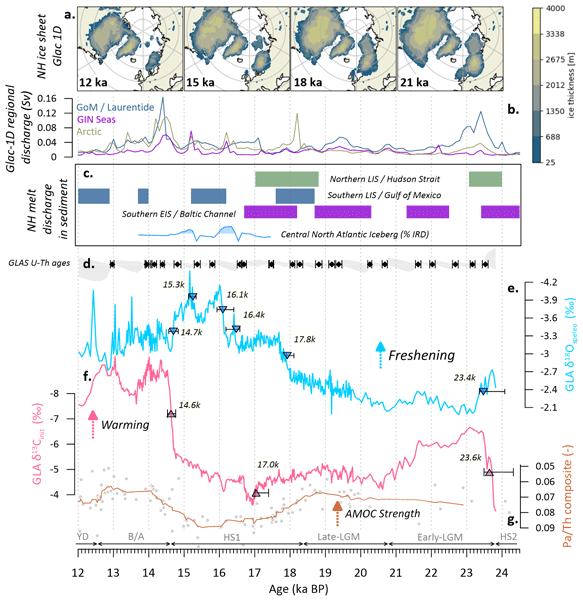
Figure 3 please include time markers of identified events in Figure 3. I also cannot see the temperature changes in d13C as mentioned in the text... The relevance of the maps in the uppermost panel are unclear to me.
L225 I cannot see a “significant cooling” in d13C at that time in Figure 3, I think the y-axis not large enough to really see this drop? A clear marker would be also helpful.
L226 what is the uncertainty of the 850 years?
L231 Again, unsure to which specific feature this refers to
L245 I think its vice versa? First the meltwater, then 850 years later the temperature drop?
L276 The “extended discussion” only discusses two other records from Iberia and the Mediterranean, and no ice core records.
L278 Before jumping to the EASM I would have expected a more comprehensive comparison to other records that are more closer to the North Atlantic realm. Is there a specific reason why this is missing?
L290 Any suggestions which “atmospheric patterns”? A more comprehensive discussion could elucidate this possibly?
L292 This is also another reason why records from that region would be worth to compare with!
L299 It would be interesting to see if the American records are better to compare with? Studies have suggested a close link to AMOC and NA temperatures - your record could provide the possibility to test this (compare eg Travis Taylor et al., 2025,Warken et al., 2020...)
L301 what is the uncertainty of the ice record here?
L402 Heading does not fit to content, its only one record also from Iberia discussed
References
Affolter, S., Häuselmann, A., Fleitmann, D., Edwards, R. L., Cheng, H., & Leuenberger, M. (2019). Central Europe temperature constrained by speleothem fluid inclusion water isotopes over the past 14,000 years. Science advances, 5(6), eaav3809.
Cheng, H., Zhang, H., Spötl, C., Baker, J., Sinha, A., Li, H., ... & Edwards, R. L. (2020). Timing and structure of the Younger Dryas event and its underlying climate dynamics. Proceedings of the National Academy of Sciences, 117(38), 23408-23417.
Li, H., Spötl, C., & Cheng, H. (2021). A high‐resolution speleothem proxy record of the Late Glacial in the European Alps: extending the NALPS19 record until the beginning of the Holocene. Journal of Quaternary Science, 36(1), 29-39.
Luetscher, M., Boch, R., Sodemann, H., Spötl, C., Cheng, H., Edwards, R. L., ... & Müller, W. (2015). North Atlantic storm track changes during the Last Glacial Maximum recorded by Alpine speleothems. Nature Communications, 6(1), 6344.
Stríkis, N. M., et al. (2015), Timing and structure of Mega-SACZ events during Heinrich Stadial 1, Geophys. Res. Lett., 42, 5477–5484, doi:10.1002/2015GL064048.
Travis-Taylor, L., Medina-Elizalde, M., Pajón, J.M. et al. Hydroclimate variability in the northern Caribbean during the last deglaciation was modulated by large-scale atmospheric circulation and climate events. Commun Earth Environ 6, 498 (2025). https://doi.org/10.1038/s43247-025-02465-0
Warken, S.F., Vieten, R., Winter, A., Spötl, C., Miller, T.E., Jochum, K.P., Schröder-Ritzrau, A., Mangini, A. and Scholz, D. (2020), Persistent Link Between Caribbean Precipitation and Atlantic Ocean Circulation During the Last Glacial Revealed by a Speleothem Record From Puerto Rico. Paleoceanography and Paleoclimatology, 35: e2020PA003944. https://doi.org/10.1029/2020PA003944
Citation: https://doi.org/10.5194/egusphere-2025-3911-RC1 -
AC2: 'Reply on RC1', Laura Endres, 31 Dec 2025
The comment was uploaded in the form of a supplement: https://egusphere.copernicus.org/preprints/2025/egusphere-2025-3911/egusphere-2025-3911-AC2-supplement.pdf
-
RC2: 'Comment on egusphere-2025-3911', Anonymous Referee #2, 28 Oct 2025
This is a fascinating and valuable new record, providing important new insights into rapid climate change in its epicentre, the deglacial North Atlantic. The absolute chronology and novel freshwater reconstructions are particularly valuable: they represent a major sampling and analytical achievement and a substantial advance given the impasse in what is possible based on the less precise dates of sediment cores in this interval. The data are well described, nicely interpreted with help from coupled modelling, and well presented throughout.
I provide line by line comments below, the most important of which are starred. The couple of these which I wish the authors to give particular attention to include:
- the interpretation of the stal d13C temperature reconstruction and whether there might be seasonal influences which could lead to some saturation of this proxy, especially given the somewhat different structure it has compared to some nearby Iberian margin SST records;
- the extent to which the stal d13C temperatures necessarily track AMOC – AMOC is one potential control, but there are others;
- the use of onsets vs midpoints, and the naming of events.
On the latter point, I would encourage the authors to use both onsets and midpoints to describe meltwater input events. It’s really neat that this amazing archive and your change point analysis can give onsets, but midpoints are probably more commonly used in paleo (as most archives struggle more with onsets), so having both would be helpful and avoid confusion. E.g. the 18.04 ka onset event is the same event as the ~17.8 ka midpoint event seen in many N Atlantic archives; ditto 16.22 vs 16.1 ka.
I note that this is done at 249 and in some other places too, I just think it would be really helpful to do throughout, and would perhaps also be worth the authors considering in their subtitles, abstract, etc., such that where a single number is used, it’s one that will be quickly recognisable by the rest of the community – getting folks excited to investigate these more precise determinations of these events in greater detail.
I’m also nervous (as discussed towards the end of the review) about the utility of introducing yet another subset of event names (HS1a,b,c,d ± E1,2,3,4f,4t etc.) into this already crowded space…
Overall I want to stress that I think this is a fantastic contribution and am very supportive of its publication, provided the comments below are dealt with. Indeed please note that the majority of these comments are stylistic or catch minor slips in writing, as I’m excited about this work, so wanted to help polish up its presentation.
21: writing in general is really nice – so do consider avoiding this clunky phrasing! “cooling in the north, warming in the south, and …” would be much smoother!
45: “the influx of NH MW to the ocean and temperature change…” would be clearer
54: measure --> measuring
55: comma after samples,
57: mid --> midpoint
58: what is Fiji (other than a Pacific island!) - software?
66: say why – explained in caption but good to briefly mention here
70: need a bit more on analytical approach, for trace elements especially (calibration curve? Sample-standard bracketing? Standards used? Reproducibility of key elements?)
81: capitalise Taylor
86: final clause is jarring - try “with more detailed model description in the Appendix.”
91: explain the significance of this region – your key moisture source, right?
99: based on fact this is plotted up, it seems more quantitative than qualitative?
Figure 1:
in 1e axis label change GIN Seas to GIN Seas and NE Atl. I also don’t understand the use of % with strong AMOC 100%, as doesn’t seem like the red bars would add to give 100%? Is there another melt source or what am I missing?
in caption: bassins basins; Northern hemisphere ice sheet’s Northern hemisphere ice sheet; “petrol” is not a widely known colour – “grey/green” or “light green” would be better
120: sensitivity index or contribution index as in 1e caption? Or are these deliberately different?
124: would delivered to the NE Atlantic and GIN Seas be more accurate here? I realise that what’s delivered to NE Atlantic is then effectively transported to GIN Seas, but melt itself may have come in to NE Atlantic to the south of GIN Seas.
Figure 2:
Don’t see yellow dots! And what is significance of open vs closed diamond symbols?
168: the presence of meltwater is confirmed, but Scandinavian source is then an inference based on the combination of this melt evidence with the eNd data, right? So slightly rephrase.
173: I don’t obviously see these other regional records in the SI – please specify figure. The compilation in A6 is useful, but these are more globally distributed rather than regional.
179: as written, it’s a bit unclear how the SBKIS links to the statement above about SIS and BIIS separation. Are these the same event e.g. the SIS and BIIS separate due to the collapse of SBKIS which previously joined them? Slight rephrasing to more clearly express how these different pieces fit together would be helpful.
184: again GIN Seas or GIN Seas and NE Atlantic?
184: sustained low d18O values
190: onset of the “15.44” event really looks a bit younger on the figure – more like 15.3. Please check!
Related, given the centennial scale of your data, it would be nice to have 100 year tick marks.
202: use of “this” is confusing, as ice sheet shrinkage was not previously being explicitly discussed.
***203: this is an interesting idea but would be good to flesh out a bit more. One important point is that – based on the analyses of model output presented above – it seems possible that the same degree of ice sheet variability might be expressed as a spikier signal if there is strong AMOC, as successive melt signals would be quickly dispersed, leading to a spikier record, even with little change in ice sheet behaviour.
Related – and tying in to interesting discussion of MWP1a below, could there be continued MW through BA onset, but d18O signal shows an apparent drop off, due to switch in AMOC regime? In other words, the change in d18O at 14.7 ka, which might at first glance be interpreted as a decrease in MW input, may actually be a signal of a restart in AMOC which dissipates the MW signal, even if the same rate of MW input persists.
I see some of this is discussed at line 260 – nice job! However I think still worth bringing out this nuance here and see also some of the further discussion in review comment there too.
207: as mentioned above, this is another place where use of onset is potentially confusing: 15.44 seems a long way from ~14.5 ka dates for MWP1a; whereas if you were to say “centred on 15 ka” or “extending from 15.4 to 14.7 ka” that would be easier to follow and to potentially reconcile with MWP1a.
See also Coonin et al., 2025 NGS for recent re-evaluation of MWP1a age constraints.
***217: Here and where d13C temperature proxy is introduced above: could the temperature proxy get saturated towards cold temperatures? There’s surprisingly little variability within HS1 compared to, say, %NP, Mg/Ca, or Uk37 records in the North Atlantic. Might this be explained by the coldest seasonal temperatures not really being recorded due to freezing? The d13C proxy would thus bottom out, recording low respiration in the unfrozen shoulder seasons, but not capturing peak winter cooling?
Figure 3:
Don’t need simplified at both start and end of the sentence!
220: unclear which “rapid decline” is being referred to: the short blip at 17.0 ka or the gradual cooling from 19-17 ka?
224: though would be interesting to compare to what structure there is within the d15N data (e.g. Buizert et al., 2014) – muted but does seem like NGRIP may share some similar structure to NISA d13C
227: agree it represents a genuine lag – but “in response time” implies that cooling would always follow meltwater input, which may or may not be true (as is discussed below). So suggest rephrasing.
247: and by Barker et al., 2015 %NP vs IRD records
260: see comment above at 203 – I think it would be good here to be slightly more specific. It’s a reduction of meltwater abundance at the surface, though might not be a change in the rate of meltwater input from ice, just its accumulation and persistence in the surface.
266-268: this is interesting and I think would benefit from a bit of elaboration and nuance, as in detail the structures of these records are quite different: NISA suggests a broader cooling between 14 and 13 ka, whereas in Greenland the oldest dryas event is quite narrow and centred on 14.0 ka.
Line 268 mentions slowed growth rate, but this only kicks in around 13 ka, so prior to that should be reasonably well resolved? Perhaps a bigger issue is the gap between age control points? I wonder if the age uncertainty from the age model (i.e. the shaded band from Figure 2) could be shown as a line next to the age control points in this figure to give a sense of this uncertainty?
269-271: this is a really interesting point, but I’m not sure I quite follow it or see the events being referred to. Could these be spelled out or shown in more detail? Are you meaning that the events at 14.4 and 14.0 ka appear to have MW then cooling, whereas this is not clear in event at 13.6, though perhaps is again at 13.2? Also in the 14.4, 14.0, and 13.6 ka events, it seems that there’s an initial warming coincident with the initial meltwater input – would you read anything in to this?
276-277: potentially confusing to introduce both HS1a,b,c,d and E1,2,3,4 terminology. Can do so if you wish, but could consider using the same system throughout. (And note that using “Events” within the Heinrich stadial, which are distinct from the Heinrich Event(s) themselves, adds an extra layer of potential confusion! E.g. I don’t think the community will adopt thinking about Event 1 within Heinrich Stadial 1, which is distinct from Heinrich Event 1…). Might be easiest to just use the mid-point ages…
Agh, now see that in Figure 4 they also come with f and t flavours! Think this is probably just too complicated… Can highlight freshening and warming or cooling events, perhaps using different colours for each and a letter at the top, but think then easiest to just use their timings and to refer to them descriptively within the text e.g. “the freshening event centred on 17.8 ka…”
282: confused here about what is being referred to, as the pink bar from 18-17.6 ka seems to be associated with a minima in d18O so a negative shift… if you mean a different feature (like the subsequent positive shift in Hulu at 17.8-17.5ka) then spell out more clearly in text (i.e. following the onset of the meltwater event beginning at 18.04 ka, a positive shift is seen in Hulu from 17.8-17.5 ka) and consider how you use and place the shaded bars (±some dashed lines) to help highlight features in your record vs Hulu and others.
Figure 4 has two panel a’s
**284: I’m not sure how strongly this temperature change should be referred to as the most abrupt AMOC reduction. Change in AMOC is one possibility, but so is change in sea ice, or non-AMOC circulation changes. It’s plausible that AMOC may have a distinct structure to this particular temperature record, especially given that other nearby SST records have slightly different structure within this interval.
286: beginning at 16.22 ka and centred on…
295: northward?
304: again, I’d be a bit careful with this, as although no abrupt cooling at this time is seen in the stal d13C, some of the SST records from e.g. Iberian Margin do show more structure within this general interval. So the stal d13C is not the only/last word on temperature change in this region and time!
305: interesting idea, given that even if not related to AMOC, many ideas about atmospheric reorganisation would invoke temperature change. What might you suggest as alternative? Ice sheet height?
315: interesting that the 15.4 ka timing seems to also correspond to Antarctic melt water input, based on Li et al. (2023), Nat. Comms.
319-322: again, encourage authors to reconsider Event terminology.
323-324: see comment above – based on the results presented here, especially the model output, it seems possible that AMOC onset could mask a MWP1a signal, at least partially, by dissipating the d18O freshwater signal. I realise that you go on to mention this at line 325, but I think it’s worth being really careful with this initial statement, as many folks will just read the conclusions and may not grasp this potentially important detail.
330: as per comment at line 304, I’d be careful making an unambiguous link between AMOC and NISA d13C.
Figure A4. Updated d18O in labels to proper formatting
Citation: https://doi.org/10.5194/egusphere-2025-3911-RC2 -
AC1: 'Reply on RC2', Laura Endres, 31 Dec 2025
The comment was uploaded in the form of a supplement: https://egusphere.copernicus.org/preprints/2025/egusphere-2025-3911/egusphere-2025-3911-AC1-supplement.pdf
Peer review completion


Interactive discussion
Status: closed
-
RC1: 'Comment on egusphere-2025-3911', Anonymous Referee #1, 23 Sep 2025
The manuscript by Endres et al. presents a high-resolution, Th/U-dated speleothem record from northwestern Iberia spanning 24-12 ka BP. The analyzed proxies are used to reconstruct North Atlantic surface ocean freshening (δ18O values) and regional temperature changes (δ13C) during the last deglaciation. The authors identify major freshening events during Heinrich Stadial 1, and claim that the initial cooling response lagged the first meltwater pulse by approximately 850 years, suggesting evolving AMOC sensitivity to freshwater forcing. Overall, the study provides interesting new constraints on the temporal relationship between ice sheet meltwater discharge and Atlantic Meridional Overturning Circulation strength. The manuscript is overall well-written and the analytical methods are sound. Also the interpretation of the proxies is based on an intensive work of the research group in that area. However, I have some comments on the description of statistical aspects including propagation of uncertainties as well as the discussion of the regional relevance of the results. Overall, the line of arguments could benefit from restructuring the discussion by re-integrating parts of the extended appendices back into the main text. It is a bit exhausting to repeatedly having to switch back and forth between main text and appendix, also given that the main text is not so long.
Other comments:
- Age model. The authors state that they have optimized the age model by using the Sr/Mg ratio in the stalagmite. Please discuss a little but further why this approach is valid at this coastal location, where one could expect a significant and varying influence of sea spray, that could affect the Sr/Mg ratio as well. Also provide more details what has been exactly done and how the age model has been optimized. Have you smoothed the Sr/Mg ratio prior correlation analysis with growth rate? What was the highest correlation coefficient? How does this approach influence the finally given uncertainties of the age model (and then, the uncertainties of the break/changepoints).
- Breakpoints/Changepoints. The outcomes of the study rely strongly on statistical time series analysis and the correct propagation of uncertainties. It is however unclear to me, how the age model uncertainties have been propagated into the uncertainties of the break/change point analysis. The resulting change/breakpoints are also only given in a table. It would be beneficial to visualize the timing of the events in the stalagmite also in Figure 3. Please also improve the quality of Figure 3, the discussed “drops” or other events in the δ13C record are not visible in the Figure, possibly because the y axis is too small. Please improve and make it easier for the reader to follow your arguments…
- Meltwater model results. I am not a modeler and after reading the manuscript the relevance of the meltwater/tracer modeling is still unclear to me. I feel like the main conclusions could also be drawn without all this effort..? If I could follow the manuscript correctly, the model results are mainly part of the methods section, and there is only a limited discussion of model implications in the results/discussion. Could the results be helpful to explain a mechanism why there is a 850y lag between meltwater and temperature? Overall, the integration of the model results into the results/discussion section should be improved and the relevance clarified for non-experts in that field.
- “Regional/global discussion”. The comparison with other records is very limited and could be strengthened. On the regional scope, only 2 other speleothem records from Iberia and the Mediterranean are mentioned and only in the appendix. It is unclear to me why the discussion then only focuses on comparing to records from the EASM region, where the comparison then turns out to be not as conclusive (compare L296ff). I strongly suggest to revise this section, and focus on a more integrative approach comparing first to records from the wider North Atlantic realm in more detail. There are e.g., some high-resolution records from across the Americas (for example Travis Taylor et al., 2025, Strikis et al., 2015, and others) that are much closer to the centers of action in the North Atlantic. There are also probably some more from Western/Central Europe… (e.g., NALPS, Li et al., 2021, Luetscher et al., 2015, …). Incorporating more records from the wider Atlantic region could support the discussion of potential “atmospheric responses”, that is at this stage only briefly mentioned in L252 or 290, but I regard this is as not irrelevant in this discussion. Also, in a subnote, I wonder about the absence of a drop into the Younger Dryas at the end of the record. I know this is not the focus of the manuscript but it still makes me wonder... Many other stalagmite records show a very sharp and clear drop in δ18O values around 12.9ka BP (e.g., Cheng et al., 2020, Affolter et al 2019, Li et al., 2021 …) , but this one, that should presumably be very sensitive to meltwater and temperature in the north Atlantic realm, does not really show a clear signal, at least not in δ18O... What does this mean?
Minor comments along the text:
L65 Please provide more support that Sr/Mg is indeed only growth rate and not related to sea spray
Figure 2 What do the open and filled symbold mean? What is the correlation between Sr/Mg and growth rate?
L171 does the number 382 years correspond to the length of the transition? Please indictae the timing and uncertainties in the Figure, it is hard to see for some of the breakpoints where they are exactly identified.
L189 Also here, I am not sure which “smaller transient event” is meant. Possibly a second plot that zooms only into the most interesting section of the record would be helpful?
Figure 3 please include time markers of identified events in Figure 3. I also cannot see the temperature changes in d13C as mentioned in the text... The relevance of the maps in the uppermost panel are unclear to me.
L225 I cannot see a “significant cooling” in d13C at that time in Figure 3, I think the y-axis not large enough to really see this drop? A clear marker would be also helpful.
L226 what is the uncertainty of the 850 years?
L231 Again, unsure to which specific feature this refers to
L245 I think its vice versa? First the meltwater, then 850 years later the temperature drop?
L276 The “extended discussion” only discusses two other records from Iberia and the Mediterranean, and no ice core records.
L278 Before jumping to the EASM I would have expected a more comprehensive comparison to other records that are more closer to the North Atlantic realm. Is there a specific reason why this is missing?
L290 Any suggestions which “atmospheric patterns”? A more comprehensive discussion could elucidate this possibly?
L292 This is also another reason why records from that region would be worth to compare with!
L299 It would be interesting to see if the American records are better to compare with? Studies have suggested a close link to AMOC and NA temperatures - your record could provide the possibility to test this (compare eg Travis Taylor et al., 2025,Warken et al., 2020...)
L301 what is the uncertainty of the ice record here?
L402 Heading does not fit to content, its only one record also from Iberia discussed
References
Affolter, S., Häuselmann, A., Fleitmann, D., Edwards, R. L., Cheng, H., & Leuenberger, M. (2019). Central Europe temperature constrained by speleothem fluid inclusion water isotopes over the past 14,000 years. Science advances, 5(6), eaav3809.
Cheng, H., Zhang, H., Spötl, C., Baker, J., Sinha, A., Li, H., ... & Edwards, R. L. (2020). Timing and structure of the Younger Dryas event and its underlying climate dynamics. Proceedings of the National Academy of Sciences, 117(38), 23408-23417.
Li, H., Spötl, C., & Cheng, H. (2021). A high‐resolution speleothem proxy record of the Late Glacial in the European Alps: extending the NALPS19 record until the beginning of the Holocene. Journal of Quaternary Science, 36(1), 29-39.
Luetscher, M., Boch, R., Sodemann, H., Spötl, C., Cheng, H., Edwards, R. L., ... & Müller, W. (2015). North Atlantic storm track changes during the Last Glacial Maximum recorded by Alpine speleothems. Nature Communications, 6(1), 6344.
Stríkis, N. M., et al. (2015), Timing and structure of Mega-SACZ events during Heinrich Stadial 1, Geophys. Res. Lett., 42, 5477–5484, doi:10.1002/2015GL064048.
Travis-Taylor, L., Medina-Elizalde, M., Pajón, J.M. et al. Hydroclimate variability in the northern Caribbean during the last deglaciation was modulated by large-scale atmospheric circulation and climate events. Commun Earth Environ 6, 498 (2025). https://doi.org/10.1038/s43247-025-02465-0
Warken, S.F., Vieten, R., Winter, A., Spötl, C., Miller, T.E., Jochum, K.P., Schröder-Ritzrau, A., Mangini, A. and Scholz, D. (2020), Persistent Link Between Caribbean Precipitation and Atlantic Ocean Circulation During the Last Glacial Revealed by a Speleothem Record From Puerto Rico. Paleoceanography and Paleoclimatology, 35: e2020PA003944. https://doi.org/10.1029/2020PA003944
Citation: https://doi.org/10.5194/egusphere-2025-3911-RC1 -
AC2: 'Reply on RC1', Laura Endres, 31 Dec 2025
The comment was uploaded in the form of a supplement: https://egusphere.copernicus.org/preprints/2025/egusphere-2025-3911/egusphere-2025-3911-AC2-supplement.pdf
-
RC2: 'Comment on egusphere-2025-3911', Anonymous Referee #2, 28 Oct 2025
This is a fascinating and valuable new record, providing important new insights into rapid climate change in its epicentre, the deglacial North Atlantic. The absolute chronology and novel freshwater reconstructions are particularly valuable: they represent a major sampling and analytical achievement and a substantial advance given the impasse in what is possible based on the less precise dates of sediment cores in this interval. The data are well described, nicely interpreted with help from coupled modelling, and well presented throughout.
I provide line by line comments below, the most important of which are starred. The couple of these which I wish the authors to give particular attention to include:
- the interpretation of the stal d13C temperature reconstruction and whether there might be seasonal influences which could lead to some saturation of this proxy, especially given the somewhat different structure it has compared to some nearby Iberian margin SST records;
- the extent to which the stal d13C temperatures necessarily track AMOC – AMOC is one potential control, but there are others;
- the use of onsets vs midpoints, and the naming of events.
On the latter point, I would encourage the authors to use both onsets and midpoints to describe meltwater input events. It’s really neat that this amazing archive and your change point analysis can give onsets, but midpoints are probably more commonly used in paleo (as most archives struggle more with onsets), so having both would be helpful and avoid confusion. E.g. the 18.04 ka onset event is the same event as the ~17.8 ka midpoint event seen in many N Atlantic archives; ditto 16.22 vs 16.1 ka.
I note that this is done at 249 and in some other places too, I just think it would be really helpful to do throughout, and would perhaps also be worth the authors considering in their subtitles, abstract, etc., such that where a single number is used, it’s one that will be quickly recognisable by the rest of the community – getting folks excited to investigate these more precise determinations of these events in greater detail.
I’m also nervous (as discussed towards the end of the review) about the utility of introducing yet another subset of event names (HS1a,b,c,d ± E1,2,3,4f,4t etc.) into this already crowded space…
Overall I want to stress that I think this is a fantastic contribution and am very supportive of its publication, provided the comments below are dealt with. Indeed please note that the majority of these comments are stylistic or catch minor slips in writing, as I’m excited about this work, so wanted to help polish up its presentation.
21: writing in general is really nice – so do consider avoiding this clunky phrasing! “cooling in the north, warming in the south, and …” would be much smoother!
45: “the influx of NH MW to the ocean and temperature change…” would be clearer
54: measure --> measuring
55: comma after samples,
57: mid --> midpoint
58: what is Fiji (other than a Pacific island!) - software?
66: say why – explained in caption but good to briefly mention here
70: need a bit more on analytical approach, for trace elements especially (calibration curve? Sample-standard bracketing? Standards used? Reproducibility of key elements?)
81: capitalise Taylor
86: final clause is jarring - try “with more detailed model description in the Appendix.”
91: explain the significance of this region – your key moisture source, right?
99: based on fact this is plotted up, it seems more quantitative than qualitative?
Figure 1:
in 1e axis label change GIN Seas to GIN Seas and NE Atl. I also don’t understand the use of % with strong AMOC 100%, as doesn’t seem like the red bars would add to give 100%? Is there another melt source or what am I missing?
in caption: bassins basins; Northern hemisphere ice sheet’s Northern hemisphere ice sheet; “petrol” is not a widely known colour – “grey/green” or “light green” would be better
120: sensitivity index or contribution index as in 1e caption? Or are these deliberately different?
124: would delivered to the NE Atlantic and GIN Seas be more accurate here? I realise that what’s delivered to NE Atlantic is then effectively transported to GIN Seas, but melt itself may have come in to NE Atlantic to the south of GIN Seas.
Figure 2:
Don’t see yellow dots! And what is significance of open vs closed diamond symbols?
168: the presence of meltwater is confirmed, but Scandinavian source is then an inference based on the combination of this melt evidence with the eNd data, right? So slightly rephrase.
173: I don’t obviously see these other regional records in the SI – please specify figure. The compilation in A6 is useful, but these are more globally distributed rather than regional.
179: as written, it’s a bit unclear how the SBKIS links to the statement above about SIS and BIIS separation. Are these the same event e.g. the SIS and BIIS separate due to the collapse of SBKIS which previously joined them? Slight rephrasing to more clearly express how these different pieces fit together would be helpful.
184: again GIN Seas or GIN Seas and NE Atlantic?
184: sustained low d18O values
190: onset of the “15.44” event really looks a bit younger on the figure – more like 15.3. Please check!
Related, given the centennial scale of your data, it would be nice to have 100 year tick marks.
202: use of “this” is confusing, as ice sheet shrinkage was not previously being explicitly discussed.
***203: this is an interesting idea but would be good to flesh out a bit more. One important point is that – based on the analyses of model output presented above – it seems possible that the same degree of ice sheet variability might be expressed as a spikier signal if there is strong AMOC, as successive melt signals would be quickly dispersed, leading to a spikier record, even with little change in ice sheet behaviour.
Related – and tying in to interesting discussion of MWP1a below, could there be continued MW through BA onset, but d18O signal shows an apparent drop off, due to switch in AMOC regime? In other words, the change in d18O at 14.7 ka, which might at first glance be interpreted as a decrease in MW input, may actually be a signal of a restart in AMOC which dissipates the MW signal, even if the same rate of MW input persists.
I see some of this is discussed at line 260 – nice job! However I think still worth bringing out this nuance here and see also some of the further discussion in review comment there too.
207: as mentioned above, this is another place where use of onset is potentially confusing: 15.44 seems a long way from ~14.5 ka dates for MWP1a; whereas if you were to say “centred on 15 ka” or “extending from 15.4 to 14.7 ka” that would be easier to follow and to potentially reconcile with MWP1a.
See also Coonin et al., 2025 NGS for recent re-evaluation of MWP1a age constraints.
***217: Here and where d13C temperature proxy is introduced above: could the temperature proxy get saturated towards cold temperatures? There’s surprisingly little variability within HS1 compared to, say, %NP, Mg/Ca, or Uk37 records in the North Atlantic. Might this be explained by the coldest seasonal temperatures not really being recorded due to freezing? The d13C proxy would thus bottom out, recording low respiration in the unfrozen shoulder seasons, but not capturing peak winter cooling?
Figure 3:
Don’t need simplified at both start and end of the sentence!
220: unclear which “rapid decline” is being referred to: the short blip at 17.0 ka or the gradual cooling from 19-17 ka?
224: though would be interesting to compare to what structure there is within the d15N data (e.g. Buizert et al., 2014) – muted but does seem like NGRIP may share some similar structure to NISA d13C
227: agree it represents a genuine lag – but “in response time” implies that cooling would always follow meltwater input, which may or may not be true (as is discussed below). So suggest rephrasing.
247: and by Barker et al., 2015 %NP vs IRD records
260: see comment above at 203 – I think it would be good here to be slightly more specific. It’s a reduction of meltwater abundance at the surface, though might not be a change in the rate of meltwater input from ice, just its accumulation and persistence in the surface.
266-268: this is interesting and I think would benefit from a bit of elaboration and nuance, as in detail the structures of these records are quite different: NISA suggests a broader cooling between 14 and 13 ka, whereas in Greenland the oldest dryas event is quite narrow and centred on 14.0 ka.
Line 268 mentions slowed growth rate, but this only kicks in around 13 ka, so prior to that should be reasonably well resolved? Perhaps a bigger issue is the gap between age control points? I wonder if the age uncertainty from the age model (i.e. the shaded band from Figure 2) could be shown as a line next to the age control points in this figure to give a sense of this uncertainty?
269-271: this is a really interesting point, but I’m not sure I quite follow it or see the events being referred to. Could these be spelled out or shown in more detail? Are you meaning that the events at 14.4 and 14.0 ka appear to have MW then cooling, whereas this is not clear in event at 13.6, though perhaps is again at 13.2? Also in the 14.4, 14.0, and 13.6 ka events, it seems that there’s an initial warming coincident with the initial meltwater input – would you read anything in to this?
276-277: potentially confusing to introduce both HS1a,b,c,d and E1,2,3,4 terminology. Can do so if you wish, but could consider using the same system throughout. (And note that using “Events” within the Heinrich stadial, which are distinct from the Heinrich Event(s) themselves, adds an extra layer of potential confusion! E.g. I don’t think the community will adopt thinking about Event 1 within Heinrich Stadial 1, which is distinct from Heinrich Event 1…). Might be easiest to just use the mid-point ages…
Agh, now see that in Figure 4 they also come with f and t flavours! Think this is probably just too complicated… Can highlight freshening and warming or cooling events, perhaps using different colours for each and a letter at the top, but think then easiest to just use their timings and to refer to them descriptively within the text e.g. “the freshening event centred on 17.8 ka…”
282: confused here about what is being referred to, as the pink bar from 18-17.6 ka seems to be associated with a minima in d18O so a negative shift… if you mean a different feature (like the subsequent positive shift in Hulu at 17.8-17.5ka) then spell out more clearly in text (i.e. following the onset of the meltwater event beginning at 18.04 ka, a positive shift is seen in Hulu from 17.8-17.5 ka) and consider how you use and place the shaded bars (±some dashed lines) to help highlight features in your record vs Hulu and others.
Figure 4 has two panel a’s
**284: I’m not sure how strongly this temperature change should be referred to as the most abrupt AMOC reduction. Change in AMOC is one possibility, but so is change in sea ice, or non-AMOC circulation changes. It’s plausible that AMOC may have a distinct structure to this particular temperature record, especially given that other nearby SST records have slightly different structure within this interval.
286: beginning at 16.22 ka and centred on…
295: northward?
304: again, I’d be a bit careful with this, as although no abrupt cooling at this time is seen in the stal d13C, some of the SST records from e.g. Iberian Margin do show more structure within this general interval. So the stal d13C is not the only/last word on temperature change in this region and time!
305: interesting idea, given that even if not related to AMOC, many ideas about atmospheric reorganisation would invoke temperature change. What might you suggest as alternative? Ice sheet height?
315: interesting that the 15.4 ka timing seems to also correspond to Antarctic melt water input, based on Li et al. (2023), Nat. Comms.
319-322: again, encourage authors to reconsider Event terminology.
323-324: see comment above – based on the results presented here, especially the model output, it seems possible that AMOC onset could mask a MWP1a signal, at least partially, by dissipating the d18O freshwater signal. I realise that you go on to mention this at line 325, but I think it’s worth being really careful with this initial statement, as many folks will just read the conclusions and may not grasp this potentially important detail.
330: as per comment at line 304, I’d be careful making an unambiguous link between AMOC and NISA d13C.
Figure A4. Updated d18O in labels to proper formatting
Citation: https://doi.org/10.5194/egusphere-2025-3911-RC2 -
AC1: 'Reply on RC2', Laura Endres, 31 Dec 2025
The comment was uploaded in the form of a supplement: https://egusphere.copernicus.org/preprints/2025/egusphere-2025-3911/egusphere-2025-3911-AC1-supplement.pdf
Peer review completion
Journal article(s) based on this preprint
Viewed
| HTML | XML | Total | BibTeX | EndNote | |
|---|---|---|---|---|---|
| 5,268 | 1,064 | 146 | 6,478 | 185 | 215 |
- HTML: 5,268
- PDF: 1,064
- XML: 146
- Total: 6,478
- BibTeX: 185
- EndNote: 215
Viewed (geographical distribution)
| Country | # | Views | % |
|---|
| Total: | 0 |
| HTML: | 0 |
| PDF: | 0 |
| XML: | 0 |
- 1

Carlos Pérez-Mejías
Ruza Ivanovic
Lauren Gregoire
Anna L. C. Hughes
Hai Cheng
Heather Stoll
The requested preprint has a corresponding peer-reviewed final revised paper. You are encouraged to refer to the final revised version.
- Preprint
(7263 KB) - Metadata XML