
the Creative Commons Attribution 4.0 License.
the Creative Commons Attribution 4.0 License.
 | 19 Sep 2025
Impact of spatial resolution on large-scale ice cover modelling of mountainous regions
Abstract. Modelling the response of mountain glaciers to anthropogenic or paleo climate change provides valuable insights given their influence on landscapes and water resources. To compensate for the high computational costs when modelling large-scale glaciers, ice fields or ice-sheets over multiple millennia, it is common practice to coarsen the spatial resolution of numerical models to typically 1–20 km, which is not sufficient to describe complex valley topographies. In this paper, we examine the influence of spatial resolution by modelling a growing and retreating ice field at resolutions ranging from 50 m to 2 km using the Instructed Glacier Model (IGM). We find that while ice-covered areas remain similar at all resolutions, ice thickness, flow, and thermal regimes vary non-linearly with altitude in three resolution modes. The highest sensitivity to resolution is characterized by particularly strong changes in simulations within the critical mode at ~400–800 m resolution. At finer resolutions, ice flow is more topographically constrained, resulting in consistently faster flowing and thinner glaciers. In contrast, topographic resampling to coarse resolutions lowers slope angles as well as mountain peaks and raises valley floors, supporting ice growth across all altitudes and prolongating glacial response times. Slower temperature change partially reduces the hysteresis between climate forcing and glacial response but has limited impact on resolution effects. Identifying the critical mode of strong resolution sensitivity is essential, as seemingly stable model results at coarse resolution may be misleading and accurate glacier geometries might arise from parameter choices that compensate for poorly resolved topography. We expect similar non-linear and altitudinal-dependent resolution effects in mountain regions worldwide and emphasize the need for model advances to enable simulations at sufficiently high spatial resolutions to accurately resolve glacier dynamics.
-
Notice on discussion status
The requested preprint has a corresponding peer-reviewed final revised paper. You are encouraged to refer to the final revised version.
-
Preprint
(1919 KB)
-
Supplement
(1690 KB)
-
The requested preprint has a corresponding peer-reviewed final revised paper. You are encouraged to refer to the final revised version.
- Preprint
(1919 KB) - Metadata XML
-
Supplement
(1690 KB) - BibTeX
- EndNote
- Final revised paper


Journal article(s) based on this preprint
Interactive discussion
Status: closed
-
RC1: 'Comment on egusphere-2025-3870', Anonymous Referee #1, 20 Oct 2025
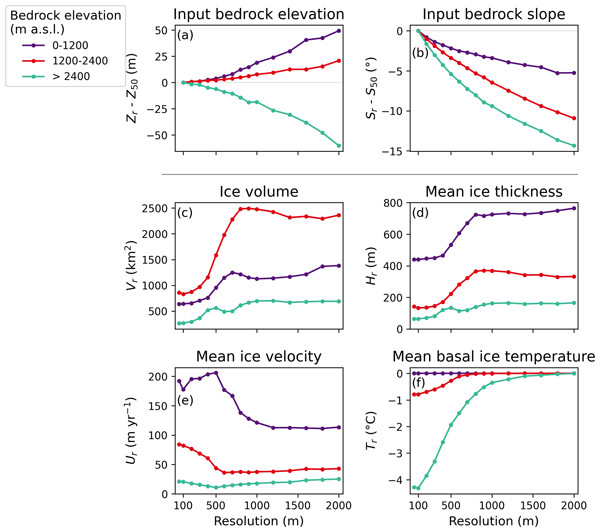
Review of Werner et al., Impact of spatial resolution on large-scale ice cover modelling of mountainous regionsWerner et al. present a study on the impact of spatial resolution when modelling extensive ice cover of mountainous regions. They find that increasingly coarse resolution leads to greater ice volume, slower ice, and slower response times -- at least part of which can be explained by the coarser resolution lowering peaks and filling in valleys.I think all of the modelling behind the results and discussion is competently and appropriately done (though one or two points about instructed vs. numerical model implementation) and as such don't believe further simulations are necessary. However, I think there is scope (and need) to really simplify, shorten, and tighten the text and the figures and to focus on providing some key takeaways for practitioners (even if that comes with caveats).For this reason I think this falls into major revisions, even if no new analysis is needed. I also expect that the current presentation means it is possible that I may not have caught all the issues.At present the emphasis is on where the highest sensitivity to resolution is (about 400-800 m). This is one way of putting it that could make sense if one has been dealing with interpreting these simulations for a long time. However, if we take 50 m as the 'most realistic' run, then the important value is not so much the rate of change with respect to the previous simulation, but the total drift away from the most realistic simulation. This information then provides an interested reader with information along the lines of 'yes, you can coarsen your resolution to improve runtime, but you will be dealing then with an error of this rough order'. It feels like the authors are maybe avoiding being more definite about this which is perhaps understandable, but I think you have a good case to provide more concrete recommendations (supplied with suitable caveats). For example, Williams et al. (2025, https://doi.org/10.1038/s43247-025-02010-z) suggest 5 km -- maybe this isn't a perfect number or maybe it's spot on, but at the very least it is a working value that can be used in lieu of further investigation.I would suggest switching to this approach, meaning figures, results, discussions of the actual variable in question (not a difference), or the error relative to that one baseline value. If the authors feel strongly about keeping their current representation I think some strong reasoning for their approach is required.Beyond that, I think there is a bit of an oversupply of figures here (and the detail in some, such as 9, is a bit too condensed). I don't want to suggest exactly how this should be done, that requires thought, time, and familiarity with the material that I don't have (nor is it my place) but I would encourage the authors to think about what the key takeaways they want a reader to have are, and emphasise these in a reduced number of figures (and figure panels). Additional information can go into the supplement, even if that is already rather crowded !I was also struggling to get through the results and part of the discussion. I hope that focussing on a reduced number of central points might make it possible to streamline your findings and paint a clearer narrative. This doesn't mean important details have to be lost, just that the ridges and valleys of the text should be a bit more defined to take a mountainous analogy. As with the figures, I won't go into full details on all of specific ways this could be done in the more minor comments.My minor comments are not fully comprehensive as I think there is enough work to be done here that that could be a redundant effort, but I have tried to go into some detail !To end on a positive note, I think the results are really interesting and that this should eventually produce a very valuable paper. So apologies if the below reads as harsh, it's not my intention. I think you have something good here but it needs a lot of filing down and a change in tack on the presentation front.Abstract:16 - Opportunity here to say in which direction at no/minor additional word cost.18 - It could be me, but here and elsewhere I had to do a bit of thinking about what the critical mode actually is. Following the major comments this could be redundant, but I would suggest using a more easily graspable phrase here.20 - Can say that coarse resolution artificially e.g. lowers slope angles as I'm sure we're all in agreement that coarse resolution is less realistic.21 - 'Slower temperature...' I guess this refers to coarse resolution? but should be clearer23 - Critical mode could be either defined, or a different term could be used24 - 'We expect similar' could go to 'non-linear... are likely in mountain regions worldwide' as I think you can be reasonably sure of this.Here and elsewhere it is not always super clear in what direction the non-linearity is pointing -- as with the major comments I would suggest honing in on a few of the most significant changes and focussing on clear descriptions of these.I might come back to this in the Discussion, but I think the question of whether these changes can be expected in different regions is an interesting one. One thought I had is that an 'idealised' mountain range could be used for widespread applicability, or you could just run this over the Himalayas too. That does arguably 'fall outside the scope of this study', but even without that I think you can be more confident in your assertion that other mountain ranges should follow similar patterns. Certainly the lower peaks and shallower valleys part is self-evident.Introduction:I think some broader literature on the importance of resolution is missing from this introduction. In addition to the Williams paper cited above, a quick google scholar search 'importance of resolution for ice sheet modelling' reveals quite a wealth of literature. I think this work should be better situated within this literature, as well as what sets it apart (namely the use of IGGM and more of a focus on mountains). Searching for mountain-glacier specific literature gave less hits, but then you can talk about this being one of the first (if that is the case).33 - Overuse of extensive if you feel inclined to change that.42 - I don't think references are necessary for this statement42 - about -> for48 - In The Alps? or in our model domain? Region could be specified, basically.65 - Averaged over the entire domain ? or a local maximum ?66 - 'A better match...' not clear how this sentence supports your argument and also raises the point, is the 400-1000 m exaggeration due to resolution or sliding, or (probably better), you're suggesting that both have a role to play.77 - This passage maybe trails off a bit -- I don't think you have to mention everything you do, but at the same time I generally find the use of 'other key variables' a bit vague. If there aren't so many 'other variables', then it's maybe best to simply list all of them, or following the major comments to be more specific about which you take as key indicators (and why).Methods:Good to talk about the implications of using IGGM over a full numerical model. How big could the innacuracies be? Your approach is certainly justified, but as IGGM is quite new, some more background (this part in the intro) would be good!88 - Can you give a more quantitive description of its accuracy ?89 - End of this sentence a bit unclears90 - A few more details here about Leger et al. would be good. Particularly the comparisons to actual physics based models, and to observational data. This is the core of your results, so it's good for the reader to know the underlying model can be trusted (even if it is an unseeing unthinking statistical emulation :p).99 - 'high-order' -> higher-order100 - hopefully not a killer question, but is the performance a function of the model resolution used in training ? I guess the training takes quite a long time to run so this is a bit difficult to test, but could be quite important. For example, if training at a much lower resolution mitigates many of the problems associated with low actual resolution, that's a pretty important result. Some discussion/thoughts on this would be good !104 - It's worth making it clear that Jouvet and Cordonnier did this and not you (if that is the case). See also the comment about introducing Leger et al. in a bit more detail (l. 90)106 - How was it retrained?130 - I guess using a spatially inextensive ice sheet ? Shouldn't really matter as you're testing sensitivity only (not gaining 'actual' results) but could be worth mentioning.151 - Not sure I catch the drift of this sentence156 - You could specify you start 'warm', or if tied to the present day temperature, how cold exactly. Also good to have a very brief idea of what ice configuration this sets the model up in. Your time step is 0.01-0.04 -- when does this value change? Why do you use this value ?165 - This lapse rate opens the possibility of reporting an annual temperature at sea level, which is a bit more human redable than degree Kelvin away from the base temperature.165 - I don't follow this statement exactly. It was multiplied by 1.6 across all times/temperatures, or just increased from 1 to 1.6 as things got colder? I fully accept the main aim of this paper is to test out resolution, but given you are emulating a realistic event, it would be nice to know a bit more information/rational behind this step.167 - This statement is implicit if you don't feel like including it176 - What percentage of your domain did this influence ? Was this applied for all resolutions if only one resolution qualified ?Results:Please also see my major comment on this. I think there is significant scope to streamline this, and I don't think it's my place to point out every opportunity so I leave that to you, hence the not huge number of individual comments.185 - Assumption to -> assessment? I get that this is a bit of a grey area but then again, there is enough of a background that you probably could call this an assessment not an assumption.190 - With reference to the 30 m base map ?193 - A little confused by this sentence ! I think it could do with some reorganisation/clarification.I also think you might need a supplementary figure showing an example of how these stream regions are classified -- from watershed to watershed ?194 - I am no master statistician, but if all the changes are positive, but the box and whisker plot goes negative, then perhaps a different range indication is called for?205 - In runs at all resolutions ?210 - Can this be a range?215 - This whole paragraph could do with tightening up a bit (sorry I know it's always hard to strike a balance between detail and brevity !). I think the reason it's a little hard to follow is that the values in question are jumping around a bit and the distinctions can feel a bit arbitrary. I.e. sometimes it's 1000 m and the 300 and 400 m, and then it's <500 and >800 . And then at line 221 it goes to 600 and 800. Good to be consistent. May also suggest just three exact values, rather than ranges, which can be a bit harder to describe. I thought about moving this to a major comment but it should be easy to rectify. I do think consistent resolution ranges across the paper are important/useful though !217 - The sentence beginning on this line is quite unclear221 - I think I got what's going on here, but it required more interpretation than I would like. the '-' between warming and cooling is a minus sign? At first glance it looks like punctuation. So either an explicit 'minus' or using more obviously mathematical variables for warming and cooling would be good.223 - % and deg C brake convection by coming directly after the number225 - So in effect, the higher resolution simulations are much more sensitive to climate change -- that could be a headline finding !255 - The first two sentences of this paragraph feel a little winding, maybe there is a punchier way to arrive at your descriptions ? I will confess I did not manage to read all of the paragraphs around this point word for word because they are very dense.264 - I guess this comes back to my earlier comments, it would be nice to have more consistency in resolutions comparisons, that might make a headline figure /narrative of 'use this resolution if you would like to avoid the worst resolution issues'. I do accept that reality will be a little bit more complicated, but here a little more synthesis is not unwarranted267 - And below? So, it only becomes a clear piedmont glacier as resolution decreases from 900 - 500 m282 - I would argue this should be reinterpreted. We can say that the lowest resolution is the most accurate, so then the importance is the drift away from that, the difference between the resolutions is then perhaps of more supplementary interest. I would lessen the number of panels (even if having a panel o is cool), but also include one that shows the actual absolute field at 50 m resolution for comparison purposes.288 - when compared. This sentence is very long-winded.290-390 - I should be honest and say that I am having a very difficult time reading through all this and I am giving it a good go. I have managed a skim but I think my main recommendation would be a focussed rewrite. For example, you switch to ice temperature at 327 after a lot of text about slope values and DEMs. That certainly should be its own paragraph, or grouped in a shorter paragraph with something clearly closely related. All this to say, I expect this can be really significantly cut down to focus on the main takeaways, and a similar approach applied to the rest of the paper. If you put in a few easy to decipher figures they can do the talking, and the results text can be much reduced.Discussion:As with the rest of the paper, this could be very much streamlined, with a big focus on what the main takeaways are. I think this could go from 8 to at most 5 paragraphs, hopefully less. Implications, and tying this in to the rest of the literature should really be emphasised. There are few citations in this section.405: The last sentence of this paragraph is useful (could actually be expanded so that reference back to Fig. 5 is not necessary). I think the rest can be restructured around distance from 50 m and the points you really want to emphasise .418 - Here and elsewhere you can drop 'apparent'. You're controlling every variable in this model so you can say this with a modicum of conviction.421 - Ditto, seem.423 - Basal melting will only happen if the temperature is at the pressure melting point, so this statement is a bit vague.424 - Taking an uncomplicated 1D column shear is a \rho g h sin(\alpha), so it's a function of height and slope. Greater thickness doesn't necessarily mean equal or greater slope.425 - Could be clearer.426 - Better in results ? Link of temperature to Arrhenius is well known, so you could just focus on temperature.428 - This definitely does not need a presumably (softness dependence on temperature)432 - 437 - Results ? But please think carefully about adding to the results !437 - Repetition ?445-447 - Results ?447 - 449 - Cool452 - 455 Results ? or Not that relevant459 - Again with seems, hopefully you can be a bit more definite about this. Interesting discussion tough471 - Half as fast, maybe twice as slow, but not half faster or twice slower, somehow. Probably 'when the rate of temperature forcing is reduced by half'4.2 Opening sentence is resultsI'm going to stop going through this line by line here. Hopefully some of the issues are clear from where I have gone line by line above! There is too much mixing of results and discussion. Each paragraph should have a really clear aim and much more direct. For example the hysterisis effect is cool, but then the main thing to emphasise is that hysterisis is reduced for higher resolutions. That, and its implications should be the main focus of this paragraph, not describing that 'up to 420 years compared to a time lag of less than 200 years at the finest resolutions'Conclusions:A conclusion table could be useful. A lot of the bullet points are different ways of saying 'at high resolution this' 'at low resolution this' 'difference is this'. Standard prose styles dictate that we don't repeat language, which I suppose is reasonable, but that really would be useful here because otherwise one has to search through the sentences for the relevant piece of information.FiguresPlease see major comments, but I do feel that the total number of figures can be streamlined into a smaller number of punchier ones. For me the ones which are very useful are 7 and 3 (and maybe something like 6 but for distance from 50 m, and without requiring quite so many panels), but that's just a quick thought !.Fig. 1 Panel a could be made a bit more recognisable to people through the use of a terrain colourmap and including a couple of city locations -- just a suggestion though.Fig. 2 - It would be nice to see an example (if not the entire region) with labelled stream order so that one can get a feel for which stream order refers to which type of feature.Fig. 3 - I accept this is a bit pedantic on my part, but could the colour bar be flipped to be in ascending order? Also, 2000 is hard to see so minor suggestion to clip at 1,800 colour (don't worry if that's too much hassle)Panel c, can't this just be described as the difference as the maximum ice volume will cancel if both are relative to that.Fig. 5 This is a valuable figure, but I think it probably could/should be transported to the supplementary material -- a reduced version showing the general trend or important jumps with a bit less white space could reside hereFig. 6 - The pedant within me would like to see Fig. 5 and 6 following the same layout, and I prefer the more compact Fig. 6 layout.Fig. 7 - I don't exactly understand the positive negative distinction here. All the positive and negative cells binned together ? I would consider omitting that.Fig. 8 - Can you not develop some improved notation for r? Such as r∈{50,100:100:1000,1200:200:2000} defined early on, and then saying for each r. Writing out the full range at every mention is a bit much. Why is there a grey horizontal line at the top ? I think to separate model inputs from outputs, but then good to label that in the figure. Otherwise a figure like this really does tell story well (though each title should be 'mean ice thickness' etc. ). A panel for total ice volume would be good, too.Fig. 9 The Hr - H50 approach is good. There should be a description on the colour bar. The images are a bit too small.Fig. 10, I'm having difficult with this as it feels like temperature is just a proxy for time here? A data axis should not decrease and then increase again. I would suggest separating this out into two rows and then using two x axis, one for temperature, and another for time. The trend is broadly consistent, so you could also drop the high, mid, low separations.Supplement:Given the quite major comments with the rest of the manuscript I have not extensively explored the supplement. It's nice to see all the parameter values in there. You could put some figures from the main text in here, though even the supplement shouldn't be too long and wavering.Citation: https://doi.org/
10.5194/egusphere-2025-3870-RC1 -
AC1: 'Reply on RC1', Helen Werner, 18 Dec 2025
We would like to thank reviewer 1 kindly for taking the time to read our manuscript and for the constructive feedback, which will help us to improve the study. Please see the attached PDF where we addressed all comments point by point and suggest respective corrections.
-
AC1: 'Reply on RC1', Helen Werner, 18 Dec 2025
-
RC2: 'Comment on egusphere-2025-3870', Anonymous Referee #2, 04 Nov 2025
General Assessment
Overall, the manuscript is well-written and the sections are clearly defined. The topic is relevant and timely, given the increasing computational capacity that now allows high-resolution simulations of mountain glaciers. The approach is interesting, and the study addresses an important question: how spatial resolution affects the simulation of ice thickness, flow, and thermal regimes in mountainous regions.
However, while the manuscript is organized into clear sections, some aspects of the results and discussion are difficult to follow, partly due to reliance on references to supplementary material. Certain patterns and the interpretation of figures could be presented more cohesively in the main text.
Besides, there are aspects that require clarification or more explicit justification. While the authors explore a wide range of resolutions (50 m to 2 km), the study relies on a single model (the Instructed Glacier Model, IGM). It is not clear whether generalizations about the impact of resolution on mountain glaciers are fully warranted based on this single framework. Explicit discussion of model limitations and how the resolution interacts with the underlying Blatter-Pattyn approximation, compared to other approaches (full Stokes or others), would strengthen the study.
Introduction
- The introduction’s opening paragraph reads as a series of descriptive statements rather than a connected narrative. Consider revising for smoother flow.
- The knowledge gap and justification for the study could be clarified more explicitly. For example, are there other studies on the effect of the spatial resolution using similar or different approaches or applied to a different setting?
Methodology
- The choice of model parameters requires more justification. For example:
- The retraining frequency of the neural network is mentioned, but no explanation about the selection of the values is provided. Explaining why this frequency was chosen would help readers understand its impact.
- Elevation bands for low, mid, and high altitudes are defined as 0–1200 m, 1200–2400 m, and >2400 m. A brief justification or reference would improve clarity.
- While the study explores a wide range of resolutions, all resampling is performed using cubic interpolation. Would the authors expect differences by using other techniques (bilinear, kriging…)? Could this lead to some misleading results?
Results
- Some aspects of the results are difficult to interpret solely from the figures, particularly given the reliance on supplementary material. Consider highlighting the key patterns in the main text to improve readability.
- While the manuscript identifies three resolution “modes,” the evidence is not entirely clear except for Figure 8 and not for all the outputs and elevation bands.
Discussion
- The discussion is generally relevant but could be more explicitly connected to practical implications. For example, explaining how these findings could guide modelers in selecting appropriate spatial resolutions would increase the impact (other than just going for finer resolution as a general rule).
- I feel that maybe a more detailed exploration of this 400-800 “critical” mode should be addressed before to clearly talk about strong sensibility.
Conclusions
- I like the bullet structure, but I think that some points could be rearranged for more clarity.
Figures and Supplementary Material
- While the figures themselves are informative, the main text often relies on references to supplementary material to interpret the results. This can make the narrative difficult to follow. Consider ensuring that the key patterns and findings are clearly described within the main text, using the supplementary figures as support rather than as primary evidence.
Minor Comments
Here I will try to skip the comments raised from the other reviewer so we don’t need to repeat the same things.
L108: Please, justify this choice of (0.01-0.04).
L178: Please, justify the selection of the elevation bands.
L184: effects -> affects?
L209: This 10 times more is not clear to me, at least from the cited figures.
L254: It is not clear to me looking at Fig. S12.
L426-7: I really don’t see those greatest relative changes at high altitudes. Probably you have the numbers, but looking at Fig. 8f such a thing is not clear to me.
L429-31: Again, this is not obvious to me just looking at Fig. 8.
L474-8: Nothing to object here, the opposite, really clear statement and good point resulting from your work.
L500: Here you suggest to go to finer than km- and ideally 500-m scale- but your defined critical mode ranges from 400 to 800m. I found this a little bit contradictory.
Overall Recommendation
Even if this is a relevant and well-executed study that addresses an important question in glacier modelling, especially in regional or global studies, I consider the manuscript as major revisions after considering some points:
- Clarifying model limitations and generalization potential.
- Justifying some methodological choices, such as elevation bands, retraining frequency, and resampling method.
- Streamlining results and discussion to highlight the most important findings and improve readability. Exploring a bit more this critical mode sensibility.
- Enhancing figure clarity and reducing overreliance on supplementary material.
I believe that addressing these points will help the resulting paper become a solid and valuable contribution to the field.
Citation: https://doi.org/10.5194/egusphere-2025-3870-RC2 -
AC2: 'Reply on RC2', Helen Werner, 18 Dec 2025
We would like to thank reviewer 2 kindly for taking the time to read our manuscript and for the constructive feedback, which will help us to improve the study. Please see the attached PDF where we addressed all comments point by point and suggest respective corrections.
Peer review completion


Interactive discussion
Status: closed
-
RC1: 'Comment on egusphere-2025-3870', Anonymous Referee #1, 20 Oct 2025
Review of Werner et al., Impact of spatial resolution on large-scale ice cover modelling of mountainous regionsWerner et al. present a study on the impact of spatial resolution when modelling extensive ice cover of mountainous regions. They find that increasingly coarse resolution leads to greater ice volume, slower ice, and slower response times -- at least part of which can be explained by the coarser resolution lowering peaks and filling in valleys.I think all of the modelling behind the results and discussion is competently and appropriately done (though one or two points about instructed vs. numerical model implementation) and as such don't believe further simulations are necessary. However, I think there is scope (and need) to really simplify, shorten, and tighten the text and the figures and to focus on providing some key takeaways for practitioners (even if that comes with caveats).For this reason I think this falls into major revisions, even if no new analysis is needed. I also expect that the current presentation means it is possible that I may not have caught all the issues.At present the emphasis is on where the highest sensitivity to resolution is (about 400-800 m). This is one way of putting it that could make sense if one has been dealing with interpreting these simulations for a long time. However, if we take 50 m as the 'most realistic' run, then the important value is not so much the rate of change with respect to the previous simulation, but the total drift away from the most realistic simulation. This information then provides an interested reader with information along the lines of 'yes, you can coarsen your resolution to improve runtime, but you will be dealing then with an error of this rough order'. It feels like the authors are maybe avoiding being more definite about this which is perhaps understandable, but I think you have a good case to provide more concrete recommendations (supplied with suitable caveats). For example, Williams et al. (2025, https://doi.org/10.1038/s43247-025-02010-z) suggest 5 km -- maybe this isn't a perfect number or maybe it's spot on, but at the very least it is a working value that can be used in lieu of further investigation.I would suggest switching to this approach, meaning figures, results, discussions of the actual variable in question (not a difference), or the error relative to that one baseline value. If the authors feel strongly about keeping their current representation I think some strong reasoning for their approach is required.Beyond that, I think there is a bit of an oversupply of figures here (and the detail in some, such as 9, is a bit too condensed). I don't want to suggest exactly how this should be done, that requires thought, time, and familiarity with the material that I don't have (nor is it my place) but I would encourage the authors to think about what the key takeaways they want a reader to have are, and emphasise these in a reduced number of figures (and figure panels). Additional information can go into the supplement, even if that is already rather crowded !I was also struggling to get through the results and part of the discussion. I hope that focussing on a reduced number of central points might make it possible to streamline your findings and paint a clearer narrative. This doesn't mean important details have to be lost, just that the ridges and valleys of the text should be a bit more defined to take a mountainous analogy. As with the figures, I won't go into full details on all of specific ways this could be done in the more minor comments.My minor comments are not fully comprehensive as I think there is enough work to be done here that that could be a redundant effort, but I have tried to go into some detail !To end on a positive note, I think the results are really interesting and that this should eventually produce a very valuable paper. So apologies if the below reads as harsh, it's not my intention. I think you have something good here but it needs a lot of filing down and a change in tack on the presentation front.Abstract:16 - Opportunity here to say in which direction at no/minor additional word cost.18 - It could be me, but here and elsewhere I had to do a bit of thinking about what the critical mode actually is. Following the major comments this could be redundant, but I would suggest using a more easily graspable phrase here.20 - Can say that coarse resolution artificially e.g. lowers slope angles as I'm sure we're all in agreement that coarse resolution is less realistic.21 - 'Slower temperature...' I guess this refers to coarse resolution? but should be clearer23 - Critical mode could be either defined, or a different term could be used24 - 'We expect similar' could go to 'non-linear... are likely in mountain regions worldwide' as I think you can be reasonably sure of this.Here and elsewhere it is not always super clear in what direction the non-linearity is pointing -- as with the major comments I would suggest honing in on a few of the most significant changes and focussing on clear descriptions of these.I might come back to this in the Discussion, but I think the question of whether these changes can be expected in different regions is an interesting one. One thought I had is that an 'idealised' mountain range could be used for widespread applicability, or you could just run this over the Himalayas too. That does arguably 'fall outside the scope of this study', but even without that I think you can be more confident in your assertion that other mountain ranges should follow similar patterns. Certainly the lower peaks and shallower valleys part is self-evident.Introduction:I think some broader literature on the importance of resolution is missing from this introduction. In addition to the Williams paper cited above, a quick google scholar search 'importance of resolution for ice sheet modelling' reveals quite a wealth of literature. I think this work should be better situated within this literature, as well as what sets it apart (namely the use of IGGM and more of a focus on mountains). Searching for mountain-glacier specific literature gave less hits, but then you can talk about this being one of the first (if that is the case).33 - Overuse of extensive if you feel inclined to change that.42 - I don't think references are necessary for this statement42 - about -> for48 - In The Alps? or in our model domain? Region could be specified, basically.65 - Averaged over the entire domain ? or a local maximum ?66 - 'A better match...' not clear how this sentence supports your argument and also raises the point, is the 400-1000 m exaggeration due to resolution or sliding, or (probably better), you're suggesting that both have a role to play.77 - This passage maybe trails off a bit -- I don't think you have to mention everything you do, but at the same time I generally find the use of 'other key variables' a bit vague. If there aren't so many 'other variables', then it's maybe best to simply list all of them, or following the major comments to be more specific about which you take as key indicators (and why).Methods:Good to talk about the implications of using IGGM over a full numerical model. How big could the innacuracies be? Your approach is certainly justified, but as IGGM is quite new, some more background (this part in the intro) would be good!88 - Can you give a more quantitive description of its accuracy ?89 - End of this sentence a bit unclears90 - A few more details here about Leger et al. would be good. Particularly the comparisons to actual physics based models, and to observational data. This is the core of your results, so it's good for the reader to know the underlying model can be trusted (even if it is an unseeing unthinking statistical emulation :p).99 - 'high-order' -> higher-order100 - hopefully not a killer question, but is the performance a function of the model resolution used in training ? I guess the training takes quite a long time to run so this is a bit difficult to test, but could be quite important. For example, if training at a much lower resolution mitigates many of the problems associated with low actual resolution, that's a pretty important result. Some discussion/thoughts on this would be good !104 - It's worth making it clear that Jouvet and Cordonnier did this and not you (if that is the case). See also the comment about introducing Leger et al. in a bit more detail (l. 90)106 - How was it retrained?130 - I guess using a spatially inextensive ice sheet ? Shouldn't really matter as you're testing sensitivity only (not gaining 'actual' results) but could be worth mentioning.151 - Not sure I catch the drift of this sentence156 - You could specify you start 'warm', or if tied to the present day temperature, how cold exactly. Also good to have a very brief idea of what ice configuration this sets the model up in. Your time step is 0.01-0.04 -- when does this value change? Why do you use this value ?165 - This lapse rate opens the possibility of reporting an annual temperature at sea level, which is a bit more human redable than degree Kelvin away from the base temperature.165 - I don't follow this statement exactly. It was multiplied by 1.6 across all times/temperatures, or just increased from 1 to 1.6 as things got colder? I fully accept the main aim of this paper is to test out resolution, but given you are emulating a realistic event, it would be nice to know a bit more information/rational behind this step.167 - This statement is implicit if you don't feel like including it176 - What percentage of your domain did this influence ? Was this applied for all resolutions if only one resolution qualified ?Results:Please also see my major comment on this. I think there is significant scope to streamline this, and I don't think it's my place to point out every opportunity so I leave that to you, hence the not huge number of individual comments.185 - Assumption to -> assessment? I get that this is a bit of a grey area but then again, there is enough of a background that you probably could call this an assessment not an assumption.190 - With reference to the 30 m base map ?193 - A little confused by this sentence ! I think it could do with some reorganisation/clarification.I also think you might need a supplementary figure showing an example of how these stream regions are classified -- from watershed to watershed ?194 - I am no master statistician, but if all the changes are positive, but the box and whisker plot goes negative, then perhaps a different range indication is called for?205 - In runs at all resolutions ?210 - Can this be a range?215 - This whole paragraph could do with tightening up a bit (sorry I know it's always hard to strike a balance between detail and brevity !). I think the reason it's a little hard to follow is that the values in question are jumping around a bit and the distinctions can feel a bit arbitrary. I.e. sometimes it's 1000 m and the 300 and 400 m, and then it's <500 and >800 . And then at line 221 it goes to 600 and 800. Good to be consistent. May also suggest just three exact values, rather than ranges, which can be a bit harder to describe. I thought about moving this to a major comment but it should be easy to rectify. I do think consistent resolution ranges across the paper are important/useful though !217 - The sentence beginning on this line is quite unclear221 - I think I got what's going on here, but it required more interpretation than I would like. the '-' between warming and cooling is a minus sign? At first glance it looks like punctuation. So either an explicit 'minus' or using more obviously mathematical variables for warming and cooling would be good.223 - % and deg C brake convection by coming directly after the number225 - So in effect, the higher resolution simulations are much more sensitive to climate change -- that could be a headline finding !255 - The first two sentences of this paragraph feel a little winding, maybe there is a punchier way to arrive at your descriptions ? I will confess I did not manage to read all of the paragraphs around this point word for word because they are very dense.264 - I guess this comes back to my earlier comments, it would be nice to have more consistency in resolutions comparisons, that might make a headline figure /narrative of 'use this resolution if you would like to avoid the worst resolution issues'. I do accept that reality will be a little bit more complicated, but here a little more synthesis is not unwarranted267 - And below? So, it only becomes a clear piedmont glacier as resolution decreases from 900 - 500 m282 - I would argue this should be reinterpreted. We can say that the lowest resolution is the most accurate, so then the importance is the drift away from that, the difference between the resolutions is then perhaps of more supplementary interest. I would lessen the number of panels (even if having a panel o is cool), but also include one that shows the actual absolute field at 50 m resolution for comparison purposes.288 - when compared. This sentence is very long-winded.290-390 - I should be honest and say that I am having a very difficult time reading through all this and I am giving it a good go. I have managed a skim but I think my main recommendation would be a focussed rewrite. For example, you switch to ice temperature at 327 after a lot of text about slope values and DEMs. That certainly should be its own paragraph, or grouped in a shorter paragraph with something clearly closely related. All this to say, I expect this can be really significantly cut down to focus on the main takeaways, and a similar approach applied to the rest of the paper. If you put in a few easy to decipher figures they can do the talking, and the results text can be much reduced.Discussion:As with the rest of the paper, this could be very much streamlined, with a big focus on what the main takeaways are. I think this could go from 8 to at most 5 paragraphs, hopefully less. Implications, and tying this in to the rest of the literature should really be emphasised. There are few citations in this section.405: The last sentence of this paragraph is useful (could actually be expanded so that reference back to Fig. 5 is not necessary). I think the rest can be restructured around distance from 50 m and the points you really want to emphasise .418 - Here and elsewhere you can drop 'apparent'. You're controlling every variable in this model so you can say this with a modicum of conviction.421 - Ditto, seem.423 - Basal melting will only happen if the temperature is at the pressure melting point, so this statement is a bit vague.424 - Taking an uncomplicated 1D column shear is a \rho g h sin(\alpha), so it's a function of height and slope. Greater thickness doesn't necessarily mean equal or greater slope.425 - Could be clearer.426 - Better in results ? Link of temperature to Arrhenius is well known, so you could just focus on temperature.428 - This definitely does not need a presumably (softness dependence on temperature)432 - 437 - Results ? But please think carefully about adding to the results !437 - Repetition ?445-447 - Results ?447 - 449 - Cool452 - 455 Results ? or Not that relevant459 - Again with seems, hopefully you can be a bit more definite about this. Interesting discussion tough471 - Half as fast, maybe twice as slow, but not half faster or twice slower, somehow. Probably 'when the rate of temperature forcing is reduced by half'4.2 Opening sentence is resultsI'm going to stop going through this line by line here. Hopefully some of the issues are clear from where I have gone line by line above! There is too much mixing of results and discussion. Each paragraph should have a really clear aim and much more direct. For example the hysterisis effect is cool, but then the main thing to emphasise is that hysterisis is reduced for higher resolutions. That, and its implications should be the main focus of this paragraph, not describing that 'up to 420 years compared to a time lag of less than 200 years at the finest resolutions'Conclusions:A conclusion table could be useful. A lot of the bullet points are different ways of saying 'at high resolution this' 'at low resolution this' 'difference is this'. Standard prose styles dictate that we don't repeat language, which I suppose is reasonable, but that really would be useful here because otherwise one has to search through the sentences for the relevant piece of information.FiguresPlease see major comments, but I do feel that the total number of figures can be streamlined into a smaller number of punchier ones. For me the ones which are very useful are 7 and 3 (and maybe something like 6 but for distance from 50 m, and without requiring quite so many panels), but that's just a quick thought !.Fig. 1 Panel a could be made a bit more recognisable to people through the use of a terrain colourmap and including a couple of city locations -- just a suggestion though.Fig. 2 - It would be nice to see an example (if not the entire region) with labelled stream order so that one can get a feel for which stream order refers to which type of feature.Fig. 3 - I accept this is a bit pedantic on my part, but could the colour bar be flipped to be in ascending order? Also, 2000 is hard to see so minor suggestion to clip at 1,800 colour (don't worry if that's too much hassle)Panel c, can't this just be described as the difference as the maximum ice volume will cancel if both are relative to that.Fig. 5 This is a valuable figure, but I think it probably could/should be transported to the supplementary material -- a reduced version showing the general trend or important jumps with a bit less white space could reside hereFig. 6 - The pedant within me would like to see Fig. 5 and 6 following the same layout, and I prefer the more compact Fig. 6 layout.Fig. 7 - I don't exactly understand the positive negative distinction here. All the positive and negative cells binned together ? I would consider omitting that.Fig. 8 - Can you not develop some improved notation for r? Such as r∈{50,100:100:1000,1200:200:2000} defined early on, and then saying for each r. Writing out the full range at every mention is a bit much. Why is there a grey horizontal line at the top ? I think to separate model inputs from outputs, but then good to label that in the figure. Otherwise a figure like this really does tell story well (though each title should be 'mean ice thickness' etc. ). A panel for total ice volume would be good, too.Fig. 9 The Hr - H50 approach is good. There should be a description on the colour bar. The images are a bit too small.Fig. 10, I'm having difficult with this as it feels like temperature is just a proxy for time here? A data axis should not decrease and then increase again. I would suggest separating this out into two rows and then using two x axis, one for temperature, and another for time. The trend is broadly consistent, so you could also drop the high, mid, low separations.Supplement:Given the quite major comments with the rest of the manuscript I have not extensively explored the supplement. It's nice to see all the parameter values in there. You could put some figures from the main text in here, though even the supplement shouldn't be too long and wavering.Citation: https://doi.org/
10.5194/egusphere-2025-3870-RC1 -
AC1: 'Reply on RC1', Helen Werner, 18 Dec 2025
We would like to thank reviewer 1 kindly for taking the time to read our manuscript and for the constructive feedback, which will help us to improve the study. Please see the attached PDF where we addressed all comments point by point and suggest respective corrections.
-
AC1: 'Reply on RC1', Helen Werner, 18 Dec 2025
-
RC2: 'Comment on egusphere-2025-3870', Anonymous Referee #2, 04 Nov 2025
General Assessment
Overall, the manuscript is well-written and the sections are clearly defined. The topic is relevant and timely, given the increasing computational capacity that now allows high-resolution simulations of mountain glaciers. The approach is interesting, and the study addresses an important question: how spatial resolution affects the simulation of ice thickness, flow, and thermal regimes in mountainous regions.
However, while the manuscript is organized into clear sections, some aspects of the results and discussion are difficult to follow, partly due to reliance on references to supplementary material. Certain patterns and the interpretation of figures could be presented more cohesively in the main text.
Besides, there are aspects that require clarification or more explicit justification. While the authors explore a wide range of resolutions (50 m to 2 km), the study relies on a single model (the Instructed Glacier Model, IGM). It is not clear whether generalizations about the impact of resolution on mountain glaciers are fully warranted based on this single framework. Explicit discussion of model limitations and how the resolution interacts with the underlying Blatter-Pattyn approximation, compared to other approaches (full Stokes or others), would strengthen the study.
Introduction
- The introduction’s opening paragraph reads as a series of descriptive statements rather than a connected narrative. Consider revising for smoother flow.
- The knowledge gap and justification for the study could be clarified more explicitly. For example, are there other studies on the effect of the spatial resolution using similar or different approaches or applied to a different setting?
Methodology
- The choice of model parameters requires more justification. For example:
- The retraining frequency of the neural network is mentioned, but no explanation about the selection of the values is provided. Explaining why this frequency was chosen would help readers understand its impact.
- Elevation bands for low, mid, and high altitudes are defined as 0–1200 m, 1200–2400 m, and >2400 m. A brief justification or reference would improve clarity.
- While the study explores a wide range of resolutions, all resampling is performed using cubic interpolation. Would the authors expect differences by using other techniques (bilinear, kriging…)? Could this lead to some misleading results?
Results
- Some aspects of the results are difficult to interpret solely from the figures, particularly given the reliance on supplementary material. Consider highlighting the key patterns in the main text to improve readability.
- While the manuscript identifies three resolution “modes,” the evidence is not entirely clear except for Figure 8 and not for all the outputs and elevation bands.
Discussion
- The discussion is generally relevant but could be more explicitly connected to practical implications. For example, explaining how these findings could guide modelers in selecting appropriate spatial resolutions would increase the impact (other than just going for finer resolution as a general rule).
- I feel that maybe a more detailed exploration of this 400-800 “critical” mode should be addressed before to clearly talk about strong sensibility.
Conclusions
- I like the bullet structure, but I think that some points could be rearranged for more clarity.
Figures and Supplementary Material
- While the figures themselves are informative, the main text often relies on references to supplementary material to interpret the results. This can make the narrative difficult to follow. Consider ensuring that the key patterns and findings are clearly described within the main text, using the supplementary figures as support rather than as primary evidence.
Minor Comments
Here I will try to skip the comments raised from the other reviewer so we don’t need to repeat the same things.
L108: Please, justify this choice of (0.01-0.04).
L178: Please, justify the selection of the elevation bands.
L184: effects -> affects?
L209: This 10 times more is not clear to me, at least from the cited figures.
L254: It is not clear to me looking at Fig. S12.
L426-7: I really don’t see those greatest relative changes at high altitudes. Probably you have the numbers, but looking at Fig. 8f such a thing is not clear to me.
L429-31: Again, this is not obvious to me just looking at Fig. 8.
L474-8: Nothing to object here, the opposite, really clear statement and good point resulting from your work.
L500: Here you suggest to go to finer than km- and ideally 500-m scale- but your defined critical mode ranges from 400 to 800m. I found this a little bit contradictory.
Overall Recommendation
Even if this is a relevant and well-executed study that addresses an important question in glacier modelling, especially in regional or global studies, I consider the manuscript as major revisions after considering some points:
- Clarifying model limitations and generalization potential.
- Justifying some methodological choices, such as elevation bands, retraining frequency, and resampling method.
- Streamlining results and discussion to highlight the most important findings and improve readability. Exploring a bit more this critical mode sensibility.
- Enhancing figure clarity and reducing overreliance on supplementary material.
I believe that addressing these points will help the resulting paper become a solid and valuable contribution to the field.
Citation: https://doi.org/10.5194/egusphere-2025-3870-RC2 -
AC2: 'Reply on RC2', Helen Werner, 18 Dec 2025
We would like to thank reviewer 2 kindly for taking the time to read our manuscript and for the constructive feedback, which will help us to improve the study. Please see the attached PDF where we addressed all comments point by point and suggest respective corrections.
Peer review completion
Journal article(s) based on this preprint
Viewed
| HTML | XML | Total | Supplement | BibTeX | EndNote | |
|---|---|---|---|---|---|---|
| 2,791 | 445 | 87 | 3,323 | 224 | 91 | 108 |
- HTML: 2,791
- PDF: 445
- XML: 87
- Total: 3,323
- Supplement: 224
- BibTeX: 91
- EndNote: 108
Viewed (geographical distribution)
| Country | # | Views | % |
|---|
| Total: | 0 |
| HTML: | 0 |
| PDF: | 0 |
| XML: | 0 |
- 1
Helen Werner

Dirk Scherler
Tancrède P. M. Leger
Guillaume Jouvet
Ricarda Winkelmann
The requested preprint has a corresponding peer-reviewed final revised paper. You are encouraged to refer to the final revised version.
- Preprint
(1919 KB) - Metadata XML
-
Supplement
(1690 KB) - BibTeX
- EndNote
- Final revised paper