
the Creative Commons Attribution 4.0 License.
the Creative Commons Attribution 4.0 License.
 | 05 Sep 2025
Response of marine post-frontal clouds to Gulf Stream variability
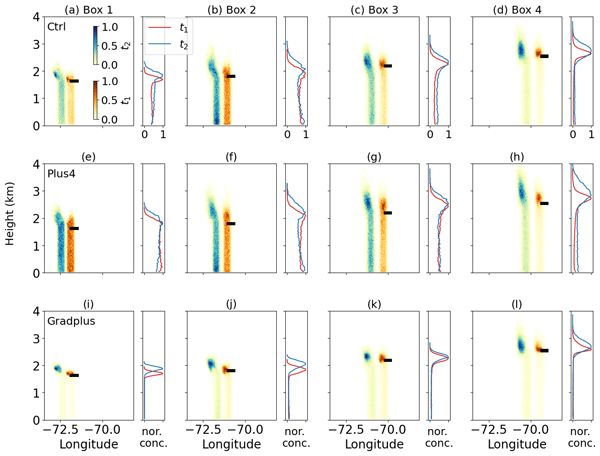
Abstract. Understanding how Gulf Stream variation influences cloud morphology is critical for evaluating cloud feedback in the western North Atlantic Ocean and beyond, where mesoscale air-sea interactions dominate. This study investigates the impact of altered mean sea surface temperature (SST) and SST gradients on post-frontal cloud characteristics during cold-air outbreaks, using the Weather Research and Forecasting (WRF) model. Three sensitivity experiments are conducted: a control simulation (default SST), Plus4 (uniform SST increase of 4 K), and Gradplus (SST gradient enhanced by 25 %, centered around mean SST). Results reveal distinctly different responses in boundary layer dynamics and cloud macro-physics. In Plus4, a warmer and moister boundary layer reduces total cloud cover but promotes larger cloud sizes and elongated cloud streets, with diminished liquid water and enhanced ice-phase hydrometeors. Conversely, Gradplus amplifies impacts in the upwind colder SST regions, yielding a drier, colder boundary layer, weaker energy transport, and higher liquid water path but reduced ice water content and cloud lines. Tracer analysis highlights that SST modifications alter airmass sources near cloud tops due to the entrainment of ambient air, with Plus4 amplifying boundary layer contributions to cloud-top regions. These findings underscore the spatially varying effects of SST gradients and mean SST on cloud organization and microphysics, emphasizing the need to resolve ocean-atmosphere coupling in global models to improve the prediction of marine cloud feedback under warming scenarios.
-
Notice on discussion status
The requested preprint has a corresponding peer-reviewed final revised paper. You are encouraged to refer to the final revised version.
-
Preprint
(0 KB)
-
The requested preprint has a corresponding peer-reviewed final revised paper. You are encouraged to refer to the final revised version.


Journal article(s) based on this preprint
Interactive discussion
Status: closed
-
RC1: 'Comment on egusphere-2025-3854', Anonymous Referee #1, 03 Oct 2025
- AC1: 'Reply on RC1', Jingyi Chen, 23 Dec 2025
-
RC2: 'Comment on egusphere-2025-3854', Anonymous Referee #2, 07 Nov 2025
The comment was uploaded in the form of a supplement: https://egusphere.copernicus.org/preprints/2025/egusphere-2025-3854/egusphere-2025-3854-RC2-supplement.pdf
- AC2: 'Reply on RC2', Jingyi Chen, 23 Dec 2025
Peer review completion


Interactive discussion
Status: closed
-
RC1: 'Comment on egusphere-2025-3854', Anonymous Referee #1, 03 Oct 2025
This study investigates the impact of enhanced uniform warming and enhanced SST gradients on cloud characteristics during cold-air outbreaks events. With high-resolution WRF model, the authors identify distinct responses under the two warming scenarios: enhanced uniform warming leads to a warmer and moister boundary layer with larger cloud size and deeper cloud development, whereas enhanced SST gradient results in a drier and colder boundary layer in regions of negative SST anomalies and a reduction of post-frontal cloud areas. Overall, the manuscript present interesting analyses and provide insights into the how clouds and boundary layers respond to warming near the Gulf Stream. However, some aspects of the manuscript could be revised to improve clarity of the manuscript and strengthen the implication of the results.
Comments:
- L53: I would recommend using a different term than “shifting” temperature patterns, as the Gradplus experiment represents an intensification of the SST gradient rather than a shift in the pattern.
- L190: The text states “from the inner domain.” Should Figure 1 refers to the outer domain instead of the inner domain?
- L240: Please briefly explain the calculation of smoothed liquid water path and specify the thresholds for each zone, so that readers do not need to refer to another paper for the definition.
- L328-330: Could the author elaborate on why the mass flux magnitude is one order larger in q_v isopleths compared to theta_e and theta isopleths, and how this indicates a stronger relationship between mass flux and q_v?
- L345-346: My understanding is that both Zones 4 and 5 correspond to the cloud street regime. Please clarify why the alignment with zone 5 represents an extension of the frontal system (zone 6).
- Section 3.2: This section presents the energy transport response using isentropic analysis. However, the discussion seems somewhat disconnected from Section 3.1 and 3.3. The implications of energy transport for cloud morphology and to the boundary layer are not entirely clear, and the results are only briefly mentioned in the conclusion and abstract. I believe providing additional explanation and clarification, such a short summary of the results at the end of Section 3.2, would help improve the clarity and flow of the manuscript.
- L382-383 “Temporal variations in Gradplus are more pronounced”: Did the authors intend to suggest the temporal variations in Gradplus are more pronounced than in Plus4? I would tend to disagree as the ranges of colorbars in Figs 9-11 are much smaller than in Fig 8. L382-383 "Temporal variations in Gradplus are more pronounced": Did the authors intend to say the temporal variations in Gradplus are more pronounced than in Plus4? I would tend to disagree as the ranges of colorbars in Figs 9-11 are much smaller than in Fig 8. Please revise accordingly, and remind the readers the differences in colorbars.
- L437-438: It is difficult to discern from Figs 10f, 10i, and 11i that stronger convergence and convection closely correlate with hydrometeor mixing ratio. In particular, the structure in Fig 11i does not appear to resemble Fig 10f and 10i. Please elaborate on this.
Text:
- L85, “GCM data”: “data” is redundant and can be removed
- L123: duplicated use of “field campaign”
- L200-202: The phrase “intensive fossil fuel burning and rapid economic growth” is mentioned twice. Please revise the text accordingly.
- L324: Should this refer to Fig 4a instead?
- L376: The hydrometeor mixing ratio is not shown in Figure 8, please revise the text.
- Figure 10 label: Please use the Greek letter omega to represent vertical velocity
- Figures 9-11 label: I would recommend adding “Neg. Anom.”, “GS”, “Pos. Anom.” in the titles to be consistent with the labeling used in Figure 7.
Citation: https://doi.org/10.5194/egusphere-2025-3854-RC1 - AC1: 'Reply on RC1', Jingyi Chen, 23 Dec 2025
-
RC2: 'Comment on egusphere-2025-3854', Anonymous Referee #2, 07 Nov 2025
The comment was uploaded in the form of a supplement: https://egusphere.copernicus.org/preprints/2025/egusphere-2025-3854/egusphere-2025-3854-RC2-supplement.pdf
- AC2: 'Reply on RC2', Jingyi Chen, 23 Dec 2025
Peer review completion
Journal article(s) based on this preprint
Viewed
Since the preprint corresponding to this journal article was posted outside of Copernicus Publications, the preprint-related metrics are limited to HTML views.
| HTML | XML | Total | BibTeX | EndNote | |
|---|---|---|---|---|---|
| 5,958 | 0 | 13 | 5,971 | 0 | 0 |
- HTML: 5,958
- PDF: 0
- XML: 13
- Total: 5,971
- BibTeX: 0
- EndNote: 0
Viewed (geographical distribution)
Since the preprint corresponding to this journal article was posted outside of Copernicus Publications, the preprint-related metrics are limited to HTML views.
| Country | # | Views | % |
|---|
| Total: | 0 |
| HTML: | 0 |
| PDF: | 0 |
| XML: | 0 |
- 1
Jingyi Chen

Hongyu Liu
David Painemal
Armin Sorooshian
Sheng-Lun Tai
Christiane Voigt
The requested preprint has a corresponding peer-reviewed final revised paper. You are encouraged to refer to the final revised version.
This study investigates the impact of enhanced uniform warming and enhanced SST gradients on cloud characteristics during cold-air outbreaks events. With high-resolution WRF model, the authors identify distinct responses under the two warming scenarios: enhanced uniform warming leads to a warmer and moister boundary layer with larger cloud size and deeper cloud development, whereas enhanced SST gradient results in a drier and colder boundary layer in regions of negative SST anomalies and a reduction of post-frontal cloud areas. Overall, the manuscript present interesting analyses and provide insights into the how clouds and boundary layers respond to warming near the Gulf Stream. However, some aspects of the manuscript could be revised to improve clarity of the manuscript and strengthen the implication of the results.
Comments:
Text: