
the Creative Commons Attribution 4.0 License.
the Creative Commons Attribution 4.0 License.
 | 05 Sep 2025
Multi-model analysis of the radiative impacts of the 2022 Hunga eruption indicates a significant cooling contribution from the volcanic plume
Abstract. On January 15, 2022, the Hunga volcano eruption released unprecedented amounts of water vapor into the atmosphere alongside a modest amount of SO2. In this work we analyse results from multiple Earth system models as part of the Hunga Tonga-Hunga Ha’apai Volcano Impact Model Observation Comparison Project.
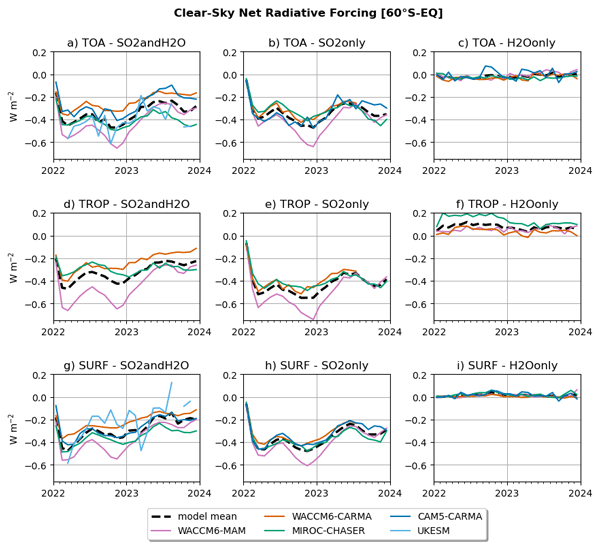
Our results show a good model agreement over the climatic outcomes of the eruption, overall indicating a significant negative radiative forcing from the Hunga eruption. The multi-model mean of global instantaneous radiative forcing averaged over 2022–2023 is estimated at -0.19 ± 0.04 W/m2 at the top-of-atmosphere (TOA), and -0.16 ± 0.03 W/m2 at the surface. Simulations with free-running meteorology and climatological sea surface temperatures and sea ice yield a global mean TOA forcing of -0.14 ± 0.10 W/m2 across two models for the first 2 years, decreasing to -0.09 ± 0.10 W/m2 on average between 2022 and 2027. However, these global values may be underestimated by about 50 %, considering that recent SO2 injection retrievals suggest nearly twice the amount than the 0.5 Tg-SO2 used in the protocol. We also find that the contribution from added stratospheric water vapor is minimal and that the injected SO2 and the resulting formation of stratospheric sulfate dominate the radiative forcing. However, water vapor played a key role in the initial aerosol growth, leading to a stronger negative radiative forcing during the first six months after the eruption compared to simulations without water vapor co-injection.
Competing interests: At least one of the (co-)authors is a member of the editorial board of Atmospheric Chemistry and Physics.
Publisher's note: Copernicus Publications remains neutral with regard to jurisdictional claims made in the text, published maps, institutional affiliations, or any other geographical representation in this paper. While Copernicus Publications makes every effort to include appropriate place names, the final responsibility lies with the authors. Views expressed in the text are those of the authors and do not necessarily reflect the views of the publisher.-
Notice on discussion status
The requested preprint has a corresponding peer-reviewed final revised paper. You are encouraged to refer to the final revised version.
-
Preprint
(2496 KB)
-
The requested preprint has a corresponding peer-reviewed final revised paper. You are encouraged to refer to the final revised version.
- Preprint
(2496 KB) - Metadata XML
- BibTeX
- EndNote
- Final revised paper


Journal article(s) based on this preprint
Interactive discussion
Status: closed
- RC1: 'Comment on egusphere-2025-3769', Anonymous Referee #1, 29 Sep 2025
-
RC2: 'Comment on egusphere-2025-3769', Anonymous Referee #2, 04 Nov 2025
Review of the manuscript “Multi-model analysis of the radiative impacts of the 2022 Hunga eruption indicates a significant cooling contribution from the volcanic plume”, Quaglia et al.
Dear Editor, dear Authors,
The manuscript “Multi-model analysis of the radiative impacts of the 2022 Hunga eruption indicates a significant cooling contribution from the volcanic plume” by Quaglia et al. describes a series of numerical modelling experiments to characterise the relatively long-term (2022-2030) radiative forcing of the Hunga eruption in 2022, in the context of the Hunga Tonga-Hunga Ha’apai Volcano Impact Model Observation Comparison Project. Different models and model setups are shown, with the aim of finally estimating the top-of-atmosphere, tropopause and surface radiative forcing of sulphate aerosols produced during this eruption. Setups with and without the observed unprecedented injection of water vapour, in clear- and all-sky conditions, with free-running and nudged runs, among others, are realised. The Authors find that a small but significant negative forcing can be associated with this event, basically due to sulphate aerosols and much less to water vapour. It is well known that the large water vapour perturbations associated with the Hunga eruption produced a rapid SO2-to-sulphate aerosol conversion, which is also discussed in the manuscript.
This work is certainly of interest for ACP readers. The manuscript is generally well written. Despite the general scientific and presentation merits of the manuscript, I have found that major revisions are needed before the manuscript can be accepted for publication on ACP. These Major Comments (MC) and a number of Specific Comments (SC) are listed in the following. I would be available to review a revised version of this manuscript once these MC and SC are successfully tackled.
Regards.
Major Comments
MC1) The large radiative forcing efficiency of the relatively modest SO2 emissions of the Hunga eruption are attributed to specific aerosol size distributions of its plume, in this manuscript. By the way, the aerosol size distribution outputs of the model runs are not shown or discussed in the manuscript. There are also observations available for these size distributions, that can be used as a comparison of what obtained here with models. I strongly suggest introducing such discussions/comparisons in the next manuscript version. Please also see SC14.
MC2) Also linked to MC1, I don’t agree with the general interpretation given here for the unusually large radiative forcing efficiency of the Hunga aerosol plume. In different parts of the text, it is mentioned that the large radiative forcing efficiency is due to larger particle sizes than what generally is found in eruptive plumes, which is quite the opposite of what shown by Li et al. (2024) and Sellitto et al. (2025) (see more details in SC10 and 14). The Authors mention the work of Li et al. (2024) but this appears very late in the text ad contradicts what is said in the Introduction, while the work of Sellitto et al. (2025) is not even mentioned. All this interpretation must be clarified in the revised text.
MC3) I disagree on the use of GloSSAC-only observational data to analyse the capabilities of the model runs to describe the peak values of the sAOD. The GloSSAC is strongly based on SAGE III/ISS which, due to its scarce spatiotemporal coverage, especially at the very initial dispersion phases after the event, might underestimate this peak. Other spatiotemporally denser datasets, like the one from OMPS-LP, should be used, in addition to GloSSAC. See also SC22 and 23.
MC4) If the Authors support the possibility that a larger amount than the used 0.5 Tg SO2 was emitted during this eruption, why not also producing a model run with larger SO2 injections? See also SC12.
Specific Comments
SC1) L20-22: Many studies have been realised in the last 10-15 years on the observed series of moderate stratospheric eruptions. This must be discussed here, especially because of the magnitude of the Hunga eruption. For a general context, see e.g. https://www.science.org/doi/10.1126/science.1206027. For specific eruptions with corresponding radiative forcing estimations, see e.g. https://acp.copernicus.org/articles/21/535/2021/ (Raikoke eruption 2019), https://www.nature.com/articles/ncomms8692 (decadal series of recent eruptions) and others.
SC2) L26: I think the limited interest in ash for this kind of events (moderate eruptions) is its limited atmospheric lifetime. This can be mentioned here.
SC3) L28-29: I think the right name for the volcano is just "Hunga", which is not an abbreviation. Please correct throughout the text.
SC4) L29: "unprecedented" with respect to what reference? Please be more precise.
SC5) L32: The estimation of 1.6 pm 0.5 Tg is for the formed sulphate aerosol mass, not SO2, in Sellitto et al., 2024. In that paper, the authors estimate the SO2 injected mass at values >1.0 Tg (1.0 Tg being the lower limit). Please correct.
SC6) L33: Be careful on the use of the word "minor" here, because you are still talking about volcanic eruptions strong enough to inject into the stratosphere. I would say "recent moderate stratospheric eruptions" or something similar
SC7) L34: While the water vapour injections for Hunga are unprecedented in terms of satellite observations (in the "satellite era") the debate is still open about the possibility that other eruptions could have injected more water vapour than thought, see https://www.nature.com/articles/s43247-024-01651-w
SC8) L35: Not only of the "injected SO2" but the plume overall (SO2, water vapour, short-lived ash and ice – i.e. the overall volcanic plume)
SC9) L35-36: The "warming effect" of the water vapour was not just found as an "early estimate" (and, in any case, note that Jenkins et al. don't consider aerosols at all in their estimations) but was due to the specific morphology of the early phases of the Hunga plume's dispersion (rapid descent of the water vapour and sulphate aerosols to altitudes where water vapour is very effective in the longwave, Sellitto et al., 2022). This changed with the following separation of the sulphate aerosols and water vapour plumes (water vapour rose, trapped into the general stratospheric circulation, and sulphate aerosols descended, due to gravitational sedimentation). Please correct this part of text accordingly.
SC10) L40-42: I think that this part/discussion here is rather incomplete and must be extended, and the main assumption (larger particles = stronger negative radiative forcing) is just wrong. There are actually two main reasons for the larger (negative) radiative efficacity of Hunga's SO2 injections with respect to other recent moderate stratospheric eruptions and larger ones as Pinatubo 1991. First, Li et al. (2024) (https://agupubs.onlinelibrary.wiley.com/doi/10.1029/2024GL108522) shown that Hunga's SO2 emissions produce larger stratospheric aerosol extinction per unit emitted SO2 mass than recent major eruptions, such as the one of Pinatubo in 1991, due to the specific aerosol size distribution in the Hunga plume and the high-altitude SO2 injection. Second, Sellitto et al. (2025) (https://acp.copernicus.org/articles/25/6353/2025/) shown that the specific size distribution of the formed Hunga's sulphate aerosols are more radiatively effective towards negative radiative forcing than Pinatubo etc, considering the shortwave radiative forcing efficiency dependency on the effective radius and the shortwave-to-longwave individual radiative interactions (see Fig. 7 therein). In both cases, the larger efficiency of Hunga's aerosols with respect to e.g. Pinatubo is not because they are larger in size but rather because they are smaller! (see Sellitto's Fig. 7 and Li's Fig. 3b). Please correct and elaborate the text with these elements.
SC11) L65-68: The very peculiar dynamics of the plume during the very first weeks of dispersion after the main eruption (injection at very high altitude and then fast radiatively-driven descent due to longwave cooling due to water vapour, Sellitto et al., 2022) must be mentioned here. How is this considered in your injection modelling?
SC12) Table 1: Please explain why simulations with larger SO2 total mass injections (suggested by later satellite observations) were not realised in this work.
SC13) L83: "form" --> "from", I guess
SC14) L169-170: I don't agree that "larger particle grow" results in "a larger radiative forcing", see previous comments. Also, can you please show the evolution of the obtained size distributions in your modelling with and without H2O, please? How so they compare with the observations of e.g. Duchamp et al., 2023 (https://agupubs.onlinelibrary.wiley.com/doi/full/10.1029/2023GL105076) and Boichu et al., 2023 (https://agupubs.onlinelibrary.wiley.com/doi/full/10.1029/2023JD039010)?
SC15) L171-172: "...may suggest...for the two cases": this is all very speculative. Is there any way to test how these processes contribute to the size distributions in the two cases?
SC16) L175: when you say "stratospheric gases", which gases do you mean, except for H2O?
SC17) L176-178: Again, the H2O impact is very dependent on the altitude of the H2O plume (https://www.science.org/doi/10.1126/science.1182488). This should be here mentioned, in particular with respect to the initial large variability of the plume height in the first month of dispersion, as shown by Sellitto et al., 2022
SC18) L189: maybe just a detail but your outputs are, I imagine, discretised: so, you are not calculating the moving average forcing as actually an integral, isn’t it?
SC19) L192: How a moving average forcing can be a measure of the "cumulative" forcing? I may be missing something here, but I don't agree with this. Can you please explain?
SC20) L198-202: Please mention here where this can be seen (panels of Fig. 4). Also, is this truly so different (for me, the magnitude and the overall spatiotemporal evolution of sAOD between the two model runs is quite similar). And if you really think it is significantly different, why the ERF response is so consistent? Please explain.
SC21) Figure 3: which are the "gas" species in this plot?
SC22) L215-217: I always had the impression that the SAGE-based GloSSAC time series is quite low, in terms of the sAOD for Hunga, than other spatiotemporally denser observations, like OMPS-LP. I strongly suggest making a similar comparison also with the OMPS-LP data set.
SC23) L219: "...while GloSSAC does not see the high peak at the beginning...", as discussed before, this is clearly due to the scarce spatiotemporal sampling of SAGE III/ISS observations, which is the basis of the GloSSAC. Please add a plot with OMPS-LP, more pertinent to study the initial peak in sAOD
SC24) Section 3.3: In my opinion, the scopes of the results shown in this section should be better explained, so that this is accessible, in terms of motivations, for the broader readership of ACP. The fact that many multi-panel figures (4) follow with little text explaining their content and their scopes in the paper narrative does not help. The text in this section should be developed further, I think.
SC25) L277: "a small amount of SO2": we still don't know exactly how much SO2 was injected and, strictly speaking, even 0.5 Tg of SO2 is not a "small amount". And "small" with respect to what? Please contextualise this.
SC26) L279: this was also obtained with different information, e.g. satellite and RTM, in Sellitto et al., 2025, which should be mentioned here (so that there is also a reference in the "observational world").
SC27) L280-281: “aerosol size” larger than which explosive eruption? Still smaller than Pinatubo, and the stronger negative forcing efficiency of Hunga than Pinatubo depends on this, see Major Comment 1. Please rephrase.
SC28) L284-287: Why not starting this paragraph with an introduction of the sAOD in your runs?
SC29) L300-301: "This suggests that the results...might be underestimated...". Still, this sounds not totally correct because the model results suggest similar sAOD burdens than observations - to be confirmed with the comparison with OMPS-LP data.
SC30) L303-304: "However, this relationship..." this is shown by Sellitto et al., 2025
SC31) L311-313: These points mentioned by Li et al. (2024) must be discussed much earlier in the text and are just half of the story, see Major Comment 1.
Citation: https://doi.org/10.5194/egusphere-2025-3769-RC2 -
AC1: 'Comment on egusphere-2025-3769', Ilaria Quaglia, 04 Jan 2026
The comment was uploaded in the form of a supplement: https://egusphere.copernicus.org/preprints/2025/egusphere-2025-3769/egusphere-2025-3769-AC1-supplement.pdf
Peer review completion


Interactive discussion
Status: closed
- RC1: 'Comment on egusphere-2025-3769', Anonymous Referee #1, 29 Sep 2025
-
RC2: 'Comment on egusphere-2025-3769', Anonymous Referee #2, 04 Nov 2025
Review of the manuscript “Multi-model analysis of the radiative impacts of the 2022 Hunga eruption indicates a significant cooling contribution from the volcanic plume”, Quaglia et al.
Dear Editor, dear Authors,
The manuscript “Multi-model analysis of the radiative impacts of the 2022 Hunga eruption indicates a significant cooling contribution from the volcanic plume” by Quaglia et al. describes a series of numerical modelling experiments to characterise the relatively long-term (2022-2030) radiative forcing of the Hunga eruption in 2022, in the context of the Hunga Tonga-Hunga Ha’apai Volcano Impact Model Observation Comparison Project. Different models and model setups are shown, with the aim of finally estimating the top-of-atmosphere, tropopause and surface radiative forcing of sulphate aerosols produced during this eruption. Setups with and without the observed unprecedented injection of water vapour, in clear- and all-sky conditions, with free-running and nudged runs, among others, are realised. The Authors find that a small but significant negative forcing can be associated with this event, basically due to sulphate aerosols and much less to water vapour. It is well known that the large water vapour perturbations associated with the Hunga eruption produced a rapid SO2-to-sulphate aerosol conversion, which is also discussed in the manuscript.
This work is certainly of interest for ACP readers. The manuscript is generally well written. Despite the general scientific and presentation merits of the manuscript, I have found that major revisions are needed before the manuscript can be accepted for publication on ACP. These Major Comments (MC) and a number of Specific Comments (SC) are listed in the following. I would be available to review a revised version of this manuscript once these MC and SC are successfully tackled.
Regards.
Major Comments
MC1) The large radiative forcing efficiency of the relatively modest SO2 emissions of the Hunga eruption are attributed to specific aerosol size distributions of its plume, in this manuscript. By the way, the aerosol size distribution outputs of the model runs are not shown or discussed in the manuscript. There are also observations available for these size distributions, that can be used as a comparison of what obtained here with models. I strongly suggest introducing such discussions/comparisons in the next manuscript version. Please also see SC14.
MC2) Also linked to MC1, I don’t agree with the general interpretation given here for the unusually large radiative forcing efficiency of the Hunga aerosol plume. In different parts of the text, it is mentioned that the large radiative forcing efficiency is due to larger particle sizes than what generally is found in eruptive plumes, which is quite the opposite of what shown by Li et al. (2024) and Sellitto et al. (2025) (see more details in SC10 and 14). The Authors mention the work of Li et al. (2024) but this appears very late in the text ad contradicts what is said in the Introduction, while the work of Sellitto et al. (2025) is not even mentioned. All this interpretation must be clarified in the revised text.
MC3) I disagree on the use of GloSSAC-only observational data to analyse the capabilities of the model runs to describe the peak values of the sAOD. The GloSSAC is strongly based on SAGE III/ISS which, due to its scarce spatiotemporal coverage, especially at the very initial dispersion phases after the event, might underestimate this peak. Other spatiotemporally denser datasets, like the one from OMPS-LP, should be used, in addition to GloSSAC. See also SC22 and 23.
MC4) If the Authors support the possibility that a larger amount than the used 0.5 Tg SO2 was emitted during this eruption, why not also producing a model run with larger SO2 injections? See also SC12.
Specific Comments
SC1) L20-22: Many studies have been realised in the last 10-15 years on the observed series of moderate stratospheric eruptions. This must be discussed here, especially because of the magnitude of the Hunga eruption. For a general context, see e.g. https://www.science.org/doi/10.1126/science.1206027. For specific eruptions with corresponding radiative forcing estimations, see e.g. https://acp.copernicus.org/articles/21/535/2021/ (Raikoke eruption 2019), https://www.nature.com/articles/ncomms8692 (decadal series of recent eruptions) and others.
SC2) L26: I think the limited interest in ash for this kind of events (moderate eruptions) is its limited atmospheric lifetime. This can be mentioned here.
SC3) L28-29: I think the right name for the volcano is just "Hunga", which is not an abbreviation. Please correct throughout the text.
SC4) L29: "unprecedented" with respect to what reference? Please be more precise.
SC5) L32: The estimation of 1.6 pm 0.5 Tg is for the formed sulphate aerosol mass, not SO2, in Sellitto et al., 2024. In that paper, the authors estimate the SO2 injected mass at values >1.0 Tg (1.0 Tg being the lower limit). Please correct.
SC6) L33: Be careful on the use of the word "minor" here, because you are still talking about volcanic eruptions strong enough to inject into the stratosphere. I would say "recent moderate stratospheric eruptions" or something similar
SC7) L34: While the water vapour injections for Hunga are unprecedented in terms of satellite observations (in the "satellite era") the debate is still open about the possibility that other eruptions could have injected more water vapour than thought, see https://www.nature.com/articles/s43247-024-01651-w
SC8) L35: Not only of the "injected SO2" but the plume overall (SO2, water vapour, short-lived ash and ice – i.e. the overall volcanic plume)
SC9) L35-36: The "warming effect" of the water vapour was not just found as an "early estimate" (and, in any case, note that Jenkins et al. don't consider aerosols at all in their estimations) but was due to the specific morphology of the early phases of the Hunga plume's dispersion (rapid descent of the water vapour and sulphate aerosols to altitudes where water vapour is very effective in the longwave, Sellitto et al., 2022). This changed with the following separation of the sulphate aerosols and water vapour plumes (water vapour rose, trapped into the general stratospheric circulation, and sulphate aerosols descended, due to gravitational sedimentation). Please correct this part of text accordingly.
SC10) L40-42: I think that this part/discussion here is rather incomplete and must be extended, and the main assumption (larger particles = stronger negative radiative forcing) is just wrong. There are actually two main reasons for the larger (negative) radiative efficacity of Hunga's SO2 injections with respect to other recent moderate stratospheric eruptions and larger ones as Pinatubo 1991. First, Li et al. (2024) (https://agupubs.onlinelibrary.wiley.com/doi/10.1029/2024GL108522) shown that Hunga's SO2 emissions produce larger stratospheric aerosol extinction per unit emitted SO2 mass than recent major eruptions, such as the one of Pinatubo in 1991, due to the specific aerosol size distribution in the Hunga plume and the high-altitude SO2 injection. Second, Sellitto et al. (2025) (https://acp.copernicus.org/articles/25/6353/2025/) shown that the specific size distribution of the formed Hunga's sulphate aerosols are more radiatively effective towards negative radiative forcing than Pinatubo etc, considering the shortwave radiative forcing efficiency dependency on the effective radius and the shortwave-to-longwave individual radiative interactions (see Fig. 7 therein). In both cases, the larger efficiency of Hunga's aerosols with respect to e.g. Pinatubo is not because they are larger in size but rather because they are smaller! (see Sellitto's Fig. 7 and Li's Fig. 3b). Please correct and elaborate the text with these elements.
SC11) L65-68: The very peculiar dynamics of the plume during the very first weeks of dispersion after the main eruption (injection at very high altitude and then fast radiatively-driven descent due to longwave cooling due to water vapour, Sellitto et al., 2022) must be mentioned here. How is this considered in your injection modelling?
SC12) Table 1: Please explain why simulations with larger SO2 total mass injections (suggested by later satellite observations) were not realised in this work.
SC13) L83: "form" --> "from", I guess
SC14) L169-170: I don't agree that "larger particle grow" results in "a larger radiative forcing", see previous comments. Also, can you please show the evolution of the obtained size distributions in your modelling with and without H2O, please? How so they compare with the observations of e.g. Duchamp et al., 2023 (https://agupubs.onlinelibrary.wiley.com/doi/full/10.1029/2023GL105076) and Boichu et al., 2023 (https://agupubs.onlinelibrary.wiley.com/doi/full/10.1029/2023JD039010)?
SC15) L171-172: "...may suggest...for the two cases": this is all very speculative. Is there any way to test how these processes contribute to the size distributions in the two cases?
SC16) L175: when you say "stratospheric gases", which gases do you mean, except for H2O?
SC17) L176-178: Again, the H2O impact is very dependent on the altitude of the H2O plume (https://www.science.org/doi/10.1126/science.1182488). This should be here mentioned, in particular with respect to the initial large variability of the plume height in the first month of dispersion, as shown by Sellitto et al., 2022
SC18) L189: maybe just a detail but your outputs are, I imagine, discretised: so, you are not calculating the moving average forcing as actually an integral, isn’t it?
SC19) L192: How a moving average forcing can be a measure of the "cumulative" forcing? I may be missing something here, but I don't agree with this. Can you please explain?
SC20) L198-202: Please mention here where this can be seen (panels of Fig. 4). Also, is this truly so different (for me, the magnitude and the overall spatiotemporal evolution of sAOD between the two model runs is quite similar). And if you really think it is significantly different, why the ERF response is so consistent? Please explain.
SC21) Figure 3: which are the "gas" species in this plot?
SC22) L215-217: I always had the impression that the SAGE-based GloSSAC time series is quite low, in terms of the sAOD for Hunga, than other spatiotemporally denser observations, like OMPS-LP. I strongly suggest making a similar comparison also with the OMPS-LP data set.
SC23) L219: "...while GloSSAC does not see the high peak at the beginning...", as discussed before, this is clearly due to the scarce spatiotemporal sampling of SAGE III/ISS observations, which is the basis of the GloSSAC. Please add a plot with OMPS-LP, more pertinent to study the initial peak in sAOD
SC24) Section 3.3: In my opinion, the scopes of the results shown in this section should be better explained, so that this is accessible, in terms of motivations, for the broader readership of ACP. The fact that many multi-panel figures (4) follow with little text explaining their content and their scopes in the paper narrative does not help. The text in this section should be developed further, I think.
SC25) L277: "a small amount of SO2": we still don't know exactly how much SO2 was injected and, strictly speaking, even 0.5 Tg of SO2 is not a "small amount". And "small" with respect to what? Please contextualise this.
SC26) L279: this was also obtained with different information, e.g. satellite and RTM, in Sellitto et al., 2025, which should be mentioned here (so that there is also a reference in the "observational world").
SC27) L280-281: “aerosol size” larger than which explosive eruption? Still smaller than Pinatubo, and the stronger negative forcing efficiency of Hunga than Pinatubo depends on this, see Major Comment 1. Please rephrase.
SC28) L284-287: Why not starting this paragraph with an introduction of the sAOD in your runs?
SC29) L300-301: "This suggests that the results...might be underestimated...". Still, this sounds not totally correct because the model results suggest similar sAOD burdens than observations - to be confirmed with the comparison with OMPS-LP data.
SC30) L303-304: "However, this relationship..." this is shown by Sellitto et al., 2025
SC31) L311-313: These points mentioned by Li et al. (2024) must be discussed much earlier in the text and are just half of the story, see Major Comment 1.
Citation: https://doi.org/10.5194/egusphere-2025-3769-RC2 -
AC1: 'Comment on egusphere-2025-3769', Ilaria Quaglia, 04 Jan 2026
The comment was uploaded in the form of a supplement: https://egusphere.copernicus.org/preprints/2025/egusphere-2025-3769/egusphere-2025-3769-AC1-supplement.pdf
Peer review completion
Journal article(s) based on this preprint
Viewed
| HTML | XML | Total | BibTeX | EndNote | |
|---|---|---|---|---|---|
| 16,379 | 3,895 | 340 | 20,614 | 308 | 278 |
- HTML: 16,379
- PDF: 3,895
- XML: 340
- Total: 20,614
- BibTeX: 308
- EndNote: 278
Viewed (geographical distribution)
| Country | # | Views | % |
|---|
| Total: | 0 |
| HTML: | 0 |
| PDF: | 0 |
| XML: | 0 |
- 1
Cited


1 citations as recorded by crossref.
Ilaria Quaglia

Daniele Visioni
Ewa M. Bednarz
Yunqian Zhu
Georgiy Stenchikov
Valentina Aquila
Cheng-Cheng Liu
Graham W. Mann
Yifeng Peng
Takashi Sekiya
Simone Tilmes
Xinyue Wang
Shingo Watanabe
Pengfei Yu
Jun Zhang
The requested preprint has a corresponding peer-reviewed final revised paper. You are encouraged to refer to the final revised version.
- Preprint
(2496 KB) - Metadata XML
Dear Authors,
Please find the attached report.