
the Creative Commons Attribution 4.0 License.
the Creative Commons Attribution 4.0 License.
 | 16 Sep 2025
Decoded Antarctic snow accumulation history reconciles observed and modeled trends in accumulation and large-scale warming patterns
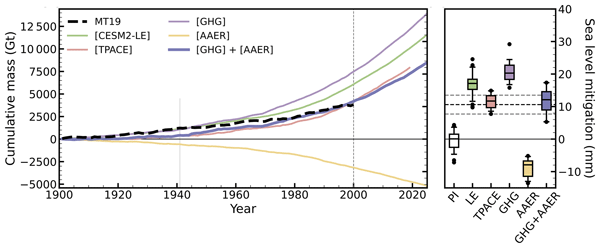
Abstract. Ice-core reconstructions indicate that increased snow accumulation on the Antarctic Ice Sheet mitigated global sea level rise by ~11 mm during 1901–2000. However, in the most recent 40 years of more intense observation and warming, the trend in the Antarctic-wide accumulation rate has been negligible. We attribute these trends by evaluating Earth system model experiments in comparison with dynamically consistent reconstructions of surface climate. Single-forcing experiments reveal that rising concentrations of greenhouse gases (GHGs) have been the underlying driver of increased accumulation, yet acting alone would have caused twice the observed accumulation-related sea level mitigation during 1901–2000. Aerosol-driven cooling partially compensates this overprediction, but there is strong evidence for other processes at work. We hypothesize that high-latitude winds have been working together with ice-shelf meltwater fluxes to dampen Southern Ocean surface warming and suppress the GHG-driven accumulation increase since the initiation of West Antarctic ice shelf thinning in the mid-twentieth century. The wind pattern associated with strengthening of the Southern Hemisphere westerlies and deepening of the Amundsen Sea Low distributes accumulation unevenly across the continent in an orographic pattern that is consistent across models and the reconstructions. In reconstructions, these same wind and accumulation patterns are associated with muted surface warming across the eastern Pacific and Southern Ocean, a pattern not captured in climate projections including the all-forcings large ensemble studied here. However, the westerly wind history constrained by paleoclimate data assimilation largely reconciles differences between the model's ensemble-mean response and the observed world for both Antarctic-wide accumulation and large-scale warming patterns. Although the large ensemble simulates similar wind histories to the real one, its corresponding responses in SSTs and Antarctic-wide accumulation are decoupled from the wind. We discuss how this significant observation-model discrepancy, which has widespread implications for projecting regional climate change, likely arises from omitted meltwater forcing and/or resolution limitations. As a component of the sea level budget and a gauge of the magnitude and spatial pattern of climate change, Antarctic snow accumulation is a critical target for models to replicate.
-
Notice on discussion status
The requested preprint has a corresponding peer-reviewed final revised paper. You are encouraged to refer to the final revised version.
-
Preprint
(20489 KB)
-
The requested preprint has a corresponding peer-reviewed final revised paper. You are encouraged to refer to the final revised version.
- Preprint
(20489 KB) - Metadata XML
- BibTeX
- EndNote
- Final revised paper


Journal article(s) based on this preprint
Interactive discussion
Status: closed
-
CC1: 'Comment on egusphere-2025-3666', Jeffrey Radke, 12 Dec 2025
This paper presents a comprehensive and carefully executed analysis of Antarctic snow accumulation that meaningfully reconciles observations, reconstructions, and Earth system model behavior. The study is well written, logically structured, and grounded in a strong physical interpretation of circulation, SST patterns, and forcing attribution. The integration of large ensembles, observation-constrained experiments, and paleoclimate data assimilation is phenomenal, and the results offer important insights with clear implications for sea-level projections and climate model evaluation.
Overall, this is a valuable and impactful contribution to the field.
Citation: https://doi.org/10.5194/egusphere-2025-3666-CC1 -
RC1: 'Comment on egusphere-2025-3666', Yetang Wang, 24 Dec 2025
By integrating observations, reconstructions, and Earth system model experiments, this study provides a comprehensive insight into changes in Antarctic snow accumulation and its underlying physical mechanisms. The research indicates that increased greenhouse gases are the primary driver of enhanced Antarctic accumulation, but their effect is partially offset by the cooling influence of aerosols. Since the mid-20th century, the high-latitude wind field and meltwater from ice shelves have collectively suppressed Southern Ocean warming, significantly weakening the greenhouse gas-induced increase in accumulation. Both models and reconstructions consistently demonstrate that wind patterns associated with the strengthening of the westerlies and Amundsen Sea Low lead to uneven accumulation distribution across the Antarctica. Furthermore, the authors note that although the historical wind fields in large ensemble simulations align with observations, the corresponding SST and overall Antarctic accumulation responses appear decoupled from these wind field changes. This discrepancy may stem from unaccounted meltwater forcing and/or limitations in model resolution.
In summary, the authors have undertaken substantial work. These results are highly valuable for estimating the changes in Antarctic snow accumulation rates and their contribution to global sea-level rise, and will be of great interest to the communities reading Earth System Dynamics. Therefore, I recommend acceptance of this manuscript after minor revisions. Some of my suggestions are as follows:
- The introduction is logical and concise. However, the summary of recent snow accumulation studies could be enhanced, particularly with regard to the multi-source data employed and the novel conclusions.
- The authors should provide a brief introduction to the spatial patterns of Antarctic snow accumulation under different forcings or modes in the results section and compare their differences.
- In the Discussion, it would be highly beneficial to include a schematic diagram, such as a conceptual model illustrating the physical feedback chain linking "wind–meltwater–SST–snow accumulation". This diagram should include as many atmospheric and oceanic processes mentioned in the study as possible.
- Current understanding indicates that Antarctic climate change is strongly influenced by internal variability. Therefore, I suggest the authors enhance the mechanistic explanation regarding the impact of modes of climate variability on Antarctic snow accumulation rates, particularly the teleconnections originating from the tropical Pacific.
- The authors should add a significance testing when conducting trend analyses, such as Figures 4 and 7.
- I recommended to add citations or comparisons with results from other CMIP6 models in the discussion.
- Regarding readability of the figure, it is suggested that the authors increase the font size of text in certain figures to make them more noticeable to readers, as illustrated in Figure 3. Moreover, the representation of statistical significance (stippling) in Figure 5 is not sufficiently clear.
Citation: https://doi.org/10.5194/egusphere-2025-3666-RC1 -
AC1: 'Reply on RC1', David Schneider, 20 Apr 2026
Reviewer #1: Yetang Wang (comments in bolded font), 24 Dec 2025
Author responses in normal font.
By integrating observations, reconstructions, and Earth system model experiments, this study provides a comprehensive insight into changes in Antarctic snow accumulation and its underlying physical mechanisms. The research indicates that increased greenhouse gases are the primary driver of enhanced Antarctic accumulation, but their effect is partially offset by the cooling influence of aerosols. Since the mid-20th century, the high-latitude wind field and meltwater from ice shelves have collectively suppressed Southern Ocean warming, significantly weakening the greenhouse gas-induced increase in accumulation. Both models and reconstructions consistently demonstrate that wind patterns associated with the strengthening of the westerlies and Amundsen Sea Low lead to uneven accumulation distribution across the Antarctica. Furthermore, the authors note that although the historical wind fields in large ensemble simulations align with observations, the corresponding SST and overall Antarctic accumulation responses appear decoupled from these wind field changes. This discrepancy may stem from unaccounted meltwater forcing and/or limitations in model resolution.
In summary, the authors have undertaken substantial work. These results are highly valuable for estimating the changes in Antarctic snow accumulation rates and their contribution to global sea-level rise, and will be of great interest to the communities reading Earth System Dynamics. Therefore, I recommend acceptance of this manuscript after minor revisions. Some of my suggestions are as follows:
We thank the Reviewer for their in-depth review, and are encouraged by their positive comments on the value of the work and its relevance to the ESD audience. Below we detail our responses and discuss the additional work that has been or will be performed for the revised version.
The introduction is logical and concise. However, the summary of recent snow accumulation studies could be enhanced, particularly with regard to the multi-source data employed and the novel conclusions.
There are several snow accumulation studies cited in the Introduction. Since our investigation was most inspired by Medley and Thomas (2019), we will expand upon that study, noting how Medley and Thomas (2019) found evidence of a warming-driven accumulation trend and evidence for circulation-driven trends. In a sense, their study had novel conclusions and subsequent studies have consistently supported those conclusions despite using different datasets and/or methods. More recent studies like Wang and Xiao (2023) and Wang et al (2025) consistently find evidence of a warming-driven accumulation trends. Due to length considerations, we will not expand upon every previous study, but instead note the consensus that has been built while pointing out the outstanding puzzles that our study addresses, e.g. the puzzle of the limited change in Antarctic-wide accumulation rates in recent decades and the gap in quantitative evaluations of how models agree with the observed trends under different combinations of external forcings and realizations of internal variability.
The authors should provide a brief introduction to the spatial patterns of Antarctic snow accumulation under different forcings or modes in the results section and compare their differences.
As discussed below in response to the second reviewer, we will revise the Introduction of Section 3.2 to explain how we evaluate the spatial patterns of snow accumulation, particularly elaborating on our pattern correlation method. The evaluation work has been performed, presented in Section 3.2 which describes the spatial patterns of Antarctic snow accumulation trends. This is accompanied by Appendix C which illustrates the trend patterns under all forcings and single forcings - (GHG, AAER, EE, GHG + EE, GHG + AAER, BMB) - due to tropical SSTs alone and the canonical La Nina (Figure C5), and across 110 individual ensemble members from the Large Ensemble and TPACE ensembles. We mention in the main text of Section 3.2 how each of the externally forced patterns compare with the pattern in MT19.
We have chosen not to use the modes of variability framework for this paper. This is partly because modes of variability do not clearly separate anthropogenic signals from internal variability, and that on the 100-year timescale discussed here, the anthropogenic signals are the dominant drivers of the accumulation trends. In addition, a given mode of variability (like the SAM) only explains a fraction of the variance of the system. In this paper, we use wind-nudged experiments to diagnose the contribution of atmospheric circulation irrespective of modes of variability. Similarly, the zonal wind index used from the proxy reconstruction is of wind speed, not a mode index like the SAM index. It is noted in Appendix B that the proxy reconstruction of wind speed is more skillful than the proxy reconstruction of the SAM index.
That said, to place these results in the context of previous work, in the Introduction and Section 3 we discuss how the patterns we illustrate relate to the SAM and ENSO patterns that have been discussed in work like Medley and Thomas (2019), Wang and Xiao (2023), and King and Christoffersen (2024).
In the Discussion, it would be highly beneficial to include a schematic diagram, such as a conceptual model illustrating the physical feedback chain linking "wind–meltwater–SST–snow accumulation". This diagram should include as many atmospheric and oceanic processes mentioned in the study as possible.
We recognize that a schematic diagram might be helpful to some readers of this paper, also noting the second reviewer’s comments that some aspects of the original manuscript were difficult to follow. We are working on a couple of approaches to a fairly simple diagram, but we have limited resources to create a comprehensive diagram that illustrates a long list of cryospheric, atmospheric, and oceanic processes. We have a couple of preliminary versions and we are consulting with some experts on whether one of these will actually be beneficial to the paper rather than adding unnecessary length. If we are not able to create one for this work, we think a diagram like this would be an excellent focus for a future review paper that summarizes this and other recent studies on the meltwater signal in Antarctic precipitation and the broader climate system. Such a paper would reflect a consensus view among multiple authors with different perspectives, not just our own.
Since our paper was submitted, Sadai et al (2025) have published a set of CESM1 experiments that explicitly model the meltwater signal in the climate system as it evolves through the 21st Century, including for Antarctic precipitation. We will cite Sadai et al. (2025) in the Discussion. Another paper was recently published – Zhang et al (2026) is a multi-model study using the SOFIA experiments to document the robust Southern Ocean and tropical responses to Antarctic meltwater. They diagnose the feedbacks involved and have a Figure 1c showing the multi-model global precipitation response, indicating a significant precipitation decrease over Antarctica. We will also cite Zhang et al (2026) in the Discussion and weave in their description of the feedbacks, noting that not all models support the eastern Pacific, Antarctic-to-tropics teleconnection pathway from Kim et al (2022).
Sadai, S., Karmalkar, A. V., Pollard, D., Dong, Y., Lucas, E., Gomez, N., DeConto, R., and Condron, A.: Antarctic meltwater alters future projections of climate and sea level, Nat Commun, 16, https://doi.org/10.1038/s41467-025-64438-3, 2025.
Zhang, X., Purich, A., Deser, C., and Pauling, A.: Robust Yet Diverse Tropical Responses to Antarctic Meltwater Across Models, Geophysical Research Letters, 53, https://doi.org/10.1029/2025gl120291, 2026.
Current understanding indicates that Antarctic climate change is strongly influenced by internal variability. Therefore, I suggest the authors enhance the mechanistic explanation regarding the impact of modes of climate variability on Antarctic snow accumulation rates, particularly the teleconnections originating from the tropical Pacific.
We agree that internal variability is important, especially on shorter timescales than the 100-year timescale that is our focus. We will expand the Methods section to explicitly state the five quantitative ways that this work examines the role of internal variability in Antarctic accumulation trends: 1. Through the use of Large Ensembles. (We show ensemble spread of cumulative mass changes in Figure 2, as well as spatial trend patterns in every ensemble member in Appendix C.) 2. Through the use of the nudged tropical Pacific pacemaker experiment and wind-nudged experiment. 3. Through the use of proxy data assimilation. 4. By use of the pi control run that does not have anthropogenic forcing. 5. Use of atmosphere-land experiments with prescribed SSTs and sea ice concentrations.
We believe that our analyses adequately address internal variability versus forced responses without formally adopting a modes of variability framing. Our revised Discussion will clarify that the main way that “real world” internal variability is highlighted in this paper is through the wind index, which clearly has both internally driven and externally forced components; the circulation pattern associated with this wind index is further matched to individual ensemble members of the Large Ensemble.
Regarding teleconnections originating from the tropical Pacific, we assume that the Reviewer is referring to the wave train that manifests in the deepened ASL. The ASL is a circulation feature with large internal variability, but as diagnosed by Dalaiden et al. (2024), it also exhibits a persistent deepening trend driven by greenhouse gas increases and stratospheric ozone depletion. These points are made in the Discussion.
Changes in tropical Pacific SSTs over the past 40 years have been the subject of much debate in the broader climate science community (e.g. Wills et al., 2022); it is not clear that any tropically driven teleconnection pattern should be assumed to be a product of internal variability alone.
As for the mechanistic explanation of tropical teleconnections, we will remind readers that the deepened ASL shown in Figures 4 and 5 is dynamically consistent with poleward propagating Rossby waves and cooling in the central and eastern tropical Pacific owing to the shifted location of tropical deep convection that these SST anomalies imply; this will be placed in the wrap up to Section 3.2 around line 425. Later in the text (Section 3.4) we expand this to argue consistency with the two-way tropical teleconnections proposed by Dong et al (2022b). The mechanism by which the deepened ASL results in the dipole pattern in snow accumulation trends across the WAIS is mentioned at line 326-330.
The authors should add a significance testing when conducting trend analyses, such as Figures 4 and 7.
We have added significance testing to the accumulation trend and wind-accumulation regression maps in Figures 4, 6, 7, 8, and 10 . The updated figures use hatching to indicate where the trends are not significant at the p < 0.05 level or better. To keep the figures easy to read and the focus of the paper on accumulation, we have chosen not to show the testing of trends in sea level pressure or surface temperature. We note that Antarctic circulation and temperature trends have been well studied in other work with well-established attributions (e.g. SLP and wind trends driven by stratospheric ozone depletion and greenhouse gasses); here they are just used to aid in interpretation of the accumulation trends. As an example of the updates, we are attempting to show Figure 7 as a supplement to this response. Hatching in panels a-c indicate the trend is not significant:
By this metric, wind has driven significant positive trends in the Peninsula and significant negative trends in Wilkes Land. The forced response explains significant positive trends in Queen Maud Land and in the interior of the EAIS. In addition to roughly matching the precipitation minus evaporation pattern in the ERA5 nudging dataset, these modeled accumulation patterns are consistent with those inferred from observational studies like Velicogna et al. (2019).
I recommended to add citations or comparisons with results from other CMIP6 models in the discussion.
Although we agree with the value of multi-model comparisons, we are not aware of a comparable study using the broader set of CMIP6 models to attribute Antarctic snow accumulation trends to specific forcings, or to distinguish anthropogenic trends from internal variability. In this work we take advantage of a comprehensive suite of CESM2 experiments that have been conducted over the last ~ 5 years. These CESM2 experiments are not necessarily part of the common set of CMIP6 experiments whose results are directly comparable across multiple models. To the best of our knowledge, most of these experiments were performed after NCAR/CESM submitted their experiments to the CMIP6 project.
Recall that the original Discussion cites some older attribution work with CMIP5 models, such as Previdi and Polvanni (2016), who evaluate the presence of anthropogenic signals vs internal variability in Antarctic precipitation. The Discussion also mentions more recent studies like Dalaiden et al (2024) attributing circulation trends with multiple models. Inasmuch as circulation trends have driven accumulation trends, we can infer that the attribution of circulation trends has some relevance to understanding accumulation trends.
It is beyond the scope of this work to analyze additional CMIP6 models, however, we agree that some general comparison with other CMIP6-era models besides CESM2 would be helpful in the Discussion if any appropriate studies exist. We would be happy to cite any CMIP6 evaluation studies if the Reviewer can suggest specific citations.
Zhang et al (2026) is not a CMIP6 study per se, nor does it diagnose surface mass balance, but as mentioned above we will cite it with respect to the robust meltwater signals in Antarctic precipitation and Southern Ocean SSTs across multiple models.
In the absence of detailed comparisons with other models, the revised Discussion will reiterate within the “limitations” paragraphs that this study uses a single model, so that future studies with additional models should be encouraged. The concluding sentence of our paper also highlights the need for multi-model studies.
Regarding readability of the figure, it is suggested that the authors increase the font size of text in certain figures to make them more noticeable to readers, as illustrated in Figure 3. Moreover, the representation of statistical significance (stippling) in Figure 5 is not sufficiently clear.
We have checked the readability of every Figure and have made appropriate adjustments to the font sizes. We also made a more substantial change to Figure 2c.
Regarding Figure 5, instead of using white stippling to indicate significance the revised Figure 5 masks out the areas where the wind-SST regression coefficients are not significant. This change highlights the clear relationship between Antarctic wind and tropical/ eastern Pacific SSTs in the observations which is much less evident in the model.
Regarding Figure 2c, we made a mistaken assumption in the calculation of cumulative mass gain congruent with the wind trend during 1901-2000. The “wind-congruent” and “wind-adjusted” timeseries will be removed from Figure 2c, and the corresponding discussions in the text will be modified accordingly (mainly affecting the first paragraph of Section 3.5 and lines 759-764 in Section 5.). We regret the error - the first author takes full responsibility for it. This correction will make the overall narrative consistent throughout the manuscript, in that both wind and meltwater signals are needed to explain the data-model discrepancies, not just the wind trend. Our revised results concur with Medley and Thomas (2019) in that the positive SAM trend (or stronger winds) does explain some mass loss since the mid twentieth century owing to lower snowfall associated with positive SAM. However, considering the 1901-2000 period as a whole, winds anomalies were relatively weak from about 1901-1940, so they contributed to a relative mass gain during the early 20th century, largely canceling out their contribution to mass loss in the second half of the 20th century. This correction does not change the Abstract’s emphasis on the role of wind and meltwater on dampening GHG-driven trends since the mid-20th Century.
In light of removing a key point from Section 3.5, we will refocus this section on the new schematic diagram that is discussed above. This will serve to synthesize the Results section and may enable the Discussion section 4 to be shortened.
-
RC2: 'Comment on egusphere-2025-3666', Anonymous Referee #2, 29 Mar 2026
This article analyses ensembles of model simulations to show that the increase in snow accumulation over Antarctica induced by greenhouse gas emissions has been dampen by aerosol emissions and by changes in winds and ice sheet meltwater release. There is a huge amount of work behind this article, with the comparison of several multi-member ensembles of climate simulations. It is an important piece of work that bridges a gap towards the attribution of the total mass change of the Antarctic ice sheet, and that helps understand limitations of the CMIP models. However, several sections of this manuscript are difficult to follow. In my opinion, major revisions would therefore be needed to make this article suitable for publication.
Major comments:
I acknowledge that this article is not easy to write due to the large variety of analysed simulations. However, there is room for improvement, and I find the manuscript difficult to read in many sections. First, the information on the experiments is difficult to find, with some in section 2, some in Appendix, some in the results section (e.g., CESM1-AIS-meltwater), and some in other articles. My recommendation would be to put everything in the Method section. Second, the description of the results is sometimes long and difficult to follow, with some numbers difficult to relate the associated figure or experiment, and a lack of introductory sentences in each section to explain the aim of the following result description (while reading, the readers do not know where these long descriptions are leading them). A short paragraph describing the overall approach at the beginning of section 3 would also help.
My second major concern is that at several places, the reasoning is difficult to follow because of a lack of description of the experimental design, and/or because some numbers are not clearly sourced. These issues are listed in the detailed comments below.
My third major comment is that the authors seem to consider wind and meltwater changes at the same level as changes in greenhouse gases and aerosols. For example, they conclude that “winds have been working together with ice sheet and ice shelf meltwater fluxes to dampen Southern Ocean surface warming and suppress the GHG-driven snow accumulation increase”. Unlike GHG and aerosols, winds and SSTs are not external forcings, they are variables of the climate system. They are affected by GHG and aerosols among others and are also part of the internal variability. Technically, prescribed meltwater may be considered as external forcing, although it is only external due to the absence of interactive ice sheet in the model, and should in theory respond to GHG, aerosols, etc. I think that better introducing all these concepts in the manuscript would make the analysis easier to follow and the results more robust.
Detailed comments:Abstract, L. 28-29: I found it awkward to describe the role of GHG and aerosols, then to mention that there are other processes and describe the role of winds and freshwater. Changes in winds and freshwater do both emerge from emissions of GHG and aerosols (and internal variability, ozone, …), so I would not present them as “other processes at work”.
L. 65: The units seem wrong, Gt yr-1 is equivalent to mm yr-1, not to mm. This number is also misleading because the net SMB is not per se equivalent to sea-level rise, it is only the anomalies that lead to sea level rise.
L. 113-114: This is unclear. Rainfall is also an accumulation term (it fills firn porosity), i.e., a positive term in the surface mass balance, not only snowfall. Is rainfall included in the accumulation term or not?
L. 170-172: I would like some more explanations about the TPACE and "everything else" (EE) ensembles, and why the role of stratospheric ozone depletion and recovery cannot be isolated with these experiments (if it is important for this article, if not, it could be removed). Why isn’t stratospheric ozone investigated in a similar way as GHG and aerosols? Stratospheric ozone is part of the usual Detection–Attribution protocol.
Appendix A / section 3.4: The only information that are provided about CESM1-AIS-meltwater are in section 3.4 (a bit late compared to the method description), and only consists of “The meltwater experiment was designed to represent the spatial pattern of freshwater fluxes from ice shelf basal melt, with the total magnitude of these fluxes set to 2000 Gt yr-1 ”. I think that more information should be provided about this:
• Is the freshwater injected at the ocean surface? Along the front of unresolved ice shelf cavities?
• Why only mentioning ice shelf basal melt rates given that more than half of the current Antarctic mass discharge ends up as iceberg melting?
• Please compare the 2000 Gt yr-1 to recent estimates, e.g., those in Coulon et al. (2024, their Tab. 1).
• Is there some kind of correction in CESM ensuring that any SMB anomaly is reinjected into the ocean to conserve the ocean mass (e.g., Schmidt et al., 2025, their Fig. 10)? If so, it is worth mentioning it because any increase in SMB will lead to an increase in freshwater release in addition to the additional 2000 Gt yr-1.L. 201: “to form the prior” may not be meaningful for readers who have not read O’Connor et al. (2021), please expend a little.
Fig. 3 is not perfectly clear to me. Does each marker represent the mean temperature of a given year in 1901-2000 (X-axis) and the surface accumulation from 1901 to that year (Y-axis in panel a)? In a context of global warming, wouldn’t there be a good correlation between anything that accumulates in time and global temperature? Wouldn’t it be more relevant to plot the global annual mean temperature vs annual mean accumulation (in Gt/yr)?
Throughout the manuscript: numbers could be provided only in sea level equivalent, providing both Gt and mm SLE everywhere does not improve the readability.
L. 264: “has a mass gain of 6079 Gt”. Add “from 1900 to 2000”.
L. 265-268: I had to read these two sentences several times to try to figure out what was the meaning and the point of these sentences.
L. 269-270: It is ok to make such a statement here, but the statistical significance of the difference between two means is not only based on the standard deviations, it is also based on the number of years and/or ensemble members used to calculate the mean (see, e.g., two-sample t-test).
L. 270-272: please help the reader to see where these numbers are from (which panel? which experiment?).
L. 327-337: add a sentence at the beginning to explain what you’re doing with a single member. How was member #40 identified as the best member? Was the selection done in an objective way, i.e., based on some metrics?
Section 3.2: Are these results robust if the second-best member is used instead of member #40? Even for a perfect model, it seems impossible to get a perfect match with all observations for a member out of only 50. So how much are the conclusions based on the specific characteristics of member #40?
L. 437:439: The sentence “Negative accumulation trends occur in Wilkes Land, where the thinning Totten Glacier is located and in West Antarctica over the thinning Thwaites and Pine Island glaciers” might suggest that the accumulation trend explains the mass loss of these glaciers, but the increase in grounding line discharge is by far the leading driver of their mass loss (e.g., Rignot et al., 2013).
Section 3.4: please comment on the realism of the meltwater perturbation in these experiments. If it is over or under estimated, what would a more realistic perturbation induce?
Title of section 3.4: why “hidden”? Is it more hidden than any other of the investigated effects?
L. 531-536: This is very unclear. First, it needs to be understandable without having to read Dong et al. (2022a). Then, in which figure, experiment or analysis is the trend multiplied by five? And why five and how is this quantitatively linked to the evolution of Pine Island and Thwaites ice shelves in the mid 20th century? From the caption of Fig. 9b, I understand that a trend over a decade is extended to 50 years, is it just that a trend estimated over 10 years is applied to 50 years or is the slope of the trend multiplied by five? Please expand and reformulate.
L. 601-602: The internal variability in the CESM model may be weaker than the natural variability of the real world, as suggested by Casado et al. (2023) for a bunch of CMIP6 models. How would this affect the conclusions of this article?
L. 657-660: I am sorry but I would need further explanations to understand this: “As diagnosed by Simpson et al. (2023), positive ice-albedo feedbacks in [AAER] act on a cold pre-industrial background state, leading to strong cooling. These feedbacks are not as pronounced in [CESM2-LE] in which aerosols are introduced only after the climate has warmed somewhat due to increasing greenhouse gases. The strong cooling in [AAER] is artificial …”.
L. 683: correct “20250”.
Section 4.4: what about the effect of stratospheric ozone recovery in the projections to 2050?
L. 692-697: Specify that surface melting and runoff only become important beyond 2050 (e.g., Kittel et al., 2021; Jourdain et al., 2025).
L. 759-760: How does “the snow accumulation history” show that there is causality?
L. 787-788: “The CESM2's ensemble-mean version of accumulation increase would have been a welcome addition to the ice sheet's mass”. What do the authors mean here?
Additional referencesCasado, M., Hébert, R., Faranda, D. and Landais, A. (2023). The quandary of detecting the signature of climate change in Antarctica. Nature Climate Change, 13(10), 1082-1088.
Coulon, V., De Rydt, J., Gregov, T., Qin, Q. and Pattyn, F. (2024). Future freshwater fluxes from the Antarctic ice sheet. Geophysical Research Letters, 51(23), e2024GL111250.
Jourdain, N. C., Amory, C., Kittel, C. and Durand, G. (2025). Changes in Antarctic surface conditions and potential for ice shelf hydrofracturing from 1850 to 2200. The Cryosphere, 19(4), 1641-1674.
Kittel, C., Amory, C., Agosta, C., Jourdain, N. C., Hofer, S., Delhasse, A. and others (2021). Diverging future surface mass balance between the Antarctic ice shelves and grounded ice sheet. The Cryosphere, 15(3), 1215-1236.
Rignot, E., Jacobs, S., Mouginot, J. and Scheuchl, B. (2013). Ice-shelf melting around Antarctica. Science, 341(6143), 266-270.
Citation: https://doi.org/10.5194/egusphere-2025-3666-RC2 -
AC2: 'Reply on RC2', David Schneider, 20 Apr 2026
REVIEWER #2 – anonymous 29 March 2026 (Reviewer's comments in bolded font).
(authors' replies in normal font)
This article analyses ensembles of model simulations to show that the increase in snow accumulation over Antarctica induced by greenhouse gas emissions has been dampen by aerosol emissions and by changes in winds and ice sheet meltwater release. There is a huge amount of work behind this article, with the comparison of several multi-member ensembles of climate simulations. It is an important piece of work that bridges a gap towards the attribution of the total mass change of the Antarctic ice sheet, and that helps understand limitations of the CMIP models. However, several sections of this manuscript are difficult to follow. In my opinion, major revisions would therefore be needed to make this article suitable for publication.
We thank Reviewer #2 for taking the time to write a thoughtful, constructive review. We appreciate the recognition of the importance of the work as well as noticing the substantial effort it took our team to arrive at these results and conclusions. We acknowledge that the clarity of the text can be improved, and are grateful for the helpful suggestions on how to make improvements. We will welcome the opportunity to revise the manuscript to make it easier to follow.
Major comments:
I acknowledge that this article is not easy to write due to the large variety of analysed simulations. However, there is room for improvement, and I find the manuscript difficult to read in many sections. First, the information on the experiments is difficult to find, with some in section 2, some in Appendix, some in the results section (e.g., CESM1-AIS-meltwater), and some in other articles. My recommendation would be to put everything in the Method section. Second, the description of the results is sometimes long and difficult to follow, with some numbers difficult to relate the associated figure or experiment, and a lack of introductory sentences in each section to explain the aim of the following result description (while reading, the readers do not know where these long descriptions are leading them). A short paragraph describing the overall approach at the beginning of section 3 would also help.
The challenge in writing this article was not necessarily in the volume of analyzed experiments, but rather in developing an interpretation that fits all of the available evidence. We appreciate the chance to better explain this interpretation and make the overall paper easier to follow.
Following the Reviewer’s suggestion above, we will move most of Appendix A to Section 2 (Methods). Table A1 will become Table 2, Table 2 will become Table 3. This will make the description and purpose of each experiment easier to find.
Regarding the overall approach, at the end of Section 2 we will summarize how these experiments are collectively used to distinguish forced responses from internal variability, and to explicitly look at the roles of SSTs, meltwater and winds in Antarctic accumulation trends. It should follow from the Introduction and Section 2.1 (discussing Dunmire et al 2022’s CESM2 results and how considering SST trend patterns might reconcile CESM2’s over prediction of the accumulation trend) why it is necessary and advantageous to look at these additional experiments despite the complexity that they add to the paper. The beginning of Section 3 will have a 1-2 sentence overview of the layout of this section; we will also add introductions to the subsections where necessary.
My second major concern is that at several places, the reasoning is difficult to follow because of a lack of description of the experimental design, and/or because some numbers are not clearly sourced. These issues are listed in the detailed comments below.
Please see our responses to the detailed comments below.
My third major comment is that the authors seem to consider wind and meltwater changes at the same level as changes in greenhouse gases and aerosols. For example, they conclude that “winds have been working together with ice sheet and ice shelf meltwater fluxes to dampen Southern Ocean surface warming and suppress the GHG-driven snow accumulation increase”. Unlike GHG and aerosols, winds and SSTs are not external forcings, they are variables of the climate system. They are affected by GHG and aerosols among others and are also part of the internal variability. Technically, prescribed meltwater may be considered as external forcing, although it is only external due to the absence of interactive ice sheet in the model, and should in theory respond to GHG, aerosols, etc. I think that better introducing all these concepts in the manuscript would make the analysis easier to follow and the results more robust.
It is not our intention to frame winds or SSTs as external forcings, and are concerned that the original manuscript may leave this impression on some readers. As emphasized in the Abstract, “rising concentrations of greenhouse gases (GHGs) have been the underlying driver of increased accumulation.”
In discussing winds and meltwater the language is much more cautious. We agree that winds and SSTs are not external forcings and have carefully gone through the text to make sure that they are not referred to as external forcings (this includes the SST nudging in TPACE, we will not describe it as “forcing”). At the same time, we feel it is critically important to discuss the roles of winds and SSTs, as models systematically fail to accurately simulate observed regional trends in winds and SSTs, which in turn negatively impacts the models’ ability to simulate trends in accumulation. We agree that it is appropriate to think about winds and meltwater as knock-on effects to GHGs, with some role also for internal variability and forcings like aerosols and stratospheric ozone.
Meltwater has been put forward as one of the leading candidates to explain SST trend discrepancies between observations and models (e.g. Dong et al., 2022a). Technically, prescribed meltwater is a forcing and we follow the lead of Schmidt et al (2023) in describing it as such. We readily acknowledge the absence of an interactive ice sheet in CESM2 and the limitations of the CESM1 prescribed meltwater experiment that we analyze.
The revised Section 2, with its expanded description of experimental design and the stated purposes (and key limitations) of each experiment will make the analyses and overall rationale easier to follow.
Detailed comments:
Abstract, L. 28-29: I found it awkward to describe the role of GHG and aerosols, then to mention that there are other processes and describe the role of winds and freshwater. Changes in winds and freshwater do both emerge from emissions of GHG and aerosols (and internal variability, ozone, …), so I would not present them as “other processes at work”.
We will modify the language in the Abstract to, “Aerosol-driven cooling somewhat compensates this overprediction, but the reconstructions provide evidence that poorly resolved processes in the model can explain observation-model trend discrepancies. In particular, these data support a hypothesis that…”
In the interest of length, the Abstract avoids partitioning trends in the winds and meltwater to anthropogenic forcing vs internal variability. These attributions are discussed in the Discussion (Section 4) in the context of previous attribution work like Holland et al. (2022) and Dalaiden et al. (2024).
65: The units seem wrong, Gt yr-1 is equivalent to mm yr-1, not to mm. This number is also misleading because the net SMB is not per se equivalent to sea-level rise, it is only the anomalies that lead to sea level rise.
We will correct mm to mm yr-1. “Sea level equivalence (SLE)” is an accepted term (used in Medley and Thomas (2019) for example) that does not mean the same as “sea level rise.” That is why this line uses the term “Sea level equivalence (SLE)” and not “sea level rise.” If dynamic mass loss exceeds mass input from snow accumulation, the ice sheet can contribute to sea level rise in the same year that a flux of water of 6 mm yr-1 SLE moves from the ocean to the ice sheet.
Within the revised Introduction we will cite a paper like Medley and Thomas (2019) when the SLE term is first used. Within the revised and expanded Methods section we will mention that we analyze anomalies in SMB/ accumulation relative to the pre-industrial control climate. Additional snow accumulation above the pi control baseline contributes to sea level mitigation, while reduced snow accumulation below the baseline contributes to sea level rise.
113-114: This is unclear. Rainfall is also an accumulation term (it fills firn porosity), i.e., a positive term in the surface mass balance, not only snowfall. Is rainfall included in the accumulation term or not?
Rainfall is included in the accumulation term, as stated in Appendix A at line 845 in the original manuscript. In revision, we will move the material from Appendix A to the Methods section.
170-172: I would like some more explanations about the TPACE and "everything else" (EE) ensembles, and why the role of stratospheric ozone depletion and recovery cannot be isolated with these experiments (if it is important for this article, if not, it could be removed). Why isn’t stratospheric ozone investigated in a similar way as GHG and aerosols? Stratospheric ozone is part of the usual Detection–Attribution protocol.
The CESM2 Single Forcing Large Ensemble (Simpson et al 2023) did not include a stand-alone ozone ensemble likely due to limited resources and the emphasis of this ensemble on understanding CESM2’s response to aerosols. In the context of this paper, the role of stratospheric ozone depletion and recovery cannot be specifically isolated because there is no CESM2 single-forcing ozone ensemble available to isolate it with. We will state this explicitly in the revised Methods section where the previous work on the ozone signal in Antarctic precipitation is mentioned (e.g. Lenaerts et al., 2018; Schneider et al., 2020; Chemke et al., 2020). We recognize that stratospheric ozone depletion is a relevant forcing, and that the lack of a stand-alone ozone ensemble is a limitation of this work. Nonetheless, we think this is a worthwhile tradeoff because previous work on Antarctic precipitation has not isolated the roles of GHGs, anthropogenic aerosols, and BMB aerosols.
Within the SFLE, prescribed ozone forcing is lumped into the EE ensemble, while some ozone depleting substances are greenhouse gases that are included in the GHG ensemble. The strong accumulation signal in EE appears after 1980 (Figure 2c), consistent with the timing of stratospheric ozone depletion, and as mentioned in Table 2 (to become Table 3) we interpret the cumulative mass gain in EE as “largely due to late-twentieth century stratospheric ozone depletion but with other influences.” “Other influences” include volcanic and solar forcing as well as tropospheric ozone. It is beyond our scope to evaluate how each of the individual forcings prescribed within EE contribute to accumulation trends. Nonetheless, it is likely that the accumulation signal appearing in EE after ~1980 is largely due to stratospheric ozone depletion.
The documentation on TPACE is admittedly limited, as no one (to our knowledge) has focused a scientific paper on this experiment. The experiment is published in the public domain, and is briefly described in the data reference of Rosenbloom et al. (2025) which we cite in the main text and the Appendix. It generally follows the nudging protocol discussed in the pioneering work of Kosaka and Xie (2013; Kosaka, Y., Xie, SP. Recent global-warming hiatus tied to equatorial Pacific surface cooling. Nature 501, 403–407 (2013). https://doi.org/10.1038/nature12534).
Appendix A / section 3.4: The only information that are provided about CESM1-AIS-meltwater are in section 3.4 (a bit late compared to the method description), and only consists of “The meltwater experiment was designed to represent the spatial pattern of freshwater fluxes from ice shelf basal melt, with the total magnitude of these fluxes set to 2000 Gt yr-1 ”. I think that more information should be provided about this:
- Is the freshwater injected at the ocean surface? Along the front of unresolved ice shelf cavities?
- Why only mentioning ice shelf basal melt rates given that more than half of the current Antarctic mass discharge ends up as iceberg melting?
- Please compare the 2000 Gt yr-1 to recent estimates, e.g., those in Coulon et al. (2024, their Tab. 1).
- Is there some kind of correction in CESM ensuring that any SMB anomaly is reinjected into the ocean to conserve the ocean mass (e.g., Schmidt et al., 2025, their Fig. 10)? If so, it is worth mentioning it because any increase in SMB will lead to an increase in freshwater release in addition to the additional 2000 Gt yr-1.
As discussed above, the revision moves the description of the meltwater experiment from Appendix A to the Methods section, so that readers will learn about it before arriving at Section 3.4. Pauling et al (2016) provide a detailed explanation of the experimental design, which we cite. Pauling et al (2016) describe two sets of experiments – one where iceberg discharge ends up as surface freshwater fluxes and the second where freshwater fluxes are prescribed at an average depth of 300 m in the location of the ice shelf fronts (their Figure 3b). This detail about the depth of meltwater injection will be mentioned in the revised Section 2. There were only a couple ensemble members available from Pauling et al (2016)’s original work, making it questionable as to whether a meltwater signal in precipitation could be detected and distinguished from noise. We were able to obtain additional ensemble members for the basal melt experiments from the work of Dong et al (2022a). Basal melting is the process highlighted in Clark et al (2024) as having accelerated significantly starting in the 1940s, and is the main process discussed by studies like Rignot et al (2019) and The IMBIE Team (2018) as the main driver of Antarctic Ice Sheet mass loss.
As for mass conservation in CESM, according to Pauling et al (2016), SMB anomalies are reinjected into the ocean in the form of runoff when the snow depth exceeds 1 m. We will mention this in the updated description of the meltwater experiment, noting that this flux is minor compared with the precipitation that falls directly onto the ocean.
It is a good idea to compare the 2000 Gt yr-1 to more recent estimates. The total observed flux for 1990-2020 reported in Table 1 of Coulon et al. (2024) is around 2600 Gt yr-1, and in their calibrated model it is 3140 Gt yr-1. Most of this is balanced by the SMB, so the anomalous freshwater flux from ice sheet mass loss is still much lower (maybe 4x lower) than 2000 Gt yr-1. It seems that Coulon et al. (2024) don’t update the anomalous freshwater flux estimate that is used as the prescribed forcing in Pauling et al (2016). If the Reviewer knows otherwise, we ask them to please elaborate on this request. Short of that, we will provide a concise description of Coulon et al.’s findings where the caveats about the CESM1-AIS meltwater experiment are introduced in the Methods section.
201: “to form the prior” may not be meaningful for readers who have not read O’Connor et al. (2021), please expend a little.
The revised text will summarize the prior as follows: “We first use the reconstruction presented in O'Connor et al. (2021) that uses members of the CESM1 Large Ensemble (Kay et al., 2015) to form the prior, which is a physically based assumption about the state of the system without accounting for observational or proxy data.”
Fig. 3 is not perfectly clear to me. Does each marker represent the mean temperature of a given year in 1901-2000 (X-axis) and the surface accumulation from 1901 to that year (Y-axis in panel a)? In a context of global warming, wouldn’t there be a good correlation between anything that accumulates in time and global temperature? Wouldn’t it be more relevant to plot the global annual mean temperature vs annual mean accumulation (in Gt/yr)?
Fig 3b plots the Antarctic annual mean temperature anomaly vs annual mean accumulation anomaly for the 100 years from 1901-2000. This follows the practice of calculating Antarctic accumulation sensitivity to Antarctic temperature in previous work like Monaghan et al. (2008) and Frieler et al. (2015). Fig 3a plots the cumulative mass timeseries vs the global mean temperature anomaly timeseries. In general, we agree that two timeseries with a positive trend may exhibit a “good” correlation even if they do not have any real physical relationship. In this case there are sound physical reasons to expect a good correlation. Correlation does not prove causation, but here we present a whole series of physical model experiments to back up this correlation and to connect GHG-driven warming with the accumulation increase.
Throughout the manuscript: numbers could be provided only in sea level equivalent, providing both Gt and mm SLE everywhere does not improve the readability.
To improve readability, for Sections 3 and 4 we will adopt the practice of only providing SLE. For completeness we will use Gt and SLE in Table 1. We will still mention the conversion between Gt and SLE in the Introduction (e.g. 2000 Gt yr-1 is approx. 6 mm SLE).
264: “has a mass gain of 6079 Gt”. Add “from 1900 to 2000”.
Will make the addition.
265-268: I had to read these two sentences several times to try to figure out what was the meaning and the point of these sentences.
Sorry for the confusion. There are two halves of the Large Ensemble that have different biomass burning forcing protocols. The default CMIP6 biomass burning forcing results in spurious warming (Fasullo et al., 2022), which we argue in turn results in a spurious accumulation rate increase and excessive cumulative mass gain. We will rewrite the two sentences as, “The original members of the Large Ensemble with the CMIP6 biomass burning protocol exhibit a slightly higher ensemble-mean value of 17.8 mm SLE, physically consistent with the spurious warming that arises from CMIP6 biomass burning emissions (Fasullo et al. 2022).” Compared with other factors like meltwater and unresolved SST trends, this is a minor point but we feel it deserves to be briefly discussed.
269-270: It is ok to make such a statement here, but the statistical significance of the difference between two means is not only based on the standard deviations, it is also based on the number of years and/or ensemble members used to calculate the mean (see, e.g., two-sample t-test).
The uncertainty ranges of MT19 and the spread of the CESM2-LE represent fundamentally different quantities. The CESM2-LE spread reflects internal variability sampled by the ensemble, whereas the MT19 uncertainty bounds arise from propagated observational and methodological uncertainties in the reconstruction, rather than from a distribution of independent realizations.
As a result, a formal two-sample statistical test is not directly applicable in this context. Our intention here is therefore limited to a qualitative comparison of the relative magnitudes and overlap between the simulated ensemble spread and the reconstruction uncertainty, and then to provide an interpretation of the differences in their means.
270-272: please help the reader to see where these numbers are from (which panel? which experiment?).
We will revise the sentence to explain that if we interpret the ensemble mean of CESM2-LE as the forced response to all forcings combined, the number is 16.8 mm SLE. To reconcile this forced response with the observed 10.5 mm SLE requires a mass loss 6.3 mm SLE, which could arise from internal variability as it lies within the ensemble spread of CESM2-LE. These numbers are from Figure 2 and the right-hand column of Table 1, which will be explicitly stated in the revised text.
As it happens, the observed SST anomalies prescribed in TPACE result in a mass loss 6.4 mm SLE.
327-337: add a sentence at the beginning to explain what you’re doing with a single member. How was member #40 identified as the best member? Was the selection done in an objective way, i.e., based on some metrics?
The revised manuscript will expand the introduction to Section 3.2 to explain that the metrics used to determine the best-matching member are the pattern correlations which are presented in Figures C1-C4: “Member 40 from CESM2-LEcmip6 has a pattern correlation with the reconstructed SLP trend over 40S-90S of 0.92 and with the reconstructed accumulation trend on Antarctica of 0.52, giving an average correlation of these two metrics of 0.72. This is the highest average correlation out of 110 individual members from the CESM2-LE, CESM2-LEcmip6, and TPACE ensembles.”
Section 3.2: Are these results robust if the second-best member is used instead of member #40? Even for a perfect model, it seems impossible to get a perfect match with all observations for a member out of only 50. So how much are the conclusions based on the specific characteristics of member #40?
The results and conclusions do not hinge on the interpretation of a single member.
Results from selecting the second-best member would be qualitatively the same but may exhibit slightly different quantitative values. By our average pattern correlation metric, member #2 is second best. From Figure C3, member #2 also has a snow accumulation trend dipole across the WAIS. From Figure C4, we see that #2 has a deepened ASL, which is basically required in order for the model to simulate the accumulation trend dipole. We see similar relationships in the third-best member, which is member #99 (member 49 of CESM2-LE, shown in Figures C1 and C4). These relationships are pretty robust, even extending to the tropical Pacific SST anomalies that go along with the high-latitude SLP and SMB trend patterns.
We do not claim that member #40 is a “perfect” match, only that it is the “best” match out of the 110 individual members. A minor caveat is that the PDA was performed using the CESM2-LEcmip6 as the prior, so it may not be by chance that the “best” member comes from the CESM2-LEcmip6 half of the ensemble. However, we would very likely have a similar story if CESM2-LE were the prior and member #99 was the “best” match.
Alternatively to the pattern correlation method, we could follow the method of Holland et al. (2022): subtract the reconstructed trend patterns from the forced response given by [CESM2-LEcmip6] to obtain the “internal” trend patterns. This would still support the same story that the observation-model trend discrepancies are associated with a deepened ASL and negative IPO-like SST trend pattern across the Pacific basin.
437:439: The sentence “Negative accumulation trends occur in Wilkes Land, where the thinning Totten Glacier is located and in West Antarctica over the thinning Thwaites and Pine Island glaciers” might suggest that the accumulation trend explains the mass loss of these glaciers, but the increase in grounding line discharge is by far the leading driver of their mass loss (e.g., Rignot et al., 2013).
To avoid any possibility of misleading readers, we will:
a) Instead of calling out the thinning of these glaciers, the revised sentence will state: “Negative accumulation trends occur in Wilkes Land over the Totten Glacier and in West Antarctica over the Thwaites and Pine Island Glaciers, two regions where independent observational studies show strong evidence for circulation-driven variability in snow accumulation that affects year-to-year variations in the mass balance of these basins (King and Christofferson, 2024).”
b) add a sentence at line 443: “Long-term mass loss in these basins has been predominantly driven by ice-ocean interactions and grounding line discharge, not by surface processes (e.g. Shepherd et al (2019), Lu et al. (2025)).”
Lu, T., Zhang, S., Xiao, F., Li, J., Geng, T., Luo, H., Yang, Y., and Wu, H.: Determination of Mass Changes in the Totten Glacier Basin, East Antarctica, Using an Improved Mascon Method With GRACE/GRACE‐FO Data, JGR Solid Earth, 130, https://doi.org/10.1029/2025jb031384, 2025.
Section 3.4: please comment on the realism of the meltwater perturbation in these experiments. If it is over or under estimated, what would a more realistic perturbation induce?
The comment on the realism will be made in the revised Methods section, which we have discussed above. This caveat is also discussed in the limitations paragraphs, Section 4.5. We invite further studies with more realistic meltwater experiments, but it is beyond our scope to perform those experiments and/or to analyze their results here. As mentioned above, the recent studies of Sadai et al (2025) and Zhang et al (2026) qualitatively support a precipitation decrease over Antarctica in response to meltwater perturbations. In any case, we would rather present the CESM1 meltwater experiment with its caveats than no meltwater experiment at all. From all the work on the meltwater signal that we have seen, there is consensus that meltwater leads to a Southern Ocean cooling, leading to Antarctic precipitation decrease. The uncertainties lie in the magnitude of the forcing, the sensitivity of the model to the forcing, and the timing of when the anomalous meltwater forcing became relevant.
We note that the SOFIA experiments analyzed in Zhang et al (2026) are not necessarily “more realistic” than the old CESM1 basal melt experiment. Zhang et al report an observed freshwater flux estimate of 0.1 Sverdup yr-1 vs 1 Sverdup yr-1 used in the SOFIA experiment protocol, while prescribing these fluxes at the surface rather than at the depth of the ice shelves. We simply do not know yet what a more realistic perturbation in a more realistic model would induce. We speculate in the limitations paragraph within the Discussion that high-resolution models may be more sensitive to meltwater perturbations than low-resolution models.
Regardless of the exact quantitative role of meltwater in driving SST trends, it is clear from the results of the CESM2-GOGA experiments that observed SST and sea ice trends do truly matter for Antarctic accumulation trends.
Title of section 3.4: why “hidden”? Is it more hidden than any other of the investigated effects?
“Hidden” was used because the role of meltwater is much more subtle and difficult to tease out of the data than say, the role of greenhouse gases or atmospheric circulation. We will change this section title to “Potential roles for meltwater and two-way teleconnections” to emphasize the uncertainty in the role of meltwater.
531-536: This is very unclear. First, it needs to be understandable without having to read Dong et al. (2022a). Then, in which figure, experiment or analysis is the trend multiplied by five? And why five and how is this quantitatively linked to the evolution of Pine Island and Thwaites ice shelves in the mid 20th century? From the caption of Fig. 9b, I understand that a trend over a decade is extended to 50 years, is it just that a trend estimated over 10 years is applied to 50 years or is the slope of the trend multiplied by five? Please expand and reformulate.
Dong et al. (2022a) express SST trends (rates of change) attributable to meltwater in units of deg. C 10 yr-1, using the CESM1-AIS meltwater ensemble in comparison with the CESM1 Large Ensemble. They provided the meltwater-induced SST field to us, as shown in Figure 9b. But instead of showing deg. C 10 yr-1 we scale it to deg C 50 yr-1, e.g. the regression coefficients (slope) at each grid box are multiplied by 5. We do this because the period of 1951-2000 is 50 years long. From the observational evidence in Clark et al. (2024) it is argued that anomalous freshwater flux from the Amundsen Sea Embayment region has occurred since around 1950. This is a back-of-the-envelope type calculation with several caveats, and we are using cautious language to discuss it. Yet it is a plausible story that ties together all the recent observational evidence and modeling work. We will add a couple of sentences to better express this.
601-602: The internal variability in the CESM model may be weaker than the natural variability of the real world, as suggested by Casado et al. (2023) for a bunch of CMIP6 models. How would this affect the conclusions of this article?
We appreciate the Casado et al. (2023) study (which is cited in the text), but cannot find within it a specific quantification of how much CESM2’s internal variability differs from the real world. Casado et al. (2023) look at a 6-member CESM2 historical ensemble from the CMIP6 archive, not the 100-member CESM2 Large Ensemble. Note that the Large Ensemble is both a “macro” ensemble (in which the ocean initial conditions are changed across members) and a “micro” ensemble (in which just the atmospheric initial conditions are changed across members), as such it samples a broader range of possible evolutions of internal variability than does the much smaller CESM2 ensemble submitted to CMIP6.
We have a multi-pronged approach for accounting for possible errors in the representation of the model’s internal variability: The TPACE experiment prescribes observed SST anomalies, constraining the model to have the observed magnitude of SST anomalies and sequence of internal variability at least in the tropical Pacific. We have quantified the effect of these SST anomalies as a mass loss of 6.4 mm SLE over 1901-2000. In other words, real world internal variability results in a mass loss, not a mass gain that could explain the observed trend of 10.5 mm SLE. Anthropogenic forcing, mainly greenhouse gases, is required to explain the observed mass gain. Second, the PDA reconstructions also contain real world internal variability within the context of the dynamical framework of CESM2. Our various regressions using the reconstructions vs the free-running model data show that the real world may have a little bit different wind-SST-accumulation relationships than does the model world. This makes sense in the context of Casado et al (2023) who discuss a mismatch between model fidelity in getting global-mean trends broadly correct and model fidelity in getting the polar regions correct.
As diagnosed in O’Connor et al (2021), the PDA reconstructions show that anthropogenic forcing is required to explain mid and high latitude atmospheric circulation trends. All in all, we do not believe errors in representing internal variability could significantly change our conclusion that anthropogenic forcing has played a strong role in recent Antarctic climate trends. This conclusion is broadly the same as Casado et al. (2023) who suggest that internal variability and the forced response are underestimated by models.
Our study hints at a related concern – that the forced atmospheric circulation trends (shown in Figures 4c and 7c) are underestimated by the model. If interested, see Klavens et al. (2025) for a discussion of this signal-to-noise problem in atmospheric circulation trends over the North Pacific:
Klavans, J. M., DiNezio, P. N., Clement, A. C., Deser, C., Shanahan, T. M., and Cane, M. A.: Human emissions drive recent trends in North Pacific climate variations, Nature, 644, 684–692, https://doi.org/10.1038/s41586-025-09368-2, 2025.
High-resolution global modeling may be one path towards solving this signal-to-noise problem (e.g. Yeager et al., 2023). We hope to do some future work with high resolution models, as alluded to in Section 4.5.
657-660: I am sorry but I would need further explanations to understand this: “As diagnosed by Simpson et al. (2023), positive ice-albedo feedbacks in [AAER] act on a cold pre-industrial background state, leading to strong cooling. These feedbacks are not as pronounced in [CESM2-LE] in which aerosols are introduced only after the climate has warmed somewhat due to increasing greenhouse gases. The strong cooling in [AAER] is artificial …”.
It also took us some time to grasp what the difference in results from AAER + GHG vs all-forcings CESM2-LE are telling us. Strong, nonlinear ice-albedo feedbacks in the AAER experiment lead to strong polar and global cooling. Simpson et al. (2023) suspect that these feedbacks are particularly amplified in AAER because the pre-Industrial climate state on which they act is rather cold. In the all-forcings CESM2-LE, aerosols are competing with greenhouse gas increases, whose effects tend to win out over time. We suggest that the strong cooling in AAER is less representative of the real world than the all-forcings CESM2-LE. When used in combination with the GHG ensemble, the strong cooling in AAER could compensate for the cooling hypothesized to be driven by missing meltwater forcing.
683: correct “20250”.
Corrected.
Section 4.4: what about the effect of stratospheric ozone recovery in the projections to 2050?
We do not know for sure, but ozone recovery would seem to be a minor player in the context of large greenhouse gas increases that are part of the SSP 3.70 scenario shown in Figure 10. As discussed above, it is not possible to isolate the role of stratospheric ozone depletion and recovery in the framework of these CESM2 experiments. Rather than speculate on its role in Section 4.4, the data-informed approach is to illustrate the role of the major players that explain the historical accumulation trends: greenhouse gases and aerosols.
To illustrate the relative roles of the different forcings on the historical and future wind trends, we have calculated cumulative near-surface zonal wind anomalies (inspired by King and Christofferson 2024’s cumulative SAM index) across 50S-70S in the ensemble means of CESM2-LE and each single-forcing experiment. Cumulative wind in the CESM2-LE is dominated by GHG-driven anomalies - see attached rough figure.
We will refine this figure, adding member #40 and CESM2-LE PDA for context, and place it in the Appendix.
692-697: Specify that surface melting and runoff only become important beyond 2050 (e.g., Kittel et al., 2021; Jourdain et al., 2025).
We will mention these studies, but it would also be responsible to mention that these processes may become important “ahead of model predictions” according to a perspective by Mottram et al. (2025). Where citing Kittel et al. (2021) and Jourdain et al. (2025), we will also cite Mottram et al. (2025):
Mottram, R., Hansen, N., Hogg, A. E., Rodehacke, C. B., Simonsen, S. B., and Wallis, B. J.: The Greenlandification of Antarctica, Nat. Geosci., 18, 928–930, https://doi.org/10.1038/s41561-025-01805-1, 2025.
759-760: How does “the snow accumulation history” show that there is causality?
As summarized in Table 3 and expanded upon throughout the text, the snow accumulation history is interpreted as the “response to greenhouse-gas driven warming, offset by SST trends associated with winds and meltwater, with a small offset role for aerosols.” A pressing question in the climate modeling community has been, “What causes the SST trends that have damped global warming (e.g. Andrews et al., 2022), and by extension, what has damped Antarctic snow accumulation trends?” Snow accumulation provides a proxy archive of the effects of winds, GHGs and meltwater on SSTs. Given the relationships illustrated here, the same drivers that have caused tropical Pacific and Southern Ocean SST trends must also explain Antarctic snow accumulation trends. By interpreting (or “decoding”) the snow accumulation history we also provide an interpretation of the broader SST trends.
As noted above in the response to Reviewer 1, we will rewrite lines 759-764 to remove the reference to the wind-congruent mass loss and its equivalence with the mass loss attributable to SST anomalies in TPACE.
787-788: “The CESM2's ensemble-mean version of accumulation increase would have been a welcome addition to the ice sheet's mass”. What do the authors mean here?
We meant that if there had been an accumulation-related mass gain of 16.8 mm SLE during the 20th Century instead of the observed 10.5 mm SLE, the ice sheet would be close to in balance if not gaining mass. The usage of the model is largely to test sensitivity (it is not a perfect predictor of reality); the objective of this paper is to bring the model and observed worlds a little closer together. We will delete this specific sentence in the revision, but reformulate this paragraph to gently remind users of CESM model output that taking the model output at face value without evaluating how it compares to the observed world may lead to overconfident or otherwise erroneous predictions of snow accumulation trends.
Additional references
Casado, M., Hébert, R., Faranda, D. and Landais, A. (2023). The quandary of detecting the signature of climate change in Antarctica. Nature Climate Change, 13(10), 1082-1088.
Coulon, V., De Rydt, J., Gregov, T., Qin, Q. and Pattyn, F. (2024). Future freshwater fluxes from the Antarctic ice sheet. Geophysical Research Letters, 51(23), e2024GL111250.
Jourdain, N. C., Amory, C., Kittel, C. and Durand, G. (2025). Changes in Antarctic surface conditions and potential for ice shelf hydrofracturing from 1850 to 2200. The Cryosphere, 19(4), 1641-1674.
Kittel, C., Amory, C., Agosta, C., Jourdain, N. C., Hofer, S., Delhasse, A. and others (2021). Diverging future surface mass balance between the Antarctic ice shelves and grounded ice sheet. The Cryosphere, 15(3), 1215-1236.
Rignot, E., Jacobs, S., Mouginot, J. and Scheuchl, B. (2013). Ice-shelf melting around Antarctica. Science, 341(6143), 266-270.
Citation: https://doi.org/10.5194/egusphere-2025-3666-RC2
-
AC2: 'Reply on RC2', David Schneider, 20 Apr 2026
Peer review completion


Interactive discussion
Status: closed
-
CC1: 'Comment on egusphere-2025-3666', Jeffrey Radke, 12 Dec 2025
This paper presents a comprehensive and carefully executed analysis of Antarctic snow accumulation that meaningfully reconciles observations, reconstructions, and Earth system model behavior. The study is well written, logically structured, and grounded in a strong physical interpretation of circulation, SST patterns, and forcing attribution. The integration of large ensembles, observation-constrained experiments, and paleoclimate data assimilation is phenomenal, and the results offer important insights with clear implications for sea-level projections and climate model evaluation.
Overall, this is a valuable and impactful contribution to the field.
Citation: https://doi.org/10.5194/egusphere-2025-3666-CC1 -
RC1: 'Comment on egusphere-2025-3666', Yetang Wang, 24 Dec 2025
By integrating observations, reconstructions, and Earth system model experiments, this study provides a comprehensive insight into changes in Antarctic snow accumulation and its underlying physical mechanisms. The research indicates that increased greenhouse gases are the primary driver of enhanced Antarctic accumulation, but their effect is partially offset by the cooling influence of aerosols. Since the mid-20th century, the high-latitude wind field and meltwater from ice shelves have collectively suppressed Southern Ocean warming, significantly weakening the greenhouse gas-induced increase in accumulation. Both models and reconstructions consistently demonstrate that wind patterns associated with the strengthening of the westerlies and Amundsen Sea Low lead to uneven accumulation distribution across the Antarctica. Furthermore, the authors note that although the historical wind fields in large ensemble simulations align with observations, the corresponding SST and overall Antarctic accumulation responses appear decoupled from these wind field changes. This discrepancy may stem from unaccounted meltwater forcing and/or limitations in model resolution.
In summary, the authors have undertaken substantial work. These results are highly valuable for estimating the changes in Antarctic snow accumulation rates and their contribution to global sea-level rise, and will be of great interest to the communities reading Earth System Dynamics. Therefore, I recommend acceptance of this manuscript after minor revisions. Some of my suggestions are as follows:
- The introduction is logical and concise. However, the summary of recent snow accumulation studies could be enhanced, particularly with regard to the multi-source data employed and the novel conclusions.
- The authors should provide a brief introduction to the spatial patterns of Antarctic snow accumulation under different forcings or modes in the results section and compare their differences.
- In the Discussion, it would be highly beneficial to include a schematic diagram, such as a conceptual model illustrating the physical feedback chain linking "wind–meltwater–SST–snow accumulation". This diagram should include as many atmospheric and oceanic processes mentioned in the study as possible.
- Current understanding indicates that Antarctic climate change is strongly influenced by internal variability. Therefore, I suggest the authors enhance the mechanistic explanation regarding the impact of modes of climate variability on Antarctic snow accumulation rates, particularly the teleconnections originating from the tropical Pacific.
- The authors should add a significance testing when conducting trend analyses, such as Figures 4 and 7.
- I recommended to add citations or comparisons with results from other CMIP6 models in the discussion.
- Regarding readability of the figure, it is suggested that the authors increase the font size of text in certain figures to make them more noticeable to readers, as illustrated in Figure 3. Moreover, the representation of statistical significance (stippling) in Figure 5 is not sufficiently clear.
Citation: https://doi.org/10.5194/egusphere-2025-3666-RC1 -
AC1: 'Reply on RC1', David Schneider, 20 Apr 2026
Reviewer #1: Yetang Wang (comments in bolded font), 24 Dec 2025
Author responses in normal font.
By integrating observations, reconstructions, and Earth system model experiments, this study provides a comprehensive insight into changes in Antarctic snow accumulation and its underlying physical mechanisms. The research indicates that increased greenhouse gases are the primary driver of enhanced Antarctic accumulation, but their effect is partially offset by the cooling influence of aerosols. Since the mid-20th century, the high-latitude wind field and meltwater from ice shelves have collectively suppressed Southern Ocean warming, significantly weakening the greenhouse gas-induced increase in accumulation. Both models and reconstructions consistently demonstrate that wind patterns associated with the strengthening of the westerlies and Amundsen Sea Low lead to uneven accumulation distribution across the Antarctica. Furthermore, the authors note that although the historical wind fields in large ensemble simulations align with observations, the corresponding SST and overall Antarctic accumulation responses appear decoupled from these wind field changes. This discrepancy may stem from unaccounted meltwater forcing and/or limitations in model resolution.
In summary, the authors have undertaken substantial work. These results are highly valuable for estimating the changes in Antarctic snow accumulation rates and their contribution to global sea-level rise, and will be of great interest to the communities reading Earth System Dynamics. Therefore, I recommend acceptance of this manuscript after minor revisions. Some of my suggestions are as follows:
We thank the Reviewer for their in-depth review, and are encouraged by their positive comments on the value of the work and its relevance to the ESD audience. Below we detail our responses and discuss the additional work that has been or will be performed for the revised version.
The introduction is logical and concise. However, the summary of recent snow accumulation studies could be enhanced, particularly with regard to the multi-source data employed and the novel conclusions.
There are several snow accumulation studies cited in the Introduction. Since our investigation was most inspired by Medley and Thomas (2019), we will expand upon that study, noting how Medley and Thomas (2019) found evidence of a warming-driven accumulation trend and evidence for circulation-driven trends. In a sense, their study had novel conclusions and subsequent studies have consistently supported those conclusions despite using different datasets and/or methods. More recent studies like Wang and Xiao (2023) and Wang et al (2025) consistently find evidence of a warming-driven accumulation trends. Due to length considerations, we will not expand upon every previous study, but instead note the consensus that has been built while pointing out the outstanding puzzles that our study addresses, e.g. the puzzle of the limited change in Antarctic-wide accumulation rates in recent decades and the gap in quantitative evaluations of how models agree with the observed trends under different combinations of external forcings and realizations of internal variability.
The authors should provide a brief introduction to the spatial patterns of Antarctic snow accumulation under different forcings or modes in the results section and compare their differences.
As discussed below in response to the second reviewer, we will revise the Introduction of Section 3.2 to explain how we evaluate the spatial patterns of snow accumulation, particularly elaborating on our pattern correlation method. The evaluation work has been performed, presented in Section 3.2 which describes the spatial patterns of Antarctic snow accumulation trends. This is accompanied by Appendix C which illustrates the trend patterns under all forcings and single forcings - (GHG, AAER, EE, GHG + EE, GHG + AAER, BMB) - due to tropical SSTs alone and the canonical La Nina (Figure C5), and across 110 individual ensemble members from the Large Ensemble and TPACE ensembles. We mention in the main text of Section 3.2 how each of the externally forced patterns compare with the pattern in MT19.
We have chosen not to use the modes of variability framework for this paper. This is partly because modes of variability do not clearly separate anthropogenic signals from internal variability, and that on the 100-year timescale discussed here, the anthropogenic signals are the dominant drivers of the accumulation trends. In addition, a given mode of variability (like the SAM) only explains a fraction of the variance of the system. In this paper, we use wind-nudged experiments to diagnose the contribution of atmospheric circulation irrespective of modes of variability. Similarly, the zonal wind index used from the proxy reconstruction is of wind speed, not a mode index like the SAM index. It is noted in Appendix B that the proxy reconstruction of wind speed is more skillful than the proxy reconstruction of the SAM index.
That said, to place these results in the context of previous work, in the Introduction and Section 3 we discuss how the patterns we illustrate relate to the SAM and ENSO patterns that have been discussed in work like Medley and Thomas (2019), Wang and Xiao (2023), and King and Christoffersen (2024).
In the Discussion, it would be highly beneficial to include a schematic diagram, such as a conceptual model illustrating the physical feedback chain linking "wind–meltwater–SST–snow accumulation". This diagram should include as many atmospheric and oceanic processes mentioned in the study as possible.
We recognize that a schematic diagram might be helpful to some readers of this paper, also noting the second reviewer’s comments that some aspects of the original manuscript were difficult to follow. We are working on a couple of approaches to a fairly simple diagram, but we have limited resources to create a comprehensive diagram that illustrates a long list of cryospheric, atmospheric, and oceanic processes. We have a couple of preliminary versions and we are consulting with some experts on whether one of these will actually be beneficial to the paper rather than adding unnecessary length. If we are not able to create one for this work, we think a diagram like this would be an excellent focus for a future review paper that summarizes this and other recent studies on the meltwater signal in Antarctic precipitation and the broader climate system. Such a paper would reflect a consensus view among multiple authors with different perspectives, not just our own.
Since our paper was submitted, Sadai et al (2025) have published a set of CESM1 experiments that explicitly model the meltwater signal in the climate system as it evolves through the 21st Century, including for Antarctic precipitation. We will cite Sadai et al. (2025) in the Discussion. Another paper was recently published – Zhang et al (2026) is a multi-model study using the SOFIA experiments to document the robust Southern Ocean and tropical responses to Antarctic meltwater. They diagnose the feedbacks involved and have a Figure 1c showing the multi-model global precipitation response, indicating a significant precipitation decrease over Antarctica. We will also cite Zhang et al (2026) in the Discussion and weave in their description of the feedbacks, noting that not all models support the eastern Pacific, Antarctic-to-tropics teleconnection pathway from Kim et al (2022).
Sadai, S., Karmalkar, A. V., Pollard, D., Dong, Y., Lucas, E., Gomez, N., DeConto, R., and Condron, A.: Antarctic meltwater alters future projections of climate and sea level, Nat Commun, 16, https://doi.org/10.1038/s41467-025-64438-3, 2025.
Zhang, X., Purich, A., Deser, C., and Pauling, A.: Robust Yet Diverse Tropical Responses to Antarctic Meltwater Across Models, Geophysical Research Letters, 53, https://doi.org/10.1029/2025gl120291, 2026.
Current understanding indicates that Antarctic climate change is strongly influenced by internal variability. Therefore, I suggest the authors enhance the mechanistic explanation regarding the impact of modes of climate variability on Antarctic snow accumulation rates, particularly the teleconnections originating from the tropical Pacific.
We agree that internal variability is important, especially on shorter timescales than the 100-year timescale that is our focus. We will expand the Methods section to explicitly state the five quantitative ways that this work examines the role of internal variability in Antarctic accumulation trends: 1. Through the use of Large Ensembles. (We show ensemble spread of cumulative mass changes in Figure 2, as well as spatial trend patterns in every ensemble member in Appendix C.) 2. Through the use of the nudged tropical Pacific pacemaker experiment and wind-nudged experiment. 3. Through the use of proxy data assimilation. 4. By use of the pi control run that does not have anthropogenic forcing. 5. Use of atmosphere-land experiments with prescribed SSTs and sea ice concentrations.
We believe that our analyses adequately address internal variability versus forced responses without formally adopting a modes of variability framing. Our revised Discussion will clarify that the main way that “real world” internal variability is highlighted in this paper is through the wind index, which clearly has both internally driven and externally forced components; the circulation pattern associated with this wind index is further matched to individual ensemble members of the Large Ensemble.
Regarding teleconnections originating from the tropical Pacific, we assume that the Reviewer is referring to the wave train that manifests in the deepened ASL. The ASL is a circulation feature with large internal variability, but as diagnosed by Dalaiden et al. (2024), it also exhibits a persistent deepening trend driven by greenhouse gas increases and stratospheric ozone depletion. These points are made in the Discussion.
Changes in tropical Pacific SSTs over the past 40 years have been the subject of much debate in the broader climate science community (e.g. Wills et al., 2022); it is not clear that any tropically driven teleconnection pattern should be assumed to be a product of internal variability alone.
As for the mechanistic explanation of tropical teleconnections, we will remind readers that the deepened ASL shown in Figures 4 and 5 is dynamically consistent with poleward propagating Rossby waves and cooling in the central and eastern tropical Pacific owing to the shifted location of tropical deep convection that these SST anomalies imply; this will be placed in the wrap up to Section 3.2 around line 425. Later in the text (Section 3.4) we expand this to argue consistency with the two-way tropical teleconnections proposed by Dong et al (2022b). The mechanism by which the deepened ASL results in the dipole pattern in snow accumulation trends across the WAIS is mentioned at line 326-330.
The authors should add a significance testing when conducting trend analyses, such as Figures 4 and 7.
We have added significance testing to the accumulation trend and wind-accumulation regression maps in Figures 4, 6, 7, 8, and 10 . The updated figures use hatching to indicate where the trends are not significant at the p < 0.05 level or better. To keep the figures easy to read and the focus of the paper on accumulation, we have chosen not to show the testing of trends in sea level pressure or surface temperature. We note that Antarctic circulation and temperature trends have been well studied in other work with well-established attributions (e.g. SLP and wind trends driven by stratospheric ozone depletion and greenhouse gasses); here they are just used to aid in interpretation of the accumulation trends. As an example of the updates, we are attempting to show Figure 7 as a supplement to this response. Hatching in panels a-c indicate the trend is not significant:
By this metric, wind has driven significant positive trends in the Peninsula and significant negative trends in Wilkes Land. The forced response explains significant positive trends in Queen Maud Land and in the interior of the EAIS. In addition to roughly matching the precipitation minus evaporation pattern in the ERA5 nudging dataset, these modeled accumulation patterns are consistent with those inferred from observational studies like Velicogna et al. (2019).
I recommended to add citations or comparisons with results from other CMIP6 models in the discussion.
Although we agree with the value of multi-model comparisons, we are not aware of a comparable study using the broader set of CMIP6 models to attribute Antarctic snow accumulation trends to specific forcings, or to distinguish anthropogenic trends from internal variability. In this work we take advantage of a comprehensive suite of CESM2 experiments that have been conducted over the last ~ 5 years. These CESM2 experiments are not necessarily part of the common set of CMIP6 experiments whose results are directly comparable across multiple models. To the best of our knowledge, most of these experiments were performed after NCAR/CESM submitted their experiments to the CMIP6 project.
Recall that the original Discussion cites some older attribution work with CMIP5 models, such as Previdi and Polvanni (2016), who evaluate the presence of anthropogenic signals vs internal variability in Antarctic precipitation. The Discussion also mentions more recent studies like Dalaiden et al (2024) attributing circulation trends with multiple models. Inasmuch as circulation trends have driven accumulation trends, we can infer that the attribution of circulation trends has some relevance to understanding accumulation trends.
It is beyond the scope of this work to analyze additional CMIP6 models, however, we agree that some general comparison with other CMIP6-era models besides CESM2 would be helpful in the Discussion if any appropriate studies exist. We would be happy to cite any CMIP6 evaluation studies if the Reviewer can suggest specific citations.
Zhang et al (2026) is not a CMIP6 study per se, nor does it diagnose surface mass balance, but as mentioned above we will cite it with respect to the robust meltwater signals in Antarctic precipitation and Southern Ocean SSTs across multiple models.
In the absence of detailed comparisons with other models, the revised Discussion will reiterate within the “limitations” paragraphs that this study uses a single model, so that future studies with additional models should be encouraged. The concluding sentence of our paper also highlights the need for multi-model studies.
Regarding readability of the figure, it is suggested that the authors increase the font size of text in certain figures to make them more noticeable to readers, as illustrated in Figure 3. Moreover, the representation of statistical significance (stippling) in Figure 5 is not sufficiently clear.
We have checked the readability of every Figure and have made appropriate adjustments to the font sizes. We also made a more substantial change to Figure 2c.
Regarding Figure 5, instead of using white stippling to indicate significance the revised Figure 5 masks out the areas where the wind-SST regression coefficients are not significant. This change highlights the clear relationship between Antarctic wind and tropical/ eastern Pacific SSTs in the observations which is much less evident in the model.
Regarding Figure 2c, we made a mistaken assumption in the calculation of cumulative mass gain congruent with the wind trend during 1901-2000. The “wind-congruent” and “wind-adjusted” timeseries will be removed from Figure 2c, and the corresponding discussions in the text will be modified accordingly (mainly affecting the first paragraph of Section 3.5 and lines 759-764 in Section 5.). We regret the error - the first author takes full responsibility for it. This correction will make the overall narrative consistent throughout the manuscript, in that both wind and meltwater signals are needed to explain the data-model discrepancies, not just the wind trend. Our revised results concur with Medley and Thomas (2019) in that the positive SAM trend (or stronger winds) does explain some mass loss since the mid twentieth century owing to lower snowfall associated with positive SAM. However, considering the 1901-2000 period as a whole, winds anomalies were relatively weak from about 1901-1940, so they contributed to a relative mass gain during the early 20th century, largely canceling out their contribution to mass loss in the second half of the 20th century. This correction does not change the Abstract’s emphasis on the role of wind and meltwater on dampening GHG-driven trends since the mid-20th Century.
In light of removing a key point from Section 3.5, we will refocus this section on the new schematic diagram that is discussed above. This will serve to synthesize the Results section and may enable the Discussion section 4 to be shortened.
-
RC2: 'Comment on egusphere-2025-3666', Anonymous Referee #2, 29 Mar 2026
This article analyses ensembles of model simulations to show that the increase in snow accumulation over Antarctica induced by greenhouse gas emissions has been dampen by aerosol emissions and by changes in winds and ice sheet meltwater release. There is a huge amount of work behind this article, with the comparison of several multi-member ensembles of climate simulations. It is an important piece of work that bridges a gap towards the attribution of the total mass change of the Antarctic ice sheet, and that helps understand limitations of the CMIP models. However, several sections of this manuscript are difficult to follow. In my opinion, major revisions would therefore be needed to make this article suitable for publication.
Major comments:
I acknowledge that this article is not easy to write due to the large variety of analysed simulations. However, there is room for improvement, and I find the manuscript difficult to read in many sections. First, the information on the experiments is difficult to find, with some in section 2, some in Appendix, some in the results section (e.g., CESM1-AIS-meltwater), and some in other articles. My recommendation would be to put everything in the Method section. Second, the description of the results is sometimes long and difficult to follow, with some numbers difficult to relate the associated figure or experiment, and a lack of introductory sentences in each section to explain the aim of the following result description (while reading, the readers do not know where these long descriptions are leading them). A short paragraph describing the overall approach at the beginning of section 3 would also help.
My second major concern is that at several places, the reasoning is difficult to follow because of a lack of description of the experimental design, and/or because some numbers are not clearly sourced. These issues are listed in the detailed comments below.
My third major comment is that the authors seem to consider wind and meltwater changes at the same level as changes in greenhouse gases and aerosols. For example, they conclude that “winds have been working together with ice sheet and ice shelf meltwater fluxes to dampen Southern Ocean surface warming and suppress the GHG-driven snow accumulation increase”. Unlike GHG and aerosols, winds and SSTs are not external forcings, they are variables of the climate system. They are affected by GHG and aerosols among others and are also part of the internal variability. Technically, prescribed meltwater may be considered as external forcing, although it is only external due to the absence of interactive ice sheet in the model, and should in theory respond to GHG, aerosols, etc. I think that better introducing all these concepts in the manuscript would make the analysis easier to follow and the results more robust.
Detailed comments:Abstract, L. 28-29: I found it awkward to describe the role of GHG and aerosols, then to mention that there are other processes and describe the role of winds and freshwater. Changes in winds and freshwater do both emerge from emissions of GHG and aerosols (and internal variability, ozone, …), so I would not present them as “other processes at work”.
L. 65: The units seem wrong, Gt yr-1 is equivalent to mm yr-1, not to mm. This number is also misleading because the net SMB is not per se equivalent to sea-level rise, it is only the anomalies that lead to sea level rise.
L. 113-114: This is unclear. Rainfall is also an accumulation term (it fills firn porosity), i.e., a positive term in the surface mass balance, not only snowfall. Is rainfall included in the accumulation term or not?
L. 170-172: I would like some more explanations about the TPACE and "everything else" (EE) ensembles, and why the role of stratospheric ozone depletion and recovery cannot be isolated with these experiments (if it is important for this article, if not, it could be removed). Why isn’t stratospheric ozone investigated in a similar way as GHG and aerosols? Stratospheric ozone is part of the usual Detection–Attribution protocol.
Appendix A / section 3.4: The only information that are provided about CESM1-AIS-meltwater are in section 3.4 (a bit late compared to the method description), and only consists of “The meltwater experiment was designed to represent the spatial pattern of freshwater fluxes from ice shelf basal melt, with the total magnitude of these fluxes set to 2000 Gt yr-1 ”. I think that more information should be provided about this:
• Is the freshwater injected at the ocean surface? Along the front of unresolved ice shelf cavities?
• Why only mentioning ice shelf basal melt rates given that more than half of the current Antarctic mass discharge ends up as iceberg melting?
• Please compare the 2000 Gt yr-1 to recent estimates, e.g., those in Coulon et al. (2024, their Tab. 1).
• Is there some kind of correction in CESM ensuring that any SMB anomaly is reinjected into the ocean to conserve the ocean mass (e.g., Schmidt et al., 2025, their Fig. 10)? If so, it is worth mentioning it because any increase in SMB will lead to an increase in freshwater release in addition to the additional 2000 Gt yr-1.L. 201: “to form the prior” may not be meaningful for readers who have not read O’Connor et al. (2021), please expend a little.
Fig. 3 is not perfectly clear to me. Does each marker represent the mean temperature of a given year in 1901-2000 (X-axis) and the surface accumulation from 1901 to that year (Y-axis in panel a)? In a context of global warming, wouldn’t there be a good correlation between anything that accumulates in time and global temperature? Wouldn’t it be more relevant to plot the global annual mean temperature vs annual mean accumulation (in Gt/yr)?
Throughout the manuscript: numbers could be provided only in sea level equivalent, providing both Gt and mm SLE everywhere does not improve the readability.
L. 264: “has a mass gain of 6079 Gt”. Add “from 1900 to 2000”.
L. 265-268: I had to read these two sentences several times to try to figure out what was the meaning and the point of these sentences.
L. 269-270: It is ok to make such a statement here, but the statistical significance of the difference between two means is not only based on the standard deviations, it is also based on the number of years and/or ensemble members used to calculate the mean (see, e.g., two-sample t-test).
L. 270-272: please help the reader to see where these numbers are from (which panel? which experiment?).
L. 327-337: add a sentence at the beginning to explain what you’re doing with a single member. How was member #40 identified as the best member? Was the selection done in an objective way, i.e., based on some metrics?
Section 3.2: Are these results robust if the second-best member is used instead of member #40? Even for a perfect model, it seems impossible to get a perfect match with all observations for a member out of only 50. So how much are the conclusions based on the specific characteristics of member #40?
L. 437:439: The sentence “Negative accumulation trends occur in Wilkes Land, where the thinning Totten Glacier is located and in West Antarctica over the thinning Thwaites and Pine Island glaciers” might suggest that the accumulation trend explains the mass loss of these glaciers, but the increase in grounding line discharge is by far the leading driver of their mass loss (e.g., Rignot et al., 2013).
Section 3.4: please comment on the realism of the meltwater perturbation in these experiments. If it is over or under estimated, what would a more realistic perturbation induce?
Title of section 3.4: why “hidden”? Is it more hidden than any other of the investigated effects?
L. 531-536: This is very unclear. First, it needs to be understandable without having to read Dong et al. (2022a). Then, in which figure, experiment or analysis is the trend multiplied by five? And why five and how is this quantitatively linked to the evolution of Pine Island and Thwaites ice shelves in the mid 20th century? From the caption of Fig. 9b, I understand that a trend over a decade is extended to 50 years, is it just that a trend estimated over 10 years is applied to 50 years or is the slope of the trend multiplied by five? Please expand and reformulate.
L. 601-602: The internal variability in the CESM model may be weaker than the natural variability of the real world, as suggested by Casado et al. (2023) for a bunch of CMIP6 models. How would this affect the conclusions of this article?
L. 657-660: I am sorry but I would need further explanations to understand this: “As diagnosed by Simpson et al. (2023), positive ice-albedo feedbacks in [AAER] act on a cold pre-industrial background state, leading to strong cooling. These feedbacks are not as pronounced in [CESM2-LE] in which aerosols are introduced only after the climate has warmed somewhat due to increasing greenhouse gases. The strong cooling in [AAER] is artificial …”.
L. 683: correct “20250”.
Section 4.4: what about the effect of stratospheric ozone recovery in the projections to 2050?
L. 692-697: Specify that surface melting and runoff only become important beyond 2050 (e.g., Kittel et al., 2021; Jourdain et al., 2025).
L. 759-760: How does “the snow accumulation history” show that there is causality?
L. 787-788: “The CESM2's ensemble-mean version of accumulation increase would have been a welcome addition to the ice sheet's mass”. What do the authors mean here?
Additional referencesCasado, M., Hébert, R., Faranda, D. and Landais, A. (2023). The quandary of detecting the signature of climate change in Antarctica. Nature Climate Change, 13(10), 1082-1088.
Coulon, V., De Rydt, J., Gregov, T., Qin, Q. and Pattyn, F. (2024). Future freshwater fluxes from the Antarctic ice sheet. Geophysical Research Letters, 51(23), e2024GL111250.
Jourdain, N. C., Amory, C., Kittel, C. and Durand, G. (2025). Changes in Antarctic surface conditions and potential for ice shelf hydrofracturing from 1850 to 2200. The Cryosphere, 19(4), 1641-1674.
Kittel, C., Amory, C., Agosta, C., Jourdain, N. C., Hofer, S., Delhasse, A. and others (2021). Diverging future surface mass balance between the Antarctic ice shelves and grounded ice sheet. The Cryosphere, 15(3), 1215-1236.
Rignot, E., Jacobs, S., Mouginot, J. and Scheuchl, B. (2013). Ice-shelf melting around Antarctica. Science, 341(6143), 266-270.
Citation: https://doi.org/10.5194/egusphere-2025-3666-RC2 -
AC2: 'Reply on RC2', David Schneider, 20 Apr 2026
REVIEWER #2 – anonymous 29 March 2026 (Reviewer's comments in bolded font).
(authors' replies in normal font)
This article analyses ensembles of model simulations to show that the increase in snow accumulation over Antarctica induced by greenhouse gas emissions has been dampen by aerosol emissions and by changes in winds and ice sheet meltwater release. There is a huge amount of work behind this article, with the comparison of several multi-member ensembles of climate simulations. It is an important piece of work that bridges a gap towards the attribution of the total mass change of the Antarctic ice sheet, and that helps understand limitations of the CMIP models. However, several sections of this manuscript are difficult to follow. In my opinion, major revisions would therefore be needed to make this article suitable for publication.
We thank Reviewer #2 for taking the time to write a thoughtful, constructive review. We appreciate the recognition of the importance of the work as well as noticing the substantial effort it took our team to arrive at these results and conclusions. We acknowledge that the clarity of the text can be improved, and are grateful for the helpful suggestions on how to make improvements. We will welcome the opportunity to revise the manuscript to make it easier to follow.
Major comments:
I acknowledge that this article is not easy to write due to the large variety of analysed simulations. However, there is room for improvement, and I find the manuscript difficult to read in many sections. First, the information on the experiments is difficult to find, with some in section 2, some in Appendix, some in the results section (e.g., CESM1-AIS-meltwater), and some in other articles. My recommendation would be to put everything in the Method section. Second, the description of the results is sometimes long and difficult to follow, with some numbers difficult to relate the associated figure or experiment, and a lack of introductory sentences in each section to explain the aim of the following result description (while reading, the readers do not know where these long descriptions are leading them). A short paragraph describing the overall approach at the beginning of section 3 would also help.
The challenge in writing this article was not necessarily in the volume of analyzed experiments, but rather in developing an interpretation that fits all of the available evidence. We appreciate the chance to better explain this interpretation and make the overall paper easier to follow.
Following the Reviewer’s suggestion above, we will move most of Appendix A to Section 2 (Methods). Table A1 will become Table 2, Table 2 will become Table 3. This will make the description and purpose of each experiment easier to find.
Regarding the overall approach, at the end of Section 2 we will summarize how these experiments are collectively used to distinguish forced responses from internal variability, and to explicitly look at the roles of SSTs, meltwater and winds in Antarctic accumulation trends. It should follow from the Introduction and Section 2.1 (discussing Dunmire et al 2022’s CESM2 results and how considering SST trend patterns might reconcile CESM2’s over prediction of the accumulation trend) why it is necessary and advantageous to look at these additional experiments despite the complexity that they add to the paper. The beginning of Section 3 will have a 1-2 sentence overview of the layout of this section; we will also add introductions to the subsections where necessary.
My second major concern is that at several places, the reasoning is difficult to follow because of a lack of description of the experimental design, and/or because some numbers are not clearly sourced. These issues are listed in the detailed comments below.
Please see our responses to the detailed comments below.
My third major comment is that the authors seem to consider wind and meltwater changes at the same level as changes in greenhouse gases and aerosols. For example, they conclude that “winds have been working together with ice sheet and ice shelf meltwater fluxes to dampen Southern Ocean surface warming and suppress the GHG-driven snow accumulation increase”. Unlike GHG and aerosols, winds and SSTs are not external forcings, they are variables of the climate system. They are affected by GHG and aerosols among others and are also part of the internal variability. Technically, prescribed meltwater may be considered as external forcing, although it is only external due to the absence of interactive ice sheet in the model, and should in theory respond to GHG, aerosols, etc. I think that better introducing all these concepts in the manuscript would make the analysis easier to follow and the results more robust.
It is not our intention to frame winds or SSTs as external forcings, and are concerned that the original manuscript may leave this impression on some readers. As emphasized in the Abstract, “rising concentrations of greenhouse gases (GHGs) have been the underlying driver of increased accumulation.”
In discussing winds and meltwater the language is much more cautious. We agree that winds and SSTs are not external forcings and have carefully gone through the text to make sure that they are not referred to as external forcings (this includes the SST nudging in TPACE, we will not describe it as “forcing”). At the same time, we feel it is critically important to discuss the roles of winds and SSTs, as models systematically fail to accurately simulate observed regional trends in winds and SSTs, which in turn negatively impacts the models’ ability to simulate trends in accumulation. We agree that it is appropriate to think about winds and meltwater as knock-on effects to GHGs, with some role also for internal variability and forcings like aerosols and stratospheric ozone.
Meltwater has been put forward as one of the leading candidates to explain SST trend discrepancies between observations and models (e.g. Dong et al., 2022a). Technically, prescribed meltwater is a forcing and we follow the lead of Schmidt et al (2023) in describing it as such. We readily acknowledge the absence of an interactive ice sheet in CESM2 and the limitations of the CESM1 prescribed meltwater experiment that we analyze.
The revised Section 2, with its expanded description of experimental design and the stated purposes (and key limitations) of each experiment will make the analyses and overall rationale easier to follow.
Detailed comments:
Abstract, L. 28-29: I found it awkward to describe the role of GHG and aerosols, then to mention that there are other processes and describe the role of winds and freshwater. Changes in winds and freshwater do both emerge from emissions of GHG and aerosols (and internal variability, ozone, …), so I would not present them as “other processes at work”.
We will modify the language in the Abstract to, “Aerosol-driven cooling somewhat compensates this overprediction, but the reconstructions provide evidence that poorly resolved processes in the model can explain observation-model trend discrepancies. In particular, these data support a hypothesis that…”
In the interest of length, the Abstract avoids partitioning trends in the winds and meltwater to anthropogenic forcing vs internal variability. These attributions are discussed in the Discussion (Section 4) in the context of previous attribution work like Holland et al. (2022) and Dalaiden et al. (2024).
65: The units seem wrong, Gt yr-1 is equivalent to mm yr-1, not to mm. This number is also misleading because the net SMB is not per se equivalent to sea-level rise, it is only the anomalies that lead to sea level rise.
We will correct mm to mm yr-1. “Sea level equivalence (SLE)” is an accepted term (used in Medley and Thomas (2019) for example) that does not mean the same as “sea level rise.” That is why this line uses the term “Sea level equivalence (SLE)” and not “sea level rise.” If dynamic mass loss exceeds mass input from snow accumulation, the ice sheet can contribute to sea level rise in the same year that a flux of water of 6 mm yr-1 SLE moves from the ocean to the ice sheet.
Within the revised Introduction we will cite a paper like Medley and Thomas (2019) when the SLE term is first used. Within the revised and expanded Methods section we will mention that we analyze anomalies in SMB/ accumulation relative to the pre-industrial control climate. Additional snow accumulation above the pi control baseline contributes to sea level mitigation, while reduced snow accumulation below the baseline contributes to sea level rise.
113-114: This is unclear. Rainfall is also an accumulation term (it fills firn porosity), i.e., a positive term in the surface mass balance, not only snowfall. Is rainfall included in the accumulation term or not?
Rainfall is included in the accumulation term, as stated in Appendix A at line 845 in the original manuscript. In revision, we will move the material from Appendix A to the Methods section.
170-172: I would like some more explanations about the TPACE and "everything else" (EE) ensembles, and why the role of stratospheric ozone depletion and recovery cannot be isolated with these experiments (if it is important for this article, if not, it could be removed). Why isn’t stratospheric ozone investigated in a similar way as GHG and aerosols? Stratospheric ozone is part of the usual Detection–Attribution protocol.
The CESM2 Single Forcing Large Ensemble (Simpson et al 2023) did not include a stand-alone ozone ensemble likely due to limited resources and the emphasis of this ensemble on understanding CESM2’s response to aerosols. In the context of this paper, the role of stratospheric ozone depletion and recovery cannot be specifically isolated because there is no CESM2 single-forcing ozone ensemble available to isolate it with. We will state this explicitly in the revised Methods section where the previous work on the ozone signal in Antarctic precipitation is mentioned (e.g. Lenaerts et al., 2018; Schneider et al., 2020; Chemke et al., 2020). We recognize that stratospheric ozone depletion is a relevant forcing, and that the lack of a stand-alone ozone ensemble is a limitation of this work. Nonetheless, we think this is a worthwhile tradeoff because previous work on Antarctic precipitation has not isolated the roles of GHGs, anthropogenic aerosols, and BMB aerosols.
Within the SFLE, prescribed ozone forcing is lumped into the EE ensemble, while some ozone depleting substances are greenhouse gases that are included in the GHG ensemble. The strong accumulation signal in EE appears after 1980 (Figure 2c), consistent with the timing of stratospheric ozone depletion, and as mentioned in Table 2 (to become Table 3) we interpret the cumulative mass gain in EE as “largely due to late-twentieth century stratospheric ozone depletion but with other influences.” “Other influences” include volcanic and solar forcing as well as tropospheric ozone. It is beyond our scope to evaluate how each of the individual forcings prescribed within EE contribute to accumulation trends. Nonetheless, it is likely that the accumulation signal appearing in EE after ~1980 is largely due to stratospheric ozone depletion.
The documentation on TPACE is admittedly limited, as no one (to our knowledge) has focused a scientific paper on this experiment. The experiment is published in the public domain, and is briefly described in the data reference of Rosenbloom et al. (2025) which we cite in the main text and the Appendix. It generally follows the nudging protocol discussed in the pioneering work of Kosaka and Xie (2013; Kosaka, Y., Xie, SP. Recent global-warming hiatus tied to equatorial Pacific surface cooling. Nature 501, 403–407 (2013). https://doi.org/10.1038/nature12534).
Appendix A / section 3.4: The only information that are provided about CESM1-AIS-meltwater are in section 3.4 (a bit late compared to the method description), and only consists of “The meltwater experiment was designed to represent the spatial pattern of freshwater fluxes from ice shelf basal melt, with the total magnitude of these fluxes set to 2000 Gt yr-1 ”. I think that more information should be provided about this:
- Is the freshwater injected at the ocean surface? Along the front of unresolved ice shelf cavities?
- Why only mentioning ice shelf basal melt rates given that more than half of the current Antarctic mass discharge ends up as iceberg melting?
- Please compare the 2000 Gt yr-1 to recent estimates, e.g., those in Coulon et al. (2024, their Tab. 1).
- Is there some kind of correction in CESM ensuring that any SMB anomaly is reinjected into the ocean to conserve the ocean mass (e.g., Schmidt et al., 2025, their Fig. 10)? If so, it is worth mentioning it because any increase in SMB will lead to an increase in freshwater release in addition to the additional 2000 Gt yr-1.
As discussed above, the revision moves the description of the meltwater experiment from Appendix A to the Methods section, so that readers will learn about it before arriving at Section 3.4. Pauling et al (2016) provide a detailed explanation of the experimental design, which we cite. Pauling et al (2016) describe two sets of experiments – one where iceberg discharge ends up as surface freshwater fluxes and the second where freshwater fluxes are prescribed at an average depth of 300 m in the location of the ice shelf fronts (their Figure 3b). This detail about the depth of meltwater injection will be mentioned in the revised Section 2. There were only a couple ensemble members available from Pauling et al (2016)’s original work, making it questionable as to whether a meltwater signal in precipitation could be detected and distinguished from noise. We were able to obtain additional ensemble members for the basal melt experiments from the work of Dong et al (2022a). Basal melting is the process highlighted in Clark et al (2024) as having accelerated significantly starting in the 1940s, and is the main process discussed by studies like Rignot et al (2019) and The IMBIE Team (2018) as the main driver of Antarctic Ice Sheet mass loss.
As for mass conservation in CESM, according to Pauling et al (2016), SMB anomalies are reinjected into the ocean in the form of runoff when the snow depth exceeds 1 m. We will mention this in the updated description of the meltwater experiment, noting that this flux is minor compared with the precipitation that falls directly onto the ocean.
It is a good idea to compare the 2000 Gt yr-1 to more recent estimates. The total observed flux for 1990-2020 reported in Table 1 of Coulon et al. (2024) is around 2600 Gt yr-1, and in their calibrated model it is 3140 Gt yr-1. Most of this is balanced by the SMB, so the anomalous freshwater flux from ice sheet mass loss is still much lower (maybe 4x lower) than 2000 Gt yr-1. It seems that Coulon et al. (2024) don’t update the anomalous freshwater flux estimate that is used as the prescribed forcing in Pauling et al (2016). If the Reviewer knows otherwise, we ask them to please elaborate on this request. Short of that, we will provide a concise description of Coulon et al.’s findings where the caveats about the CESM1-AIS meltwater experiment are introduced in the Methods section.
201: “to form the prior” may not be meaningful for readers who have not read O’Connor et al. (2021), please expend a little.
The revised text will summarize the prior as follows: “We first use the reconstruction presented in O'Connor et al. (2021) that uses members of the CESM1 Large Ensemble (Kay et al., 2015) to form the prior, which is a physically based assumption about the state of the system without accounting for observational or proxy data.”
Fig. 3 is not perfectly clear to me. Does each marker represent the mean temperature of a given year in 1901-2000 (X-axis) and the surface accumulation from 1901 to that year (Y-axis in panel a)? In a context of global warming, wouldn’t there be a good correlation between anything that accumulates in time and global temperature? Wouldn’t it be more relevant to plot the global annual mean temperature vs annual mean accumulation (in Gt/yr)?
Fig 3b plots the Antarctic annual mean temperature anomaly vs annual mean accumulation anomaly for the 100 years from 1901-2000. This follows the practice of calculating Antarctic accumulation sensitivity to Antarctic temperature in previous work like Monaghan et al. (2008) and Frieler et al. (2015). Fig 3a plots the cumulative mass timeseries vs the global mean temperature anomaly timeseries. In general, we agree that two timeseries with a positive trend may exhibit a “good” correlation even if they do not have any real physical relationship. In this case there are sound physical reasons to expect a good correlation. Correlation does not prove causation, but here we present a whole series of physical model experiments to back up this correlation and to connect GHG-driven warming with the accumulation increase.
Throughout the manuscript: numbers could be provided only in sea level equivalent, providing both Gt and mm SLE everywhere does not improve the readability.
To improve readability, for Sections 3 and 4 we will adopt the practice of only providing SLE. For completeness we will use Gt and SLE in Table 1. We will still mention the conversion between Gt and SLE in the Introduction (e.g. 2000 Gt yr-1 is approx. 6 mm SLE).
264: “has a mass gain of 6079 Gt”. Add “from 1900 to 2000”.
Will make the addition.
265-268: I had to read these two sentences several times to try to figure out what was the meaning and the point of these sentences.
Sorry for the confusion. There are two halves of the Large Ensemble that have different biomass burning forcing protocols. The default CMIP6 biomass burning forcing results in spurious warming (Fasullo et al., 2022), which we argue in turn results in a spurious accumulation rate increase and excessive cumulative mass gain. We will rewrite the two sentences as, “The original members of the Large Ensemble with the CMIP6 biomass burning protocol exhibit a slightly higher ensemble-mean value of 17.8 mm SLE, physically consistent with the spurious warming that arises from CMIP6 biomass burning emissions (Fasullo et al. 2022).” Compared with other factors like meltwater and unresolved SST trends, this is a minor point but we feel it deserves to be briefly discussed.
269-270: It is ok to make such a statement here, but the statistical significance of the difference between two means is not only based on the standard deviations, it is also based on the number of years and/or ensemble members used to calculate the mean (see, e.g., two-sample t-test).
The uncertainty ranges of MT19 and the spread of the CESM2-LE represent fundamentally different quantities. The CESM2-LE spread reflects internal variability sampled by the ensemble, whereas the MT19 uncertainty bounds arise from propagated observational and methodological uncertainties in the reconstruction, rather than from a distribution of independent realizations.
As a result, a formal two-sample statistical test is not directly applicable in this context. Our intention here is therefore limited to a qualitative comparison of the relative magnitudes and overlap between the simulated ensemble spread and the reconstruction uncertainty, and then to provide an interpretation of the differences in their means.
270-272: please help the reader to see where these numbers are from (which panel? which experiment?).
We will revise the sentence to explain that if we interpret the ensemble mean of CESM2-LE as the forced response to all forcings combined, the number is 16.8 mm SLE. To reconcile this forced response with the observed 10.5 mm SLE requires a mass loss 6.3 mm SLE, which could arise from internal variability as it lies within the ensemble spread of CESM2-LE. These numbers are from Figure 2 and the right-hand column of Table 1, which will be explicitly stated in the revised text.
As it happens, the observed SST anomalies prescribed in TPACE result in a mass loss 6.4 mm SLE.
327-337: add a sentence at the beginning to explain what you’re doing with a single member. How was member #40 identified as the best member? Was the selection done in an objective way, i.e., based on some metrics?
The revised manuscript will expand the introduction to Section 3.2 to explain that the metrics used to determine the best-matching member are the pattern correlations which are presented in Figures C1-C4: “Member 40 from CESM2-LEcmip6 has a pattern correlation with the reconstructed SLP trend over 40S-90S of 0.92 and with the reconstructed accumulation trend on Antarctica of 0.52, giving an average correlation of these two metrics of 0.72. This is the highest average correlation out of 110 individual members from the CESM2-LE, CESM2-LEcmip6, and TPACE ensembles.”
Section 3.2: Are these results robust if the second-best member is used instead of member #40? Even for a perfect model, it seems impossible to get a perfect match with all observations for a member out of only 50. So how much are the conclusions based on the specific characteristics of member #40?
The results and conclusions do not hinge on the interpretation of a single member.
Results from selecting the second-best member would be qualitatively the same but may exhibit slightly different quantitative values. By our average pattern correlation metric, member #2 is second best. From Figure C3, member #2 also has a snow accumulation trend dipole across the WAIS. From Figure C4, we see that #2 has a deepened ASL, which is basically required in order for the model to simulate the accumulation trend dipole. We see similar relationships in the third-best member, which is member #99 (member 49 of CESM2-LE, shown in Figures C1 and C4). These relationships are pretty robust, even extending to the tropical Pacific SST anomalies that go along with the high-latitude SLP and SMB trend patterns.
We do not claim that member #40 is a “perfect” match, only that it is the “best” match out of the 110 individual members. A minor caveat is that the PDA was performed using the CESM2-LEcmip6 as the prior, so it may not be by chance that the “best” member comes from the CESM2-LEcmip6 half of the ensemble. However, we would very likely have a similar story if CESM2-LE were the prior and member #99 was the “best” match.
Alternatively to the pattern correlation method, we could follow the method of Holland et al. (2022): subtract the reconstructed trend patterns from the forced response given by [CESM2-LEcmip6] to obtain the “internal” trend patterns. This would still support the same story that the observation-model trend discrepancies are associated with a deepened ASL and negative IPO-like SST trend pattern across the Pacific basin.
437:439: The sentence “Negative accumulation trends occur in Wilkes Land, where the thinning Totten Glacier is located and in West Antarctica over the thinning Thwaites and Pine Island glaciers” might suggest that the accumulation trend explains the mass loss of these glaciers, but the increase in grounding line discharge is by far the leading driver of their mass loss (e.g., Rignot et al., 2013).
To avoid any possibility of misleading readers, we will:
a) Instead of calling out the thinning of these glaciers, the revised sentence will state: “Negative accumulation trends occur in Wilkes Land over the Totten Glacier and in West Antarctica over the Thwaites and Pine Island Glaciers, two regions where independent observational studies show strong evidence for circulation-driven variability in snow accumulation that affects year-to-year variations in the mass balance of these basins (King and Christofferson, 2024).”
b) add a sentence at line 443: “Long-term mass loss in these basins has been predominantly driven by ice-ocean interactions and grounding line discharge, not by surface processes (e.g. Shepherd et al (2019), Lu et al. (2025)).”
Lu, T., Zhang, S., Xiao, F., Li, J., Geng, T., Luo, H., Yang, Y., and Wu, H.: Determination of Mass Changes in the Totten Glacier Basin, East Antarctica, Using an Improved Mascon Method With GRACE/GRACE‐FO Data, JGR Solid Earth, 130, https://doi.org/10.1029/2025jb031384, 2025.
Section 3.4: please comment on the realism of the meltwater perturbation in these experiments. If it is over or under estimated, what would a more realistic perturbation induce?
The comment on the realism will be made in the revised Methods section, which we have discussed above. This caveat is also discussed in the limitations paragraphs, Section 4.5. We invite further studies with more realistic meltwater experiments, but it is beyond our scope to perform those experiments and/or to analyze their results here. As mentioned above, the recent studies of Sadai et al (2025) and Zhang et al (2026) qualitatively support a precipitation decrease over Antarctica in response to meltwater perturbations. In any case, we would rather present the CESM1 meltwater experiment with its caveats than no meltwater experiment at all. From all the work on the meltwater signal that we have seen, there is consensus that meltwater leads to a Southern Ocean cooling, leading to Antarctic precipitation decrease. The uncertainties lie in the magnitude of the forcing, the sensitivity of the model to the forcing, and the timing of when the anomalous meltwater forcing became relevant.
We note that the SOFIA experiments analyzed in Zhang et al (2026) are not necessarily “more realistic” than the old CESM1 basal melt experiment. Zhang et al report an observed freshwater flux estimate of 0.1 Sverdup yr-1 vs 1 Sverdup yr-1 used in the SOFIA experiment protocol, while prescribing these fluxes at the surface rather than at the depth of the ice shelves. We simply do not know yet what a more realistic perturbation in a more realistic model would induce. We speculate in the limitations paragraph within the Discussion that high-resolution models may be more sensitive to meltwater perturbations than low-resolution models.
Regardless of the exact quantitative role of meltwater in driving SST trends, it is clear from the results of the CESM2-GOGA experiments that observed SST and sea ice trends do truly matter for Antarctic accumulation trends.
Title of section 3.4: why “hidden”? Is it more hidden than any other of the investigated effects?
“Hidden” was used because the role of meltwater is much more subtle and difficult to tease out of the data than say, the role of greenhouse gases or atmospheric circulation. We will change this section title to “Potential roles for meltwater and two-way teleconnections” to emphasize the uncertainty in the role of meltwater.
531-536: This is very unclear. First, it needs to be understandable without having to read Dong et al. (2022a). Then, in which figure, experiment or analysis is the trend multiplied by five? And why five and how is this quantitatively linked to the evolution of Pine Island and Thwaites ice shelves in the mid 20th century? From the caption of Fig. 9b, I understand that a trend over a decade is extended to 50 years, is it just that a trend estimated over 10 years is applied to 50 years or is the slope of the trend multiplied by five? Please expand and reformulate.
Dong et al. (2022a) express SST trends (rates of change) attributable to meltwater in units of deg. C 10 yr-1, using the CESM1-AIS meltwater ensemble in comparison with the CESM1 Large Ensemble. They provided the meltwater-induced SST field to us, as shown in Figure 9b. But instead of showing deg. C 10 yr-1 we scale it to deg C 50 yr-1, e.g. the regression coefficients (slope) at each grid box are multiplied by 5. We do this because the period of 1951-2000 is 50 years long. From the observational evidence in Clark et al. (2024) it is argued that anomalous freshwater flux from the Amundsen Sea Embayment region has occurred since around 1950. This is a back-of-the-envelope type calculation with several caveats, and we are using cautious language to discuss it. Yet it is a plausible story that ties together all the recent observational evidence and modeling work. We will add a couple of sentences to better express this.
601-602: The internal variability in the CESM model may be weaker than the natural variability of the real world, as suggested by Casado et al. (2023) for a bunch of CMIP6 models. How would this affect the conclusions of this article?
We appreciate the Casado et al. (2023) study (which is cited in the text), but cannot find within it a specific quantification of how much CESM2’s internal variability differs from the real world. Casado et al. (2023) look at a 6-member CESM2 historical ensemble from the CMIP6 archive, not the 100-member CESM2 Large Ensemble. Note that the Large Ensemble is both a “macro” ensemble (in which the ocean initial conditions are changed across members) and a “micro” ensemble (in which just the atmospheric initial conditions are changed across members), as such it samples a broader range of possible evolutions of internal variability than does the much smaller CESM2 ensemble submitted to CMIP6.
We have a multi-pronged approach for accounting for possible errors in the representation of the model’s internal variability: The TPACE experiment prescribes observed SST anomalies, constraining the model to have the observed magnitude of SST anomalies and sequence of internal variability at least in the tropical Pacific. We have quantified the effect of these SST anomalies as a mass loss of 6.4 mm SLE over 1901-2000. In other words, real world internal variability results in a mass loss, not a mass gain that could explain the observed trend of 10.5 mm SLE. Anthropogenic forcing, mainly greenhouse gases, is required to explain the observed mass gain. Second, the PDA reconstructions also contain real world internal variability within the context of the dynamical framework of CESM2. Our various regressions using the reconstructions vs the free-running model data show that the real world may have a little bit different wind-SST-accumulation relationships than does the model world. This makes sense in the context of Casado et al (2023) who discuss a mismatch between model fidelity in getting global-mean trends broadly correct and model fidelity in getting the polar regions correct.
As diagnosed in O’Connor et al (2021), the PDA reconstructions show that anthropogenic forcing is required to explain mid and high latitude atmospheric circulation trends. All in all, we do not believe errors in representing internal variability could significantly change our conclusion that anthropogenic forcing has played a strong role in recent Antarctic climate trends. This conclusion is broadly the same as Casado et al. (2023) who suggest that internal variability and the forced response are underestimated by models.
Our study hints at a related concern – that the forced atmospheric circulation trends (shown in Figures 4c and 7c) are underestimated by the model. If interested, see Klavens et al. (2025) for a discussion of this signal-to-noise problem in atmospheric circulation trends over the North Pacific:
Klavans, J. M., DiNezio, P. N., Clement, A. C., Deser, C., Shanahan, T. M., and Cane, M. A.: Human emissions drive recent trends in North Pacific climate variations, Nature, 644, 684–692, https://doi.org/10.1038/s41586-025-09368-2, 2025.
High-resolution global modeling may be one path towards solving this signal-to-noise problem (e.g. Yeager et al., 2023). We hope to do some future work with high resolution models, as alluded to in Section 4.5.
657-660: I am sorry but I would need further explanations to understand this: “As diagnosed by Simpson et al. (2023), positive ice-albedo feedbacks in [AAER] act on a cold pre-industrial background state, leading to strong cooling. These feedbacks are not as pronounced in [CESM2-LE] in which aerosols are introduced only after the climate has warmed somewhat due to increasing greenhouse gases. The strong cooling in [AAER] is artificial …”.
It also took us some time to grasp what the difference in results from AAER + GHG vs all-forcings CESM2-LE are telling us. Strong, nonlinear ice-albedo feedbacks in the AAER experiment lead to strong polar and global cooling. Simpson et al. (2023) suspect that these feedbacks are particularly amplified in AAER because the pre-Industrial climate state on which they act is rather cold. In the all-forcings CESM2-LE, aerosols are competing with greenhouse gas increases, whose effects tend to win out over time. We suggest that the strong cooling in AAER is less representative of the real world than the all-forcings CESM2-LE. When used in combination with the GHG ensemble, the strong cooling in AAER could compensate for the cooling hypothesized to be driven by missing meltwater forcing.
683: correct “20250”.
Corrected.
Section 4.4: what about the effect of stratospheric ozone recovery in the projections to 2050?
We do not know for sure, but ozone recovery would seem to be a minor player in the context of large greenhouse gas increases that are part of the SSP 3.70 scenario shown in Figure 10. As discussed above, it is not possible to isolate the role of stratospheric ozone depletion and recovery in the framework of these CESM2 experiments. Rather than speculate on its role in Section 4.4, the data-informed approach is to illustrate the role of the major players that explain the historical accumulation trends: greenhouse gases and aerosols.
To illustrate the relative roles of the different forcings on the historical and future wind trends, we have calculated cumulative near-surface zonal wind anomalies (inspired by King and Christofferson 2024’s cumulative SAM index) across 50S-70S in the ensemble means of CESM2-LE and each single-forcing experiment. Cumulative wind in the CESM2-LE is dominated by GHG-driven anomalies - see attached rough figure.
We will refine this figure, adding member #40 and CESM2-LE PDA for context, and place it in the Appendix.
692-697: Specify that surface melting and runoff only become important beyond 2050 (e.g., Kittel et al., 2021; Jourdain et al., 2025).
We will mention these studies, but it would also be responsible to mention that these processes may become important “ahead of model predictions” according to a perspective by Mottram et al. (2025). Where citing Kittel et al. (2021) and Jourdain et al. (2025), we will also cite Mottram et al. (2025):
Mottram, R., Hansen, N., Hogg, A. E., Rodehacke, C. B., Simonsen, S. B., and Wallis, B. J.: The Greenlandification of Antarctica, Nat. Geosci., 18, 928–930, https://doi.org/10.1038/s41561-025-01805-1, 2025.
759-760: How does “the snow accumulation history” show that there is causality?
As summarized in Table 3 and expanded upon throughout the text, the snow accumulation history is interpreted as the “response to greenhouse-gas driven warming, offset by SST trends associated with winds and meltwater, with a small offset role for aerosols.” A pressing question in the climate modeling community has been, “What causes the SST trends that have damped global warming (e.g. Andrews et al., 2022), and by extension, what has damped Antarctic snow accumulation trends?” Snow accumulation provides a proxy archive of the effects of winds, GHGs and meltwater on SSTs. Given the relationships illustrated here, the same drivers that have caused tropical Pacific and Southern Ocean SST trends must also explain Antarctic snow accumulation trends. By interpreting (or “decoding”) the snow accumulation history we also provide an interpretation of the broader SST trends.
As noted above in the response to Reviewer 1, we will rewrite lines 759-764 to remove the reference to the wind-congruent mass loss and its equivalence with the mass loss attributable to SST anomalies in TPACE.
787-788: “The CESM2's ensemble-mean version of accumulation increase would have been a welcome addition to the ice sheet's mass”. What do the authors mean here?
We meant that if there had been an accumulation-related mass gain of 16.8 mm SLE during the 20th Century instead of the observed 10.5 mm SLE, the ice sheet would be close to in balance if not gaining mass. The usage of the model is largely to test sensitivity (it is not a perfect predictor of reality); the objective of this paper is to bring the model and observed worlds a little closer together. We will delete this specific sentence in the revision, but reformulate this paragraph to gently remind users of CESM model output that taking the model output at face value without evaluating how it compares to the observed world may lead to overconfident or otherwise erroneous predictions of snow accumulation trends.
Additional references
Casado, M., Hébert, R., Faranda, D. and Landais, A. (2023). The quandary of detecting the signature of climate change in Antarctica. Nature Climate Change, 13(10), 1082-1088.
Coulon, V., De Rydt, J., Gregov, T., Qin, Q. and Pattyn, F. (2024). Future freshwater fluxes from the Antarctic ice sheet. Geophysical Research Letters, 51(23), e2024GL111250.
Jourdain, N. C., Amory, C., Kittel, C. and Durand, G. (2025). Changes in Antarctic surface conditions and potential for ice shelf hydrofracturing from 1850 to 2200. The Cryosphere, 19(4), 1641-1674.
Kittel, C., Amory, C., Agosta, C., Jourdain, N. C., Hofer, S., Delhasse, A. and others (2021). Diverging future surface mass balance between the Antarctic ice shelves and grounded ice sheet. The Cryosphere, 15(3), 1215-1236.
Rignot, E., Jacobs, S., Mouginot, J. and Scheuchl, B. (2013). Ice-shelf melting around Antarctica. Science, 341(6143), 266-270.
Citation: https://doi.org/10.5194/egusphere-2025-3666-RC2
-
AC2: 'Reply on RC2', David Schneider, 20 Apr 2026
Peer review completion
Journal article(s) based on this preprint
Viewed
| HTML | XML | Total | BibTeX | EndNote | |
|---|---|---|---|---|---|
| 6,870 | 4,533 | 212 | 11,615 | 176 | 178 |
- HTML: 6,870
- PDF: 4,533
- XML: 212
- Total: 11,615
- BibTeX: 176
- EndNote: 178
Viewed (geographical distribution)
| Country | # | Views | % |
|---|
| Total: | 0 |
| HTML: | 0 |
| PDF: | 0 |
| XML: | 0 |
- 1
David P. Schneider

Gemma K. O'Connor
Edward Blanchard-Wrigglesworth
Zaria I. Cast
Rajashree Tri Datta
Zachary I. Espinosa
The requested preprint has a corresponding peer-reviewed final revised paper. You are encouraged to refer to the final revised version.
- Preprint
(20489 KB) - Metadata XML