
the Creative Commons Attribution 4.0 License.
the Creative Commons Attribution 4.0 License.
 | 29 Sep 2025
Insights into the high temporal variability of atmospheric carbon dioxide (CO2) at a suburban station in the Indo-Gangetic Plain
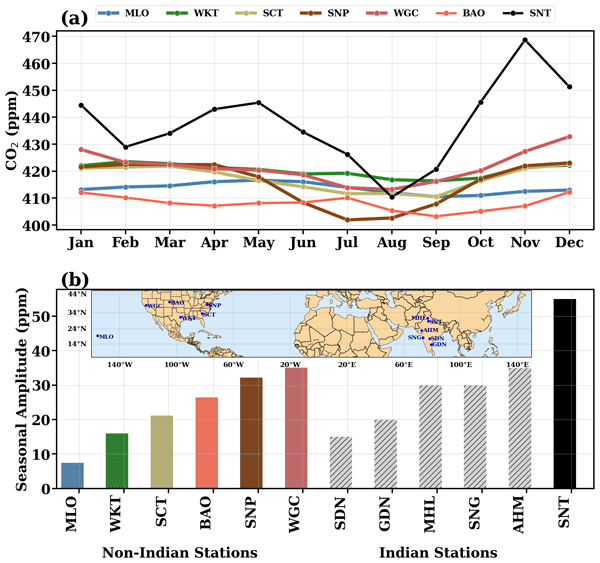
Abstract. The unusual weather patterns and large anthropogenic emissions over the Indo-Gangetic Plain make it a hotspot of greenhouse gases like carbon dioxide (CO2). Given the paramount significance of the IGP, a GHG observatory was set up at a suburban monitoring station, Sonipat, Haryana (28.95° N, 77.10° E), in the Delhi National Capital Region. Using continuous measurements of CO2 using a laser-based cavity ring-down spectroscopy (CRDS) technique, we investigated the temporal evolution of CO2 concentrations from February 2023 to January 2025. We observed an annual average CO2 concentration of 440.8 ± 19.7 parts per million (ppm) with an unusually strong seasonal variability ranging from 422.6 ± 23.3 to 456.4 ± 30.8 ppm in monsoon and post-monsoon, respectively. A strong CO2 diurnal amplitude of 29 ppm in May and 63 ppm in October was observed mainly due to seasonal changes in boundary layer mixing and biospheric activity. Further investigation of the drivers of this unique feature (strong seasonal and diurnal CO2 variability) over IGP revealed a strong contrast to other global monitoring stations in the same latitude band. A strong correlation between CO2 and CH4 indicated a co-located emission source, while the strong positive correlation between CO2 and carbon monoxide (CO) during post-monsoon indicates the footprint of crop residue burning on CO2 concentrations. We demonstrate that the high temporal CO2 variability in the IGP is driven by the interplay of local anthropogenic and biomass burning emissions, biospheric fluxes, and prevailing meteorology.
-
Notice on discussion status
The requested preprint has a corresponding peer-reviewed final revised paper. You are encouraged to refer to the final revised version.
-
Preprint
(3824 KB)
-
Supplement
(1488 KB)
-
The requested preprint has a corresponding peer-reviewed final revised paper. You are encouraged to refer to the final revised version.
- Preprint
(3824 KB) - Metadata XML
-
Supplement
(1488 KB) - BibTeX
- EndNote
- Final revised paper


Journal article(s) based on this preprint
Interactive discussion
Status: closed
-
RC1: 'Comment on egusphere-2025-3538', Anonymous Referee #2, 19 Oct 2025
-
AC1: 'Reply on RC1', Vimal Jose Vazhathara, 14 Feb 2026
The comment was uploaded in the form of a supplement: https://egusphere.copernicus.org/preprints/2025/egusphere-2025-3538/egusphere-2025-3538-AC1-supplement.pdf
-
AC1: 'Reply on RC1', Vimal Jose Vazhathara, 14 Feb 2026
-
RC2: 'Comment on egusphere-2025-3538', Anonymous Referee #3, 05 Jan 2026
The comment was uploaded in the form of a supplement: https://egusphere.copernicus.org/preprints/2025/egusphere-2025-3538/egusphere-2025-3538-RC2-supplement.pdf
-
AC2: 'Reply on RC2', Vimal Jose Vazhathara, 14 Feb 2026
The comment was uploaded in the form of a supplement: https://egusphere.copernicus.org/preprints/2025/egusphere-2025-3538/egusphere-2025-3538-AC2-supplement.pdf
-
AC2: 'Reply on RC2', Vimal Jose Vazhathara, 14 Feb 2026
Peer review completion


Interactive discussion
Status: closed
-
RC1: 'Comment on egusphere-2025-3538', Anonymous Referee #2, 19 Oct 2025
review of manuscript egusphere-2025-3538
Title: Insights into the high temporal variability of atmospheric carbon dioxide (CO2) at a suburban station in the Indo-Gangetic Plain
Author(s): Vimal Jose Vazhathara et al.
General Comments
The manuscript presents a comprehensive analysis of two years of continuous ground-based in-situ carbon dioxide and methane measurements at a suburban site in India. The authors compare these observations with satellite products, simulated CO₂ data, and other measured variables such as planetary boundary layer height and carbon monoxide. The study covers a wide range of approaches and datasets, which is commendable.
However, the manuscript suffers from several issues that require major revision:
- The language is often imprecise, wordy, and repetitive.
- The conclusions largely reiterate textbook knowledge and remain qualitative, even when quantitative data is presented.
- Methodological details are sometimes unclear or inconsistent.
- Figures and data presentation could be improved for clarity and comparability.
The manuscript would benefit significantly from major language editing and restructuring to improve clarity and conciseness.
Specific Comments
- CO₂, expressed as parts per million (ppm), refers to mole fractions, not concentrations.
- Line 20: Add height above sea level (asl).
- Line 23: Clarify how an annual average is determined over a two-year period.
- Section 2.1: Include station location relative to Delhi (direction, distance).
- Line 118: A cavity temperature of 45°C is standard and not user-adjustable.
- Lines 120–121: Clarify what is located 10 m above the instrument housing. Specify building height, canopy height, and inlet height above ground.
- Line 121: Teflon tubing is permeable to CO₂ and thus inappropriate. Include tubing size, sample residence time, and any checks for CO₂ losses or contamination.
- Line 149: Provide specifications for low-cost sensors (e.g. precision, accuracy, drift).
- Clarify the distance between the 1-Techpark building and the CRDS location.
- Lines 165–166: Describe calibration procedures for low-cost sensors.
- Line 175: Justify exclusion of Boulder Laboratory data.
- Line 180: Confirm whether all 625 datasets were used.
- Line 252: Add missing citation.
- Figure 1c: Add boundaries of the Indo-Gangetic Plain.
- Split Figure 1 into two: one for spatial context (Fig. 1b,c,d), one for time series, add CH4 and CO (new Fig. 2).
- Line 299: Clarify that the “annual mean” is a two-year average.
- Lines 300–302: Rephrase for clarity.
- Figure 2: Highlight seasonal regimes (monsoon, pre-monsoon, post-monsoon, winter) with background colors. Define pre-monsoon explicitly. Not done yet. Do you exclude any data when regimes transition?
- Monthly separation is coarse given the availability of hourly data. Consider using meteorological indicators (humidity, precipitation, temperature) for regime classification.
- Lines 321 ff.: Detrend data before comparing seasonal regimes to avoid bias from annual trends (~2.5–3 ppm/year).
- Lines 360 ff.: The association between increased CO₂ and ecosystem productivity is unclear.
- Seasonality discussion is verbose and based on coarse temporal resolution. Regime transitions likely do not align with calendar months, leading to blurred results.
- Figures 3 & 4: Use consistent scales for observed and simulated data. Current presentation is misleading due to scale differences (e.g., 60 ppm vs. 8 ppm (Fig. 3) and 70 ppm vs. 20 ppm (Fig. 4)).
- Section 3.2.3: Clarify why only 12 ObsPack stations are used and why Boulder data is treated inconsistently. Above, it is mention that Boulder data were excluded.
- Figure 6: Apply detrending before calculating seasonal cycles.
- Section 3.3: Explain why growth rate is considered for diurnal cycles but not for seasonal cycles.
- Lines 540–541: Clarify what is meant by “other local sources.”
- Define “local emissions” consistently. Is crop burning considered local? Examples show inconsistent treatment:
- Line 657–658: “… high concentrations of CO2 during November (post-monsoon) from local emissions and crop residue burning …”
- Line 32 ff.: “… CO2 variability in the IGP is driven by the interplay of local anthropogenic and biomass burning emissions …”
- Line 461 ff.: “Being surrounded by agricultural land, Sonipat is prone to emissions from crop residue burning.”
- Line 417 ff.: “This enhancement during the post-monsoon season can be attributed to crop residue burning over the monitoring station and the added transport from Punjab […] This highlights the inability of high-resolution satellite data to capture enhancements from local sources.”
- Figures 8 & 9: Justify use of Mauna Loa as a baseline. Explain deviation from ADHS methodology. Specify which Mauna Loa data were used and whether a background filter was applied.
- Clarify how CH₄ and CO backgrounds were determined.
While the manuscript addresses an important topic and presents valuable observational data from a region with limited coverage, it requires substantial revisions to improve clarity, consistency, and methodological rigor. The most compelling insight is the difficulty global products have in resolving local processes—an important but not unexpected finding.
With careful revision, the study has the potential to contribute meaningfully to the understanding of regional CO₂ variability in the Indo-Gangetic Plain.
Citation: https://doi.org/10.5194/egusphere-2025-3538-RC1 -
AC1: 'Reply on RC1', Vimal Jose Vazhathara, 14 Feb 2026
The comment was uploaded in the form of a supplement: https://egusphere.copernicus.org/preprints/2025/egusphere-2025-3538/egusphere-2025-3538-AC1-supplement.pdf
-
RC2: 'Comment on egusphere-2025-3538', Anonymous Referee #3, 05 Jan 2026
The comment was uploaded in the form of a supplement: https://egusphere.copernicus.org/preprints/2025/egusphere-2025-3538/egusphere-2025-3538-RC2-supplement.pdf
-
AC2: 'Reply on RC2', Vimal Jose Vazhathara, 14 Feb 2026
The comment was uploaded in the form of a supplement: https://egusphere.copernicus.org/preprints/2025/egusphere-2025-3538/egusphere-2025-3538-AC2-supplement.pdf
-
AC2: 'Reply on RC2', Vimal Jose Vazhathara, 14 Feb 2026
Peer review completion
Journal article(s) based on this preprint
Viewed
| HTML | XML | Total | Supplement | BibTeX | EndNote | |
|---|---|---|---|---|---|---|
| 3,990 | 1,362 | 221 | 5,573 | 426 | 200 | 200 |
- HTML: 3,990
- PDF: 1,362
- XML: 221
- Total: 5,573
- Supplement: 426
- BibTeX: 200
- EndNote: 200
Viewed (geographical distribution)
| Country | # | Views | % |
|---|
| Total: | 0 |
| HTML: | 0 |
| PDF: | 0 |
| XML: | 0 |
- 1
Vimal Jose Vazhathara

Ravi Kumar Kunchala
Sajeev Philip
Jaswant Rathore
Dilip Ganguly
Sagnik Dey
Yutaka Matsumi
Prabir K. Patra
The requested preprint has a corresponding peer-reviewed final revised paper. You are encouraged to refer to the final revised version.
- Preprint
(3824 KB) - Metadata XML
-
Supplement
(1488 KB) - BibTeX
- EndNote
- Final revised paper
review of manuscript egusphere-2025-3538
Title: Insights into the high temporal variability of atmospheric carbon dioxide (CO2) at a suburban station in the Indo-Gangetic Plain
Author(s): Vimal Jose Vazhathara et al.
General Comments
The manuscript presents a comprehensive analysis of two years of continuous ground-based in-situ carbon dioxide and methane measurements at a suburban site in India. The authors compare these observations with satellite products, simulated CO₂ data, and other measured variables such as planetary boundary layer height and carbon monoxide. The study covers a wide range of approaches and datasets, which is commendable.
However, the manuscript suffers from several issues that require major revision:
The manuscript would benefit significantly from major language editing and restructuring to improve clarity and conciseness.
Specific Comments
While the manuscript addresses an important topic and presents valuable observational data from a region with limited coverage, it requires substantial revisions to improve clarity, consistency, and methodological rigor. The most compelling insight is the difficulty global products have in resolving local processes—an important but not unexpected finding.
With careful revision, the study has the potential to contribute meaningfully to the understanding of regional CO₂ variability in the Indo-Gangetic Plain.