
the Creative Commons Attribution 4.0 License.
the Creative Commons Attribution 4.0 License.
 | 25 Jul 2025
Langmuir Turbulence in the Arctic Ocean: Insights From a Coupled Sea Ice –Wave Model
Abstract. Upper ocean mixing governs the vertical transport of heat, momentum, and tracers in the ocean surface boundary layer (OSBL), yet large-scale climate models often misrepresent its underlying processes, leading to significant uncertainty in sea ice and ocean predictions. Langmuir turbulence (LT) is one of the primary mechanisms of mixing in the open ocean and is generated by the interaction of wind stress and wave-induced Stokes drift. Observations have confirmed LT activity in leads, polynyas, and the marginal ice zone (MIZ), however its spatial and seasonal variability remains poorly constrained. In this study, we conduct the first Arctic-wide assessment of LT potential using a coupled sea ice–wave model that integrates neXtSIM and WAVEWATCH III. We analyze the spatiotemporal variability of LT by examining model-resolved turbulent dissipation and vertical kinetic energy within the OSBL. Our analysis reveals that LT potential is higher in the MIZ during melt and freeze-up, when partial sea ice cover allows intermittent wave propagation. Under these conditions, LT commonly coexists with wind-driven shear, forming a mixed-forcing regime that shapes upper-ocean energetics in response to evolving sea ice and wave states. Sea ice concentration and wind–wave alignment strongly influence the intensity and distribution of LT-driven mixing. On average, LT contributes roughly 15 % of the total upper-ocean dissipation in the Arctic MIZ, with episodic wave-driven events during transitional ice periods doubling local mixing rates compared to wind-only conditions. This analysis highlights the energetic role of wave-induced mixing in the upper ocean, with potential implications for vertical momentum transport, mixed layer structure, and sea ice–ocean interactions in the Arctic.
-
Notice on discussion status
The requested preprint has a corresponding peer-reviewed final revised paper. You are encouraged to refer to the final revised version.
-
Preprint
(26133 KB)
-
The requested preprint has a corresponding peer-reviewed final revised paper. You are encouraged to refer to the final revised version.
- Preprint
(26133 KB) - Metadata XML
- BibTeX
- EndNote
- Final revised paper


Journal article(s) based on this preprint
Interactive discussion
Status: closed
-
RC1: 'Comment on egusphere-2025-3438', Anonymous Referee #1, 18 Aug 2025
- AC1: 'Reply on RC1', Aikaterini Tavri, 17 Oct 2025
-
RC2: 'Comment on egusphere-2025-3438', Anonymous Referee #2, 22 Aug 2025
Overall comments:
This paper provides an assessment of Langmuir turbulence in the Arctic using a coupled wave-sea ice model. For the most part it acknowledges its shortcomings and is fairly well written. However, the conclusions from this work are not surprising, and I do wonder how much is gained and how much we trust the configuration used or if it has been validated against observations.
Major comments:
- Section 3:
- More details are required in the model configuration section.
- The authors never mention which attenuation scheme is used in WW3.
- What is the regional domain cut off for your regional model?
- What are the lateral boundary conditions used for WW3?
- You specify the atmospheric and oceanic forcing are for NeXtSIM - does WW3 receive the same forcing? Please specify.
- Please explain what “ Oceanic boundary conditions for NeXtSIM” means. Does this include both the lateral boundary conditions and oceanic forcing?
- You specify that "Our simulation spans the period 2018 - 2022 over a pan-Arctic domain with 25 km nominal resolution" - does this assume both NextSim and WW3 are defined on the exact same mesh?
- What is the advantage of this configuration over just analyzing sea ice data and ERA5 wave fields? Is it simply to get Stokes drift? Did you consider using a method like in Webb 2011 - https://www.sciencedirect.com/science/article/pii/S1463500311001454. To obtain stokes drift from Hs
- The waves should also modify the ocean and this cannot happen, can you comment on this potential impact?
- Section 3.1: Using an absolute wind formulation overestimates the momentum flux into the ocean since you neglect the momentum loss due to generation of waves? What is the potential impact of this choice? It may be possible to estimate this from the GLORYS data.
- Section 3.2: Alpha_L is not introduced well. I suggest ‘dynamic orientation of the Langmuir cells relative to the wind direction (alpha_L)’ or something similar. I understand not including alpha_L, but an alpha_LOW is proposed at the end of Van Roekel et al 2012 that could be used here. Given the overestimation with Theta_ww produces a muted response, I would expect alpha_LOW to be less as well. But it would be useful to discuss this better.
- Section 3.2.1:
- Use of the scaling- The scalings from Van Roekel et al 2012 were derived from destabilizing LES conditions primarily. I’m not aware of any work examining LT and the scaling in stabilizing conditions. Therefore, it’s not clear how applicable the VKE scalings, LaT etc… are to the arctic.
- The relationships between Eqn 9 to eqns 10 and 11 are unclear. What is the wave driven contribution to TKE? Is eqn 9 the total dissipation? If so Eqns 9 and 11 are redundant.
- It would be helpful to explicitly state that these dissipation relationships emerge from a vertically integrated turbulence kinetic energy budget.
- Section4:
- Figure 1: Why does Hs exceed but not Us(0)? I usually expect Hs and Us to be related. Is there any way to calculate these exceedance rate from observations? How well does the WW3-NeXTSIM coupled model reproduce observed statistics?
- Wouldn’t the exceedance statistic (eqn 14) be biased since the OW cells are systematically located at lower latitudes, and experience different forcings than ice covered cells higher latitude cells?
- Section 4.3
- The conclusion at the start of section 4.3 doesn’t seem supported well by evidence. This could be fixed by specifying “ in the MIZ” as opposed to “in the Arctic”. The current phrase suggests this is pan-Arctic.
- L 355 - The text here is speculative. Have you examined ocean stratification over this period? This would be a useful compliment to your analysis. Even for your mixing discussion, you have more mixing energy, but there is no guarantee there is more mixing without examining stratification.
- Please clarify what the connection between the kernel analysis is and subgrid variability. It’s a measure of local heterogeneity but using a spatial kernel doesn’t say anything about variability below the model grid scale. There certainly is a lot of spatial variability, but this doesn’t mean it’s subgrid.
Minor comments:
- L 58: WaveWatch III is trademarked all mentions of the full model name should be “WAVEWATCHIII”
- L 73: WaveWatch III should be “WAVEWATCHIII”
- L 75: remove word ‘fully’
- L 76: WW3 is already defined
- L 143: tilda is above the 2 in 25km?
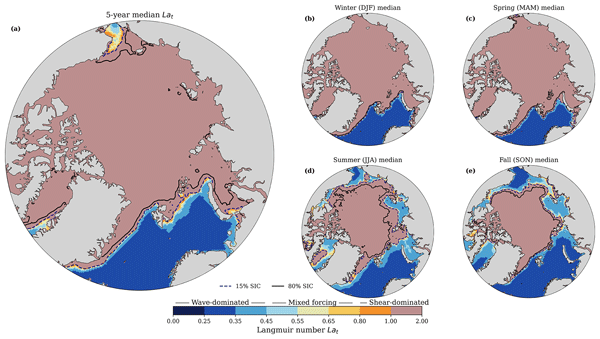
- Fig 2 - Caption the Median 15% and 80% SIC contours are overlaid in black and blue… Based on the image, the 15% SIC is actually BLUE and the 80% line is black - make sure the listed order of the contours match.
- L 239- the concept of a MIZ day is confusing… please clarify if you mean that a “MIZ day” is defined as when ANY grid cell in the entire domain on a given day is between 15-80% SIC. If so, I would expect every ‘day’ in the time series to be classified as a MIZ day, which would make this metric essentially meaningless. Is there any spatial requirement for a grid cell to be located within the MIZ in this definition? In other words, please clarify if these exceedance values (in Fig A1) are only valid for grid cells within the MIZ, or ALL grid cells on a day where any MIZ cell is present within the domain (which would be 100% of the time).
- Figure 3 results - what is the definition of persistence?
- L 330- is there a missing reference?
- L 331- typo - “Lusing”
- L 332 - something wrong with the in-line dissipation equation
- L375-376 - it would be useful to reiterate that use of theta_ww will overestimate the impact of misalignment here.
- L391-394 - how are 1 and 2 different? I would expect spatial coherence of u* and us in regions that are fetch limited.. Could you also compute theta_ww directly to show there is little misalignment?
- L395-397 - I believe this is confirmed in Van Roekel et al 2012 - Fig 16 for low Lat and Laproj
- L 402 - remove “comprehensive”. This study cannot be compressive without, for example, comparison against observations, an estimate of the fine scale processes, or the use of an active ocean model in the coupled framework.
- L420 and 447 - again I don’t think subgrid scale is appropriate for what is presented. Perhaps use the phrase “fine scale” variability or something similar.
- L438-440 - what are the implications of overestimates from Langmuir diagnostics? Are you making connections to things like the KPP enhancement factor being based on LaT? Couldn't this capture the regime if Stokes drift is dynamic (say from WW3?)?
- L452 - what is meant by “focus on integrating directional wave spectra”? Do you mean into things like KPP?
- L 452: “Fully coupled” should include an active atmosphere as well.
Citation: https://doi.org/10.5194/egusphere-2025-3438-RC2 - AC3: 'Reply on RC2', Aikaterini Tavri, 17 Oct 2025
- AC4: 'Reply on RC2', Aikaterini Tavri, 17 Oct 2025
-
RC3: 'Comment on egusphere-2025-3438', Anonymous Referee #3, 31 Aug 2025
Review of Langmuir Turbulence in the Arctic Ocean: Insights From a Coupled Sea Ice–Wave Model”
Overview
This manuscript presents a novel application of a coupled sea ice–wave model to investigate the contribution of surface waves to upper-ocean mixing via Langmuir Turbulence (LT) in the Arctic between 2018–2022. As expected, the results show that wave-driven mixing is negligible across most of the pack ice but occurs more frequently in the marginal ice zone (MIZ). The authors also examine the role of wind–wave directional mismatch, which is found to be significant in high ice-concentration conditions.Overall, the paper is well-prepared, carefully edited, and supported by clear figures. It addresses an important question at the intersection of sea ice, waves, and upper-ocean mixing. However, the strength of the conclusions is currently limited by several caveats that should be addressed more explicitly. The points below highlight areas where the manuscript could be strengthened. Specifically, strengthening the treatment of model fidelity, refining the focus of the analysis, and clarifying domain and presentation details will improve the robustness and impact of the conclusions.
Major Comments
- Model Fidelity
While the manuscript cites earlier studies validating this model, some evaluation specific to the present application is needed. In particular, comparisons of modeled winds, shear, and wave fields (especially short waves, which strongly influence Stokes drift) would provide important context. Because the LT parameterizations are sensitive to these inputs, even brief error estimates or uncertainty ranges would help clarify the robustness of the conclusions. It would also be useful to discuss how well the model captures heterogeneous ice concentration features (e.g., leads), which can locally enhance Stokes processes. - Key Conclusions and Metrics
The primary focus on regime classification raises questions of utility. Why is the frequency of transitions between regimes the most relevant measure? Should this instead be linked to event duration or intensity?
The discussion introduces two compelling applications: (i) how wave-driven forcing may evolve in a changing climate, and (ii) implications for tracer transport and stratification. These questions seem ideally suited for this model framework. Even a preliminary analysis—for instance, a future-scenario run or a waves-on vs. waves-off experiment—would help demonstrate the broader utility of the work.
Additionally, the statement that “wind–wave alignment strongly influences LT-driven mixing” may be overstated given the results in Figure 7. A more quantitative phrasing (e.g., “up to X% effect in the MIZ”) would provide a more measured conclusion.
- Domain of Analysis
The spatial and seasonal definition of the analysis domain needs to be clarified. In maps, regions outside the study area should be removed or masked. Presenting this earlier in the results (e.g., with characteristic winds, peak wave heights, or other basic descriptors) would give readers helpful context. - Presentation and Scope
The manuscript currently introduces more metrics than are fully justified by the conclusions. Several variables appear in the methods but are not explored in the results, while additional metrics are introduced later in the analysis. A more streamlined focus on the most relevant parameters would strengthen the narrative.
Minor Comments
- Line 34: Out of curiosity, have you also applied this model in the Southern Ocean? Given its energetic wave climate, it may be an equally or more interesting test case.
- Figures/Visuals:
- Figure 1: The exceedance plots, especially panels (e, f), are difficult to interpret and appear saturated. Consider simplifying (e.g., show only u*), or adopt a different approach to highlight relative values.
- Figure 2: The averaging domain is unclear. Does it include the entire region shown? Also, labels such as “wave-dominated” and “shear-dominated” (introduced later, L268) could be used here. Color contrast between LT-active and mixed regimes should be improved.
- Figure 3: The line label in panel (a) is unreadable. In panel (b), clarify the domain for SIC; the 20% threshold seems surprisingly low.
- Figure 4: The increase in La_T at moderate SIC (likely due to larger fetch) should be noted in the text.
- Figure 6: SIC would be clearer as a black line rather than shading. Caption should clarify that VKE refers to the upper ocean.
- Line 330: Reference missing.
- Line 364–365: The statement that this “confirms” LT effects is too strong—covariance may also arise from wind–shear processes.
Citation: https://doi.org/10.5194/egusphere-2025-3438-RC3 - AC2: 'Reply on RC3', Aikaterini Tavri, 17 Oct 2025
- Model Fidelity
Peer review completion


Interactive discussion
Status: closed
-
RC1: 'Comment on egusphere-2025-3438', Anonymous Referee #1, 18 Aug 2025
Review of “Langmuir Turbulence in the Arctic Ocean: Insights From a Coupled Sea Ice –Wave Model” by Aikaterini Tavri et al.
By applying scaling laws of Langmuir turbulence enhanced ocean mixing from previous studies to the simulation data from a coupled ice-wave model, the authors quantified the spatial distribution and occurrence of surface conditions that potentially favor the development of Langmuir turbulence in the Arctic. I think this study is quite interesting and the topic discussed in this manuscript is important in improving our understanding of the effects of Langmuir turbulence in the marginal ice zone and is potentially useful in parameterizing such effects in fully coupled atmosphere-ocean-ice-wave model. The manuscript is well written and easy to follow. However, I have a few concerns on the methods used in this study as detailed below, which may require significant revisions of the analyses and discussions. I therefore recommend a major revision.
General comments
My first concern is on the use of an enhancement factor defined in Eq. (8) to scale the enhancement of TKE dissipation by Langmuir turbulence in Eq. (9). The Langmuir enhancement factor in Eq. (8) describes the enhancement of turbulent velocity scale, which is based on scalings of vertical velocity variance in a set of large eddy simulations described in Van Roekel et al., 2012. The TKE dissipation does not necessarily scale in the same way. In fact, it shouldn’t scale the same way as it depends on the turbulent velocity scale cubed. One may instead use Eq. (5) in Belcher et al., 2012 to estimate the enhancement of TKE dissipation due to Langmuir turbulence. But I’m not sure it is possible to clearly attribute the TKE dissipation to shear-driven and Langmuir-induced component. This incorrect scaling of TKE dissipation may explain the mismatch between the results and theory in Fig. 5b. Since this study is based on the turbulence scalings (as summarized in Table 1), the choice of the scaling of TKE dissipation may significantly affect the conclusions and discussions, in particular the interpretation of Langmuir turbulence’s influence on TKE dissipation in Section 4.3 and the impact of wind-wave misalignment on the dissipation ratio in Section 4.4.
My second concern is that the turbulence scalings used in this study were derived in ice-free conditions. It is not clear how well these scalings describe the effect of Langmuir turbulence on the turbulent mixing in the presence of sea ice. While I understand that an assessment of the validity of turbulence scalings in the presence of sea ice may be beyond the scope of this study, a more careful discussion on this point would be helpful.
Finally, the effects of surface buoyancy flux are probably significant in the turbulent mixing in the Arctic, for example, during ice formation/melting and in open waters between sea ice when air-sea temperature difference is large. A discussion on the effects of surface buoyancy flux versus the role of Langmuir turbulence would be helpful.
Specific comments
L60: Define “LT potential”?
Section 2 and 3: Something wrong with the section title?
L91-92: Was WW3 forced with the same ocean and atmosphere forcing?
L98: delete the second “both”?
Eq (2): Why not account for the ocean currents? Does it matter here?
L104: C_{ao} should not be in bold font?
L107-108: Be more specific on what do “the surface forcing of momentum pathways”? It would be helpful to list what variables in the GLORYS12 reanalysis and ERA5 were used.
L132-133: In addition to wind-wave misalignment, another refined formulation is to account for the decay of Stokes drift with depth. Any comments on this?
L153: Van Roekel et al., 2012 is probably a more appropriate reference here.
L155 and L176: \citep{} -> \citet{}
Eq (9): Also (11). As I mentioned in my general comment, I don’t think the effect of LT on TKE dissipation can be estimated in this way.
L173: Not sure this separation can be done.
L181: “Langmuir scaling” -> “Langmuir number”
L197-201: It would be helpful to elaborate more on the physical meaning of this metric. The frequency of OW conditions in different seasons depends on the location? Also, OW conditions depends on the seasons?
L206: The distribution does not seem narrow to me. It ranges from 0 to 0.03 m/s? And the seasonal variability is greater than Stokes drift?
L207-208: It’s variation between seasons does not seem to be bigger than wind stress to me.
L212-213: What are the discontinuities in the exceedance rates?
Fig 1: What is the area of analysis in these statistics? The area shown in panels (d), (e), (f)?
Fig 1b: Maybe adjust the range of horizontal axis to reduce the empty space?
L225: “Asymmetry” between what?
L237: Not sure the thresholds described below are physically motivated. The effects of waves on the mixing not only depend on the absolute value of Stokes drift, but also its ratio over friction velocity (thus Langmuir number)? What additional information is provided by the distribution of surface Stokes drift as compared to the distribution of Langmuir number?
L239: The definition of a MIZ day is confusing. At least one grid cell satisfies the MIZ condition over the whole Arctic Ocean?
L240: Why put the figure in the Appendix if it is discussed in such details here?
L255-256: Not sure this conclusion is sufficiently supported by the analysis so far.
L259-260: A Langmuir number of La_t = 0.4 also corresponds to strong Langmuir turbulence? It’s also inconsistent the definition of mixing regime in Eq (15).
Eq. (15): The regime boundaries seem arbitrary. How were they determined? Are the results sensitive to the choice of these boundaries?
L276-277: Why use the number of grid cells instead of the total area? Different grid cells may have different sizes.
L306: Why “subgrid variability”? Isn’t it the variability across neighboring grid cells?
L325-326: This is due to the wrong scaling of TKE dissipation?
L331: “Lusing” -> “using”
L391-400: It might be helpful to check the partitioning between swell and wind-waves in the MIZ and their directions. Also their contribution to the Stokes drift. I’d expect the misalignment between wind and waves to be stronger in the MIZ than in the ice-free waters. But it may not significantly affect the surface Stokes drift if locally generated wind-waves are also strong.
L447-448: How was the subgrid variability captured?
Appendix A: I think Table A1 and Figure A1 may be move in the text where they are referred to.
References
Belcher, S. E., Grant, A. L. M., Hanley, K. E., Fox-Kemper, B., Van Roekel, L., Sullivan, P. P., et al. (2012). A global perspective on Langmuir turbulence in the ocean surface boundary layer. Geophysical Research Letters, 39(18), L18605. https://doi.org/10.1029/2012GL052932
Van Roekel, L., Fox-Kemper, B., Sullivan, P. P., Hamlington, P. E., & Haney, S. R. (2012). The form and orientation of Langmuir cells for misaligned winds and waves. Journal of Geophysical Research, 117(C05001), C05001. https://doi.org/10.1029/2011JC007516
Citation: https://doi.org/10.5194/egusphere-2025-3438-RC1 - AC1: 'Reply on RC1', Aikaterini Tavri, 17 Oct 2025
-
RC2: 'Comment on egusphere-2025-3438', Anonymous Referee #2, 22 Aug 2025
Overall comments:
This paper provides an assessment of Langmuir turbulence in the Arctic using a coupled wave-sea ice model. For the most part it acknowledges its shortcomings and is fairly well written. However, the conclusions from this work are not surprising, and I do wonder how much is gained and how much we trust the configuration used or if it has been validated against observations.
Major comments:
- Section 3:
- More details are required in the model configuration section.
- The authors never mention which attenuation scheme is used in WW3.
- What is the regional domain cut off for your regional model?
- What are the lateral boundary conditions used for WW3?
- You specify the atmospheric and oceanic forcing are for NeXtSIM - does WW3 receive the same forcing? Please specify.
- Please explain what “ Oceanic boundary conditions for NeXtSIM” means. Does this include both the lateral boundary conditions and oceanic forcing?
- You specify that "Our simulation spans the period 2018 - 2022 over a pan-Arctic domain with 25 km nominal resolution" - does this assume both NextSim and WW3 are defined on the exact same mesh?
- What is the advantage of this configuration over just analyzing sea ice data and ERA5 wave fields? Is it simply to get Stokes drift? Did you consider using a method like in Webb 2011 - https://www.sciencedirect.com/science/article/pii/S1463500311001454. To obtain stokes drift from Hs
- The waves should also modify the ocean and this cannot happen, can you comment on this potential impact?
- Section 3.1: Using an absolute wind formulation overestimates the momentum flux into the ocean since you neglect the momentum loss due to generation of waves? What is the potential impact of this choice? It may be possible to estimate this from the GLORYS data.
- Section 3.2: Alpha_L is not introduced well. I suggest ‘dynamic orientation of the Langmuir cells relative to the wind direction (alpha_L)’ or something similar. I understand not including alpha_L, but an alpha_LOW is proposed at the end of Van Roekel et al 2012 that could be used here. Given the overestimation with Theta_ww produces a muted response, I would expect alpha_LOW to be less as well. But it would be useful to discuss this better.
- Section 3.2.1:
- Use of the scaling- The scalings from Van Roekel et al 2012 were derived from destabilizing LES conditions primarily. I’m not aware of any work examining LT and the scaling in stabilizing conditions. Therefore, it’s not clear how applicable the VKE scalings, LaT etc… are to the arctic.
- The relationships between Eqn 9 to eqns 10 and 11 are unclear. What is the wave driven contribution to TKE? Is eqn 9 the total dissipation? If so Eqns 9 and 11 are redundant.
- It would be helpful to explicitly state that these dissipation relationships emerge from a vertically integrated turbulence kinetic energy budget.
- Section4:
- Figure 1: Why does Hs exceed but not Us(0)? I usually expect Hs and Us to be related. Is there any way to calculate these exceedance rate from observations? How well does the WW3-NeXTSIM coupled model reproduce observed statistics?
- Wouldn’t the exceedance statistic (eqn 14) be biased since the OW cells are systematically located at lower latitudes, and experience different forcings than ice covered cells higher latitude cells?
- Section 4.3
- The conclusion at the start of section 4.3 doesn’t seem supported well by evidence. This could be fixed by specifying “ in the MIZ” as opposed to “in the Arctic”. The current phrase suggests this is pan-Arctic.
- L 355 - The text here is speculative. Have you examined ocean stratification over this period? This would be a useful compliment to your analysis. Even for your mixing discussion, you have more mixing energy, but there is no guarantee there is more mixing without examining stratification.
- Please clarify what the connection between the kernel analysis is and subgrid variability. It’s a measure of local heterogeneity but using a spatial kernel doesn’t say anything about variability below the model grid scale. There certainly is a lot of spatial variability, but this doesn’t mean it’s subgrid.
Minor comments:
- L 58: WaveWatch III is trademarked all mentions of the full model name should be “WAVEWATCHIII”
- L 73: WaveWatch III should be “WAVEWATCHIII”
- L 75: remove word ‘fully’
- L 76: WW3 is already defined
- L 143: tilda is above the 2 in 25km?
- Fig 2 - Caption the Median 15% and 80% SIC contours are overlaid in black and blue… Based on the image, the 15% SIC is actually BLUE and the 80% line is black - make sure the listed order of the contours match.
- L 239- the concept of a MIZ day is confusing… please clarify if you mean that a “MIZ day” is defined as when ANY grid cell in the entire domain on a given day is between 15-80% SIC. If so, I would expect every ‘day’ in the time series to be classified as a MIZ day, which would make this metric essentially meaningless. Is there any spatial requirement for a grid cell to be located within the MIZ in this definition? In other words, please clarify if these exceedance values (in Fig A1) are only valid for grid cells within the MIZ, or ALL grid cells on a day where any MIZ cell is present within the domain (which would be 100% of the time).
- Figure 3 results - what is the definition of persistence?
- L 330- is there a missing reference?
- L 331- typo - “Lusing”
- L 332 - something wrong with the in-line dissipation equation
- L375-376 - it would be useful to reiterate that use of theta_ww will overestimate the impact of misalignment here.
- L391-394 - how are 1 and 2 different? I would expect spatial coherence of u* and us in regions that are fetch limited.. Could you also compute theta_ww directly to show there is little misalignment?
- L395-397 - I believe this is confirmed in Van Roekel et al 2012 - Fig 16 for low Lat and Laproj
- L 402 - remove “comprehensive”. This study cannot be compressive without, for example, comparison against observations, an estimate of the fine scale processes, or the use of an active ocean model in the coupled framework.
- L420 and 447 - again I don’t think subgrid scale is appropriate for what is presented. Perhaps use the phrase “fine scale” variability or something similar.
- L438-440 - what are the implications of overestimates from Langmuir diagnostics? Are you making connections to things like the KPP enhancement factor being based on LaT? Couldn't this capture the regime if Stokes drift is dynamic (say from WW3?)?
- L452 - what is meant by “focus on integrating directional wave spectra”? Do you mean into things like KPP?
- L 452: “Fully coupled” should include an active atmosphere as well.
Citation: https://doi.org/10.5194/egusphere-2025-3438-RC2 - AC3: 'Reply on RC2', Aikaterini Tavri, 17 Oct 2025
- AC4: 'Reply on RC2', Aikaterini Tavri, 17 Oct 2025
-
RC3: 'Comment on egusphere-2025-3438', Anonymous Referee #3, 31 Aug 2025
Review of Langmuir Turbulence in the Arctic Ocean: Insights From a Coupled Sea Ice–Wave Model”
Overview
This manuscript presents a novel application of a coupled sea ice–wave model to investigate the contribution of surface waves to upper-ocean mixing via Langmuir Turbulence (LT) in the Arctic between 2018–2022. As expected, the results show that wave-driven mixing is negligible across most of the pack ice but occurs more frequently in the marginal ice zone (MIZ). The authors also examine the role of wind–wave directional mismatch, which is found to be significant in high ice-concentration conditions.Overall, the paper is well-prepared, carefully edited, and supported by clear figures. It addresses an important question at the intersection of sea ice, waves, and upper-ocean mixing. However, the strength of the conclusions is currently limited by several caveats that should be addressed more explicitly. The points below highlight areas where the manuscript could be strengthened. Specifically, strengthening the treatment of model fidelity, refining the focus of the analysis, and clarifying domain and presentation details will improve the robustness and impact of the conclusions.
Major Comments
- Model Fidelity
While the manuscript cites earlier studies validating this model, some evaluation specific to the present application is needed. In particular, comparisons of modeled winds, shear, and wave fields (especially short waves, which strongly influence Stokes drift) would provide important context. Because the LT parameterizations are sensitive to these inputs, even brief error estimates or uncertainty ranges would help clarify the robustness of the conclusions. It would also be useful to discuss how well the model captures heterogeneous ice concentration features (e.g., leads), which can locally enhance Stokes processes. - Key Conclusions and Metrics
The primary focus on regime classification raises questions of utility. Why is the frequency of transitions between regimes the most relevant measure? Should this instead be linked to event duration or intensity?
The discussion introduces two compelling applications: (i) how wave-driven forcing may evolve in a changing climate, and (ii) implications for tracer transport and stratification. These questions seem ideally suited for this model framework. Even a preliminary analysis—for instance, a future-scenario run or a waves-on vs. waves-off experiment—would help demonstrate the broader utility of the work.
Additionally, the statement that “wind–wave alignment strongly influences LT-driven mixing” may be overstated given the results in Figure 7. A more quantitative phrasing (e.g., “up to X% effect in the MIZ”) would provide a more measured conclusion.
- Domain of Analysis
The spatial and seasonal definition of the analysis domain needs to be clarified. In maps, regions outside the study area should be removed or masked. Presenting this earlier in the results (e.g., with characteristic winds, peak wave heights, or other basic descriptors) would give readers helpful context. - Presentation and Scope
The manuscript currently introduces more metrics than are fully justified by the conclusions. Several variables appear in the methods but are not explored in the results, while additional metrics are introduced later in the analysis. A more streamlined focus on the most relevant parameters would strengthen the narrative.
Minor Comments
- Line 34: Out of curiosity, have you also applied this model in the Southern Ocean? Given its energetic wave climate, it may be an equally or more interesting test case.
- Figures/Visuals:
- Figure 1: The exceedance plots, especially panels (e, f), are difficult to interpret and appear saturated. Consider simplifying (e.g., show only u*), or adopt a different approach to highlight relative values.
- Figure 2: The averaging domain is unclear. Does it include the entire region shown? Also, labels such as “wave-dominated” and “shear-dominated” (introduced later, L268) could be used here. Color contrast between LT-active and mixed regimes should be improved.
- Figure 3: The line label in panel (a) is unreadable. In panel (b), clarify the domain for SIC; the 20% threshold seems surprisingly low.
- Figure 4: The increase in La_T at moderate SIC (likely due to larger fetch) should be noted in the text.
- Figure 6: SIC would be clearer as a black line rather than shading. Caption should clarify that VKE refers to the upper ocean.
- Line 330: Reference missing.
- Line 364–365: The statement that this “confirms” LT effects is too strong—covariance may also arise from wind–shear processes.
Citation: https://doi.org/10.5194/egusphere-2025-3438-RC3 - AC2: 'Reply on RC3', Aikaterini Tavri, 17 Oct 2025
- Model Fidelity
Peer review completion
Journal article(s) based on this preprint
Viewed
| HTML | XML | Total | BibTeX | EndNote | |
|---|---|---|---|---|---|
| 11,221 | 2,215 | 254 | 13,690 | 409 | 430 |
- HTML: 11,221
- PDF: 2,215
- XML: 254
- Total: 13,690
- BibTeX: 409
- EndNote: 430
Viewed (geographical distribution)
| Country | # | Views | % |
|---|
| Total: | 0 |
| HTML: | 0 |
| PDF: | 0 |
| XML: | 0 |
- 1

Chris Horvat
Brodie Pearson
Guillaume Boutin
Anne Hansen
Ara Lee
The requested preprint has a corresponding peer-reviewed final revised paper. You are encouraged to refer to the final revised version.
- Preprint
(26133 KB) - Metadata XML
Review of “Langmuir Turbulence in the Arctic Ocean: Insights From a Coupled Sea Ice –Wave Model” by Aikaterini Tavri et al.
By applying scaling laws of Langmuir turbulence enhanced ocean mixing from previous studies to the simulation data from a coupled ice-wave model, the authors quantified the spatial distribution and occurrence of surface conditions that potentially favor the development of Langmuir turbulence in the Arctic. I think this study is quite interesting and the topic discussed in this manuscript is important in improving our understanding of the effects of Langmuir turbulence in the marginal ice zone and is potentially useful in parameterizing such effects in fully coupled atmosphere-ocean-ice-wave model. The manuscript is well written and easy to follow. However, I have a few concerns on the methods used in this study as detailed below, which may require significant revisions of the analyses and discussions. I therefore recommend a major revision.
General comments
My first concern is on the use of an enhancement factor defined in Eq. (8) to scale the enhancement of TKE dissipation by Langmuir turbulence in Eq. (9). The Langmuir enhancement factor in Eq. (8) describes the enhancement of turbulent velocity scale, which is based on scalings of vertical velocity variance in a set of large eddy simulations described in Van Roekel et al., 2012. The TKE dissipation does not necessarily scale in the same way. In fact, it shouldn’t scale the same way as it depends on the turbulent velocity scale cubed. One may instead use Eq. (5) in Belcher et al., 2012 to estimate the enhancement of TKE dissipation due to Langmuir turbulence. But I’m not sure it is possible to clearly attribute the TKE dissipation to shear-driven and Langmuir-induced component. This incorrect scaling of TKE dissipation may explain the mismatch between the results and theory in Fig. 5b. Since this study is based on the turbulence scalings (as summarized in Table 1), the choice of the scaling of TKE dissipation may significantly affect the conclusions and discussions, in particular the interpretation of Langmuir turbulence’s influence on TKE dissipation in Section 4.3 and the impact of wind-wave misalignment on the dissipation ratio in Section 4.4.
My second concern is that the turbulence scalings used in this study were derived in ice-free conditions. It is not clear how well these scalings describe the effect of Langmuir turbulence on the turbulent mixing in the presence of sea ice. While I understand that an assessment of the validity of turbulence scalings in the presence of sea ice may be beyond the scope of this study, a more careful discussion on this point would be helpful.
Finally, the effects of surface buoyancy flux are probably significant in the turbulent mixing in the Arctic, for example, during ice formation/melting and in open waters between sea ice when air-sea temperature difference is large. A discussion on the effects of surface buoyancy flux versus the role of Langmuir turbulence would be helpful.
Specific comments
L60: Define “LT potential”?
Section 2 and 3: Something wrong with the section title?
L91-92: Was WW3 forced with the same ocean and atmosphere forcing?
L98: delete the second “both”?
Eq (2): Why not account for the ocean currents? Does it matter here?
L104: C_{ao} should not be in bold font?
L107-108: Be more specific on what do “the surface forcing of momentum pathways”? It would be helpful to list what variables in the GLORYS12 reanalysis and ERA5 were used.
L132-133: In addition to wind-wave misalignment, another refined formulation is to account for the decay of Stokes drift with depth. Any comments on this?
L153: Van Roekel et al., 2012 is probably a more appropriate reference here.
L155 and L176: \citep{} -> \citet{}
Eq (9): Also (11). As I mentioned in my general comment, I don’t think the effect of LT on TKE dissipation can be estimated in this way.
L173: Not sure this separation can be done.
L181: “Langmuir scaling” -> “Langmuir number”
L197-201: It would be helpful to elaborate more on the physical meaning of this metric. The frequency of OW conditions in different seasons depends on the location? Also, OW conditions depends on the seasons?
L206: The distribution does not seem narrow to me. It ranges from 0 to 0.03 m/s? And the seasonal variability is greater than Stokes drift?
L207-208: It’s variation between seasons does not seem to be bigger than wind stress to me.
L212-213: What are the discontinuities in the exceedance rates?
Fig 1: What is the area of analysis in these statistics? The area shown in panels (d), (e), (f)?
Fig 1b: Maybe adjust the range of horizontal axis to reduce the empty space?
L225: “Asymmetry” between what?
L237: Not sure the thresholds described below are physically motivated. The effects of waves on the mixing not only depend on the absolute value of Stokes drift, but also its ratio over friction velocity (thus Langmuir number)? What additional information is provided by the distribution of surface Stokes drift as compared to the distribution of Langmuir number?
L239: The definition of a MIZ day is confusing. At least one grid cell satisfies the MIZ condition over the whole Arctic Ocean?
L240: Why put the figure in the Appendix if it is discussed in such details here?
L255-256: Not sure this conclusion is sufficiently supported by the analysis so far.
L259-260: A Langmuir number of La_t = 0.4 also corresponds to strong Langmuir turbulence? It’s also inconsistent the definition of mixing regime in Eq (15).
Eq. (15): The regime boundaries seem arbitrary. How were they determined? Are the results sensitive to the choice of these boundaries?
L276-277: Why use the number of grid cells instead of the total area? Different grid cells may have different sizes.
L306: Why “subgrid variability”? Isn’t it the variability across neighboring grid cells?
L325-326: This is due to the wrong scaling of TKE dissipation?
L331: “Lusing” -> “using”
L391-400: It might be helpful to check the partitioning between swell and wind-waves in the MIZ and their directions. Also their contribution to the Stokes drift. I’d expect the misalignment between wind and waves to be stronger in the MIZ than in the ice-free waters. But it may not significantly affect the surface Stokes drift if locally generated wind-waves are also strong.
L447-448: How was the subgrid variability captured?
Appendix A: I think Table A1 and Figure A1 may be move in the text where they are referred to.
References
Belcher, S. E., Grant, A. L. M., Hanley, K. E., Fox-Kemper, B., Van Roekel, L., Sullivan, P. P., et al. (2012). A global perspective on Langmuir turbulence in the ocean surface boundary layer. Geophysical Research Letters, 39(18), L18605. https://doi.org/10.1029/2012GL052932
Van Roekel, L., Fox-Kemper, B., Sullivan, P. P., Hamlington, P. E., & Haney, S. R. (2012). The form and orientation of Langmuir cells for misaligned winds and waves. Journal of Geophysical Research, 117(C05001), C05001. https://doi.org/10.1029/2011JC007516