
the Creative Commons Attribution 4.0 License.
the Creative Commons Attribution 4.0 License.
 | 17 Jul 2025
Measurement report: Age-dependent BVOC emissions in Eucalyptus urophylla: a comparison of leaf cuvette and branch chamber measurements
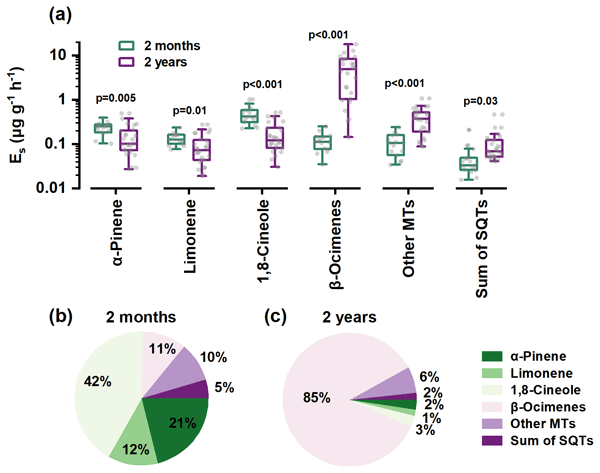
Abstract. Biogenic volatile organic compound (BVOC) emission factors (Es) underpin air quality and climate models, yet current databases intermingle data from both seedlings and mature trees and from two enclosure techniques, leaf cuvettes and dynamic branch chambers, whose comparability has rarely been rigorously tested. Here we quantified BVOC emissions from Eucalyptus urophylla by pairing the two methods on a statistically representative number of 2-month-old seedlings in the laboratory and 2-year-old trees measured at a managed plantations in subtropical China. Leaf-cuvette and branch-chamber determination of isoprene Es matched within 5 % for both age classes, demonstrating method equivalence. In contrast, tree age exerted a significant impact on both the magnitude and speciation of emissions. Seedlings emitted ~50 % more isoprene and were enriched in cyclic monoterpenes like α-pinene and 1,8-cineole, whereas field-grown trees shifted toward highly reactive acyclic monoterpenes, with β-ocimenes accounted for over 85 % of the terpene flux. These ontogenetic shifts imply that one-third of the entries in global Es compilations, which are derived from seedling studies, likely overestimate local isoprene fluxes while under-representing the atmospheric reactivity of mature canopies. Our results validate the use of either chamber type for measuring isoprene Es, highlight the need for improved analytical sensitivity before extending this equivalence to terpenes, and call for systematic, large-sample, branch-level measurements of adult trees to produce representative Es values. Incorporating age-resolved emission factors into models will refine estimates of ozone and secondary organic aerosol formation in fast-growing subtropical plantations and other managed forests worldwide.
-
Notice on discussion status
The requested preprint has a corresponding peer-reviewed final revised paper. You are encouraged to refer to the final revised version.
-
Preprint
(725 KB)
-
Supplement
(400 KB)
-
The requested preprint has a corresponding peer-reviewed final revised paper. You are encouraged to refer to the final revised version.
- Preprint
(725 KB) - Metadata XML
-
Supplement
(400 KB) - BibTeX
- EndNote
- Final revised paper


Journal article(s) based on this preprint
Interactive discussion
Status: closed
-
RC1: 'Comment on egusphere-2025-3226', Anonymous Referee #1, 30 Jul 2025
-
AC1: 'Reply on RC1', Xinming Wang, 18 Sep 2025
The comment was uploaded in the form of a supplement: https://egusphere.copernicus.org/preprints/2025/egusphere-2025-3226/egusphere-2025-3226-AC1-supplement.pdf
-
AC1: 'Reply on RC1', Xinming Wang, 18 Sep 2025
-
RC2: 'Comment on egusphere-2025-3226', Anonymous Referee #2, 04 Sep 2025
Dear Authors-
As handling editor of this manuscript, I am passing on an anonymous review submitted via email. The two specific comments were as follows:
1. Were the genotypes of the seedlings and saplings the same? Croteau (Mentha) and Lorio (Pinus) showed more than 30 years ago that genotype has a huge impact on the particular monoterpenes emitted, even from the same species of plant.
2. Were the light, temperature, and nitrogen conditions similar for the seedling and sapling leaf development? This is NOT a question about light and temperature during measurement but during the growth of the leaf. Fall, Funk, Guenther, Harley, Monson, and several others have shown the importance of growth environment, especially for isoprene emission.Building on these comments, though you describe ontogenetic effects, which does suggest some attention to environment, the major conclusions of the paper (outside sampling strategy) focus on on age-dependent emissions, with no controls for environmental conditions. It is not clear how these two can be differentiated, or what the implications are for the results and conclusions.
Paraphrasing a final author comment: If the authors did not control for genotype (not just species), AND if they did not control for the growth conditions, then I suggest rejection.
Citation: https://doi.org/10.5194/egusphere-2025-3226-RC2 -
AC2: 'Reply on RC2', Xinming Wang, 18 Sep 2025
The comment was uploaded in the form of a supplement: https://egusphere.copernicus.org/preprints/2025/egusphere-2025-3226/egusphere-2025-3226-AC2-supplement.pdf
-
AC2: 'Reply on RC2', Xinming Wang, 18 Sep 2025
Peer review completion


Interactive discussion
Status: closed
-
RC1: 'Comment on egusphere-2025-3226', Anonymous Referee #1, 30 Jul 2025
This research is a fundamental study in the field of BVOCs, highlighting the previously overlooked emission factors and potential variations in the composition of BVOCs with tree age in previous studies. It also clarifies to a certain extent issues such as the comparability of different sampling methods. Overall, the research has good innovation, especially for model users and developers, it has very good enlightenment and guidance significance. However, the manuscript still requires some revision to enhance its reliability, make the manuscript's logic more complete, and enrich the content to reach the publication standard.
- The manuscript lacks a description of the specific sampling times. When were the leaf samples and branch samples collected? How many days apart were thistwo methods?
- When using the Li-6800 to take samples at the leaf level, the environmental temperature was set at 30℃ and 1000 mol m-2 s-1. If the growth environment of the seedlings was not strictly 30℃ and 1000 mol m-2 s-1, then the actual leaf temperature would definitely not be equal to the set value, and thus the set value could not be used as a substitute. Unless the 2-month-old seedlings were completely grown in a greenhouse or an artificial climate chamber in the laboratory. However, if the 2-month-old seedlings were completely grown in an artificial climate chamber, it would not be fully consistent with the basic assumption stated in the manuscript that the emission factor of the seedlings does not represent that of mature trees. Because most studies based on seedlings are not conducted in artificial climate chambers or greenhouses. That is to say, the 2-month-old seedlings in this study are not in the traditional sense of seedlings.
- Similarly, the manuscript mentions several times that the emission factors for young seedlings and mature trees are different. However, in this paper, Eucalyptus urophyllawas only 2-year-old saplings under field conditions. Can these represent mature trees?
- Based on the second and the third comment, I have another concern. Are there other variables besides tree age and sampling method that affect the emission factor of Eucalyptus urophyllain this research? Are there also influences/interferences from the growth environment (indoor and outdoor), soil conditions, and water conditions? Please clarify and add necessary discussions.
- The manuscript mentionedthat in the sampling chamber used in this paper, there are only 6 to 10 leaves. It can be anticipated that the shading effect within each leaf might be relatively small. However, when the sampling cover is larger (with the number of BVOCs sampling leaves within the chamber far exceeding 10, which should be quite common), will there be significant shading effects between different leaves under these conditions? Will the differences in different sampling methods still be negligible under such circumstances? This should be discussed more.
- Is there excessive inference in the conclusion section? (line 197) The trees used in the text were not mature ones, did they have canopies? Additionally, the conclusion section is not concise enough; many parts should be placed in the discussion section instead.
- Problems with the figures and tables in the article: Firstly, the author separately reported Es based on quality and Es based on area. I understand the reason for the author's actions, but the relevant background was not well introduced in the manuscript. Additionally, it is suggested thatIsoprene's Es placed in the appendix to avoid confusion regarding the units of Es in the main text. Secondly, there is a suspicion of duplicate reporting of Es for Isoprene in Figures 1, 3, and Table 2. The author is requested to reorganize and present it in a more concise form.
Citation: https://doi.org/10.5194/egusphere-2025-3226-RC1 -
AC1: 'Reply on RC1', Xinming Wang, 18 Sep 2025
The comment was uploaded in the form of a supplement: https://egusphere.copernicus.org/preprints/2025/egusphere-2025-3226/egusphere-2025-3226-AC1-supplement.pdf
-
RC2: 'Comment on egusphere-2025-3226', Anonymous Referee #2, 04 Sep 2025
Dear Authors-
As handling editor of this manuscript, I am passing on an anonymous review submitted via email. The two specific comments were as follows:
1. Were the genotypes of the seedlings and saplings the same? Croteau (Mentha) and Lorio (Pinus) showed more than 30 years ago that genotype has a huge impact on the particular monoterpenes emitted, even from the same species of plant.
2. Were the light, temperature, and nitrogen conditions similar for the seedling and sapling leaf development? This is NOT a question about light and temperature during measurement but during the growth of the leaf. Fall, Funk, Guenther, Harley, Monson, and several others have shown the importance of growth environment, especially for isoprene emission.Building on these comments, though you describe ontogenetic effects, which does suggest some attention to environment, the major conclusions of the paper (outside sampling strategy) focus on on age-dependent emissions, with no controls for environmental conditions. It is not clear how these two can be differentiated, or what the implications are for the results and conclusions.
Paraphrasing a final author comment: If the authors did not control for genotype (not just species), AND if they did not control for the growth conditions, then I suggest rejection.
Citation: https://doi.org/10.5194/egusphere-2025-3226-RC2 -
AC2: 'Reply on RC2', Xinming Wang, 18 Sep 2025
The comment was uploaded in the form of a supplement: https://egusphere.copernicus.org/preprints/2025/egusphere-2025-3226/egusphere-2025-3226-AC2-supplement.pdf
-
AC2: 'Reply on RC2', Xinming Wang, 18 Sep 2025
Peer review completion
Journal article(s) based on this preprint
Data sets
Measurement report: Age‑dependent BVOC emissions in Eucalyptus urophylla: a comparison of leaf‑cuvette and branch‑chamber measurements Jianqiang Zeng https://doi.org/10.17632/jw8g8gkm5t.1
Viewed
| HTML | XML | Total | Supplement | BibTeX | EndNote | |
|---|---|---|---|---|---|---|
| 5,012 | 808 | 291 | 6,111 | 455 | 251 | 411 |
- HTML: 5,012
- PDF: 808
- XML: 291
- Total: 6,111
- Supplement: 455
- BibTeX: 251
- EndNote: 411
Viewed (geographical distribution)
| Country | # | Views | % |
|---|
| Total: | 0 |
| HTML: | 0 |
| PDF: | 0 |
| XML: | 0 |
- 1
Xiao Tian
Jianqiang Zeng

Weihua Pang
Yuting Lu
Haofan Ran
Hao Guo
Zhaobin Mu
Wei Song
Xinming Wang
The requested preprint has a corresponding peer-reviewed final revised paper. You are encouraged to refer to the final revised version.
- Preprint
(725 KB) - Metadata XML
-
Supplement
(400 KB) - BibTeX
- EndNote
- Final revised paper
This research is a fundamental study in the field of BVOCs, highlighting the previously overlooked emission factors and potential variations in the composition of BVOCs with tree age in previous studies. It also clarifies to a certain extent issues such as the comparability of different sampling methods. Overall, the research has good innovation, especially for model users and developers, it has very good enlightenment and guidance significance. However, the manuscript still requires some revision to enhance its reliability, make the manuscript's logic more complete, and enrich the content to reach the publication standard.