
the Creative Commons Attribution 4.0 License.
the Creative Commons Attribution 4.0 License.
 | 22 Jul 2025
The influence of ocean waves on Antarctic sea-ice albedo and seasonal melting, and physical-biological feedbacks
Abstract. Identifying the processes that drive the rapid climatological retreat phase of Antarctica’s annual sea-ice cycle is crucial to understanding, modelling and attributing observed trends and recent high variability in sea-ice extent, and to projecting future sea-ice conditions and impacts accurately. To date, the rapid annual retreat of Antarctic sea ice each spring–summer has been largely attributed to lateral and basal melting of ice floes, enhanced by wave-induced breakup of large floes. Here, based on observations and modelling, we propose that waves play important additional roles in generating previously-neglected surface and interior melting, by removing snow from small floes, flooding them, and pulverising them into slush. Results here show a resultant estimated reduction in albedo by 0.38–0.54, that increases melting by 0.9–5.2 cm day-1 at 60–70o S compared to a snow-covered floe of first-year ice, and depending on surface type, wave-flooding coverage, latitude and ice density. Rapid proliferation of algae within and on the high-light and high-nutrient environment of the wave-modified ice reduces the albedo by a further 0.1 to increase the melt-rate enhancement to 1.1–6.1 cm day-1. Melting is further accelerated by a wave-induced ice–albedo feedback mechanism, similar to that associated with Arctic melt ponds but involving seawater rather than freshwater. This positive feedback is strengthened by ice-algal greening. Floe thinning and weakening by wave-melting initiate additional dynamic–thermodynamic feedbacks by increasing the likelihood of both wave-flooding and flexural breakup, leading to further floe melting. Wave melting and the associated physical–biological feedbacks will likely increase in importance in a predicted stormier and warmer Southern Ocean, and will also become more prevalent in a changing Arctic. There are implications for global weather and climate, the health of the ocean and its ecosystems, fisheries, ice-shelf stability and sea-level rise, atmospheric and oceanic biogeochemistry, and human activities.
Competing interests: Klaus Meiners is on the editorial board
Publisher's note: Copernicus Publications remains neutral with regard to jurisdictional claims made in the text, published maps, institutional affiliations, or any other geographical representation in this paper. While Copernicus Publications makes every effort to include appropriate place names, the final responsibility lies with the authors. Views expressed in the text are those of the authors and do not necessarily reflect the views of the publisher.-
Notice on discussion status
The requested preprint has a corresponding peer-reviewed final revised paper. You are encouraged to refer to the final revised version.
-
Preprint
(1607 KB)
-
The requested preprint has a corresponding peer-reviewed final revised paper. You are encouraged to refer to the final revised version.
- Preprint
(1607 KB) - Metadata XML
- BibTeX
- EndNote
- Final revised paper


Journal article(s) based on this preprint
Interactive discussion
Status: closed
-
RC1: 'Comment on egusphere-2025-3166', Anonymous Referee #1, 15 Aug 2025
Review of “The influence of ocean waves on Antarctic sea-ice albedo and seasonal melting, and physical-biological feedbacks” submitted by Massom et al., to The Cryosphere
Recommendation: minor revision
This manuscript is highly appropriate for The Cryosphere as it addresses fundamental cryospheric processes with large implications for climate modelling and polar oceanography.
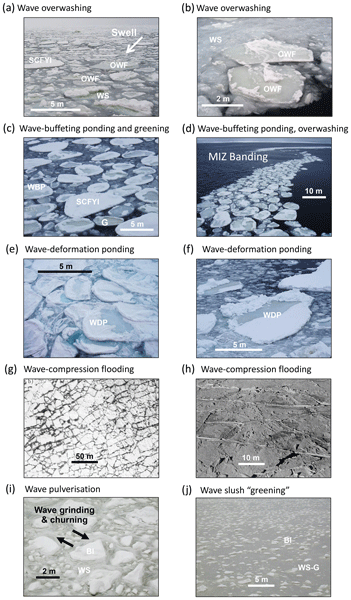
The manuscript presents a paradigm shift by identifying and quantifying previously neglected wave-driven processes that dramatically accelerate seasonal ice retreat through coupled physical-biological mechanisms. The authors challenge the long-held view that Antarctic sea ice loss is primarily driven by lateral and basal melting, instead demonstrating that ocean waves play crucial additional roles in surface and interior melting through six distinct processes: wave overwashing, buffeting/ponding, deformation ponding, compression flooding, pulverisation, and algal greening.
Despite scare observations due to the inherent challenges of Antarctic fieldwork, the authors have collated and synthesized existing data to make a compelling case that these wave processes reduce ice albedo by 0.38-0.54 compared to snow-covered ice, resulting in extraordinary melt rate enhancements of 0.9-5.2 cm day⁻¹, with biological effects pushing this to 1.1-6.1 cm day⁻¹. The research identifies four positive feedback mechanisms that create self-reinforcing cycles of ice destruction, addressing a critical gap in current climate models, which account for wave effects on floe size distributions but completely miss these thermodynamic and biological processes that may explain why Antarctic sea ice can disappear so rapidly each summer.
Given the inherent challenges of Antarctic fieldwork, the authors' synthesis approach is appropriate. The quantitative estimates, while preliminary, provide essential first-order approximations that will guide future research. The lack of observations reflects the broader challenge of Antarctic research, and the authors appropriately frame this as a first estimate intended to stimulate further investigation. Nonetheless, the work highlights poorly understood processes with profound implications for planetary albedo, global climate feedbacks, and the accuracy of future climate projections in an increasingly stormy Southern Ocean.
I have some minor suggestions to improve the readability of the manuscript.
The terminology is quite complex and sometimes inconsistent. For example:
- I initially found it difficult to get my head around the terminology, e.g., how wave flooding related to the other terms, and especially that it was an umbrella term and not the same as wave compression flooding.
- Clarification on boundaries and distinction between processes. For example, buffeting/ponding and deformation ponding both describe wave-induced surface depressions filled with seawater. Is there a difference between “wave ponds” and “wave-deformation ponds” that warrants this distinction (or could they all be described as “surface-saline ponds” following Ackley and Sullivan, 1994?). I get that one is caused by water splashing over the edges of the floe to get trapped, and the other is caused by the floe being pushed down so it floods from below, but is there an important distinction to the pond that is formed in terms of seasonal melting? An additional confusion is that on line 266 you describe how rafted ice blocks also affect wave pond formation by decreasing freeboard. Could you clarify the importance of the distinctions? If they are distinct, does it make better sense to have wave-buffeting ponding and wave-deformation ponding? i.e., why is one described as 2 separate processes and the other described as 1 process?
- Inconsistent naming, e.g., “wave buffeting” vs “floe-floe buffeting” - why not stick to one term? Please standardise terminology throughout
- It would be helpful to clarify which processes are subprocesses, e.g. churning appears to be a subprocess under wave pulverisation.
- It could be helpful to give the reader a hierarchy of the terms. I provide a suggestion as an example at the end of the review, but this probably needs refining. It would be helpful to be clear on which processes are subprocesses, e.g. churning seems to be a sub-process under wave pulverisation.
Specific comments:
Line 40: consider calling the "wave-induced ice-albedo feedback" a “wave-driven ice-albedo feedback” to match your definition on line 88.
Line 395: please link to Table 1b and/or Table 2 to explain where you got these 4 albedo classes to aid the reader, i.e. different types of wave-modified ice surfaces with increasing levels of albedo reduction.
Line 555: consider calling the “open water-sea ice feedback” and the “ocean-ice albedo feedback” from line 109 the same thing?
Line 567: consistency with the names of the feedback processes to aid readability
Figures and tables:
Figure 3 - I know it is defined on lines 196 and 389, but please define fw on the figure or caption. Suggestion for the caption to make it easier to read and incorporate this information: Wave-driven sea ice melt rate enhancement showing dramatic increases in melting (1-6 cm/day extra) caused by wave flooding and albedo reduction. Results shown for three wave coverage fractions (fw = 0.33, 0.5, 1.0) and four surface darkening scenarios (Δα = 0.38-0.64) across Antarctic latitudes (60-70°S) during austral summer (Nov, Dec, Jan).
Is there a particular reason why you did not include the biological feedbacks in figs 5 and 6 like you did in fig 4? Surely the biological feedbacks work in the same way to enhance all three dynamic-thermodynamic feedbacks?
Overall assessment: This manuscript represents important foundational work that successfully integrates physical oceanography, glaciology, and marine biology to reveal previously hidden mechanisms driving Antarctic sea ice dynamics. While the terminology issues need addressing, the scientific contribution is substantial, and the framework provided will guide future observational and modelling studies. The work appropriately acknowledges its preliminary nature while making a compelling case for the significance of these wave-driven processes.
Hierarchy of new terminology:
WAVE MELTING (Overall concept)
- WAVE FLOODING (Physical inundation processes)
- Wave Overwashing
- Wave Buffeting/Ponding
- Wave Deformation Ponding
- Wave Compression Flooding
- WAVE PULVERISATION (Mechanical breakdown)
- Churning and fragmentation
- WAVE GREENING (Biological processes)
- Algal proliferation and darkening
Citation: https://doi.org/10.5194/egusphere-2025-3166-RC1 -
AC1: 'Author Response to Reviewer 1', R. A. Massom, 30 Oct 2025
GENERAL RESPONSE
We wish to pass on our deep appreciation and thanks to both Reviewer #1 and Reviewer #2 – for their detailed expert, insightful, highly-constructive and extremely helpful comments and suggestions, which have undoubtedly improved and strengthened the paper and helped to clarify its message. We are also very grateful for their encouragement and recognition of our preliminary work, which we sincerely hope will stimulate further trans-disciplinary investigation and provide a community-building opportunity for not only Antarctic but also Arctic sea-ice research.
In response to Reviewer #2, we have changed the title from “The influence of ocean waves on Antarctic sea-ice albedo and seasonal melting, and physical-biological feedbacks” to “The influence of ocean waves on Antarctic sea-ice albedo and seasonal melting, and potential coupled physical and biological feedbacks”.
We feel that the original Abstract as provided was rather convoluted, so have replaced it with what we feel is a clearer and more readable alternative (that also adapts excellent input from Reviewer #1 – which is again much appreciated).
Please note that we have moved the section about feedbacks and their potential influence on wave melting from its original placing at the end of Section 4 (Discussion as Section 4.3 to immediately after Section 3.3 (Wave enhancement of sea-ice vertical melt rate) in Section 3 (Results) i.e., as new Section 3.4. This is because we now believe that the feedbacks section is more logically placed immediately after Section 3.3, in that it immediately moves to introducing the new feedback mechanisms and their likely effect in accelerating the melt-rate enhancement estimates given in previous Section 3.3. This logical follow-in is spelled out in the new text as first paragraph 1 of new Section 3.4:
“This initial study is limited to immediate and localised estimates of daily wave-driven melt-rate enhancement only, and it does not attempt to determine the overall contribution of wave melting on larger and longer spatial and temporal scales, respectively; this is intended to be the focus of follow-up work. Here, we propose that the initial instantaneous estimates of vertical melt-rate enhancement by wave melting given above are in fact likely to be substantially accelerated over time by a suite of three wave-driven physical dynamic–thermodynamic positive feedback mechanisms that are in turn amplified by two biological-physical sub-feedbacks activated by wave flooding and pulverisation. These wave-driven non-linear feedbacks, which are closely coupled and have been unconsidered to date (cf., Goosse et al., 2018), are depicted schematically in Fig. 4–5. Estimation of the overall magnitude of this extra feedback-driven wave melting around Antarctica is challenging and beyond the scope of this initial concept-driven paper, but again merits investigation. The purpose here is to introduce the coupled wave-driven feedbacks in order to stimulate their wider investigation and quantification.”
In addition, we have changed the title of the new feedbacks section (3.4) from its original "Positive feedback mechanisms" to "Potential positive feedback mechanisms that amplify melting."
We have added an acknowledgement to both reviewers in the Acknowledgements.
SPECIFIC RESPONSE TO REVIEWER #1
We very much appreciate Reviewer #1’s suggestion to improve the readability of the manuscript and have endeavoured to make requisite changes throughout towards addressing this. Working through the entire manuscript in this way also unearthed a number of errors, which we have rectified. We have also eliminated inconsistency (in terminology etc.).
We have addressed the fully-justified request to simplify the (new) terminology, following the excellent suggestions and direction given. Firstly, we have amended text in the Introduction to spell out upfront that wave flooding is an umbrella term, and that this in concert with wave pulverisation drives wave melting. Moreover and following Reviewer #1’s excellent advice and suggestion, we clearly lay out the terminology and hierarchy of processes at the start of Section 3.1 (Wave melting processes) as follows:
“Based on available observations, we identify the following coupled dynamic–thermodynamic (and –biological) processes and associated sub-processes driven by waves that operate year round and contribute to seasonal “wave melting”, with open circles denoting sub-processes and dashes sub-sub-processes:
- Wave Flooding (physical seawater-inundation processes)
o Wave overwashing
o Wave ponding
- Wave-buffeting ponding
- Wave-deformation ponding
o Wave-compression flooding
- Wave Pulverisation (mechanical grinding down of floes into wave slush and brash ice)
o Wave-driven churning
- Wave Greening (biological processes, involving algal proliferation and ice/wave-pond darkening)”
This same clarification of terminology and hierarchy is now also applied throughout the sub-sections of Section 3.1, which have been re-written. Here, we have also rewritten the text to provide clarification on boundaries and distinction between the different processes, sub-processes and sub-sub-processes, as requested.
In similar fashion, we have provided hierarchy and clarification for the wave-driven positive feedbacks and for their connectivity i.e., in Section 1.1 and new re-written Section 3.4 (Potential positive feedback mechanisms that amplify wave melting).
Regarding Reviewer #1’s questions:
Is there a difference between “wave ponds” and “wave-deformation ponds” that warrants this distinction (or could they all be described as “surface-saline ponds” following Ackley and Sullivan, 1994?);and Does it make better sense to have wave-buffeting ponding and wave-deformation ponding?Regarding whether there’s a difference between “wave ponds” and “wave-deformation ponds” – no, but as now clarified in the new hierarchy given and the accompanying text (new Section 3.1.2 Wave ponding), “wave pond/ing” is the umbrella term/process, and “wave-deformation pond/ing” and “wave-buffeting pond/ing” are the sub-terms/-processes sitting under it.
Regarding “surface-saline ponds” v “wave ponds” - There is in fact overlap, in that wave ponds are specifically formed by wave processes, whereas surface-saline ponds (as described/coined by Ackley and Sullivan) can be formed by deformation that is driven by either winds and currents or by wave processes. There may not be a distinction in terms of impact on seasonal melting, but as the focus of this paper is on wave processes only, we have added the following text for clarification:
“Flooded areas caused by pressure-ridge loading have been termed surface-saline ponds by Ackley and Sullivan (1994), but we retain the term wave-deformation ponds here as surface-saline ponds can also result from sea-ice convergence and deformation driven by winds and ocean currents.”
Regarding: An additional confusion is that on line 266 you describe how rafted ice blocks also affect wave pond formation by decreasing freeboard. Could you clarify the importance of the distinctions? If they are distinct, does it make better sense to have wave-buffeting ponding and wave-deformation ponding? i.e., why is one described as 2 separate processes and the other described as 1 process? This text has been removed as it was indeed confusing. The two processes are distinct, so it does indeed make sense to have both wave-buffeting ponding and wave-deformation ponding (as is the case in the clarified hierarchy).
Regarding: Inconsistent naming, e.g., “wave buffeting” vs “floe-floe buffeting” - why not stick to one term? Please standardise terminology throughout.We have now standardised throughout (also with the new feedback terms), and stick to wave buffeting.
Regarding: It would be helpful to clarify which processes are subprocesses, e.g. churning appears to be a subprocess under wave pulverisation.As stated above, this is now clarified in the hierarchy in Section 3.1 (Wave melting processes.
Responses to Specific Comments of Reviewer #1:
Line 40: consider calling the "wave-induced ice-albedo feedback" a “wave-driven ice-albedo feedback” to match your definition on line 88.Corrected as suggested.
Line 395: please link to Table 1b and/or Table 2 to explain where you got these 4 albedo classes to aid the reader, i.e. different types of wave-modified ice surfaces with increasing levels of albedo reduction. Done as suggested - “We next carry out a broader sensitivity analysis of the relative enhancements in daily melt rates (dh/dt) for the four different classes of wave-modified (-darkened) ice surfaces A-D given in Table 2 (Δα = 0.38, 0.48. 0.54, 0.64)………”
Line 555: consider calling the “open water-sea ice feedback” and the “ocean-ice albedo feedback” from line 109 the same thing? Done – ocean-ice albedo feedback.
Line 567: consistency with the names of the feedback processes to aid readability. Done, as requested.
Figures and tables:
Figure 3 - I know it is defined on lines 196 and 389, but please define fw on the figure or caption. Suggestion for the caption to make it easier to read and incorporate this information: Wave-driven sea ice melt rate enhancement showing dramatic increases in melting (1-6 cm/day extra) caused by wave flooding and albedo reduction. Results shown for three wave coverage fractions (fw = 0.33, 0.5, 1.0) and four surface darkening scenarios (Δα = 0.38-0.64) across Antarctic latitudes (60-70°S) during austral summer (Nov, Dec, Jan).Done as suggested – and have also linked back to Table 2 – “We next carry out a broader sensitivity analysis of the relative enhancements in daily melt rates (dh/dt) for the four different classes of wave-modified (-darkened) ice surfaces A-D given in Table 2…..”
Is there a particular reason why you did not include the biological feedbacks in figs 5 and 6 like you did in fig 4? Surely the biological feedbacks work in the same way to enhance all three dynamic-thermodynamic feedbacks?
This was an oversight. The biological feedbacks do indeed enhance all three dynamic-thermodynamic feedbacks. The Figures (4 and 5) have been changed to include this, noting that original Figures 5 and 6 have been combined into new single Figure 5 (as per the request/suggestion of Reviewer #2). Moreover, the text has been changed throughout new Section 3.4 (Potential positive feedback mechanisms that amplify wave melting) to highlight these linkages e.g., “Here, we propose that the initial instantaneous estimates of vertical melt-rate enhancement by wave melting given above are in fact likely to be substantially accelerated over time by a suite of three wave-driven physical dynamic–thermodynamic positive feedback mechanisms that are in turn amplified by two biological-physical sub-feedbacks that are activated by wave flooding and pulverisation.” Regarding this and in order to clarify the hierarchy of feedbacks, we now term the 2 biological feedbacks “sub-feedbacks” i.e., ice-algae-albedo sub-feedback and algae-ice permeability sub-feedback.
Citation: https://doi.org/10.5194/egusphere-2025-3166-AC1
-
RC2: 'Comment on egusphere-2025-3166', Anonymous Referee #2, 21 Aug 2025
This manuscript describes and estimates the contribution of previously overlooked wave-ice processes to Antarctic seasonal sea ice melt and growth, further enhanced by ice-algal feedback. It details seven wave-driven processes: wave overwashing, wave buffeting, wave ponding, wave deformation ponding, wave compression flooding, wave pulverization and wave greening.
It synthesizes observational data from previous studies to provide estimates of melt rate enhancement from wave-driven processes. The authors acknowledge and highlight that a key limitation in this study is the lack of in-situ and remote observations, and make it clear that the presented quantities are estimates that do not evidence a tangible contribution of these processes to sea ice variability but instead provide motivation to further investigate this. This manuscript is appropriate for The Cryosphere as it addresses previously neglected sea ice processes, providing new insight into Antarctic sea ice variability, with important potential implications for climate modeling.
Major comments:
The focus of the paper is on the existence of these potential physical impacts and asserts a rather broad scope (as evidenced by the title). However, as the authors note (L505), they do not examine their large-scale impact. Thus it is hard to understand the overall importance of these effects, and whether they are spatially or temporally confined to highly specific circumstances. There do exist simulations and observational products that capture the large-scale existence of waves in sea ice, as well as ecology, lead fraction, etc., so many of the required datasets are in existence. I think using these datasets is essential to supporting the claims made in the paper as to the potential existence of feedbacks. Otherwise, it is important to narrow the scope of the paper to simply reanalyzing existing limited datasets by changing the title and abstract to better reflect the analyses conducted in the manuscript.
The title impresses upon the reader that the study is an investigation on the influence of waves on seasonal melt and biophysical feedback. However, the final estimated melt-rate enhancements describe a local, immediate influence and do not allude to the significance of such contributions on longer and larger time-scales. It is thus unclear to what extent these wave-driven processes have influence on a regional or pan-polar scale. Some quantification of the percentage contribution of these wave-driven processes relative to seasonal melt/growth rate would be helpful. I suggest presenting a realistic case study or example to demonstrate that the contributions of these processes can considerably account for better calculations of sea ice variability would offer the audience more conviction in the ideas put forth in this manuscript. The methodology for calculating this has already been described in L195-200. While the authors specify this to be out of scope for the study, I think it would provide more compelling evidence to these processes enhancing sea ice melt. .
While being a key component of this manuscript’s title, the ice-algae-albedo feedback (S4.3) lacks supporting evidence to be proposed and is relegated to the discussion section. The results section only draws comparisons of green and non-green wave slush and wave pond, but does not provide indicative evidence of a feedback over time. Suggestion to include time-varying observations that demonstrate this feedback mechanism in the results. For example, comparing the changes in albedo or melt rate between green and non-green ice over time. Otherwise, alternative evidence needs to be provided.
The “wave greening” (S3.1.6) and “ice-algae-albedo feedback” (S4.3) appear to be overlapping, with the former being both a secondary effect of the previously-defined wave-driven processes and an initiation of the latter. A suggestion to remove wave greening as a seventh process.
Minor comments:
- The manuscript is verbose and often reads like a review, which distracts from the key outcomes of this study that may not require them.
- . Suggestions to make Section 1 and sub-sections in Section 3 more concise.
- For example, in the abstract, L40-41: Suggest to rewrite to “by a wave-driven ice-albedo positive feedback mechanism, strengthened by ice-algal greening”
- Figure 1: The capital letters on Fig 1(a) and (c) are not described in the figure caption or in-text. I suggest either removing these or describing them in the caption to improve clarity.
- Figures 5 & 6: Can these figures be combined as two panels side by side? Was there a deliberate decision to leave out the coupled biophysical ice-algal feedback in these two diagrams?
- Tables 1-3: Even though it is defined in the figure captions for Tables 2 & 3, I suggest that adding a sub-column on the left of Table 1 denoting the respective types A-D would make it easier for the audience to contextualize across the tables.
- The manuscript introduces a lot of terminology that are sometimes inconsistent:
- L212: “wave compression flooding”; Figure 2 caption: “wave-compression flooding”
- L216: wave slush; L270: wave slush ice
- L323: “floe oases”; L628: “mini oases”
- “Wave-driven” and “wave-induced” are used to describe different processes and also used interchangeably (e.g. L545 & L548)
- L514: the term “rotting from within” is not used again later in the manuscript.
Citation: https://doi.org/10.5194/egusphere-2025-3166-RC2 -
AC2: 'Author response to Reviewer 2', R. A. Massom, 30 Oct 2025
GENERAL RESPONSE
We wish to pass on our deep appreciation and thanks to both Reviewer #1 and Reviewer #2 – for their detailed expert, insightful, highly-constructive and extremely helpful comments and suggestions, which have undoubtedly improved and strengthened the paper and helped to clarify its message. We are also very grateful for their encouragement and recognition of our preliminary work, which we sincerely hope will stimulate further trans-disciplinary investigation and provide a community-building opportunity for not only Antarctic but also Arctic sea-ice research.
In response to Reviewer #2, we have changed the title from “The influence of ocean waves on Antarctic sea-ice albedo and seasonal melting, and physical-biological feedbacks” to “The influence of ocean waves on Antarctic sea-ice albedo and seasonal melting, and potential coupled physical and biological feedbacks”.
We feel that the original Abstract as provided was rather convoluted, so have replaced it with what we feel is a clearer and more readable alternative (that also adapts excellent input from Reviewer #1 – which is again much appreciated).
Please note that we have moved the section about feedbacks and their potential influence on wave melting from its original placing at the end of Section 4 (Discussion as Section 4.3 to immediately after Section 3.3 (Wave enhancement of sea-ice vertical melt rate) in Section 3 (Results) i.e., as new Section 3.4. This is because we now believe that the feedbacks section is more logically placed immediately after Section 3.3, in that it immediately moves to introducing the new feedback mechanisms and their likely effect in accelerating the melt-rate enhancement estimates given in previous Section 3.3. This logical follow-in is spelled out in the new text as first paragraph 1 of new Section 3.4:
“This initial study is limited to immediate and localised estimates of daily wave-driven melt-rate enhancement only, and it does not attempt to determine the overall contribution of wave melting on larger and longer spatial and temporal scales, respectively; this is intended to be the focus of follow-up work. Here, we propose that the initial instantaneous estimates of vertical melt-rate enhancement by wave melting given above are in fact likely to be substantially accelerated over time by a suite of three wave-driven physical dynamic–thermodynamic positive feedback mechanisms that are in turn amplified by two biological-physical sub-feedbacks activated by wave flooding and pulverisation. These wave-driven non-linear feedbacks, which are closely coupled and have been unconsidered to date (cf., Goosse et al., 2018), are depicted schematically in Fig. 4–5. Estimation of the overall magnitude of this extra feedback-driven wave melting around Antarctica is challenging and beyond the scope of this initial concept-driven paper, but again merits investigation. The purpose here is to introduce the coupled wave-driven feedbacks in order to stimulate their wider investigation and quantification.”
In addition, we have changed the title of the new feedbacks section (3.4) from its original "Positive feedback mechanisms" to "Potential positive feedback mechanisms that amplify melting."
We have added an acknowledgement to both reviewers in the Acknowledgements.
REVIEWER #2
Major comments:
The focus of the paper is on the existence of these potential physical impacts and asserts a rather broad scope (as evidenced by the title). However, as the authors note (L505), they do not examine their large-scale impact. Thus it is hard to understand the overall importance of these effects, and whether they are spatially or temporally confined to highly specific circumstances. There do exist simulations and observational products that capture the large-scale existence of waves in sea ice, as well as ecology, lead fraction, etc., so many of the required datasets are in existence. I think using these datasets is essential to supporting the claims made in the paper as to the potential existence of feedbacks. Otherwise, it is important to narrow the scope of the paper to simply reanalyzing existing limited datasets by changing the title and abstract to better reflect the analyses conducted in the manuscript.
The title impresses upon the reader that the study is an investigation on the influence of waves on seasonal melt and biophysical feedback. However, the final estimated melt-rate enhancements describe a local, immediate influence and do not allude to the significance of such contributions on longer and larger time-scales. It is thus unclear to what extent these wave-driven processes have influence on a regional or pan-polar scale. Some quantification of the percentage contribution of these wave-driven processes relative to seasonal melt/growth rate would be helpful. I suggest presenting a realistic case study or example to demonstrate that the contributions of these processes can considerably account for better calculations of sea ice variability would offer the audience more conviction in the ideas put forth in this manuscript. The methodology for calculating this has already been described in L195-200. While the authors specify this to be out of scope for the study, I think it would provide more compelling evidence to these processes enhancing sea ice melt.
Thank you for these comments. We agree that the manuscript may have been misleading in places as to its actual scope and claims. As such, we have pared any “over claims” as appropriate throughout the manuscript, while clarifying the scope and the need for follow-up work. We now refer to “potential” feedbacks that require verification etc., and have also changed the title from “The influence of ocean waves on Antarctic sea-ice albedo and seasonal melting, and physical-biological feedbacks” to “The influence of ocean waves on Antarctic sea-ice albedo and seasonal melting, and potential coupled physical and biological feedbacks”.
Having changed/adapted the text in this way, we wish to retain the scope of the paper as is - as we still maintain that this initial study provides compelling preliminary evidence that overlooked wave processes enhance (instantaneous) vertical melting of an idealised parcel of ice in summer, and that it provides guidance and stimulation for important follow-on work that is outside the scope of this preliminary study. This is underpinned by the overall the aim, which is: 1) to introduce the wave processes and to use a simple one-dimensional model to make a first estimate of their impact on albedo reduction and vertical melt rate (of an idealised parcel of ice); and 2) to stimulate important/essential follow-up investigation that verifies and quantifies the effects of the proposed processes and feedback mechanisms and their large-scale influence.
In accordance, we have removed L195-200, as they were superfluous to the scope of the paper.
Regarding Reviewer #2’s recommendation for "presenting a realistic case study or example to demonstrate that the contributions of these processes can considerably account for better calculations of sea ice variability"” – we again feel that this is entirely worthwhile as a topic for follow-on work but is again outside the scope of this initial paper. Moreover and as stated, a primary aim of such follow-on research would be to assess the influence of the wave melting on the mean (climatological) annual sea-ice cycle, with a view to reducing current large model discrepancies around the observed rapid melt phase.
In response to Reviewer #2’s comments, we have adapted the text to more clearly state the paper’s scope and aims upfront in the Introduction:
- “Here, we focus on making a first estimate of the impact of wave modification of albedo on enhancing the melt rate of an idealised floe/parcel of wave slush as a function of latitude and time-of-year, based on simple one-dimensional modelling. Examination and quantification of the wider spatio-temporal occurrence of wave melting and its contribution to the large-scale annual sea-ice cycle is outside the scope of this initial study but will be the focus of future work requiring more observations and targeted modelling (recommendations are set out in Section 6).”
- “The primary contribution of this preliminary work is on making a first estimate of the effect of previously-unconsidered wave flooding, wave pulverisation and wave greening on the daily melt rate of an idealised ice floe (and/or area of wave-pulverised slush) in the Antarctic SIZ in summer by changing the ice albedo (α) in the surface radiation energy budget – and to introduce potential feedbacks that may accelerate wave melting. The overall aim is to show that the effects could be significant and are therefore worthy of further investigation by targeted fieldwork and modelling as well as collation of other relevant existing datasets and model simulations. As stated above, this initial study does not attempt quantitative assessment of either 1) the large-scale coverage and influence of wave flooding, pulverisation and greening, or 2) the overall magnitude and influence of wave melting and its contribution to the annual sea-ice cycle, but rather aims to stimulate and guide their investigation in follow-on research.”
While being a key component of this manuscript’s title, the ice-algae-albedo feedback (S4.3) lacks supporting evidence to be proposed and is relegated to the discussion section. The results section only draws comparisons of green and non-green wave slush and wave pond, but does not provide indicative evidence of a feedback over time. Suggestion to include time-varying observations that demonstrate this feedback mechanism in the results. For example, comparing the changes in albedo or melt rate between green and non-green ice over time. Otherwise, alternative evidence needs to be provided.
Regarding our introduction of potential coupled feedbacks (and sub-feedbacks) linking physics and biology – we have elevated them to the Results Section from the Discussion Section (see General Response and Response to Reviewer #1 above). They now sit immediately after Section 3.3 (Wave enhancement of sea-ice vertical melt rate) as Section 3.4 (Potential positive feedback mechanisms that amplify wave melting). We feel that it is entirely appropriate to introduce them here as they likely accelerate wave-melting as proposed and – again – the intention is to stimulate further investigation including quantification of their influence. This will require a certain complexity of modelling, given the non-linearity involved, that is again outside the scope of this paper but is certainly merited in follow-on work.
For clarification, we have added this new text at the start of Section 3.4: “This initial study is limited to immediate and localised estimates of daily wave-driven melt-rate enhancement only, and it does not attempt to determine the overall contribution of wave melting on larger and longer spatial and temporal scales, respectively; this is intended to be the focus of follow-up work. Here, we propose that the initial instantaneous estimates of vertical melt-rate enhancement by wave melting given above are in fact likely to be substantially accelerated over time by a suite of three wave-driven physical dynamic–thermodynamic positive feedback mechanisms that are in turn amplified by two biological-physical sub-feedbacks activated by wave flooding and pulverisation. These wave-driven non-linear feedbacks, which are closely coupled and have been unconsidered to date (cf., Goosse et al., 2018), are depicted schematically in Fig. 4–5. Estimation of the overall magnitude of this extra feedback-driven wave melting around Antarctica is challenging and beyond the scope of this initial concept-driven paper, but again merits investigation. The purpose here is to introduce the coupled wave-driven feedbacks in order to stimulate their wider investigation and quantification.”
The “wave greening” (S3.1.6) and “ice-algae-albedo feedback” (S4.3) appear to be overlapping, with the former being both a secondary effect of the previously-defined wave-driven processes and an initiation of the latter. A suggestion to remove wave greening as a seventh process.
Wave greening is an “instantaneous” process, whereas ice-algae-albedo feedback refers to a self-reinforcing cycle that accelerates the melt-rate over time (while increasing algal proliferation) while also intensifying the wave-driven ice-albedo feedback. As such, it is now couched as the ice-algae-albedo sub-feedback. For these reasons, we wish to retain Section 3.1.6 Wave Greening.
Minor comments:
The manuscript is verbose and often reads like a review, which distracts from the key outcomes of this study that may not require them.
We have worked hard to address this and have substantially re-written Section 4 (Discussion) and Section 5 (Conclusions and outlook) to make them more punchy and less verbose.
Suggestions to make Section 1 and sub-sections in Section 3 more concise. Done.
For example, in the abstract, L40-41: Suggest to rewrite to “by a wave-driven ice-albedo positive feedback mechanism, strengthened by ice-algal greening”. We have rewritten the Abstract to make it more readable (See General Response above).
Figure 1: The capital letters on Fig 1(a) and (c) are not described in the figure caption or in-text. I suggest either removing these or describing them in the caption to improve clarityCorrected.
Figures 5 & 6: Can these figures be combined as two panels side by side? Was there a deliberate decision to leave out the coupled biophysical ice-algal feedback in these two diagrams? Combined, and the coupled biophysical ice-algae feedback is now included in these two diagrams – see Response to Reviewer #1 above.
Tables 1-3: Even though it is defined in the figure captions for Tables 2 & 3, I suggest that adding a sub-column on the left of Table 1 denoting the respective types A-D would make it easier for the audience to contextualize across the tablesDone.
The manuscript introduces a lot of terminology that are sometimes inconsistent:
L212: “wave compression flooding”; Figure 2 caption: “wave-compression flooding.” Corrected – to wave-compression flooding.
L216: wave slush; L270: wave slush ice. Corrected to wave slush.
L323: “floe oases”; L628: “mini oases.” Corrected – now only 1 reference, to mini oases.
“Wave-driven” and “wave-induced” are used to describe different processes and also used interchangeably (e.g. L545 & L548). Corrected – to wave-driven.
L514: the term “rotting from within” is not used again later in the manuscript. Removed this term.
Citation: https://doi.org/10.5194/egusphere-2025-3166-AC2
Peer review completion


Interactive discussion
Status: closed
-
RC1: 'Comment on egusphere-2025-3166', Anonymous Referee #1, 15 Aug 2025
Review of “The influence of ocean waves on Antarctic sea-ice albedo and seasonal melting, and physical-biological feedbacks” submitted by Massom et al., to The Cryosphere
Recommendation: minor revision
This manuscript is highly appropriate for The Cryosphere as it addresses fundamental cryospheric processes with large implications for climate modelling and polar oceanography.
The manuscript presents a paradigm shift by identifying and quantifying previously neglected wave-driven processes that dramatically accelerate seasonal ice retreat through coupled physical-biological mechanisms. The authors challenge the long-held view that Antarctic sea ice loss is primarily driven by lateral and basal melting, instead demonstrating that ocean waves play crucial additional roles in surface and interior melting through six distinct processes: wave overwashing, buffeting/ponding, deformation ponding, compression flooding, pulverisation, and algal greening.
Despite scare observations due to the inherent challenges of Antarctic fieldwork, the authors have collated and synthesized existing data to make a compelling case that these wave processes reduce ice albedo by 0.38-0.54 compared to snow-covered ice, resulting in extraordinary melt rate enhancements of 0.9-5.2 cm day⁻¹, with biological effects pushing this to 1.1-6.1 cm day⁻¹. The research identifies four positive feedback mechanisms that create self-reinforcing cycles of ice destruction, addressing a critical gap in current climate models, which account for wave effects on floe size distributions but completely miss these thermodynamic and biological processes that may explain why Antarctic sea ice can disappear so rapidly each summer.
Given the inherent challenges of Antarctic fieldwork, the authors' synthesis approach is appropriate. The quantitative estimates, while preliminary, provide essential first-order approximations that will guide future research. The lack of observations reflects the broader challenge of Antarctic research, and the authors appropriately frame this as a first estimate intended to stimulate further investigation. Nonetheless, the work highlights poorly understood processes with profound implications for planetary albedo, global climate feedbacks, and the accuracy of future climate projections in an increasingly stormy Southern Ocean.
I have some minor suggestions to improve the readability of the manuscript.
The terminology is quite complex and sometimes inconsistent. For example:
- I initially found it difficult to get my head around the terminology, e.g., how wave flooding related to the other terms, and especially that it was an umbrella term and not the same as wave compression flooding.
- Clarification on boundaries and distinction between processes. For example, buffeting/ponding and deformation ponding both describe wave-induced surface depressions filled with seawater. Is there a difference between “wave ponds” and “wave-deformation ponds” that warrants this distinction (or could they all be described as “surface-saline ponds” following Ackley and Sullivan, 1994?). I get that one is caused by water splashing over the edges of the floe to get trapped, and the other is caused by the floe being pushed down so it floods from below, but is there an important distinction to the pond that is formed in terms of seasonal melting? An additional confusion is that on line 266 you describe how rafted ice blocks also affect wave pond formation by decreasing freeboard. Could you clarify the importance of the distinctions? If they are distinct, does it make better sense to have wave-buffeting ponding and wave-deformation ponding? i.e., why is one described as 2 separate processes and the other described as 1 process?
- Inconsistent naming, e.g., “wave buffeting” vs “floe-floe buffeting” - why not stick to one term? Please standardise terminology throughout
- It would be helpful to clarify which processes are subprocesses, e.g. churning appears to be a subprocess under wave pulverisation.
- It could be helpful to give the reader a hierarchy of the terms. I provide a suggestion as an example at the end of the review, but this probably needs refining. It would be helpful to be clear on which processes are subprocesses, e.g. churning seems to be a sub-process under wave pulverisation.
Specific comments:
Line 40: consider calling the "wave-induced ice-albedo feedback" a “wave-driven ice-albedo feedback” to match your definition on line 88.
Line 395: please link to Table 1b and/or Table 2 to explain where you got these 4 albedo classes to aid the reader, i.e. different types of wave-modified ice surfaces with increasing levels of albedo reduction.
Line 555: consider calling the “open water-sea ice feedback” and the “ocean-ice albedo feedback” from line 109 the same thing?
Line 567: consistency with the names of the feedback processes to aid readability
Figures and tables:
Figure 3 - I know it is defined on lines 196 and 389, but please define fw on the figure or caption. Suggestion for the caption to make it easier to read and incorporate this information: Wave-driven sea ice melt rate enhancement showing dramatic increases in melting (1-6 cm/day extra) caused by wave flooding and albedo reduction. Results shown for three wave coverage fractions (fw = 0.33, 0.5, 1.0) and four surface darkening scenarios (Δα = 0.38-0.64) across Antarctic latitudes (60-70°S) during austral summer (Nov, Dec, Jan).
Is there a particular reason why you did not include the biological feedbacks in figs 5 and 6 like you did in fig 4? Surely the biological feedbacks work in the same way to enhance all three dynamic-thermodynamic feedbacks?
Overall assessment: This manuscript represents important foundational work that successfully integrates physical oceanography, glaciology, and marine biology to reveal previously hidden mechanisms driving Antarctic sea ice dynamics. While the terminology issues need addressing, the scientific contribution is substantial, and the framework provided will guide future observational and modelling studies. The work appropriately acknowledges its preliminary nature while making a compelling case for the significance of these wave-driven processes.
Hierarchy of new terminology:
WAVE MELTING (Overall concept)
- WAVE FLOODING (Physical inundation processes)
- Wave Overwashing
- Wave Buffeting/Ponding
- Wave Deformation Ponding
- Wave Compression Flooding
- WAVE PULVERISATION (Mechanical breakdown)
- Churning and fragmentation
- WAVE GREENING (Biological processes)
- Algal proliferation and darkening
Citation: https://doi.org/10.5194/egusphere-2025-3166-RC1 -
AC1: 'Author Response to Reviewer 1', R. A. Massom, 30 Oct 2025
GENERAL RESPONSE
We wish to pass on our deep appreciation and thanks to both Reviewer #1 and Reviewer #2 – for their detailed expert, insightful, highly-constructive and extremely helpful comments and suggestions, which have undoubtedly improved and strengthened the paper and helped to clarify its message. We are also very grateful for their encouragement and recognition of our preliminary work, which we sincerely hope will stimulate further trans-disciplinary investigation and provide a community-building opportunity for not only Antarctic but also Arctic sea-ice research.
In response to Reviewer #2, we have changed the title from “The influence of ocean waves on Antarctic sea-ice albedo and seasonal melting, and physical-biological feedbacks” to “The influence of ocean waves on Antarctic sea-ice albedo and seasonal melting, and potential coupled physical and biological feedbacks”.
We feel that the original Abstract as provided was rather convoluted, so have replaced it with what we feel is a clearer and more readable alternative (that also adapts excellent input from Reviewer #1 – which is again much appreciated).
Please note that we have moved the section about feedbacks and their potential influence on wave melting from its original placing at the end of Section 4 (Discussion as Section 4.3 to immediately after Section 3.3 (Wave enhancement of sea-ice vertical melt rate) in Section 3 (Results) i.e., as new Section 3.4. This is because we now believe that the feedbacks section is more logically placed immediately after Section 3.3, in that it immediately moves to introducing the new feedback mechanisms and their likely effect in accelerating the melt-rate enhancement estimates given in previous Section 3.3. This logical follow-in is spelled out in the new text as first paragraph 1 of new Section 3.4:
“This initial study is limited to immediate and localised estimates of daily wave-driven melt-rate enhancement only, and it does not attempt to determine the overall contribution of wave melting on larger and longer spatial and temporal scales, respectively; this is intended to be the focus of follow-up work. Here, we propose that the initial instantaneous estimates of vertical melt-rate enhancement by wave melting given above are in fact likely to be substantially accelerated over time by a suite of three wave-driven physical dynamic–thermodynamic positive feedback mechanisms that are in turn amplified by two biological-physical sub-feedbacks activated by wave flooding and pulverisation. These wave-driven non-linear feedbacks, which are closely coupled and have been unconsidered to date (cf., Goosse et al., 2018), are depicted schematically in Fig. 4–5. Estimation of the overall magnitude of this extra feedback-driven wave melting around Antarctica is challenging and beyond the scope of this initial concept-driven paper, but again merits investigation. The purpose here is to introduce the coupled wave-driven feedbacks in order to stimulate their wider investigation and quantification.”
In addition, we have changed the title of the new feedbacks section (3.4) from its original "Positive feedback mechanisms" to "Potential positive feedback mechanisms that amplify melting."
We have added an acknowledgement to both reviewers in the Acknowledgements.
SPECIFIC RESPONSE TO REVIEWER #1
We very much appreciate Reviewer #1’s suggestion to improve the readability of the manuscript and have endeavoured to make requisite changes throughout towards addressing this. Working through the entire manuscript in this way also unearthed a number of errors, which we have rectified. We have also eliminated inconsistency (in terminology etc.).
We have addressed the fully-justified request to simplify the (new) terminology, following the excellent suggestions and direction given. Firstly, we have amended text in the Introduction to spell out upfront that wave flooding is an umbrella term, and that this in concert with wave pulverisation drives wave melting. Moreover and following Reviewer #1’s excellent advice and suggestion, we clearly lay out the terminology and hierarchy of processes at the start of Section 3.1 (Wave melting processes) as follows:
“Based on available observations, we identify the following coupled dynamic–thermodynamic (and –biological) processes and associated sub-processes driven by waves that operate year round and contribute to seasonal “wave melting”, with open circles denoting sub-processes and dashes sub-sub-processes:
- Wave Flooding (physical seawater-inundation processes)
o Wave overwashing
o Wave ponding
- Wave-buffeting ponding
- Wave-deformation ponding
o Wave-compression flooding
- Wave Pulverisation (mechanical grinding down of floes into wave slush and brash ice)
o Wave-driven churning
- Wave Greening (biological processes, involving algal proliferation and ice/wave-pond darkening)”
This same clarification of terminology and hierarchy is now also applied throughout the sub-sections of Section 3.1, which have been re-written. Here, we have also rewritten the text to provide clarification on boundaries and distinction between the different processes, sub-processes and sub-sub-processes, as requested.
In similar fashion, we have provided hierarchy and clarification for the wave-driven positive feedbacks and for their connectivity i.e., in Section 1.1 and new re-written Section 3.4 (Potential positive feedback mechanisms that amplify wave melting).
Regarding Reviewer #1’s questions:
Is there a difference between “wave ponds” and “wave-deformation ponds” that warrants this distinction (or could they all be described as “surface-saline ponds” following Ackley and Sullivan, 1994?);and Does it make better sense to have wave-buffeting ponding and wave-deformation ponding?Regarding whether there’s a difference between “wave ponds” and “wave-deformation ponds” – no, but as now clarified in the new hierarchy given and the accompanying text (new Section 3.1.2 Wave ponding), “wave pond/ing” is the umbrella term/process, and “wave-deformation pond/ing” and “wave-buffeting pond/ing” are the sub-terms/-processes sitting under it.
Regarding “surface-saline ponds” v “wave ponds” - There is in fact overlap, in that wave ponds are specifically formed by wave processes, whereas surface-saline ponds (as described/coined by Ackley and Sullivan) can be formed by deformation that is driven by either winds and currents or by wave processes. There may not be a distinction in terms of impact on seasonal melting, but as the focus of this paper is on wave processes only, we have added the following text for clarification:
“Flooded areas caused by pressure-ridge loading have been termed surface-saline ponds by Ackley and Sullivan (1994), but we retain the term wave-deformation ponds here as surface-saline ponds can also result from sea-ice convergence and deformation driven by winds and ocean currents.”
Regarding: An additional confusion is that on line 266 you describe how rafted ice blocks also affect wave pond formation by decreasing freeboard. Could you clarify the importance of the distinctions? If they are distinct, does it make better sense to have wave-buffeting ponding and wave-deformation ponding? i.e., why is one described as 2 separate processes and the other described as 1 process? This text has been removed as it was indeed confusing. The two processes are distinct, so it does indeed make sense to have both wave-buffeting ponding and wave-deformation ponding (as is the case in the clarified hierarchy).
Regarding: Inconsistent naming, e.g., “wave buffeting” vs “floe-floe buffeting” - why not stick to one term? Please standardise terminology throughout.We have now standardised throughout (also with the new feedback terms), and stick to wave buffeting.
Regarding: It would be helpful to clarify which processes are subprocesses, e.g. churning appears to be a subprocess under wave pulverisation.As stated above, this is now clarified in the hierarchy in Section 3.1 (Wave melting processes.
Responses to Specific Comments of Reviewer #1:
Line 40: consider calling the "wave-induced ice-albedo feedback" a “wave-driven ice-albedo feedback” to match your definition on line 88.Corrected as suggested.
Line 395: please link to Table 1b and/or Table 2 to explain where you got these 4 albedo classes to aid the reader, i.e. different types of wave-modified ice surfaces with increasing levels of albedo reduction. Done as suggested - “We next carry out a broader sensitivity analysis of the relative enhancements in daily melt rates (dh/dt) for the four different classes of wave-modified (-darkened) ice surfaces A-D given in Table 2 (Δα = 0.38, 0.48. 0.54, 0.64)………”
Line 555: consider calling the “open water-sea ice feedback” and the “ocean-ice albedo feedback” from line 109 the same thing? Done – ocean-ice albedo feedback.
Line 567: consistency with the names of the feedback processes to aid readability. Done, as requested.
Figures and tables:
Figure 3 - I know it is defined on lines 196 and 389, but please define fw on the figure or caption. Suggestion for the caption to make it easier to read and incorporate this information: Wave-driven sea ice melt rate enhancement showing dramatic increases in melting (1-6 cm/day extra) caused by wave flooding and albedo reduction. Results shown for three wave coverage fractions (fw = 0.33, 0.5, 1.0) and four surface darkening scenarios (Δα = 0.38-0.64) across Antarctic latitudes (60-70°S) during austral summer (Nov, Dec, Jan).Done as suggested – and have also linked back to Table 2 – “We next carry out a broader sensitivity analysis of the relative enhancements in daily melt rates (dh/dt) for the four different classes of wave-modified (-darkened) ice surfaces A-D given in Table 2…..”
Is there a particular reason why you did not include the biological feedbacks in figs 5 and 6 like you did in fig 4? Surely the biological feedbacks work in the same way to enhance all three dynamic-thermodynamic feedbacks?
This was an oversight. The biological feedbacks do indeed enhance all three dynamic-thermodynamic feedbacks. The Figures (4 and 5) have been changed to include this, noting that original Figures 5 and 6 have been combined into new single Figure 5 (as per the request/suggestion of Reviewer #2). Moreover, the text has been changed throughout new Section 3.4 (Potential positive feedback mechanisms that amplify wave melting) to highlight these linkages e.g., “Here, we propose that the initial instantaneous estimates of vertical melt-rate enhancement by wave melting given above are in fact likely to be substantially accelerated over time by a suite of three wave-driven physical dynamic–thermodynamic positive feedback mechanisms that are in turn amplified by two biological-physical sub-feedbacks that are activated by wave flooding and pulverisation.” Regarding this and in order to clarify the hierarchy of feedbacks, we now term the 2 biological feedbacks “sub-feedbacks” i.e., ice-algae-albedo sub-feedback and algae-ice permeability sub-feedback.
Citation: https://doi.org/10.5194/egusphere-2025-3166-AC1
-
RC2: 'Comment on egusphere-2025-3166', Anonymous Referee #2, 21 Aug 2025
This manuscript describes and estimates the contribution of previously overlooked wave-ice processes to Antarctic seasonal sea ice melt and growth, further enhanced by ice-algal feedback. It details seven wave-driven processes: wave overwashing, wave buffeting, wave ponding, wave deformation ponding, wave compression flooding, wave pulverization and wave greening.
It synthesizes observational data from previous studies to provide estimates of melt rate enhancement from wave-driven processes. The authors acknowledge and highlight that a key limitation in this study is the lack of in-situ and remote observations, and make it clear that the presented quantities are estimates that do not evidence a tangible contribution of these processes to sea ice variability but instead provide motivation to further investigate this. This manuscript is appropriate for The Cryosphere as it addresses previously neglected sea ice processes, providing new insight into Antarctic sea ice variability, with important potential implications for climate modeling.
Major comments:
The focus of the paper is on the existence of these potential physical impacts and asserts a rather broad scope (as evidenced by the title). However, as the authors note (L505), they do not examine their large-scale impact. Thus it is hard to understand the overall importance of these effects, and whether they are spatially or temporally confined to highly specific circumstances. There do exist simulations and observational products that capture the large-scale existence of waves in sea ice, as well as ecology, lead fraction, etc., so many of the required datasets are in existence. I think using these datasets is essential to supporting the claims made in the paper as to the potential existence of feedbacks. Otherwise, it is important to narrow the scope of the paper to simply reanalyzing existing limited datasets by changing the title and abstract to better reflect the analyses conducted in the manuscript.
The title impresses upon the reader that the study is an investigation on the influence of waves on seasonal melt and biophysical feedback. However, the final estimated melt-rate enhancements describe a local, immediate influence and do not allude to the significance of such contributions on longer and larger time-scales. It is thus unclear to what extent these wave-driven processes have influence on a regional or pan-polar scale. Some quantification of the percentage contribution of these wave-driven processes relative to seasonal melt/growth rate would be helpful. I suggest presenting a realistic case study or example to demonstrate that the contributions of these processes can considerably account for better calculations of sea ice variability would offer the audience more conviction in the ideas put forth in this manuscript. The methodology for calculating this has already been described in L195-200. While the authors specify this to be out of scope for the study, I think it would provide more compelling evidence to these processes enhancing sea ice melt. .
While being a key component of this manuscript’s title, the ice-algae-albedo feedback (S4.3) lacks supporting evidence to be proposed and is relegated to the discussion section. The results section only draws comparisons of green and non-green wave slush and wave pond, but does not provide indicative evidence of a feedback over time. Suggestion to include time-varying observations that demonstrate this feedback mechanism in the results. For example, comparing the changes in albedo or melt rate between green and non-green ice over time. Otherwise, alternative evidence needs to be provided.
The “wave greening” (S3.1.6) and “ice-algae-albedo feedback” (S4.3) appear to be overlapping, with the former being both a secondary effect of the previously-defined wave-driven processes and an initiation of the latter. A suggestion to remove wave greening as a seventh process.
Minor comments:
- The manuscript is verbose and often reads like a review, which distracts from the key outcomes of this study that may not require them.
- . Suggestions to make Section 1 and sub-sections in Section 3 more concise.
- For example, in the abstract, L40-41: Suggest to rewrite to “by a wave-driven ice-albedo positive feedback mechanism, strengthened by ice-algal greening”
- Figure 1: The capital letters on Fig 1(a) and (c) are not described in the figure caption or in-text. I suggest either removing these or describing them in the caption to improve clarity.
- Figures 5 & 6: Can these figures be combined as two panels side by side? Was there a deliberate decision to leave out the coupled biophysical ice-algal feedback in these two diagrams?
- Tables 1-3: Even though it is defined in the figure captions for Tables 2 & 3, I suggest that adding a sub-column on the left of Table 1 denoting the respective types A-D would make it easier for the audience to contextualize across the tables.
- The manuscript introduces a lot of terminology that are sometimes inconsistent:
- L212: “wave compression flooding”; Figure 2 caption: “wave-compression flooding”
- L216: wave slush; L270: wave slush ice
- L323: “floe oases”; L628: “mini oases”
- “Wave-driven” and “wave-induced” are used to describe different processes and also used interchangeably (e.g. L545 & L548)
- L514: the term “rotting from within” is not used again later in the manuscript.
Citation: https://doi.org/10.5194/egusphere-2025-3166-RC2 -
AC2: 'Author response to Reviewer 2', R. A. Massom, 30 Oct 2025
GENERAL RESPONSE
We wish to pass on our deep appreciation and thanks to both Reviewer #1 and Reviewer #2 – for their detailed expert, insightful, highly-constructive and extremely helpful comments and suggestions, which have undoubtedly improved and strengthened the paper and helped to clarify its message. We are also very grateful for their encouragement and recognition of our preliminary work, which we sincerely hope will stimulate further trans-disciplinary investigation and provide a community-building opportunity for not only Antarctic but also Arctic sea-ice research.
In response to Reviewer #2, we have changed the title from “The influence of ocean waves on Antarctic sea-ice albedo and seasonal melting, and physical-biological feedbacks” to “The influence of ocean waves on Antarctic sea-ice albedo and seasonal melting, and potential coupled physical and biological feedbacks”.
We feel that the original Abstract as provided was rather convoluted, so have replaced it with what we feel is a clearer and more readable alternative (that also adapts excellent input from Reviewer #1 – which is again much appreciated).
Please note that we have moved the section about feedbacks and their potential influence on wave melting from its original placing at the end of Section 4 (Discussion as Section 4.3 to immediately after Section 3.3 (Wave enhancement of sea-ice vertical melt rate) in Section 3 (Results) i.e., as new Section 3.4. This is because we now believe that the feedbacks section is more logically placed immediately after Section 3.3, in that it immediately moves to introducing the new feedback mechanisms and their likely effect in accelerating the melt-rate enhancement estimates given in previous Section 3.3. This logical follow-in is spelled out in the new text as first paragraph 1 of new Section 3.4:
“This initial study is limited to immediate and localised estimates of daily wave-driven melt-rate enhancement only, and it does not attempt to determine the overall contribution of wave melting on larger and longer spatial and temporal scales, respectively; this is intended to be the focus of follow-up work. Here, we propose that the initial instantaneous estimates of vertical melt-rate enhancement by wave melting given above are in fact likely to be substantially accelerated over time by a suite of three wave-driven physical dynamic–thermodynamic positive feedback mechanisms that are in turn amplified by two biological-physical sub-feedbacks activated by wave flooding and pulverisation. These wave-driven non-linear feedbacks, which are closely coupled and have been unconsidered to date (cf., Goosse et al., 2018), are depicted schematically in Fig. 4–5. Estimation of the overall magnitude of this extra feedback-driven wave melting around Antarctica is challenging and beyond the scope of this initial concept-driven paper, but again merits investigation. The purpose here is to introduce the coupled wave-driven feedbacks in order to stimulate their wider investigation and quantification.”
In addition, we have changed the title of the new feedbacks section (3.4) from its original "Positive feedback mechanisms" to "Potential positive feedback mechanisms that amplify melting."
We have added an acknowledgement to both reviewers in the Acknowledgements.
REVIEWER #2
Major comments:
The focus of the paper is on the existence of these potential physical impacts and asserts a rather broad scope (as evidenced by the title). However, as the authors note (L505), they do not examine their large-scale impact. Thus it is hard to understand the overall importance of these effects, and whether they are spatially or temporally confined to highly specific circumstances. There do exist simulations and observational products that capture the large-scale existence of waves in sea ice, as well as ecology, lead fraction, etc., so many of the required datasets are in existence. I think using these datasets is essential to supporting the claims made in the paper as to the potential existence of feedbacks. Otherwise, it is important to narrow the scope of the paper to simply reanalyzing existing limited datasets by changing the title and abstract to better reflect the analyses conducted in the manuscript.
The title impresses upon the reader that the study is an investigation on the influence of waves on seasonal melt and biophysical feedback. However, the final estimated melt-rate enhancements describe a local, immediate influence and do not allude to the significance of such contributions on longer and larger time-scales. It is thus unclear to what extent these wave-driven processes have influence on a regional or pan-polar scale. Some quantification of the percentage contribution of these wave-driven processes relative to seasonal melt/growth rate would be helpful. I suggest presenting a realistic case study or example to demonstrate that the contributions of these processes can considerably account for better calculations of sea ice variability would offer the audience more conviction in the ideas put forth in this manuscript. The methodology for calculating this has already been described in L195-200. While the authors specify this to be out of scope for the study, I think it would provide more compelling evidence to these processes enhancing sea ice melt.
Thank you for these comments. We agree that the manuscript may have been misleading in places as to its actual scope and claims. As such, we have pared any “over claims” as appropriate throughout the manuscript, while clarifying the scope and the need for follow-up work. We now refer to “potential” feedbacks that require verification etc., and have also changed the title from “The influence of ocean waves on Antarctic sea-ice albedo and seasonal melting, and physical-biological feedbacks” to “The influence of ocean waves on Antarctic sea-ice albedo and seasonal melting, and potential coupled physical and biological feedbacks”.
Having changed/adapted the text in this way, we wish to retain the scope of the paper as is - as we still maintain that this initial study provides compelling preliminary evidence that overlooked wave processes enhance (instantaneous) vertical melting of an idealised parcel of ice in summer, and that it provides guidance and stimulation for important follow-on work that is outside the scope of this preliminary study. This is underpinned by the overall the aim, which is: 1) to introduce the wave processes and to use a simple one-dimensional model to make a first estimate of their impact on albedo reduction and vertical melt rate (of an idealised parcel of ice); and 2) to stimulate important/essential follow-up investigation that verifies and quantifies the effects of the proposed processes and feedback mechanisms and their large-scale influence.
In accordance, we have removed L195-200, as they were superfluous to the scope of the paper.
Regarding Reviewer #2’s recommendation for "presenting a realistic case study or example to demonstrate that the contributions of these processes can considerably account for better calculations of sea ice variability"” – we again feel that this is entirely worthwhile as a topic for follow-on work but is again outside the scope of this initial paper. Moreover and as stated, a primary aim of such follow-on research would be to assess the influence of the wave melting on the mean (climatological) annual sea-ice cycle, with a view to reducing current large model discrepancies around the observed rapid melt phase.
In response to Reviewer #2’s comments, we have adapted the text to more clearly state the paper’s scope and aims upfront in the Introduction:
- “Here, we focus on making a first estimate of the impact of wave modification of albedo on enhancing the melt rate of an idealised floe/parcel of wave slush as a function of latitude and time-of-year, based on simple one-dimensional modelling. Examination and quantification of the wider spatio-temporal occurrence of wave melting and its contribution to the large-scale annual sea-ice cycle is outside the scope of this initial study but will be the focus of future work requiring more observations and targeted modelling (recommendations are set out in Section 6).”
- “The primary contribution of this preliminary work is on making a first estimate of the effect of previously-unconsidered wave flooding, wave pulverisation and wave greening on the daily melt rate of an idealised ice floe (and/or area of wave-pulverised slush) in the Antarctic SIZ in summer by changing the ice albedo (α) in the surface radiation energy budget – and to introduce potential feedbacks that may accelerate wave melting. The overall aim is to show that the effects could be significant and are therefore worthy of further investigation by targeted fieldwork and modelling as well as collation of other relevant existing datasets and model simulations. As stated above, this initial study does not attempt quantitative assessment of either 1) the large-scale coverage and influence of wave flooding, pulverisation and greening, or 2) the overall magnitude and influence of wave melting and its contribution to the annual sea-ice cycle, but rather aims to stimulate and guide their investigation in follow-on research.”
While being a key component of this manuscript’s title, the ice-algae-albedo feedback (S4.3) lacks supporting evidence to be proposed and is relegated to the discussion section. The results section only draws comparisons of green and non-green wave slush and wave pond, but does not provide indicative evidence of a feedback over time. Suggestion to include time-varying observations that demonstrate this feedback mechanism in the results. For example, comparing the changes in albedo or melt rate between green and non-green ice over time. Otherwise, alternative evidence needs to be provided.
Regarding our introduction of potential coupled feedbacks (and sub-feedbacks) linking physics and biology – we have elevated them to the Results Section from the Discussion Section (see General Response and Response to Reviewer #1 above). They now sit immediately after Section 3.3 (Wave enhancement of sea-ice vertical melt rate) as Section 3.4 (Potential positive feedback mechanisms that amplify wave melting). We feel that it is entirely appropriate to introduce them here as they likely accelerate wave-melting as proposed and – again – the intention is to stimulate further investigation including quantification of their influence. This will require a certain complexity of modelling, given the non-linearity involved, that is again outside the scope of this paper but is certainly merited in follow-on work.
For clarification, we have added this new text at the start of Section 3.4: “This initial study is limited to immediate and localised estimates of daily wave-driven melt-rate enhancement only, and it does not attempt to determine the overall contribution of wave melting on larger and longer spatial and temporal scales, respectively; this is intended to be the focus of follow-up work. Here, we propose that the initial instantaneous estimates of vertical melt-rate enhancement by wave melting given above are in fact likely to be substantially accelerated over time by a suite of three wave-driven physical dynamic–thermodynamic positive feedback mechanisms that are in turn amplified by two biological-physical sub-feedbacks activated by wave flooding and pulverisation. These wave-driven non-linear feedbacks, which are closely coupled and have been unconsidered to date (cf., Goosse et al., 2018), are depicted schematically in Fig. 4–5. Estimation of the overall magnitude of this extra feedback-driven wave melting around Antarctica is challenging and beyond the scope of this initial concept-driven paper, but again merits investigation. The purpose here is to introduce the coupled wave-driven feedbacks in order to stimulate their wider investigation and quantification.”
The “wave greening” (S3.1.6) and “ice-algae-albedo feedback” (S4.3) appear to be overlapping, with the former being both a secondary effect of the previously-defined wave-driven processes and an initiation of the latter. A suggestion to remove wave greening as a seventh process.
Wave greening is an “instantaneous” process, whereas ice-algae-albedo feedback refers to a self-reinforcing cycle that accelerates the melt-rate over time (while increasing algal proliferation) while also intensifying the wave-driven ice-albedo feedback. As such, it is now couched as the ice-algae-albedo sub-feedback. For these reasons, we wish to retain Section 3.1.6 Wave Greening.
Minor comments:
The manuscript is verbose and often reads like a review, which distracts from the key outcomes of this study that may not require them.
We have worked hard to address this and have substantially re-written Section 4 (Discussion) and Section 5 (Conclusions and outlook) to make them more punchy and less verbose.
Suggestions to make Section 1 and sub-sections in Section 3 more concise. Done.
For example, in the abstract, L40-41: Suggest to rewrite to “by a wave-driven ice-albedo positive feedback mechanism, strengthened by ice-algal greening”. We have rewritten the Abstract to make it more readable (See General Response above).
Figure 1: The capital letters on Fig 1(a) and (c) are not described in the figure caption or in-text. I suggest either removing these or describing them in the caption to improve clarityCorrected.
Figures 5 & 6: Can these figures be combined as two panels side by side? Was there a deliberate decision to leave out the coupled biophysical ice-algal feedback in these two diagrams? Combined, and the coupled biophysical ice-algae feedback is now included in these two diagrams – see Response to Reviewer #1 above.
Tables 1-3: Even though it is defined in the figure captions for Tables 2 & 3, I suggest that adding a sub-column on the left of Table 1 denoting the respective types A-D would make it easier for the audience to contextualize across the tablesDone.
The manuscript introduces a lot of terminology that are sometimes inconsistent:
L212: “wave compression flooding”; Figure 2 caption: “wave-compression flooding.” Corrected – to wave-compression flooding.
L216: wave slush; L270: wave slush ice. Corrected to wave slush.
L323: “floe oases”; L628: “mini oases.” Corrected – now only 1 reference, to mini oases.
“Wave-driven” and “wave-induced” are used to describe different processes and also used interchangeably (e.g. L545 & L548). Corrected – to wave-driven.
L514: the term “rotting from within” is not used again later in the manuscript. Removed this term.
Citation: https://doi.org/10.5194/egusphere-2025-3166-AC2
Peer review completion
Journal article(s) based on this preprint
Viewed
| HTML | XML | Total | BibTeX | EndNote | |
|---|---|---|---|---|---|
| 11,408 | 1,665 | 260 | 13,333 | 483 | 447 |
- HTML: 11,408
- PDF: 1,665
- XML: 260
- Total: 13,333
- BibTeX: 483
- EndNote: 447
Viewed (geographical distribution)
| Country | # | Views | % |
|---|
| Total: | 0 |
| HTML: | 0 |
| PDF: | 0 |
| XML: | 0 |
- 1
Discussed


Phillip Reid
Stephen Warren
Bonnie Light
Donald Perovich
Luke Bennetts
Petteri Uotila
Siobhan O'Farrell
Michael Meylan
Klaus Meiners
Pat Wongpan
Alexander Fraser
Alessandro Toffoli
Giulio Passerotti
Peter Strutton
Sean Chua
Melissa Fedrigo
The requested preprint has a corresponding peer-reviewed final revised paper. You are encouraged to refer to the final revised version.
- Preprint
(1607 KB) - Metadata XML