
the Creative Commons Attribution 4.0 License.
the Creative Commons Attribution 4.0 License.
 | 25 Sep 2025
Make the invisible visible: Reveal the Magnetic Field and Air Pollution to Foster Engagement in a Community-based Participatory Research Project
Abstract. Citizen science is increasingly recognized as essential for engaging the public in participatory sustainability research and for addressing the complex challenges of the Anthropocene. However, fostering meaningful dialogue between science and society remains difficult, often hindered by limited opportunities for interaction and varying levels of scientific understanding. Identifying outreach formats that foster citizen engagement and initiate productive exchanges between scientists and the public is therefore a key challenge.
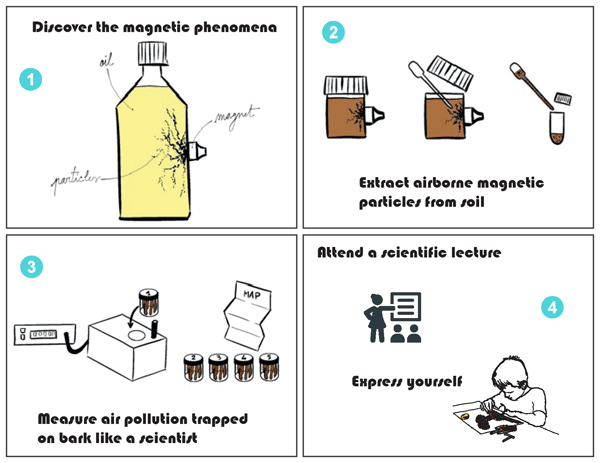
Here we present a hands-on science outreach workshop, based on environmental magnetism methods and conducted at schools and science fairs, that encourages citizen participation in air monitoring projects. We conducted the workshop between 2018 and 2023, reaching 850 people at 9 scientific outreach events and 195 children at 3 elementary schools. The workshop prompted more than 150 people to participate in the associated NanoEnvi community-based participatory research project, which offers to host passive biosensors in their homes or at school for a year. The workshop includes three hands-on demonstrations and experiences. It proposed to discover the magnetic phenomena, to extract airborne magnetic particles from soils, and to measure air pollution trapped on bark like a scientist. The workshop was also accompanied by lectures and an exhibition.
We observed that the workshop fostered two-way dialogue between researchers and a wide range of participants, creating opportunities for shared experimentation and knowledge co-production. We found that the positive emotions raised by experimenting and playing with magnetic phenomena during the workshop led to engagement in a participatory project on potential air pollution in urban surroundings. Our findings demonstrate that hands-on geoscience outreach activities have a positive impact on the science-society dialogue.
-
Notice on discussion status
The requested preprint has a corresponding peer-reviewed final revised paper. You are encouraged to refer to the final revised version.
-
Preprint
(5154 KB)
-
The requested preprint has a corresponding peer-reviewed final revised paper. You are encouraged to refer to the final revised version.
- Preprint
(5154 KB) - Metadata XML
- BibTeX
- EndNote
- Final revised paper


Journal article(s) based on this preprint
Interactive discussion
Status: closed
-
RC1: 'Comment on egusphere-2025-3118', Anonymous Referee #1, 02 Oct 2025
-
AC2: 'Reply on RC1', Melina Macouin, 26 Apr 2026
We thank Reviewer 1 for their time and comments. Our responses are provided in bold below.
It’s a nice work to “make the invisible visible” and thus improve engagement—is compelling and timely, fitting well within the rise of citizen science and environmental justice initiatives.
Overall, I would like to give a major review as this requires a good amount of revision in terms of rewriting the paper. The representations and flow need to be improved.
Some other areas to improve – a) very few references were included, especially comparing other citizen science projects with similar nature – should add much more insights from the existing citizen science projects; b) results section requires major rewriting – major sub-sections in results are inadequately written; c) evaluation methods (depending upon objectives – improved awareness etc.) were not adequately discussed.
We appreciate the reviewer’s positive feedback and recognition of the relevance of our approach. We address the three points raised for improvement below.
a) We will add references in different parts of the manuscript (notably in the Methods section and in Sections 5.2 and 5.3 of the Discussion). These references will be used to support choices regarding survey methods and to contextualize the use of bark as a biomonitoring medium and environmental magnetism. They will also reinforce the discussion on interdisciplinary communication and engagement between scientists and the general public.
b) We will rewrite or rework some parts of the results (see also RC2).
Notably, we will substantially rewrite Section 3.4 to explain the approach behind the activity. Section 4.4 will be removed.c) We will discuss our choice regarding the evaluation and the choice not to perform a quantitative survey in section 2.2 by adding references and context (see RC2). To clarify our evaluation approach, we will detail the specific context, including the noisy and time-limited constraints during the workshop, and refer to relevant references on survey methods. We will explain why a quantitative survey didn't seem feasible given the workshop conditions. We will also mention that we attempted a survey but discontinued it after two participants because we found the approach unsuitable.
Here are a few other suggestions –
Abstract – please make the abstract more focused. Specifically mention the objectives and methods. It needs to answer what environmental magnetism project and link to air pollution monitoring. Passive sensor to monitor what? Requesting to make the abstract a bit more specific.
We will clarify the goal in the abstract (see RC2) and the type of project, as suggested.
Methods
- There is no 2.2 section.
This will be corrected
- In section 1 or 2, it’s important to mention the objective and aim for the study. Is it improving citizen awareness or testing new methods for crowd-sourcing data in future or something else? The objective is not clear. "To promote encounters and get our experiences out of the laboratory" – is a bit generic – need to add some specific and tangible one.
We will clarify the project’s goal, as also suggested by RC2, by specifying that it aims to promote broad participation in science through improved geoscience communication. We will also rework Section 2.1 to explain the project’s goal and the context of the workshop.
- Although a reference has been provided, it would be good to provide details of how tree bark works to detect air pollution. Section 3.4 needs to be more improved. Please take time (possibly add pictures in supplementary) to explain in more detail.
Section 3.4 will be expanded to explain how bark collects PM. This point will also be presented in the method section 2.1 (with references).
- How were participants introduced in the method linking the passive monitoring by tree bark? How did you address issues like "what if we buy a low-cost sensor instead of the passive method?" from the participants?
The method of passive monitoring using tree bark was introduced during components 3 and 4 of the workshop and was further explained during the lecture that sometimes accompanied the workshop (section 3.5). We will clarify this point in the corresponding sections (3.3 and 3.4).
"What if we buy a low-cost sensor instead of the passive method?" : This point was occasionally discussed, as some workshop participants were also involved in a participatory campaign using low-cost sensors (non-academic). These exchanges occurred after the workshop, during the registration process of participants willing to join the participatory project involving passive sensors, and are therefore beyond the scope of the present paper.
Here, we focus on describing the workshop developed to engage citizens and present our approach as an initial step in the broader participatory project. The workshop has also been implemented in other contexts (we will clarify this point).
Therefore, this issue is beyond the scope of the present manuscript. However, we note that participants generally did not perceive passive sensors as less effective than connected low-cost sensors, but were interested in the differences between the two approaches. The respective advantages and limitations of both methods were discussed, and participants expressed a need for support in interpreting the results from low-cost sensors.
- Why was a survey not conducted? Please provide some reasons.
As mentioned above, we will add references and contextual elements in Section 2.2 to clarify and justify our methodological choices. In particular, we will include: “To preserve interaction and engagement, we chose not to administer a survey to evaluate the workshops. In interactive and time-constrained workshop settings, standardized surveys may introduce response and participation biases and provide limited quantitative reliability (Tourangeau et al., 2000; Groves et al., 2009). They may also affect interaction dynamics and potentially reduce participant engagement (Bryman, 2016).” In addition, we will present our preliminary survey, which was discontinued after testing with two participants, as this experience further supported our methodological choice.
- Section 4.2, 4.3, 4.4, 4.5 – are inadequate and need some rewriting and addition of information. These sections depend a lot on the overall objective of the study. So depending upon the objective, some sections can be scrapped off and some sections can be explained in detail.
We will remove the section 4.4.
We thank the reviewer for their valuable feedback, which will help improve the manuscript’s structure, literature coverage, and methodological rigor.
Citation: https://doi.org/10.5194/egusphere-2025-3118-AC2
-
AC2: 'Reply on RC1', Melina Macouin, 26 Apr 2026
-
RC2: 'Comment on egusphere-2025-3118', Anonymous Referee #2, 31 Oct 2025
This article discusses the implementation of a hands-on science workshop developed to engage students, teachers, citizens, and academics in citizen science projects. The authors conducted and participated in an impressive number of outreach events in France (and one in Senegal), where the workshop was held with hundreds of individuals, including children in elementary schools. Through demonstration and experimentation, the workshops sought to make visible: (1) magnetic forces and phenomena, (2) magnetic particles in air and soil, and (3) magnetic particles on tree bark, including its spatial variation within the city. The authors discuss the mutual benefits of the workshop for both the organizers and the participants, including enhanced dialogue, knowledge co-production, and shared experimentation.
This is an inspiring project that demonstrates the power of effective geoscience communication and engagement. I was particularly excited about the type, nature, and diversity of experiments and the insights on two-way dialogue and learning. Below, I provide a few major comments that I hope will be helpful to the authors as they refine the manuscript.
Additional context on the participatory air pollution project and on the workshop itself would strengthen the paper. As a reader with little familiarity of either the project or the workshop, there were several instances when I had a hard time following the text because I didn’t have enough background information. Currently, there are only a few sentences in section 2.1 on the larger project and one sentence at the end of section 2.1 that connects the two (i.e., the project and the workshop). From this text, I gathered that the workshop is an outreach component of the larger research project. Later in the text, it seems the workshop also serves as a citizen recruiting event.
It would be helpful to clearly state the overarching goal of the workshop. Is the goal to promote participation in the larger community-based air quality project? To promote participation in science more broadly? To improve geoscience/science communication? From my reading, the aim is to promote participation in science broadly through improved geoscience communication (hence the emphasis on citizen science and the contrasting, unsuccessful approach of distributing leaflets).
My second major comment is the discussion. To bring these different threads together, could you frame your discussion as “four lessons learned” from the workshop? Could you also elaborate more in sections 5.2 and 5.3 on how the project fostered dialogue and facilitated interdisciplinary/inter-science communication? A few concrete examples with some supporting evidence from the literature?
The tables and figures are fabulous. I really enjoyed their clarity and artistic quality. The legends are also clear and digestible.
Below, I provide major and minor comments by section.
- Methods
- Each participant received two “paired indoor/outdoor” biosensors? Why? So that participants learn that air can be polluted in both environments? Perhaps this detail is not necessary for this paper. You could also simply say that participants received biosensors as part of the larger study.
- You mention that bark was collected far from traffic. Why? Is the assumption that this bark has accumulated less pollution and serves as a baseline/reference? Because you revisit the concept of traffic as a source of air pollution in the hands-on mapping with color coded stickers, it would be good to clarify this.
- Not all readers will be familiar with these methods. Consider mentioning that bark is a good bioindicator of pollution with levels typically higher near traffic sources (add a recent reference?).
- Consider moving section 2.3 on Evaluation and Ethical Considerations to the end of Section 3. Make it section 3.6. Without knowing the details of the workshop, it is hard to understand the evaluation section. It is also leads perfectly into section 4 on Evaluation.
- The last few sentences of Section 2.3 need some refining.
- I suggest cutting the sentence “We assume that the commitment and testimonies of energy and general satisfaction of all those involved - students, researchers, teachers, and visitors - must be taken into account and discussed in the results.”
- I also do not understand the meaning of the following sentence in the context of workshop evaluation “The work with teachers (see Leite et al., 2022) helps to set up the researchers' interventions in schools”.
- I would reorder the sentences that remain as follows
- We did not collect any information during the workshop…
- We also did not conduct a survey because?? …
- We did, however conduct interviews… please elaborate here in one sentence. How many? With whom? To what end?
- Minor detail – by animation, do you mean workshop? If so, just use the term workshop more generally.
- Hands-on workshop
Section 3.1
- The workshop was held at outreach events designed to explain NanoEnvi? Maybe to clarify you could say that you capitalized on a series of NanoEnvi outreach projects to conduct the workshops.
- Below Table 1, you say the workshop set up was designed for the launch of NanoEnvi. You could put this background context in section 2.1.
- Instead of “sequences”, consider using the word “components”.
- I assume the pilot project where bark measurements were made by children was successful and contributed to the development of the workshop, specifically component 3?
Section 3.4
- Change “for children of 8 years old” to “for children of 8 years of age or older”
- Evaluation
Section 4.4
- I am not sure what the last sentence means. “However, it could be argued that too few researchers are proposing this type of workshop, and the communication around the citizen science project sheds light on our team.” Cut?
Overall
- Consider using past tense since the research and work were completed.
Thank you for devising this lovely project. I would have loved to participate!
Citation: https://doi.org/10.5194/egusphere-2025-3118-RC2 -
AC1: 'Reply on RC2', Melina Macouin, 26 Apr 2026
We sincerely thank the reviewer for their positive comments and the very helpful, relevant, and constructive suggestions. Our responses are provided in bold below.
This article discusses the implementation of a hands-on science workshop developed to engage students, teachers, citizens, and academics in citizen science projects. The authors conducted and participated in an impressive number of outreach events in France (and one in Senegal), where the workshop was held with hundreds of individuals, including children in elementary schools. Through demonstration and experimentation, the workshops sought to make visible: (1) magnetic forces and phenomena, (2) magnetic particles in air and soil, and (3) magnetic particles on tree bark, including its spatial variation within the city. The authors discuss the mutual benefits of the workshop for both the organizers and the participants, including enhanced dialogue, knowledge co-production, and shared experimentation.
This is an inspiring project that demonstrates the power of effective geoscience communication and engagement. I was particularly excited about the type, nature, and diversity of experiments and the insights on two-way dialogue and learning. Below, I provide a few major comments that I hope will be helpful to the authors as they refine the manuscript.
Additional context on the participatory air pollution project and on the workshop itself would strengthen the paper. As a reader with little familiarity of either the project or the workshop, there were several instances when I had a hard time following the text because I didn’t have enough background information. Currently, there are only a few sentences in section 2.1 on the larger project and one sentence at the end of section 2.1 that connects the two (i.e., the project and the workshop). From this text, I gathered that the workshop is an outreach component of the larger research project. Later in the text, it seems the workshop also serves as a citizen recruiting event.
We acknowledge that the approach (here, biomonitoring using tree bark and environmental magnetism) requires additional explanation. We will provide clarifications on these two topics in the methods, in Section 2.1, to better explain our approach, which we aimed to convey during the workshop.
Additionally, we will clarify the link between the participatory air pollution project and the workshop itself, as well as explain other contexts of implementation.
It would be helpful to clearly state the overarching goal of the workshop. Is the goal to promote participation in the larger community-based air quality project? To promote participation in science more broadly? To improve geoscience/science communication? From my reading, the aim is to promote participation in science broadly through improved geoscience communication (hence the emphasis on citizen science and the contrasting, unsuccessful approach of distributing leaflets).
The reviewer is right that it is better to clarify the goal of promoting participation in science broadly. We will address this in the abstract and in Section 2.1.
My second major comment is the discussion. To bring these different threads together, could you frame your discussion as “four lessons learned” from the workshop? Could you also elaborate more in sections 5.2 and 5.3 on how the project fostered dialogue and facilitated interdisciplinary/inter-science communication? A few concrete examples with some supporting evidence from the literature?
We thank the reviewer for the suggestion to structure the discussion around “four lessons learned”, which we will adopt. We will elaborate on Sections 5.2 and 5.3. For instance, for section 5.2, we will highlight that engaging with participants has proven essential in long-term citizen science projects (Lopez et al., 2024). We will also explicit that face-to-face interactions fostered reciprocal exchanges, allowing scientists to articulate their motivations and ethical principles while addressing the necessity for researchers to clearly communicate (Riaux et al., 2023) and acknowledge their value systems (Dietz, 2013). Also that discussions on the environmental impact of using plant-based materials versus short-lived, low-cost sensors further underscored these underlying values and methodological choices, even before the broader dialogue between science and society facilitated by citizen science (Wagenknecht et al., 2021).
The tables and figures are fabulous. I really enjoyed their clarity and artistic quality. The legends are also clear and digestible.
We thank the reviewer for this positive feedback on the tables and figures.
Below, I provide major and minor comments by section.
- Methods
- Each participant received two “paired indoor/outdoor” biosensors? Why? So that participants learn that air can be polluted in both environments? Perhaps this detail is not necessary for this paper. You could also simply say that participants received biosensors as part of the larger study.
Indeed, we will simplify the details of the participatory project itself and instead focus on developing the approach: biomonitoring through tree bark and environmental magnetism methods, as mentioned earlier.
- You mention that bark was collected far from traffic. Why? Is the assumption that this bark has accumulated less pollution and serves as a baseline/reference? Because you revisit the concept of traffic as a source of air pollution in the hands-on mapping with color coded stickers, it would be good to clarify this.
Finally, this detail does not seem relevant; we will remove it and include an explanation in Section 3.4 “Measuring air pollution trapped on bark like a scientist”, to clarify why we use tree bark and magnetic susceptibility, and the reasoning we proposed to participants when interpreting the measurements. We will clarify the use of colored stickers.
- Not all readers will be familiar with these methods. Consider mentioning that bark is a good bioindicator of pollution with levels typically higher near traffic sources (add a recent reference?).
As mentioned previously, we will explain better the use of bark as a biomonitor and include supporting references.
- Consider moving section 2.3 on Evaluation and Ethical Considerations to the end of Section 3. Make it section 3.6. Without knowing the details of the workshop, it is hard to understand the evaluation section. It is also leads perfectly into section 4 on Evaluation.
To clarify our evaluation approach, we will detail the specific context, including the noisy and time-limited constraints during the workshop, and refer to relevant references on survey methods. We will explain why a quantitative survey didn't seem feasible given the workshop conditions. We will also mention that we initially attempted a survey but discontinued it after two participants because we found the approach unsuitable.
However, we believe that, with the developed context and the justification, including references, it should remain in the Methods section (as it relates to the methodology).The last few sentences of Section 2.3 need some refining.
We will refine these sentences.
- I suggest cutting the sentence “We assume that the commitment and testimonies of energy and general satisfaction of all those involved - students, researchers, teachers, and visitors - must be taken into account and discussed in the results.”
Indeed, we will simplify this sentence and split it into two sentences.
- I also do not understand the meaning of the following sentence in the context of workshop evaluation “The work with teachers (see Leite et al., 2022) helps to set up the researchers' interventions in schools”.
We will clarify this point by moving this part to Section 2.1 and explain 1) that exchanges with teachers (see Leite et al., 2022) before the workshops supported the implementation of school-based interventions and 2) that this was achieved by helping to define appropriate timing and the duration of each activity, understand children’s perceptions and fears regarding environmental issues, and address the activities in practice.
- I would reorder the sentences that remain as follows
- We did not collect any information during the workshop…
- We also did not conduct a survey because?? …
- We did, however conduct interviews… please elaborate here in one sentence. How many? With whom? To what end?
As suggested, we will reorder the paragraph. We will provide details on the justification for choosing not to perform quantitative surveys. As mentioned earlier, we also included a questionnaire that was tentatively administered (and aborted after two responses). We will specify the role of teachers before the implementation of the survey and the semi-structured interviews after the implementation.
- Minor detail – by animation, do you mean workshop? If so, just use the term workshop more generally.
We will harmonize by using “workshop”.
- Hands-on workshop
Section 3.1
- The workshop was held at outreach events designed to explain NanoEnvi? Maybe to clarify you could say that you capitalized on a series of NanoEnvi outreach projects to conduct the workshops.
We will add this point as suggested, as it is indeed very important.
- Below Table 1, you say the workshop set up was designed for the launch of NanoEnvi. You could put this background context in section 2.1.
We will add this point as suggested.
- Instead of “sequences”, consider using the word “components”.
We will change as suggested.
- I assume the pilot project where bark measurements were made by children was successful and contributed to the development of the workshop, specifically component 3?
The 2013 experiment helped in the design of the workshop. We will clarify this.
Section 3.4
- Change “for children of 8 years old” to “for children of 8 years of age or older”
OK
- Evaluation
Section 4.4
- I am not sure what the last sentence means. “However, it could be argued that too few researchers are proposing this type of workshop, and the communication around the citizen science project sheds light on our team.” Cut?
We will remove this sentence.
Overall
- Consider using past tense since the research and work were completed.
We will change as suggested.
Thank you for devising this lovely project. I would have loved to participate!
To reviever 2 : We sincerely appreciate your time and your feedback. Your enthusiasm and insights are truly inspiring. We thank you again for this review, which will help us improve the manuscript to better convey the spirit of this workshop, an experience that proved crucial for our team in fostering geoscience communication and engagement with participants.
Citation: https://doi.org/10.5194/egusphere-2025-3118-AC1
Peer review completion


Interactive discussion
Status: closed
-
RC1: 'Comment on egusphere-2025-3118', Anonymous Referee #1, 02 Oct 2025
It’s a nice work to “make the invisible visible” and thus improve engagement—is compelling and timely, fitting well within the rise of citizen science and environmental justice initiatives.
Overall, I would like to give a major review as this requires a good amount of revision in terms of rewriting the paper. The representations and flow need to be improved.
Some other areas to improve – a) very few references were included, especially comparing other citizen science projects with similar nature – should add much more insights from the existing citizen science projects; b) results section requires major rewriting – major sub-sections in results are inadequately written; c) evaluation methods (depending upon objectives – improved awareness etc.) were not adequately discussed.
Here are a few other suggestions –
Abstract – please make the abstract more focused. Specifically mention the objectives and methods. It needs to answer what environmental magnetism project and link to air pollution monitoring. Passive sensor to monitor what? Requesting to make the abstract a bit more specific.
Methods
-
There is no 2.2 section.
-
In section 1 or 2, it’s important to mention the objective and aim for the study. Is it improving citizen awareness or testing new methods for crowd-sourcing data in future or something else? The objective is not clear. "To promote encounters and get our experiences out of the laboratory" – is a bit generic – need to add some specific and tangible one.
-
Although a reference has been provided, it would be good to provide details of how tree bark works to detect air pollution. Section 3.4 needs to be more improved. Please take time (possibly add pictures in supplementary) to explain in more detail.
-
How were participants introduced in the method linking the passive monitoring by tree bark? How did you address issues like "what if we buy a low-cost sensor instead of the passive method?" from the participants?
-
Why was a survey not conducted? Please provide some reasons.
Results
-
Section 4.2, 4.3, 4.4, 4.5 – are inadequate and need some rewriting and addition of information. These sections depend a lot on the overall objective of the study. So depending upon the objective, some sections can be scrapped off and some sections can be explained in detail.
Citation: https://doi.org/10.5194/egusphere-2025-3118-RC1 -
AC2: 'Reply on RC1', Melina Macouin, 26 Apr 2026
We thank Reviewer 1 for their time and comments. Our responses are provided in bold below.
It’s a nice work to “make the invisible visible” and thus improve engagement—is compelling and timely, fitting well within the rise of citizen science and environmental justice initiatives.
Overall, I would like to give a major review as this requires a good amount of revision in terms of rewriting the paper. The representations and flow need to be improved.
Some other areas to improve – a) very few references were included, especially comparing other citizen science projects with similar nature – should add much more insights from the existing citizen science projects; b) results section requires major rewriting – major sub-sections in results are inadequately written; c) evaluation methods (depending upon objectives – improved awareness etc.) were not adequately discussed.
We appreciate the reviewer’s positive feedback and recognition of the relevance of our approach. We address the three points raised for improvement below.
a) We will add references in different parts of the manuscript (notably in the Methods section and in Sections 5.2 and 5.3 of the Discussion). These references will be used to support choices regarding survey methods and to contextualize the use of bark as a biomonitoring medium and environmental magnetism. They will also reinforce the discussion on interdisciplinary communication and engagement between scientists and the general public.
b) We will rewrite or rework some parts of the results (see also RC2).
Notably, we will substantially rewrite Section 3.4 to explain the approach behind the activity. Section 4.4 will be removed.c) We will discuss our choice regarding the evaluation and the choice not to perform a quantitative survey in section 2.2 by adding references and context (see RC2). To clarify our evaluation approach, we will detail the specific context, including the noisy and time-limited constraints during the workshop, and refer to relevant references on survey methods. We will explain why a quantitative survey didn't seem feasible given the workshop conditions. We will also mention that we attempted a survey but discontinued it after two participants because we found the approach unsuitable.
Here are a few other suggestions –
Abstract – please make the abstract more focused. Specifically mention the objectives and methods. It needs to answer what environmental magnetism project and link to air pollution monitoring. Passive sensor to monitor what? Requesting to make the abstract a bit more specific.
We will clarify the goal in the abstract (see RC2) and the type of project, as suggested.
Methods
- There is no 2.2 section.
This will be corrected
- In section 1 or 2, it’s important to mention the objective and aim for the study. Is it improving citizen awareness or testing new methods for crowd-sourcing data in future or something else? The objective is not clear. "To promote encounters and get our experiences out of the laboratory" – is a bit generic – need to add some specific and tangible one.
We will clarify the project’s goal, as also suggested by RC2, by specifying that it aims to promote broad participation in science through improved geoscience communication. We will also rework Section 2.1 to explain the project’s goal and the context of the workshop.
- Although a reference has been provided, it would be good to provide details of how tree bark works to detect air pollution. Section 3.4 needs to be more improved. Please take time (possibly add pictures in supplementary) to explain in more detail.
Section 3.4 will be expanded to explain how bark collects PM. This point will also be presented in the method section 2.1 (with references).
- How were participants introduced in the method linking the passive monitoring by tree bark? How did you address issues like "what if we buy a low-cost sensor instead of the passive method?" from the participants?
The method of passive monitoring using tree bark was introduced during components 3 and 4 of the workshop and was further explained during the lecture that sometimes accompanied the workshop (section 3.5). We will clarify this point in the corresponding sections (3.3 and 3.4).
"What if we buy a low-cost sensor instead of the passive method?" : This point was occasionally discussed, as some workshop participants were also involved in a participatory campaign using low-cost sensors (non-academic). These exchanges occurred after the workshop, during the registration process of participants willing to join the participatory project involving passive sensors, and are therefore beyond the scope of the present paper.
Here, we focus on describing the workshop developed to engage citizens and present our approach as an initial step in the broader participatory project. The workshop has also been implemented in other contexts (we will clarify this point).
Therefore, this issue is beyond the scope of the present manuscript. However, we note that participants generally did not perceive passive sensors as less effective than connected low-cost sensors, but were interested in the differences between the two approaches. The respective advantages and limitations of both methods were discussed, and participants expressed a need for support in interpreting the results from low-cost sensors.
- Why was a survey not conducted? Please provide some reasons.
As mentioned above, we will add references and contextual elements in Section 2.2 to clarify and justify our methodological choices. In particular, we will include: “To preserve interaction and engagement, we chose not to administer a survey to evaluate the workshops. In interactive and time-constrained workshop settings, standardized surveys may introduce response and participation biases and provide limited quantitative reliability (Tourangeau et al., 2000; Groves et al., 2009). They may also affect interaction dynamics and potentially reduce participant engagement (Bryman, 2016).” In addition, we will present our preliminary survey, which was discontinued after testing with two participants, as this experience further supported our methodological choice.
- Section 4.2, 4.3, 4.4, 4.5 – are inadequate and need some rewriting and addition of information. These sections depend a lot on the overall objective of the study. So depending upon the objective, some sections can be scrapped off and some sections can be explained in detail.
We will remove the section 4.4.
We thank the reviewer for their valuable feedback, which will help improve the manuscript’s structure, literature coverage, and methodological rigor.
Citation: https://doi.org/10.5194/egusphere-2025-3118-AC2
-
-
RC2: 'Comment on egusphere-2025-3118', Anonymous Referee #2, 31 Oct 2025
This article discusses the implementation of a hands-on science workshop developed to engage students, teachers, citizens, and academics in citizen science projects. The authors conducted and participated in an impressive number of outreach events in France (and one in Senegal), where the workshop was held with hundreds of individuals, including children in elementary schools. Through demonstration and experimentation, the workshops sought to make visible: (1) magnetic forces and phenomena, (2) magnetic particles in air and soil, and (3) magnetic particles on tree bark, including its spatial variation within the city. The authors discuss the mutual benefits of the workshop for both the organizers and the participants, including enhanced dialogue, knowledge co-production, and shared experimentation.
This is an inspiring project that demonstrates the power of effective geoscience communication and engagement. I was particularly excited about the type, nature, and diversity of experiments and the insights on two-way dialogue and learning. Below, I provide a few major comments that I hope will be helpful to the authors as they refine the manuscript.
Additional context on the participatory air pollution project and on the workshop itself would strengthen the paper. As a reader with little familiarity of either the project or the workshop, there were several instances when I had a hard time following the text because I didn’t have enough background information. Currently, there are only a few sentences in section 2.1 on the larger project and one sentence at the end of section 2.1 that connects the two (i.e., the project and the workshop). From this text, I gathered that the workshop is an outreach component of the larger research project. Later in the text, it seems the workshop also serves as a citizen recruiting event.
It would be helpful to clearly state the overarching goal of the workshop. Is the goal to promote participation in the larger community-based air quality project? To promote participation in science more broadly? To improve geoscience/science communication? From my reading, the aim is to promote participation in science broadly through improved geoscience communication (hence the emphasis on citizen science and the contrasting, unsuccessful approach of distributing leaflets).
My second major comment is the discussion. To bring these different threads together, could you frame your discussion as “four lessons learned” from the workshop? Could you also elaborate more in sections 5.2 and 5.3 on how the project fostered dialogue and facilitated interdisciplinary/inter-science communication? A few concrete examples with some supporting evidence from the literature?
The tables and figures are fabulous. I really enjoyed their clarity and artistic quality. The legends are also clear and digestible.
Below, I provide major and minor comments by section.
- Methods
- Each participant received two “paired indoor/outdoor” biosensors? Why? So that participants learn that air can be polluted in both environments? Perhaps this detail is not necessary for this paper. You could also simply say that participants received biosensors as part of the larger study.
- You mention that bark was collected far from traffic. Why? Is the assumption that this bark has accumulated less pollution and serves as a baseline/reference? Because you revisit the concept of traffic as a source of air pollution in the hands-on mapping with color coded stickers, it would be good to clarify this.
- Not all readers will be familiar with these methods. Consider mentioning that bark is a good bioindicator of pollution with levels typically higher near traffic sources (add a recent reference?).
- Consider moving section 2.3 on Evaluation and Ethical Considerations to the end of Section 3. Make it section 3.6. Without knowing the details of the workshop, it is hard to understand the evaluation section. It is also leads perfectly into section 4 on Evaluation.
- The last few sentences of Section 2.3 need some refining.
- I suggest cutting the sentence “We assume that the commitment and testimonies of energy and general satisfaction of all those involved - students, researchers, teachers, and visitors - must be taken into account and discussed in the results.”
- I also do not understand the meaning of the following sentence in the context of workshop evaluation “The work with teachers (see Leite et al., 2022) helps to set up the researchers' interventions in schools”.
- I would reorder the sentences that remain as follows
- We did not collect any information during the workshop…
- We also did not conduct a survey because?? …
- We did, however conduct interviews… please elaborate here in one sentence. How many? With whom? To what end?
- Minor detail – by animation, do you mean workshop? If so, just use the term workshop more generally.
- Hands-on workshop
Section 3.1
- The workshop was held at outreach events designed to explain NanoEnvi? Maybe to clarify you could say that you capitalized on a series of NanoEnvi outreach projects to conduct the workshops.
- Below Table 1, you say the workshop set up was designed for the launch of NanoEnvi. You could put this background context in section 2.1.
- Instead of “sequences”, consider using the word “components”.
- I assume the pilot project where bark measurements were made by children was successful and contributed to the development of the workshop, specifically component 3?
Section 3.4
- Change “for children of 8 years old” to “for children of 8 years of age or older”
- Evaluation
Section 4.4
- I am not sure what the last sentence means. “However, it could be argued that too few researchers are proposing this type of workshop, and the communication around the citizen science project sheds light on our team.” Cut?
Overall
- Consider using past tense since the research and work were completed.
Thank you for devising this lovely project. I would have loved to participate!
Citation: https://doi.org/10.5194/egusphere-2025-3118-RC2 -
AC1: 'Reply on RC2', Melina Macouin, 26 Apr 2026
We sincerely thank the reviewer for their positive comments and the very helpful, relevant, and constructive suggestions. Our responses are provided in bold below.
This article discusses the implementation of a hands-on science workshop developed to engage students, teachers, citizens, and academics in citizen science projects. The authors conducted and participated in an impressive number of outreach events in France (and one in Senegal), where the workshop was held with hundreds of individuals, including children in elementary schools. Through demonstration and experimentation, the workshops sought to make visible: (1) magnetic forces and phenomena, (2) magnetic particles in air and soil, and (3) magnetic particles on tree bark, including its spatial variation within the city. The authors discuss the mutual benefits of the workshop for both the organizers and the participants, including enhanced dialogue, knowledge co-production, and shared experimentation.
This is an inspiring project that demonstrates the power of effective geoscience communication and engagement. I was particularly excited about the type, nature, and diversity of experiments and the insights on two-way dialogue and learning. Below, I provide a few major comments that I hope will be helpful to the authors as they refine the manuscript.
Additional context on the participatory air pollution project and on the workshop itself would strengthen the paper. As a reader with little familiarity of either the project or the workshop, there were several instances when I had a hard time following the text because I didn’t have enough background information. Currently, there are only a few sentences in section 2.1 on the larger project and one sentence at the end of section 2.1 that connects the two (i.e., the project and the workshop). From this text, I gathered that the workshop is an outreach component of the larger research project. Later in the text, it seems the workshop also serves as a citizen recruiting event.
We acknowledge that the approach (here, biomonitoring using tree bark and environmental magnetism) requires additional explanation. We will provide clarifications on these two topics in the methods, in Section 2.1, to better explain our approach, which we aimed to convey during the workshop.
Additionally, we will clarify the link between the participatory air pollution project and the workshop itself, as well as explain other contexts of implementation.
It would be helpful to clearly state the overarching goal of the workshop. Is the goal to promote participation in the larger community-based air quality project? To promote participation in science more broadly? To improve geoscience/science communication? From my reading, the aim is to promote participation in science broadly through improved geoscience communication (hence the emphasis on citizen science and the contrasting, unsuccessful approach of distributing leaflets).
The reviewer is right that it is better to clarify the goal of promoting participation in science broadly. We will address this in the abstract and in Section 2.1.
My second major comment is the discussion. To bring these different threads together, could you frame your discussion as “four lessons learned” from the workshop? Could you also elaborate more in sections 5.2 and 5.3 on how the project fostered dialogue and facilitated interdisciplinary/inter-science communication? A few concrete examples with some supporting evidence from the literature?
We thank the reviewer for the suggestion to structure the discussion around “four lessons learned”, which we will adopt. We will elaborate on Sections 5.2 and 5.3. For instance, for section 5.2, we will highlight that engaging with participants has proven essential in long-term citizen science projects (Lopez et al., 2024). We will also explicit that face-to-face interactions fostered reciprocal exchanges, allowing scientists to articulate their motivations and ethical principles while addressing the necessity for researchers to clearly communicate (Riaux et al., 2023) and acknowledge their value systems (Dietz, 2013). Also that discussions on the environmental impact of using plant-based materials versus short-lived, low-cost sensors further underscored these underlying values and methodological choices, even before the broader dialogue between science and society facilitated by citizen science (Wagenknecht et al., 2021).
The tables and figures are fabulous. I really enjoyed their clarity and artistic quality. The legends are also clear and digestible.
We thank the reviewer for this positive feedback on the tables and figures.
Below, I provide major and minor comments by section.
- Methods
- Each participant received two “paired indoor/outdoor” biosensors? Why? So that participants learn that air can be polluted in both environments? Perhaps this detail is not necessary for this paper. You could also simply say that participants received biosensors as part of the larger study.
Indeed, we will simplify the details of the participatory project itself and instead focus on developing the approach: biomonitoring through tree bark and environmental magnetism methods, as mentioned earlier.
- You mention that bark was collected far from traffic. Why? Is the assumption that this bark has accumulated less pollution and serves as a baseline/reference? Because you revisit the concept of traffic as a source of air pollution in the hands-on mapping with color coded stickers, it would be good to clarify this.
Finally, this detail does not seem relevant; we will remove it and include an explanation in Section 3.4 “Measuring air pollution trapped on bark like a scientist”, to clarify why we use tree bark and magnetic susceptibility, and the reasoning we proposed to participants when interpreting the measurements. We will clarify the use of colored stickers.
- Not all readers will be familiar with these methods. Consider mentioning that bark is a good bioindicator of pollution with levels typically higher near traffic sources (add a recent reference?).
As mentioned previously, we will explain better the use of bark as a biomonitor and include supporting references.
- Consider moving section 2.3 on Evaluation and Ethical Considerations to the end of Section 3. Make it section 3.6. Without knowing the details of the workshop, it is hard to understand the evaluation section. It is also leads perfectly into section 4 on Evaluation.
To clarify our evaluation approach, we will detail the specific context, including the noisy and time-limited constraints during the workshop, and refer to relevant references on survey methods. We will explain why a quantitative survey didn't seem feasible given the workshop conditions. We will also mention that we initially attempted a survey but discontinued it after two participants because we found the approach unsuitable.
However, we believe that, with the developed context and the justification, including references, it should remain in the Methods section (as it relates to the methodology).The last few sentences of Section 2.3 need some refining.
We will refine these sentences.
- I suggest cutting the sentence “We assume that the commitment and testimonies of energy and general satisfaction of all those involved - students, researchers, teachers, and visitors - must be taken into account and discussed in the results.”
Indeed, we will simplify this sentence and split it into two sentences.
- I also do not understand the meaning of the following sentence in the context of workshop evaluation “The work with teachers (see Leite et al., 2022) helps to set up the researchers' interventions in schools”.
We will clarify this point by moving this part to Section 2.1 and explain 1) that exchanges with teachers (see Leite et al., 2022) before the workshops supported the implementation of school-based interventions and 2) that this was achieved by helping to define appropriate timing and the duration of each activity, understand children’s perceptions and fears regarding environmental issues, and address the activities in practice.
- I would reorder the sentences that remain as follows
- We did not collect any information during the workshop…
- We also did not conduct a survey because?? …
- We did, however conduct interviews… please elaborate here in one sentence. How many? With whom? To what end?
As suggested, we will reorder the paragraph. We will provide details on the justification for choosing not to perform quantitative surveys. As mentioned earlier, we also included a questionnaire that was tentatively administered (and aborted after two responses). We will specify the role of teachers before the implementation of the survey and the semi-structured interviews after the implementation.
- Minor detail – by animation, do you mean workshop? If so, just use the term workshop more generally.
We will harmonize by using “workshop”.
- Hands-on workshop
Section 3.1
- The workshop was held at outreach events designed to explain NanoEnvi? Maybe to clarify you could say that you capitalized on a series of NanoEnvi outreach projects to conduct the workshops.
We will add this point as suggested, as it is indeed very important.
- Below Table 1, you say the workshop set up was designed for the launch of NanoEnvi. You could put this background context in section 2.1.
We will add this point as suggested.
- Instead of “sequences”, consider using the word “components”.
We will change as suggested.
- I assume the pilot project where bark measurements were made by children was successful and contributed to the development of the workshop, specifically component 3?
The 2013 experiment helped in the design of the workshop. We will clarify this.
Section 3.4
- Change “for children of 8 years old” to “for children of 8 years of age or older”
OK
- Evaluation
Section 4.4
- I am not sure what the last sentence means. “However, it could be argued that too few researchers are proposing this type of workshop, and the communication around the citizen science project sheds light on our team.” Cut?
We will remove this sentence.
Overall
- Consider using past tense since the research and work were completed.
We will change as suggested.
Thank you for devising this lovely project. I would have loved to participate!
To reviever 2 : We sincerely appreciate your time and your feedback. Your enthusiasm and insights are truly inspiring. We thank you again for this review, which will help us improve the manuscript to better convey the spirit of this workshop, an experience that proved crucial for our team in fostering geoscience communication and engagement with participants.
Citation: https://doi.org/10.5194/egusphere-2025-3118-AC1
Peer review completion
Journal article(s) based on this preprint
Viewed
| HTML | XML | Total | BibTeX | EndNote | |
|---|---|---|---|---|---|
| 1,807 | 848 | 163 | 2,818 | 143 | 158 |
- HTML: 1,807
- PDF: 848
- XML: 163
- Total: 2,818
- BibTeX: 143
- EndNote: 158
Viewed (geographical distribution)
| Country | # | Views | % |
|---|
| Total: | 0 |
| HTML: | 0 |
| PDF: | 0 |
| XML: | 0 |
- 1

Sonia Rousse
Sandrine Suchon
Loïc Drigo
Laure Laffont
Laurence Delville
Eva Vedel
Paul Antonio
Jean-François Léon
Arua da Silva Leite
Eva Schreck
Fabrice Gangneron
The requested preprint has a corresponding peer-reviewed final revised paper. You are encouraged to refer to the final revised version.
- Preprint
(5154 KB) - Metadata XML
It’s a nice work to “make the invisible visible” and thus improve engagement—is compelling and timely, fitting well within the rise of citizen science and environmental justice initiatives.
Overall, I would like to give a major review as this requires a good amount of revision in terms of rewriting the paper. The representations and flow need to be improved.
Some other areas to improve – a) very few references were included, especially comparing other citizen science projects with similar nature – should add much more insights from the existing citizen science projects; b) results section requires major rewriting – major sub-sections in results are inadequately written; c) evaluation methods (depending upon objectives – improved awareness etc.) were not adequately discussed.
Here are a few other suggestions –
Abstract – please make the abstract more focused. Specifically mention the objectives and methods. It needs to answer what environmental magnetism project and link to air pollution monitoring. Passive sensor to monitor what? Requesting to make the abstract a bit more specific.
Methods
There is no 2.2 section.
In section 1 or 2, it’s important to mention the objective and aim for the study. Is it improving citizen awareness or testing new methods for crowd-sourcing data in future or something else? The objective is not clear. "To promote encounters and get our experiences out of the laboratory" – is a bit generic – need to add some specific and tangible one.
Although a reference has been provided, it would be good to provide details of how tree bark works to detect air pollution. Section 3.4 needs to be more improved. Please take time (possibly add pictures in supplementary) to explain in more detail.
How were participants introduced in the method linking the passive monitoring by tree bark? How did you address issues like "what if we buy a low-cost sensor instead of the passive method?" from the participants?
Why was a survey not conducted? Please provide some reasons.
Results
Section 4.2, 4.3, 4.4, 4.5 – are inadequate and need some rewriting and addition of information. These sections depend a lot on the overall objective of the study. So depending upon the objective, some sections can be scrapped off and some sections can be explained in detail.