
the Creative Commons Attribution 4.0 License.
the Creative Commons Attribution 4.0 License.
 | 15 Oct 2025
Mapping the fertosphere’s phosphorus availability distribution in a field trial using a novel diffusive gradients in thin-films (fDGT) technique
Abstract. Phosphorus (P) is limiting to crop growth worldwide and optimising P fertiliser use is essential for maintaining crop productivity and avoiding negative environmental impacts. To achieve this, a thorough understanding of the chemistry and potential plant availability of P fertilisers in soil is required, particularly the chemistry in the region of soil surrounding the fertiliser granules i.e. the fertosphere. The diffusive gradients in thin-films (DGT) technique is commonly used to estimate potentially bioavailable nutrient concentrations and the distribution of nutrients in the environment, including for P. This method correlates strongly to plant available nutrients because it mimics plant nutrient uptake by acting as an infinite sink. The technique has been used to obtain two-dimensional (2D) images of labile P concentrations or P fluxes in soil using X-ray fluorescence microscopy (XFM) and laser ablation (LA) ICP-MS in laboratory settings. Conventional DGTs are tedious to prepare and difficult to deploy at a scale (10s of cm2) relevant to field scale observations. We recently developed a DGT with a gel-free binding layer that addresses these limitations. This innovative design is robust and simplifies preparation and analysis, making it ideal for field deployment. Here, we describe the details of the design of this novel field DGT (fDGT) device and evaluate its effectiveness in assessing the spatial availability of P from different fertilizer sources in a barley field trial in calcareous soil. Using X-ray fluorescence microscopy (XFM) analysis of DGT binding layers, we demonstrate that there are distinct reaction zones along the P fertiliser band in the field, and that differences between P treatments can be visualised and quantified using this novel fDGT. This approach provides a foundation for expanded use of field-deployable DGTs in studying macronutrient dynamics and supports the development of more efficient, site-specific fertiliser strategies to improve P use efficiency in agricultural systems. As the next step, we propose to further develop and refine this fDGT device and to make it applicable for other macro and/or nutrients. This will ultimately support research that aims to assist farmers by enhancing fertiliser use efficiency.
-
Notice on discussion status
The requested preprint has a corresponding peer-reviewed final revised paper. You are encouraged to refer to the final revised version.
-
Preprint
(954 KB)
-
The requested preprint has a corresponding peer-reviewed final revised paper. You are encouraged to refer to the final revised version.
- Preprint
(954 KB) - Metadata XML
- BibTeX
- EndNote
- Final revised paper


Journal article(s) based on this preprint
Interactive discussion
Status: closed
-
RC1: 'Comment on egusphere-2025-3044', Anonymous Referee #1, 12 Nov 2025
A very interesting abstract. No additional comments.
Citation: https://doi.org/10.5194/egusphere-2025-3044-RC1 -
AC1: 'Reply on RC1', Casey L. Doolette, 08 Jan 2026
We thank the anonymous reviewer for reviewing this manuscript and their support of this work.
Citation: https://doi.org/10.5194/egusphere-2025-3044-AC1
-
AC1: 'Reply on RC1', Casey L. Doolette, 08 Jan 2026
-
RC2: 'Comment on egusphere-2025-3044', Anonymous Referee #2, 11 Dec 2025
This is a high-quality manuscript presenting a significant methodological advance with clear relevance to improving phosphorus (P) use efficiency in agriculture using a new methodological approach which is building on an established technique to analise available fractions of P (DGT). The work is robust, novel, and well-structured. The core achievement is the successful development and first field application of a novel, gel-free "fDGT" device for the two-dimensional, in-situ mapping of labile P availability around fertilizer bands in a barley trial. The study effectively bridges a critical gap between controlled laboratory experiments and field conditions to expand the use of a well-known technique at the bench scale.
The paper's primary strength is the novelty: the deployment of a large-format, robust DGT device to visualize P availability gradients directly in the field. This addresses a known technical limitation in soil science (missing soil heterogeneity during sampling, processing, etc). The methodology is sound and well-described, integrating innovative device design, field application, and advanced synchrotron analysis. The results are promissing, providing the first field-visualized evidence of three distinct P reaction zones (saturation plateau, transition, sorption-controlled) within the fertosphere, a phenomenon previously only described in lab studies. The discussion connects findings to potential mechanisms (e.g., precipitation vs. sorption) and compares results to previous laboratory work. I was doubtful regarding the use of new terms like fertosphere, but after seeing the definition, I agree that it can be used in the text.
To enhance clarity, impact, and readiness for publication, focus on the following improvements:
Abstract and introduction: Explicitly state the novelty in the Abstract and Introduction. Emphasize that this is the first report of 2D, spatially-resolved P availability mapping obtained in situ (field) at the fertilizer band scale in a dryland crop system.
Comment on the discussion: While the mechanistic discussion of the three zones is excellent, as well as the technical aspects of the technique, elevate the discussion by more directly linking spatial findings to agronomic implications. For example, discuss how the identified "saturation plateau" and limited vertical diffusion (10-15 mm) could inform optimal fertilizer granule spacing or band placement to maximize root interception. Also, connect the reduced plant biomass at high DAP rates to the discussion, noting that fDGT measures P supply, but other factors (e.g., ammonium toxicity) ultimately determine crop response, if there was any effect that could explain this contrast.
Table 2: I would consider removing the data of soil pH and EC, because at the end you conclude that the changes aren’t very clear changes that you can use. And, if you do so, maybe the data of plants can be included in figure 2.
Figure 2: Define all abbreviations (DAP, DAP2, Bio) fully within the figure legend itself. I would add here the results of plant P (Table 2) and also I would select a colour for each treatment and light for the upper and dark for the deeper depth, putting in pairs each treatment and maybe the concentration in plant as a line.
Figure 3: The legend is currently insufficient. It must be self-contained and explicitly describe: (a) what the color scale represents (e.g., P concentration on the binding layer and values, including the numerical range in a scale on the side); and (b) panel caption should be explained, mainly how it was estimated from a 2D to a dispersion of 1 point per depth (one line in the gel? Or the average of different lines in the gel?).
Otherwise, congratulations, the authors have done a great work and this contribution will be of great interest in SOIL journal.
Citation: https://doi.org/10.5194/egusphere-2025-3044-RC2 -
AC2: 'Reply on RC2', Casey L. Doolette, 08 Jan 2026
We thank the anonymous reviewer for their succinct summary of our manuscript and for highlighting the positive contribution that they believe this research can bring to soil science and agricultural research communities.
We thank the review for their advice and will add the following text (underlined) to the Abstract and Introduction:
Abstract: We believe this is the first report of two-dimensional spatially resolved mapping of P bioavailability obtained in situ (field) at the fertiliser band scale in a dryland cropping system.
Introduction, Page 3: To the best of our knowledge, such an approach has not been used to investigate the availability of P from fertilisers in field trials of major crops, excluding rice, and specifically not in any dryland cropping systems.
Introduction, Page 3: Here, we report the design of a novel field DGT (fDGT) device and its evaluation for visualising and assessing the spatial availability of P from different fertiliser sources in a barley field trial for the first time.
Thank you for the suggestions regarding the Discussion. We will add the following text to the manuscript:
Discussion, Page 9:
This mechanistic knowledge of how fertilisers behave in the field can be used to drive improvements in management practices and fertiliser formulations, ultimately increasing fertiliser nutrient use efficiency (Lombi et al., 2025). In contrast to the bulk soil, the fertosphere is likely to also have steep gradients for soil pH and EC which can influence nutrient availability. Therefore, by better understanding these spatial differences, agronomic practices could be improved by developing fertiliser formulations with a more sustained nutrient supply, in turn reducing precipitation and fixation reactions, and by optimising the placement of fertilisers (Lombi et al., 2025). For example, for this fertiliser-soil combination (i.e. DAP granules in a calcareous soil), if seeds are placed ≤ 5 mm from the fertiliser, primary roots would be exposed to the highest concentration of available P, but increasing the application rate of P may not be beneficial as the P availability plateau has been reached. In addition, although sorption reactions dominate further away from the granule, vertical spacing between fertiliser and seed bands should not exceed 20 mm due to the limited vertical diffusion of P.
We agree with the reviewer regarding the comment on reduced plant biomass at high DAP rates, and agree that this is an important point. However, we contend that this has already been addressed in the Discussion at Line 188-192:
Line 188-192: The lower biomass at the higher DAP rate, is possibly due to ammonia/ammonium (NH3/NH4+) toxicity; a known issue when ammoniacal fertilisers are banded in the vicinity of seeds (Pan et al., 2016). A review of the literature in relation to ammonia/ammonium-induced plant toxicity, caused by fertilisers with a high N:P ratio, shows that nutrient uptake, root proliferation and plant biomass can be reduced when NH3/NH4+ accumulate (Sica et al., 2025).
For Table 2, we appreciate this comment and agree that the pH and EC data were minimally impacted by fertiliser application due to potential masking by the bulk sampling protocol (0-4 cm and 4-6 cm). However, we feel there is still value in presenting these data as there were significant differences in pH (albeit minimal) between the two depths. We feel this information is also important for highlighting the importance of shifting from focussing on bulk chemistry to spatially resolved approaches.
For Figure 2, we will define all abbreviations in the legend and update the figure. The original colour scheme was ‘colourblind safe’, but we will insert a new figure (still colourblind safe) where the treatments are paired together as suggested and the colours better show the grouping i.e. light blue and dark blue for shallow and deep sampling depths. For some treatments due to the colourblind safe scheme a light and dark option is not always available but we will reorder the grouping of treatments to make this image clearer.
For Figure 3, thank you for picking this up. We will amend the figure caption as suggested to more clearly explain the colour scale and how we averaged the XFM data for each horizontal transect to produce 1 point per depth.
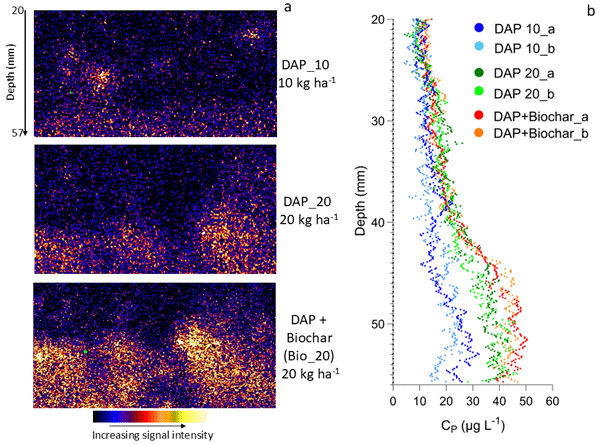
Proposed revised Figure 3 legend: Two dimensional phosphorus diffusion images measured using field-deployed DGT in combination with XFM, where (a) are phosphorus XFM images of the DGT binding layers collected from; the diammonium phosphate treatment (DAP) where P was applied at 10 kg ha-1, the DAP treatment (DAP2, 20 kg ha-1) and Biochar + DAP treatment (20 kg P ha-1), and (b) labile P concentrations (Cp, μg P L−1) calculated as a function of depth for the three fertiliser regimes tested – obtained by averaging the 2D XFM maps across the horizontal axis i.e. each coloured point in (b) is the average of the Cp values in a horizontal transect across the gel and each transect is 100 um apart. ‘Depth’ is the distance from the soil surface.
We thank the reviewer for their time taken in reviewing this manuscript and their suggestions to improve its quality.
Citation: https://doi.org/10.5194/egusphere-2025-3044-AC2
-
AC2: 'Reply on RC2', Casey L. Doolette, 08 Jan 2026
Peer review completion


Interactive discussion
Status: closed
-
RC1: 'Comment on egusphere-2025-3044', Anonymous Referee #1, 12 Nov 2025
A very interesting abstract. No additional comments.
Citation: https://doi.org/10.5194/egusphere-2025-3044-RC1 -
AC1: 'Reply on RC1', Casey L. Doolette, 08 Jan 2026
We thank the anonymous reviewer for reviewing this manuscript and their support of this work.
Citation: https://doi.org/10.5194/egusphere-2025-3044-AC1
-
AC1: 'Reply on RC1', Casey L. Doolette, 08 Jan 2026
-
RC2: 'Comment on egusphere-2025-3044', Anonymous Referee #2, 11 Dec 2025
This is a high-quality manuscript presenting a significant methodological advance with clear relevance to improving phosphorus (P) use efficiency in agriculture using a new methodological approach which is building on an established technique to analise available fractions of P (DGT). The work is robust, novel, and well-structured. The core achievement is the successful development and first field application of a novel, gel-free "fDGT" device for the two-dimensional, in-situ mapping of labile P availability around fertilizer bands in a barley trial. The study effectively bridges a critical gap between controlled laboratory experiments and field conditions to expand the use of a well-known technique at the bench scale.
The paper's primary strength is the novelty: the deployment of a large-format, robust DGT device to visualize P availability gradients directly in the field. This addresses a known technical limitation in soil science (missing soil heterogeneity during sampling, processing, etc). The methodology is sound and well-described, integrating innovative device design, field application, and advanced synchrotron analysis. The results are promissing, providing the first field-visualized evidence of three distinct P reaction zones (saturation plateau, transition, sorption-controlled) within the fertosphere, a phenomenon previously only described in lab studies. The discussion connects findings to potential mechanisms (e.g., precipitation vs. sorption) and compares results to previous laboratory work. I was doubtful regarding the use of new terms like fertosphere, but after seeing the definition, I agree that it can be used in the text.
To enhance clarity, impact, and readiness for publication, focus on the following improvements:
Abstract and introduction: Explicitly state the novelty in the Abstract and Introduction. Emphasize that this is the first report of 2D, spatially-resolved P availability mapping obtained in situ (field) at the fertilizer band scale in a dryland crop system.
Comment on the discussion: While the mechanistic discussion of the three zones is excellent, as well as the technical aspects of the technique, elevate the discussion by more directly linking spatial findings to agronomic implications. For example, discuss how the identified "saturation plateau" and limited vertical diffusion (10-15 mm) could inform optimal fertilizer granule spacing or band placement to maximize root interception. Also, connect the reduced plant biomass at high DAP rates to the discussion, noting that fDGT measures P supply, but other factors (e.g., ammonium toxicity) ultimately determine crop response, if there was any effect that could explain this contrast.
Table 2: I would consider removing the data of soil pH and EC, because at the end you conclude that the changes aren’t very clear changes that you can use. And, if you do so, maybe the data of plants can be included in figure 2.
Figure 2: Define all abbreviations (DAP, DAP2, Bio) fully within the figure legend itself. I would add here the results of plant P (Table 2) and also I would select a colour for each treatment and light for the upper and dark for the deeper depth, putting in pairs each treatment and maybe the concentration in plant as a line.
Figure 3: The legend is currently insufficient. It must be self-contained and explicitly describe: (a) what the color scale represents (e.g., P concentration on the binding layer and values, including the numerical range in a scale on the side); and (b) panel caption should be explained, mainly how it was estimated from a 2D to a dispersion of 1 point per depth (one line in the gel? Or the average of different lines in the gel?).
Otherwise, congratulations, the authors have done a great work and this contribution will be of great interest in SOIL journal.
Citation: https://doi.org/10.5194/egusphere-2025-3044-RC2 -
AC2: 'Reply on RC2', Casey L. Doolette, 08 Jan 2026
We thank the anonymous reviewer for their succinct summary of our manuscript and for highlighting the positive contribution that they believe this research can bring to soil science and agricultural research communities.
We thank the review for their advice and will add the following text (underlined) to the Abstract and Introduction:
Abstract: We believe this is the first report of two-dimensional spatially resolved mapping of P bioavailability obtained in situ (field) at the fertiliser band scale in a dryland cropping system.
Introduction, Page 3: To the best of our knowledge, such an approach has not been used to investigate the availability of P from fertilisers in field trials of major crops, excluding rice, and specifically not in any dryland cropping systems.
Introduction, Page 3: Here, we report the design of a novel field DGT (fDGT) device and its evaluation for visualising and assessing the spatial availability of P from different fertiliser sources in a barley field trial for the first time.
Thank you for the suggestions regarding the Discussion. We will add the following text to the manuscript:
Discussion, Page 9:
This mechanistic knowledge of how fertilisers behave in the field can be used to drive improvements in management practices and fertiliser formulations, ultimately increasing fertiliser nutrient use efficiency (Lombi et al., 2025). In contrast to the bulk soil, the fertosphere is likely to also have steep gradients for soil pH and EC which can influence nutrient availability. Therefore, by better understanding these spatial differences, agronomic practices could be improved by developing fertiliser formulations with a more sustained nutrient supply, in turn reducing precipitation and fixation reactions, and by optimising the placement of fertilisers (Lombi et al., 2025). For example, for this fertiliser-soil combination (i.e. DAP granules in a calcareous soil), if seeds are placed ≤ 5 mm from the fertiliser, primary roots would be exposed to the highest concentration of available P, but increasing the application rate of P may not be beneficial as the P availability plateau has been reached. In addition, although sorption reactions dominate further away from the granule, vertical spacing between fertiliser and seed bands should not exceed 20 mm due to the limited vertical diffusion of P.
We agree with the reviewer regarding the comment on reduced plant biomass at high DAP rates, and agree that this is an important point. However, we contend that this has already been addressed in the Discussion at Line 188-192:
Line 188-192: The lower biomass at the higher DAP rate, is possibly due to ammonia/ammonium (NH3/NH4+) toxicity; a known issue when ammoniacal fertilisers are banded in the vicinity of seeds (Pan et al., 2016). A review of the literature in relation to ammonia/ammonium-induced plant toxicity, caused by fertilisers with a high N:P ratio, shows that nutrient uptake, root proliferation and plant biomass can be reduced when NH3/NH4+ accumulate (Sica et al., 2025).
For Table 2, we appreciate this comment and agree that the pH and EC data were minimally impacted by fertiliser application due to potential masking by the bulk sampling protocol (0-4 cm and 4-6 cm). However, we feel there is still value in presenting these data as there were significant differences in pH (albeit minimal) between the two depths. We feel this information is also important for highlighting the importance of shifting from focussing on bulk chemistry to spatially resolved approaches.
For Figure 2, we will define all abbreviations in the legend and update the figure. The original colour scheme was ‘colourblind safe’, but we will insert a new figure (still colourblind safe) where the treatments are paired together as suggested and the colours better show the grouping i.e. light blue and dark blue for shallow and deep sampling depths. For some treatments due to the colourblind safe scheme a light and dark option is not always available but we will reorder the grouping of treatments to make this image clearer.
For Figure 3, thank you for picking this up. We will amend the figure caption as suggested to more clearly explain the colour scale and how we averaged the XFM data for each horizontal transect to produce 1 point per depth.
Proposed revised Figure 3 legend: Two dimensional phosphorus diffusion images measured using field-deployed DGT in combination with XFM, where (a) are phosphorus XFM images of the DGT binding layers collected from; the diammonium phosphate treatment (DAP) where P was applied at 10 kg ha-1, the DAP treatment (DAP2, 20 kg ha-1) and Biochar + DAP treatment (20 kg P ha-1), and (b) labile P concentrations (Cp, μg P L−1) calculated as a function of depth for the three fertiliser regimes tested – obtained by averaging the 2D XFM maps across the horizontal axis i.e. each coloured point in (b) is the average of the Cp values in a horizontal transect across the gel and each transect is 100 um apart. ‘Depth’ is the distance from the soil surface.
We thank the reviewer for their time taken in reviewing this manuscript and their suggestions to improve its quality.
Citation: https://doi.org/10.5194/egusphere-2025-3044-AC2
-
AC2: 'Reply on RC2', Casey L. Doolette, 08 Jan 2026
Peer review completion
Journal article(s) based on this preprint
Viewed
| HTML | XML | Total | BibTeX | EndNote | |
|---|---|---|---|---|---|
| 1,329 | 461 | 101 | 1,891 | 71 | 78 |
- HTML: 1,329
- PDF: 461
- XML: 101
- Total: 1,891
- BibTeX: 71
- EndNote: 78
Viewed (geographical distribution)
| Country | # | Views | % |
|---|
| Total: | 0 |
| HTML: | 0 |
| PDF: | 0 |
| XML: | 0 |
- 1
Casey Louise Doolette

Euan Smith
Ehsan Tavakkoli
Lukas van Zwieten
Peter Martin Kopittke
Enzo Lombi
The requested preprint has a corresponding peer-reviewed final revised paper. You are encouraged to refer to the final revised version.
- Preprint
(954 KB) - Metadata XML